 by Tom Gurney
Tom Gurney BSc (Hons) is an art history expert with over 20 years experience
Published on August 14, 2026 / Updated on August 14, 2026
Email: tomgurney1@gmail.com / Phone: +44 7429 011000
Woman Holding a Fruit: Introduction
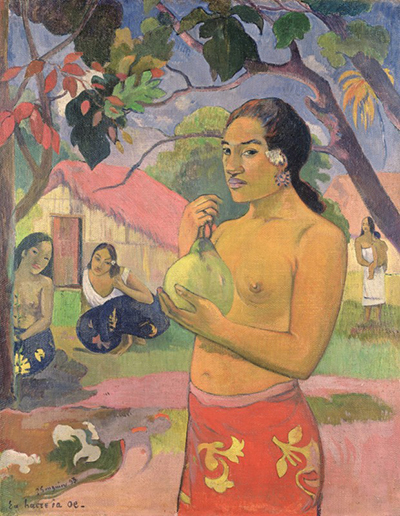
A standing figure almost fills Paul Gauguin's upright canvas. She supports a large green-yellow fruit against her torso with one hand while the other rises towards its stem or cord. A red pareu patterned in yellow crosses the lower half of the picture; pale flowers sit beside her dark hair. She looks outward rather than towards the smaller figures gathered among the huts and foliage behind her. At the lower left, a black-and-white animal rests near the painted inscription. [1]
At a Glance
- ArtistPaul Gauguin [1]
- TitleWoman Holding a Fruit [1]
- Date1893 [1]
- Mediumoil painting on canvas [1]
- Dimensions / object size92 by 73.5 centimetres [1]
- Object recordEu Haere ia oe (Woman with Fruit); 1893; oil on canvas; inv. 9120; State Hermitage [1]
- FocusA standing figure almost fills Paul Gauguin's upright canvas.
Contents
- Woman Holding a Fruit: Introduction
- The Hermitage object
- A greeting without a destination
- What is the fruit?
- Not *Woman of the Mango*
- Figures within a constructed setting
- From Tahiti to Saint Petersburg
The fruit gives the picture its familiar English name, but Gauguin wrote a question on the canvas: Eu haere ia oe. The State Hermitage Museum translates the phrase as “Where are you going?” and describes it as a Tahitian greeting. [1] That distinction is the key to the work. The descriptive title identifies what the figure holds. The inscription invites an exchange without telling us who speaks, where anyone is going or whether the scene records a particular encounter.
The Hermitage object
The Hermitage's official collection guide records Eu Haere ia oe (Woman with Fruit) as an 1893 oil painting on canvas, measuring 92 by 73.5 centimetres. At the bottom left it transcribes the signature, date and title as P Gauguin 93 / Eu haere ia oe. The inventory number is 9120, also written ГЭ-9120. [1] The museum continued to feature the same work under its Russian title and Eu haere ia oe in a 2020 educational series on French painting. [2]
Other scholarly records reveal small but genuine variations. The Art Institute of Chicago captions the same Hermitage object as Ea haere ia oe and gives its height as 92.5 rather than 92 centimetres. [3] NeWestMuseum preserves inventory 9120 and former Museum of Modern Western Art number 291, but its multilingual records disagree among themselves about the measurements. [4] These differences do not create another painting. For the present object, the holding museum's Eu spelling and 92 by 73.5 centimetres provide the soundest public metadata.
A greeting without a destination
The Hermitage guide compares the painting with Gauguin's 1892 Stuttgart canvas E haere oe i hia. It translates both titles as the same everyday question, although their Tahitian wording differs. In Stuttgart the principal figure holds an animal; in Saint Petersburg the held fruit becomes the composition's centre. [1]
AIC extends the comparison. Its catalogue connects the standing figures, smaller background figures and landscape in both paintings to a work on paper made around 1892, Two Tahitian Women in a Landscape. [3] Reuse is visible across the group: a pose and setting could be retained while the held object, title form, colour and relationship of the figures changed. The Hermitage picture was therefore assembled through revision and recombination, not simply copied from one witnessed moment.
That process helps explain why the greeting never settles into a plot. It could be directed towards the foreground figure, voiced by her, exchanged elsewhere in the scene or addressed to the viewer. None of these options is secured by a speaking gesture or written explanation. The question supplies social contact while leaving its direction open.
What is the fruit?
Visually, the rounded fruit bridges the figure's hands and interrupts the long contour of her torso. Its pale green and yellow surface contrasts with the red pareu and the darker canopy overhead. It is large enough to command the centre, just as the Hermitage guide observes. [1]
The guide proposes that it may function as an attribute of Eve. That is a museum interpretation, not an identification supplied by the object. No visible serpent, act of taking or named biblical scene requires the figure to be Eve. The analogy helps explain how a European viewer might turn a held fruit into moral symbolism; it does not establish the figure's identity or beliefs.
Even the species needs care. AIC calls the object a breadfruit when tracing the recurring figure, whereas the Hermitage's own entry uses only fruit. [1] [3] Without a botanical identification from the holding museum or a technical study, the broader term is preferable. Calling it a mango would be especially misleading because that name belongs securely to another Gauguin painting.
Not *Woman of the Mango*
The Baltimore Museum of Art holds Vahine no te vi (Woman of the Mango), a separate 1892 oil painting measuring 73 by 45.1 centimetres and numbered BMA 1950.213. [5] It is not an earlier title for the Hermitage canvas. The date, proportions, collection, accession and depicted arrangement all differ.
This separation also prevents biography and symbolism from migrating between objects. Scholarship about the Baltimore sitter, its mango and the sexual or fertility meanings attached to that fruit cannot identify the unnamed Hermitage figure. Similar upright formats and fruit-bearing bodies show Gauguin revisiting motifs; they do not make every canvas a record of the same person.
Figures within a constructed setting
The foreground figure's scale compresses the world behind her. Angular pink roof shapes, bands of green and brown ground, seated figures at the left and a small standing group at the right are held beneath dark foliage. Their reduced size suggests depth, but the overlapping colour zones keep the surface emphatically flat. The resting animal at the bottom edge adds another quiet horizontal shape. [1]
Nothing in this arrangement discloses the foreground figure's age, name, relationship, consent, destination or thoughts. A flower near the ear cannot safely be translated into marital or sexual status, and the fruit does not prove fertility, pregnancy, temptation or availability. Those claims would turn pictorial attributes into a biography the painting does not possess.
From Tahiti to Saint Petersburg
The Hermitage records the painting's passage through Ambroise Vollard's gallery and Ivan Morozov's collection, then the Museum of Modern Western Art in Moscow, before its acquisition by the Hermitage in 1948. [1] NeWestMuseum's GMNZI number 291 preserves evidence of that institutional middle stage. [4]
This history also traces a change of audience. Gauguin painted the canvas during his first stay in French-colonial Tahiti; it then entered European commercial and Russian collecting systems. The National Gallery of Australia's recent reassessment argues that his Pacific work must be read alongside colonial history and his conduct. [6] Here that means distinguishing a represented person from the titles, biblical analogies and identities imposed around her.
Woman Holding a Fruit remains deliberately double. Its English name directs attention to a conspicuous object, while Eu haere ia oe offers an ordinary greeting. Motifs reused from other compositions make the encounter feel familiar without making it factual. The soundest reading preserves that openness: a question is present, a fruit is held, and neither authorises us to invent the life of the person before us.
Related Pages
Frequently Asked Questions
A standing figure almost fills Paul Gauguin's upright canvas.
The guide proposes that it may function as an attribute of Eve.
Woman Holding a Fruit remains deliberately double.
Discussion
A standing figure almost fills Paul Gauguin's upright canvas.
Reader Insights
A standing figure almost fills Paul Gauguin's upright canvas.
It is large enough to command the centre, just as the Hermitage guide observes.
The soundest reading preserves that openness: a question is present, a fruit is held, and neither authorises us to invent the life of the person before us.
Join the Conversation
Share the visible detail or source that most changed your reading.
References
- State Hermitage Museum, In the Hermitage: Western European Art, entry 216, Eu Haere ia oe (Woman with Fruit), official collection guide, p. 276 View source
- State Hermitage Museum Friends, Pearls of the Collection, 2020 programme listing Женщина, держащая плод (Eu haere ia oe) View source
- Art Institute of Chicago, Cat. 64 Two Tahitian Women in a Landscape, c. 1892, online scholarly catalogue, including the Stuttgart and Hermitage comparisons View source
- NeWestMuseum / Museum of Modern Western Art research project, Woman Holding a Fruit. Eu haere ia oe (Where Are You Going?), collection-history record View source
- Baltimore Museum of Art, Vahine no te vi (Woman of the Mango), current digital collection guide, BMA 1950.213 View source
- National Gallery of Australia, Gauguin's World: Tōna Iho, Tōna Ao, current exhibition overview and contemporary-context statement View source
 Paul Gauguin.jpg)