 by Tom Gurney
Tom Gurney BSc (Hons) is an art history expert with over 20 years experience
Published on August 14, 2026 / Updated on August 14, 2026
Email: tomgurney1@gmail.com / Phone: +44 7429 011000
Why Are You Angry? (No te aha oe riri): Introduction
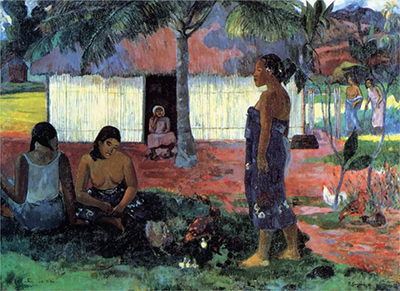
Six figures occupy Paul Gauguin's broad Tahitian scene, yet none plainly acts out the confrontation promised by its title. Two people sit together at the left: one turns away from us, while the other lowers her head and faces outward. A standing figure in a blue wrap divides the foreground from the red path. Another sits in the dark entrance of a palm-roofed hut, and two more approach at the far right. Chickens and chicks forage between them. The arrangement is populated but remarkably quiet. [1] [2]
At a Glance
- ArtistPaul Gauguin [1]
- TitleWhy Are You Angry? (No te aha oe riri) [1]
- Date1896 [1]
- Mediumoil painting on jute canvas [1]
- Dimensions / object size95.3 by 130.6 centimetres [1]
- Object recordThe Art Institute of Chicago records No te aha oe riri (Why Are You Angry?) as an 1896 oil painting on jute canvas, 95.3 by 130.6 centimetres. [1]
- FocusSix figures occupy Paul Gauguin's broad Tahitian scene, yet none plainly acts out the confrontation promised by its title.
Contents
- Why Are You Angry? (No te aha oe riri): Introduction
- The Chicago painting
- A title sent to France
- An earlier landscape enlarged
- Texture made before the figures
- The scene changed while it was painted
- Stories attracted by a question
- Looking without inventing an answer
The question appears on the object itself. Gauguin wrote no te aha oe riri in blue-black paint at the lower left; at the opposite corner he signed and dated the canvas P. Gauguin ’96 in dark blue. [2] The words tell us to look for anger. The bodies do not identify who speaks, who is addressed or what has happened.
The Chicago painting
The Art Institute of Chicago records No te aha oe riri (Why Are You Angry?) as an 1896 oil painting on jute canvas, 95.3 by 130.6 centimetres. It belongs to the Mr. and Mrs. Martin A. Ryerson Collection and bears accession number 1933.1119. [1] The museum's scholarly catalogue gives the width more precisely as 130.55 centimetres, so the public figure is simply a rounded version of the same measurement. [2]
At this size the figures read less like incidental occupants of a landscape than a group set across a shallow stage. The catalogue places the work among six similarly proportioned figure paintings made between the summer of 1896 and March 1897. These canvases marked a turn towards monumental scale and came close to the dimensions and ambitions of wall decoration, even though they were not a documented mural cycle. [2]
The horizontal spread also controls how the question works. No central action explains it. Instead, separated clusters lead the eye from the seated pair to the doorway, the standing profile and the distant walkers. The tree trunk acts as a strong vertical pause, while the hut wall, grass and path create broad bands behind the figures. Anger is supplied by language, not by a single decisive gesture.
A title sent to France
The title was not added only after the work entered a museum. On 14 February 1897 Gauguin told his friend Georges-Daniel de Monfreid to expect a shipment and listed six paintings. In the historic English edition of the letter, one entry reads Note aha oe Riri—Why Are You Angry? [4] AIC's catalogue, citing a later French edition, records the paired form Note aha oe riri. Pourquoi es-tu fâchée? [2]
Those records confirm the question's early association with the canvas, but they do not resolve every linguistic issue. The letter's Note aha differs from the painted and current museum form No te aha, and each translation reaches us through an edited European publication. It is safer to preserve the variants than to present one modern English wording as a complete account of the Tahitian phrase.
More importantly, the letter is a title list, not a plot summary. It gives no speaker and no cause. Even the addressee remains unstable: the implied “you” might be sought among the painted figures, or the question might turn outward and implicate the viewer. [1] [2]
An earlier landscape enlarged
The composition did not begin as the record of one moment in 1896. AIC identifies it as an enlargement and substantial reworking of Gauguin's 1891 Te raau rahi (The Large Tree). The Cleveland Museum of Art now holds that earlier oil painting, a smaller canvas measuring 74 by 92.8 centimetres. [5]
Both pictures organise figures around a long hut and shaded vegetation. The later version retains a seated group and a profile figure moving across the scene, but it enlarges the people, simplifies some vegetation, introduces distant mountains and distributes poultry through the foreground. AIC cannot establish whether Gauguin had the earlier painting, a photograph, a tracing or only memory available. The uncertainty matters: resemblance proves reuse, not the exact workshop procedure. [2]
Drawings offered another store of material. On the reverse of an 1891–93 sketchbook sheet, Gauguin drew roosters and chickens; AIC finds close correspondences with two birds at the right of the Chicago painting. [3] Such studies make the final scene a composite built from earlier images and fresh decisions rather than a transparent report of what stood together before him.
Texture made before the figures
The support is coarse jute, but the painting's roughness does not come from the fabric alone. Microscopic study shows that Gauguin coated the canvas with a glue-and-starch priming, then spread a white oil ground containing mainly zinc white and barium sulfate. He worked this layer unevenly with a palette knife and brush, lifting, scoring and redistributing it until the surface acquired a stucco-like relief. Much of the colour above it is comparatively thin. [2]
The hut demonstrates how material and image cooperate. Horizontal grooves cut into the ground meet vertical painted strokes across the wall, producing a crosshatched effect. Elsewhere the bumpy jute reappears where the ground was brushed down. Grass is articulated with raised vertical touches, while the red path is smoother and more thinly spread. These differences make the site feel varied without depending on conventional depth. [2]
Gauguin sketched first with what appears to be charcoal and then with dark-blue oil paint. Some contours were reserved before the first washes; others were drawn over established colour. The standing figure's legs, for example, were outlined over grass before being painted more fully. The visible blue contours are therefore both planning tools and final accents. [2]
The scene changed while it was painted
Technical imaging makes the apparent stillness even less like a frozen incident. The frontal seated figure at left was introduced after other major elements and positioned to balance the standing woman across the centre. Gauguin tested several head positions for the figure at the far left, shifted details of the standing woman's face, hair and clothing, lengthened the central tree and adjusted the boundary between grass and path. [2]
The dark doorway changed more dramatically. Macro-XRF mapping found vermilion and chrome-yellow passages beneath its final colour, as well as an earlier, higher position for the seated head. The catalogue proposes that the first state may have suggested an interior lit by fire, but the pigments prove a bright understate, not the exact thing it represented. [2]
The birds also entered at different times. The central clutch was part of the early design. A rooster on the right arrived during the painting process, and two nearby hens were later additions. Their spacing may help balance the two sides of the canvas. [2] This sequence is secure technical evidence; what the birds mean is not.
Stories attracted by a question
AIC surveys several attempts to supply the missing narrative. One connects the outward-facing seated figure with Rarahu, the abandoned protagonist of Pierre Loti's Le mariage de Loti. Another makes the two foreground women and the birds into a story of maternity, envy or jealousy. The back-facing figure has also been imagined as the speaker. [2]
These are proposals, not discoveries of hidden fact. A European novel cannot identify a painted person, and Gauguin's private relationships cannot serve as a universal key to every figure. Nor do chicks prove that either seated woman is a mother, still less what she feels. The technical finding that some birds were added late shows compositional revision; it does not turn them into a fixed code for rivalry.
The same caution applies to the background. The catalogue suggests that the hanging lengths near the two distant figures appear to be mulberry bark prepared for tapa cloth. [2] That carefully qualified identification may enrich the setting. It still does not tell us where the figures are going, how they are related or whether any of them participates in the question.
Looking without inventing an answer
The painting was made in French-colonial Tahiti and prepared for circulation to viewers in Europe. AIC describes Gauguin's Tahitian scenes as combinations of observed detail and artistic fantasy, while the National Gallery of Australia's recent reassessment stresses that the work must be considered alongside colonial history and the artist's conduct. [1] [6] Those contexts make it especially important not to treat represented people as characters whose names, ages, consent or inner lives can be supplied from his titles.
Why Are You Angry? is powerful because its verbal urgency and visual quiet never fully agree. The inscribed question reaches the canvas early enough to belong to Gauguin's conception, yet the reuse of an older landscape, the layered ground and the many revisions expose how deliberately that conception was assembled. Looking closely does not reveal a lost quarrel. It reveals how a question can organise attention while withholding the answer it seems to promise.
Related Pages
Frequently Asked Questions
Six figures occupy Paul Gauguin's broad Tahitian scene, yet none plainly acts out the confrontation promised by its title.
The support is coarse jute, but the painting's roughness does not come from the fabric alone.
Why Are You Angry? is powerful because its verbal urgency and visual quiet never fully agree.
Discussion
Six figures occupy Paul Gauguin's broad Tahitian scene, yet none plainly acts out the confrontation promised by its title.
Reader Insights
Six figures occupy Paul Gauguin's broad Tahitian scene, yet none plainly acts out the confrontation promised by its title.
Microscopic study shows that Gauguin coated the canvas with a glue-and-starch priming, then spread a white oil ground containing mainly zinc white and barium sulfate.
It reveals how a question can organise attention while withholding the answer it seems to promise.
Join the Conversation
Share the visible detail or source that most changed your reading.
References
- Art Institute of Chicago, No te aha oe riri (Why Are You Angry?), current collection record, 1933.1119 View source
- Art Institute of Chicago, Cat. 90 No te aha oe riri (Why Are You Angry?), 1896, online scholarly catalogue, including commentary, technical study and source notes View source
- Art Institute of Chicago, Cat. 35 Seated Tahitian Woman (recto), Sketches of Roosters and Chickens (verso), 1891/93, online scholarly catalogue View source
- Paul Gauguin, The Letters of Paul Gauguin to Georges Daniel de Monfreid, 1922 English edition, letter of 14 February 1897 and shipment-title list View source
- Cleveland Museum of Art, The Large Tree, 1891, current collection record, 1975.263 View source
- National Gallery of Australia, Gauguin's World: Tōna Iho, Tōna Ao, current exhibition overview and contemporary-context statement View source
 Paul Gauguin.jpg)