 by Tom Gurney
Tom Gurney BSc (Hons) is an art history expert with over 20 years experience
Published on August 14, 2026 / Updated on August 14, 2026
Email: tomgurney1@gmail.com / Phone: +44 7429 011000
The Siesta: Introduction
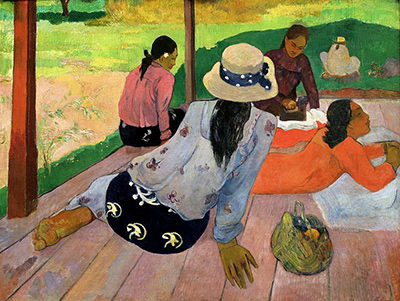
Paul Gauguin's title promises sleep, but no one in The Siesta is visibly asleep. Four women occupy a wooden porch. One sits at the far-left edge and turns inward; a second, enlarged by proximity, faces away beneath a broad hat; another bends over a pale cloth; the figure at right reclines while holding an object that the Metropolitan Museum of Art's collection API identifies as an iron. [1] [2] A fruit basket stands near her feet.
At a Glance
- ArtistPaul Gauguin [1]
- TitleThe Siesta [1]
- Date1892 [1]
- Mediumoil painting on canvas [1]
- Dimensions / object size88.9 by 116.2 centimetres [1]
- Object recordThe Siesta; Paul Gauguin; ca. 1892-94; oil on canvas; 1993.400.3 [1]
- FocusPaul Gauguin's title promises sleep, but no one in The Siesta is visibly asleep.
Contents
- The Siesta: Introduction
- The Met object
- What kind of siesta?
- Clothing in a colonial present
- The painting beneath the painting
- Why the date remains broad
- From the Annenberg Collection to the Met
The contrast matters. A porch in shade, relaxed postures and the title all encourage a reading of rest. The iron, upright bodies and purposeful changes of direction complicate it. This is not a transparent record of an entire society's leisure. It is a carefully rebuilt group whose present arrangement conceals several earlier versions.
The Met object
The Metropolitan Museum records The Siesta as an oil painting on canvas dating from about 1892–94. It measures 88.9 by 116.2 centimetres and carries object number 1993.400.3. [1] [2] The current date and dimensions govern, even though older Met publications used narrower dates and slightly smaller measurements.
Two porch posts divide the canvas into strong vertical sections. Between them, diagonal floorboards lead towards the four figures, while bright green and yellow bands beyond the porch form a compressed outdoor view. The large foreground woman blocks part of that landscape. Her pale blue top, dark skirt and hat create the picture's most expansive shape; the woman in orange at the right stretches laterally against the boards. The other two figures hold the middle distance. [1]
The composition therefore makes depth without opening a conventional view. Architecture supplies a grid, bodies overlap it, and the landscape remains a shallow screen of mixed colour. The Met audio observes that the figures are formed mainly from flat colour areas bounded by continuous outlines, while the porch floor and background permit looser, mottled handling. [1] Here that contrast is object-specific: firm contours keep the group readable while the floor and vegetation make the surrounding space less fixed.
What kind of siesta?
The Met's audio guide calls the work a Polynesian genre scene rather than one of Gauguin's overtly religious or mythological Tahitian pictures. It interprets the group as seeking shade from afternoon sun. [1] That classification helps separate The Siesta from paintings organised around named deities, visions or written myths. It does not prove what any represented person was doing or feeling.
The title itself is not an eyewitness statement by the four women. A reclined body can signify rest, but the picture contains no secure evidence that anyone sleeps. The iron identified in the current API suggests an object associated with household work, although it cannot tell us whether ironing is occurring at this instant or who used it. [2] The basket may imply carrying, food or storage, but its contents and purpose do not produce a biography either.
Older Met language described communal ease and an unaffected manner. Those phrases belong to a long European habit of turning Polynesian people into evidence of supposedly natural simplicity. A current National Gallery of Australia reassessment instead asks viewers to place Gauguin's Pacific work within colonial history and to reconsider the conduct and power surrounding its production. [6] For this painting, that means treating the shaded gathering as one artist's construction, not a universal social fact.
Clothing in a colonial present
The Met audio groups the women's clothes under the term so-called missionary dresses and says such garments were regularly imported from England. [1] The qualification is important. Mission clothing belongs to a history of Christian intervention, trade and colonisation, but the painted surface cannot establish where every visible textile was manufactured or why each woman wore it.
National Gallery of Australia research on Gauguin's Tahitian figures explains more broadly that cotton textiles and mission dress entered local life through missions, commerce and colonial change. [5] That history prevents the clothes from being treated as neutral costume. It also prevents the opposite mistake: introduced fabric does not make a person passive, culturally empty or less Tahitian.
Gauguin uses clothing as colour and structure. Pink, pale blue, dark navy, orange and patterned forms separate bodies that otherwise overlap. The broad hat conceals the foreground figure's head and strengthens the back-turned pose. These choices organise what viewers can see; they do not disclose private belief, acceptance of mission teaching, kinship, friendship or consent.
The painting beneath the painting
Close examination published by the Met in 1994 showed that Gauguin repeatedly altered the group. He corrected profiles, eliminated an additional figure at the far left and painted the present basket of fruit over a dog. The dark navy garment of the foreshortened foreground woman had originally been bright red. [3] The current collection record adds that the surviving woman at the left edge once sat farther left. [1]
These are not minor finishing adjustments. Removing one body, moving another, changing a major colour area and substituting a basket for an animal altered the spacing, emphasis and implied activity of the entire porch. The current four-person scene was engineered through subtraction and replacement.
That evidence changes how the title should be read. If the group had been a direct transcription of a single interval of rest, such extensive redesign would be difficult to explain as mere correction. Gauguin preserved the idea of an informal gathering while revising the bodies and objects through which viewers encounter it. The apparent ease of the result was produced by sustained work.
The revisions do not, however, supply their own timetable. The Met's current page says Gauguin worked on the canvas over an extended period, but it does not assign each change to a month or place. [1] It would be unsafe to claim that the dog, eliminated figure or colour shift all occurred after his return to France.
Why the date remains broad
The 1994 Bulletin recorded active disagreement. Its author noted that the size-50 canvas format was common during Gauguin's first Tahitian stay, from 1891 to 1894, but also allowed that he might have returned to the format in France in 1894–95. [3] A 2002 Met exhibition caption presented the painting as probably 1891–92 and used measurements of 87 by 115.9 centimetres. [4]
The museum now dates the work ca. 1892–94 and gives 88.9 by 116.2 centimetres. [1] [2] The newer record does not erase the older debate. It offers the most responsible public identification while leaving open where the final state emerged. The historic measurements are evidence of catalogue history, not a reason to average two records or multiply the object into separate versions.
From the Annenberg Collection to the Met
The 1994 Bulletin described The Siesta as a partial gift from Walter H. and Leonore Annenberg in 1993. [3] The current Met credit line records the Walter H. and Leonore Annenberg Collection, their 1993 gift and Walter H. Annenberg's 2002 bequest. [1] Those stages explain the accession number and the painting's present public home. A complete earlier ownership chain is not supplied by the accessible governing records used here and should not be reconstructed from unattributed web lists.
The Siesta finally resists its easiest label. It shows shade and repose, but also an iron, a basket and four alert bodies. It appears informal, but close examination reveals an erased figure, a moved figure, corrected profiles, a replaced dog and a transformed foreground colour. Its strength lies in that tension: Gauguin made a scene look unforced by repeatedly forcing its parts into a new arrangement.
Related Pages
Frequently Asked Questions
Paul Gauguin's title promises sleep, but no one in The Siesta is visibly asleep.
National Gallery of Australia research on Gauguin's Tahitian figures explains more broadly that cotton textiles and mission dress entered local life through missions, commerce and colonial change.
The Siesta finally resists its easiest label.
Discussion
Paul Gauguin's title promises sleep, but no one in The Siesta is visibly asleep.
Reader Insights
Paul Gauguin's title promises sleep, but no one in The Siesta is visibly asleep.
It also prevents the opposite mistake: introduced fabric does not make a person passive, culturally empty or less Tahitian.
Its strength lies in that tension: Gauguin made a scene look unforced by repeatedly forcing its parts into a new arrangement.
Join the Conversation
Share the visible detail or source that most changed your reading.
References
- Metropolitan Museum of Art, The Siesta, current collection record and gallery-audio transcript, object 1993.400.3 View source
- Metropolitan Museum of Art, Open Access API record 436449, including current metadata, institutional image and object tags View source
- Metropolitan Museum of Art, Recent Acquisitions, A Selection: 1993–1994, Metropolitan Museum of Art Bulletin 52, no. 2 (Fall 1994), Paul Gauguin, The Siesta, p. 51 View source
- Metropolitan Museum of Art, Gauguin in New York Collections: The Lure of the Exotic, 2002 exhibition image caption for The Siesta View source
- National Gallery of Australia, Paul Gauguin, Appropriation and Reclamation learning resource View source
- National Gallery of Australia, Gauguin's World: Tōna Iho, Tōna Ao, current exhibition overview and contemporary-context statement View source
 Paul Gauguin.jpg)