 by Tom Gurney
Tom Gurney BSc (Hons) is an art history expert with over 20 years experience
Published on August 14, 2026 / Updated on August 14, 2026
Email: tomgurney1@gmail.com / Phone: +44 7429 011000
Tahitian Mountains (Tahitian Landscape): Introduction
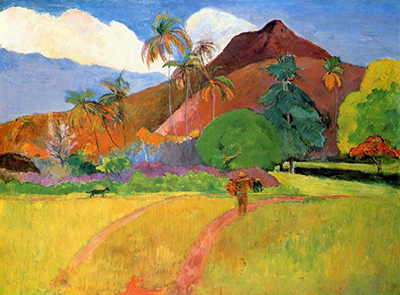
A person walks away beneath a broad hat, balancing a load at either end of a pole. A small dark dog moves across the ground to the left. Pale tracks split and curve through the yellow-green foreground before disappearing behind the figure. These details are modest beside the red-brown mountain and the tall palms, yet they change what Paul Gauguin's Tahitian Landscape can mean. The scene is not empty nature. It is a place of passage and carrying, made to appear remote by the painting's choices of scale and colour. [1] [2]
At a Glance
- ArtistPaul Gauguin [1]
- TitleTahitian Mountains (Tahitian Landscape) [1]
- Date1891 [1]
- Mediumoil painting on canvas [1]
- Dimensions / object size67.95 by 92.39 centimetres [1]
- Object recordTahitian Landscape; Paul Gauguin; 1891; oil on canvas; 49.10 [1]
- FocusA person walks away beneath a broad hat, balancing a load at either end of a pole.
Contents
- Tahitian Mountains (Tahitian Landscape): Introduction
- From tracks to mountain
- Human presence without a supplied story
- How remoteness is constructed
- A title shared by several works
- What the 1959 catalogue adds
The Minneapolis Institute of Art records the work as Tahitian Landscape, dated 1891, rather than Tahitian Mountains, the name by which the image also circulates. It is an oil painting on canvas measuring 67.95 by 92.39 centimetres, accession 49.10, acquired through the Julius C. Eliel Memorial Fund. At lower left, the museum records an abraded white signature, P Go. [1] [3]
Those particulars matter because Gauguin made several different works called Tahitian Landscape. This page concerns the horizontal Minneapolis canvas, not merely any picture of a tropical ridge.
From tracks to mountain
The foreground occupies almost the lower third of the canvas. Its broad yellow and green area is interrupted by two pinkish tracks. One rises from near the bottom centre towards the loaded figure; another enters from the lower left, then bends across the field. They create depth through movement rather than through finely measured perspective. The eye follows them inward and then meets a low horizontal band of shrubs.
Above that band, the landscape rises quickly. Orange, grey-violet and green vegetation forms a crowded middle zone. Thin palm trunks lift irregular crowns into the sky. Behind them, ochre and rose slopes lead to the dark red peak near the upper right. Pale forms at the left and centre may be distant ridges or cloud masses; the painting does not define them with topographical precision. [2]
Gauguin builds the view as stacked colour regions. The yellow foreground, violet boundary, mixed vegetation, red mountain and blue sky remain visibly separate even where brushwork softens their edges. Curves recur from the paths through the shrubs and up the ridges. The mountain therefore feels large not because Gauguin maps its distance exactly, but because its uninterrupted red-brown shape dominates the much smaller bearer below.
No secure source used here names the summit, the path or the place represented. Nor does colour alone prove that the foreground contains a particular crop. Dark marks at middle right are too ambiguous to identify as a fence, gate or building. Resisting those labels keeps close reading close to the object: one can see land being crossed without inventing a village or agricultural history.
Human presence without a supplied story
The loaded figure provides the clearest evidence that this is inhabited ground. The balancing pole extends sideways across the shoulders, with an orange-red mass on one side and a blue-green form on the other. Their contents are not legible. The image cannot tell us the person's name, destination, occupation or reason for carrying them. The dog likewise proves animal presence, not ownership or companionship. [2]
What the painting does control is relative importance. The figure is close enough to anchor the paths but small enough to be absorbed by the fields and mountain. The hat makes the head readable while withholding a face. This combination turns purposeful movement into a sign within the landscape rather than a portrait of an individual.
The effect can look peaceful, but peace is an interpretation rather than a visible activity. The person is walking under a load. The tracks register repeated passage. Even without a securely identifiable house, crop or road, these are traces of use. Calling the setting untouched would require viewers to disregard the very evidence Gauguin left in the foreground.
How remoteness is constructed
The museum's current account belongs to a much older way of presenting Gauguin. It says he went to Tahiti seeking supposedly exotic motifs and escape from European civilisation, then describes the picture in terms of joy, serenity and an untamed natural world. [1] [3] Such language reports Gauguin's self-fashioned desire and the picture's reception. It does not neutrally describe Tahiti in 1891.
The canvas itself helps produce that fantasy. It pushes any larger settlement beyond the frame, reduces the traveller to a small silhouette and uses the ridge as a nearly continuous wall of colour. Its luminous fields and vegetation do not offer documentary information about land tenure, work or colonial infrastructure. They offer a distilled encounter between a bearer and an enlarged environment.
Yet the fantasy never fully removes human use. The two tracks cut into the colour bands; the pole and loads interrupt the figure's outline; the dog creates a second moving point. These details make the work more interesting than an uncomplicated paradise image. Gauguin constructed visual distance from material signs that also contradict it.
Current National Gallery of Australia interpretation places Gauguin's Pacific art within debates about his conduct, historical impact and contemporary legacies, including perspectives from the Pacific. It states plainly that his late nineteenth-century interactions in Polynesia would not now be accepted. [8] That context does not turn the loaded figure into evidence for an invented private biography. It does require care with the larger claim: an inhabited colonised island should not be converted into timeless scenery simply because one European painter enlarged a mountain and minimised a traveller.
A title shared by several works
The institutional title is essential for searching but insufficient for identification. The Metropolitan Museum owns a vertical Tahitian Landscape dated 1892, measuring 64.5 by 47.3 centimetres and numbered 39.182. It contains figures, a hut and a horse that do not belong to the Minneapolis composition. [5] MoMA's work of the same title is a much smaller 1899 canvas, 30.8 by 46.4 centimetres, object SPC67.1990. [6] The Art Institute of Chicago also catalogues a 1894 Tahitian Landscape, but that work is a watercolor monotype with gouache on paper, 2002.238R. [7]
Keeping those works separate prevents apparently plausible mistakes. A hut described by the Met cannot supply a building in Minneapolis; the Paley history of MoMA's canvas cannot become the provenance of MIA 49.10; the Chicago monotype cannot establish this painting's technique. Date, format, size and accession number together provide the reliable identity.
What the 1959 catalogue adds
An Art Institute of Chicago exhibition catalogue published in 1959 already listed the Minneapolis canvas as no. 36. It recorded the same 26 3/4 by 36 3/8 inch measurements and the lower-left P Go signature, and placed the work around 1891 in Tahiti. [4] Its description considered the landscape closer to observed nature than some of Gauguin's more stylised tropical scenes. That is a historical judgement, not proof that the view is unedited.
The catalogue also recorded an earlier ownership sequence: Ambroise Vollard in Paris, Mrs Chester Beatty in London, Wildenstein in New York, the Henry Clay Frick Collection, and Wildenstein again before the Minneapolis holding. [4] The entries have no transfer dates, so they should not be presented as a complete modern provenance. The current MIA record governs the accession as 49.10 and credits the Eliel Fund. [1]
The abraded signature, institutional record and catalogue history secure the object; they do not settle its landscape as a literal map. Tahitian Landscape remains powerful because the construction is easy to overlook. Mountain, palms and saturated ground suggest enormous natural presence, while a traveller, dog and branching tracks quietly show that people already move through this place. The painting creates remoteness without ever quite achieving emptiness.
Related Pages
Frequently Asked Questions
A person walks away beneath a broad hat, balancing a load at either end of a pole.
The effect can look peaceful, but peace is an interpretation rather than a visible activity.
The abraded signature, institutional record and catalogue history secure the object; they do not settle its landscape as a literal map.
Discussion
A person walks away beneath a broad hat, balancing a load at either end of a pole.
Reader Insights
A person walks away beneath a broad hat, balancing a load at either end of a pole.
The tracks register repeated passage.
The painting creates remoteness without ever quite achieving emptiness.
Join the Conversation
Share the visible detail or source that most changed your reading.
References
- Minneapolis Institute of Art, Tahitian Landscape, current collection page and public search API, object 10435 / accession 49.10. and View source
- Google Arts & Culture with the Minneapolis Institute of Art, Tahitian Landscape, 1891, current high-resolution partner record View source
- Minneapolis Institute of Art, People and Their Environments, current education record for Tahitian Landscape View source
- Art Institute of Chicago, Gauguin: Paintings, Drawings, Prints, Sculpture (1959), catalogue no. 36, pp. 45–46 View source
- Metropolitan Museum of Art, Tahitian Landscape, 1892, object 39.182 View source
- Museum of Modern Art, Tahitian Landscape, 1899, object SPC67.1990 View source
- Art Institute of Chicago, Tahitian Landscape, 1894, reference 2002.238R View source
- National Gallery of Australia, Gauguin's World: Tōna Iho, Tōna Ao, current exhibition and contemporary-context overview View source
 Paul Gauguin.jpg)