 by Tom Gurney
Tom Gurney BSc (Hons) is an art history expert with over 20 years experience
Published on August 14, 2026 / Updated on August 14, 2026
Email: tomgurney1@gmail.com / Phone: +44 7429 011000
Faa Iheihe (Tahitian Pastoral): Introduction
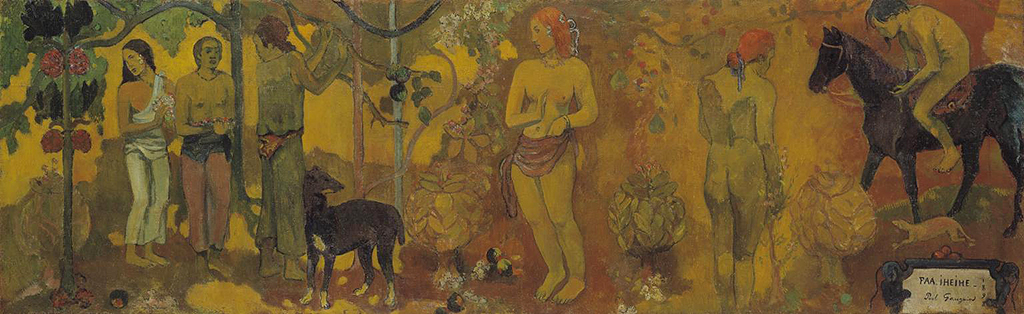
Paul Gauguin's Faa Iheihe is almost three times as wide as it is high. Across that long field, figures stand among flowering plants, fruit and patches of saturated colour. A dark dog moves through the lower left; a rider on a dark horse occupies the far right. Between them, bodies and vegetation appear less like participants in a single incident than motifs arranged along a painted frieze.
At a Glance
- ArtistPaul Gauguin [1]
- TitleFaa Iheihe (Tahitian Pastoral) [1]
- Date1898 [1]
- Mediumoil painting on canvas [1]
- Dimensions / object size54 by 169.5 centimetres [1]
- Object recordThe National Gallery, London, records Faa Iheihe as an oil painting on canvas made in 1898, measuring 54 by 169.5 centimetres. [1]
- FocusPaul Gauguin's Faa Iheihe is almost three times as wide as it is high.
Contents
- Faa Iheihe (Tahitian Pastoral): Introduction
- A panoramic object
- Groups without a settled story
- What does the title mean?
- A landscape assembled from other images
- Abundance under colonial rule
The proportions change the way the picture is read. There is no dominant figure equivalent to the sitter in a conventional portrait, and no deep landscape leading towards a climax. The eye travels laterally—from one upright accent to another, through intervals of ochre-orange, green, blue and red. Abundance is everywhere, yet the people do not gather into an obvious social group. The effect is pastoral, but the scene is not a transparent record of Tahitian life.
A panoramic object
The National Gallery, London, records Faa Iheihe as an oil painting on canvas made in 1898, measuring 54 by 169.5 centimetres. It carries the gallery's loan number L708 and is on loan from Tate, to which Lord Duveen presented it in 1919. [1] Tate's current public material independently repeats the 1898 date, medium and unusual dimensions. [2]
At lower right, a pale scroll-like cartouche places the title FAA. IHEIHE beside Gauguin's name. The National Gallery records the canvas as signed and dated, although its public text does not supply a complete inscription transcription. [1] That painted label matters compositionally. It occupies the end of the panorama rather than standing outside it, making title and authorship part of the constructed world.
The picture's extreme width has encouraged the suggestion that Gauguin conceived it as a decorative frieze for a large reception room. The National Gallery presents this as a possibility, not the history of a documented commission. [1] Even without a known architectural destination, the format explains much about the surface. Figures repeat like vertical beats; trees and flowering stems divide the field; dog, fruit and horse fill the low horizontal band. The canvas asks to be scanned rather than entered.
Groups without a settled story
At the left, two clothed women stand near a tall flowering plant. Other upright bodies lead towards the centre, where the grouping becomes deliberately difficult to parse. Slightly right of centre, a frontal nude raises one arm across her chest. Nearby, another nude turns her back. The forms might be read as separate women, as repeated aspects of a figure, or simply as shapes joined by Gauguin's rhythm. The painting does not settle the question.
That uncertainty resists a narrative account. Fruit and flowers suggest gathering, preparation or plenty, but no visible action proves a specific festival. The horseman is spatially detached from the women; nothing establishes that he has arrived, is leaving or commands the scene. The dog crosses the foreground without becoming a guide between episodes. Each motif contributes to the panorama while retaining an unusual degree of isolation.
The National Gallery detects sadness within the apparent idyll, noting downward gazes and the figures' seeming lack of awareness of one another. [1] The lowered heads are visible; sadness and unawareness remain interpretation. A safer close reading starts with the gap between physical richness and social connection. The canvas is crowded with bodies, leaves, blossoms and fruit, but its inhabitants are held apart by colour zones and repeated trunks.
What does the title mean?
Faa Iheihe cannot be reduced to the familiar subtitle Tahitian Pastoral. The latter is a later descriptive name, useful for recognition but not the phrase Gauguin painted into the picture. The National Gallery associates Faa Iheihe with a transliteration of fa'ai'ei'e, “to beautify,” in the sense of dressing for a special occasion. It also reports a proposed correction, Faa Ineine, meaning “preparations for a festival.” [1]
Those alternatives open possibilities without resolving the action. Fine clothes, flowers and gathered fruit can support an idea of adornment or preparation. They cannot identify which occasion is represented, whether the people share one task or whether Gauguin understood the language consistently. A corrected spelling does not turn the picture into documentary evidence of a named ceremony.
The title instead exposes a productive mismatch. Words point towards beautification or preparation, while the image refuses a clear sequence of causes and effects. Gauguin offers the signs of an event—dress, flowers, fruit, assembled people—without a stable event itself. The later word “pastoral” performs a similar operation: it identifies an idealised mode more readily than a historical situation.
A landscape assembled from other images
The central standing nude demonstrates how deliberately that mode was built. The National Gallery compares her to European figures of Eve or Venus and to a photograph of standing nudes among stylised trees at a Javanese temple, found among Gauguin's possessions after his death. [1] These sources do not reveal the woman's identity. They show an artist combining remembered poses and reproduced art within a setting presented as Tahitian.
The dog supplies another crossing of places and periods. The National Gallery connects its pose both to a painting by Gustave Courbet and to the red dog in Gauguin's Breton Harvest: Le Pouldu. [1] The animal in Faa Iheihe is dark rather than that Breton dog's emphatic red, but the bodily pattern recurs. What looks like a passing creature is also a portable compositional device.
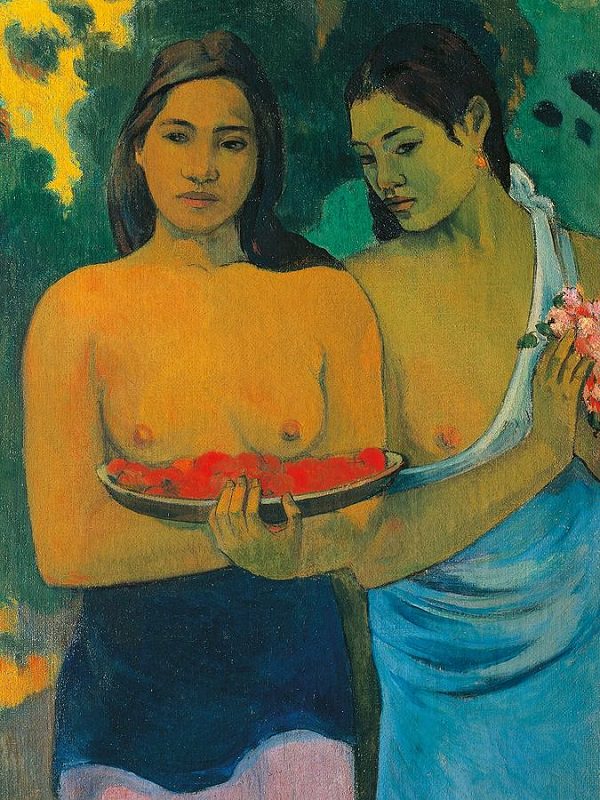
Human figures were portable too. The Metropolitan Museum of Art states that both women in its 1899 Two Tahitian Women also appear in Faa Iheihe and Rupe Rupe. [3] That recurrence does not identify the women or prove that the canvases record successive moments. It shows Gauguin reusing bodies across different arrangements. The apparent company in Faa Iheihe is therefore not simply a group encountered at one place and time; at least part of it belongs to a repertoire revised across works.
Colour makes these borrowings cohere. Warm ground runs behind cool green and blue vegetation, while isolated red and purple passages turn the eye. Depth is compressed, so the horse, plants and bodies remain close to the surface even when one motif overlaps another. Gauguin turns difference of source into unity of design.
Abundance under colonial rule
The assembled character of the scene is historically important. Gauguin painted Faa Iheihe during his second period in Tahiti, not in a society untouched by European power. The Art Institute of Chicago describes the culture he encountered as transformed by colonisation and characterises his late Pacific art as a reinvention of what the island might once have been, rather than an historically accurate recovery. [4]
That distinction prevents the painting's fertility from becoming evidence. Flowers, fruit and intense colour manufacture an image of natural plenty, but they do not prove that colonial conditions were absent from the lives of the people represented. Nor does the frieze preserve a timeless indigenous ceremony. Its “pastoral” order is Gauguin's solution: a European genre idea joined to Tahitian words, recurrent Polynesian bodies, a Javanese pose, a Courbet comparison and a motif first used in Brittany.
The Metropolitan Museum similarly warns that Gauguin fashioned a tropical Eden through the European male gaze, often recasting Indigenous women as classicising nudes or versions of a “Tahitian Eve.” [3] In Faa Iheihe, the central nude's possible Eve or Venus ancestry makes that process visible. Her body is made to carry ideas of origin and untouched nature that the painting's colonial present could not sustain.
Yet critique should not flatten the work into an illustrated accusation. The painting's formal intelligence lies in how it withholds the very unity its subtitle promises. Figures recur but do not quite meet. The horseman remains separate. The dog traverses the foreground without linking it. Title, fruit and flowers propose preparation, while the panoramic structure fragments activity into an ornamental sequence.
Faa Iheihe is therefore most revealing when abundance and distance are kept together. Gauguin made a compelling surface from intense colour, borrowed poses, repeated figures and a title whose language remains uncertain. The result can look like an effortless Tahitian idyll. Close attention shows effort everywhere: in the revisions of bodies, in the transfers between cultures, in the painted cartouche and in the work required to turn a colonised present into an imagined pastoral.
Related Pages
Frequently Asked Questions
Paul Gauguin's Faa Iheihe is almost three times as wide as it is high.
The title instead exposes a productive mismatch.
Faa Iheihe is therefore most revealing when abundance and distance are kept together.
Discussion
Paul Gauguin's Faa Iheihe is almost three times as wide as it is high.
Reader Insights
Paul Gauguin's Faa Iheihe is almost three times as wide as it is high.
Those alternatives open possibilities without resolving the action.
Close attention shows effort everywhere: in the revisions of bodies, in the transfers between cultures, in the painted cartouche and in the work required to turn a colonised present into an imagined pastoral.
Join the Conversation
Share the visible detail or source that most changed your reading.
References
- National Gallery, London, Paul Gauguin: Faa Iheihe, current object record, interpretation and official image, L708 View source
- Tate, Gauguin: Faa Iheihe, current public collection/shop record View source
- Metropolitan Museum of Art, Paul Gauguin: Two Tahitian Women, current object record and interpretation, 49.58.1 View source
- Art Institute of Chicago, Gauguin: Artist as Alchemist, exhibition record and thematic overview View source
 Paul Gauguin.jpg)