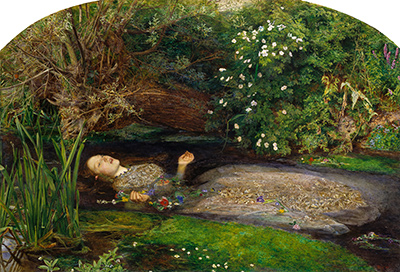
Image reference: John Everett Millais, Ophelia.
At a Glance
- Core period1848–c. 1900
- FoundedLondon, 1848
- Major centresLondon · Oxford · Birmingham
- Known forluminous colour · close observation · literary subjects · medievalism · design
- Founding membersRossetti · Millais · Hunt · W. M. Rossetti · Collinson · Stephens · Woolner
Contents
- Pre-Raphaelite Brotherhood in context
- What was the Brotherhood?
- The argument with academic art
- Colour, detail and truth to nature
- Three early shocks
- Poetry and medievalism
- Hunt, Rossetti and diverging paths
- Modern life, labour and emigration
- Women as artists and collaborators
- Artists to know
Pre-Raphaelite Brotherhood in context
Dante Gabriel Rossetti
Principal careerJohn Everett Millais
Principal careerWilliam Holman Hunt
Principal careerFord Madox Brown
Principal careerEdward Burne-Jones
Principal careerWilliam Morris
Principal careerJohn William Waterhouse
Principal careerThe Pre-Raphaelite Brotherhood began as a private pact among seven young men in London and became one of the most recognisable currents in nineteenth-century art. Its name evokes jewelled colour, exact flowers, medieval stories and women with abundant hair. Yet those familiar features tell only part of the story. The movement also confronted modern labour, sexual double standards, religious doubt, emigration, industrial manufacture and the status of the artist. It joined pictures to poems and eventually carried its ideas into furniture, stained glass, textiles, books and photography.
The original Brotherhood lasted only a few years. Pre-Raphaelitism lasted for decades. Keeping those two facts together explains both its intensity and its extraordinary reach.
Pre-Raphaelitism belongs inside Victorian culture, but it cannot be confined to a single style or decade. Its early rebellion overlaps with Romantic medievalism and Gothic Revival. Its later love of sensuous beauty feeds Aestheticism and Symbolism, while its ideas about making and design help prepare Arts and Crafts. These are connections rather than tidy handovers: religious realism, modern-life painting, medieval fantasy and decorative art continued side by side.[1] [3]
A useful chronology has four stages. From 1848 to 1850, the Brotherhood formed, exhibited under the initials PRB and published The Germ. From 1851 to 1854, public controversy, Ruskin’s defence and major “truth to nature” paintings brought fame. During the later 1850s, the formal group disappeared while its three best-known painters followed different paths and Rossetti gathered a second circle. From the 1860s to the end of the century, Pre-Raphaelite ideas moved through design, poetry, photography, Aestheticism, Arts and Crafts and international art.[2] [30] [39]
Follow the movement through four stages
–1850
Formation and The Germ
Seven young members form the Brotherhood, exhibit under the PRB initials and join art to poetry and criticism.
–1854
Controversy and close observation
Ruskin’s defence, luminous colour and painstaking outdoor study bring public attention to the movement’s most radical early pictures.
–1860
Diverging careers
The formal group dissolves as Millais, Hunt, Rossetti and Brown pursue different forms of modern, literary and moral painting.
–1900
Design and international afterlife
Rossetti’s second circle, Burne-Jones and Morris carry Pre-Raphaelite ideas into poetry, decorative art, Aestheticism and Arts and Crafts.
What was the Pre-Raphaelite Brotherhood?
In September 1848, Dante Gabriel Rossetti, John Everett Millais and William Holman Hunt met with four companions and formed the Pre-Raphaelite Brotherhood. James Collinson and Frederic George Stephens were painters, Thomas Woolner was a sculptor, and Rossetti’s brother William Michael became the group’s secretary and later one of its most important witnesses. The number seven had an appealing completeness, but the members differed in commitment, temperament and achievement from the outset.[2] [5] [6]
They were young. Millais, the most precociously successful, had entered the Royal Academy Schools as a child. Hunt had struggled for admission. Rossetti was an erratic student who possessed literary ambition equal to his interest in painting. What united them was dissatisfaction with the habits of contemporary British art. They thought too much academic painting depended on inherited poses, pyramidal compositions, brownish shadows and grand subjects handled without fresh conviction.
Their remembered statement contained four principles: to have genuine ideas; to study nature attentively; to value what was direct, serious and heartfelt in earlier art rather than what was conventional or learned by rote; and, most importantly, to make thoroughly good pictures and sculptures.[2] The wording is revealing. Historical revival and natural observation were not opposites. Earlier art could release the modern artist from formula, while nature could test whether an idea had become visually convincing.
The name “Pre-Raphaelite” referred to European art before Raphael, especially early Italian painting, but it did not amount to a simple campaign against Raphael himself. The members opposed what they saw as “Raphaelism”: the routine academic inheritance that turned admired High Renaissance solutions into recipes. They found alternatives in the clear outlines, patterned surfaces, brilliant colour and spiritual directness they associated with medieval and early Renaissance art. Italian exhibitions continue to test that claimed ancestry against the works of the older masters themselves.[11] [37] Netherlandish painting offered another precedent. Jan van Eyck’s sharply described interiors and reflective surfaces later became especially important to Victorian artists depicting rooms dense with social meaning.[14]
Their rebellion was artistic rather than a party-political platform, but it emerged at a charged moment. Revolutions swept continental Europe in 1848, Chartism pressed demands for political reform in Britain, and industrialisation transformed cities, labour and social relations. A group of students questioning inherited authority could appear part of a much wider generational disturbance. Their pictures did not translate Chartist demands into a manifesto, yet the climate of upheaval shaped the urgency with which both supporters and enemies interpreted them.[1] [4]
The initials PRB were initially secret. When paintings bearing them appeared in exhibitions in 1849, curiosity grew. The three most important early examples were Millais’s Isabella, Hunt’s Rienzi Vowing to Obtain Justice for the Death of His Young Brother, and Rossetti’s The Girlhood of Mary Virgin. They drew on Keats, a historical novel and sacred narrative, but shared bright colour, packed detail and moral intensity.[1]
The group also created a periodical. The Germ: Thoughts towards Nature in Poetry, Literature and Art appeared in four issues during 1850. Its short life should not obscure its importance. Poems, stories, criticism and illustrations made clear that Pre-Raphaelitism was a word-and-image project from the beginning. Painting did not merely decorate literature, nor did poetry simply explain pictures. Each medium tested how concentrated description could produce feeling and thought.[7]
The argument with academic art
The Royal Academy was not a single enemy and the Brotherhood never entirely stood outside it. Millais and Hunt had trained there; its exhibitions offered the most visible route to a public; Millais eventually became an Academician and later its president. The conflict concerned authority within the system: which past should artists study, how should sacred and literary subjects look, and how much finish or idealisation made a picture “high art”?
Academic teaching placed great weight on drawing from casts and the life model, compositional hierarchy and emulation of established masters. The Pre-Raphaelites did not reject training. Their own work could be painstakingly planned. What they resisted was the assumption that dignity required softened particularity. A carpenter’s workshop could contain wood shavings and dirty feet. A medieval banquet could appear crowded and socially abrasive. Plants could retain their individual structures instead of dissolving into a generalised green setting.
This refusal created visual discomfort. Critics saw hard outlines where they expected modelling, high colour where they expected tonal unity, and crowded foregrounds where they expected recession. Even admiration could sound anxious, because a Pre-Raphaelite picture denied the viewer an easy path from principal figures to subordinate surroundings. The edge of a leaf might demand almost as much attention as a human face.
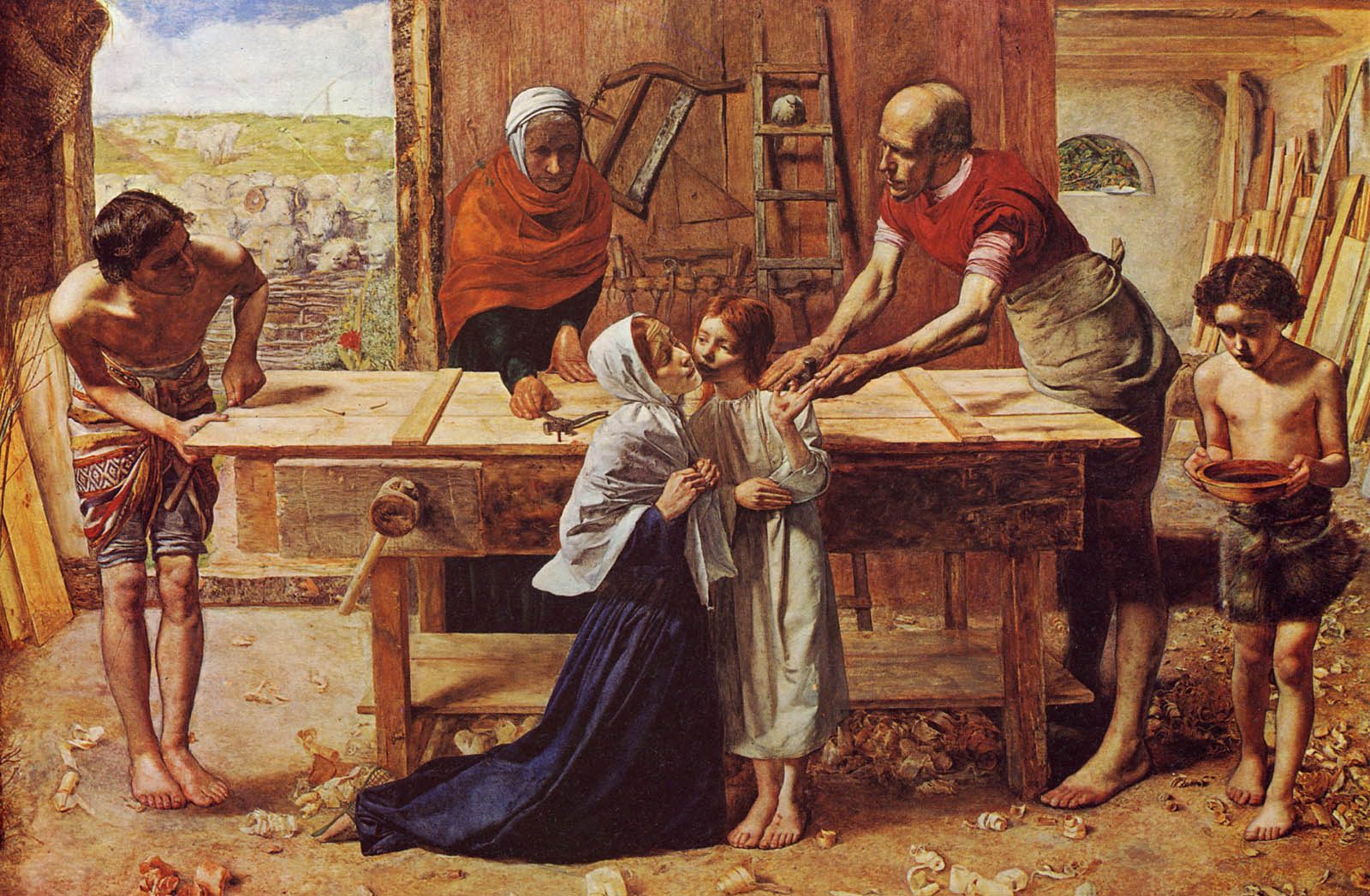
The most notorious confrontation followed Millais’s Christ in the House of His Parents in 1850. Charles Dickens attacked the painting in Household Words under the title “Old Lamps for New Ones”. His language mocked the Virgin, the child Christ and the workshop as physically ugly and socially degraded.[8] [9] The review reveals more than personal dislike. It shows how unsettling it was to place a sacred family in a recognisable working environment rather than an idealised biblical past. Class prejudice, theology and standards of beauty converged in the response.
John Ruskin intervened publicly in 1851. He had not founded the Brotherhood and did not initially share every aspect of its aims, but he recognised in its close study of nature a practice he had long defended. His letters to The Times and the pamphlet Pre-Raphaelitism argued that serious modern art should begin with honest observation rather than second-hand imitation. He predicted that the young painters might establish a great English school if experience disciplined their powers.[2] [10]
Ruskin’s support changed the public argument, but it did not hold the group together. Collinson resigned, Woolner emigrated to Australia, Millais moved towards the artistic mainstream, Hunt travelled to the eastern Mediterranean, and Rossetti increasingly avoided major public exhibitions. By around 1853 the formal Brotherhood had ceased to function. Its dissolution was not failure so much as dispersal: shared experiments became several careers, networks and later movements.[1] [39]
Colour, detail and truth to nature
Pre-Raphaelite paintings often seem illuminated from within. This effect begins with materials. Instead of relying on the warm brown preparations and dark glazes common in academic practice, the artists frequently worked over a bright white ground. In some passages they applied colour over fresh white paint, allowing light to pass through transparent pigments and reflect back from below. Conservation research, however, warns against turning this into a universal recipe. Different artists used white grounds and wet layers selectively, changed their methods over time and combined them with ordinary opaque painting.[15]
The result could be startling: scarlet cloth, blue enamel, green leaves and pale skin remain distinct rather than merging into a single atmosphere. Colour has structural force. In Rossetti’s Ecce Ancilla Domini!, white dominates the narrow bedroom while a strip of blue and flashes of gold make the Annunciation feel both austere and alarmingly immediate. In Hunt’s landscapes, sunlit grass contains many greens instead of one conventional local tone.
“Truth to nature” is easy to misunderstand. It did not mean that pictures were neutral transcriptions of whatever happened to be in front of the artist. The Pre-Raphaelites selected sites, combined studies, altered scale and organised symbols. They could paint a landscape outdoors over many months and complete the figure separately in a studio. Exact observation was a discipline through which invention gained credibility.
Outdoor work changed what could be noticed. A bank contained recognisable flowers rather than decorative dots. Water had a particular current and reflection. Rock strata suggested geological duration. Yet accumulation also disrupted conventional perspective. If every blade of grass is sharply present, the eye lacks the blur and atmospheric simplification that usually signal depth. Some early pictures therefore feel simultaneously meticulous and flat.
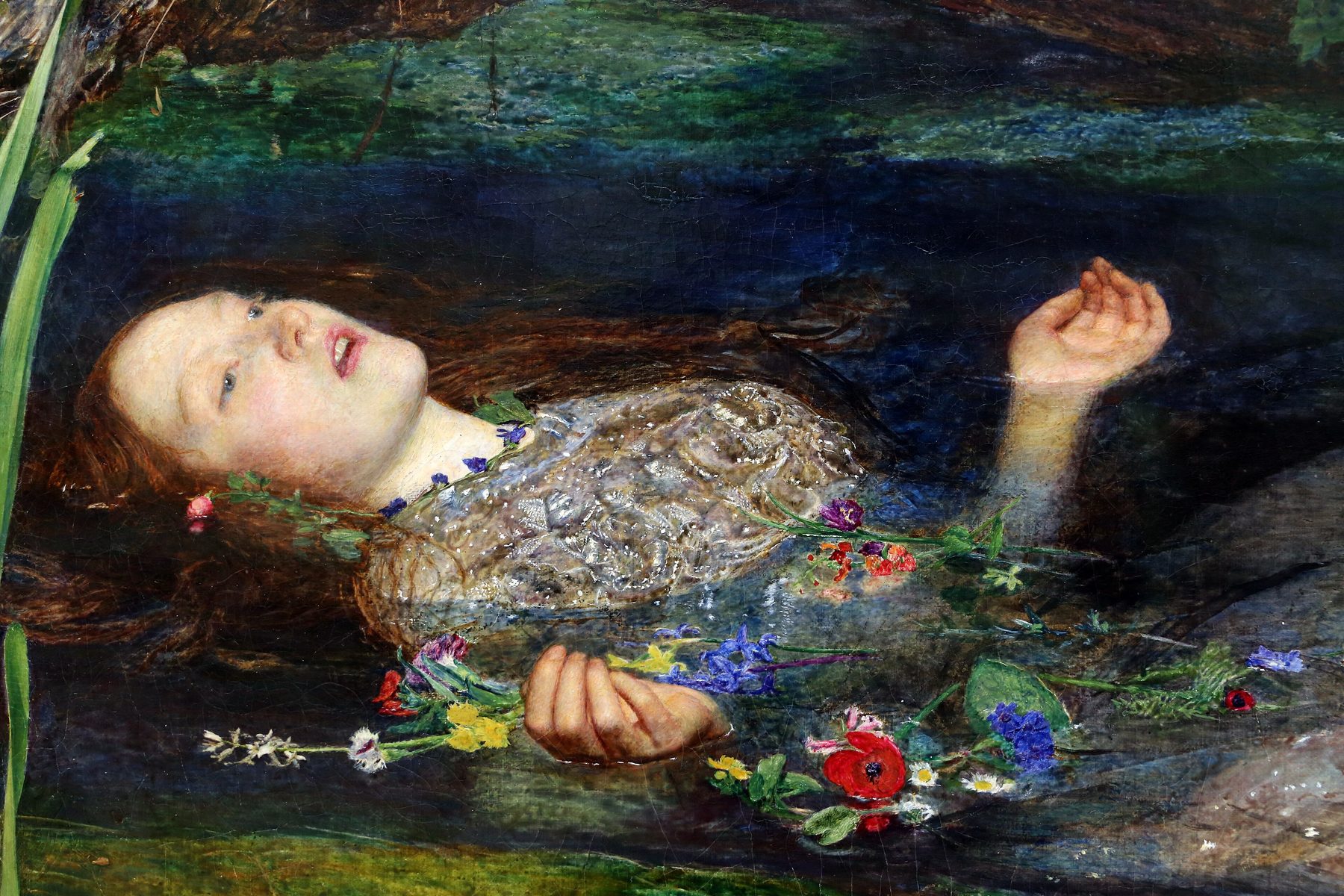
That tension is productive. The viewer must scan rather than glance. In Millais’s Ophelia, flowers are both plants observed in a specific environment and carriers of literary or traditional associations. In Hunt’s Our English Coasts, an intensely appealing landscape surrounds sheep dangerously close to a cliff. The title later associated with “Strayed Sheep” encouraged moral interpretation, but the painted evidence never collapses into a single code.
Pre-Raphaelite detail should therefore not be approached as a puzzle in which every object has one fixed translation. Symbols interact with narrative, colour and mood. Some were explained by artists; some belonged to established religious or literary traditions; others remain uncertain. A red poppy might suggest sleep or death, but its shape, colour and place in the composition matter as much as a dictionary meaning.
The movement’s encounter with early Netherlandish painting reinforces this point. Van Eyck’s Arnolfini Portrait inspired later Victorian interiors not because it supplied a list of symbols, but because a room, its possessions and its reflecting surfaces could turn social life into a dense visual event.[14] Pre-Raphaelite realism is theatrical in precisely this way: an abundance of facts creates interpretation rather than ending it.
Three early shocks
Isabella
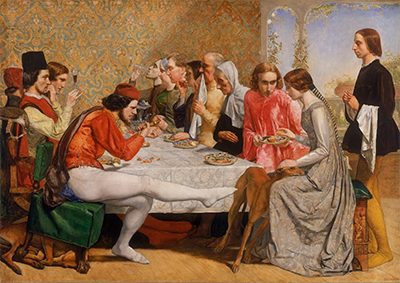
Millais began Isabella in 1848 and exhibited it the following year. Based on Keats’s retelling of a story from Boccaccio, it shows Isabella sharing a meal with Lorenzo while her hostile brothers recognise their attachment. National Museums Liverpool identifies it as the first painting Millais completed according to the Brotherhood’s new principles.[16]
The long table does not recede politely. Figures sit in a compressed sequence, their gestures colliding with objects and one another. A brother kicks at Isabella’s dog while cracking a nut; another raises a glass; patterned cloth, fruit, ceramics and costume form a brilliant surface. The deliberate awkwardness refuses graceful academic balance. Violence has not yet occurred, but social aggression is already lodged in the geometry of legs, arms and stares.
The painting also shows why literary subjects mattered. Millais does not attempt to illustrate the entire poem. He chooses the instant at which future tragedy becomes perceptible without being publicly acknowledged. Viewers know more than the lovers and must read hostile gestures for what they predict.
Christ in the House of His Parents
In Millais’s 1849–50 painting, the young Christ has cut his hand in Joseph’s workshop. Mary kneels to comfort him while a child who prefigures John the Baptist brings water. Wood, nails, blood and a ladder carry associations with the Crucifixion, yet the symbolism is embedded in a functioning workplace. Shavings curl on the floor; tools hang from the wall; bodies are lean and individual.
Dickens’s fury demonstrates that naturalism was not automatically progressive or comfortable. By describing the figures through demeaning social and physical stereotypes, he defended an ideal of sacred beauty against Millais’s working family.[8] The painting’s challenge lies in refusing to separate incarnation from material labour. If Christ truly entered human life, the picture asks, why should a carpenter’s shop be cleansed of dirt, strain and ordinary bodies?
Ophelia
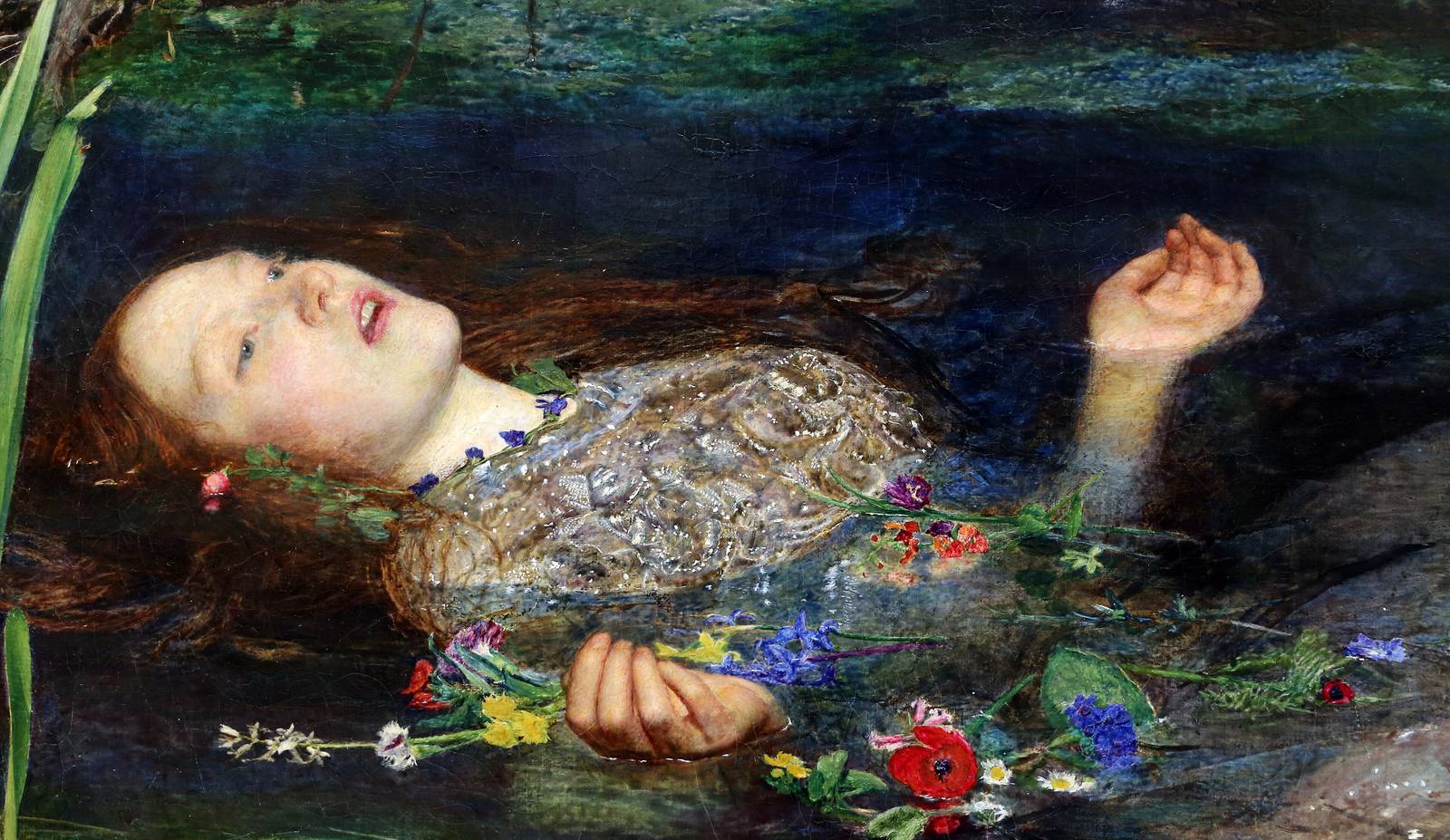
Millais painted the landscape of Ophelia outdoors in Surrey during 1851 and added the figure later, using Elizabeth Siddal as his model. The finished picture shows Shakespeare’s drowned heroine floating with open hands and parted lips, suspended between song and death. Each plant appears vividly specific: willow, nettle, daisy, poppy and other flowers gather around her.[17]
The density makes nature neither a passive background nor a consoling refuge. Growth continues with unsettling energy. Ophelia’s embroidered dress spreads in the water like another bed of vegetation, while her face remains the quietest passage. The composition extends the suspended moment almost beyond narrative time. She has not vanished beneath the surface, yet rescue already feels impossible.
Later retellings often make Siddal’s modelling ordeal the main story. Her labour and illness matter, but reducing the picture to an anecdote repeats the habit of making a woman’s body serve somebody else’s legend. The work belongs to Millais’s design, Shakespeare’s text, Siddal’s paid modelling, months of landscape observation and a long history of viewers who have found beauty inseparable from danger.
Poetry, medievalism and the suspended moment
Pre-Raphaelite art is unusually literary, but its relationship to texts is not simple illustration. Dante, Shakespeare, Chaucer, Keats, Tennyson, Malory and old ballads supplied worlds in which loyalty, desire, betrayal and death could be concentrated into one charged instant. The picture often pauses before recognition or immediately after an irreversible choice.
In Millais’s Mariana, a woman rises from embroidery and stretches before a stained-glass window. Tennyson’s abandoned heroine is defined through waiting, but the interior makes waiting active: fallen leaves collect outside; the embroidery frame, devotional imagery and richly coloured room measure repetitive time. Van Eyck’s example is visible in the way an interior becomes psychological without losing its material specificity.[14]
Rossetti went further than any other member in joining poetry and visual art. Named Gabriel Charles Dante Rossetti, he rearranged his names to foreground Dante and made the Italian poet central to his artistic identity. He wrote sonnets for pictures, drew scenes from medieval literature and treated repeated figures and objects across texts and images. The Rossetti Archive appropriately presents this career as an integrated field rather than separate shelves for painter and poet.[26]
Medievalism offered alternatives to industrial modernity, but it was not innocent escape. The imagined Middle Ages could represent spiritual community, craft integrity, masculine fraternity, erotic danger or authoritarian hierarchy. Different artists took different elements. Hunt pursued moral consequence. Rossetti cultivated desire and memory. Morris eventually connected medieval craft to a critique of factory manufacture and social alienation.
Nor were literary women merely passive beauties. Christina Rossetti’s poetry gives speakers complex negotiations with faith, temptation, refusal and loss. Elizabeth Siddal’s poems and drawings often make intimacy tense rather than decorative. Marie Spartali Stillman developed visual interpretations of Dante and other writers through her own elongated figures, quiet spaces and tonal restraint. Word and image allowed women to enter the movement’s arguments even when formal institutions restricted their training and exhibition opportunities.[22] [23]
Hunt, Rossetti and diverging paths
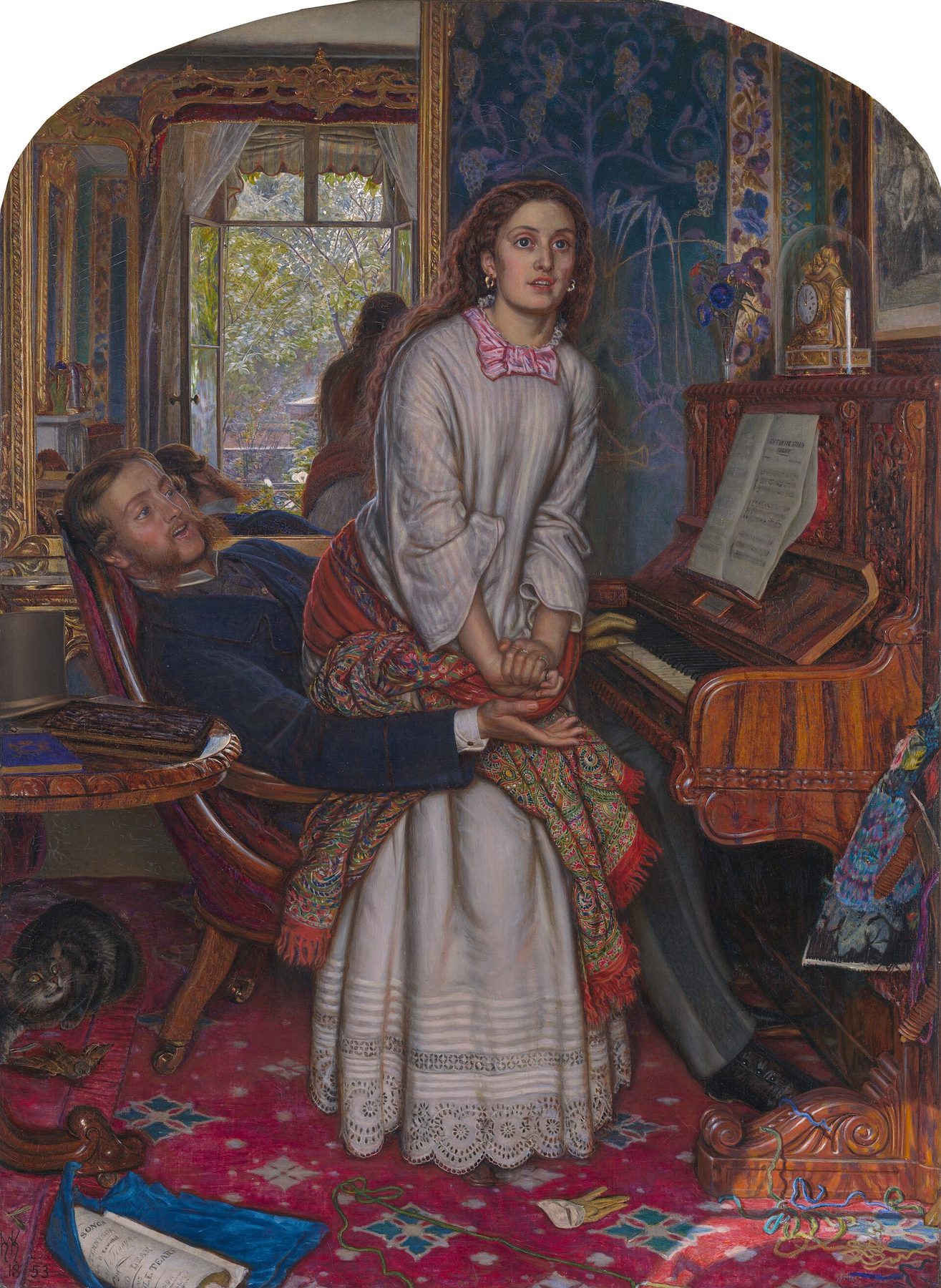
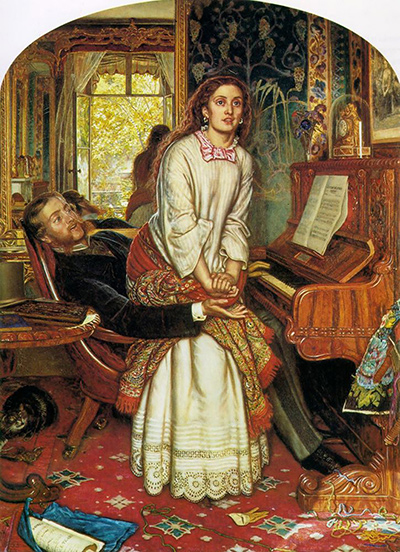
William Holman Hunt remained the most committed to the Brotherhood’s early union of moral purpose and exact observation. The Awakening Conscience places a kept woman on her lover’s lap at the instant a song appears to recall another life. She rises towards a sunlit garden reflected in a mirror, while the overfurnished room reveals the artificiality of her situation. Jewellery, tangled thread, a cat with a bird and a discarded glove invite interpretation, but the woman’s sudden posture carries the drama. Hunt leaves the possibility of change open.
In The Light of the World, Christ stands outside a door overgrown with weeds and without an exterior handle. The image converts a biblical verse into a scene of patient invitation. Its popularity through versions and reproductions made it one of Victorian Britain’s most widely recognised religious images. Hunt’s belief in environmental specificity later took him to Egypt, Syria and Jerusalem, where he sought landscapes and material settings for biblical subjects.[41]
The Scapegoat emerged from this journey. A brilliantly coloured animal stands in the harsh landscape around the Dead Sea, carrying the burden of communal sin into desolation. Hunt’s expedition involved real physical risk and sustained observation, yet modern viewers should also recognise the unequal structures that enabled a British artist to claim the region as a field of biblical authenticity. Accuracy is never outside history.
Dante Gabriel Rossetti moved in another direction. His earliest oils, The Girlhood of Mary Virgin and Ecce Ancilla Domini!, are angular, pale and religious. During the 1850s he increasingly worked in watercolour on compact medieval and Dantean subjects. He also gathered a younger circle whose art valued dense pattern, music, poetry and emotional atmosphere.
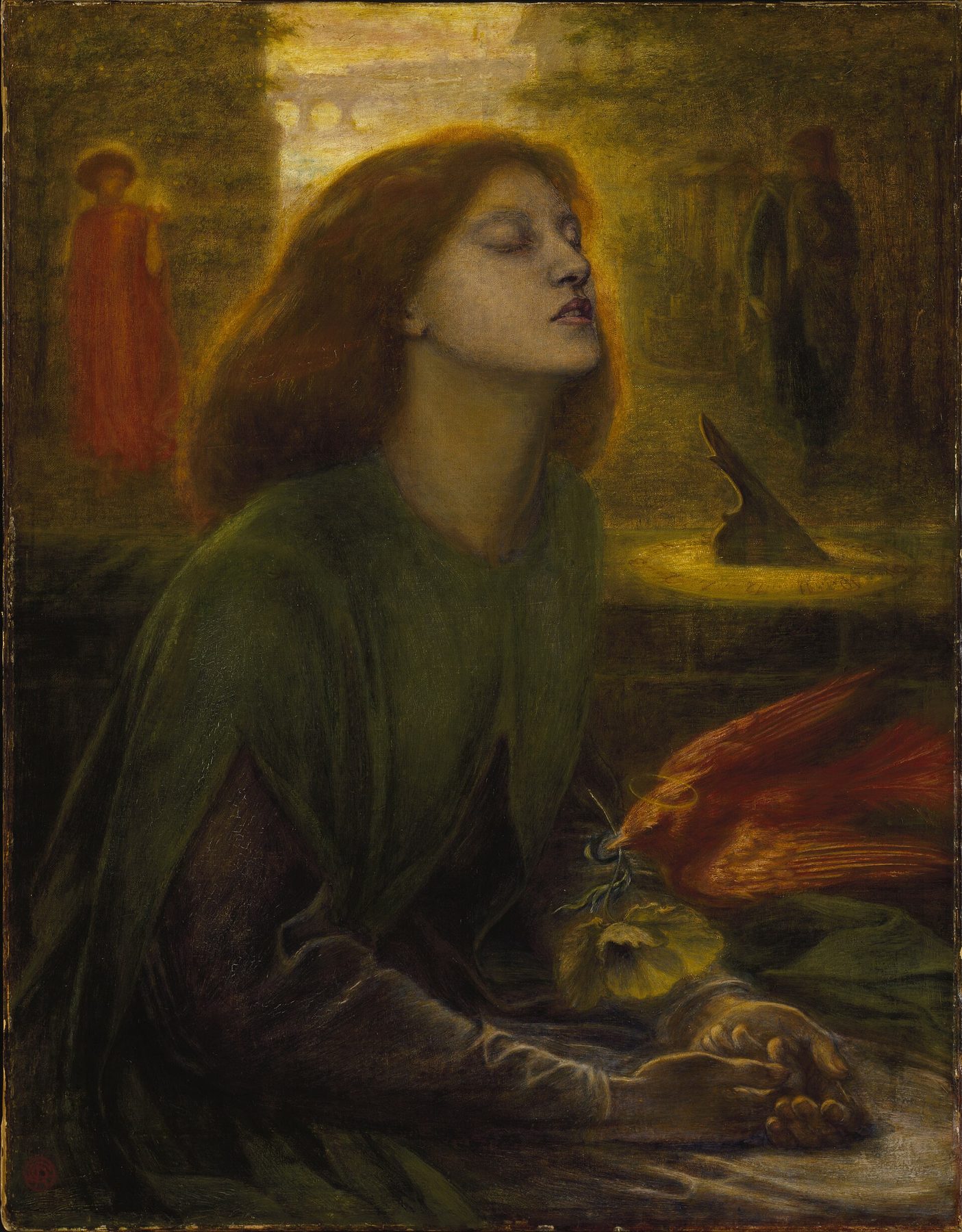
From Bocca Baciata of 1859 onward, Rossetti developed half-length female figures with heavy hair, elaborate jewellery, flowers and enclosed decorative backgrounds. Pictures such as The Beloved, Beata Beatrix and Proserpine transform portrait likeness into symbolic presence. Their beauty is never merely impersonal: named models, relationships and exchanges shaped them. Yet Rossetti repeatedly turned individual women into types of desire, captivity, mourning or dangerous fascination.[25] [35]
Beata Beatrix is inseparable from Elizabeth Siddal, whom Rossetti married in 1860 and who died in 1862, but it is not simply a portrait memorial. The image adapts Dante’s Beatrice, shows a trance-like transition rather than a conventional deathbed and surrounds the figure with a red dove, poppy and distant sundial. Biography, poetry and symbol overlap without becoming identical.
Millais followed a third path. After the intense experiments of the early 1850s, he developed a successful career in portraiture, subject painting and illustration and eventually became president of the Royal Academy. Older accounts sometimes treat this as betrayal. A more useful view recognises how early Pre-Raphaelite skills—surface description, emotional timing and command of costume—were redirected towards a broad Victorian public.
Modern life, labour and emigration
The medieval reputation of Pre-Raphaelitism can hide its engagement with contemporary society. The Awakening Conscience addresses sexual inequality through a modern interior. Its moral structure is paternalistic, but it grants its central woman a moment of thought that unsettles the role assigned to her. Modernity enters through furniture, popular music, money and domestic power.
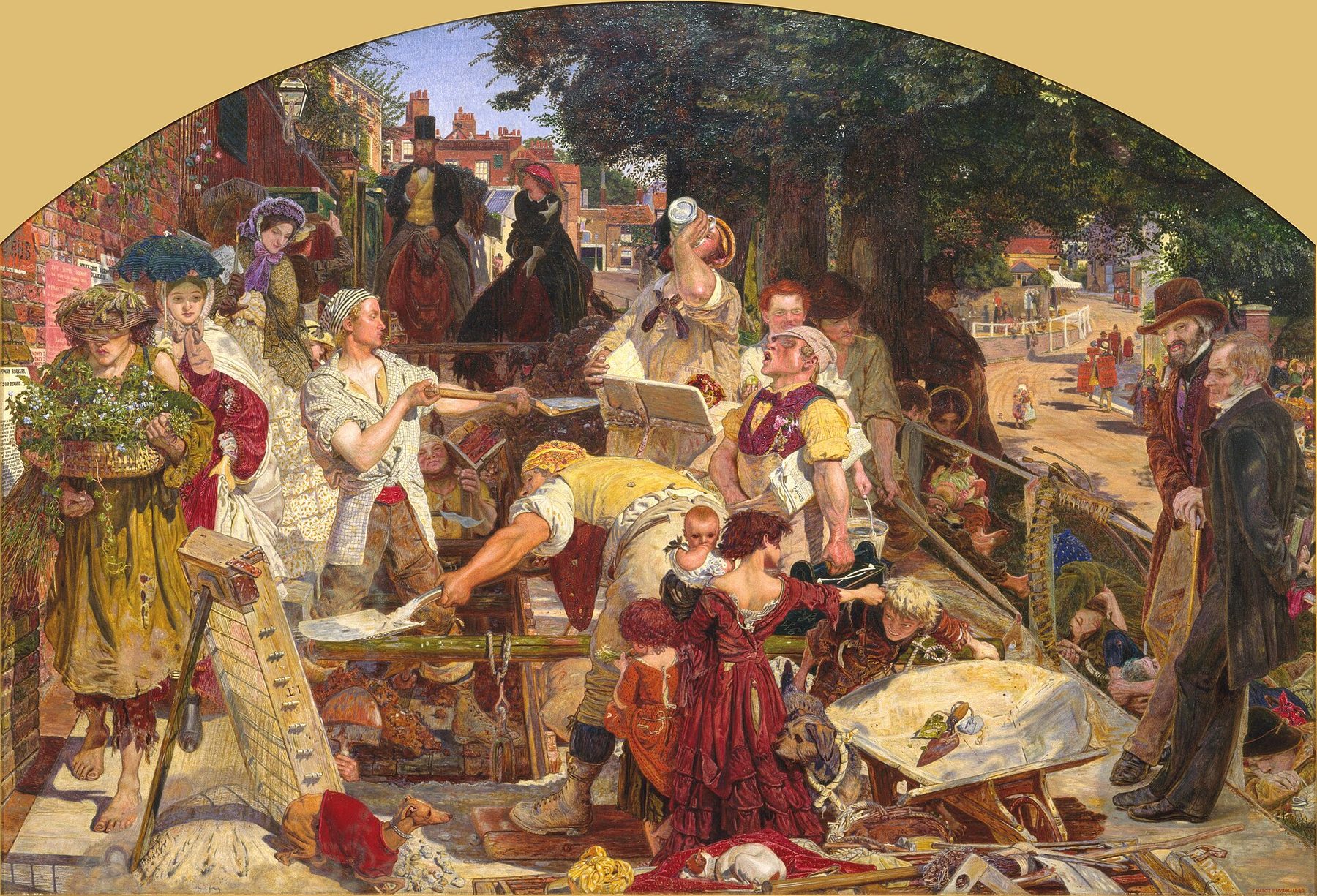
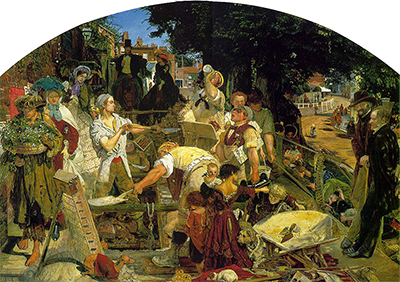
Ford Madox Brown was never a formal Brother, though he was closely associated with the circle and taught Rossetti. His Work, begun in 1852, turns a street excavation in Hampstead into an ambitious history painting of Victorian society. Labourers occupy the physical centre, watched or crossed by flower sellers, children, dogs, fashionable riders, political thinkers and other social types.[18] [19]
Brown published a detailed explanation of the picture in 1865. It helps identify characters and his intended social categories, but the painting exceeds the key. Its circular pit interrupts ordinary movement; bodies tilt and press; sunlight differentiates those working from those able to observe. Thomas Carlyle and F. D. Maurice stand at the side as thinkers about labour. No harmonious social order fully resolves the crowd.
The picture’s abundance resembles early Pre-Raphaelite detail, but its subject is emphatically present-day. Tools, clothes, gestures and street geography make labour worthy of the scale and density of historical painting. At the same time, the labourers are viewed through Brown’s own class position. Attention does not abolish hierarchy.
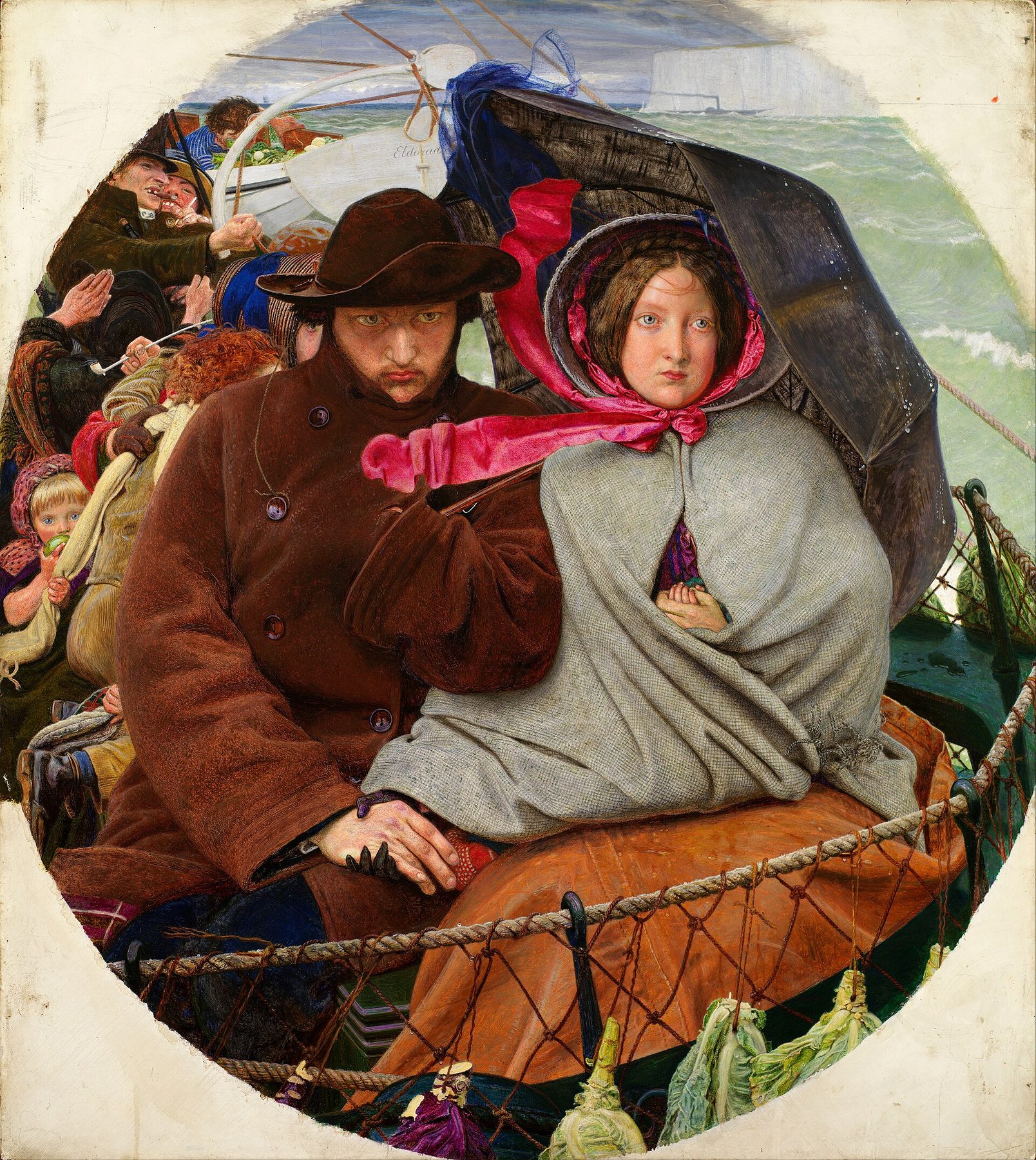
The Last of England, painted in the 1850s, shows a couple aboard a ship leaving Britain. Brown used himself and his wife Emma as models, while the child’s tiny hand is visible beneath her cloak. The circular format compresses sea, passengers, cabbages, ropes and anxious faces around their joined hands. The Birmingham painting belongs to an era when many Britons emigrated to Australia and elsewhere in search of work and security.[20]
The couple are neither heroic explorers nor picturesque poor. Their tight expressions make departure an inward psychological event. The painting asks what a nation looks like from the moment it is being lost. Like Work, it uses exact modern detail without pretending to deliver an impartial social report.
Landscape could also address the present. Hunt’s Our English Coasts was later associated with the title Strayed Sheep and interpreted against political fears of invasion. Millais’s painstaking backgrounds made railway-era access to the countryside part of artistic practice. Pre-Raphaelite nature is not outside industrial Britain; it is a way of measuring what modern habits of sight, work and ownership were doing to the land.
Essential works
Isabella
John Everett Millais, 1848–49
Christ in the House of His Parents
John Everett Millais, 1849–50
Ophelia
John Everett Millais, 1851–52
The Awakening Conscience
William Holman Hunt, 1853
Work
Ford Madox Brown, 1852–65
Women as artists, writers, models and collaborators
The title “Brotherhood” described a male association, and older histories extended that boundary by casting women as muses. Recent museum research instead traces overlapping creative roles across the movement’s successive phases. The National Portrait Gallery’s Pre-Raphaelite Sisters exhibition centred twelve women, among them Elizabeth Siddal, Christina Rossetti, Joanna Boyce Wells, Marie Spartali Stillman, Evelyn De Morgan, Jane Morris, Georgiana Burne-Jones, Fanny Eaton and Fanny Cornforth.[23]
Elizabeth Siddal is the clearest test of how the story changes. Born into a working family and employed in dressmaking, she entered the circle as a model but developed as an artist and poet. Rossetti gave her instruction, Ruskin offered financial support, and she produced drawings and watercolours with spare figures, medieval subjects and psychologically taut encounters.[21] Limited anatomical training and uneven health affected her practice, but neither fact makes it amateur decoration.
Her art often looks unlike the lush paintings for which her face became famous. Thin, angular figures occupy compressed rooms or austere landscapes. In subjects from ballads such as Clerk Saunders, hands, beds and enclosing lines carry emotional strain. Her poems similarly treat love as haunted by separation, death and failed speech. The surviving drawings and watercolours also reveal how uneven access to formal training affected different members of the circle.[13] Seeing Siddal only as Ophelia or Beatrice erases the person who also made images and sentences.
Joanna Boyce Wells trained seriously, exhibited portraits and genre subjects, and received strong contemporary praise before her early death. Marie Spartali Stillman sustained a long international career, working between Britain, Italy and the United States. Evelyn De Morgan used literary and mythological figures for ambitious allegories involving captivity, spiritual conflict and war. These careers show that there was no single “female Pre-Raphaelite” style.[22] [31]
Jane Morris’s role was also multiple. Her face and body shaped major works by Rossetti and Morris-circle photography, but she became highly skilled in embroidery and participated in the making and management of decorated environments. Georgiana Burne-Jones supported, documented and critically interpreted the circle as well as managing a household enmeshed in its work. Christina Rossetti was a major poet whose religious and secular writing both belonged to and resisted the expectations of the network.
Models performed labour. They held difficult poses, travelled to studios and negotiated reputations shaped by images they did not wholly control. Fanny Eaton, born in Jamaica to a woman of African descent, worked as a domestic servant and needlewoman while raising a large family. She modelled for artists including Brown, Millais, Rossetti and Simeon Solomon. Her presence expanded Victorian representations of beauty, ethnicity and biblical or historical character, but it did not mean the circle had escaped racial hierarchy.[24]
Individual sitters should not be reduced to the symbolic titles imposed upon their faces. Fanny Cornforth, Annie Miller, Maria Zambaco and others had distinct relationships to money, respectability, sexuality and artistic work. Pre-Raphaelite art often turns women into embodiments of virtue, danger, longing or fatal beauty. Responsible looking holds two truths together: those images can be formally compelling, and the transformation of a living person into a type involved unequal power.
Women were patrons and audiences too. Martha Combe helped build one of the most important early collections at Oxford. Ruskin’s support and the Combes’ patronage connected the movement to the university before Morris and Burne-Jones arrived.[12] Networks of acquisition, friendship and household display affected what was made and preserved, even when official histories recorded male artists most prominently.
Oxford, Burne-Jones and Morris
In the 1850s Pre-Raphaelitism acquired a second generation. Edward Burne-Jones and William Morris met as students at Exeter College, Oxford, sharing interests in theology, medieval literature and social ideals. After encountering Rossetti in 1856, both abandoned planned church careers for art. They were never members of the 1848 Brotherhood.[1] [27]
Rossetti recruited them and other young artists for murals illustrating Arthurian legends in the Oxford Union. The undertaking was technically troubled, but socially decisive. Painting, poetry, costume, furniture and friendship began to look like parts of one environment. The group’s medievalism shifted away from the early Brotherhood’s hard-edged naturalism towards dream, pattern and decorative continuity.
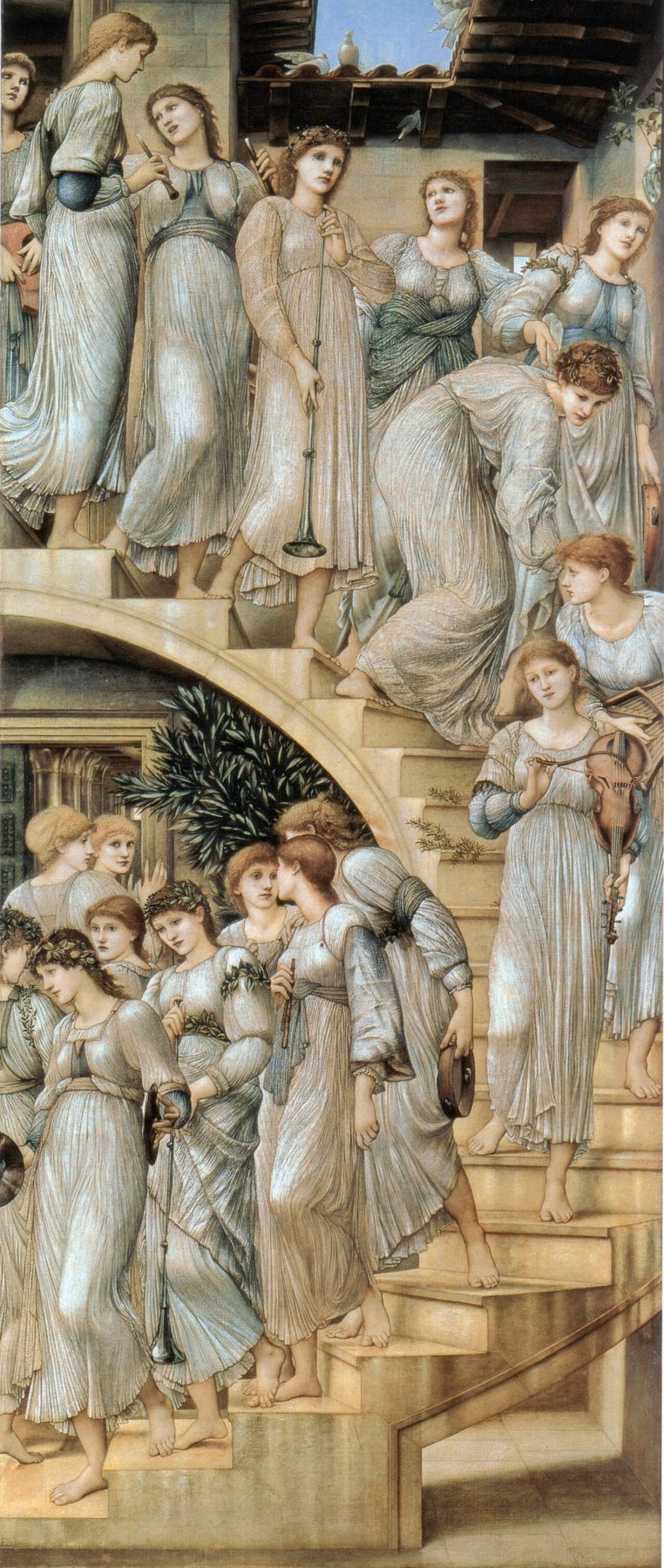
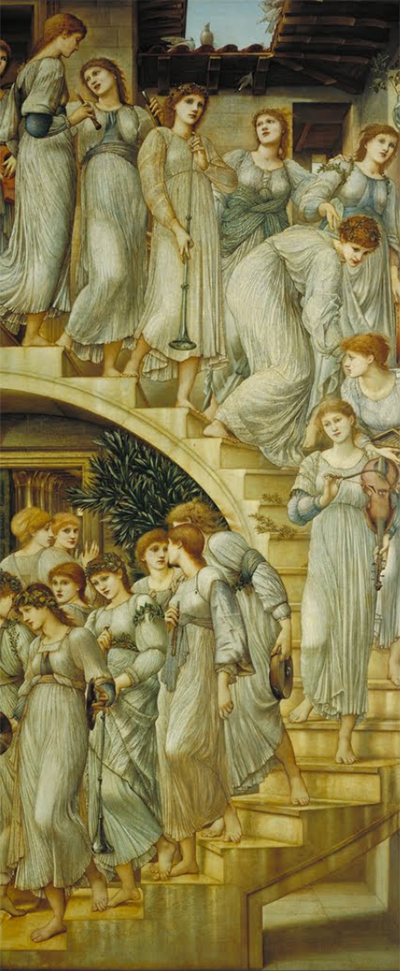
Burne-Jones developed tall, rhythmically repeated figures and narratives that seem to unfold outside ordinary time. In The Beguiling of Merlin, desire and entrapment are carried by enclosing foliage and narrow vertical space. The Golden Stairs offers no clear story at all: a procession of women descends with musical instruments, turning repetition, colour and movement into the subject. His long cycles, including The Briar Rose, linked easel painting to room-scale decoration.[33]
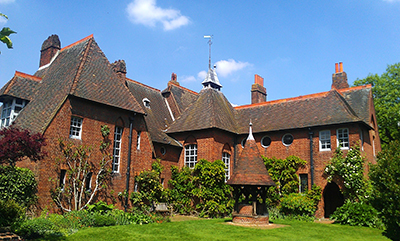
Morris pursued the unity of the arts more directly. Red House, designed with Philip Webb, became a testing ground for furniture, stained glass, painted decoration, embroidery and patterned surfaces. In 1861 Morris, Marshall, Faulkner & Co. was founded with partners including Burne-Jones, Rossetti, Brown and Webb. It produced stained glass, furniture, textiles, wallpaper and other objects.[28] [34]
The firm was collaborative. An artist might design figures on paper; specialist craftspeople translated the design into glass, wood, thread or print; workshops and clients shaped the result. V&A conservation resources make this division of labour visible in stained-glass cartoons and finished windows.[29] The famous name “Morris” should not conceal the designers, makers and women whose work sustained the enterprise.
The medieval workshop offered a moral image of integrated labour against the fragmentation associated with industrial manufacture. Yet Morris’s goods were expensive, the firm operated in a competitive market, and the recovery of satisfying craft did not automatically make beautiful objects available to everyone. This contradiction helped drive Morris towards socialist politics and later arguments about work, pleasure and ownership.
Pre-Raphaelitism therefore changed scale. A picture was no longer only an object on a gallery wall. It could be a room in which wall covering, chair, window, book and embroidered surface belonged to a common visual language. That expanded ambition helped prepare Arts and Crafts and affected Art Nouveau design far beyond Britain.[30]
Artists to know
Dante Gabriel Rossetti
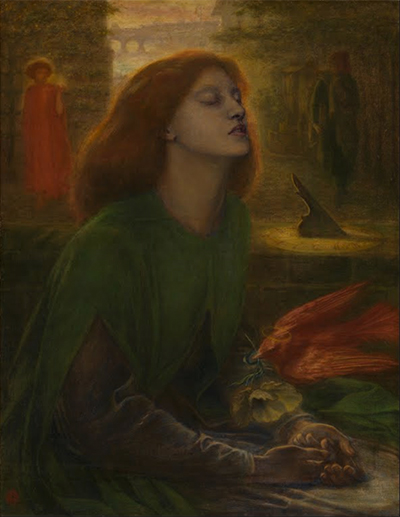
Rossetti joined painting and poetry more completely than any other founder. Begin with the austere religious pictures, then follow the shift through medieval watercolours to Bocca Baciata, Beata Beatrix and Proserpine. His later beauty is powerful precisely because it is entangled with biography, symbolism and the unequal exchange between artist and model.[40]
John Everett Millais
Millais brought extraordinary technical control to the Brotherhood’s most radical early pictures. Isabella, Christ in the House of His Parents, Mariana and Ophelia make colour, detail and narrative timing inseparable. His later success inside the Academy belongs to the movement’s history, not outside it.
William Holman Hunt
Hunt held longest to moral narrative and environmental specificity. In The Awakening Conscience, objects press upon a modern crisis; in The Light of the World, landscape and symbolism turn doctrine into encounter; in The Scapegoat, biblical interpretation enters a geographically observed but politically unequal terrain.
Ford Madox Brown
Brown was an associate, never a Brother. Work and The Last of England extend Pre-Raphaelite density into labour, class and emigration. His career is essential because movements are made by friendships and shared practices as well as membership rules.
Edward Burne-Jones
Burne-Jones belongs to the second generation. His elongated figures, repeated rhythms and dreamlike legends carried Pre-Raphaelitism towards Symbolism and large decorative schemes. Look for how pattern suspends narrative rather than merely ornamenting it.
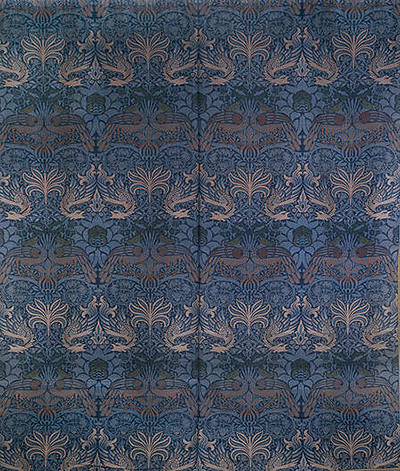
William Morris
Morris turned the movement’s medievalism into a theory of environments and making. His wallpapers and textiles are only the most visible part of a career spanning architecture, stained glass, books, poetry, preservation and socialism. Collaboration is the key to understanding his achievement.[27]
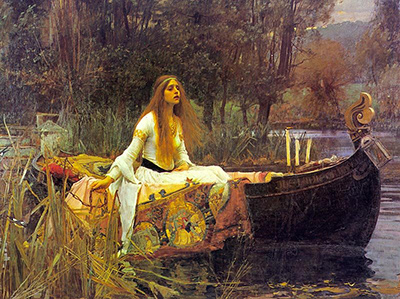
John William Waterhouse
John William Waterhouse was born in 1849, after the Brotherhood had formed, and should not be called a member. His later paintings of The Lady of Shalott, Circe and other literary women demonstrate the continuing appeal of Pre-Raphaelite themes within late Victorian academic exhibition culture.
How to look at Pre-Raphaelite art
Begin by asking which Pre-Raphaelitism you are seeing. An early 1850s painting by Millais may use hard light and observed vegetation. A later Rossetti places a half-length figure against flowers and fabric. A Burne-Jones cycle creates dreamlike repetition. A Morris textile turns botanical growth into a repeat pattern. Shared ancestry does not make these objects stylistically identical.
Next, establish the source. Is the subject biblical, modern, Shakespearean, Dantean or Arthurian? Knowing the text can reveal why the artist selected a particular instant, but avoid measuring the picture by fidelity alone. Ask what the image changes: whose expression becomes visible, what is withheld, and how material details slow the story.
Change your distance. From across a room, find the dominant colour relationships and the large pattern of bodies. Up close, notice plants, textiles, inscriptions and reflections. Then step back again. Detail matters when it alters the whole composition, not when it becomes a hunt for isolated symbols.
Watch the organisation of attention. Early works often deny atmospheric blur, forcing near and far elements into competition. Later works may enclose a face so tightly that jewellery and hair become a decorative field. In each case, the picture controls looking by giving the eye too much rather than too little.
Ask how bodies have been idealised and who supplied them. A named model was a working person, not the same thing as the heroine represented. Consider pose, duration, payment, class, race and reputation alongside the artist’s transformation. This does not cancel beauty; it makes beauty historical.
Materials matter. White preparation can intensify colour, watercolour can produce jewel-like compactness, stained glass turns daylight into part of the work, and textile repeats abolish the single privileged centre of an easel painting. Do not let reproductions make every surface look like the same smooth image.[15] [29]
Finally, hold sincerity and artifice together. Pre-Raphaelite artists valued heartfelt ideas and close observation, but their pictures are highly constructed. Flowers were selected, landscapes assembled, costumes invented and ancient stories redirected towards Victorian concerns. The movement’s distinctive power comes from making invention look exact and exactness feel visionary.
Legacy and afterlife
Pre-Raphaelitism transformed British art without becoming a stable school. Its earliest pictures widened the possibilities of colour, natural description and modern sacred art. Its literary method showed how a painting could inhabit rather than simply illustrate a text. Its modern-life subjects brought domestic power, labour and emigration into ambitious compositions.
The later movement altered the boundary between fine and decorative art. Morris and his collaborators treated an interior as a total field of design, helping to prepare Arts and Crafts. Rossetti’s enclosed female figures contributed to Aestheticism’s emphasis on sensuous form, while Burne-Jones’s dream worlds reached Symbolist audiences in continental Europe.[33] [35]
Photography developed in dialogue with these changes. Staged medieval scenes, literary subjects, close portraits and carefully arranged drapery moved between camera and painting. Julia Margaret Cameron’s soft-focus photographs differ technically from Pre-Raphaelite sharpness, but share an interest in turning friends and contemporaries into sacred, poetic or legendary presences.[32]
International exhibitions and collections made the movement more than a British curiosity. Italian scholarship has emphasised the paradox of a “modern Renaissance”: artists used Italian art to reinvent modern British practice, and their version of that past later returned to Italian audiences as a nineteenth-century historical construction.[36] [38] Burne-Jones and Morris also mattered to European Symbolism and design reform.
The movement’s popularity produced simplifications. Red hair, flowers and medieval costume became a marketable look detached from the original arguments about observation, morality and craft. Later artists such as Waterhouse inherited parts of the imagery without belonging to the Brotherhood. Illustration, fantasy art, fashion and cinema continue to reactivate its visual vocabulary.
Its history has also changed as institutions recover people once described only in relation to famous men. Exhibitions of women artists, research on models such as Fanny Eaton and digital access to poetry and archival material have not added a separate footnote; they have altered what the movement is understood to be.[23] [24] [26] Pre-Raphaelitism now appears less like seven isolated rebels and more like a contested network of making, posing, writing, collecting and looking.
Frequently Asked Questions
The founders were the artists Rossetti, Millais, Hunt, Collinson and Stephens, together with the sculptor Woolner and the critic-secretary William Michael Rossetti. Ford Madox Brown was a close associate but never a member; Edward Burne-Jones and William Morris belonged to a later generation.[2]
The formal association had effectively dissolved by the early 1850s, often dated around 1853. Pre-Raphaelitism continued much longer through the individual founders, later artists, poetry and decorative design.[39]
No. Bright white grounds and colour worked into fresh white paint helped produce luminous effects in some works and passages, but technical research shows variation between artists, pictures and stages of a career.[15]
Waterhouse was not a member of the Brotherhood and was born after it formed. He is best understood as a later Victorian artist who renewed Pre-Raphaelite literary subjects, visual intensity and fascination with psychologically charged heroines.
Discussion
Pre-Raphaelite artists claimed to study nature with unusual honesty, yet they also built pictures from literature, symbols and elaborate staging. Which feels more important when you look at their work: close observation or imaginative construction? Choose one picture and explain how the two interact.
Reader Insights
Move between brilliant colour, exact botanical detail and the larger pattern of bodies before interpreting individual symbols.
Identify the poem, biblical passage or modern social situation, then ask why the artist selected this particular suspended moment.
Notice how paint, stained glass, textile or book design changes the role of light, repetition and surface.
Join the Conversation
Have a thought or observation about the Pre-Raphaelites? Share it below. Thoughtful responses may be added to this section.
References
- “The Pre-Raphaelites”, Metropolitan Museum of Art, Jennifer Meagher. View Source
- “The Pre-Raphaelite Brotherhood”, Fitzwilliam Museum. View Source
- “Pre-Raphaelites: Victorian Art and Design, 1848–1900”, National Gallery of Art, Washington. View Source
- Pre-Raphaelites exhibition guide, National Gallery of Art, Washington. View Source
- “Pre-Raphaelites” group record, National Portrait Gallery. View Source
- The P.R.B. Journal, William Michael Rossetti. View Source
- facsimile of all four issues, The Germ. View Source
- “Old Lamps for New Ones”, Charles Dickens. View Source
- “Old Lamps for New Ones” article record, Dickens Journals Online. View Source
- Pre-Raphaelitism, John Ruskin. View Source
- “Pre-Raphaelites gallery”, Ashmolean Museum. View Source
- “Oxford and the Pre-Raphaelites”, Ashmolean Museum. View Source
- “Pre-Raphaelite drawings and watercolours”, Ashmolean Museum. View Source
- “Reflections: Van Eyck and the Pre-Raphaelites”, National Gallery, London. View Source
- “Pre-Raphaelite technique and its consequences”, Joyce H. Townsend, Jacqueline Ridge and Stephen Hackney. View Source
- “Isabella by John Everett Millais”, National Museums Liverpool. View Source
- “John Everett Millais: Ophelia”, Tate. View Source
- A Description of the Celebrated Picture Work, Ford Madox Brown and Manchester Art Gallery. View Source
- “Unlocking Work by Ford Madox Brown”, Manchester Art Gallery. View Source
- “The Last of England”, Birmingham Museums. View Source
- “Elizabeth Eleanor Siddal”, Delaware Art Museum. View Source
- “Spotlight on Women Artists of the Pre-Raphaelite Movement”, Delaware Art Museum. View Source
- “Pre-Raphaelite Sisters”, National Portrait Gallery. View Source
- “Fanny Eaton”, National Portrait Gallery. View Source
- The Rossettis exhibition book, Tate. View Source
- The Rossetti Archive, University of Virginia. View Source
- “Introducing William Morris”, Victoria and Albert Museum. View Source
- “About William Morris”, William Morris Gallery. View Source
- “Stained glass on paper: Morris & Co. and the Pre-Raphaelites”, Victoria and Albert Museum. View Source
- “Victorian Radicals”, Birmingham Museums. View Source
- “The Pre-Raphaelites”, Birmingham Museums. View Source
- “Une ballade d’amour et de mort: photographie préraphaélite en Grande-Bretagne, 1848–1875”, Musée d’Orsay. View Source
- “Edward Burne-Jones (1833–1898), un maître anglais de l’imaginaire”, Musée d’Orsay. View Source
- “Morris, Marshall, Faulkner & Co.”, Musée d’Orsay. View Source
- “Beauté, morale et volupté dans l’Angleterre d’Oscar Wilde”, Musée d’Orsay. View Source
- Preraffaelliti: Rinascimento moderno press dossier, Fondazione Cassa dei Risparmi di Forlì. View Source
- “La visione degli antichi”, Musei San Domenico. View Source
- “Preraffaelliti: il Rinascimento moderno”, Regione Emilia-Romagna. View Source
- “Präraffaeliten”, Städel Museum. View Source
- “Dante Gabriel Rossetti”, Städel Museum. View Source
- “William Holman Hunt” biography, National Portrait Gallery. View Source
- Tate Introductions: Pre-Raphaelites, Tate and Jason Rosenfeld. View Source
- Pre-Raphaelite Sisters, National Portrait Gallery and Jan Marsh. View Source
- Modern Painters, Old Masters, Yale University Press and Elizabeth Prettejohn. View Source
- Poetry and the Pre-Raphaelite Arts, Yale University Press and Elizabeth Helsinger. View Source
- Image references 46–53: open-access reproductions and institutional collection records.