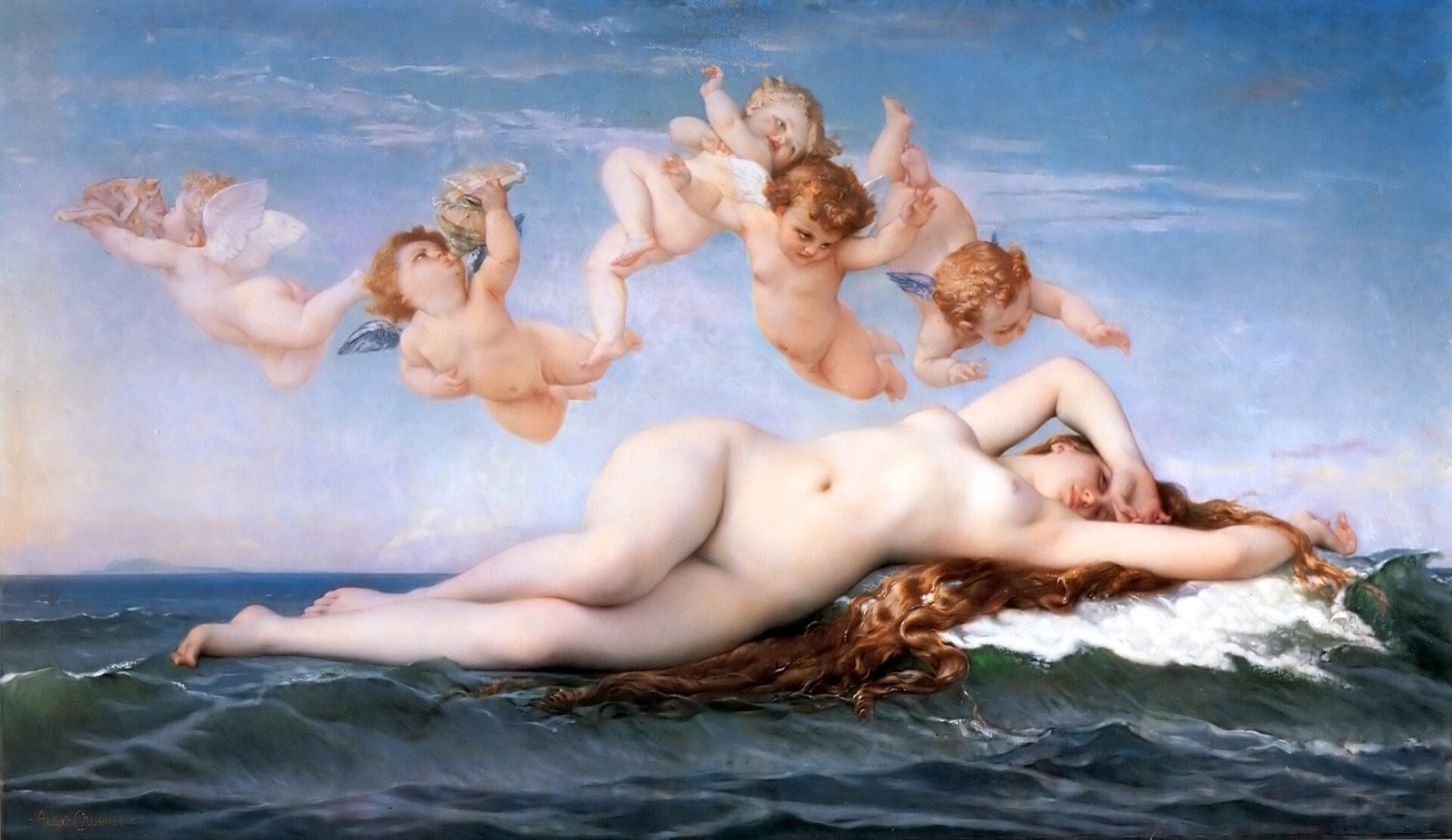
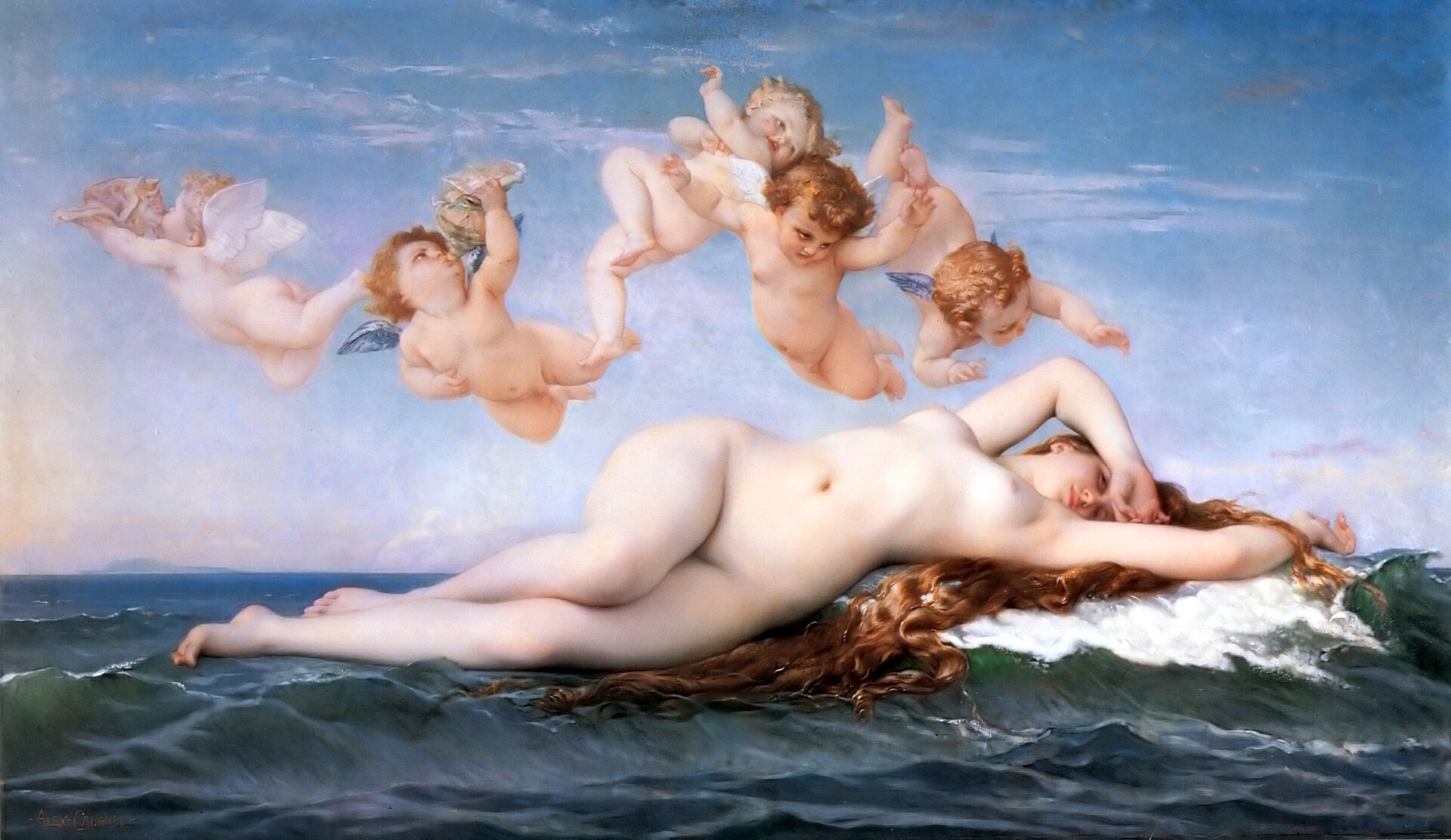
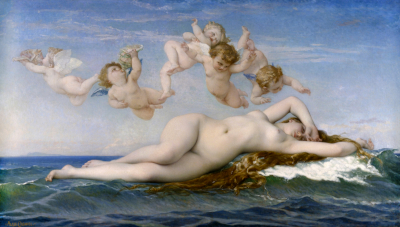
Image reference: Alexandre Cabanel, The Birth of Venus.
At a Glance
- Core periodc. 1750–1900, with roots in the seventeenth century
- Major centresParis, London, Rome, Madrid, Vienna, Berlin and St Petersburg
- Known forfigure drawing, history painting, idealised form and controlled finish
- Key contextacademies, ateliers, competitions, state patronage and Salons
Contents
- Academic art in context
- What is academic art?
- How academic training worked
- The hierarchy of genres
- The Salon and the making of a career
- What academic art looks like
- Academic artists to know
- Academies beyond Paris
- Women, models and unequal access
- Challenge, fragmentation and modernism
Academic art in context
William-Adolphe Bouguereau
Principal careerAlexandre Cabanel
Principal careerJean-Léon Gérôme
Principal careerLawrence Alma-Tadema
Principal careerFrederic Leighton
Principal careerJohn William Godward
Principal careerFrank Dicksee
Principal careerAcademic art sits across several periods rather than forming one neat movement. Its institutions grew from Renaissance ideas about artistic knowledge and seventeenth-century attempts to raise painting and sculpture above the status of guild crafts. They became especially powerful during the age of Neoclassicism, remained central through Romanticism and Realism, and reached their most visible public form in the nineteenth-century Salon. Their influence continued even as Impressionism, Symbolism and the early modern movements challenged their standards. [1][2][5]
For that reason, Academicism cannot be placed on a timeline like a short-lived avant-garde group. A broad span from about 1600 to the early twentieth century describes the institutional history, while roughly 1750–1900 marks its strongest international phase. The academy system outlived individual styles because it organised training, professional status, exhibitions and rewards. Its story is not simply the story of conservative artists resisting change. It is also the story of how artists learned to draw, how states defined culture, how publics encountered new work and how modernism constructed the tradition it wished to defeat. [9][26][27]
Follow Academic Art through four stages
–1793
Institutions form
Academies separate learned art from guild structures and connect teaching, theory, prizes and public recognition.
–1848
Systems expand
Revolution changes institutions without ending academic training; Rome prizes and national academies spread their authority.
–1881
The Salon age
Large public exhibitions, juries, medals and reproductions make academic success internationally visible.
–1914
Fragmentation and reassessment
Independent exhibitions and dealers weaken one-Salon authority while academic methods continue across Europe and beyond.
What is academic art?
Academic art is art shaped by an academy: an institution that taught artists, debated standards, awarded honours and often influenced exhibitions or state commissions. The term can describe the work of artists trained inside those systems, but it is most useful when it identifies a network of practices rather than a single look. Academic painters might favour severe classical design, theatrical Romantic action, exact archaeological detail, sentimental rural subjects, fashionable portraiture or richly decorative visions of antiquity. [5][7][9]
The French system provides the best-known model. The Académie royale de peinture et de sculpture, founded in 1648, argued that painting and sculpture were intellectual disciplines comparable to poetry and history. Its founders wanted freedom from the rules of the Guild of Saint Luke and claimed a higher social position for artists educated in theory as well as manual practice. Meetings and lectures turned art into a subject of public reasoning: members discussed composition, expression, colour, drawing and the achievements of earlier masters. [1][2]
That intellectual claim had practical consequences. The academy could define which skills mattered, which subjects carried prestige and which artists received institutional recognition. It also created opportunities. Regular teaching gave students access to models and collections; competitions rewarded sustained ambition; exhibitions placed contemporary art before large audiences. An academy could protect standards and professionalise a field that had previously depended heavily on workshop or guild structures. [2][3]
The same power could become restrictive. Standards hardened into expectations about correct anatomy, elevated subject matter, coherent composition and finish. Juries and prizes could favour artists already closest to the accepted model. Artists without money, social connections or access to the required training faced greater obstacles. Women were particularly disadvantaged when excluded from life drawing, because mastery of the nude figure was treated as the foundation of the most prestigious art. [6][14]
The word Academicism often carries this negative sense: correct technique without life, inherited formulas followed without conviction, or an institution protecting itself against experiment. In France, hostile critics later used art pompier—literally “fireman art”—to mock grand historical pictures, sometimes linking their warriors’ classical helmets to contemporary firemen’s headgear. The Musée d’Orsay notes that modernism’s later success turned académisme into a term of rejection so powerful that, when the museum opened in 1986, exhibiting this material could still be mistaken for an attempt to rehabilitate it wholesale. [6]
Neither worship nor dismissal is adequate. Academic institutions enabled formidable knowledge and technical control, but they also concentrated authority. Academic pictures can be visually inventive, politically troubling, emotionally persuasive and institutionally privileged at the same time.
From guild to academy
Art academies did not begin in nineteenth-century Paris. Italian institutions and drawing societies had already connected artistic practice to study, discussion and classical precedent. What made the French Académie royale especially influential was its relationship to monarchy and state. Under Louis XIV, court culture, central administration and major decorative projects gave the academy both symbolic authority and practical work. [1][2]
Its foundation in 1648 challenged the Paris guild that regulated painters and sculptors as tradespeople. The academy’s claim was not that artistic skill ceased to involve labour. It was that the highest art required invention, learning and judgement beyond manual competence. The distinction elevated painters and sculptors socially while reinforcing a separation between the “fine arts” and other skilled forms of making. That boundary would influence museums and art history long after the original guild dispute had disappeared. [1][2]
The academy developed several connected functions. It admitted established artists as members, trained students, held theoretical conferences and organised displays of work. Public exhibitions anticipated the Salon, named after the Salon Carré in the Louvre where academy exhibitions were held from the eighteenth century. The academy’s Roman branch, founded in 1666, gave the classical past a physical centre. Winners of the Prix de Rome could spend years in Italy studying ancient sculpture, Renaissance painting, architecture and the city itself. [1][4]
The French Revolution broke the royal institution but did not end institutional art. In 1793 the National Convention abolished the academies, and the Prix de Rome was interrupted. New republican bodies then reorganised artistic education and recognition. By the nineteenth century the Académie des Beaux-Arts, the École des Beaux-Arts, the French Academy in Rome and the Salon formed related parts of an evolving system, but they were not one unchanging organisation. [1][4]
This distinction matters because “the Academy” is often imagined as a single committee controlling every brushstroke. In reality, authority moved among academicians, teachers, government officials, juries and artist societies. Private ateliers prepared students for official competitions, while independent academies offered other routes. Salon juries changed, reforms altered membership, and artistic factions fought within the establishment. Academic culture was powerful precisely because it was an ecosystem, not one room with one set of rules.
How academic training worked
Academic education began with drawing. Students learned proportion, contour and the construction of solid form before attempting the most difficult figure compositions. They copied prints and drawings, then studied plaster casts of celebrated antique sculptures. The cast removed colour and material difference, turning a statue into a lesson in outline, light, volume and idealised anatomy. A corridor filled with casts was therefore not mere decoration; it was a working library of bodies and poses. [3][16]
The living model marked a further stage. In French usage, an académie can mean a drawn or painted nude study as well as the institution that commissioned it. Students worked from a posed body under controlled light, learning how muscles, balance and foreshortening altered with the position of a figure. Anatomy lectures explained the structures beneath the skin. Perspective, geometry, history, archaeology and ornament supported the larger task of building credible pictorial worlds. Beaux-Arts de Paris preserves competition drawings in perspective from 1813, anatomy from 1855, history and archaeology from 1867 and ornament from 1873, evidence of a curriculum that expanded while retaining the figure at its centre. [3][6]
Copying Old Masters also trained judgement. A student could study how Raphael organised groups, how Poussin clarified a narrative, how Michelangelo enlarged anatomical movement or how Titian used colour. Copying was not supposed to end in imitation. It gave the artist a repertoire of solutions that could be adapted during invention. The persistent risk was that admired examples became recipes rather than resources.
Competitions tested both knowledge and endurance. A set theme—often biblical, mythological or historical—required students to invent a composition within strict conditions. Success at successive stages could lead toward the Prix de Rome. Founded in the seventeenth century, the prize made residence in Rome an extension of academic education. Students drew ancient sculpture and Renaissance works, but they also encountered modern Rome, landscape, archaeology and other artists. The Metropolitan Museum describes how that classical programme produced varied results: Hubert Robert absorbed Piranesi and outdoor landscape study, while Jacques-Louis David joined classical rigour to Baroque drama. [4]
The famous smooth Salon canvas was the end of a long process. An artist might begin with thumbnail sketches, settle the arrangement in a compositional drawing, make separate studies from models, test colour in a painted sketch and then transfer the design to a large support. Layers of paint refined modelling and suppressed awkward transitions. A seemingly effortless body could depend on dozens of decisions made before the final surface. [3][5]
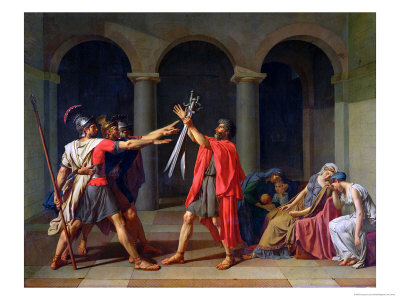
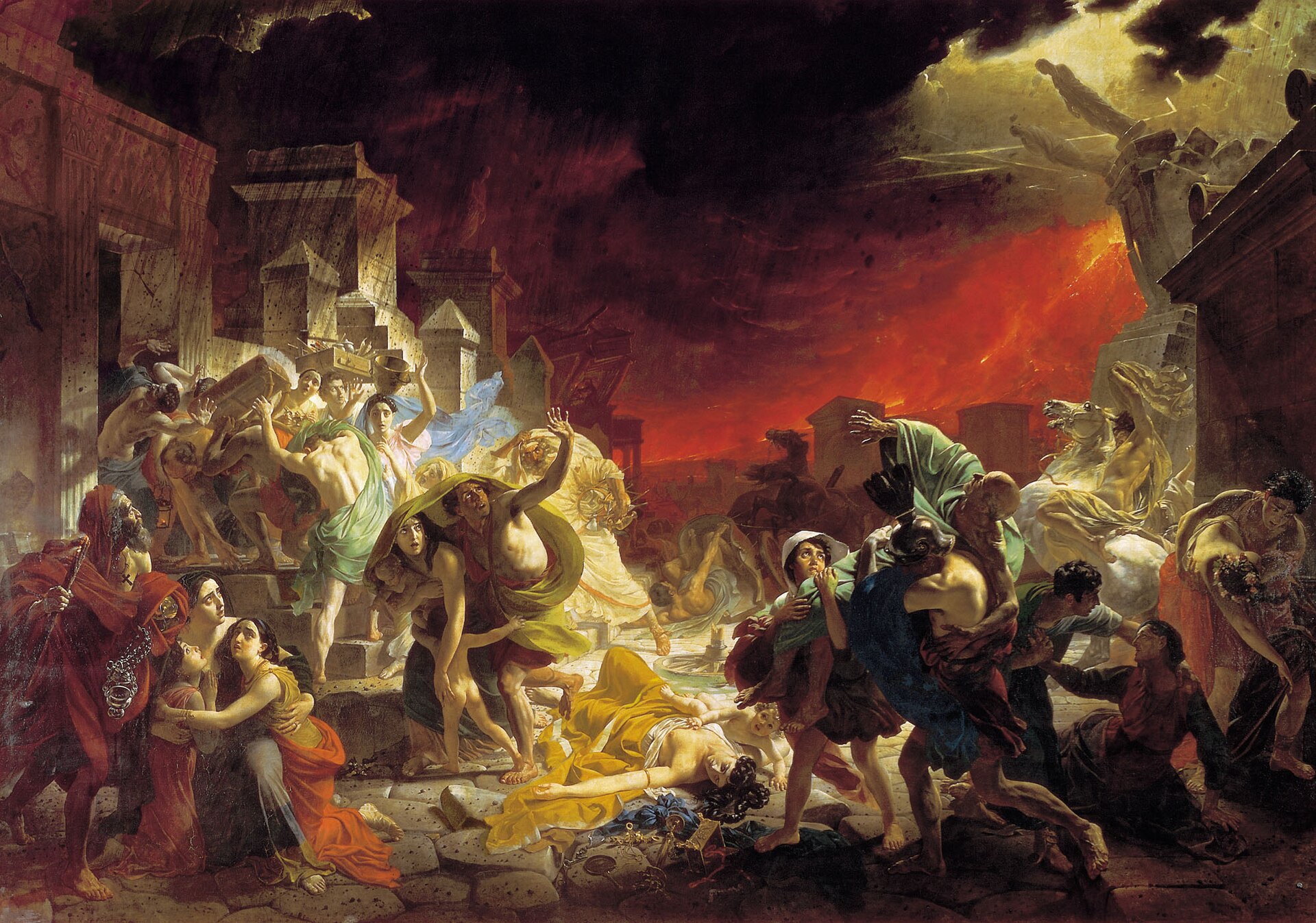
Academic painters did not all hide their touch to the same degree. Ingres made line and contour seem sovereign, while other academicians embraced richer colour or more visible handling. Karl Brullov’s The Last Day of Pompeii joined academy training to Romantic spectacle, and his portraits could be notably free in execution. Even in Paris, teachers such as Gustave Moreau encouraged students whose later work departed radically from academic appearance. Henri Matisse passed through the Académie Julian and the École des Beaux-Arts before helping create Fauvism. [23][31]
The atelier was as important as the formal school. Students often entered the studio of an established master, where advanced pupils learned from corrections, peers and repeated competition exercises. Cabanel, Gérôme and Bouguereau became influential teachers. Private institutions such as the Académie Julian adopted elements of the Beaux-Arts method while serving women and foreign students who could not enter the state school. Their existence shows both the international attraction of Paris and the exclusions built into its official route. [14][15]
The hierarchy of genres
Academic theory ranked subjects according to the kinds of knowledge and invention they appeared to require. History painting stood highest. The category included ancient history, scripture, mythology and literary subjects, not simply accurate reconstruction of a past event. A successful history painter had to imagine a complex action, arrange multiple figures, express emotion, command anatomy and costume, and give the scene moral or intellectual weight. [5][6]
Portraiture generally followed because it joined likeness to the expression of character and status. Genre painting—scenes of everyday life—stood below portraiture, followed by landscape and still life. The hierarchy valued invention over imitation: composing a heroic action was considered more demanding than recording a face, a street or a bowl of fruit. It also reflected social assumptions about which experiences deserved monumental scale.
Actual art did not behave so neatly. Portraiture could be more profitable than history painting. Landscapes attracted collectors and developed their own prizes. Rosa Bonheur turned animal painting into international celebrity. Still-life painters demonstrated technical and symbolic ambition, while modern-life subjects transformed public expectations. Academies adjusted categories because artists, patrons and markets kept exposing the gap between theory and practice. [5][9]
The hierarchy nevertheless shaped artistic ambition. Myth and history offered permission to paint the nude, stage violence or address political ideas. Cabanel’s Birth of Venus could display an erotic body under the protection of classical mythology. A contemporary naked woman looking directly at the viewer, as in Manet’s Olympia, disrupted that protective distance. Subject and style were inseparable from decorum: the academy did not simply ask whether a body was skilfully painted, but what kind of body it claimed to be. [8]
The Salon and the making of a career
The Paris Salon was the great public theatre of nineteenth-century art. Thousands of visitors saw paintings and sculptures hung closely across enormous walls. Critics reviewed successes and failures; caricaturists mocked the crowds; dealers and collectors watched reputations form. Acceptance could bring sales, state purchases, medals and commissions. Rejection could leave an ambitious work almost invisible. [5][6]
The Salon was connected to the academy system, but it should not be mistaken for a display restricted to one style. Its rooms contained Ingres’s followers, Romantic colour, rural genre, official portraits, military pictures, Orientalist scenes, Realist provocations and decorative fantasies. Musée d’Orsay describes the Second Empire Salon as eclectic and crowded: Delacroix, Courbet, Bouguereau and other very different artists could all appear within it. [6]
Jury decisions were still decisive. In 1863, an unusually severe jury rejected roughly half or more of the submitted works. Protests led Napoleon III to order a separate Salon des Refusés, where viewers could judge the rejected pictures. Manet’s Le Déjeuner sur l’herbe became the most famous scandal, while Cabanel’s Birth of Venus triumphed in the official Salon and was bought by the emperor. The contrast has become a compact origin story for modern art: one smooth Venus accepted, one confrontational modern nude refused. [6][8]
The story is useful but too tidy. Manet continued submitting to the Salon because its audience mattered. Academic juries did not reject every later modernist, nor did acceptance guarantee lasting fame. In 1874—the year of the first Impressionist exhibition—Gérôme, Bonnat, Bouguereau and Henner were celebrated Salon figures addressing subjects that contemporary audiences considered urgent or impressive. A modern reconstruction of that year must show both exhibitions, not pretend Paris had already chosen the canon familiar today. [10]
Alternative routes gradually weakened the Salon’s near-monopoly. The Impressionists organised eight exhibitions between 1874 and 1886. The Salon des Indépendants began in 1884 without a conventional jury, and other societies created competing Salons. Private galleries and dealers became increasingly powerful. State control of the principal Salon ended in 1881, and divisions among artist organisations produced rival exhibition structures. Patricia Mainardi argues that the Salon’s roles as public instruction and art marketplace pulled it in contradictory directions during the Third Republic. [6][28]
World’s fairs extended academic prestige internationally. Large, highly finished paintings and sculpture worked well within national displays of cultural achievement. Medals circulated reputations across borders, and reproductions carried successful pictures into illustrated books, prints and domestic interiors. Academic art was therefore not only state culture. It was also mass visual culture, reproduced and sold to audiences far beyond the original Salon wall. [9][29]
What does academic art look like?
The first clue is usually design. Academic painters aimed for figures that read clearly, poses that conveyed the action and compositions that guided attention through a scene. The body was constructed from training rather than copied from one unaltered observation. Limbs could be lengthened, profiles refined and awkward features adjusted toward an ideal. Even when the subject appeared natural, its clarity was often the result of selection. [3][5]
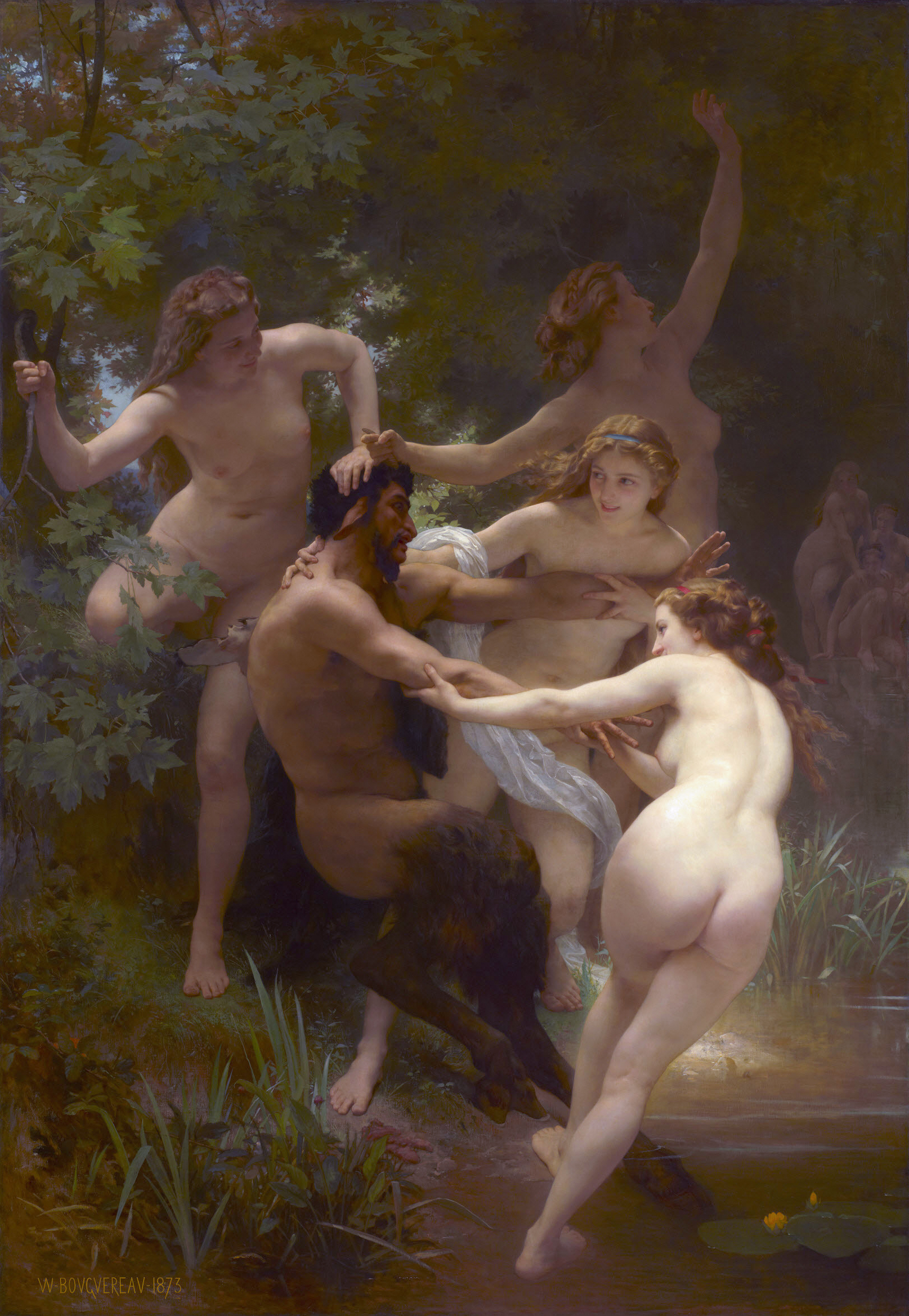
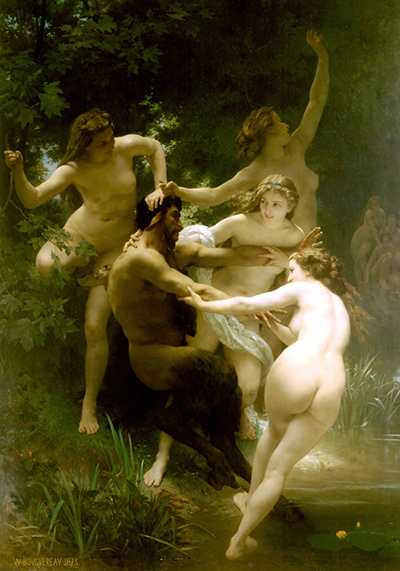
Finish is the second familiar trait. Forms are modelled through gradual transitions of light and shadow; edges sharpen or soften according to depth; brushmarks often disappear into the illusion. Bouguereau’s nudes make skin appear continuous and touchable, set against textures that confirm the painter’s control. The Clark Art Institute notes the contrast between the soft body in his Seated Nude and the earth, rock and water around it. Such finish invited close admiration of craft, even when later critics equated it with sterility. [30]
Cabanel’s Birth of Venus offers a different refinement. The pale figure stretches across the surface with almost no bodily weight, while waves and airborne putti convert the scene into decorative rhythm. The Musée d’Orsay describes the work as an eclectic combination of Ingres and eighteenth-century painting. Myth dignifies the nude and makes sensual display publicly acceptable. The picture’s smoothness does not eliminate desire; it regulates how desire may appear. [8]
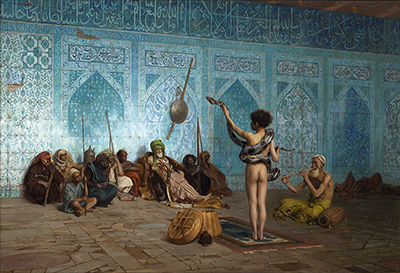
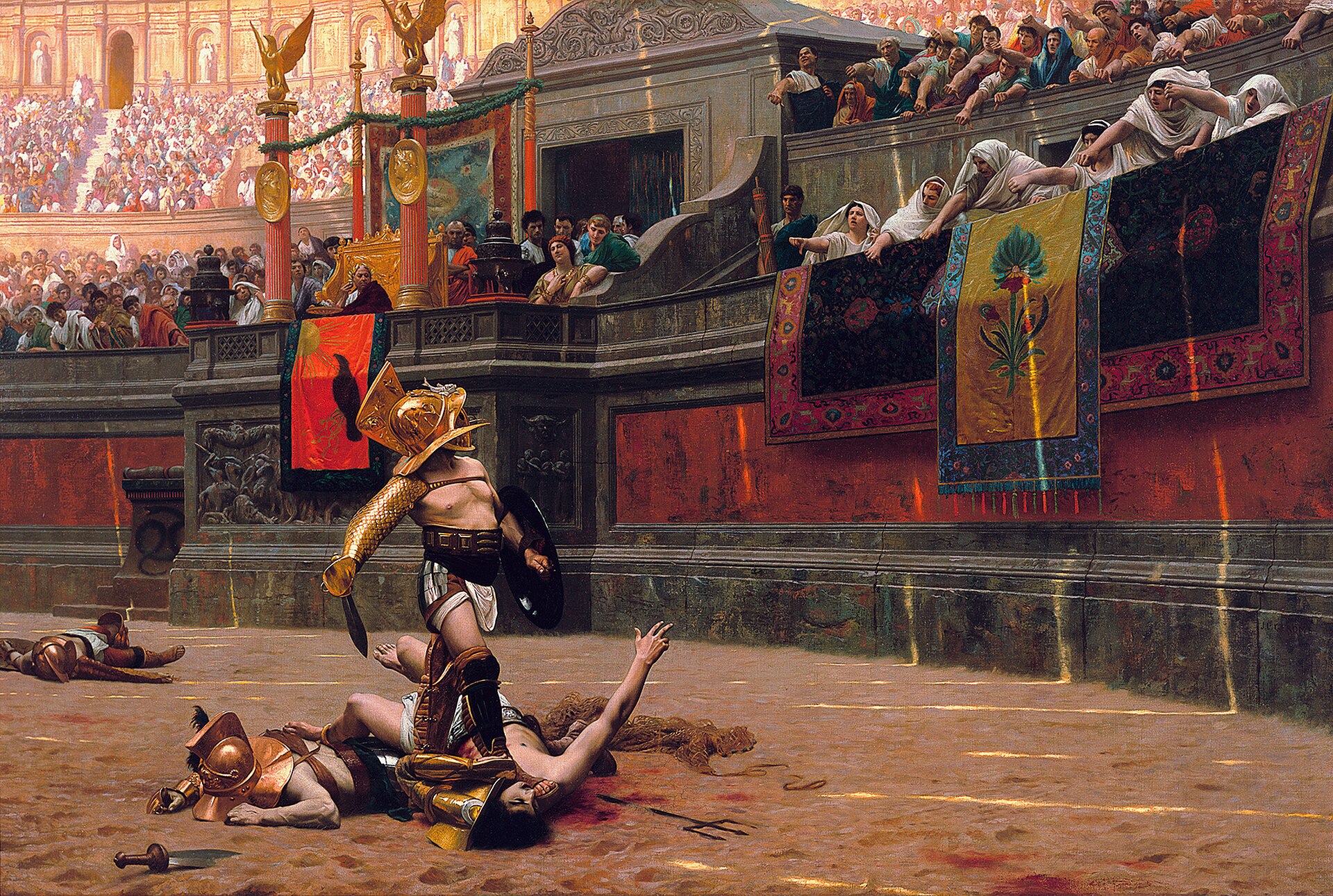
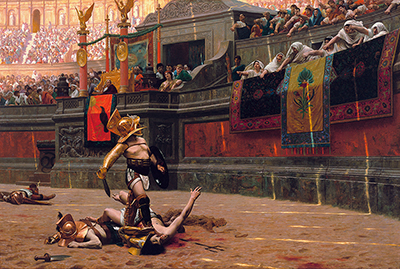
Academic art could also pursue exact detail. Gérôme reconstructed ancient arenas, studios and Near Eastern settings with costumes, architecture and objects that seemed evidential. His pictures benefited from travel, collecting, archaeology and photography, yet each scene remained staged. The polished surface joins disparate observations into a convincing fiction. His late experiments with coloured sculpture even challenged the modern habit of imagining ancient marble as pure white. [11]
Scale and narrative matter too. A history painting may use gesture like theatre: one hand accuses, another shields a child, a fallen weapon explains what has just happened. Viewers were expected to recognise a text or historical episode and read the emotional relations among bodies. That legibility could become formulaic, but at its best it created powerful compression—the sense that a whole story has gathered around one irreversible instant.
There is no rule that academic art must be enormous, classical or French. Portraits by academic artists could be intimate; figure studies could remain unfinished; British painters combined academy training with Aestheticism or Pre-Raphaelite detail; Russian artists joined classicism to Romantic colour and national history. Institutions taught a shared vocabulary, but artists spoke it with different accents.
Essential works
The Birth of Venus
Alexandre Cabanel, 1863
Nymphs and Satyr
William-Adolphe Bouguereau, 1873
Pollice Verso
Jean-Léon Gérôme, 1872
The Last Day of Pompeii
Karl Bryullov, 1830–33
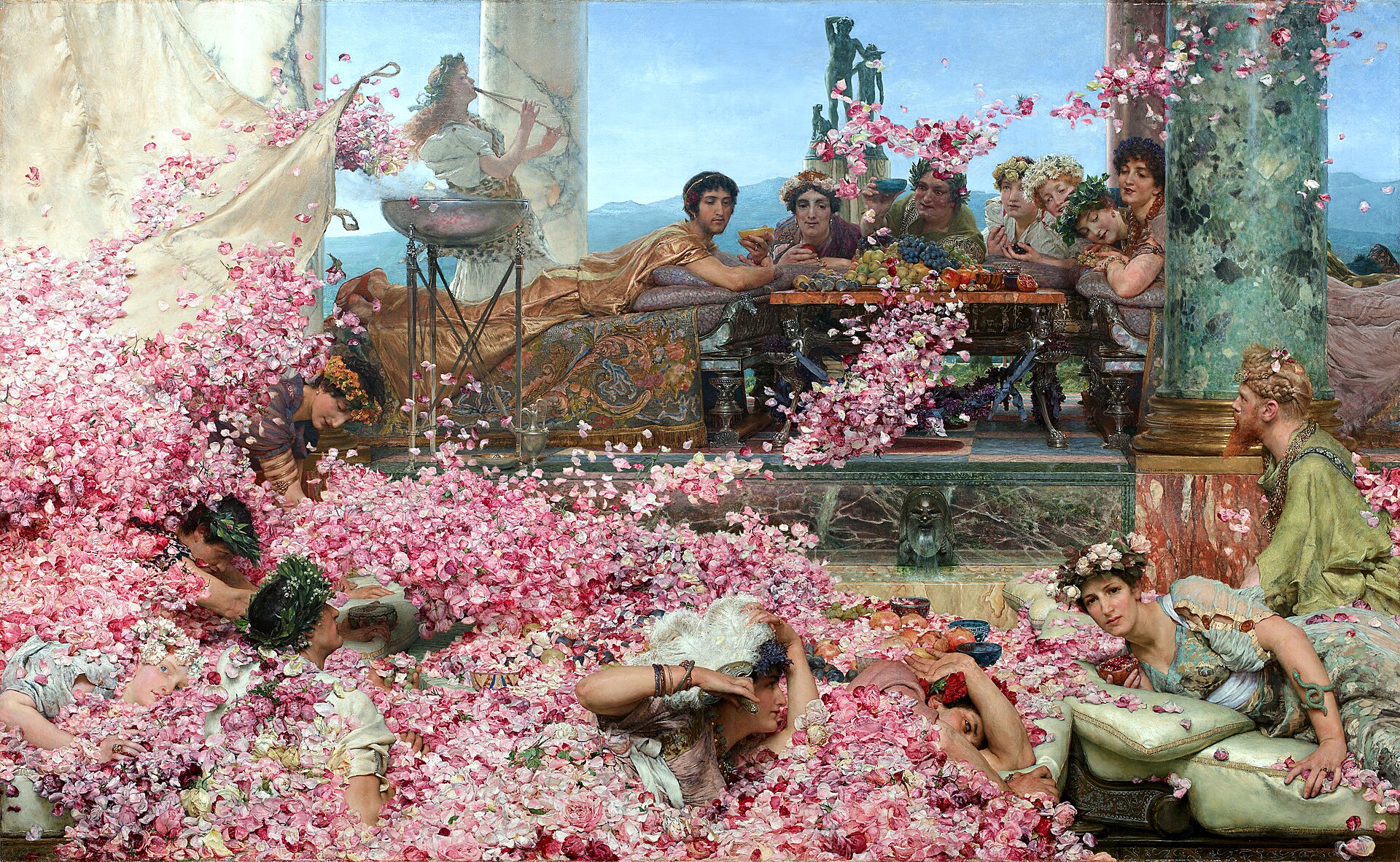
The Roses of Heliogabalus
Lawrence Alma-Tadema, 1888
Academic artists to know
William-Adolphe Bouguereau
Idealised figure painting, exact drawing and seamless finish.
Alexandre Cabanel
Salon success, teaching and institutional authority in one career.
Jean-Léon Gérôme
Historical reconstruction, Orientalism, sculpture and mass reproduction.
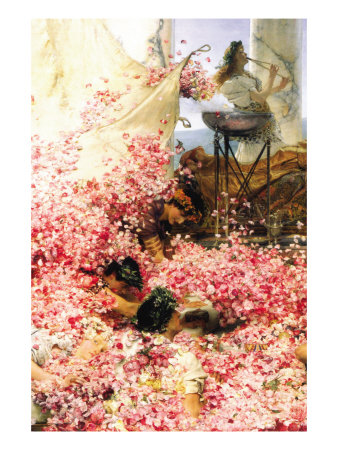
Lawrence Alma-Tadema
Archaeological detail transformed into sensuous Victorian antiquity.
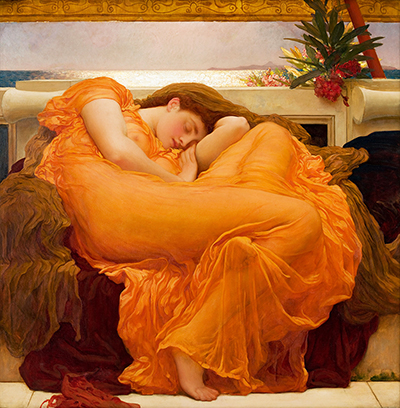
Frederic Leighton
Academic anatomy redirected toward Aesthetic colour and design.
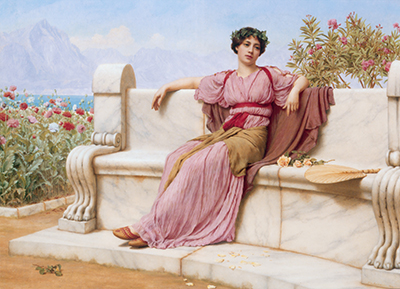
John William Godward
Classical stillness, marble, textiles and carefully balanced colour.
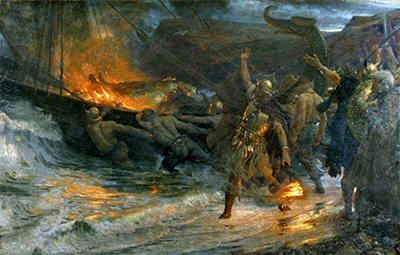
Frank Dicksee
Literary narrative, romance and late Royal Academy culture.
William-Adolphe Bouguereau
William-Adolphe Bouguereau became the modern shorthand for French Academicism because his technique made idealised bodies appear seamless. He won the Prix de Rome, exhibited regularly, taught large numbers of students and achieved international commercial success. Mythological nudes, religious images and scenes of mothers or rural children show the breadth of his market. His skill is easiest to see in the relation between drawing and surface: bodies remain structurally precise while paint conceals the effort of their construction. [10][30]
Alexandre Cabanel
Alexandre Cabanel joined artistic production to institutional power. He won the Prix de Rome, taught at the École des Beaux-Arts and served on Salon juries. The Birth of Venus became a defining success of 1863, but his work also included biblical histories, portraits and decorative schemes. His career shows why Academicism is more than a look: the painter, professor, juror and honoured exhibitor belonged to one professional system. [8]
Jean-Léon Gérôme
Jean-Léon Gérôme made archaeological reconstruction and Orientalist spectacle feel almost photographic. His Roman gladiators, sculptor’s studios, mosque interiors and North African figures reached huge audiences through reproductions. The Getty stresses that these pictures stood at the centre of debate about the future of French painting. Gérôme was both an establishment teacher and an experimental sculptor, a combination that resists the idea of academic artists as merely passive custodians. [11][29]
Lawrence Alma-Tadema
Lawrence Alma-Tadema transformed antiquity into an environment of marble, flowers, textiles, sea light and leisured bodies. Born in the Netherlands and successful in Britain, he used archaeological research to make ancient settings materially convincing while arranging them for Victorian expectations of luxury and intimacy. Getty research into Spring shows that identifying his antique sources is only the beginning: he altered those sources through colour, space and form to create a modern image of the past. His pictures link Academicism to Aestheticism and to the international market for classical fantasy. [32]
Frederic Leighton
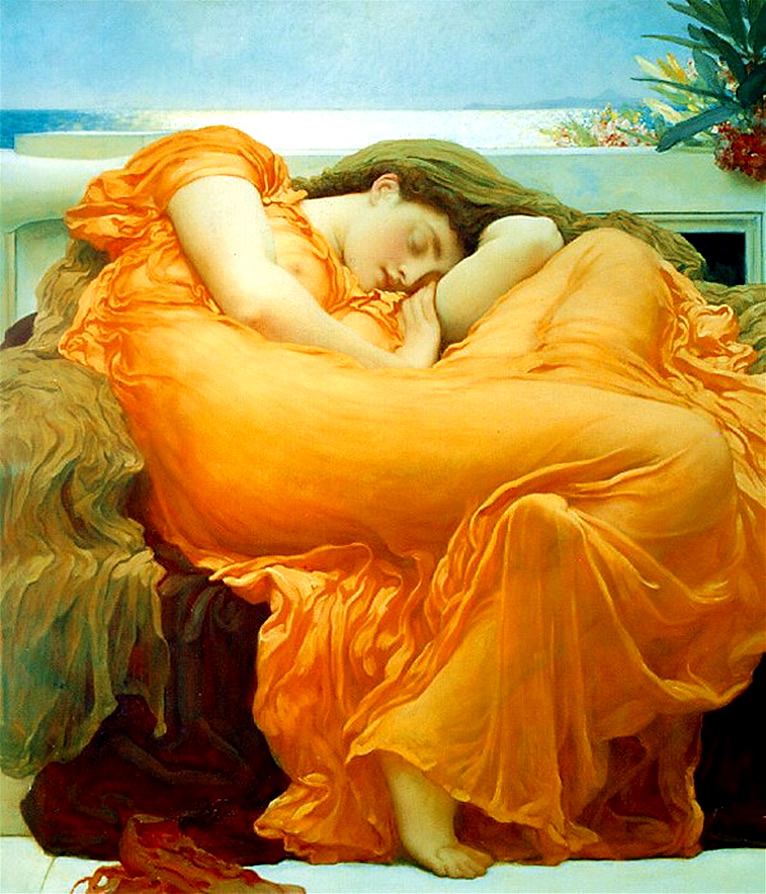
Frederic Leighton trained across Europe and became president of London’s Royal Academy. His art moves between historical narrative, ideal figure painting and the Aesthetic Movement. Flaming June is less a story than an orchestration of a sleeping body, circular drapery and saturated orange. Leighton shows how an academic command of anatomy and composition could be redirected toward beauty as an end in itself. [33]
John William Godward
John William Godward specialised in classical women placed against marble, flowers, textiles and Mediterranean views. Getty research shows that details in his Pompeian interiors could be borrowed from excavated houses even when the sensual scene itself had little basis in ancient practice. His narrow range has often made him appear as a late echo of Alma-Tadema, yet sustained comparison reveals a deliberate art of colour intervals, surfaces and stillness. His career also exposes the risk of specialisation when avant-garde values altered the prestige of classical figure painting. [34]
Frank Dicksee
Frank Dicksee brought academic drawing to medievalising romance, portraiture and literary narrative. He found early success at the Royal Academy and developed a public career through quasi-historical subjects in a later Pre-Raphaelite manner as well as modern melodrama. As president of the institution in the 1920s, he defended standards of finish and beauty after modernism had made them contentious. His work overlaps with Victorian narrative painting, Pre-Raphaelite subjects and Symbolist mood, demonstrating again that movement boundaries are tools rather than walls. [35]
Academies beyond Paris
The Parisian system became an international reference point, but academies developed for local purposes. A recent National Gallery of Art study presents them as adaptable institutions shaped by monarchical, state, ecclesiastical, civic and private support. Some trained painters, sculptors and architects; others combined fine art with design or trade education. Their rules concerning class, race, gender and membership changed in response to different political settings. [26]
London’s Royal Academy, founded in 1768, joined an artist membership body to a school and annual exhibition. The Royal Academy Schools opened in 1769 and remained free, with casts and the Life Room at the heart of training. Unlike a state ministry, the institution depended on its community of Royal Academicians and the income and visibility generated by exhibitions. Its model produced Reynolds, Kauffman, Turner, Leighton and generations of artists who could criticise the academy while still seeking its walls. [9][16]
Madrid’s Real Academia de Bellas Artes de San Fernando accumulated drawings, prints, casts, prize works and objects sent by students in Rome. Its collections make the teaching process visible: copying, comparison and competition created an archive as well as artists. The academy also trained architects and granted professional titles, linking aesthetic authority to the building of the state. [19]
Berlin’s academy, founded in 1696, served court representation, artistic education, professional membership and advice. Its German history describes a practical ambition to strengthen artistic and craft production in Brandenburg while raising the region’s cultural standing. Vienna’s academy developed from a private foundation recognised by the imperial court in 1692 and was reorganised across the eighteenth century. These institutions participated in a shared European culture without following one identical constitution. [24][25]
The Imperial Academy in St Petersburg, founded in 1757, taught painting, sculpture, architecture and medal-making and became a major centre of Russian artistic life. Students competed for medals and travel, particularly to Italy. Brullov’s The Last Day of Pompeii emerged from this world, but its international success depended on Romantic drama as much as classical learning. The Russian Museum records that the work’s triumph in Rome, Milan and St Petersburg turned its maker into a national figure. [22][23]
Academies also became instruments of colonial administration and national formation. Mexico City’s Academy of San Carlos grew from a school of engraving and drawing in the 1780s under Spanish royal authority. It survived political upheaval, recruited European teachers and later helped shape visual culture in independent Mexico. Rio de Janeiro’s Imperial Academy of Fine Arts, formally established in 1826 after the arrival of the French Artistic Mission, trained artists within the Brazilian Empire. Neither history is adequately described as Europe simply sending a style abroad. Teachers, students and governments adapted academic methods to local struggles over identity, race, landscape and public memory. [20][21][26]
Women, models and unequal access
Academies could celebrate female allegories of Painting while denying women the training needed to become history painters. Johann Zoffany’s group portrait of London’s founding Royal Academicians stages the men around nude models. Angelica Kauffman and Mary Moser, the two female founders, appear only as framed portraits on the wall because respectable women were barred from the male life class. The image records membership and exclusion at once. [17]
Life drawing mattered because the hierarchy of genres made the body central to professional ambition. A student unable to study the nude could be judged unprepared for complex figure composition, then excluded from the very work that would demonstrate such ability. The restriction was therefore structural, not a minor inconvenience. Women received private lessons, learned within artistic families, copied in museums or entered schools that offered separate classes, often at greater expense. [14]
France offered a large market and many private studios, but its state school was slow to admit women. The École des Beaux-Arts opened to them only in 1897. The Académie Julian had established a separate women’s studio by 1880 and attracted students from France, Britain, Germany, Russia, Poland, Switzerland and the United States. Bouguereau and Jean-Paul Laurens were among its prominent teachers. Women could gain serious figure training there, although separation and fees did not amount to full institutional equality. [14][15]
Other countries followed different timelines. The Royal Swedish Academy states that it became the first European academy to offer women full artistic training when it opened a Ladies’ Department in 1864, though women such as Ulrica Fredrika Pasch had become members earlier. London admitted women students from 1860, long after Kauffman and Moser had helped found the institution. Membership, schooling and access to the nude model must therefore be tracked separately. [18]
Models occupied another unequal position. Their bodies were essential to academy education, yet their names often disappeared behind generic labels. Musée d’Orsay’s research into Black models has recovered details from École des Beaux-Arts archives and connected studio figures to named people such as Joseph, born in Saint-Domingue. The contrast between individualised studies and stereotyped Salon roles shows how academic process could observe a person closely and then transform that person into a type. [13]
Empire, Orientalism and national culture
Academic art grew alongside European empire. States commissioned histories of conquest, world’s fairs arranged cultures within national hierarchies, and artists travelled through regions shaped by military and colonial power. Antique, biblical and Orientalist subjects offered distant settings in which modern ideas about race, sexuality and civilisation could be projected. [9][12]
Gérôme travelled repeatedly in Egypt, North Africa, Syria, Asia Minor and the Holy Land. His architecture, costumes and objects could be based on careful observation, photographs and collected material. Yet the resulting scenes are not documentary windows. A mosque interior may combine studies made at different times; a slave market can stage nudity and power for European viewers; an apparently timeless street may erase contemporary colonial change. Accuracy of detail can make a constructed fantasy more persuasive. [11][12]
Orientalism was neither one style nor an invention of academies alone. Romantic painters, Realists, photographers and decorative artists also participated. Academic training supplied an especially effective language for it: controlled perspective, convincing bodies, historical costume and seamless finish. These techniques could dignify non-European subjects, turn them into spectacle or do both at once.
Academic institutions outside Europe also used European forms to construct national identities. At San Carlos, Neoclassical teaching entered a colonial society and then survived independence, political conflict and reform. Landscape teaching helped prepare the ground for José María Velasco’s powerful images of Mexico. Later artists rebelled against inherited Academicism while retaining skills and institutions formed within it. Brazil’s academy likewise became part of debates over imperial history and modern national culture. [20][21]
The important question is therefore not whether academic technique was “foreign” or “authentic”. It is who controlled training, what histories were made monumental, which bodies represented the nation and how local artists transformed the tools they inherited.
Challenge, fragmentation and modernism
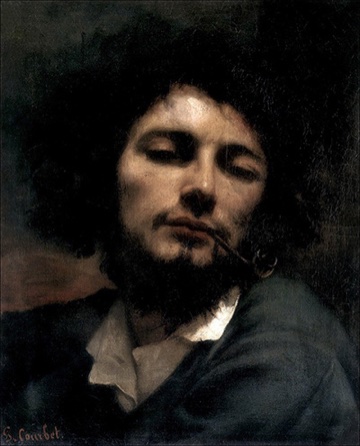
Academic art was challenged throughout its strongest period. Romantic artists disputed the authority of classical restraint; Realists rejected idealisation and elevated contemporary labour or ordinary life; Impressionists opposed studio finish and official exhibition structures. Yet these conflicts happened within a shared world. Delacroix exhibited at the Salon. Courbet sought public confrontation through it. Manet trained in the atelier of Thomas Couture and continued submitting work even after rejection. [6]
Modern artists often carried academic knowledge into their rebellion. Accurate drawing could be simplified rather than forgotten. A classical composition could be quoted and made contemporary. Manet’s Olympia refers to Titian while refusing the conventional distance of myth. Matisse’s path through Bouguereau’s Académie Julian and Moreau’s studio did not prevent Fauvism; it gave him traditions to redirect. Albert Boime’s history of academy teaching stresses its unintended contribution to independent nineteenth-century movements. [27][31]
The familiar duel between Cabanel and Manet is therefore best treated as a conflict over representation, not skill against incompetence. Cabanel transformed a contemporary model into an ideal goddess and dissolved paint into finish. Manet flattened modelling, made transitions abrupt and allowed the viewer to confront a modern woman whose social identity could not be disguised as Venus. Each picture is controlled. They ask viewers to accept different relations between paint, body and public morality. [8]
By the late nineteenth century, the old system fragmented. Competing Salons, artist societies, dealers, galleries and international exhibitions offered routes around one jury. Photography and mechanical reproduction changed visual authority. New collectors supported Impressionism and later movements, while academies revised their curricula. The shift was uneven: Bouguereau and Gérôme remained famous and commercially successful long after modernist narratives imply their defeat. [10][28][29]
The twentieth-century museum canon reversed many nineteenth-century reputations. Impressionists moved from rejection stories to the centre of public taste; academic celebrities entered storage. The terms academic and pompier became shortcuts for art history’s losers. This reversal revealed genuine changes in values—visible touch, modern life, formal experiment and individual vision—but it also simplified the world from which modernism emerged.
Reassessment and how to look
Recent scholarship has restored academic art as a subject without asking viewers to surrender criticism. Gérôme can be studied for visual intelligence, archaeology, reproduction and polychrome sculpture while his Orientalist images are questioned as products of unequal power. Cabanel’s finish can be admired while its regulation of the nude is compared with Manet. Academy schools can be recognised as engines of professional training while their gender and class exclusions remain central. [6][11][13][26]
Begin looking with the picture’s task. Is it telling a known story, presenting an ideal body, recreating a place, commemorating an event or advertising the status of a sitter? Identify the moment chosen. In a history painting, gestures and glances often reveal what happened just before and what will happen next.
Then inspect the path from study to finish. Look for the clarity of contour, the organisation of groups and the way light models bodies. Ask which surfaces invite attention and which signs of labour have been hidden. Smoothness is not the absence of technique; it is a technical effect.
Consider decorum. Why can this nude appear in public? Does myth, distance, costume or racial type make a difficult subject acceptable? Who is an individual, and who has been turned into a category? Exact detail may strengthen historical understanding, but it may also lend authority to fantasy.
Finally, compare rather than rank automatically. Place an academic and an avant-garde work from the same year beside one another. The difference may be less about old versus new than about competing definitions of truth, finish, public address and artistic freedom. Academic art becomes most interesting when it is returned to that contested present.
Frequently Asked Questions
Not in the sense of a group with one manifesto. It was an institutional system and artistic tradition encompassing different styles, countries and generations. Its common ground lay in training, professional recognition, exhibitions and standards more than identical appearance.
Academy theory argued that history painting demanded the greatest range of invention and knowledge: multiple figures, anatomy, expression, composition, costume, literature and moral meaning. The hierarchy placed portraiture, genre, landscape and still life below it, although markets and artistic practice often contradicted that order. [5][6]
The Salon was France’s principal public exhibition of contemporary art. Acceptance placed work before enormous audiences and could lead to reviews, medals, purchases and commissions. It was influenced by academic institutions but displayed a broad field of artists rather than one uniform academic style. [5][6]
Rules differed by institution. Women sometimes gained membership before receiving equal education. They were widely restricted from nude life study, and the École des Beaux-Arts in Paris did not admit women until 1897. Private schools such as the Académie Julian provided important alternative training. [14][15][17][18]
They represent competing priorities, but not complete isolation. Impressionists challenged Salon authority, idealisation and conventional finish, yet many modern artists passed through academic schools or private ateliers and continued to seek Salon exposure. The opposition is historically useful only when those connections remain visible. [10][27][31]
Alternative exhibitions and markets weakened academy control, while modernism valued contemporary life, visible process and formal experiment. Later museums built a history centred on the avant-garde, turning once-famous academic artists into symbols of rejected convention. Current reassessment studies their achievement and power critically rather than simply restoring the old hierarchy. [6][11][28][29]
Discussion
When you look at an academic painting, does its technical finish deepen the subject or make the process feel too controlled—and does your answer change when you know what the artist had to study to achieve it?
Reader Insights
Follow the contours of one figure, then notice where an edge dissolves into shadow and where it sharpens to direct attention.
Ask which institution, exhibition, prize, patron or public commission helped define the work’s original purpose.
Does the label “academic” explain what the picture does, or only describe the system through which its artist was trained and recognised?
Join the Conversation
Have a thought or observation about Academic Art or Academicism? Share it below. Thoughtful responses may be added to this section.
References
- Académie des Beaux-Arts, Histoire, (in French). View Source
- Jacqueline Lichtenstein and Christian Michel, Au cœur de la connaissance de l’art et des artistes français de l’Ancien Régime: les conférences de l’Académie royale, (in French). View Source
- Beaux-Arts de Paris, Dessins scolaires et dessins de maîtres, (in French). View Source
- Kathryn Calley Galitz, “The French Academy in Rome,” Metropolitan Museum of Art, metmuseum.org. View Source
- National Gallery of Art, Picturing France, 1830–1900, nga.gov. View Source
- Musée d’Orsay, Les peintres, le Salon, la critique, 1848–1870, (in French). View Source
- Musée d’Orsay, De l’académisme à l’impressionnisme, (in French). View Source
- Musée d’Orsay, Alexandre Cabanel, The Birth of Venus, musee-orsay.fr. View Source
- Metropolitan Museum of Art, “The Salon and the Royal Academy in the Nineteenth Century”, metmuseum.org. View Source
- National Gallery of Art, Paris 1874: The Impressionist Moment, nga.gov. View Source
- J. Paul Getty Museum, The Spectacular Art of Jean-Léon Gérôme, getty.edu. View Source
- Metropolitan Museum of Art, “Orientalism in Nineteenth-Century Art”, metmuseum.org. View Source
- Musée d’Orsay, Le modèle noir de Géricault à Matisse, (in French). View Source
- Metropolitan Museum of Art, “Women Artists in Nineteenth-Century France”, metmuseum.org. View Source
- Institut national d’histoire de l’art, Académie Julian, (in French). View Source
- Royal Academy of Arts, RA Schools Background and History, royal-academy-production-asset.s3.amazonaws.com. View Source
- Royal Collection Trust, Johann Zoffany, The Academicians of the Royal Academy, rct.uk. View Source
- Royal Swedish Academy of Fine Arts, History, konstakademien.se. View Source
- Real Academia de Bellas Artes de San Fernando, Colecciones, (in Spanish). View Source
- Academia de San Carlos, UNAM, Historia, (in Spanish). View Source
- Pinacoteca de São Paulo, Glossário, (in Portuguese). View Source
- St Petersburg Academy of Arts, История, (in Russian). View Source
- State Russian Museum, Карл Брюллов: юбилейная выставка к 200-летию со дня рождения, (in Russian). View Source
- Akademie der Künste, Berlin, Geschichte der Akademie der Künste, (in German). View Source
- Akademie der bildenden Künste Wien, Geschichte, (in German). View Source
- Peter M. Lukehart, Ulrich Pfisterer and Oscar E. Vázquez, eds., Academies of Art in Europe and the Americas, 1600–1900, National Gallery of Art, nga.gov. View Source
- Albert Boime, The Academy and French Painting in the Nineteenth Century, Yale University Press, yalebooks.yale.edu. View Source
- Patricia Mainardi, The End of the Salon: Art and the State in the Early Third Republic, Cambridge University Press, books.google.com. View Source
- Scott Allan and Mary Morton, eds., Reconsidering Gérôme, Getty Publications, shop.getty.edu. View Source
- Clark Art Institute, William-Adolphe Bouguereau, Seated Nude, clarkart.edu. View Source
- Metropolitan Museum of Art, “Henri Matisse (1869–1954)”, metmuseum.org. View Source
- Louise Lippincott, Lawrence Alma Tadema: Spring, J. Paul Getty Museum, getty.edu. View Source
- Leighton House, “Frederic Leighton”, rbkc.gov.uk. View Source
- J. Paul Getty Museum, The Last Days of Pompeii: Decadence, getty.edu. View Source
- National Portrait Gallery, “Frank Dicksee”, npg.org.uk. View Source
- Image references 36–41: open-access reproductions and institutional collection records.