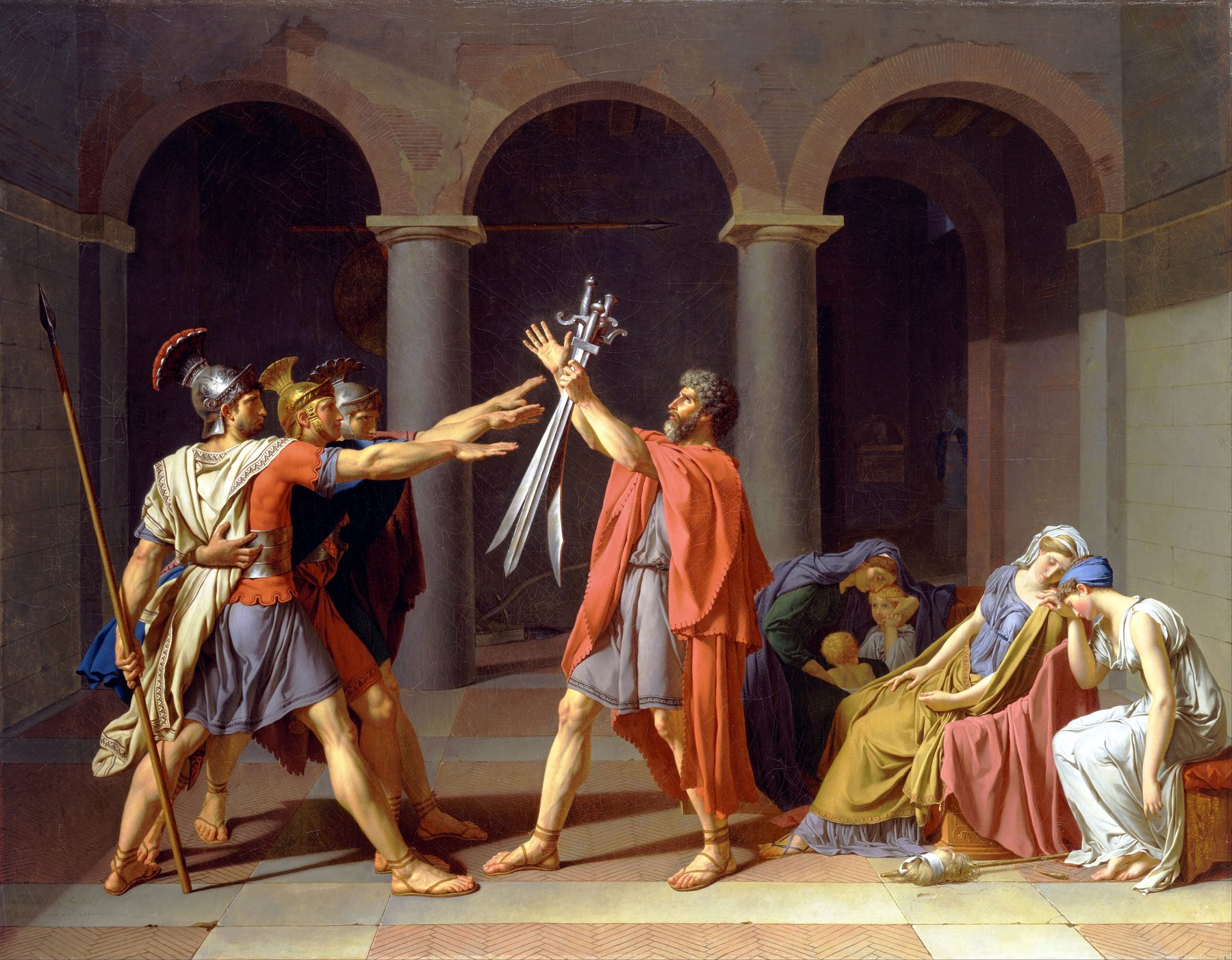
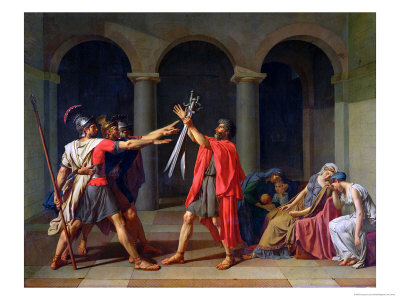
Image reference: Jacques-Louis David, The Oath of the Horatii.
At a Glance
- Core periodc. 1750s–1830s
- Major hubsRome · Paris · London · Madrid · Copenhagen
- Wider reachGerman states · Russia · Poland · United States and beyond
- Known forlinear clarity · idealised form · antique subjects · architectural order · moral example
- Key cautionclassical form had no single politics and no one authentic ancient source
Contents
- Neoclassicism in context
- What Neoclassicism means
- Inventing antiquity
- Grace, history and the first generation
- David and the politics of example
- Ingres and a boundary that would not hold
- Canova, Thorvaldsen and the sculptor’s studio
- Architecture, interiors and objects
- Women, race and the revolutionary public
- Artists to know
Neoclassicism in context
Angelica Kauffman
Principal careerJacques-Louis David
Principal careerAntonio Canova
Principal careerFrançois Gérard
Principal careerJean-Auguste-Dominique Ingres
Principal careerNeoclassicism made antiquity newly present. A Roman oath invented for a painting became an image of public duty. A marble goddess seemed to breathe. A London drawing room gathered painted arabesques, furniture and ceramics into one imagined classical world. An unbuilt sphere became a monument to Newton. Across Europe and the Americas, columns and pediments gave palaces, museums, legislatures and plantation houses an air of inherited authority.
This was not one organised movement with a manifesto. It was a broad, contested revival of Greek and Roman models during the later eighteenth and early nineteenth centuries. Artists, architects, patrons and scholars reconstructed the ancient world through excavated objects, surviving monuments, Roman copies of Greek sculpture, prints, casts, texts and imagination. What they created could be restrained or sensual, republican or imperial, public or intimate. Neoclassicism promised order, but its history is full of contradictions.
Neoclassicism overlaps with Rococo before it and Romanticism after it. It did not begin on one day when curves gave way to straight lines, nor did it end when painters discovered storms and strong emotion. Graceful classical subjects were being painted while Rococo interiors remained fashionable. David's severe moral dramas appeared beside sensuous sculpture, archaeological decoration and spectacular visions of ruin. Ingres remained devoted to contour and Raphael while making bodies that critics found anatomically impossible.
The broadest useful frame runs from the 1750s to the 1830s. It begins with a new intensity of archaeological research, collecting and theoretical argument. It reaches a first maturity in the work of Anton Raphael Mengs, Angelica Kauffman, Benjamin West, Joseph-Marie Vien and others. In the 1780s Jacques-Louis David made ancient history feel urgent and public. Revolution and Napoleon then changed institutions, patrons and subjects. After 1815, Neoclassical practices continued within Restoration culture, Greek Revival architecture, national schools and work often labelled Romantic.[1] [2]
These boundaries vary by medium and place. Robert Adam was transforming British interiors in the 1760s. Antonio Canova's European fame rose in the 1780s and remained enormous until his death in 1822. Bertel Thorvaldsen sustained a major Roman studio deep into the nineteenth century. The United States used Neoclassical government architecture as a national language long after the French Revolution. A date range should orient the reader, not turn a mobile culture into a sealed box.
Follow Neoclassicism through four stages
–1765
Antiquity is reconstructed
Excavation, travel, prints and theory make Rome an international laboratory for competing Greek, Roman and modern classicisms.
–1789
Grace becomes moral history
Kauffman, Mengs and David give family, duty and exemplary action new clarity without producing one emotional register.
–1804
Revolution remakes the public image
David and Benoist test how portraiture and history painting can address martyrdom, reconciliation, race and citizenship.
–1840
Empire and transformation
Canova, Ingres and imperial patrons join ideal form to sensuality, dynastic spectacle, modern identity and widening Romantic boundaries.
What Neoclassicism means
The name literally means a new classicism. The National Gallery uses it for a conscious revival and appropriation of classical values in the later eighteenth and early nineteenth centuries. “Classical” did not refer only to ancient Greek and Roman objects. It also included later artists such as Raphael and Poussin, whose ordered compositions had themselves been shaped by antique precedents.[1]
That distinction matters. A Neoclassical painter did not need to copy an excavated vase. The classical could be a method: select the most beautiful parts of observed bodies, organise a scene for clarity, control expression, prefer lasting significance to accidental detail and treat history as a source of exemplary action. It could also be an institutional claim. Academies ranked history painting above portrait, landscape and still life because it required invention, learning and command of the human figure.
The familiar visual signs are real but incomplete. Look for firm contours, smooth surfaces, balanced groups, shallow frieze-like spaces, antique dress, restrained settings and gestures that carry the action. In sculpture, idealised nudity and polished marble appear repeatedly. In architecture, columns, porticoes, domes, geometric volumes and Greek or Roman orders establish lineage. Decorative arts turn palmettes, urns, sphinxes, cameos and low-relief figures into repeatable ornament.
Yet Neoclassicism was never uniformly severe. Kauffman's history paintings can be tender and melodious. François Gérard's Cupid and Psyche presents mythology through youthful bodies, delicate contact and an almost weightless landscape; it was exhibited at the Salon of 1798, amid the political instability of post-revolutionary France.[44] Canova pursued morbidezza, the appearance of living softness in stone. Adam filled interiors with light ornament. A style supposedly founded on restraint could also be erotic, luxurious and theatrical.
Nor was it simply a reaction against Rococo. Patrons, makers and households moved between tastes. Archaeological motifs entered fashionable objects without abolishing curved furniture, bright colour or pleasure. Neoclassicism is strongest as a historical question: how and why did people make the ancient world useful to their present?
Inventing antiquity
The ancient world became newly visible during the eighteenth century, but visibility was structured by money, power and mediation. Systematic excavations began at Herculaneum in 1738 and at Pompeii in 1748 under Bourbon rule. Travellers visited sites, artists studied finds and publishers circulated images. The discoveries renewed interest in ancient domestic decoration as well as monumental sculpture, revealing painted walls, furniture forms and everyday objects that could be adapted for modern rooms.[4]
The Grand Tour brought wealthy northern Europeans to Paris, Venice, Florence, Naples and above all Rome. It was education, social performance and a collecting system. Tourists commissioned portraits, bought antiquities and visited studios. Robert Adam acquired the experience that would reshape British interiors. Josiah Wedgwood converted the fame of the ancient cameo-glass Portland Vase into jasperware copies. What appeared to be learned taste was also a market supplied by dealers, excavators, artists, guides and skilled makers.[3]
Rome functioned as an international exchange. Ancient monuments and papal collections stood beside academies and modern studios. Giovanni Battista Piranesi settled there in 1740 and made its buildings, ruins and imagined prisons available through prints. His views documented, enlarged and dramatised the city. He also designed objects for Grand Tour patrons, demonstrating that antiquarian knowledge could become a modern luxury language.[10]
Johann Joachim Winckelmann gave this revival a powerful theory. After moving to Rome in 1755, he studied celebrated sculptures, collections of gems and the newly excavated cities around the Bay of Naples. His History of the Art of Antiquity, published in 1764, organised ancient art through changing historical styles and helped establish both archaeology and art history as modern disciplines.[6]
Winckelmann's ideal centred on Greek art, beauty, harmonious proportion and moderated expression. His phrase “noble simplicity and quiet grandeur” became a compact formula for an age. But the antiquity he described was not a neutral recovery. The Klassik Stiftung Weimar stresses its projective character: later generations used his imagined Greece to answer aesthetic, anthropological and political questions of their own.[5] His preference for ideal male bodies and Greek supremacy has also been re-examined through politics and homoerotic desire.[50]
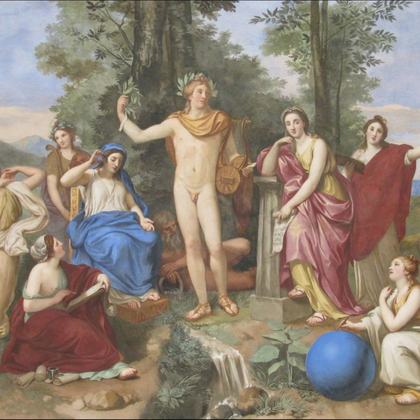
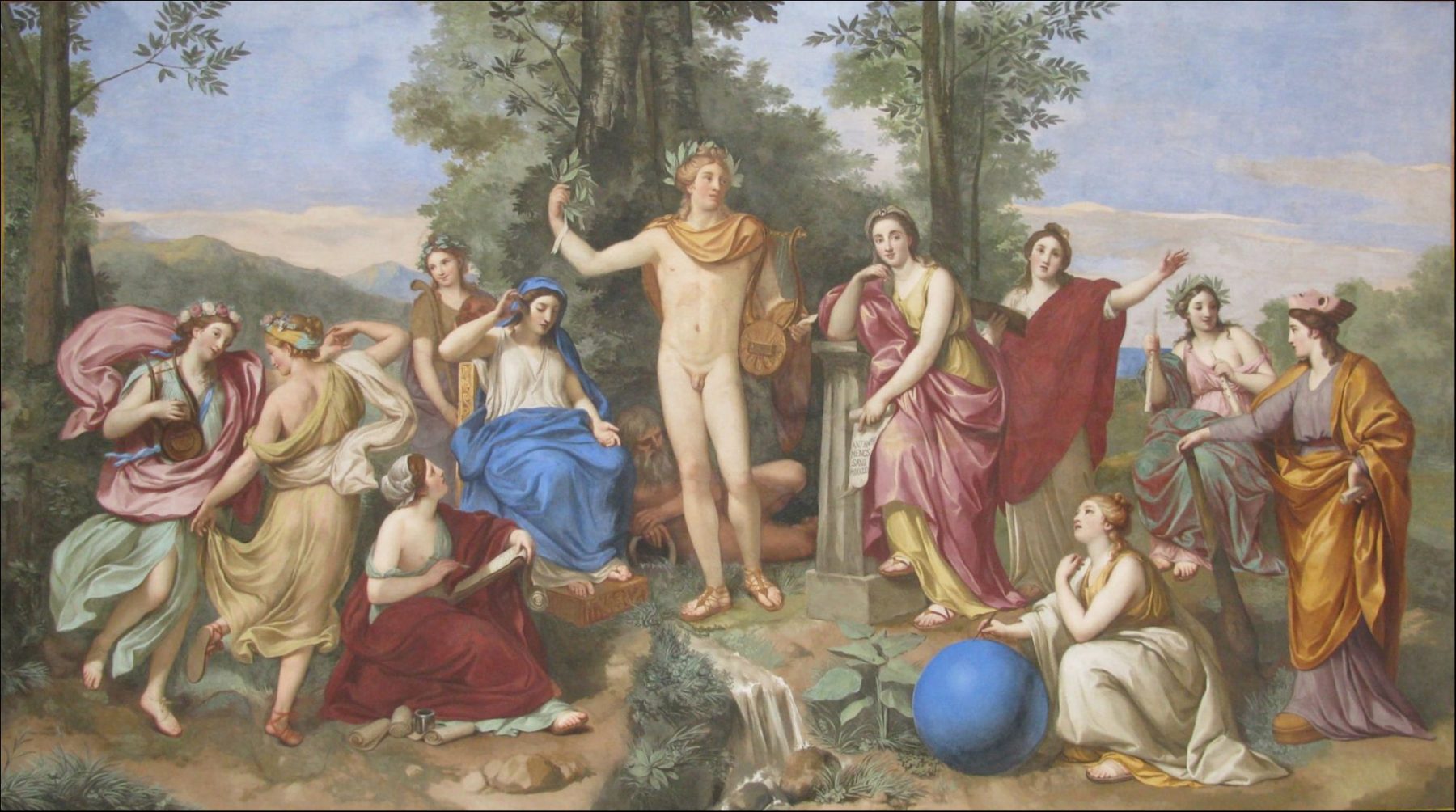
Anton Raphael Mengs turned related ideas into painting. Born in Bohemia, trained under his father in Dresden and repeatedly resident in Rome, he studied antiquity, Raphael and other classicising masters. His friendship with Winckelmann began in 1755. Mengs's Parnassus at Villa Albani, painted in 1760–61, arranged Apollo and the Muses with deliberate clarity and was soon treated as a manifesto of the emerging style.[8] [9]
His career was cosmopolitan and courtly rather than politically insurgent. Mengs worked for Saxon and Spanish rulers, moving between Dresden, Rome and Madrid. The Prado describes him as a central force in what would only later be called Neoclassicism; in his own time the project could be understood as a “restoration of the arts”. He combined ancient sculpture with Raphael's drawing and expression, Correggio's grace and Titian's colour.[7] This selective synthesis is more revealing than the idea of copying Greece.
Even “Greek” classicism depended on difficult routes of access. Many admired sculptures were Roman versions of lost Greek works. The whiteness of weathered marble became an ideal even though ancient sculpture had often been painted and treated with coloured wax. Architects knew Athens partly through measured publications. James Stuart and Nicholas Revett's Antiquities of Athens, whose first volume appeared in 1762, documented specific Greek monuments and encouraged a more explicitly Grecian style in Britain, challenging the dominance of Roman and Renaissance sources.[12]
Neoclassicism therefore invented antiquity in the plural. Winckelmann's ideal Greece, Piranesi's monumental Rome, Pompeian interiors and measured Athenian buildings could disagree. Their differences gave artists options.
Grace, history and the first generation
Before David came to dominate later accounts, an international first generation had already made ancient history modern. Mengs, Kauffman, West, Gavin Hamilton, Vien, Jean-Baptiste Greuze and others used mythology and history to explore duty, family, grief and public virtue. Their settings might be simplified and their figures sculptural, but their emotional temperatures differed.[2]
Angelica Kauffman is central to this history. Born in Switzerland and trained through travel and her artist father, she studied ancient and modern art in Italy. As a woman she could not follow the normal academy-school route, which depended on access to life drawing. She nevertheless became renowned for history painting, the field institutions ranked most highly. After moving to London in 1766, she became one of only two women among the founding members of the Royal Academy in 1768.[15]
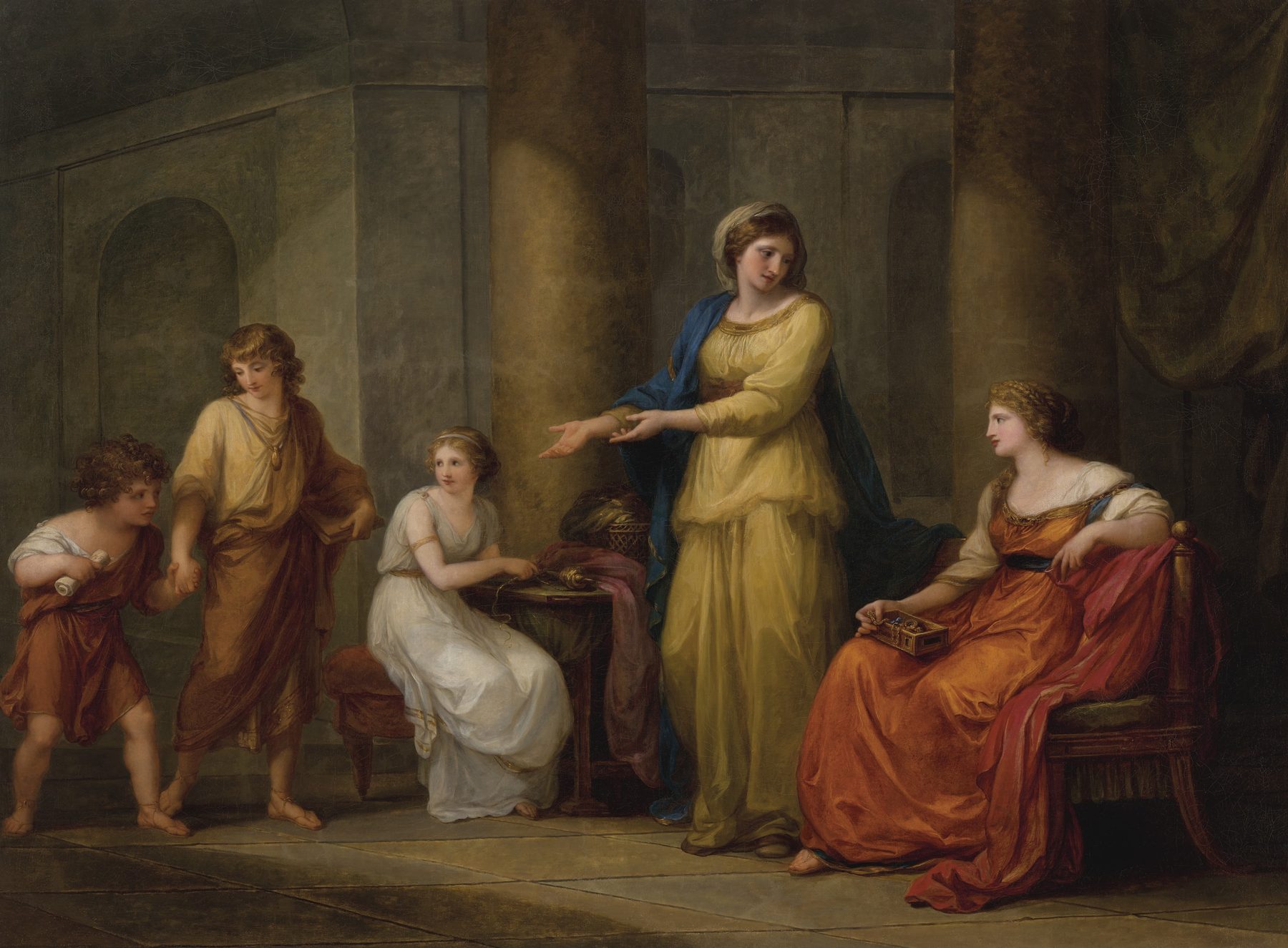
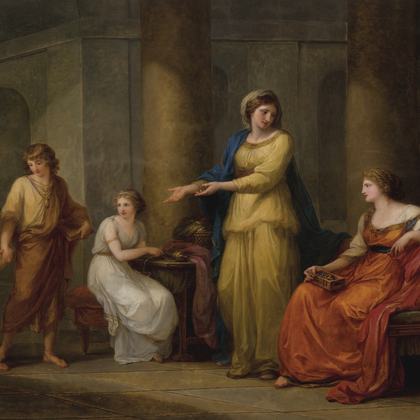
Her subjects gave women more than decorative presence. In Cornelia, Mother of the Gracchi, a wealthy visitor displays jewels while the Roman matron identifies her children as her treasures. The work uses an ancient moral anecdote to oppose material display and maternal formation. One version was commissioned in Rome in 1788 by the Polish collector Prince Stanisław Poniatowski, showing how patronage connected Rome, Britain and the Polish-Lithuanian Commonwealth.[17]
Kauffman's elegant rhythms once helped critics place her outside a supposedly muscular core of Neoclassicism. That judgement reproduces the exclusions of the academy. Recent National Gallery scholarship argues for an integrated history in which her Neoclassical scenes, British historical subjects, religious work and portraiture belong to the age's central artistic problems.[16] Grace was not a lesser form of thought.
Her Achilles Discovered among the Daughters of Lycomedes stages a revelation from ancient literature. Ulysses exposes Achilles by placing weapons among feminine gifts; the disguised hero instinctively reaches for them. Classical poses and stage-like architecture order the drama, while clothing, gender performance and gesture make identity unstable.[15] The ancient exemplum could be socially complicated as well as morally direct.
The first generation also established a visual economy of circulation. Prints carried compositions across borders. Kauffman's works became widely known through engravings. John Flaxman later reduced Homeric scenes to spare outlines that recalled vase painting and almost eliminated spatial illusion. Line could suggest archaeological purity, make an image easy to circulate and free the imagination to complete what modelling withheld.[2]
Jacques-Louis David and the politics of example
Jacques-Louis David made Neoclassical history painting feel inseparable from political life, but his politics changed and his forms served opposing regimes. He trained under Joseph-Marie Vien, won the Prix de Rome in 1774 and studied in Italy. His mature paintings transformed ancient narratives into theatres of decision: a few bodies, a limited space and a decisive gesture became sufficient to test loyalty, sacrifice and authority.
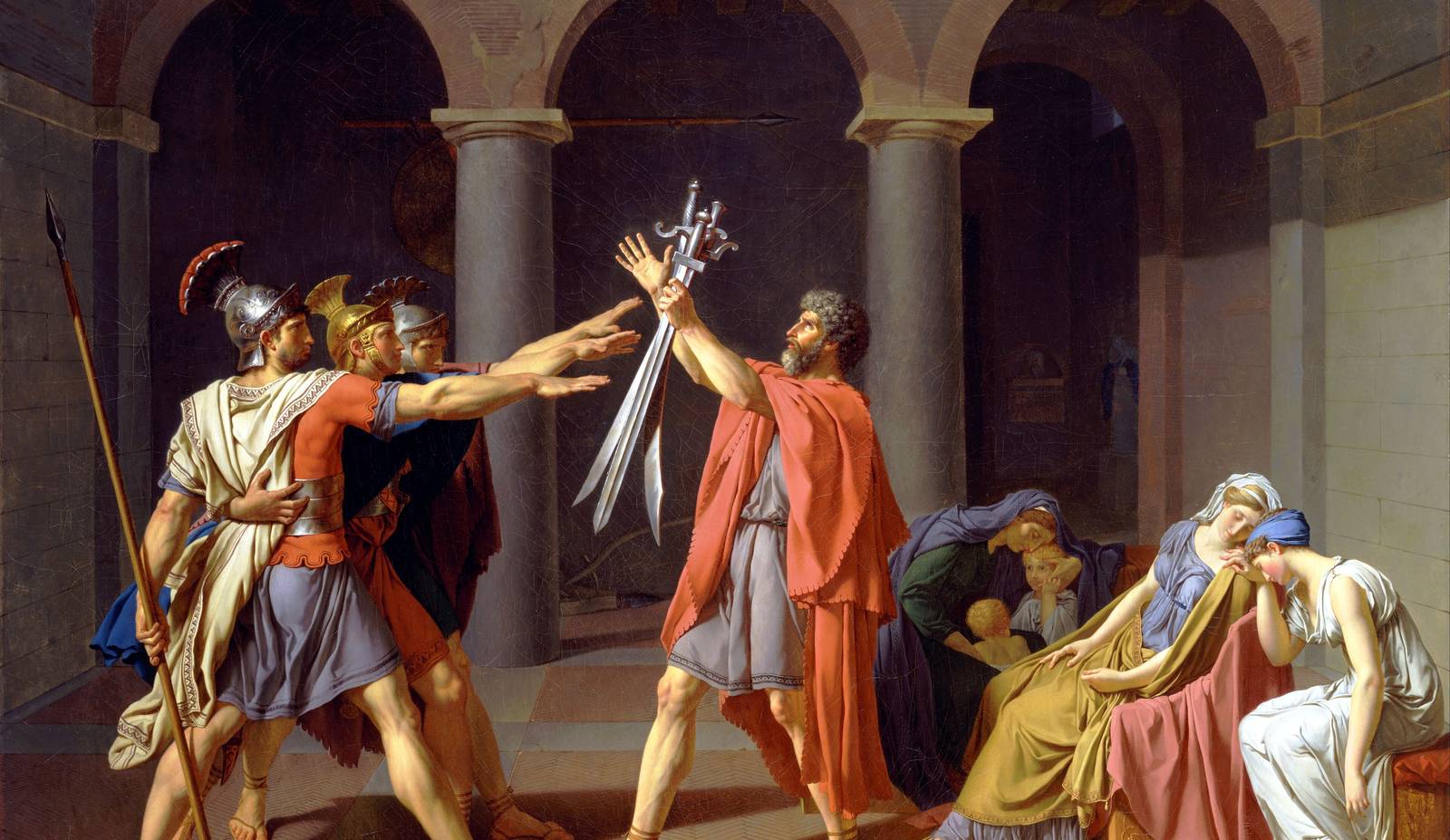
The Oath of the Horatii is the defining case. It was commissioned through the royal administration of Louis XVI, painted in Rome and exhibited at the Paris Salon in 1785.[18] Three brothers extend their arms towards swords held by their father. Three arches divide the canvas into actions: oath, authority and grief. Men form hard diagonals; seated women and children curve into mourning. Stone architecture, controlled colour and a shallow stage strip away distraction.
The oath itself does not appear in the ancient texts behind the story. David invented the moment. That invention allowed him to concentrate the conflict between public duty and family attachment before any combat occurred. The Louvre's research emphasises the tripartite construction, the opposition between male civic resolve and women's anticipated grief, and the painting's moral language of honour and discipline.[20]
It is tempting to call the picture revolutionary because it later seemed to embody collective virtue. That reverses its history. A royal institution commissioned it several years before 1789. Its power lay partly in the ability of later viewers to detach Roman sacrifice from its first patron and redirect it. Classical history did not encode one politics; it created an arena in which competing political communities could recognise themselves.
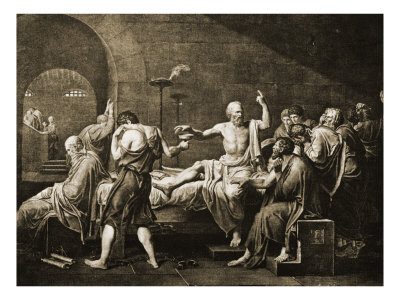
The Death of Socrates of 1787 intensifies the ethical theatre. The philosopher reaches for hemlock while continuing to teach; followers collapse in grief, but his raised finger links argument to action. The prison is severe, figures read almost as a frieze and each gesture has a distinct rhetorical role. David had explored the subject earlier, then returned to it for a private commission after the breakthrough of the Horatii.[21] Stoic constancy here precedes revolutionary government, even if revolution later made it newly urgent.
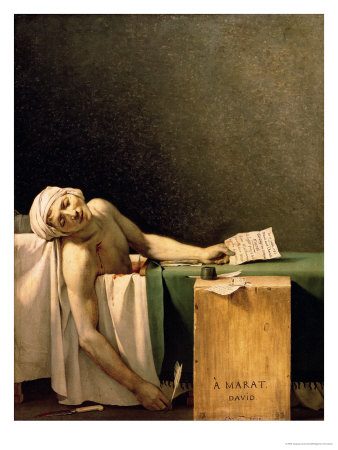
David was not merely an artist whose pictures were appropriated by politics. He became a deputy, voted for the death of Louis XVI, aligned himself with Robespierre and held posts during the Terror. He designed festivals, public costumes and a new civic imagery. When Jean-Paul Marat was murdered in 1793, the Convention commissioned David to commemorate him.[22]
The Death of Marat replaces ancient costume with contemporary fact but retains the structure of exemplary sacrifice. Marat's body sinks in a bath; a letter, knife and rough wooden box reduce the story to evidence. David combines portrait, history painting and the visual language of Christian martyrdom. The bare setting makes the dedication on the box—“To Marat, David”—feel like both inscription and personal pledge. Displayed near the Convention, the painting was political communication made by a participant in power, not neutral reportage.[22]
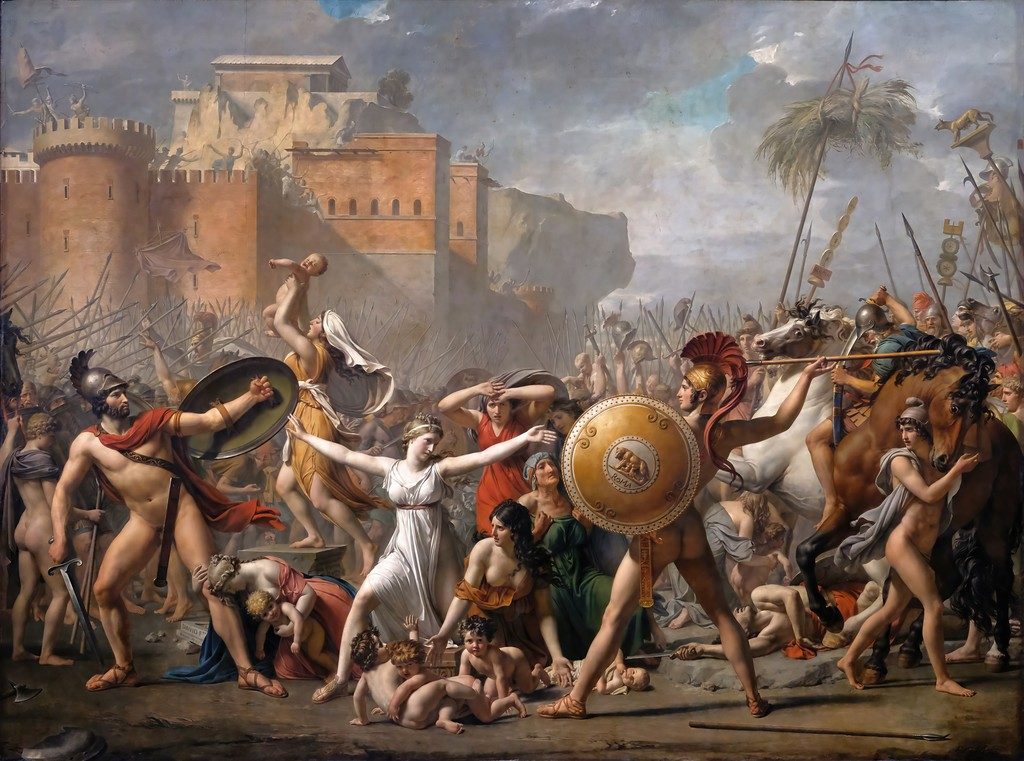
After Robespierre's fall, David was imprisoned. His Intervention of the Sabine Women, shown in 1799, reworked the role of women in his historical imagination. Hersilia stands between armed men, stopping civil slaughter. Other women protect children or thrust themselves into combat. The Louvre describes them as agents of history rather than passive mourners. In a society emerging from Terror, the picture proposed reconciliation without forgetting violence.[23]
David also changed how art reached a public. He exhibited the Sabines independently, charged admission and used a mirror to draw spectators into the painted space. A Neoclassical history could be a moral statement, an immersive spectacle and a commercial event.
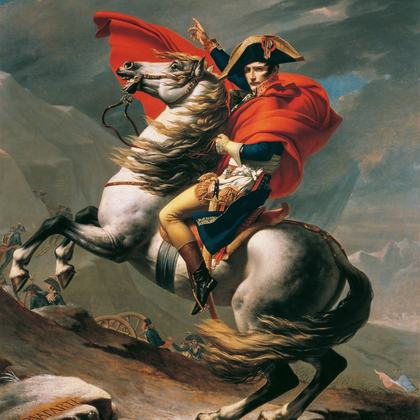
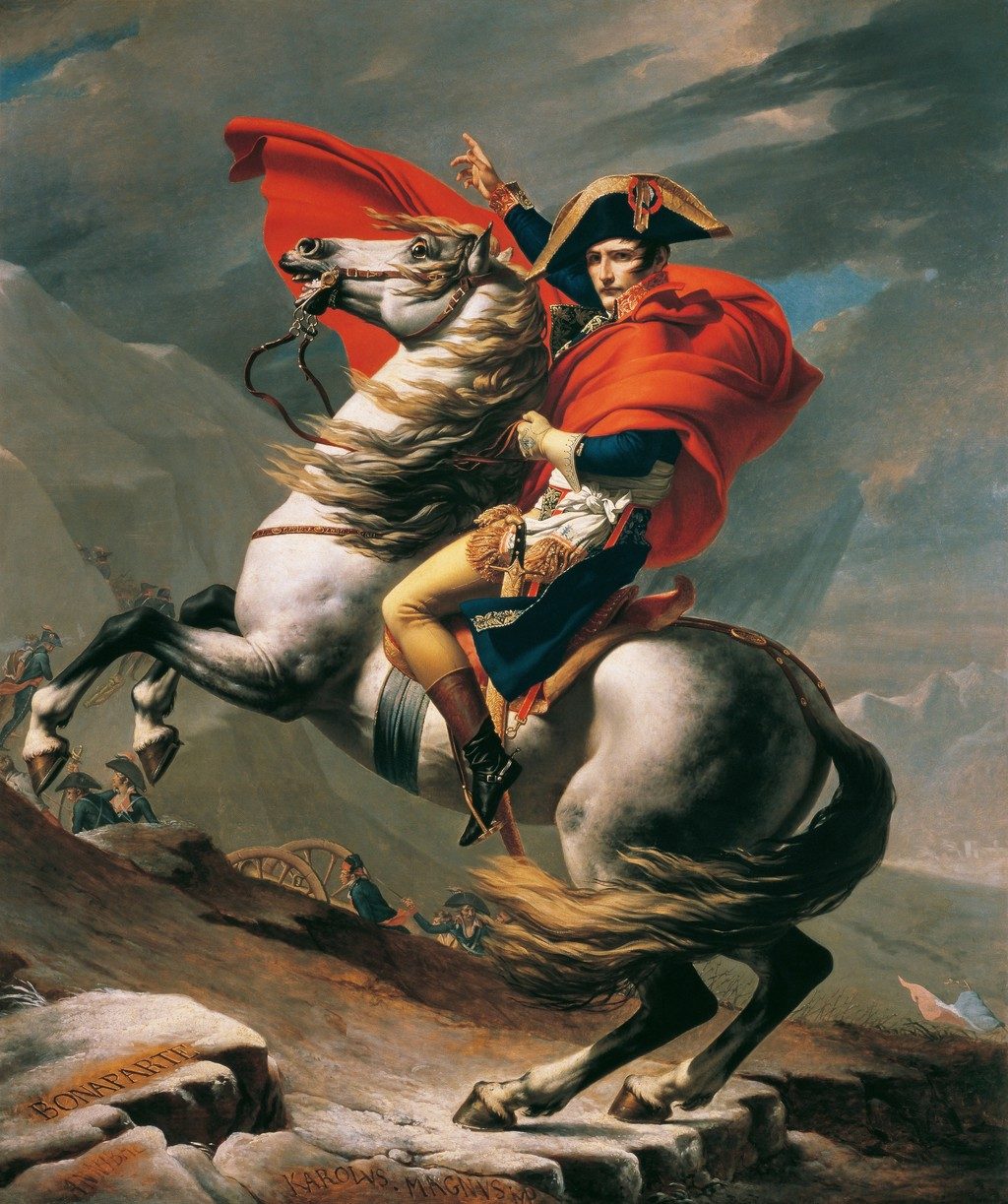
Bonaparte offered another political future. In Bonaparte Crossing the Alps, David fused contemporary portraiture with heroic history. The general controls a rearing horse while names including Hannibal and Charlemagne appear on rocks below. The actual crossing was less theatrical, but accuracy was not the purpose. The image created charismatic inevitability: one leader inherits and surpasses ancient precedent.[24]
As first painter to Napoleon, David represented imperial ceremony in the enormous Coronation. Neoclassical austerity gives way to crowded splendour, textiles, portraits and ritual. Yet composition still organises power. The revolutionary painter who had helped dismantle sacred monarchy now constructed an image of a new dynasty. The Louvre's recent reassessment stresses that “Neoclassical” is insufficient if it reduces David to abstract form; his art was also a political, moral and social project across six regimes.[19]
This changing career does not expose hypocrisy that style can solve. It demonstrates that form is a resource. A clear gesture can bind brothers to a father, legislators to a martyr or a nation to a ruler. David's art asks who commands the exemplary body and who pays its cost.
Essential works
Parnassus
Anton Raphael Mengs, 1760–61
Cornelia, Mother of the Gracchi
Angelica Kauffman, 1785
The Oath of the Horatii
Jacques-Louis David, 1784–85
The Death of Socrates
Jacques-Louis David, 1787
The Death of Marat
Jacques-Louis David, 1793
Ingres and a boundary that would not hold
Jean-Auguste-Dominique Ingres entered David's studio in 1797 and remained there until 1801. He copied the Oath of the Horatii, studying the composition that had defined the previous generation.[25] He shared David's commitment to line, ideal form, history painting and the authority of earlier masters, especially Raphael. Yet his career reveals how quickly a movement boundary becomes porous.
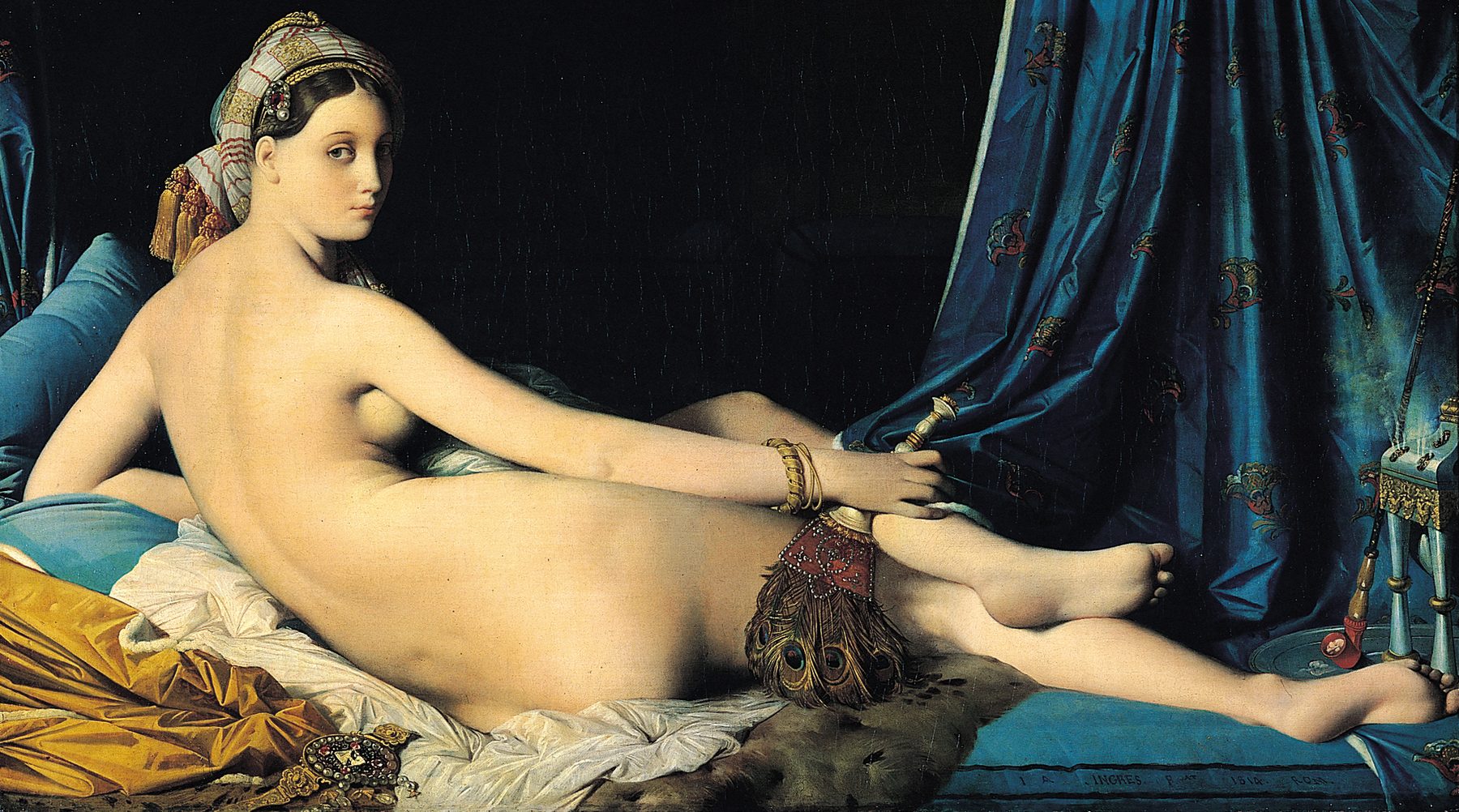
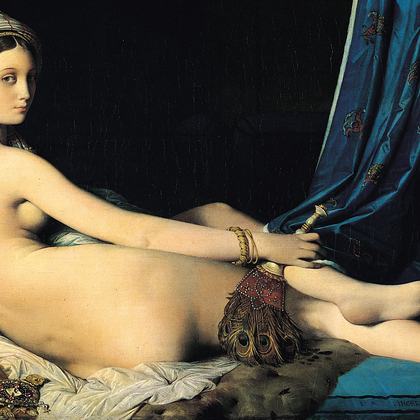
Grande Odalisque was commissioned for Caroline Murat, queen of Naples and Napoleon's sister, and completed in Rome in 1814. It appeared at the Salon in 1819.[27] A nude woman turns her back to the viewer while occupying an imagined Ottoman interior of turban, fan, jewels, heavy textiles and smoking pipe. The body is smooth and sculptural, but its spine, limbs and proportions have been lengthened beyond anatomical probability.
The Louvre describes an anatomy of fantasy governed by the long arabesque of the back. The image draws on Renaissance Venuses but converts them into a Western fantasy of the harem.[28] The “odalisque” is not an observed Ottoman subject; she is an imagined enslaved woman offered to a European gaze. Precision of contour coexists with distortion, and cool finish with erotic invitation.
Should the picture be called Neoclassical, Romantic or Orientalist? Each name illuminates something. Its line, finish and idealisation belong to Neoclassical formation. Its exotic setting and refusal of ordinary anatomy approach Romanticism. Its invented East belongs to Orientalism. National Gallery of Art teaching material uses Ingres to show that supposedly opposed movements shared careful finish, balanced composition and a strong role for line.[29]
The Louvre's account of Ingres similarly places him near troubadour painters, Nazarenes and other early-nineteenth-century experiments rather than inside one inherited school.[26] The useful conclusion is not that labels fail. It is that artists worked across the borders labels help us discuss.
Canova, Thorvaldsen and the sculptor's studio
Antonio Canova gave Neoclassicism its most celebrated sculptural bodies. Born in Possagno in 1757 and trained in Venice, he travelled through Italian collections before establishing a studio in Rome in 1781. His Theseus and the Minotaur replaced the twisting drama of earlier work with an aftermath: the hero sits over the defeated creature in calm control. It established a new reputation.[30]
Canova did not simply copy statues. He reworked ancient types through living models, Venetian sensitivity to surface and an exact studio process. He drew and modelled rapidly in clay, calling this stage invention. A small model could test the movement of a whole group. He then produced larger clay and plaster versions from which measurements were transferred to marble.[33]
The Roman workshop divided labour. Skilled assistants roughed out blocks and brought the marble close to the plaster model using points and measuring tools. Canova reserved the “last hand” for himself, refining transitions and surfaces. Contemporary accounts stress how much the final intervention mattered: it converted accurate transfer into the appearance of skin, atmosphere and individual authorship.[32]
This process should not be judged by a later fantasy in which a true sculptor must carve every chip alone. Large international studios were systems of design, labour, replication and finishing. Patrons could order versions; plaster models preserved inventions; craftsmen possessed specialised knowledge. Canova's authority rested on directing this system and making the final surface feel alive.
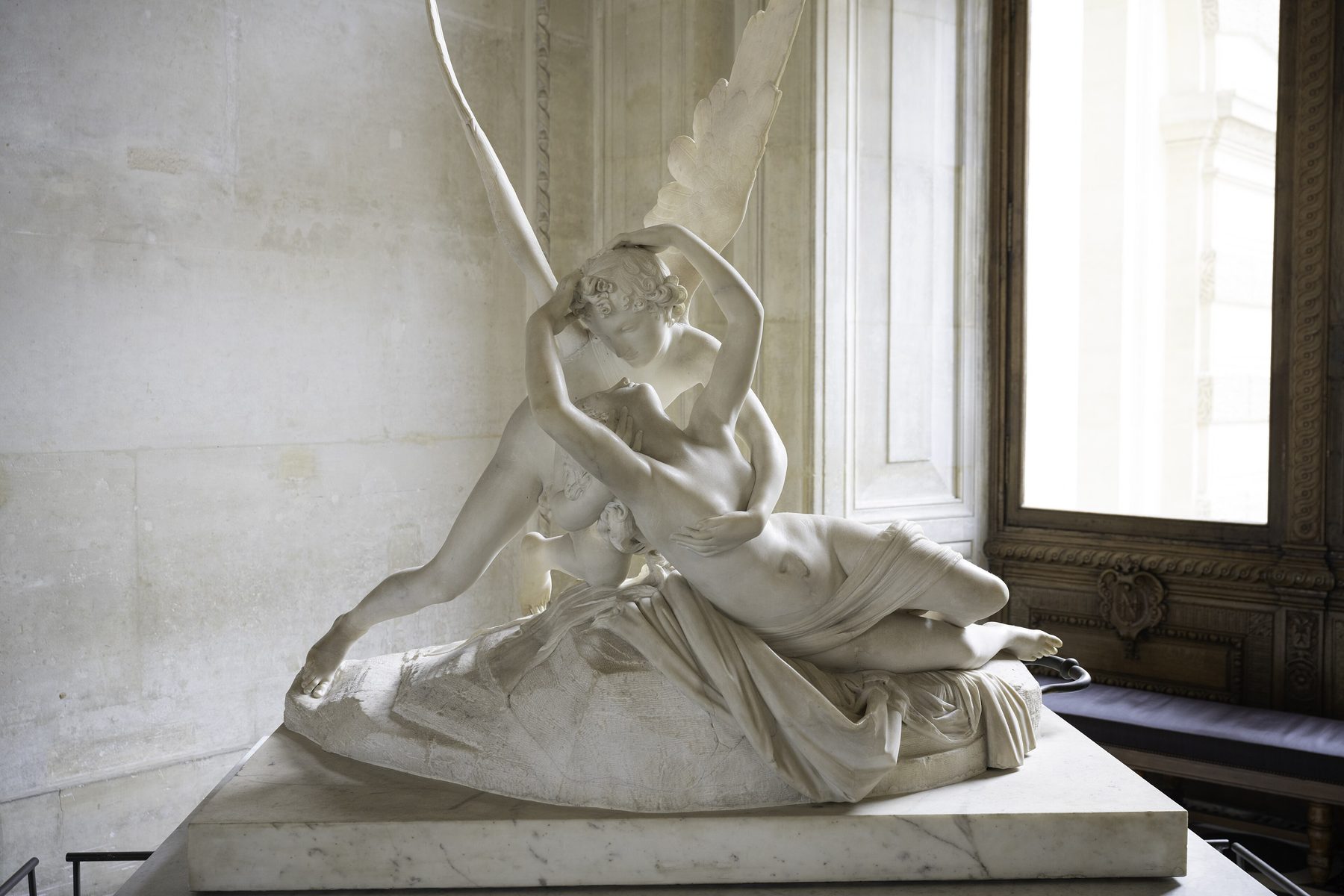
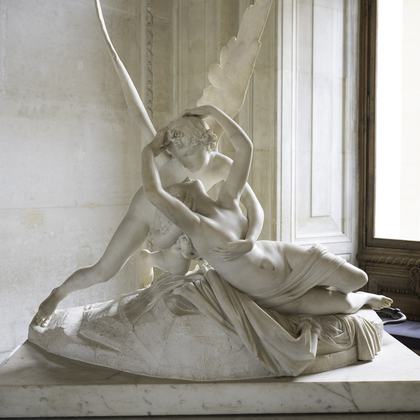
Cupid and Psyche turns a myth of awakening into a structure of arcs. Psyche rises towards Cupid; wings, limbs and gazes circle an interval just before the kiss. From one angle the group seems perfectly resolved, but walking around it changes the balance of support and desire. Polished stone describes flesh, feather, cloth and rock without abandoning material unity.
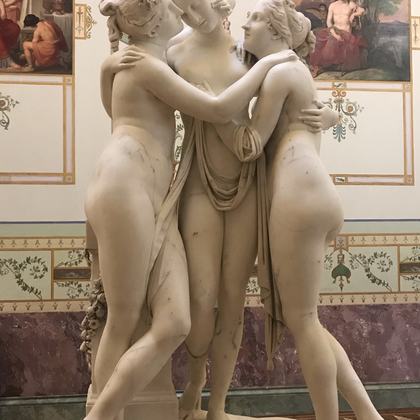
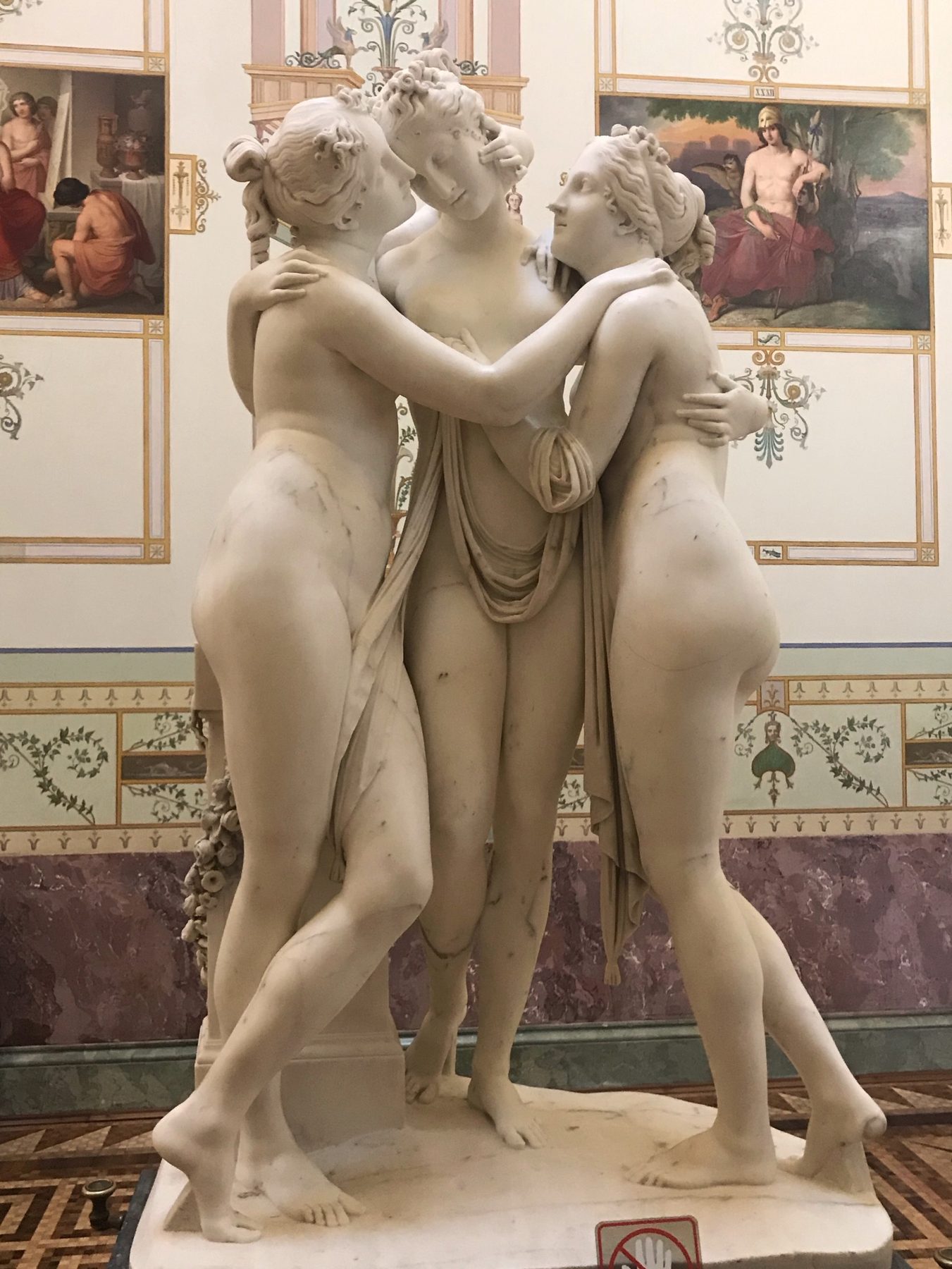
The Three Graces brings three bodies into a closed embrace. Canova departed from an older arrangement in which the central Grace faced away. His figures stand close, joined by arms and a shared scarf. The result is compact and balanced but depends on movement around the sculpture. The Hermitage version was made between 1813 and 1816 and became a celebrated image of ideal beauty.[35]
Another version, completed for the Duke of Bedford, altered marble, support and proportions. The patron praised its morbidezza, the living softness that made stone seem as though it might yield to touch.[34] Such reception contradicts the cliché that Neoclassical sculpture was admired only for cold purity.
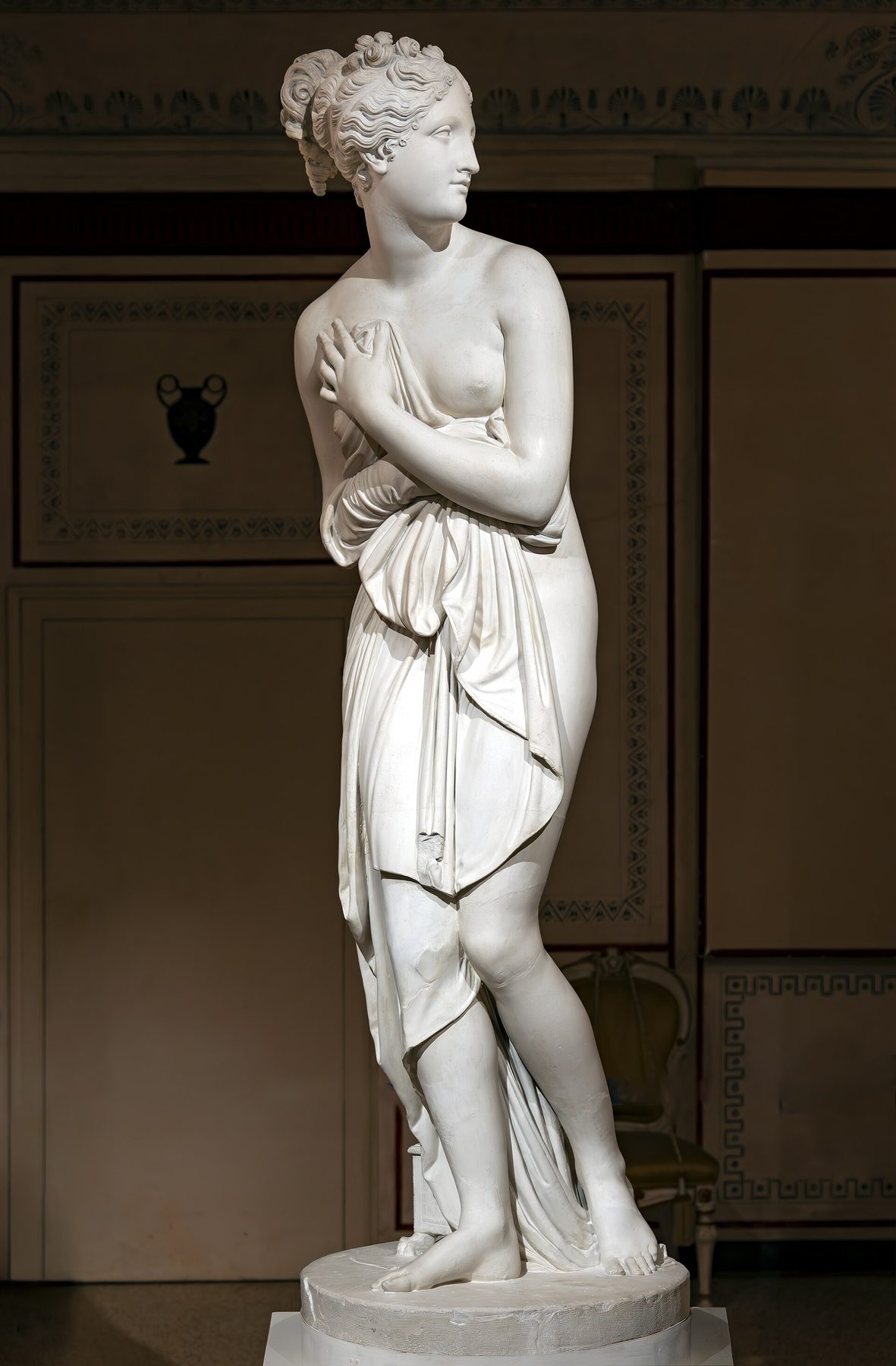
Canova's relationship with antiquity also involved replacement and cultural loss. French authorities removed the ancient Medici Venus from Florence in 1802. Canova was asked to make a copy, but created the Venus Italica as a new answer to the ancient work. She appears more self-conscious and human, covering herself after bathing. When the ancient Venus returned after Napoleon's fall, the modern statue moved to the Pitti Palace.[37]
The episode joined artistic rivalry to conquest. Napoleon commissioned Canova and members of his family became important patrons, even though the sculptor resented the destruction of the Venetian Republic. In 1802 the pope appointed him inspector general of antiquities and fine arts. After Napoleon's defeat, Canova went to Paris as a papal agent to negotiate the return of works removed during French campaigns.[31]
The restitution operation exposed museums as political instruments. The Treaty of Tolentino had forced the Papal States to surrender major works. In 1815 Canova supervised the packing and departure of an immense convoy from Paris. His museum records describe Napoleonic art seizure as cultural domination and works as trophies of war.[36] Neoclassical admiration for antiquity existed beside the coercive redistribution of antiquities and modern masterpieces.
Bertel Thorvaldsen offered Rome another model. The Danish sculptor arrived in 1797 on an academy scholarship. His Jason established his reputation, and he built an international career in the same city as Canova. Contemporary and later critics often turned the pair into opposites: Canova sensuous and narrative, Thorvaldsen severe and Greek. Their actual relationship included rivalry, respect and shared studio conditions.[38]
Thorvaldsen's long Roman presence made him a bridge to northern European art. C. W. Eckersberg studied with David in Paris, then lived in Rome in the same house as Thorvaldsen, who advised and supported him. In Denmark, Davidian composition and close observation were transformed into a national school rather than copied unchanged.[39]
Architecture, interiors and objects
Neoclassical architecture did more than attach temple fronts to modern buildings. It asked which ancient source should govern, how accurately it should be known and what forms could communicate a building's purpose.
Robert Adam travelled through France and Italy from 1754, studied with Charles-Louis Clérisseau and encountered Piranesi. Back in Britain, he developed a coordinated interior in which ceilings, walls, floors, furniture, silver and ceramics belonged to one decorative system. Low-relief ornament and repeatable patterns allowed designs to be recombined and spread through the market.[13]
Adam's rooms are evidence against defining the movement through emptiness. They can be light, colourful and intricate. Their modernity lay in transforming fragments from ancient wall painting, Renaissance decoration and Roman architecture into a coherent environment suited to contemporary sociability. The Adam brothers' illustrated Works in Architecture, issued from 1773, helped carry this approach beyond individual patrons.[13]
Sir John Soane treated classical form even more freely. A Royal Academy travelling scholarship took him to Rome, Paestum and Pompeii. Ancient ruins, casts, fragments and architectural models became tools for design and teaching. His own museum placed models of modern buildings beneath models of the ancient structures that inspired them, making comparison an active practice rather than a chain of obedient copies.[12]
In France, Étienne-Louis Boullée made architecture monumental on paper. His visionary projects used spheres, cylinders, vast colonnades, darkness and light to give institutions an emotional character. The unbuilt cenotaph for Newton imagined a colossal sphere: by day, small perforations would create a starry night within; by night, an internal light would produce an artificial sun. Boullée's surviving drawings and Essay on Art show a revolutionary-era teacher treating architecture as the poetry of elementary form.[14]
Decorative objects brought antiquity into daily performance. The V&A traces Neoclassical design in Britain and France from the 1750s, spreading through travel, publications and manufacture. Cameos, urns and archaeological profiles appeared on furniture, ceramics, metalwork and dress.[11] Wedgwood's dark grounds and pale reliefs resembled ancient cameos while relying on modern industrial organisation. A breakfast service could stage classical taste without requiring ownership of an antiquity.
Napoleon amplified the system into Empire style. Greek and Roman motifs joined eagles, laurel, military trophies and Egyptian forms associated with French campaigning. The ideal of Rome could legitimise a new emperor, furnish ministries and enter fashionable interiors. Archaeology and conquest were not separate stories.
Across the Atlantic, Thomas Jefferson studied Palladio, Gibbs, ancient architecture and the Neoclassical buildings he saw while minister to France. He adapted those sources at Monticello, the Virginia State Capitol and the University of Virginia. The university's domed Rotunda looked to the Pantheon, while different classical orders made the campus a built lesson.[45]
The United States Capitol used Greek and Roman forms to claim descent from ancient republics. Construction began in 1793, and official interpretation still presents its Neoclassical design as an image of the founders' political ideals.[47] That symbolism was powerful, but it was not politically innocent. Classical architecture could proclaim liberty while citizenship and freedom remained radically restricted.
Monticello makes the contradiction unavoidable. The house was an inventive Neoclassical project rebuilt across decades, but it was also the centre of a plantation. Monticello's archaeological research states that slavery made the celebrated house and its social world possible; hundreds of enslaved African Americans lived and worked on the estate.[46] Portico, dome and ordered plan cannot be interpreted honestly without the labour and unfreedom that sustained them.
Women, race and the revolutionary public
Academies described art as universal while controlling who could acquire its highest training. History painting required knowledge of the nude, but respectable women were normally excluded from the life class. Kauffman built a history-painting career through family training, travel, classical learning, patronage and self-fashioning. Her achievement reveals both possibility and the structure that made it exceptional.
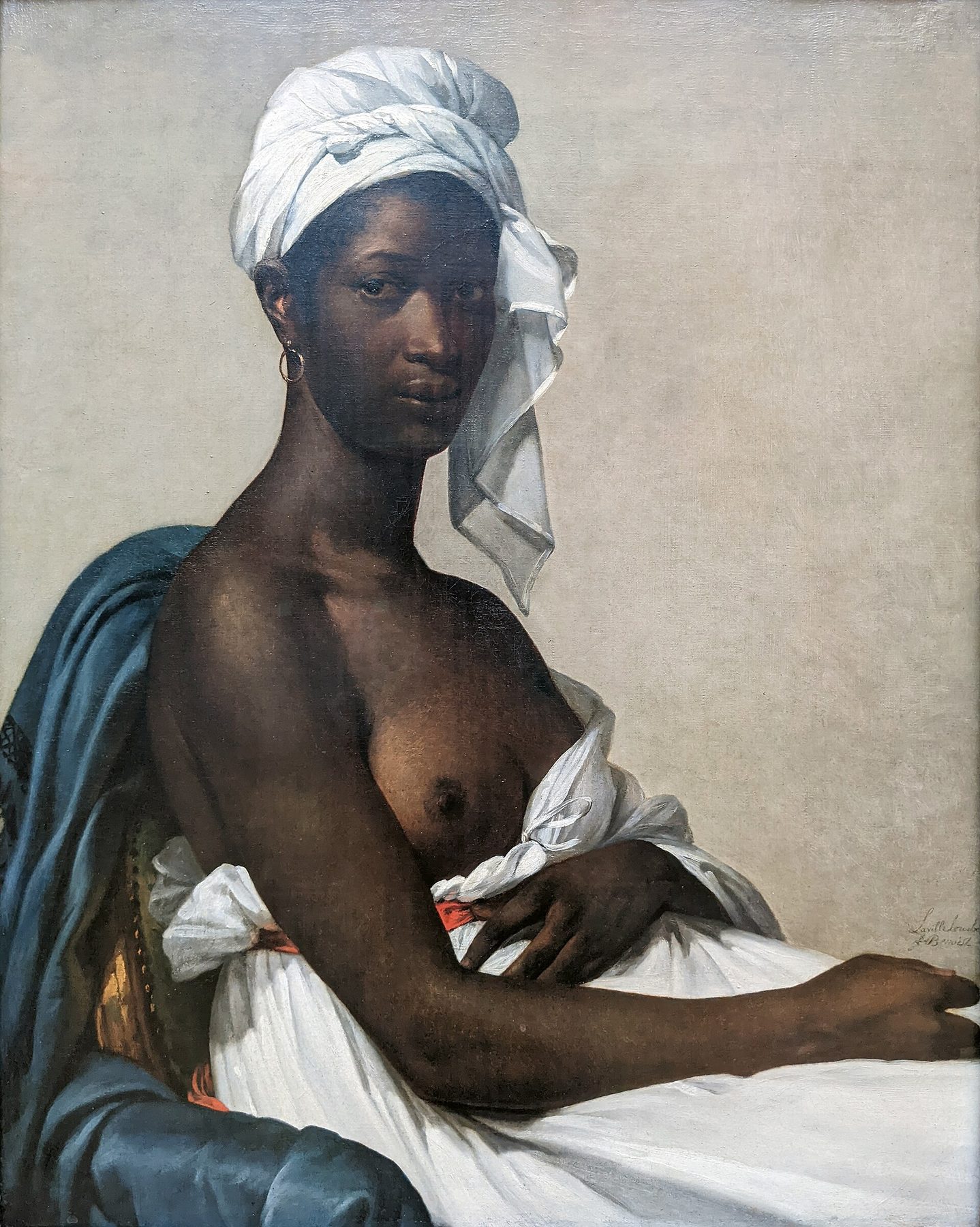
The French Revolution altered exhibition and teaching systems without creating equality. Marie-Guillemine Benoist first studied with Élisabeth Vigée Le Brun and then entered David's circle. David taught a significant number of women, and the Salon became more open after the old academy's restrictions weakened. Benoist exhibited from 1791 and later established a studio for women.[40]
Her painting shown at the Salon of 1800 under the title Portrait of a Black Woman is now often called Portrait of Madeleine. A young Black sitter occupies a chair and looks directly at the viewer. White cloth, red belt and blue drapery set her body against a pale ground. Benoist adapts the composure and simplified setting of elite portraiture, granting the sitter a scale and presence rarely afforded Black women in European art.[40]
The date follows the French abolition of slavery in 1794, and the Louvre relates the work to dignity and emancipation. But the institution's detailed catalogue warns that the identification of the sitter as Madeleine depends on an unproven modern reconstruction. A passenger record names a servant called Magdeleine travelling with the artist's Guadeloupean in-laws, but no document securely proves she was the model.[41]
That uncertainty should not return the sitter to anonymity, nor should a desired name become fact. It invites a more precise history. The original Salon title used a racial term that reflected domination even after legal emancipation. Slavery was restored in French colonies in 1802. The portrait can assert individual presence while remaining embedded in a society that classified, exposed and controlled Black bodies.[41] [43]
Benoist's wider context resists a simple abolitionist reading. She married into networks connected to colonial wealth. A family portrait now at the Metropolitan Museum depicts a woman whose marital fortune came from sugar and coffee plantations on Réunion worked by an immense enslaved labour force.[42] Form alone cannot tell us that an artist opposed the system surrounding her.
Neoclassicism's moral language was thus unevenly distributed. Roman mothers, philosophers and brothers could embody virtue, while contemporary women and colonised people encountered restrictions those universal ideals failed to dissolve. Studying the contradiction does not place social history outside aesthetics. It changes how we understand idealisation, nudity, dignity, access and the authority to represent another person.
Artists to know
Jacques-Louis David
David turned the clear action of history painting into a mutable political instrument. Compare the royal commission of the Horatii, the private moral drama of Socrates, the revolutionary martyrdom of Marat, the reconciliation of the Sabines and the manufactured charisma of Napoleon. The same artist makes the movement's political instability visible.
Jean-Auguste-Dominique Ingres
Ingres inherited Davidian line and academic ambition but refused to remain within them. Grande Odalisque joins ideal finish to distortion and Orientalist fantasy. His portraits, religious paintings and lifelong study of Raphael show Neoclassicism continuing inside nineteenth-century debates.
Antonio Canova
Canova made marble appear alive through a disciplined studio system and his decisive final surface. His mythological groups require the viewer to move, while his career connected Rome to Napoleon, European courts, museum politics and restitution.
Angelica Kauffman
Kauffman was a leading history painter, portraitist and international cultural figure, not a decorative footnote. Her ancient heroines make family, education, judgement and gender part of Neoclassical moral history.
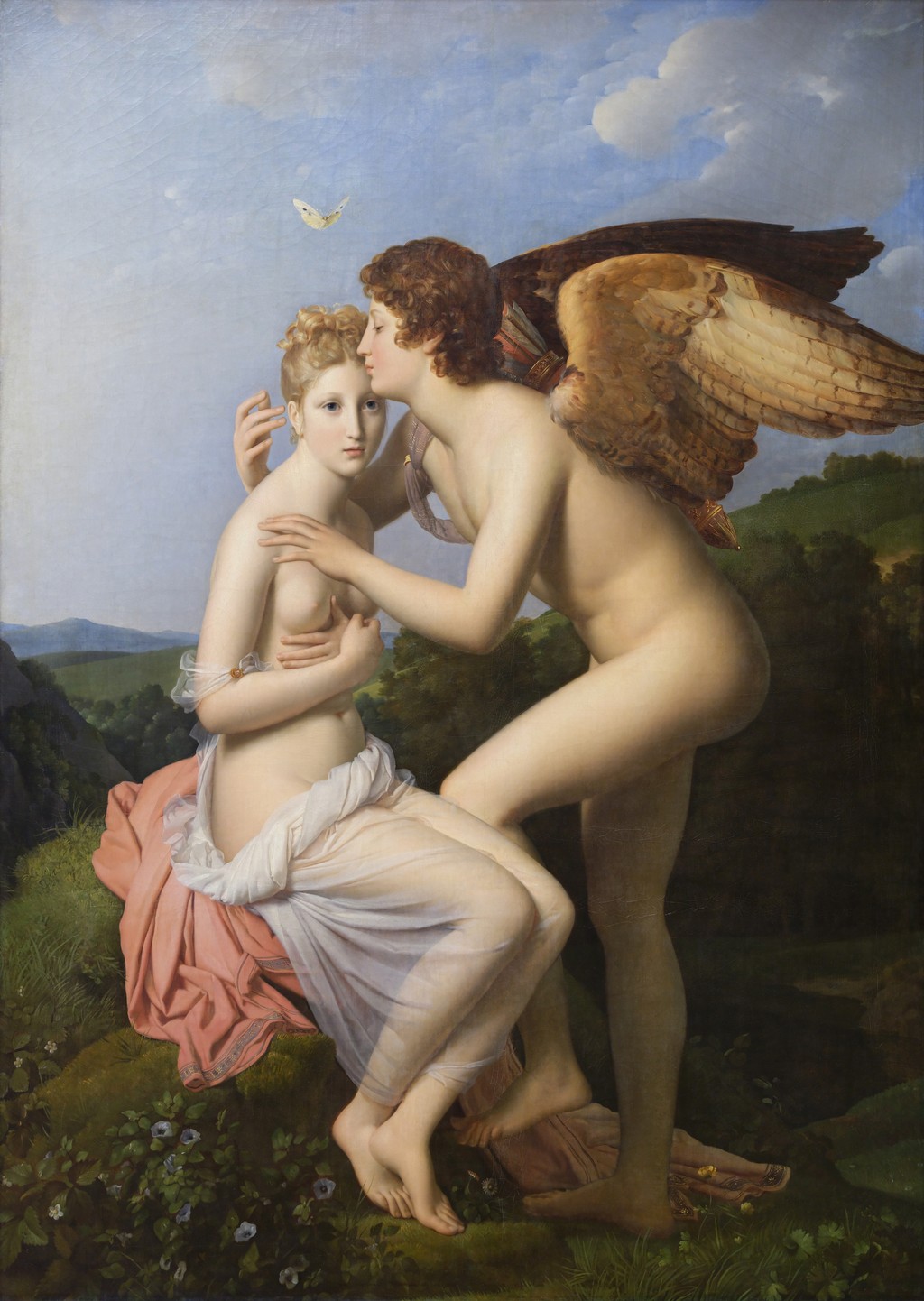
François Gérard
François Gérard trained with David and adapted successfully across Revolution, Empire and Restoration. Cupid and Psyche reveals a graceful, sensuous current within the movement; his portraits show how polished classicism could serve changing elites.
Anton Raphael Mengs, Benjamin West, Joseph-Marie Vien, Gavin Hamilton, John Flaxman, Anne-Louis Girodet, Pierre-Paul Prud'hon, Marie-Guillemine Benoist, Bertel Thorvaldsen, C. W. Eckersberg, Robert Adam, John Soane, Étienne-Louis Boullée, Claude-Nicolas Ledoux and Juan de Villanueva belong to the wider field.
How to look at Neoclassical art
Begin by asking which antiquity you are seeing. A picture may use Roman history, a sculptor may answer a famous statue and an architect may combine Palladio with Pompeian ornament. “Classical” is not one source.
Find the decisive gesture. In the Horatii, arms and swords create the oath. In Socrates, the raised finger opposes the hand reaching for poison. In Kauffman's Cornelia, a mother's indication transforms children into moral treasure. Neoclassical composition often turns gesture into argument.
Examine the space. A shallow stage can make bodies read like a relief; three arches can divide emotional roles; an empty wall can concentrate ethical choice. In architecture, a portico may claim public dignity, but the rooms and labour behind it may tell another story.
Look at surface before calling it cold. David suppresses distracting brushwork so that contour and action dominate. Ingres makes skin continuous enough to support an impossible anatomy. Canova uses polish, abrasion and minute transitions to suggest living softness. Smoothness is an effect produced by labour.
Move around sculpture. Canova and Thorvaldsen designed in the round, even when photographs encourage one privileged view. Supports, gaps and overlapping limbs change as you walk. The sculptural ideal is temporal because the viewer assembles it through movement.
Separate original context from later reputation. Horatii was not commissioned by revolutionaries. Benoist's sitter cannot be securely named from current evidence. The Venus Italica cannot be understood without the removal and return of the ancient Medici Venus. Good looking begins with what an object did before deciding what it symbolises now.
Notice who receives ideal status. Are women active moral agents or embodiments of grief and beauty? Is nudity heroic, erotic or coerced by an imagined harem? Whose labour made a marble, room or plantation house? Neoclassicism's universal claims become historically meaningful when tested against access and power.
Finally, compare works that do not fit the stereotype. Place Gérard's tender myth beside David's severe oath, Adam's ornament beside Boullée's sphere, and Canova's softness beside Thorvaldsen's restraint. The movement becomes clearer through difference.
Transformation and legacy
Neoclassicism did not disappear when Romanticism arrived. The two developed together, sharing exhibitions, patrons, academic training and historical ambition. Girodet used Davidian form for dreamlike subjects. Ingres made linear idealism strange. Greek Revival architecture expanded. National schools adapted the Roman international network to local institutions.
Later critics often treated Neoclassicism as cold, academic or politically compromised. Modern scholarship recovered its diversity and its role in transforming how art addressed public life. Robert Rosenblum's influential study organised the later eighteenth century through complementary and contradictory currents rather than a simple march from one style to another.[49]
The movement's legacy is visible whenever classical form claims permanence: in courthouses, museums, memorials, government buildings and luxury design. That authority remains double-edged. A portico can promise civic equality or dignify an unequal institution. An ideal body can stand for shared humanity or exclude bodies it refuses to recognise.
Neoclassicism matters because it did not merely imitate the past. It revealed how the past is selected, polished and mobilised in the present.
Frequently Asked Questions
Look for clear contour, balanced or frieze-like composition, idealised bodies, antique subjects, smooth surfaces and Greek or Roman architectural forms. These are clues, not a checklist. Function, patron and place remain essential.
Neoclassicism is often associated with line, order, antiquity and exemplary history, while Romanticism is associated with colour, emotion, modern crisis and the sublime. Artists such as Ingres and Girodet cross that division, so it is best treated as a comparison of tendencies rather than an absolute boundary.[26] [29]
Not usually. Much ancient sculpture and architecture carried colour, but weathering removed or reduced it. Eighteenth-century viewers often encountered pale marble originals, Roman copies, casts and prints, helping whiteness become a modern classical ideal.
Discussion
Choose one Neoclassical work or building and ask what its classical form is being asked to legitimise. Does the appeal to antiquity make its political or social claim feel universal—or help you see the contradiction more clearly?
Reader Insights
Ask whether the work uses Greek sculpture, Roman architecture, an ancient text or a later classicising master as its model.
Identify who makes antiquity useful: an academy, household, revolutionary public, emperor, nation or commercial audience.
Notice where ideals of liberty, beauty and universality meet exclusions structured by gender, race, empire and wealth.
Join the Conversation
Have a thought or observation about Neoclassicism? Share it below. Thoughtful responses may be added to this section.
References
- “Neoclassical”, National Gallery, London. View Source
- “Neoclassicism”, Metropolitan Museum of Art. View Source
- “The Grand Tour”, Metropolitan Museum of Art, Jean Sorabella. View Source
- “France, 1600–1800”, Metropolitan Museum of Art. View Source
- “Winckelmann. Moderne Antike”, Klassik Stiftung Weimar. View Source
- “Winckelmanns Werdegang”, Klassik Stiftung Weimar. View Source
- “Antonio Raphael Mengs (1728–1779)”, Museo Nacional del Prado. View Source
- “Antonio Raphael Mengs”, Museo Nacional del Prado. View Source
- “Antonio Raphael Mengs: mural painting”, Museo Nacional del Prado. View Source
- “Giovanni Battista Piranesi”, Victoria and Albert Museum. View Source
- “Neoclassicism”, Victoria and Albert Museum. View Source
- “These Superb Monuments”, Sir John Soane's Museum. View Source
- “Robert Adam: Neoclassical architect and designer”, Victoria and Albert Museum. View Source
- “Étienne-Louis Boullée”, Bibliothèque nationale de France. View Source
- “Angelica Kauffmann: Achilles Discovered among the Daughters of Lycomedes”, National Gallery, London. View Source
- The Spirit of a Particular Age, National Gallery, London, Paris A. Spies-Gans. View Source
- “Angelica Kauffman: Cornelia, Mother of the Gracchi”, Royal Castle in Warsaw. View Source
- “Le Serment des Horaces”, Musée du Louvre collections. View Source
- “Jacques-Louis David” exhibition presentation, Musée du Louvre. View Source
- Jacques-Louis David education dossier, Musée du Louvre. View Source
- “Jacques-Louis David: The Death of Socrates”, Metropolitan Museum of Art. View Source
- “Une icône de la Révolution: Marat assassiné”, Musée du Louvre. View Source
- “Un appel à la réconciliation: Les Sabines”, Musée du Louvre. View Source
- “Un chef charismatique: Bonaparte franchissant les Alpes”, Musée du Louvre. View Source
- “Ingres after David's Oath of the Horatii”, Musée du Louvre collections. View Source
- “Ingres: Davidian training and later affinities”, Musée du Louvre. View Source
- “Une odalisque, dite La grande odalisque”, Musée du Louvre collections. View Source
- Une beauté idéale?, Musée du Louvre. View Source
- Picturing France classroom guide, National Gallery of Art. View Source
- “Antonio Canova (1757–1822)”, Metropolitan Museum of Art, Christina Ferando. View Source
- “Biografia di Antonio Canova”, Museo Gypsotheca Antonio Canova. View Source
- “L'opera di Antonio Canova”, Museo Gypsotheca Antonio Canova. View Source
- “Who Is Antonio Canova?”, National Gallery of Art. View Source
- “The Three Graces by Antonio Canova”, Victoria and Albert Museum. View Source
- “Три Грации”, State Hermitage Museum. View Source
- “Monsieur l'emballeour: Canova e il rientro delle opere in Italia”, Museo Gypsotheca Antonio Canova. View Source
- “Venere Italica di Antonio Canova”, Uffizi Galleries. View Source
- “Thorvaldsen and His Ganymede and the Eagle”, Thorvaldsens Museum. View Source
- “C. W. Eckersberg”, Statens Museum for Kunst. View Source
- “Portrait d'une femme noire: Portrait de Madeleine”, Musée du Louvre. View Source
- “Portrait d'une femme noire”, Musée du Louvre collections. View Source
- “Marie-Guillemine Benoist: Madame Philippe Panon Desbassayns and Her Son”, Metropolitan Museum of Art. View Source
- “Le modèle noir de Géricault à Matisse”, Musée d'Orsay. View Source
- “Psyché et l'Amour by François Gérard”, Musée du Louvre collections. View Source
- “Thomas Jefferson and Architecture”, Thomas Jefferson Foundation at Monticello. View Source
- Archaeology report on the Hemings site, Thomas Jefferson Foundation at Monticello. View Source
- “Neoclassical”, Architect of the Capitol. View Source
- Neo-classicism, Hugh Honour. View Source
- Transformations in Late Eighteenth-Century Art, Robert Rosenblum. View Source
- Flesh and the Ideal, Alex Potts. View Source
- Jacques-Louis David (1748–1825), Bibliothèque nationale de France. View Source
- Image references 52–63: open-access reproductions and institutional collection records.
View 12 image sources
01 · commons.wikimedia.org02 · commons.wikimedia.org03 · commons.wikimedia.org04 · commons.wikimedia.org05 · commons.wikimedia.org06 · commons.wikimedia.org07 · commons.wikimedia.org08 · commons.wikimedia.org09 · commons.wikimedia.org10 · commons.wikimedia.org11 · commons.wikimedia.org12 · commons.wikimedia.org