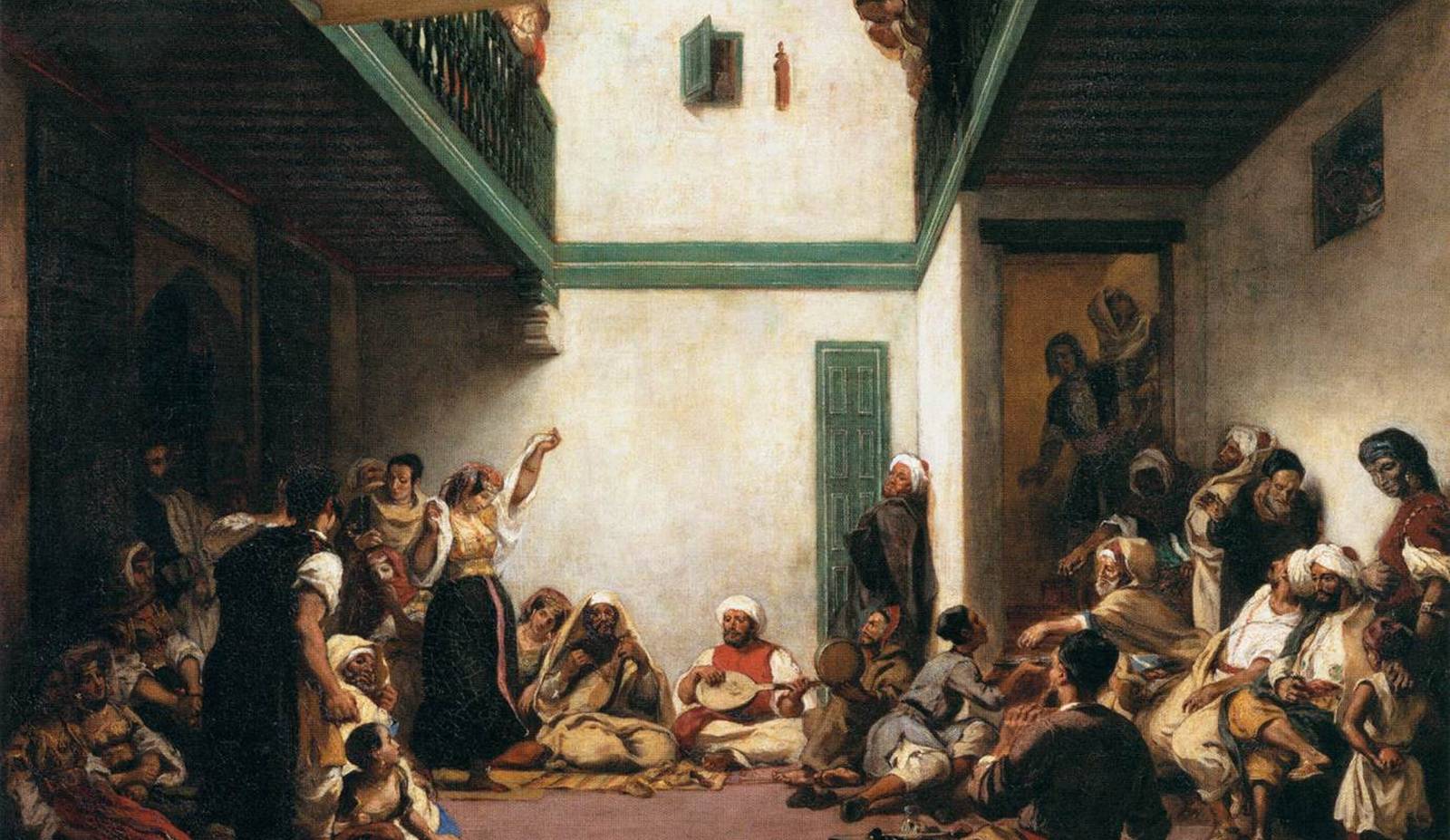
Image reference: Eugène Delacroix, Jewish Wedding in Morocco.
At a Glance
- Core periodc. 1798–1914, concentrated in the nineteenth century
- Principal centresParis · London · Rome · Vienna · Madrid · Istanbul
- Common settingsNorth Africa · Egypt · the Levant · Ottoman territories · an often imaginary “East”
- Known forsaturated colour · detailed architecture and costume · harems · religious interiors · desert travel · markets
- Leading namesIngres · Delacroix · Gérôme · Decamps · Chassériau · Lewis · Roberts · Browne · Osman Hamdi Bey
- Key contextempire · travel · scholarship · photography · museums · world fairs · picture markets
- Best understood asa contested subject field and way of representing cultural difference—not one style
Contents
- Orientalism in context
- Three meanings of the word
- Napoleon, Egypt and knowledge as power
- Empire, travel and the picture market
- Ingres and the imagined harem
- Delacroix in Morocco and Algeria
- Gérôme and manufactured authenticity
- Photography and evidence
- Osman Hamdi Bey
- Artists to know
Where Orientalism fits
Ingres
Principal careerDelacroix
Principal careerDecamps
Principal careerDavid Roberts
Principal careerJohn Frederick Lewis
Principal careerChassériau
Principal careerHenriette Browne
Principal careerGérôme
Principal careerOsman Hamdi Bey
Principal careerAlma-Tadema
Principal careerOrientalism is the name given to a vast and contested field of images through which nineteenth-century European and American artists pictured places they called “the Orient”. Its most familiar paintings show North Africa, the Middle East and the Ottoman world: mosques and markets, desert journeys, soldiers, baths, harems and imagined slave sales. They range from Romantic eruptions of colour to the polished surfaces of Academic art.[1] [2]
There was no organised Orientalist movement, common manifesto or single technique. Some artists travelled repeatedly; others never left Europe. Some pursued biblical archaeology or architectural record, while others made erotic fantasies. What connected them was a directional idea of the “East”, constructed from European positions and circulated through empires, exhibitions, books, photographs, museums and markets.[3] [4] [55]
The paintings can be visually brilliant and historically revealing. They can also convert distinct peoples into types, offer private lives to outsiders, remove colonial power from the scene and make invention appear to be fact. Looking critically does not require choosing between beauty and politics. It means understanding how beauty helps a picture persuade.
Orientalism cuts across the normal sequence of nineteenth-century styles. Jean-Auguste-Dominique Ingres brought it into Neoclassicism; Eugène Delacroix made it central to Romantic painting; Jean-Léon Gérôme gave it Academic precision; Realist, Pre-Raphaelite, Aesthetic and early modern artists borrowed its subjects or materials. It is therefore more accurate to call it a genre, subject field or visual discourse than a movement.[5]
Its strongest visual-art period begins around Napoleon Bonaparte's invasion of Egypt in 1798 and extends into the early twentieth century. The French conquest of Algeria from 1830, Britain's expanding imperial routes, Ottoman reform, the Crimean War, archaeological exploration, steam travel, photography and the Suez Canal all changed who could travel and what images could circulate.
The endpoint is no cleaner than the beginning. Academic Orientalist painting lost status as modernism advanced, but its figures and spaces migrated into cinema, opera, advertising, fashion and tourism. Modern artists returned to the odalisque; contemporary artists in the Middle East, North Africa and their diasporas have restaged, attacked and complicated the inherited gaze.
The category's geography also shifts. To some nineteenth-century French travellers, the Orient began in Greece; Spain and especially Andalusia could be treated as an internal European Orient. Other uses reached across Persia, India, China and Japan. This page concentrates on painting shaped by encounters with Islamic cultures around the Mediterranean, because that is where the art-historical category is most coherent. Chinoiserie and Japonisme have different histories even when older language groups them together.[3] [7]
Three meanings of the word
“Orientalism” has at least three meanings, and confusion begins when they are treated as interchangeable.
First, an Orientalist was historically a scholar of languages, religions and histories that European institutions grouped under “the Orient”. That scholarship produced knowledge of great value, but its classifications could also support diplomatic, commercial and imperial power.
Second, Orientalist art describes European and American representations of Eastern places, objects and peoples. In this sense, the term can identify a Salon painting without deciding in advance whether it is sympathetic, hostile, documentary or imaginary.
Third, Edward Said's Orientalism, published in 1978, gave the word its most influential critical meaning. Said examined how Western texts and institutions created an “Orient” that could be known, governed and contrasted with a supposedly rational West. His project concerned structures of representation and authority, not simply individual prejudice.[6]
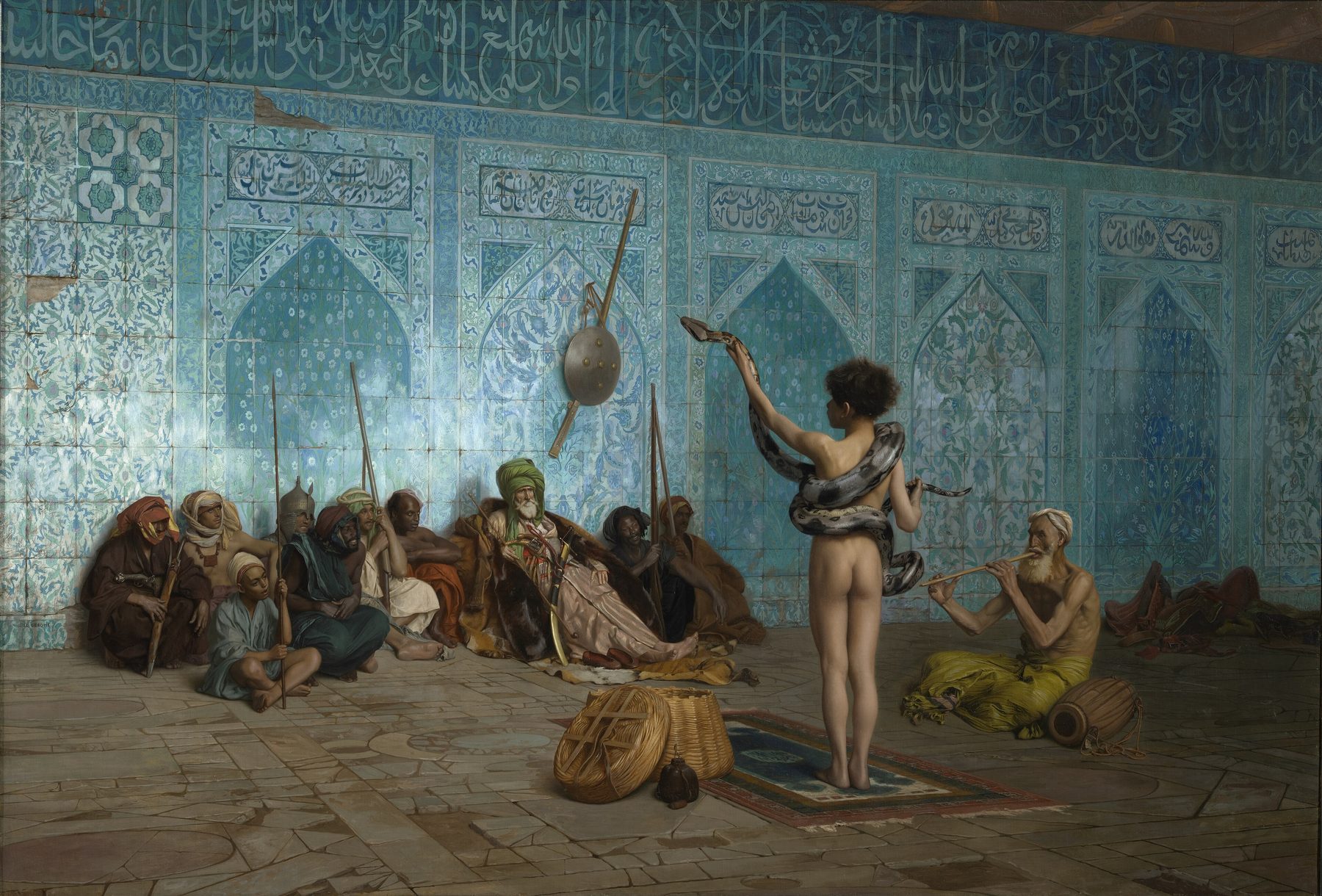
Said did not write an art-historical catalogue and did not analyse Gérôme's Snake Charmer, although the painting appeared on an edition's cover and later became inseparable from the book's reception. Art historians, especially Linda Nochlin, extended the method to images: who is allowed to look, whose history is absent, and why does a scene of apparently precise observation contain no sign of the colonial power that made the view possible?[7] [8]
The three meanings overlap. Nineteenth-century paintings drew upon travel writing and scholarship; modern criticism asks how both image and scholarship classified people. But a reader should always know whether “Orientalism” names a historical genre or a critique of the power embedded in representation.
Before 1800: trade, costume and imagined Easts
European fascination with eastern dress, rulers and luxury goods long predates the nineteenth century. Venetian painters represented Ottoman visitors; Rembrandt dressed models in turbans; French Rococo art enjoyed turquerie and harem fantasy. Porcelain, lacquer, carpets, silk and metalwork moved through commercial and diplomatic exchange.[3]
These earlier images were not produced from complete ignorance. Merchants, ambassadors, converts, captives and travellers crossed political and religious frontiers. Objects had makers, users and routes. Yet European art frequently recombined them. A turban could signal biblical antiquity, contemporary Ottoman identity, wealth or theatrical otherness without specifying one society. Later paintings by Benjamin-Constant continued this theatrical method, transforming textiles, music and languid pose into a portable harem atmosphere.[25] [26]
The Arabian Nights, travel accounts and stage design offered an Orient of luxury, despotism, erotic availability and violent reversal. It could be feared or admired. In either case, it served as a contrast through which Europeans imagined themselves: industrious against idle, restrained against sensual, free against despotic—or, in a different mood, spiritually impoverished against a world of colour and ceremony.
The nineteenth century intensified this older habit because military conquest, organised scholarship and mass reproduction gave representation new institutional power. The Orient was no longer only a masquerade at court. It became something governments claimed to survey.
Napoleon, Egypt and knowledge as power
Bonaparte invaded Egypt in 1798 to attack British interests and establish French power in the eastern Mediterranean. He brought not only soldiers but more than 160 scholars, engineers, naturalists, architects, draughtsmen and other specialists. The military occupation failed by 1801, yet the research expedition produced an extraordinary archive.[9] [51]
The monumental Description de l'Égypte, published in instalments from 1809, recorded ancient monuments, contemporary buildings, natural history, crafts, inhabitants and topography. Its scale and visual precision shaped Egyptology, Empire-style design and the European image of Egypt.[9]
Knowledge and conquest were not separate stories. The same expedition that measured temples and catalogued species invaded a sovereign Ottoman province. Surveying turned place into organised information available to French institutions. The Description remains an invaluable scholarly achievement and evidence of how imperial power could present itself as universal knowledge.
Painters absorbed the new archive. Antoine-Jean Gros's Napoleon in the Plague House at Jaffa presents the general touching a sick prisoner with the authority of a saint or king. Gros had not travelled to the region. Architecture, costume and racial difference make French command appear heroic amid an eastern crisis.[3]
The campaign also stimulated Egyptomania: sphinxes, lotus forms and hieroglyph-like ornament entered furniture, architecture and public monuments. Ancient Egypt could be detached from contemporary Egyptian people and made to support modern European prestige. Orientalism was already operating across painting, archaeology and design.
Empire, travel and the expanding picture market
Travel became easier during the century, but ease was political. France's conquest of Algeria began in 1830 and developed through violent war, dispossession and settlement colonisation. Military control opened routes for artists, photographers and tourists who could experience North Africa as accessible while local communities experienced domination.[11] [50]
Steamships shortened Mediterranean journeys. Railways linked ports and inland cities. Hotels, guidebooks and Thomas Cook tours organised an itinerary from Alexandria through Cairo and the Holy Land to Constantinople. The Suez Canal opened in 1869, accelerating commerce and imperial communication while transforming the very “timeless East” travellers hoped to encounter.[10]
The artist's journey became a credential. Salon catalogues and dealers could advertise a picture as the result of direct experience. Sketchbooks, oil studies, purchased costumes and architectural measurements added evidence. Yet the traveller arrived with expectations shaped by literature and earlier images. Many sought biblical permanence, picturesque poverty or a harem they had already imagined.
Back in Paris or London, the market completed the journey. Paintings entered the Salon, Royal Academy, dealers' rooms and wealthy collections. Gérôme's relationship with the dealer and publisher Adolphe Goupil was especially powerful: engravings and photographic reproductions made his invented scenes globally recognisable.[19]
Orientalism therefore joined mobility to distance. The more easily artists travelled, the more confidently they could claim authenticity; the more widely images circulated, the more a limited set of motifs stood for enormous and diverse regions.
Seeing, remembering and inventing
An Orientalist painting can contain accurate tiles, textiles and weapons without representing an event that happened. This distinction is essential. Artists normally worked through several stages: observation and sketches during travel, acquisition of objects and photographs, memory, studio models and final composition.
Direct observation could correct earlier fantasies. It also supplied detail with which to make new fantasies convincing. Gérôme's precise walls and costumes act like evidence in a historical novel: because the small things look right, viewers trust the larger story.[18]
Studio invention was not hidden. Artists collected rugs, robes, armour and brassware, arranged them around European or immigrant models and reused them. A single garment might appear in pictures supposedly set in different countries. Friedrich von Amerling's Die Morgenländerin was painted in Vienna from a local model in orientalist costume; the title transforms theatrical presentation into identity.[54]
The problem is not simply that an artist altered facts. All art selects and constructs. The question is what the construction claims. When a picture offers itself as fantasy, the viewer recognises invention. When an Academic surface claims the authority of eyewitness evidence, incompatible details and invisible conditions of access carry greater consequence.
Ingres and the imagined harem
Ingres never travelled to North Africa or the Ottoman Empire. His “Orient” was built in European studios from nude models, literature, earlier art and a small vocabulary of accessories. That distance was not an obstacle. It allowed him to turn the harem into a setting where the female nude could be made newly exotic.[16]
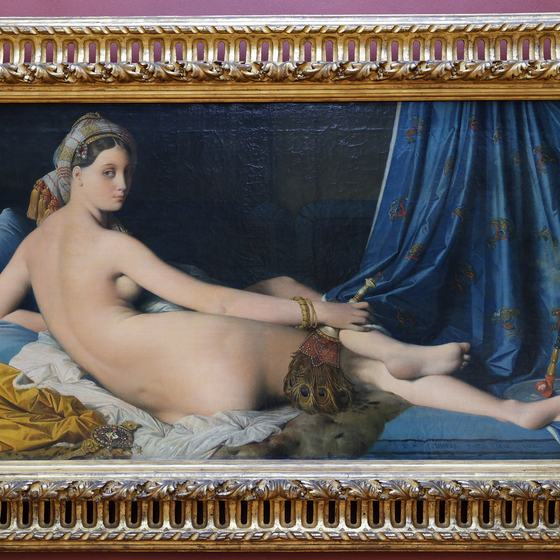
In La Grande Odalisque of 1814, a reclining woman turns her back while looking toward the spectator. A turban, fan, pipe, jewels and textiles relocate a body descended from European Venuses into an imagined Ottoman interior. Her elongated spine, attenuated arm and improbably arranged legs subordinate anatomy to flowing contour.[15] [17]
The deformation is often admired as pure style. It also structures availability. The figure is both remote and completely exposed, an unnamed household type rather than a portrait. “Odalisque” derived from a word for a female servant within an Ottoman household, but European painting made it synonymous with a sexually available reclining nude.
The harem was especially productive because European male travellers usually could not enter women's private quarters. Lack of access generated fantasy rather than restraint. Illustrated books could present a supposedly intimate Constantinople interior to readers who had never crossed its threshold.[28] Ingres's later Turkish Bath multiplies nude bodies into a circular field of touch, music and self-quotation. The East becomes a device that suspends ordinary European rules around sexuality while leaving the male spectator unseen.
German museum interpretation of Ingres makes the contradiction clear: the forbidden domestic space could be pictured precisely because it was inaccessible. Nineteenth-century sexual restraint at home was displaced into an allegedly timeless elsewhere.[17] The painting's sinuous design remains inventive; critical attention asks what kind of freedom that invention grants to painter, viewer and represented woman.
Essential works
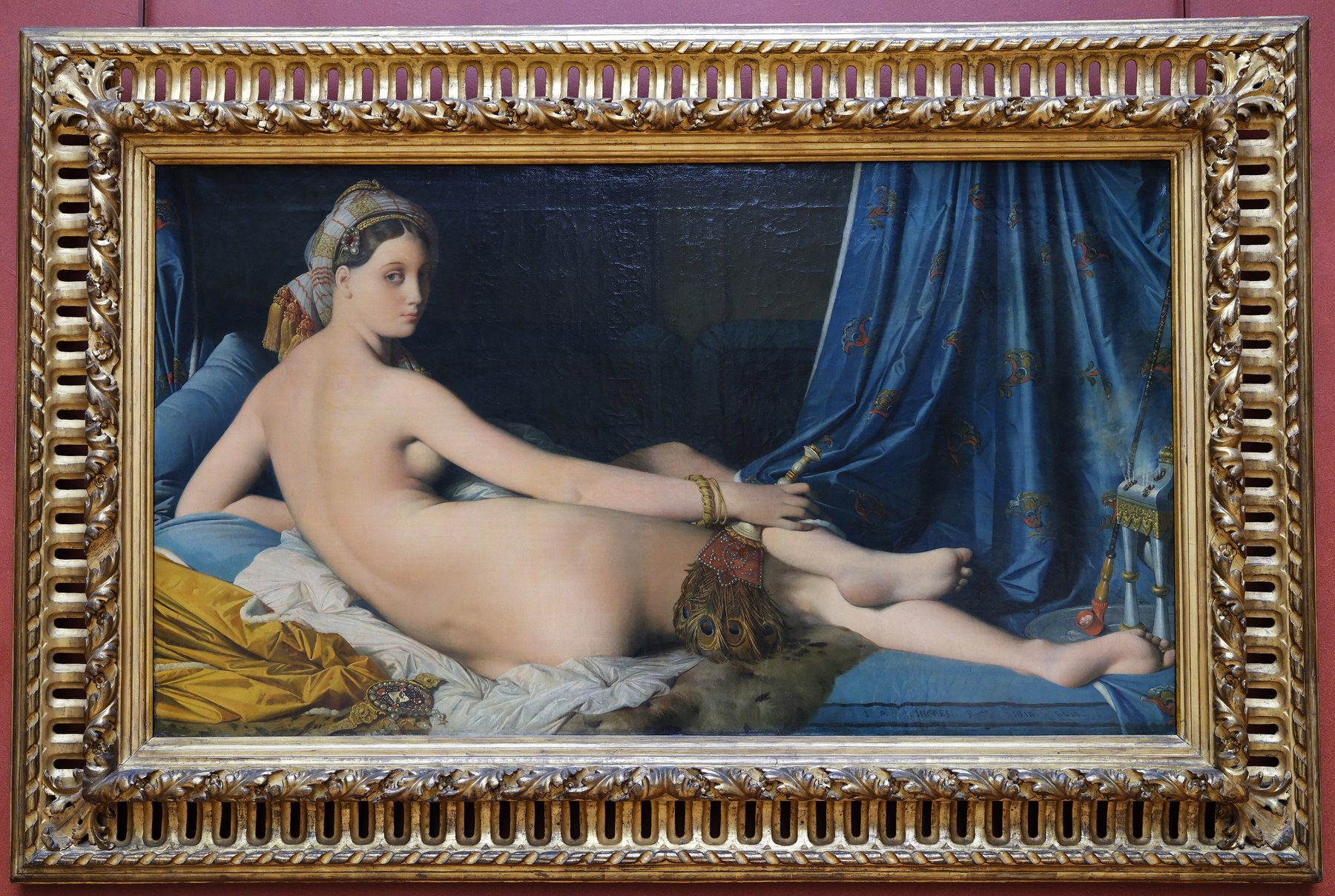
La Grande Odalisque
Jean-Auguste-Dominique Ingres, 1814
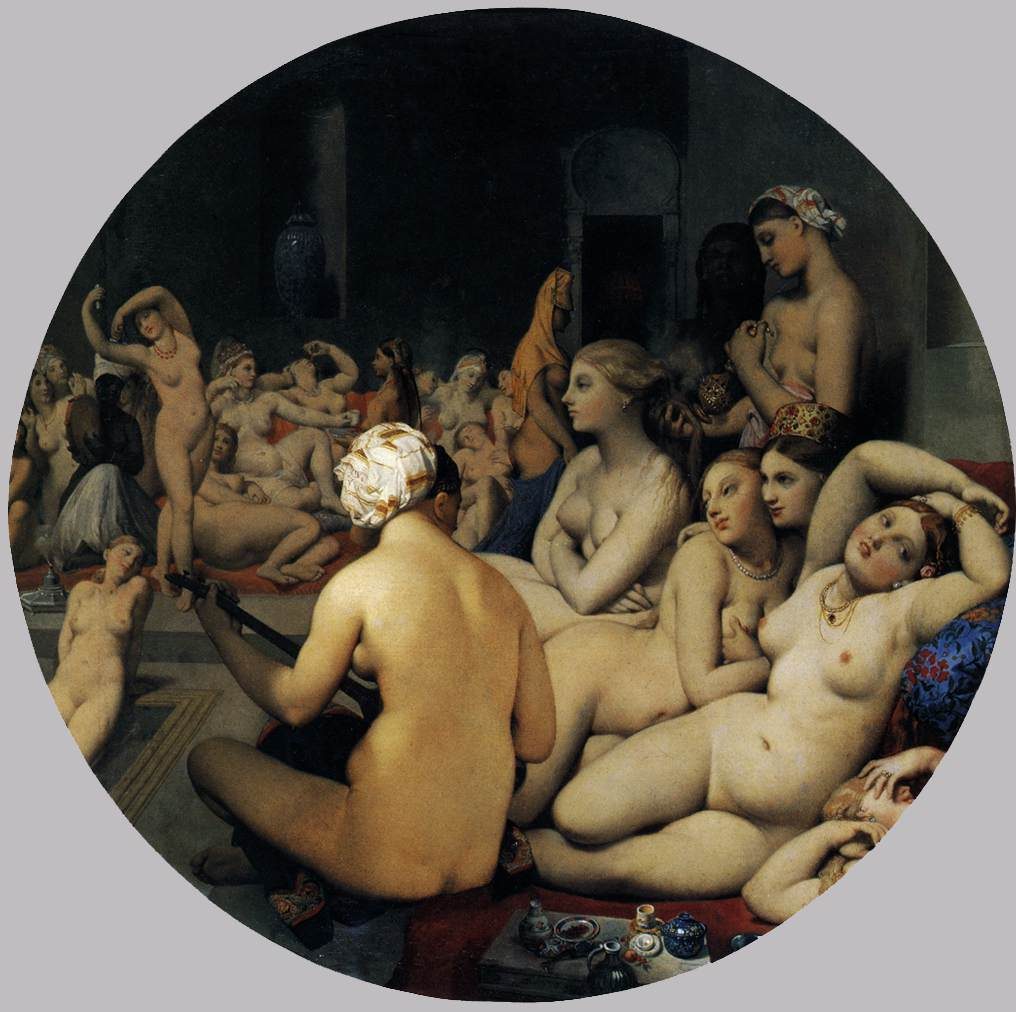
The Turkish Bath
Jean-Auguste-Dominique Ingres, 1862
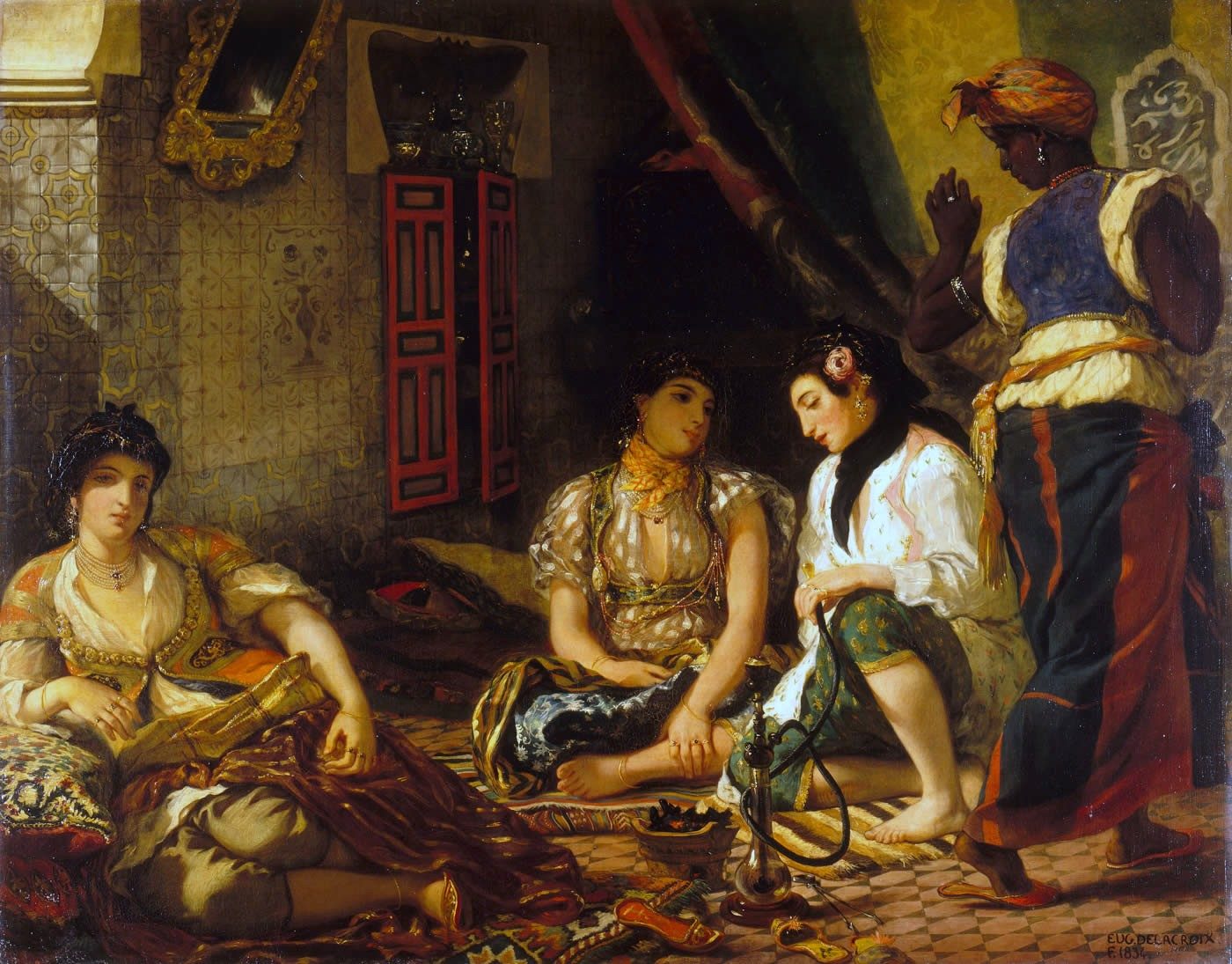
Women of Algiers in Their Apartment
Eugène Delacroix, 1834
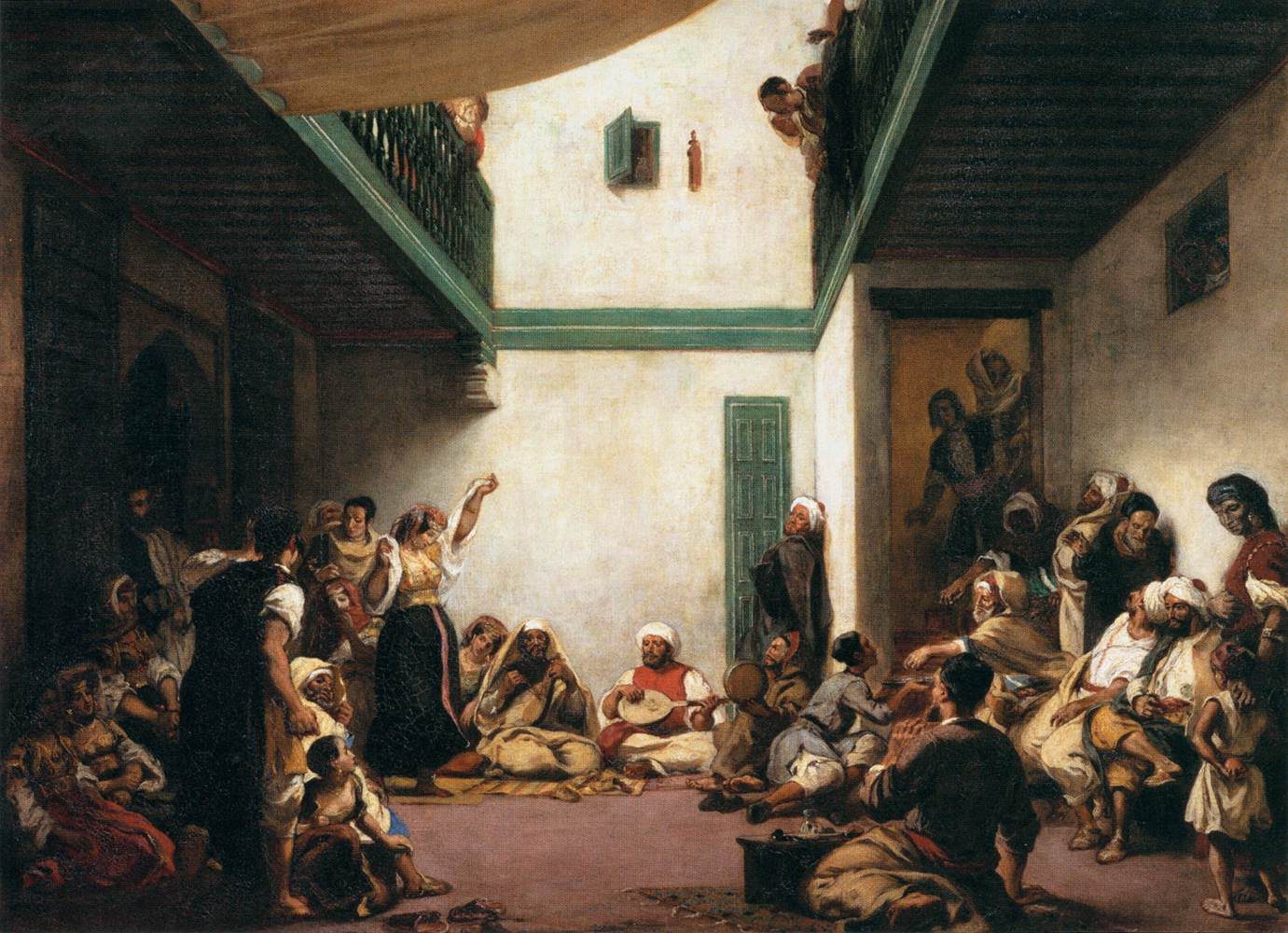
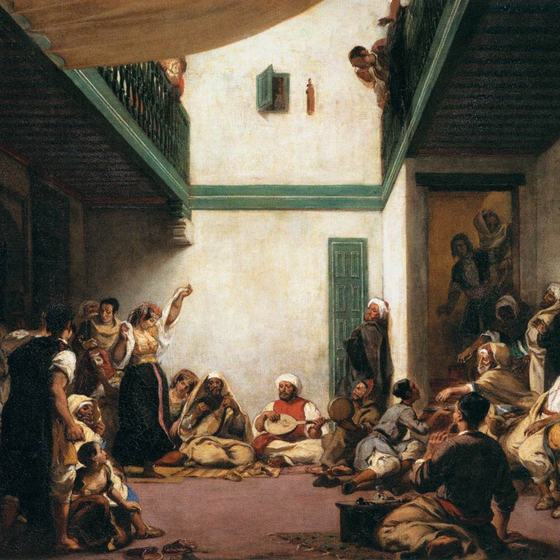
Jewish Wedding in Morocco
Eugène Delacroix, 1839
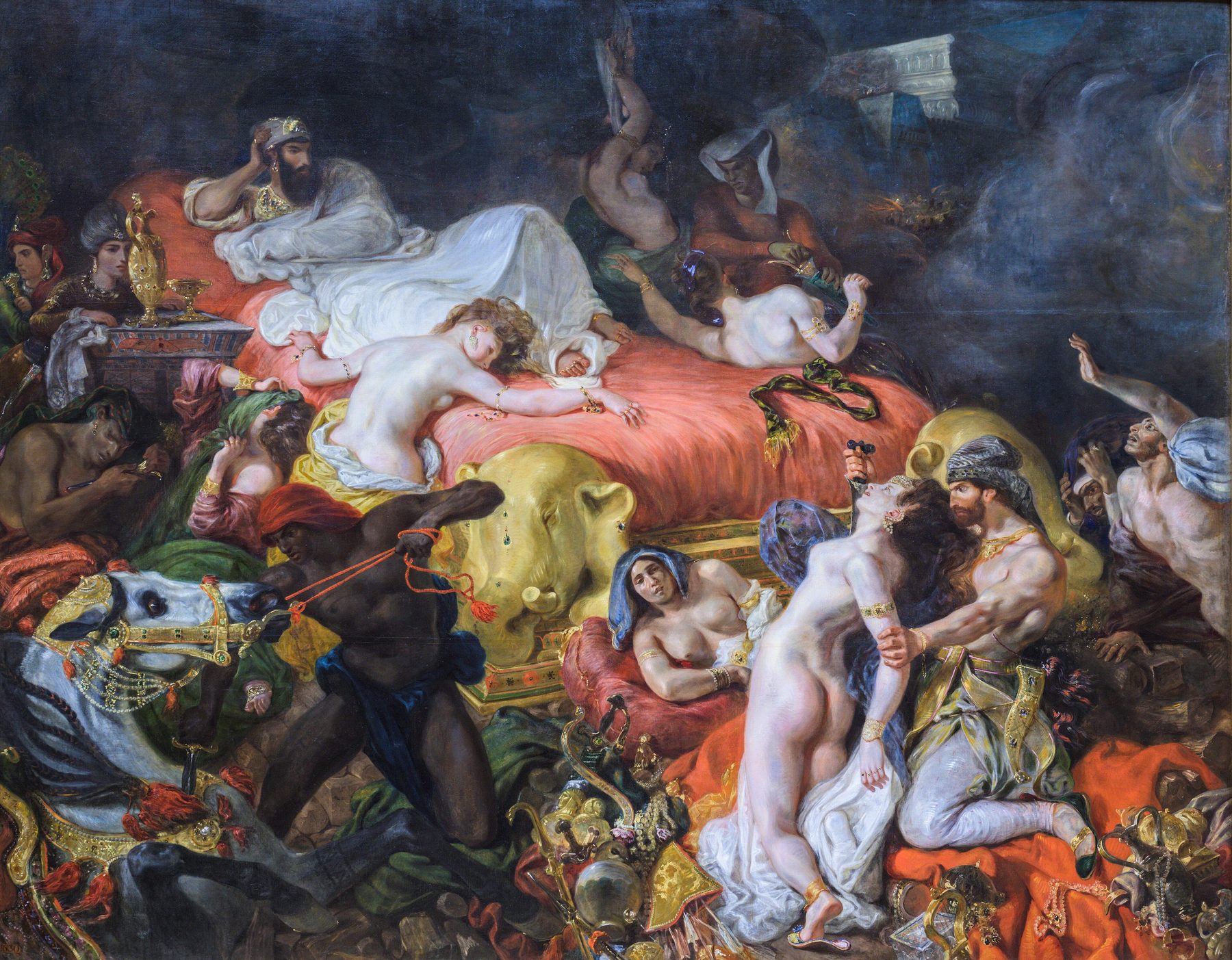
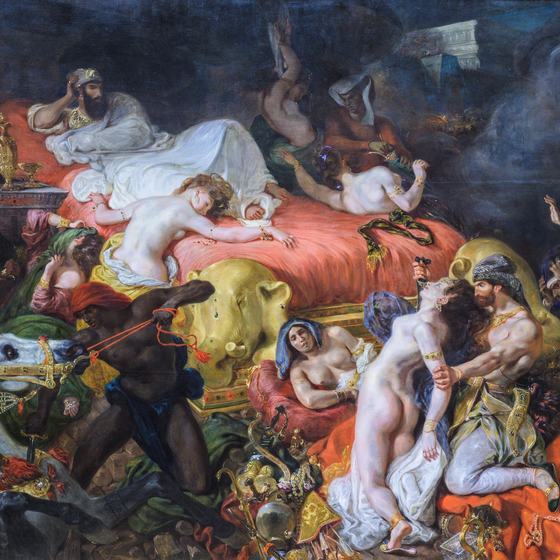
The Death of Sardanapalus
Eugène Delacroix, 1827
Delacroix in Morocco and Algeria
Delacroix's route was different. In 1832 he accompanied the comte de Mornay on a French diplomatic mission to the Moroccan sultan. He travelled through Tangier and Meknes, visited southern Spain and later stopped in Oran and Algiers. The journey transformed his store of costumes, gestures, architecture, animals, ceremonies and colour.[14]
Morocco was an independent state negotiating with France. Algeria was already under French military domination. To merge them into one exotic journey would erase a crucial difference. Delacroix moved through diplomacy in one place and colonial privilege in another.
Before travelling, he had already made “Oriental” subjects. The Massacre at Chios responded to the Greek War of Independence; The Death of Sardanapalus turned a literary ancient ruler's destruction into a vortex of bodies, fabric, jewels and violence. These paintings use the Orient for Romantic extremity rather than ethnographic description.[3]
The 1832 notebooks offered a more particular archive. Delacroix attended a Jewish wedding in Tangier, recorded clothing and music and later painted Jewish Wedding in Morocco. The subject should not be absorbed into a generic Islamic East: Morocco's Jewish community and the documented ceremony give the scene a distinct history.[13]
Travel did not replace imagination. Delacroix continued combining remembered observation with art-historical composition for decades. Arab Horseman from around 1854 shows how the journey remained productive long after his return.[14] His handling of colour and movement affected artists who cared little for ethnographic categories; German collections place his Orientalism beside his role as a major Romantic and precursor of later colour painting.[53]
Delacroix's achievement therefore cannot be reduced to either witness or fantasy. He saw more than Ingres and saw under conditions that must be reconstructed. His paintings made particular people and materials visible, but converted them into works addressed primarily to European institutions and viewers.
Women of Algiers in Their Apartment
Delacroix's Women of Algiers in Their Apartment, exhibited at the Salon of 1834, originated in a rare visit to an Algerian household. Three seated women occupy a richly furnished interior while a Black attendant turns toward the exit. Carpets, cushions, jewellery, garments, ceramics and a mirror create a dense material environment. Light moves across white fabric and warm flesh rather than presenting the figures as sharply outlined specimens.[12]
The title matters. This is an apartment, not simply “the harem”. The women are clothed and largely self-contained. They do not enact the overt invitation of Ingres's odalisque. Delacroix's colour became so important to later painters that the work can be read as a declaration about paint as much as a record of Algiers.[13]
Yet the spectator occupies the position of an exceptional visitor. French military power had taken Algiers only two years before. The attendant's turning body seems to open or close the scene, making access itself part of the composition. The women remain unnamed; their stillness was repeatedly interpreted by European critics as indolence.[13]
The Black attendant introduces another hierarchy. Her movement and darker skin distinguish service from repose, while her partial departure helps reveal the seated group. Race, labour and looking are arranged together even where the picture resists the most explicit harem fantasy.
It is possible to admire the painting's colour, notice its unusual restraint and still ask how colonial privilege structures the view. These readings do not cancel one another. They explain why the work became both a formal touchstone and a site of later critique.
Follow the field through four stages
Trade, costume and imagined Easts
Diplomacy, commerce, collecting, biblical costume and courtly fantasy establish visual habits that nineteenth-century Orientalism will intensify.
–1830
Conquest, archives and Romantic invention
Napoleon’s Egyptian expedition joins military power to organised knowledge while Ingres and Delacroix develop contrasting imagined Easts.
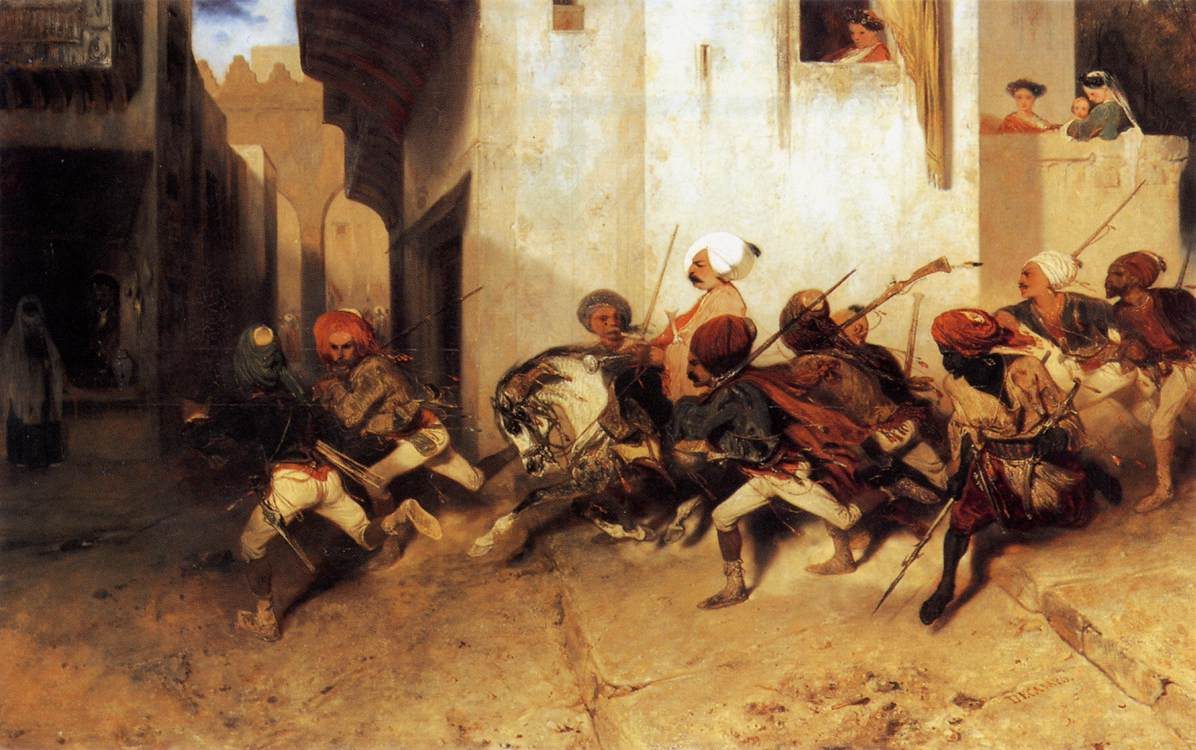
–1870
Travel, colonial access and the expanding market
Steam travel, Algeria, Salon culture and first-hand sketching supply new evidence while studio invention and unequal access remain decisive.
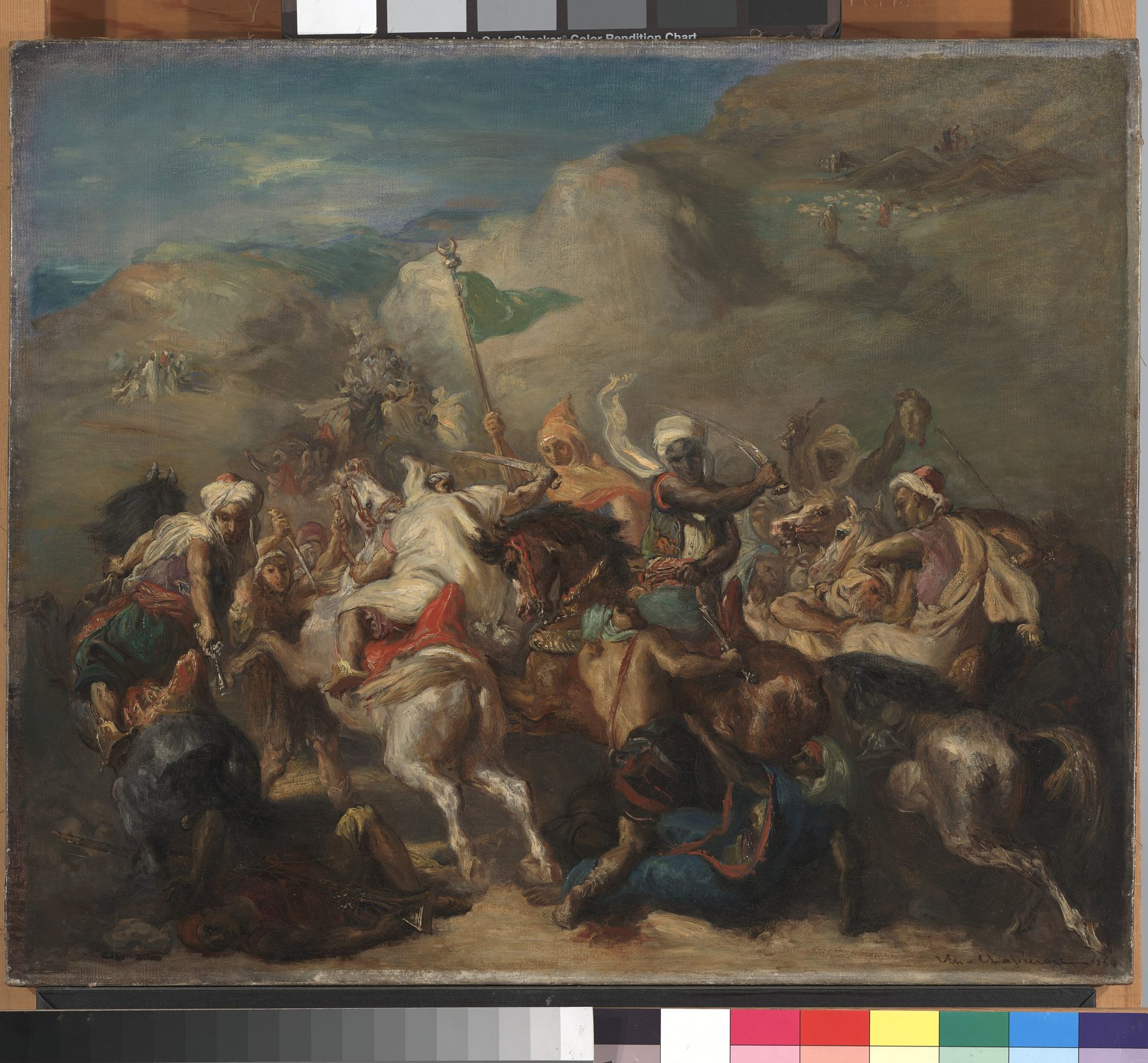
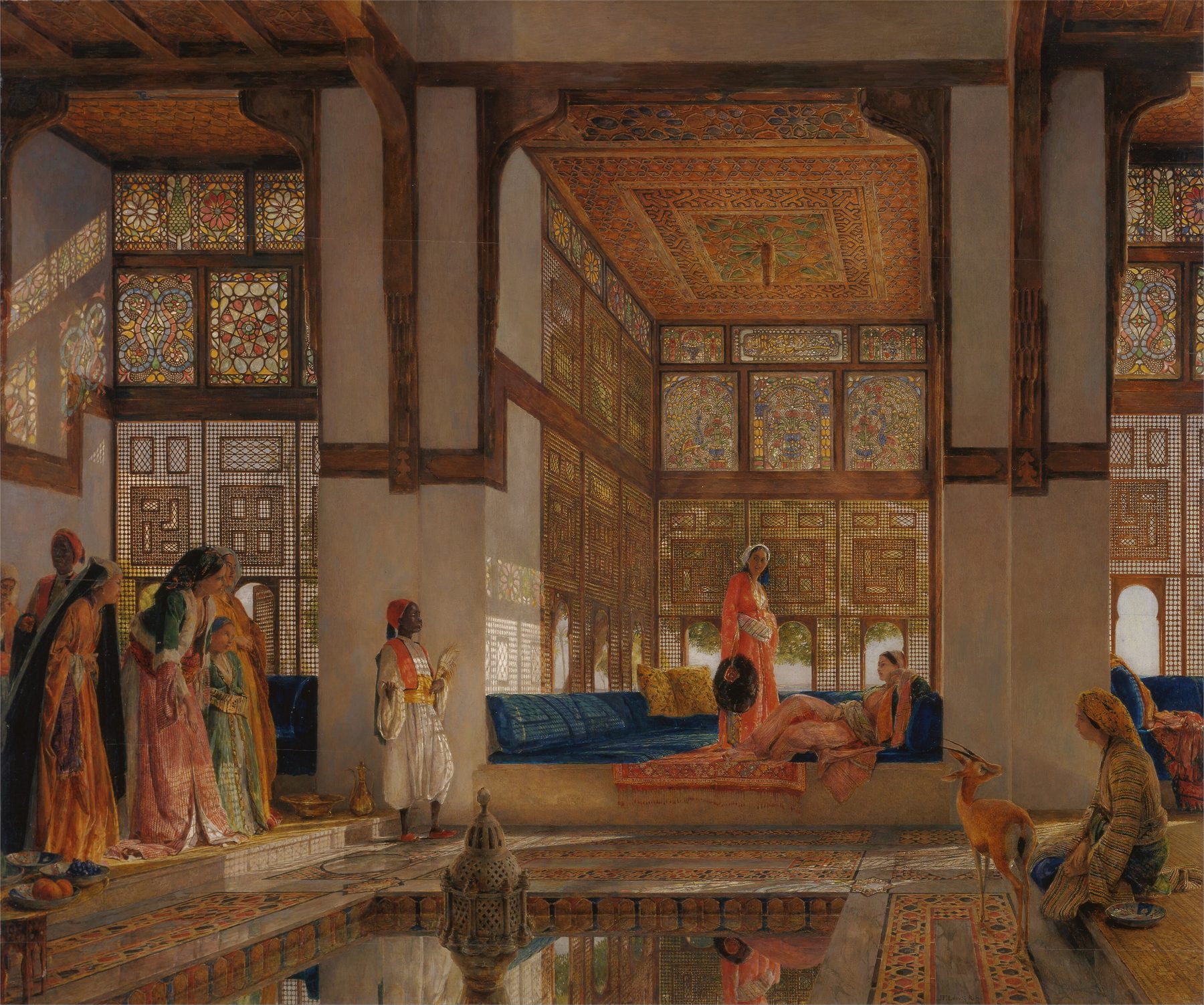
–1914
Academic spectacle, circulation and Ottoman response
Gérôme’s manufactured authenticity circulates through Goupil as Ottoman artists and institutions appropriate, redirect and contest the genre.
Gérôme and manufactured authenticity
Gérôme was one of the most successful painters of his age. He travelled to Constantinople, Egypt, Palestine and Syria, sometimes with artists and photographers. He sketched buildings and people, collected objects and used photographs. His smooth finish minimises visible brushwork, encouraging the eye to pass through paint toward an apparently witnessed event.[18]
That realism was manufactured with great intelligence. Gérôme assembled scenes in Paris from memory, photographs, models, textiles and objects. His Orientalist subjects and ancient histories use the same method: archaeological fragments and precise surfaces make dramatic inventions feel present.[18]
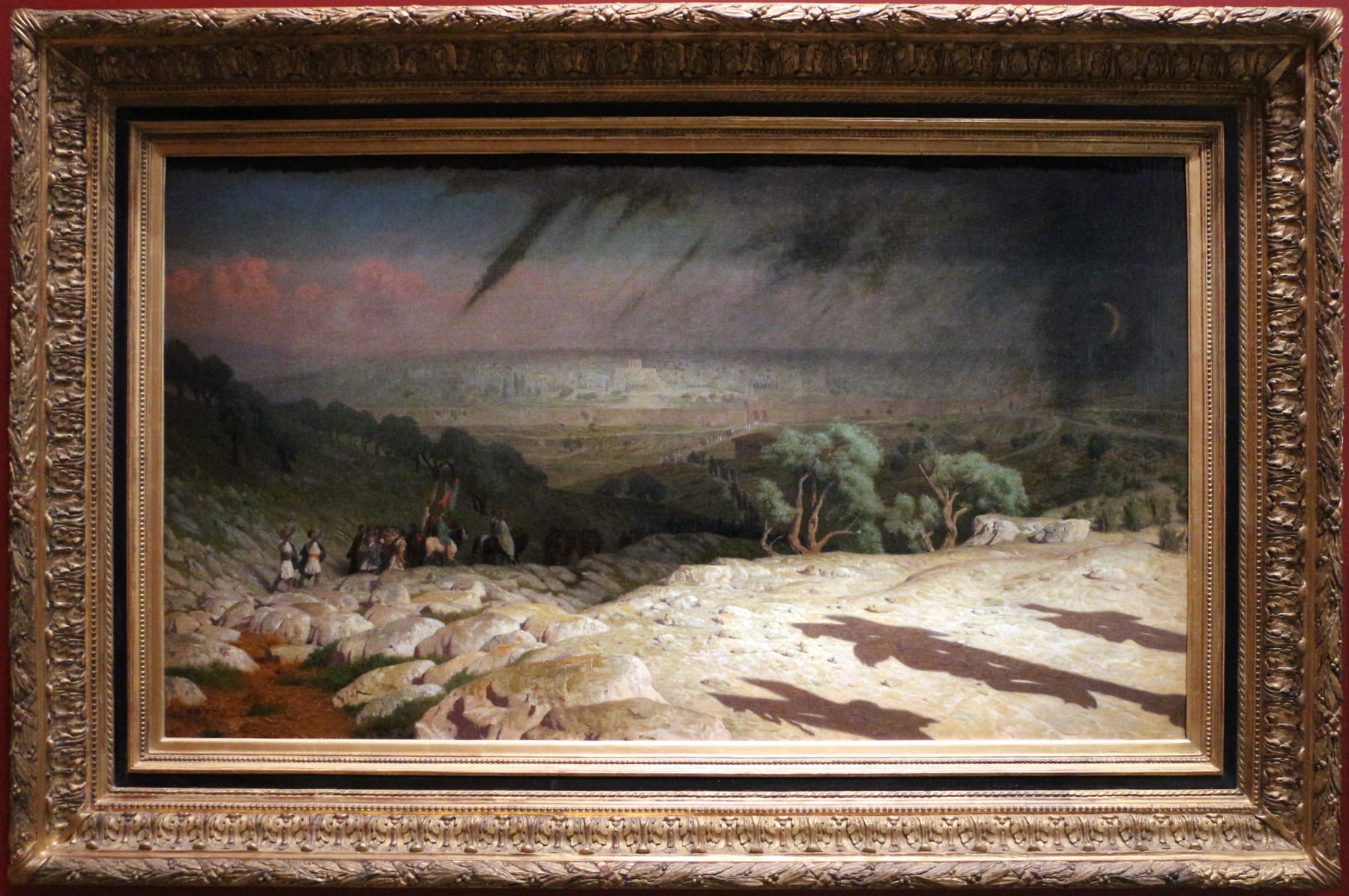
The distinction between truth and fiction is not a simple accusation. Gérôme could describe fabric, architecture or posture with astonishing sensitivity. His Jerusalem of 1867 avoids the conventional view of the Crucifixion: only three shadows fall across a desolate foreground beneath a stormy sky. Topographical and archaeological interest helps produce an original religious image.[52]
But the same authority can naturalise stereotypes. Gérôme repeatedly pictured a place outside modern history: violent, sensual, idle and unchanged. Photography reinforced rather than corrected the construction because he could select one factual fragment from an image and move it into a different narrative.
Goupil amplified the effect. From 1859, reproductions circulated Gérôme's compositions far beyond owners of the paintings. His slave markets, bathers and soldiers became visual knowledge for people who would never travel.[19] Orientalism worked not only through what an original canvas said, but through how frequently its claim was repeated.
Snake Charmer, Bashi-Bazouk and Slave Market
In Snake Charmer, a naked boy performs before a row of armed men. The tiled wall, worn floor, baskets, costumes, armour and metalwork appear meticulously particular. Yet they do not belong to one observed room. Scholars have traced elements to different regions and photographs, while the performance itself is implausibly moved indoors. The wealth of detail produces authority for a composite fantasy.[7] [8]
The spectator is given intimate access without explanation. No European traveller appears; no modern administration or tourist route disturbs the apparently sealed culture. Erotic vulnerability, male spectatorship and racial difference become facts about an imagined East rather than choices made in Gérôme's studio.
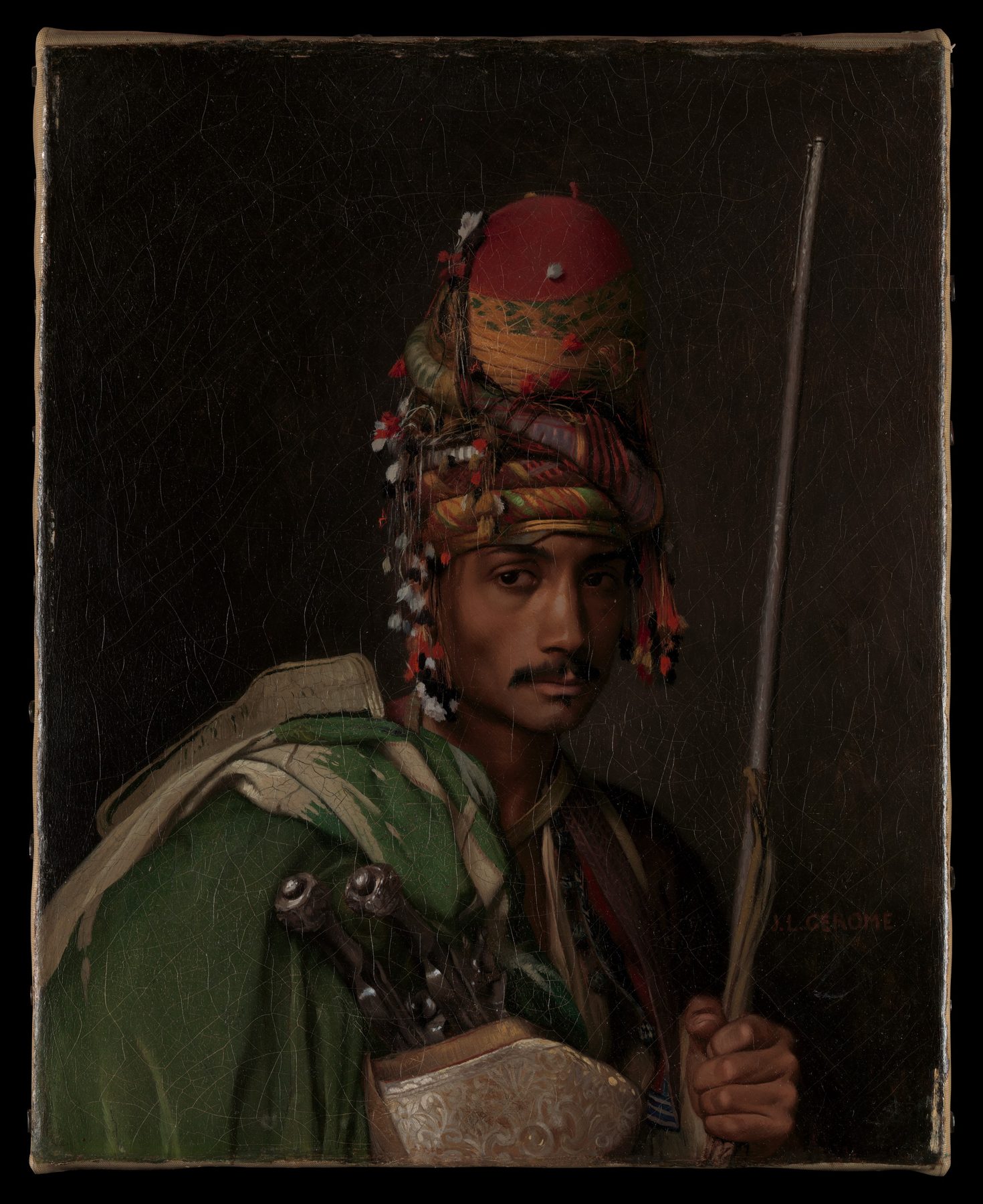
Bashi-Bazouk works differently. Gérôme dressed a studio model in textiles collected during travel and titled the portrait after an Ottoman irregular soldier associated in European accounts with violence and indiscipline. The figure neither fights nor threatens. His guarded expression and magnificent costume give him an individual dignity that exceeds the type.[21]
The model's name was not preserved. This loss is historically important. Nineteenth-century European art often transformed Black models into representatives of a race, continent or institution while discarding their biographies.[22] Looking closely means resisting the title's demand that one man become “the bashi-bazouk”.
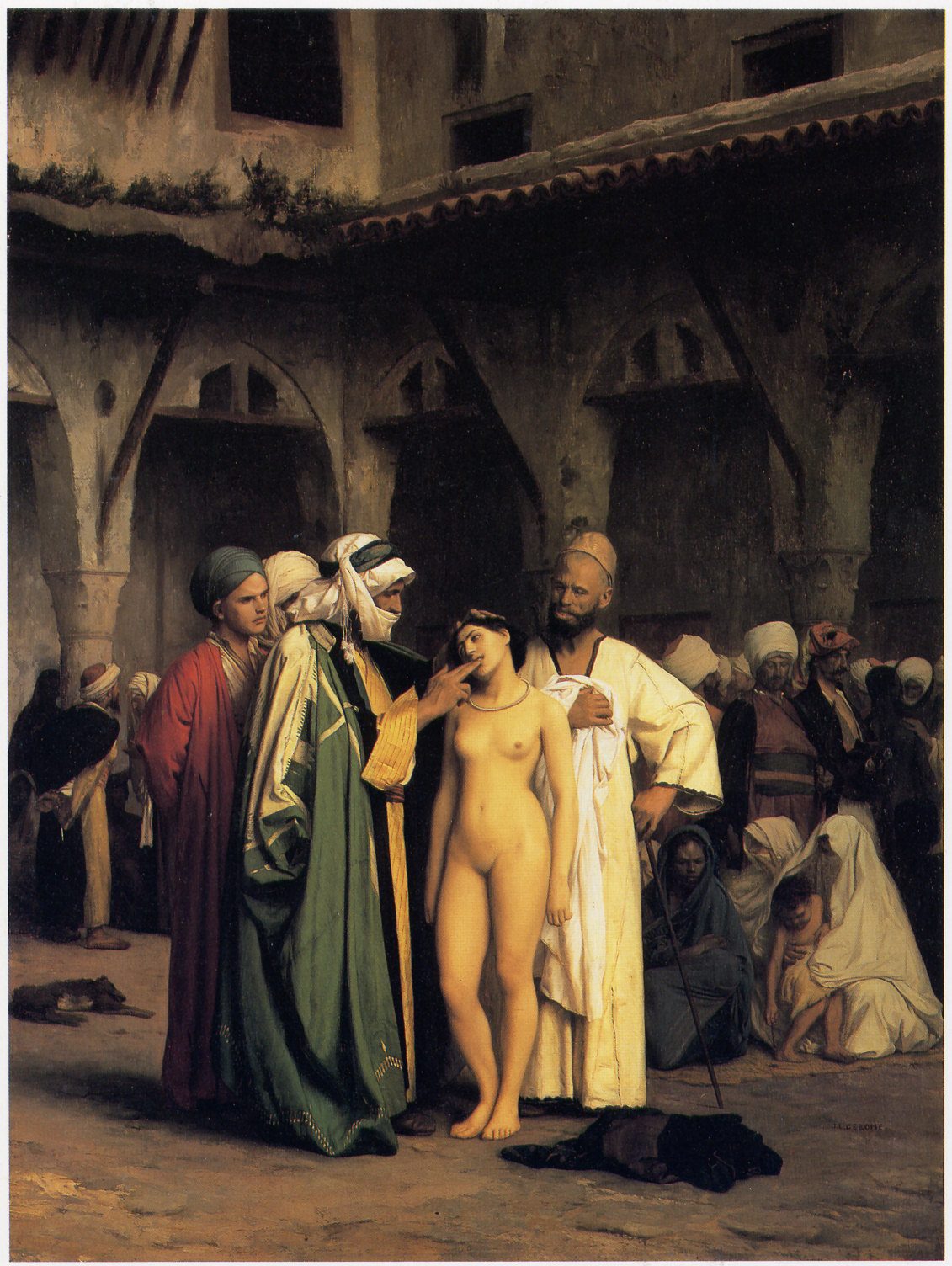
In Slave Market, a prospective buyer examines the teeth of a naked woman while clothed men surround her. Gérôme had seen and studied Middle Eastern places, but the exact event is not securely documented; literary accounts, travel sketches and studio models likely contributed. The architecture remains nonspecific.[20]
The scene condemns slavery as dehumanising while offering the female body to the European viewer. The buyer, whose own body is concealed, can inspect what the spectator sees. Slavery becomes an eastern barbarism from which Europe appears morally separate, despite European and Atlantic histories of enslavement and contemporary colonial coercion.[20]
These paintings should not be read by a single formula. Bashi-Bazouk can resist its own typology; Slave Market can produce horror and voyeurism simultaneously. The shared lesson is that pictorial exactitude never guarantees ideological neutrality.
Photography and the promise of evidence
Photography entered the Ottoman Empire and Middle East soon after its invention. European travellers, military officers, archaeologists and commercial studios used it to record monuments and people. Ottoman photographers and patrons used it for court portraiture, administration, family history and commerce.[23]
The camera did not eliminate staging. Studios such as Bonfils, Abdullah Frères and Pascal Sébah arranged backdrops, costumes, props and repeated “types” for tourist buyers. Albums mixed professional and amateur pictures; travellers photographed themselves among monuments as evidence of possession and experience.[24]
Painters used photographs as modular sources. Gérôme might borrow tiles or architecture without retaining the photographed setting. Photography's mechanical detail lent credibility even when the final composition was fictional.
At the same time, local image-makers complicate any story of a camera aimed only from West to East. Abdullah Frères served Ottoman patrons and photographed imperial architecture; Sébah's Istanbul studio employed local expertise and participated in international exhibitions. Subjects could commission, circulate and preserve images, even within unequal markets.
The useful distinction is not painting equals fantasy and photography equals truth. Both mediums involve framing, pose, selection, caption, purchaser and archive. The question is who controls those decisions and what kind of evidence the image claims to provide.
British, Spanish and German-speaking variants
French Orientalism is the best-known because Parisian institutions, Egyptian occupation and Algerian colonisation created an especially powerful conjunction. Other European traditions had different routes.
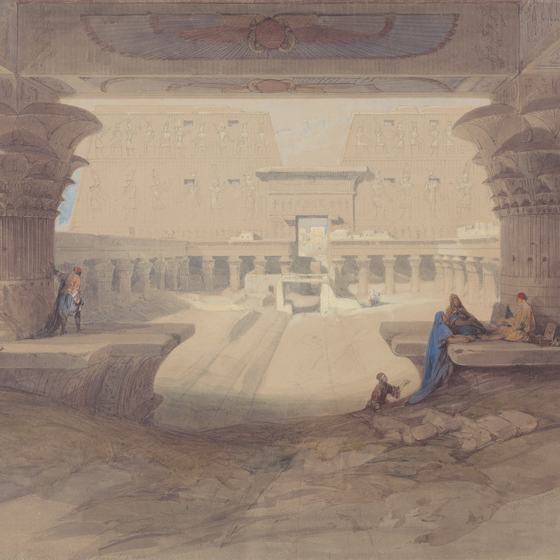
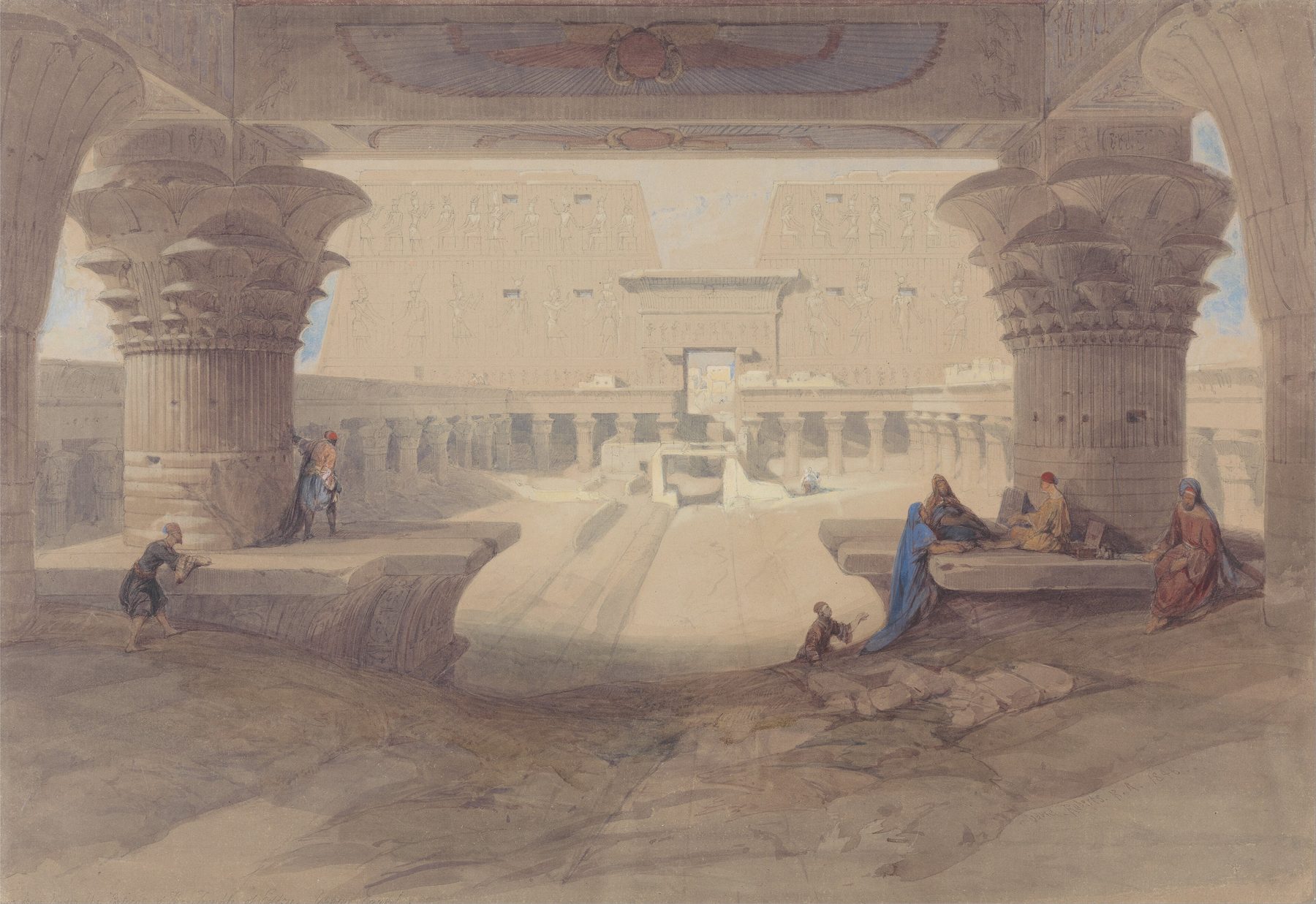
British painters and illustrators often travelled through imperial and biblical networks. David Roberts visited Egypt and the Holy Land in 1838–39, turning watercolour studies into highly successful lithographs. His carefully staged architecture offered armchair travellers monumental access while joining archaeological interest to the picturesque.[30]
John Frederick Lewis lived in Cairo for years and became celebrated for complex interiors. His Courtyard of the Coptic Patriarch's House attends to animals, architecture and social activity rather than the conventional Muslim harem.[29] Yet residence did not remove the market's expectation of intricate, luxurious eastern life.
British religious painters sought the exact landscape and costume of the Bible. Detailed contemporary observation was used to reconstruct sacred antiquity, as though the modern region had remained outside historical change. Protestant demands for legibility and direct study could thus coexist with an Orientalist idea of timelessness.[3]
Spain occupied an unstable position. Andalusia's Islamic architecture made it seem partly eastern to northern European visitors, while Spanish artists themselves travelled to Morocco. Mariano Fortuny's brilliant surfaces and crowded Moroccan subjects joined eyewitness studies to the market for spectacle.
In Vienna and German-speaking centres, proximity to Ottoman history, travel and studio masquerade all mattered. Amerling's Viennese model became The Oriental Woman through costume and light.[54] Delacroix and Gérôme circulated through German collections, while the harem offered the same sexual displacement visible in France.[17] [53]
These variants show why Orientalism is not a French style exported intact. Each national culture built its East from different imperial, religious, commercial and artistic needs.
Biblical, archaeological and ancient Orientalisms
Not every Orientalist picture represents contemporary Muslim life. Artists travelled to Palestine and Egypt to reconstruct biblical history or ancient civilisation. Architecture and costume were treated as surviving evidence for the distant past.
This method could yield remarkable innovations. Gérôme's Jerusalem uses a studied landscape to avoid conventional sacred figures.[52] David Roberts made ancient temples available through an architectural traveller's eye.[30] Yet the search for biblical authenticity could make living inhabitants seem like remnants rather than modern subjects.
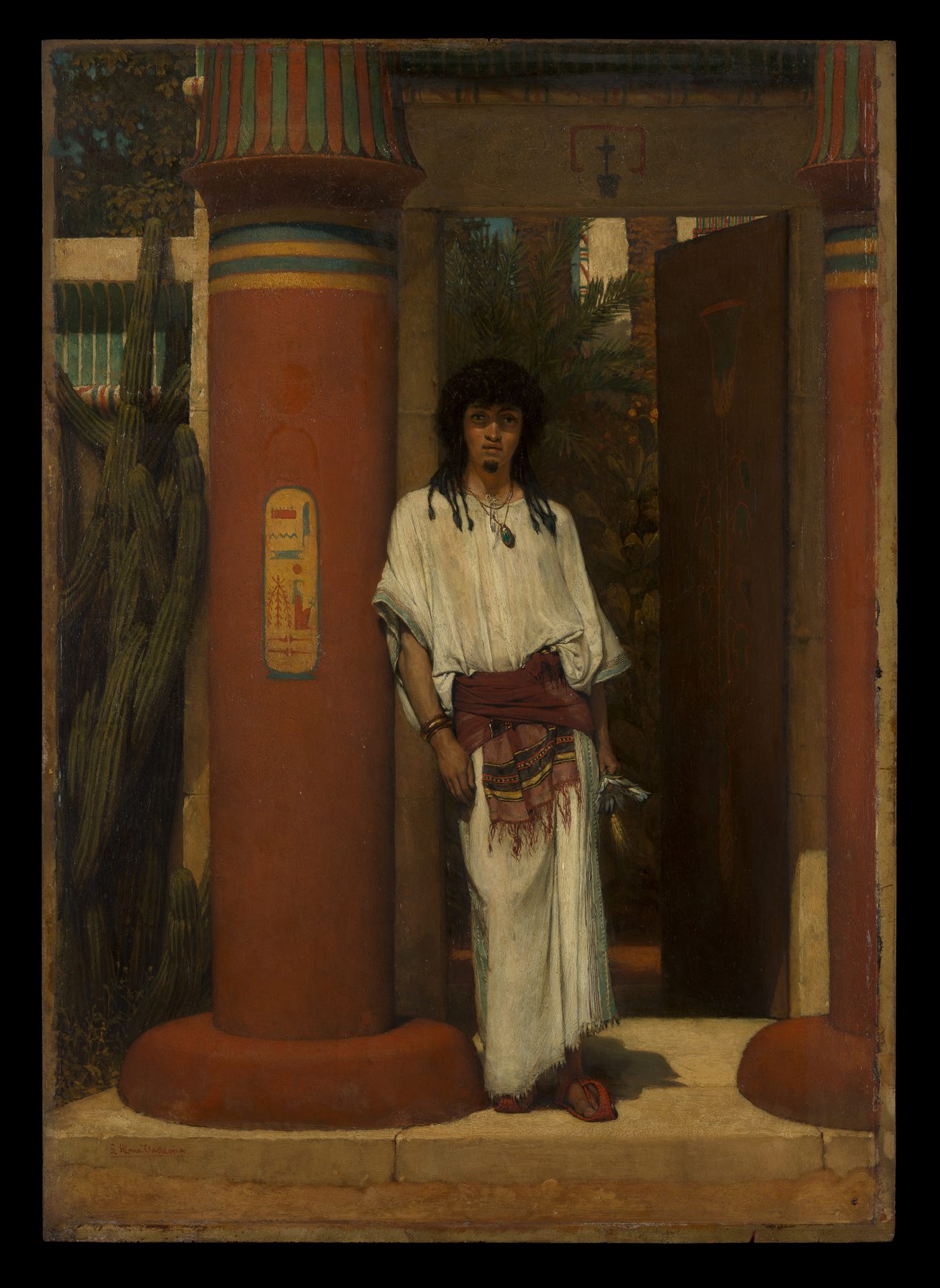
Lawrence Alma-Tadema belongs at the category's edge. In the mid-1860s he painted ancient Egyptian scenes with archaeological precision and an uncanny appearance of daily life. An Egyptian in a Doorway parallels Gérôme's ability to make a distant civilisation look immediately present. Alma-Tadema later specialised in Greece and Rome, so he should not be labelled primarily an Orientalist.[34]
Archaeology itself participated in competition over excavation, collecting and export. An ancient object in a painting might signal scholarship; the same object in a European museum carried a modern history of acquisition. Orientalism joined the fantasy of an unchanging East to the aggressive recovery of its past.
Henriette Browne and gendered access
Women were artists as well as imagined inhabitants of the harem. Sophie de Boutellier worked under the name Henriette Browne, partly concealing a professional identity considered improper for a woman of her social position. Diplomatic connections enabled her to travel in the Middle East and enter spaces generally closed to European men.[49]
Her A Flute Player (Harem Interior, Constantinople, 1860) appeared at the Salon of 1861.[48] Browne could observe women's domestic space without inventing the male traveller's forbidden threshold. Later work such as A Poet: The Copts in Upper Egypt avoids the excessive luxury and eroticism familiar in the genre.[49]
Access does not automatically make her paintings transparent records. She still worked for European exhibitions, selected picturesque subjects and occupied a privileged travelling position. But gender changed what she could see and how she pictured it. Her quiet interiors disrupt the assumption that the Orientalist gaze was always male, nude-seeking and stylistically uniform.
Her career also reveals barriers within Europe. A woman needed a pseudonym and unusual social connections to pursue professional travel. Orientalism could expand a female artist's subject matter while the art world continued to constrain her identity.
Ottoman artists, patrons and photographers
The Ottoman world did not wait to be represented. Sultans, officials, artists, photographers, collectors and publishers actively shaped modern visual culture. Reform brought European-style military schools, art education, architecture and easel painting into dialogue with Ottoman traditions.[35]
Sultan Abdülaziz collected contemporary European art and employed foreign painters. Through Goupil, the palace acquired French paintings that included Orientalist subjects. Ottoman buyers could therefore purchase European images of an East to which Europeans imagined they belonged.[42]
Photography served state and private purposes. Court patrons commissioned albums of architecture, officials and institutions; commercial studios sold portraits and views to local and foreign buyers. Images flowed in more than one direction.
Şeker Ahmet Paşa studied in Paris and developed landscape and still-life painting rather than Gérôme-like Orientalist genre. Osman Hamdi Bey took a different route, adopting Academic figure painting for Ottoman interiors. Their choices demonstrate that European technique did not dictate one subject or identity.[35]
The language of influence can therefore mislead. Ottoman modernity was not passive Westernisation. Artists selected, translated and institutionalised practices while operating within their own empire's hierarchies. European and Ottoman powers were unequal in many contexts, but neither “East” nor “West” acted as one person.
Osman Hamdi Bey: inside, outside and between
Osman Hamdi Bey was born in Istanbul, studied in Paris and absorbed the Academic language associated with Gérôme and Gustave Boulanger. He exhibited internationally and painted carefully constructed scenes of Ottoman religious architecture, scholars, objects and dress.[36]
He was also an administrator, archaeologist and institution-builder. As director of the Imperial Museum and founder-director of the Academy of Fine Arts, he shaped how Ottoman antiquities and modern art were collected and taught. In 1884 he revised antiquities regulations intended to retain cultural objects within Ottoman lands.[36]
His paintings complicate the category of Orientalism because formal resemblance does not settle viewpoint. He frequently used himself or relatives as models, sometimes photographed in costume. He combined real architectural features, textiles, books and inscriptions into scenes that were historically attentive but not literal records.[39] [40]
In Hodja Reading the Koran, a seated figure occupies the Green Mosque in Bursa. Mamluk metalwork, Venetian glass, a Qur'an case, books and legible or partly legible inscriptions create a material history of exchange. Visible underdrawing and unfinished passages remind viewers that meticulous illusion was built through process.[39]
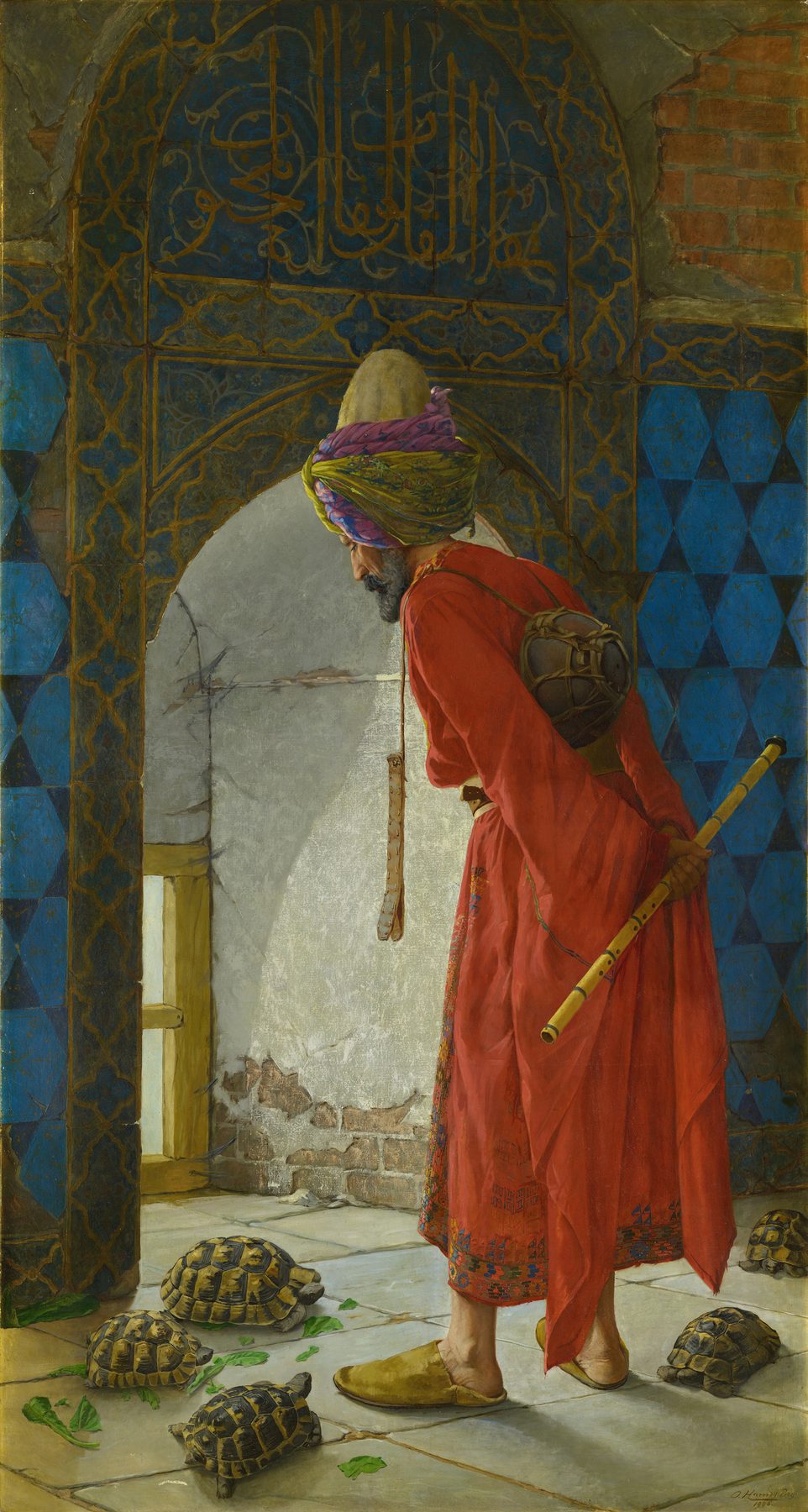
In The Tortoise Trainer, Osman Hamdi pictured himself as an invented dervish carrying a flute and drum while tortoises move below. The Bursa interior and carefully assembled costume support interpretations of slow reform, patient culture and institutional frustration, but no single allegorical key is secure.[40]
His 1879 At the Mosque Door entered a modern international art market while remaining an Istanbul-made work by an Ottoman artist.[41] Is this self-Orientalism, cultural preservation, reformist critique or a strategic use of Western expectations? Turkish scholarship continues to disagree. Recent research examines coded social criticism without denying that the paintings employ a marketable Orientalist language.[37] [38]
Calling Osman Hamdi an “insider” does not solve the problem. He was an elite Ottoman official educated in Paris, exercising institutional power within a multiethnic empire. Calling him simply a Westernised imitator is equally inadequate. His work shows that Orientalism could be adopted, redirected and contested from within the territories it claimed to describe.
Objects, design and international exhibitions
Orientalism extended far beyond paintings. Islamic carpets, tiles, glass, metalwork, manuscripts, arms and garments entered European collections. Artists used them as studio props; designers studied their patterns; museums classified them; consumers bought machine-made adaptations.[1] [2]
Owen Jones studied the Alhambra and published its ornament before making Islamic design central to The Grammar of Ornament. At the South Kensington Museum, now the V&A, his Oriental Courts placed Indian, Chinese and Japanese collections within decorated environments. Such projects challenged narrow European design habits and treated pattern as a sophisticated visual language.[33]
Admiration could still detach form from history. A tile pattern might be copied without its architectural, religious or linguistic context. “Oriental” fashion deliberately mixed Chinese silk, Indian shawls, Japanese kimono forms and Ottoman accessories to create exotic novelty.[32]
International exhibitions intensified the process. Pavilions reconstructed streets and palaces, imported craftspeople and performers and promised visitors a journey without leaving Paris or London. The display could give non-European governments a platform for self-representation, yet fair organisers often converted living cultures into spectacle.[7]
Collecting preserved remarkable objects and supported serious scholarship. It was also shaped by colonial excavation, unequal trade and the authority to remove and rename. Current museum displays increasingly place Islamic art and European Orientalist painting in dialogue rather than treating one as timeless source material for the other.[1] [31]
Said, Nochlin and the critical turn
Said's Orientalism changed how scholars understood representation. His central argument was not that every Western statement about Asia or the Middle East was false. It was that a durable system of knowledge defined “the Orient” as an object of study and rule, contrasting it with a self-authorising West.[6]
Nochlin's “The Imaginary Orient” applied this challenge to nineteenth-century painting. Gérôme's seamless realism suppresses signs of manufacture. His streets appear outside modern history; labour, resistance and colonial officials disappear; the European viewer enjoys access without becoming visible. The picture's absence of brushwork parallels its absence of power.[7] [20]
This approach restored questions excluded by connoisseurship. Who commissioned and bought the image? Could the artist enter the place represented? Why are some figures nude and others armed? What histories would disturb the scene's timelessness?
Criticism has also revised the framework. A strict West/East opposition can repeat the division it seeks to expose. It may overlook Ottoman patrons, local photographers, mixed families, translators, artists trained abroad and objects made for export. It can make represented people passive once again by discussing only what Europe did to them.[1] [35]
The strongest current scholarship holds structure and exchange together. Colonial power affected access and meaning; admiration and learning were also real; artists and patrons in Ottoman and Arab societies acted within the same global market. No single moral label replaces object-specific history.
Returned gazes and modern afterlives
Orientalist forms did not disappear when Academic painting declined. Cinema inherited desert spectacle and harem décor; fashion revived the odalisque; tourism repeated picturesque types. Modernist painters borrowed colour and the reclining figure, sometimes loosening older narratives while retaining their visual privileges.
Artists from the regions represented have actively reworked this archive. Moroccan-born Lalla Essaydi stages large photographs of women in interiors, referring to nineteenth-century odalisques while clothing her subjects and covering bodies and walls with Arabic calligraphy. Their gazes confront the viewer; henna, writing and bullet casings join beauty to questions of gender, authorship and violence.[43] [44]
Egyptian artist Hamed Abdalla transformed the familiar image of women carrying water. In Les porteuses d'eau, bodies emerge through Arabic words, connecting rural labour, Pan-Arab politics and a claim that modern abstraction has local intellectual sources.[45] [46]
Shirin Neshat, Rania Matar and Youssef Nabil use photography and staged imagery to address veiling, rooms, memory and performance without forming one corrective “Eastern view”. Current Musée d'Orsay displays place Nabil's work beside nineteenth-century collections, allowing quotation and difference to become visible.[47]
These artists do more than answer Europeans. Their works have their own formal languages, political circumstances and audiences. A returned gaze becomes most powerful when it is not reduced to a footnote in the history it transforms.
Artists to know
Jean-Auguste-Dominique Ingres
Ingres made the imagined harem a laboratory for line and the nude. His refusal of ordinary anatomy is formally radical, while his accessories and unnamed figures reveal how distance authorised erotic availability.[15] [17]
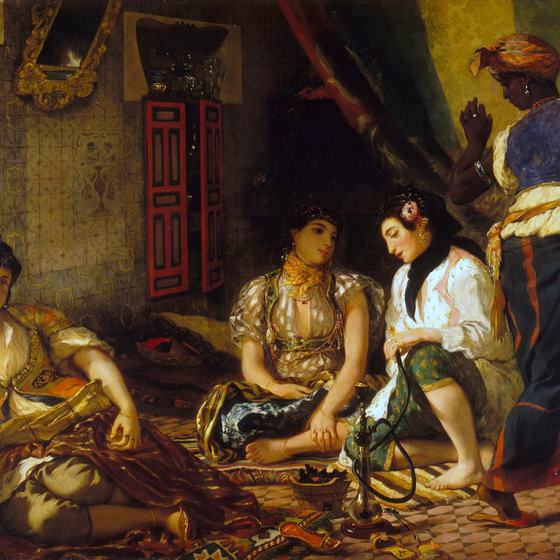
Eugène Delacroix
Delacroix moved from literary violence to a deep travel archive after 1832. Moroccan ceremony, Algerian domestic space, animals and costume enriched a colour practice that later painters separated from its original Orientalist settings.[12] [14]
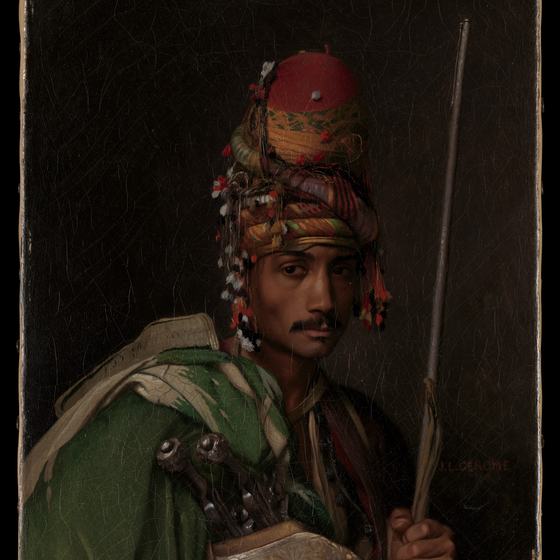
Jean-Léon Gérôme
Gérôme perfected the appearance of witnessed fact. Travel, photography, objects and Academic technique gave his invented scenes unusual credibility, while Goupil made them globally influential.[18] [19]
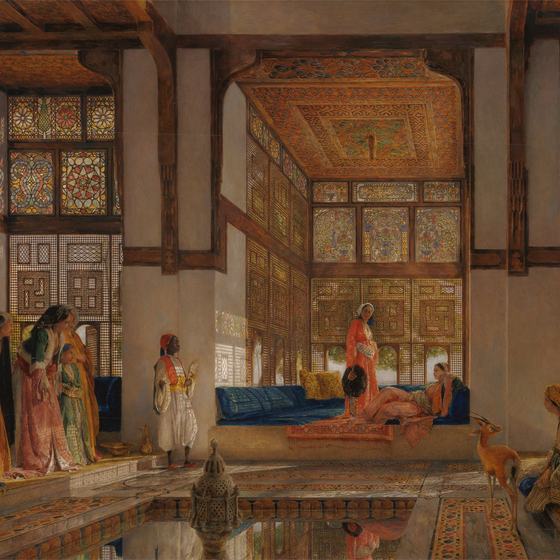
John Frederick Lewis
Lewis's long residence in Cairo supported minutely described courtyards and interiors. His watercolour-like precision made domestic space appear accessible while distinguishing British genre from French Romantic drama.[29]
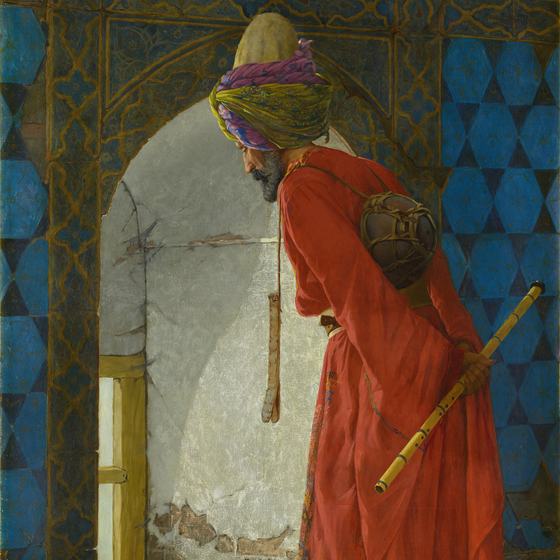
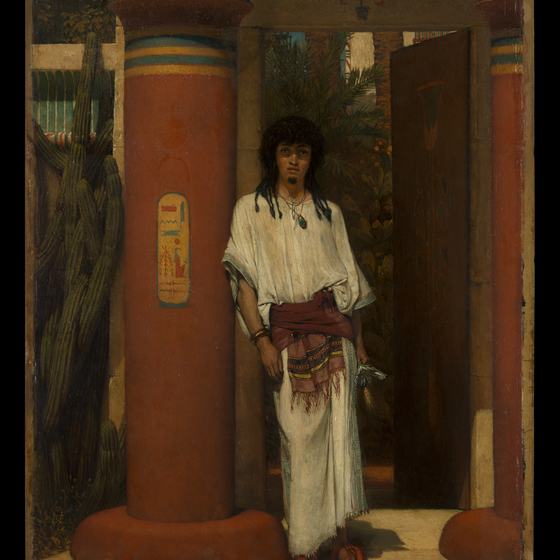
Lawrence Alma-Tadema
Alma-Tadema's early Egyptian subjects share Orientalism's archaeological illusion, though his later art is more securely associated with classical Greece and Rome.[34]
Further artists
Alexandre-Gabriel Decamps
Decamps's journey in Asia Minor helped establish Orientalist genre painting in the 1830s. Soldiers, streets and ordinary activity offered an alternative to both Neoclassical fantasy and grand imperial history.[3]
Théodore Chassériau
Chassériau joined Ingres's linear inheritance to Delacroix's colour and travelled to Algeria in 1846. His Jewish-quarter scenes, battles and bathers show how observed communities and erotic conventions could coexist uneasily.[3]
David Roberts
Roberts translated travel drawings of Egypt and the Holy Land into widely distributed lithographs. Architecture becomes both archaeological evidence and theatrical stage.[30]
Henriette Browne
Browne's professional identity and access to women's spaces complicate a male-centred canon. Her quieter domestic and Coptic subjects resist some familiar excesses without standing outside European privilege.[48] [49]
Major artists directory
| Name | Nationality | Key Works |
|---|---|---|
| Alexandre-Gabriel Decamps | French | The Turkish Patrol |
| David Roberts | British | From under the Portico of the Temple of Edfu |
| Eugène Delacroix | French | Women of Algiers in Their Apartment, Jewish Wedding in Morocco |
| Henriette Browne | French | A Flute Player |
| Jean-Auguste-Dominique Ingres | French | La Grande Odalisque, The Turkish Bath |
| Jean-Léon Gérôme | French | The Snake Charmer, Bashi-Bazouk, The Slave Market |
| John Frederick Lewis | British | The Reception |
| Lawrence Alma-Tadema | Dutch-British | An Egyptian in a Doorway |
| Osman Hamdi Bey | Ottoman | The Tortoise Trainer |
| Théodore Chassériau | French | Battle of Arab Horsemen Around a Standard |
How to look at an Orientalist painting
Start with the title. Does it name a person, city and date, or offer a type such as “odalisque”, “Arab”, “bashi-bazouk” or “oriental woman”? A generic title can convert individuality into category before the looking begins.
Locate the scene as precisely as possible. A painting may combine Turkish tiles, Balkan costume, Persian armour and an Egyptian performance. Geographic mixture can be deliberate fantasy or hidden beneath a claim of exactitude.
Ask how the artist gained access. Did they travel? Was the subject public architecture or a private women's interior? Was a photograph used? Travel answers only the first question; it does not prove that the depicted encounter occurred.
Look for the spectator's position. Are you placed at a doorway, above a market, inside a bath or directly before an exposed body? Does anyone in the scene meet your gaze? Orientalist pictures often make extraordinary access feel effortless.
Examine surface and technique. Delacroix's visible colour can emphasise sensory encounter. Gérôme's smooth finish suppresses manufacture and makes the scene appear factual. Ingres's contour announces aesthetic deformation. Political meaning is carried through these choices, not added after formal analysis.
Identify objects. Carpets, weapons, tiles and inscriptions may be accurately rendered, but ask whether they belong together and what happens when sacred or functional things become décor. An illegible inscription is not equivalent to a readable one.
Notice time. Does the scene contain modern technology, trade and administration, or does it appear unchanged for centuries? Timelessness can make colonial intervention seem like an encounter with a culture without history.
Finally, recover agency. The represented people were not simply figures in European stories. What local artists, patrons, photographers and writers were producing at the same moment? What does the painting reveal despite its framework? Critical looking should expand the field of vision, not make the object disappear.
Frequently Asked Questions
Not in the strict sense. There was no organisation, manifesto or shared style. Orientalism is a subject field found across Neoclassicism, Romanticism, Academic art, Realism and other movements. Its artists were linked by ways of imagining and representing an East rather than by one technique.[1] [5]
The meaning changed with speaker and context. It could include Greece, the Ottoman Empire, North Africa, the Middle East, Persia, India and East Asia. Because the term is defined from a European point of view, it compresses distinct cultures into a directional opposite. Art historians now use more specific geography whenever possible.[3] [7]
No single verdict fits every object. Some works explicitly supported empire; others pursued colour, religion, architecture, portraiture or cultural admiration. Even sympathetic pictures may depend on unequal access or stereotypes, while overtly constructed works can preserve valuable material evidence. The task is to analyse the specific image, market and history.[1] [3]
Some did and some did not. Ingres never travelled to the regions represented in his odalisques. Delacroix visited Morocco and Algeria in 1832; Gérôme made several journeys; Lewis lived in Cairo; Roberts travelled in Egypt and the Holy Land. Travel supplied evidence but did not prevent studio invention.[10] [14] [18]
European men generally had little access to women's domestic quarters. That prohibition made the harem an especially potent fantasy of luxury, idleness and sexual availability. The historical harem was a protected household space with family, service and political functions, not merely the erotic room imagined in painting.[17] [27]
Orientalism can be used very broadly, but nineteenth-century art history normally treats Japonisme as a more specific engagement with Japanese prints, objects and design after Japan's international trade expanded. Orientalist painting focused chiefly on North Africa, the Middle East and Ottoman lands and was more directly entangled with European colonial rule in those regions.
Photography supplied painters, tourists, governments and scholars with detailed visual records. It also created staged studio types and tourist albums that repeated existing fantasies. Ottoman and local photographers participated actively, so the medium cannot be described as a wholly European gaze.[23] [24]
His Academic technique, composite interiors and international market connect him to Orientalism. Yet he was an Ottoman artist, museum director, archaeologist and art-school founder who used himself and relatives as models and pursued cultural preservation and possible social critique. Scholars reasonably disagree over whether “Ottoman Orientalist” clarifies or oversimplifies him.[36] [37] [38]
Said showed that representations of the Orient belonged to systems of knowledge and authority, not merely private fantasy. Art historians then asked how paintings naturalised difference, hid colonial presence and positioned the viewer. Later scholarship has extended the critique by restoring Ottoman, Arab and other local agents to the history.[6] [7] [35]
Discussion
Choose an Orientalist painting that initially appears highly realistic. Which details establish its authority, and which parts of the encounter cannot be verified from the image? Consider the title, models, architecture, objects, viewpoint and intended buyer. Does greater knowledge of its construction reduce its visual power, or explain how that power was made?
Reader Insights
Replace the vague “East” with the most precise city, region, people and political situation the evidence allows.
Ask how the artist could enter, observe or reconstruct the space—and which conditions made the spectator’s view possible.
Notice how brushwork, polish, contour and detail either reveal construction or make an invented scene appear factual.
Join the Conversation
Which apparently realistic Orientalist painting becomes most revealing when you investigate how its authority was constructed? Share your view below.
References
- Orientalism: Between Fact and Fantasy, Metropolitan Museum of Art. View Source
- Orientalism: Between Fact and Fantasy — publication, Metropolitan Museum of Art. View Source
- Orientalism in Nineteenth-Century Art — Spanish edition, Metropolitan Museum of Art. View Source
- An Introduction to Orientalist Painting, British Museum. View Source
- L'orientalisme, Musée d'Orsay. View Source
- Edward Said, Orientalism: teaching materials, Columbia University. View Source
- Orientalism, Nancy Demerdash, Smarthistory. View Source
- Nineteenth-Century European Paintings: Snake Charmer, Clark Art Institute. View Source
- La Description de l'Égypte, Bibliothèque nationale de France. View Source
- Le voyage en Orient, Bibliothèque nationale de France. View Source
- 1848, Musée national de l'histoire de l'immigration. View Source
- Les Femmes d'Alger de Delacroix retrouvent leurs couleurs, Musée du Louvre. View Source
- Delacroix, Metropolitan Museum of Art. View Source
- Jinete árabe, Museo Nacional Thyssen-Bornemisza. View Source
- Ingres: Eros ingresque, Musée du Louvre. View Source
- Une beauté idéale? La Grande Odalisque, Musée du Louvre. View Source
- Jean-Auguste-Dominique Ingres: Odalisque, Städel Museum. View Source
- Jean-Léon Gérôme: L'Histoire en spectacle, Musée d'Orsay. View Source
- Jean-Léon Gérôme — Spanish exhibition, Museo Nacional Thyssen-Bornemisza. View Source
- Nineteenth-Century European Paintings: Slave Market, Clark Art Institute. View Source
- Bashi-Bazouk — French edition, Metropolitan Museum of Art. View Source
- Fictions of Emancipation: Carpeaux Recast, Metropolitan Museum of Art. View Source
- Orientalist Photography, Getty Research Institute. View Source
- Photographs of the Middle East and North Africa, Getty Research Institute. View Source
- Afternoon in the Harem, Metropolitan Museum of Art. View Source
- The Favorite of the Emir, National Gallery of Art. View Source
- Henry Laurens et Laure Chabanne: Ramsès dans son harem, Musée d'Orsay. View Source
- The Harem, British Museum. View Source
- Courtyard of the Coptic Patriarch's House in Cairo, Tate. View Source
- Egyptian Temple, National Galleries of Scotland. View Source
- Collecting Islam: The Western Eye, Victoria and Albert Museum. View Source
- Orientalism: Visions of the East in Western Dress, Metropolitan Museum of Art. View Source
- Owen Jones and the Grammar of Ornament, Victoria and Albert Museum. View Source
- An Egyptian in a Doorway, Metropolitan Museum of Art. View Source
- The Later Ottomans and the Impact of Europe — German edition, Metropolitan Museum of Art. View Source
- Osman Hamdi Bey, Sakıp Sabancı Museum. View Source
- Oryantalist Resim Koleksiyonu, Pera Museum. View Source
- Oryantalizm ve Eleştiri: Osman Hamdi Bey'in Sanatında Batı'nın Beklentisi, Hülya Kalyoncu. View Source
- Hodja Reading the Koran, Sakıp Sabancı Museum. View Source
- Portraits from the Empire, Pera Museum. View Source
- At the Mosque Door, Metropolitan Museum of Art. View Source
- Abdülmecid Efendi — Russian edition, Metropolitan Museum of Art. View Source
- Returning the Gaze: Lalla Essaydi, National Museum of Women in the Arts. View Source
- She Who Tells a Story, National Museum of Women in the Arts. View Source
- Les porteuses d'eau, Metropolitan Museum of Art. View Source
- Egyptian Modern Art, Metropolitan Museum of Art. View Source
- Nouveaux regards sur les collections orientalistes, Musée d'Orsay. View Source
- Une joueuse de flûte (intérieur de harem, Constantinople, 1860), Musée d'Orsay Salon database. View Source
- Paris 1874: The Impressionist Moment — Henriette Browne, National Gallery of Art. View Source
- L'Orient vu et corrigé par l'Occident, Musée de l'Armée. View Source
- L'expédition d'Égypte (1798–1801), Bibliothèque nationale de France. View Source
- Jérusalem, Musée d'Orsay. View Source
- Eugène Delacroix — German collection, Städel Museum. View Source
- Die Morgenländerin, Belvedere. View Source
- Orientalism: Between Fact and Fantasy — German edition, Metropolitan Museum of Art. View Source
- Image references 56–70: open-access reproductions and institutional collection records.
View 15 image sources
01 · commons.wikimedia.org02 · commons.wikimedia.org03 · commons.wikimedia.org04 · commons.wikimedia.org05 · commons.wikimedia.org06 · commons.wikimedia.org07 · commons.wikimedia.org08 · commons.wikimedia.org09 · commons.wikimedia.org10 · commons.wikimedia.org11 · commons.wikimedia.org12 · commons.wikimedia.org13 · commons.wikimedia.org14 · commons.wikimedia.org15 · commons.wikimedia.org