 by Tom Gurney
Tom Gurney BSc (Hons) is an art history expert with over 20 years experience
Published on June 19, 2020 / Updated on August 21, 2026
Email: tomgurney1@gmail.com / Phone: +44 7429 011000
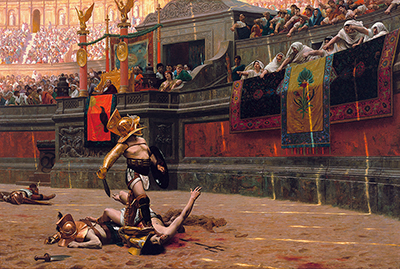
The defeated gladiator raises two fingers, but the appeal for mercy is being drowned by a forest of hostile hands. Spectators lean over the arena wall. White-robed women thrust out their thumbs. The victor waits above the fallen man, his weapon poised for the decision that will turn spectacle into death.
Jean-Léon Gérôme's Pollice Verso is so visually persuasive that it helped make one interpretation of the Roman arena feel like common knowledge: thumbs down meant kill. Ancient evidence is far less straightforward. The Latin title means “with a turned thumb,” without stating a direction, and historians disagree about the gesture's precise form. Rather than illustrating a settled custom, Gérôme gave an uncertain phrase a compelling modern image.
Painted in 1872, the canvas is both an archaeological spectacle and a study of spectatorship. Its violence belongs to the crowd as much as to the armed men. The deepest question is not only whether Gérôme reconstructed Rome correctly. It is why he places us where we can see the victim, the executioner and the pleasure of those demanding the blow.
At a Glance
- ArtistJean-Léon Gérôme
- TitlePollice Verso (Thumbs Down)
- Date1872
- MediumOil on canvas
- Dimensions97.4 × 146.6 cm (38 3/8 × 57 3/4 in.)
- CollectionPhoenix Art Museum
- AccessionMuseum purchase, 1968.52[1]
The Instant Before the Death Stroke
Gérôme does not paint the contest itself. One gladiator has already fallen. His shield and body lie close to the sand while his raised hand asks for a different ending. The standing victor occupies the painting's central axis, turning towards the authority that will decide whether he completes the kill.
That pause gives every gesture consequence. The victor's stillness is conditional: his body contains action but waits for permission. The defeated man's smaller gesture must cross the physical and social distance between the arena floor and the judging crowd. Above them, dozens of arms answer more loudly.
The painting is organised through stacked zones. Sand fills the foreground, bearing the bodies and discarded equipment of combat. A decorated barrier separates fighters from spectators. Above it, the audience rises in dense tiers towards the imperial box. Gérôme makes the architecture readable at a glance, then uses it to describe power. Those lowest in the composition are most exposed; those above can demand violence without receiving it.
The hard arena light sharpens metal, cloth and skin. The fighters are given material weight, but the surrounding crowd becomes a mass of faces and repeated gestures. Individual identity gives way to collective appetite. The white garments of the women nearest the arena make their extended arms especially prominent. Tradition identified them as Vestal Virgins, sacred figures whose participation intensifies the painting's moral shock.[2]
The emperor sits above and to the right, but Gérôme does not allow imperial authority to dominate the whole canvas. The crowd's verdict already seems overwhelming. Power moves downwards from the box, sideways through the spectators and finally into the victor's weapon.
What Does Pollice Verso Mean?
The title comes from Latin. Pollice is a form of pollex, meaning thumb; verso indicates turning. The phrase can be translated as “with a turned thumb,” but it does not say that the thumb pointed downwards.[3][4]
The familiar modern code—down for death, up for mercy—cannot be projected backwards with confidence. Ancient texts mention the thumb in relation to gladiatorial decisions, but their wording is brief, culturally specific and difficult to connect to one surviving image. Modern reconstructions therefore differ.
Classicist Anthony Corbeill has argued that Roman gestures depended on the thumb's symbolic force. In his reconstruction, a hostile, extended thumb represented the weapon and demanded the fatal stroke, while mercy could be indicated by pressing or concealing the thumb. The decisive opposition was not necessarily down versus up, but visible hostile extension versus restraint.[3][4]
That interpretation differs from the scene Gérôme made famous. His spectators project their thumbs towards the arena in varied directions, and the English subtitle “Thumbs Down” fixes the modern reading more firmly than the Latin itself. Other scholars have debated the evidence, so the safest conclusion is not that one precisely documented ancient gesture has been recovered. The sources leave room for disagreement.
Gérôme's achievement lies partly in making ambiguity disappear. A disputed phrase becomes a clear pictorial command. Because the painting feels archaeologically dense, its invented clarity can be mistaken for fact.
Archaeology and Artistic Reconstruction
Gérôme took the ancient world seriously as a visual problem. A conversation reported after his death recalls his excitement that earlier painters and sculptors had visited Rome without thinking to “recreate a gladiator.”[5] The wording survives through André Castaigne and Charles Moreau-Vauthier rather than a contemporary transcript, but it captures an ambition evident in the paintings: archaeology could supply an immense horizon for art.
Project translation of the reported passage:
> “This opens an immense horizon for me! How is it that all the painters and sculptors have come here and seen this, yet not one has thought of recreating a gladiator?”[5]
Recreation required more than copying an excavated helmet or building. Gérôme needed bodies, equipment, architecture, ritual and a dramatic relation between them. The visible world of Pollice Verso draws authority from detailed objects, but the final event is a synthesis. Evidence has been selected and arranged to produce an intelligible Rome.
The distinction protects the painting from two equally weak readings. It is not a photograph of an ancient arena. Nor is it careless fantasy with decorative archaeology. Gérôme's historical research and his dramatic invention work together. The more persuasive the individual detail, the more easily the whole reconstruction acquires the status of memory.
Modern scholarship has corrected elements of nineteenth-century arena imagery, including the thumb convention. Those corrections do not empty the canvas of interest. They show how historical images can shape the questions later audiences bring to history.
The Crowd as the Subject
Emily Beeny's study of Gérôme's arena pictures shifts attention from archaeological props to the act of viewing. The Roman crowd consumes blood as spectacle, while the modern audience stands before a painted spectacle of the same violence.[2] Gérôme makes the two forms of looking uncomfortably similar.
The painting offers us a privileged position. We are close enough to see the defeated man's gesture, but elevated enough to survey the arena and its social order. We do not occupy one literal seat. Our view glides between sand and stands, combining access that no single ancient spectator would possess.
That freedom makes the audience powerful. We can inspect the fighters' bodies, decode the crowd and assess the emperor. Yet the defeated man cannot meet our gaze or appeal directly to us. Like the Roman spectators, we receive violence as a composed image.
The painting can therefore be understood as a mirror with an unequal surface. It condemns or at least exposes the crowd's appetite, but it also uses the same appetite to hold attention. Armour, architecture, suspense and bodily danger make death visually compelling. Gérôme does not let moral distance arrive easily because spectacle is the means by which he asks us to judge spectacle.
The Vestals sharpen this contradiction. Their white clothing signifies ceremonial status and sets them apart visually, yet they join the demand for blood with extraordinary energy. The supposed guardians of sacred continuity become leaders of the mob. Whether or not the ancient role is reconstructed accurately, the pictorial function is clear: no social rank or claim to virtue guarantees humane looking.
From Painting to the Moving Image
Gérôme's arena compositions have often been connected to cinema. Marc Gotlieb places the artist within a developing visual culture in which painting, photographic reproduction and later moving images shared strategies of framing and spectacle.[6] Pollice Verso is especially suited to that afterlife: the scene has an instantly legible conflict, a suspended decision and a crowd whose repeated gesture can be amplified on screen.
Scholarship and film discussion have identified Gérôme's composition as an important visual precedent for Ridley Scott's Gladiator (2000).[2][6] The connection should not be reduced to the claim that one movie simply copied one canvas. Modern screen Rome draws on a long network of paintings, novels, stage traditions, earlier films, archaeological reconstructions and production design. Gérôme became one powerful link in that chain.
The cinematic afterlife demonstrates how a historical painting can influence understanding beyond museums. Viewers who have never seen the Phoenix canvas may recognise its opposition between vulnerable fighter, armed victor, imperial authority and a crowd voting with thumbs. Repetition can make the convention seem ancient because its modern image has become familiar.
What the Painting Gets Right—and What That Means
It is tempting to make accuracy the final test. Gérôme researched ancient material, but the thumb gesture is uncertain and the scene contains dramatic choices that cannot be verified as one event. A checklist would identify useful corrections while missing the painting's more durable insight.
Pollice Verso understands that public violence depends on structures of permission. The victor is armed, but he waits. The emperor holds formal authority, but the crowd produces pressure. The defeated man has a voice only through a small gesture, and even that gesture is overwhelmed.
The painting also understands that spectators are actors. Watching, demanding and enjoying are part of the event. Gérôme gives that idea a Roman costume, then extends it to everyone standing before the canvas.
Its archaeological errors or uncertainties matter because images influence belief. Its theatrical power matters for the same reason. Gérôme made a modern visual fact out of an ancient ambiguity, and the resulting picture still governs how many people imagine the arena.
Artist Up Close
Begin with the defeated gladiator's raised hand. It is a small appeal set against the much larger rhythm of the crowd's arms.
Then follow the standing victor's turn. His weapon points towards the fallen body, but his attention moves upward. The pose connects physical force to social command.
Finally, compare your view with those inside the painting. The crowd looks down, the fighters look up and the emperor looks across. Gérôme gives you all three directions at once. That impossible clarity is the source of both the painting's authority and its unease.
Frequently Asked Questions
Discussion
Which detail in Pollice Verso most changes how you read Gérôme's balance of spectacle, evidence and invention?
Reader Insights
Which detail in Pollice Verso most changes how you read the scene's balance of evidence, staging and spectacle?
Set this page beside the Gérôme biography, paintings overview and related works to test how travel, studio practice and the Salon shaped the image.
What should a careful modern reading preserve, question or leave uncertain when looking at this work today?
Join the Conversation
Share a thoughtful observation about Pollice Verso, Gérôme's method, or the wider context that would help another reader look more carefully.
References
- Phoenix Art Museum. “Pollice Verso (Thumbs Down).” Collection record, 1968.52 View source.
- Emily Beeny. “Blood Spectacle: Gérôme in the Arena.” In Scott Allan and Mary Morton, eds., Reconsidering Gérôme, pp. 40–53. Los Angeles: J. Paul Getty Museum, 2010 View source.
- Anthony Corbeill. “Thumbs in Ancient Rome: Pollex as Index.” Memoirs of the American Academy in Rome 42 (1997): 61–81 View source.
- Anthony Corbeill. Nature Embodied: Gesture in Ancient Rome. Princeton: Princeton University Press, 2004, chapter 2, “The Power of Thumbs.” Reviewed by Jan Bremmer, Bryn Mawr Classical Review, 2004.06.18 View source.
- Charles Moreau-Vauthier. Gérôme, peintre et sculpteur. Paris: Hachette, 1906, p. 65. Reporting chain identified in Aurélie Gavoille, doctoral thesis, Université Paris Ouest Nanterre La Défense, 2013, p. 188 n. 515 View source.
- Marc Gotlieb. “Gérôme's Cinematic Imagination.” In Scott Allan and Mary Morton, eds., Reconsidering Gérôme, pp. 54–64. Los Angeles: J. Paul Getty Museum, 2010 View source.