 by Tom Gurney
Tom Gurney BSc (Hons) is an art history expert with over 20 years experience
Published on June 19, 2020 / Updated on August 21, 2026
Email: tomgurney1@gmail.com / Phone: +44 7429 011000
Jean-Léon Gérôme left memorable statements about photography, travel and historical reconstruction, but not every sentence attributed to him has an equally secure source. Some words survive in a publication issued during his lifetime. Others were recorded after his death by people drawing on conversations, correspondence and the memories of friends and pupils.
That difference matters. A direct printed statement can be located within the document Gérôme wrote. Reported speech reaches us through another person's memory and editorial choices. It may remain valuable evidence, but it should not be silently presented as a letter, diary entry or exact contemporary transcript.
Every statement below has a controlled source and transmission history. The French is followed by a labelled English translation.
At a Glance
- ArtistJean-Léon Gérôme
- FocusStatements, reception and critical responses connected with Gérôme's art
- ThemesAcademic training, historical spectacle, Orientalism, sculpture and artistic legacy
- Related readingGérôme biography and paintings
Photography Opens the Eyes
Gérôme's strongest surviving statement on photography appeared in his preface to Émile Bayard's Le Nu esthétique, published in 1902. Unlike a conversation recalled later, this is a text Gérôme placed before the public during his lifetime:
> “La photographie est un art. La photographie force les artistes à se dépouiller de la vieille routine et à oublier les vieilles formules. Elle nous a ouvert les yeux et forcé à regarder ce qu'auparavant nous n'avions jamais vu, service considérable et inappréciable qu'elle a rendu à l'Art. C'est grâce à elle que la vérité est enfin sortie de son puits. Elle n'y rentrera plus.”[1]
Project translation:
> “Photography is an art. Photography forces artists to cast off old routine and forget old formulas. It has opened our eyes and compelled us to look at what we had never seen before, a considerable and invaluable service it has rendered to Art. Thanks to it, Truth has finally come out of her well. She will not go back.”
The passage unsettles the image of Gérôme as an artist who opposed everything modern. He resisted Impressionism, but welcomed photography as a force that changed how artists saw. In his account, it broke inherited habits and forced closer attention to appearances.
The final image of Truth emerging from a well recalls Gérôme's painted allegories, especially the 1896 canvas commonly called Truth Coming Out of Her Well. It does not prove that the earlier painting was originally conceived as an illustration of photography. Six years separate the painting from the published preface, and the painting's longer title and other possible contexts complicate any single explanation. The verbal echo is important evidence, but it is not a complete programme for the artwork.
Constantinople and the Desire to Travel
Charles Moreau-Vauthier's 1906 biography of Gérôme drew on correspondence, notes and memories from the artist's circle. It reports Gérôme reflecting on a short stay in Constantinople in 1853:
> “Mon court séjour à Constantinople m'avait mis en appétit, et l'Orient était le plus fréquent de mes rêves.”[2]
Project translation:
> “My brief stay in Constantinople had whetted my appetite, and the Orient was the most frequent of my dreams.”
This is later reported speech, not a surviving travel diary entry. Its source remains useful: Moreau-Vauthier prints the French on page 113, and the passage is independently cited in the Clark Art Institute's scholarly catalogue.[2]
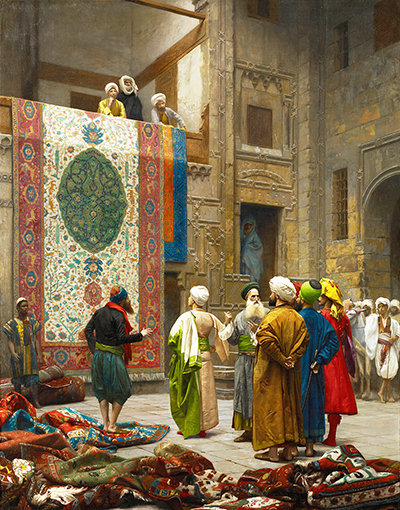
Gérôme's word “Orient” belongs to nineteenth-century European usage. It compressed many different societies and regions into a single imagined field of desire. The places Gérôme later visited supplied drawings, photographs, objects and memories, but his paintings also emerged from what he had already dreamed those places might offer.
That mixture is central to reading his Orientalist pictures. Travel gave Gérôme firsthand visual material; it did not make every mosque, market or bath an eyewitness record. The statement's language of appetite is revealing precisely because it joins the geographical journey to the artist's and audience's desire for images.
Recreating a Gladiator
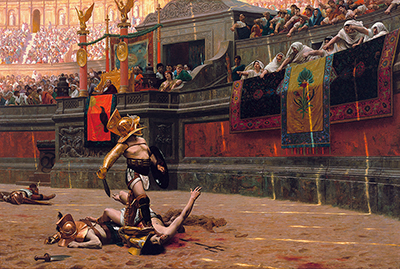
Another reported conversation concerns Gérôme's interest in the Roman arena. The remarks were transmitted through a conversation with illustrator André Castaigne and printed by Moreau-Vauthier. Their reporting chain has been identified in later scholarship:
> “Voilà qui m'ouvre un horizon immense !... Comment ! tous les peintres, tous les sculpteurs sont venus ici, ont vu cela, et pas un n'a songé à refaire un gladiateur.”[3]
Project translation:
> “This opens an immense horizon for me! How is it that all the painters and sculptors have come here and seen this, yet not one has thought of recreating a gladiator?”
The wording presents the gladiator as an opportunity for artistic reconstruction. Gérôme wants to “remake” a figure—to use visible remains and artistic invention to give the past a body.
That ambition helps explain pictures such as Ave Caesar! Morituri te salutant and Pollice Verso, as well as his first exhibited sculpture, The Gladiators. Yet the quotation should not be mistaken for proof that every reconstructed detail was correct. The ancient evidence was incomplete, and modern historians continue to dispute familiar features such as the precise meaning of arena thumb gestures. Gérôme's excitement concerns the imaginative horizon opened by archaeology, not possession of an infallible past.
Because the remarks survive through recollection, they should be introduced as reported conversation. Their value lies in how closely this desire corresponds to the questions his art repeatedly asks.
A Contemporary Critic: Calvary via Athens
Not every useful quotation on this page belongs to Gérôme. Contemporary criticism shows how his work appeared to people encountering it at the Salon.
Reviewing Gérôme's The Virgin, the Infant Jesus and Saint John in La Presse on 27 April 1848, Théophile Gautier observed, in Sotheby's published English translation:
> “Gérôme is heading for Calvary, but his route takes him via Athens.”[4]
Gautier's compact judgment describes the young artist's fusion of Christian subject matter with a classicising visual language. The road to the Crucifixion passes through Greece because Gérôme's sacred image remains shaped by the forms, bodies and aesthetic priorities associated with the Néo-Grecs.
The sentence is sometimes useful as a summary of Gérôme's early art, but its speaker must remain clear. It is a critic's response, not the artist's self-description.
How to Use Gérôme Quotations
First ask what kind of source preserves the words. Gérôme's 1902 preface is a direct publication. The Constantinople and gladiator passages are reported retrospectively by Moreau-Vauthier. Gautier's sentence is contemporary reception from another writer.
Retain the original language and identify translations, especially when a word such as Orient carries a historical framework that no modern English substitute can make neutral.
Do not ask one sentence to explain an entire painting or career. Quotations have dates, purposes and limits. Used carefully, these passages reveal an artist attracted to new visual technology, travel and the reconstruction of the past—and a critic aware of Gérôme's unusual routes to his subjects.
Frequently Asked Questions
Discussion
Which detail in Jean-Léon Gérôme Quotes most changes how you read Gérôme's balance of spectacle, evidence and invention?
Reader Insights
Which detail in Quotes most changes how you read the scene's balance of evidence, staging and spectacle?
Set this page beside the Gérôme biography, paintings overview and related works to test how travel, studio practice and the Salon shaped the image.
What should a careful modern reading preserve, question or leave uncertain when looking at this work today?
Join the Conversation
Share a thoughtful observation about Quotes, Gérôme's method, or the wider context that would help another reader look more carefully.
References
- Jean-Léon Gérôme. Preface to Émile Bayard, Le Nu esthétique: l'homme, la femme, l'enfant; albums de documents artistiques inédits d'après nature. Paris: Bernard, 1902. Bibliothèque nationale de France catalogue record View source.
- Charles Moreau-Vauthier. Gérôme, peintre et sculpteur: l'homme et l'artiste d'après sa correspondance, ses notes, les souvenirs de ses élèves et de ses amis. Paris: Hachette, 1906, p. 113. Passage independently checked in Sarah Lees, ed., Nineteenth-Century European Paintings at the Sterling and Francine Clark Art Institute, vol. 1, cat. 154, p. 367 n. 2 View source.
- Charles Moreau-Vauthier. Gérôme, peintre et sculpteur. Paris: Hachette, 1906, p. 65. Reporting chain independently identified in Aurélie Gavoille, doctoral thesis, Université Paris Ouest Nanterre La Défense, 2013, p. 188 n. 515 View source.
- Théophile Gautier. La Presse, 27 April 1848. Quoted and translated in Sotheby's, “Jean-Léon Gérôme, The Virgin, the Infant Jesus and Saint John,” European Art, lot 6, 2017 View source.