 by Tom Gurney
Tom Gurney BSc (Hons) is an art history expert with over 20 years experience
Published on June 19, 2020 / Updated on August 21, 2026
Email: tomgurney1@gmail.com / Phone: +44 7429 011000
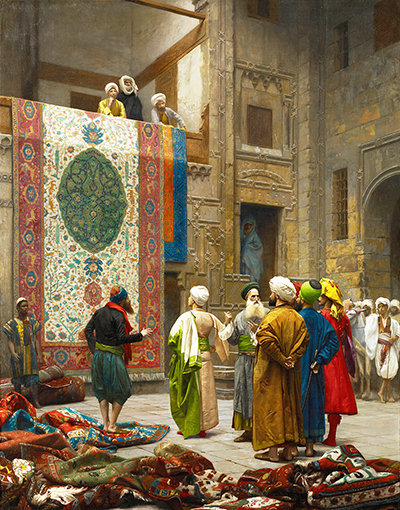
Two men raise an enormous carpet until it becomes a wall of colour. Its patterned surface faces the waiting group below—and the viewer—as though a sale has become a performance. In Jean-Léon Gérôme's The Carpet Merchant, fabric does more than furnish a Cairo setting. It controls the picture.
The precision is seductive. Stone, clothing and woven pattern appear minutely observed, encouraging us to accept the scene as a report from another place. Gérôme had travelled in Egypt and gathered visual material, but he made paintings such as this in France from sketches, memories, photographs and studio objects. The canvas joins observation to construction. Understanding that combination is essential to seeing both its artistry and its place within nineteenth-century Orientalism.
At a Glance
- ArtistJean-Léon Gérôme
- TitleThe Carpet Merchant; also exhibited in French as Marchand de tapis au Caire
- Dateca. 1887
- MediumOil on canvas
- Dimensions86 × 68.7 cm
- CollectionMinneapolis Institute of Art
- AccessionThe William Hood Dunwoody Fund; 70.40[1][2]
The Carpet as a Temporary Stage
The displayed carpet occupies the upper centre of the vertical canvas. Held wide, it interrupts the architecture behind it and creates a temporary backdrop. Its lower edge hangs above the seated and standing observers, while its colours and repeated forms offer a dense alternative to the pale masonry around it.
The two handlers actively present the textile. Their raised arms stretch it into visibility. One body anchors each side, and the weight between them makes the presentation look both practised and strenuous. The carpet becomes an event: lifted, judged and perhaps bargained over.
Below, the potential buyers or spectators form a looser band of heads, robes and gestures. Gérôme does not give the transaction an obvious conclusion. No exchange of money fixes a sale; no single expression tells us whether the textile has met approval. The picture suspends commerce at the moment of looking.
That delay draws the museum viewer into the same activity. We face the carpet more directly than many figures inside the scene do. Its pattern has been arranged for our inspection as well as theirs. The painting therefore contains one display inside another: merchants exhibit a textile, and Gérôme exhibits the exhibition.
Other carpets appear folded, hung or spread through the space. They soften steps and walls, overlap clothing and carry colour across the stone enclosure. Their placement keeps the principal object from seeming isolated, yet the raised carpet remains distinct because it blocks depth. It behaves almost like a curtain drawn across the scene.
A doorway offers a contrasting opening. Through it, a donkey and a brighter exterior register the world beyond the enclosed market space.[1] The animal is a small but effective interruption to the formal display. The passage promises movement, while the figures and carpet hold the viewer inside.
Pattern, Surface and the Work of Looking
Gérôme's finish rewards close attention. Different materials are made legible through shifts in texture: worn stone, woven pile, embroidered or patterned cloth, skin and metal. This distinction is one reason the image can feel documentary even before the viewer knows anything about its history.
The textile is the strongest test of that skill. A carpet shown frontally risks becoming a flat rectangle pasted onto the wall. Gérôme keeps it physical through sagging weight, irregular edges and the effort of the men holding it. At the same time, its flat design echoes the flat painted canvas on which every illusion depends.
Pattern also regulates attention. The eye may try to follow one motif across the carpet, then lose it in repetition and colour. That slow inspection resembles a buyer examining workmanship, but it is also an aesthetic response detached from use. Gérôme allows the textile to dominate as a pictorial structure.
Without a specialist catalogue identifying the weave, origin and date of the displayed object, those details should not be guessed from appearance. The painting supports careful description of pattern and colour; it does not by itself provide a technical classification. Gérôme's accuracy in rendering a surface is not the same as proof of the textile's precise identity.
From Egypt to a Paris Studio
The Minneapolis Institute of Art explains that Gérôme made several trips to Egypt, filled sketchbooks with people, animals and buildings, and later used those drawings and his memories in France.[1] Travel gave him first-hand visual resources that many European painters of the region did not possess.
Yet travel did not convert every later canvas into an eyewitness record. The Musée d'Orsay describes Gérôme as a studio painter who worked from memory and from a broad literary, theatrical and visual imagination. His Paris studio contained collected objects, including large carpets acquired during travel, and these materials could reappear in invented settings.[3]
The current Brooklyn Museum label for Gérôme's different 1869 Carpet Merchant of Cairo likewise notes his use of collected photographs, textiles and other props in Paris. It cautions that documentary appearance could coexist with images designed for European expectations of the Arab-Islamic world.[4]
This method helps explain the strange authority of the Minneapolis painting. Individual components may derive from things Gérôme saw, drew, photographed or owned. Their combination remains an artistic decision. The architecture may be adapted, figures may be posed and objects may be brought together across different encounters.
The correct question is therefore not whether every detail is “real” or “fake.” The picture is a composite. Its persuasiveness comes from the way Gérôme makes separately gathered elements appear to share one continuous time and place.
Orientalism: Precision and Power
“Orientalism” describes a broad field of European and North American representations of North Africa, the Middle East and parts of Asia. It includes travel, scholarship, collecting, design and painting, but it developed within a century of colonial expansion and unequal political power.
The Metropolitan Museum of Art's current exhibition Orientalism: Between Fact and Fantasy stresses this mixture of encounter and invention. Artists sometimes painted what they had seen; at other times they reconstructed distant places from memory and imagination, using Islamic objects to stage their scenes.[5] Gérôme is central to that history because his extraordinary precision made constructed worlds appear especially authoritative.
In The Carpet Merchant, the problem is not that the objects lack beauty or that Gérôme lacked observational skill. It is that a European painting could turn selected details into a general image of Cairo for audiences who had little basis for questioning it. Repeated market scenes, guards, mosques, baths and street encounters helped produce an apparently timeless “East,” even while Egypt and the wider Ottoman world were undergoing profound political and social change.
Jennifer Meagher's Met essay situates nineteenth-century Orientalist art within travel, imperial expansion and the European appetite for architecture, clothing and decorative objects from the region.[6] Carpets were especially suited to this market. They could be admired as complex works of design while also functioning, in a painting, as instantly legible signs of elsewhere.
The people in Gérôme's scene are caught in the same structure. Their clothing provides colour and social differentiation, but costume alone does not allow a modern viewer to assign every figure a fixed ethnicity or status. The painting describes appearances chosen by the artist. It does not deliver the people's names, voices or own accounts of the exchange.
This imbalance extends to the imagined audience. The transaction appears available for Western inspection without requiring participation in its language, customs or economics. The painting offers the pleasure of access while keeping the depicted figures at a distance.
What Kind of Market Do We See?
The title identifies a merchant, and the raised carpet suggests an offer or appraisal. Beyond that, Gérôme leaves relationships ambiguous. It is not certain who owns each textile, which figures are buyers, who is accompanying whom or whether a sale follows.
This uncertainty is easy to overlook because the physical setting looks so specific. Detail can persuade viewers that social knowledge is equally complete. In fact, we know much more about the surfaces than about the exchange.
The carpet itself becomes the clearest participant. It separates sellers from architecture, commands the group and meets the viewer frontally. Human identities remain uncertain while the commodity receives exhaustive visual attention.
That emphasis reflects the painting's own status. Gérôme transformed a scene of display into an object for display and sale in an international art market. Buyers could acquire a meticulously painted encounter with textiles, architecture and figures framed as Cairo. The internal market and the external market mirror each other.
Recognising that structure does not cancel the pleasure of looking. It makes the pleasure more precise. We can admire Gérôme's orchestration of colour and surface while asking how technical conviction encourages cultural belief.
Two Different Carpet-Merchant Paintings
This work is sometimes confused with Gérôme's The Carpet Merchant of Cairo in the Brooklyn Museum. They are separate paintings. The Brooklyn canvas dates from 1869, measures 81 × 55.9 cm and carries accession number 74.208.[4] The Minneapolis Carpet Merchant is the later, larger work dated about 1887, accession 70.40.[1][2]
The shared subject shows Gérôme's sustained interest in textiles and commerce, but one museum record should never be used to supply the other's date, dimensions or scene description. Keeping the objects apart also prevents a general account of his Orientalism from replacing close attention to this particular arrangement.
Artist Up Close
Begin with the raised hands. They reveal the carpet's weight and show that its apparently flat pattern depends on physical labour.
Then compare textile and stone. Gérôme lets flexible colour cover rigid architecture, turning a market display into a temporary transformation of the space.
Finally, find the doorway and donkey. That small opening makes the chamber feel embedded in a larger world, while reminding us how carefully the visible “place” has been composed.
Frequently Asked Questions
Discussion
Which detail in The Carpet Merchant most changes how you read Gérôme's balance of spectacle, evidence and invention?
Reader Insights
Which detail in The Carpet Merchant most changes how you read the scene's balance of evidence, staging and spectacle?
Set this page beside the Gérôme biography, paintings overview and related works to test how travel, studio practice and the Salon shaped the image.
What should a careful modern reading preserve, question or leave uncertain when looking at this work today?
Join the Conversation
Share a thoughtful observation about The Carpet Merchant, Gérôme's method, or the wider context that would help another reader look more carefully.
References
- Minneapolis Institute of Art. “Sense of Place: The Carpet Merchant.” Teaching the Arts object entry View source.
- Boletín Oficial del Estado, Spanish Ministry of Culture. Order CUL/3433/2010, state-guarantee schedule for the exhibition Jean-Léon Gérôme, entry for The Carpet Merchant, accession 70.40 View source.
- Musée d'Orsay. “The Spectacular Art of Jean-Léon Gérôme (1824–1904).” Exhibition presentation, especially “In the Studio” and “Gérôme's Imaginary Orients,” 2010–11 View source.
- Brooklyn Museum. “The Carpet Merchant of Cairo.” Collection record and current object label, 1869, accession 74.208 View source.
- The Metropolitan Museum of Art. “Orientalism: Between Fact and Fantasy.” Exhibition overview, 2026–27 View source.
- Jennifer Meagher. “Orientalism in Nineteenth-Century Art.” Heilbrunn Timeline of Art History, The Metropolitan Museum of Art, October 2004 View source.