 by Tom Gurney
Tom Gurney BSc (Hons) is an art history expert with over 20 years experience
Published on June 19, 2020 / Updated on August 21, 2026
Email: tomgurney1@gmail.com / Phone: +44 7429 011000
Jean-Léon Gérôme's finished paintings often conceal their own making. Edges are controlled, surfaces appear complete and complicated scenes arrive without visible hesitation. His drawings tell a different story. Bodies are searched for, poses corrected and compositions tested. Some sheets record sustained observation; others isolate one problem on the route towards a painting. Together they reveal drawing as a flexible way of thinking rather than a single preliminary step.
Drawing also connected Gérôme's private studio practice to his public role as a teacher. The widely distributed Cours de dessin, published with Charles Bargue between 1867 and 1870, turned academic methods of copying and figure study into a reproducible course. To understand Gérôme's drawings is therefore to see both an artist constructing images and a teacher working within a nineteenth-century system of training.
At a Glance
- ArtistJean-Léon Gérôme
- Common mediaGraphite, black chalk, pen and ink, and combinations on paper
- UsesObservation, figure study, animal study, compositional planning, transfer and teaching
- Major published teaching projectCharles Bargue and Jean-Léon Gérôme, Cours de dessin, three parts, 1867–70
- Important collection studyClaire Stoullig and Sophie Harent, Dessins de Jean-Léon Gérôme: la collection du Musée des beaux-arts de Nancy[1][2]
Drawing as a Way of Solving Problems
No surviving group supports the idea that Gérôme followed one fixed sequence for every work. A monumental history painting, an animal study and a studio allegory demanded different preparation. Individual sheets may be observational records, searches for a pose, arrangements of a whole composition or polished works with their own visual purpose.
That variety matters because the word “study” can sound more definite than the evidence permits. A museum title may securely connect a sheet to a painting. A resemblance alone cannot. Drawings were also reused, retained in studio collections, pasted into notebooks and separated from their original groups. When context has been lost, the responsible answer may remain provisional.
Oil sketches belong to the wider story of preparation but should not be called drawings. A small painted study can test colour and atmosphere in ways that graphite cannot. The distinction preserves what each medium allowed Gérôme to investigate.
A Figure for a Lost Mural
The Morgan Library & Museum owns Gérôme's Study for the Allegorical Figure of Art, dating from about 1850. Drawn in graphite on light brown paper, the sheet shows a reclining figure associated with an allegorical medallion of Art for a mural in the Paris home of the architect Alfred-Nicolas Normand.[3]
The study is valuable partly because the completed setting no longer survives. The mural was destroyed in 1965, although photographs and an oil study preserve evidence of it.[3] More than an imperfect substitute for the lost work, the drawing concentrates attention on the body's structure: the turn of the torso, the placement of limbs and the way a figure must fit a predetermined decorative shape.
Graphite remains visible as a working material. It can strengthen a contour, soften a transition or revise an uncertain passage. The sheet brings us closer to a stage at which form is being established, before colour and architectural setting make the image appear inevitable.
Building an Arena Composition
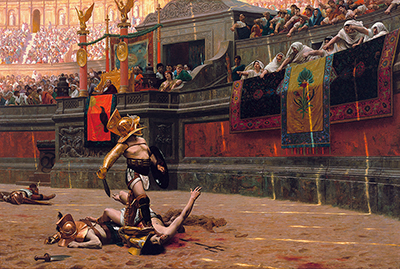
A preparatory study at the Yale University Art Gallery provides a different scale of thought. Preparatory Study for “Ave Caesar, Morituri te Salutant”, dated 1858, combines graphite with pen and ink on paper. The finished painting followed in 1859.[4]
Here the problem is not one isolated body. Gérôme must coordinate an arena, a group of gladiators and the elevated authority they address. The sheet tests the distribution of figures across a broad format. Lines establish where masses will gather and where empty space must remain. The artist is designing the viewer's access to the scene before surface detail gives it archaeological conviction.
The live Yale record identifies the drawing as accession 1994.24.1.[4] That precise control is important because preparatory studies can acquire inconsistent numbers or titles as they are repeated in derivative sources. The owning collection's current record should govern the object's identity.
The comparison with the final canvas also shows why drawings cannot be treated as miniature paintings. Their job is selective. A compositional sheet can resolve placement and movement while leaving colour, texture and many objects undecided. What looks unfinished may be complete for the question the artist was asking.
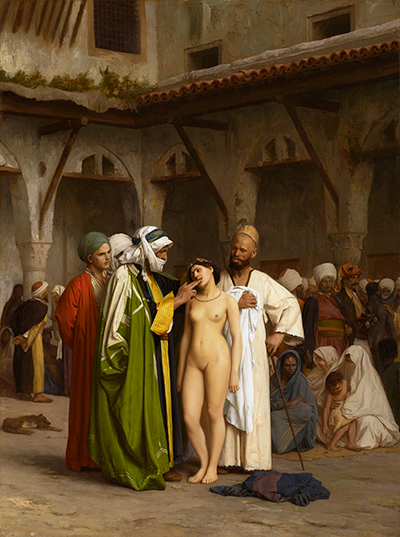
The Body in A Roman Slave Market
The Walters Art Museum's Study for “The Roman Slave Market” concentrates on a single standing figure. Made in graphite, the drawing presents the pose connected to the exposed woman in Gérôme's later painting. The sheet once belonged to a notebook associated with Gérôme's son-in-law and former pupil Aimé Morot; the notebook was later dismembered.[5]
That history demonstrates how the survival of drawings can shape interpretation. Detached from neighbouring sheets, a study loses part of its original sequence. The current museum title secures its relationship to A Roman Slave Market, but it does not reconstruct every stage between drawing and painting.
The sheet also reveals how formal study and troubling subject matter intersect. Gérôme investigates balance, weight and the contour of a nude body. In the finished painting, that body becomes a person displayed for sale. The drawing's academic purpose does not erase the violence of the final scenario; the later scenario, in turn, should not prevent close examination of how the pose was made.
Preparation can intensify the ethical question. It shows that the exposed body was not a spontaneous detail but a carefully developed centre of spectatorship.
From Individual Pose to Public Drama
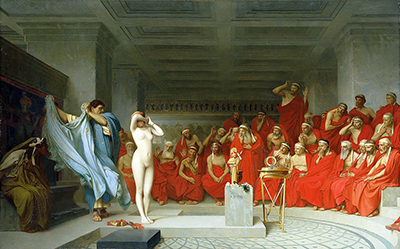
Other surviving drawings connect Gérôme's figure studies to the theatrical structure of his history paintings. Paris Musées records a study for Hyperides, the orator in Phryne before the Areopagus.[6] In the completed picture, Hyperides unveils Phryne before her judges. His movement must communicate action, guide the eye and establish a relationship between the exposed woman and the male audience.
A study of such a figure is not only anatomical. Gesture carries narrative. The arm that lifts fabric, the body's direction and the relation of one pose to an imagined group all help make the later incident legible.
This is one reason Gérôme's paintings can appear so theatrically clear. Before the costumes, architecture and polished textures are added, the figures have been assigned visual roles. Drawings can show that underlying grammar more openly than the completed surface.
Travel and Observation
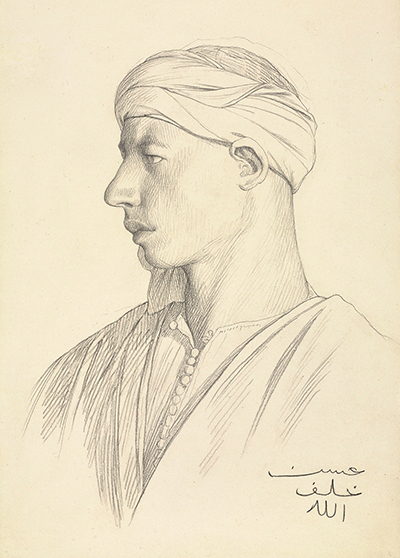
Gérôme's journeys provided opportunities to draw architecture, landscapes, animals and people. Such sheets could serve as records of something seen, stores of information for later work or independent exercises in observation. Photographs and collected objects supplemented this material.[7]
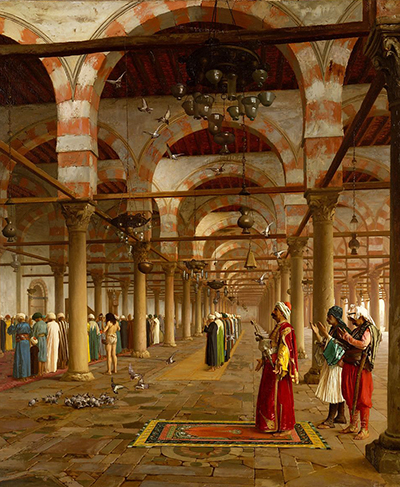
Yet an observed study does not certify an entire finished scene. A mosque column drawn in Cairo might later enter an invented service; a costume recorded or collected during travel might be worn by a Paris studio model; a landscape memory might support a narrative that never occurred there. Drawings are pieces of evidence, not passports guaranteeing the truth of every painting built from them.
The distinction makes the surviving sheets more useful. Instead of forcing them to validate a finished image, we can ask what Gérôme chose to retain: a silhouette, an architectural rhythm, an animal's posture or the fall of cloth. The movement from observation to composition involved selection and rearrangement.
The Bargue–Gérôme Cours de dessin
Between 1867 and 1870, Goupil published the Cours de dessin under the names of lithographer Charles Bargue and Gérôme. Its three parts move through studies after casts and isolated features, copies after master drawings, and exercises concerned with the living model. Complete digitised copies are available through the Bibliothèque nationale de France.[2]
The course depended on copying. Students were expected to analyse proportion and value by reproducing carefully ordered plates. To modern readers, copying can sound opposed to creativity. Within academic training, it was conceived as a means of educating eye and hand before the student attempted complex invention.
The publication should not be described as Gérôme's sole-authored personal manifesto. Bargue's role was substantial, and the course emerged through Goupil's publishing enterprise and a broader culture of art instruction. Its printed plates also differ from unique working drawings: they standardise models so the same exercise can travel between students and institutions.
Even with those cautions, the course illuminates Gérôme's values. Form is built through proportion, contour, light and shadow. Difficulty is divided into stages. Looking is treated as a discipline that can be practised rather than a gift that arrives complete.
Gérôme as a Teacher
Gérôme became a professor at the École des Beaux-Arts in 1864 and taught French and international pupils over several decades.[7] His authority was considerable, but his students cannot be reduced to copies of their teacher. They entered different careers, countries and artistic debates.
Drawings provide a better way to understand the common foundation. Academic study equipped students to organise a body, build an illusion of volume and make a complex composition readable. What they later did with those skills could differ widely.
The tension between discipline and individuality also appears in Gérôme's own work. His surfaces may seem governed by fixed rules, yet the preparatory sheets show adjustment and choice. Academic practice did not eliminate invention; it gave invention a technical language.
Artist Up Close
When looking at a Gérôme drawing, begin with pressure. Darkened contours often mark decisions; lighter lines may preserve alternatives or locate a form before it is fixed.
Next ask whether the sheet solves a local or a whole-picture problem. A single standing body and a panoramic arena design have different purposes, even if both relate to finished paintings.
Finally, notice what the drawing does not attempt. The absence of colour, texture or architectural finish is not necessarily a lack. It can reveal the precise question Gérôme chose to isolate.
Frequently Asked Questions
Discussion
Which detail in Jean-Léon Gérôme Drawings most changes how you read Gérôme's balance of spectacle, evidence and invention?
Reader Insights
Which detail in Drawings most changes how you read the scene's balance of evidence, staging and spectacle?
Set this page beside the Gérôme biography, paintings overview and related works to test how travel, studio practice and the Salon shaped the image.
What should a careful modern reading preserve, question or leave uncertain when looking at this work today?
Join the Conversation
Share a thoughtful observation about Drawings, Gérôme's method, or the wider context that would help another reader look more carefully.
References
- Claire Stoullig and Sophie Harent. Dessins de Jean-Léon Gérôme: la collection du Musée des beaux-arts de Nancy. Paris: Somogy, 2008; catalogue for the Nancy exhibition, 2009. Rijksmuseum Research Library record View source.
- Charles Bargue and Jean-Léon Gérôme. Cours de dessin. Three parts. Paris: Goupil, 1867–70. Gallica, Bibliothèque nationale de France: Part 1, Part 2, Part 3, View source 1 View source 2 View source 3.
- The Morgan Library & Museum. “Study for the Allegorical Figure of Art.” Collection record, 2005.84 View source.
- Yale University Art Gallery. “Preparatory Study for ‘Ave Caesar, Morituri te Salutant.’” Collection record, 1994.24.1 View source.
- Walters Art Museum. “Study for ‘The Roman Slave Market.’” Collection record, 37.2783 View source.
- Paris Musées. “Étude pour Hyperide dans Phryné devant l'Aréopage.” Collection record View source.
- Musée d'Orsay. “The Spectacular Art of Jean-Léon Gérôme (1824–1904).” Exhibition presentation, 19 October 2010–23 January 2011 View source.