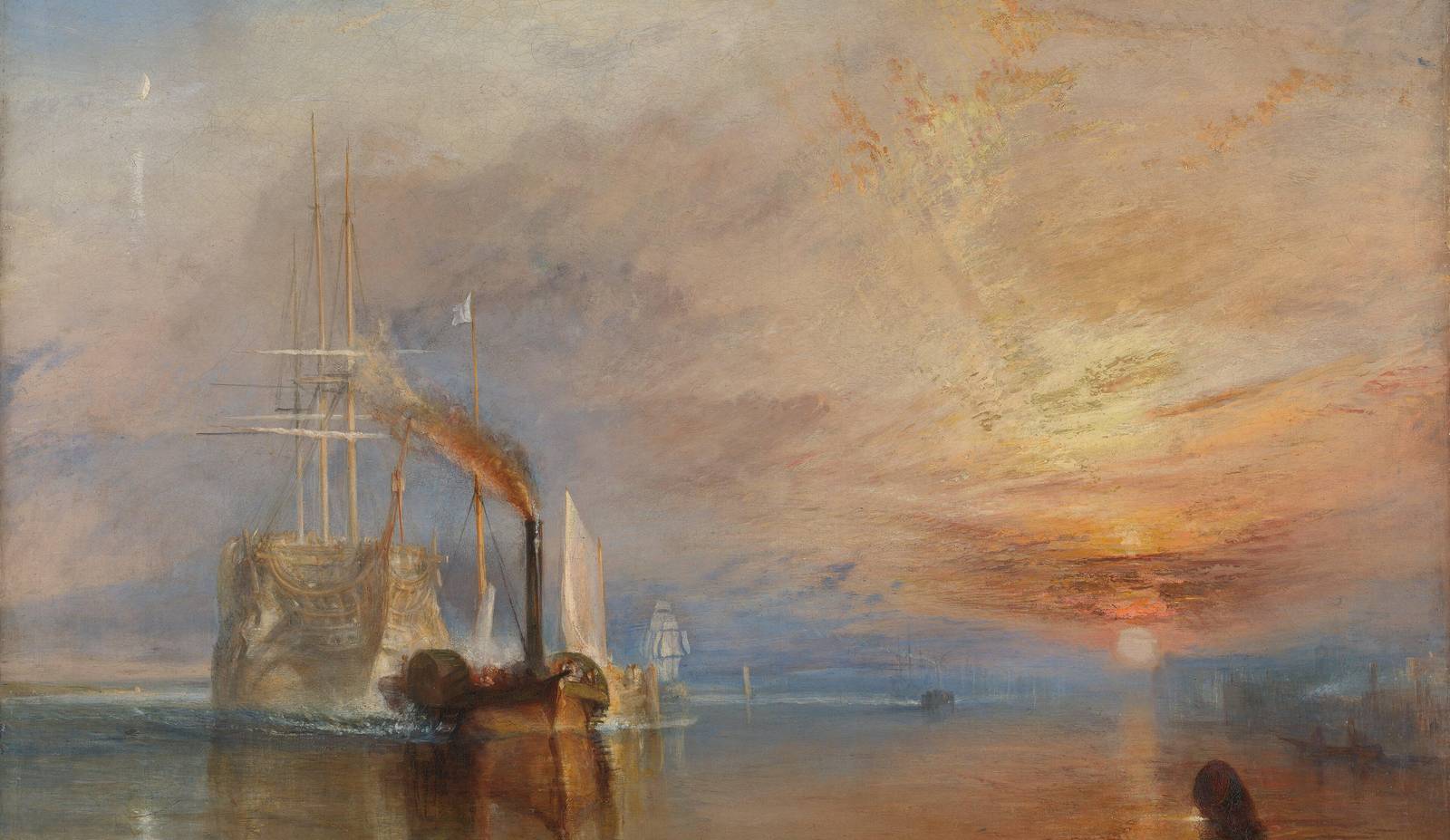
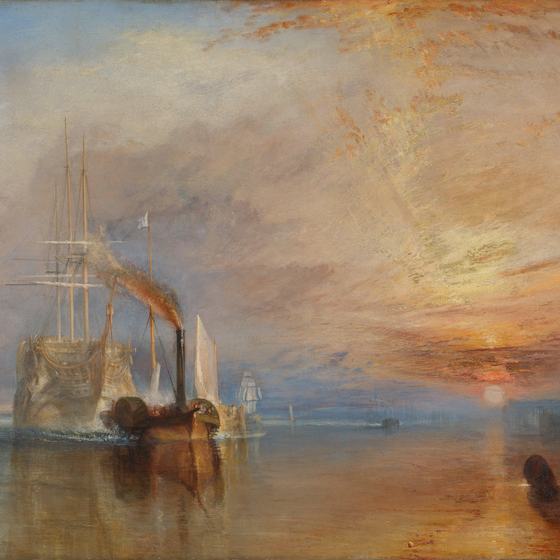
Image reference: J. M. W. Turner, The Fighting Temeraire.
At a Glance
- Core periodc. 1770–1850, concentrated around 1790–1840
- NationsEngland · Scotland · Wales · Ireland
- Principal mediaoil · watercolour · drawing · relief etching · engraving · mezzotint · illustrated books
- Major institutionsRoyal Academy · Society of Painters in Water Colours · publishers · commercial galleries
- Known forimagination · sublime · picturesque · weather · memory · history · modernity
- Key artistsTurner · Constable · Blake · Fuseli · Girtin · Cotman · Palmer · Martin · Danby
- Key contextrevolution · war · industrialisation · enclosure · empire · slavery and abolition
Contents
- Where British Romanticism fits
- Revolution and a changing world
- The sublime, picturesque and beautiful
- Academies, watercolour and print
- Fuseli and the theatre of nightmare
- Blake’s illuminated universe
- Turner and the modern world
- Constable and the worked landscape
- Scotland, Wales and British art
- Artists and places to know
Where British Romanticism fits
Henry Fuseli
Principal careerPhilip James de Loutherbourg
Principal careerWilliam Blake
Principal careerThomas Girtin
Principal careerJ. M. W. Turner
Principal careerJohn Constable
Principal careerJohn Sell Cotman
Principal careerAlexander Nasmyth
Principal careerFrancis Danby
Principal careerJohn Martin
Principal careerSamuel Palmer
Principal careerCharlotte Nasmyth
Principal careerBritish Romanticism was not a society with rules, a shared studio style or a single theory of nature. It is a later name for a broad artistic culture that developed from the later eighteenth century into the middle of the nineteenth. Its artists could be scholarly or visionary, commercially successful or nearly unknown, closely observant or spectacularly theatrical. What connects them is less a common appearance than a conviction that art could test the limits of perception, imagination, history and feeling.
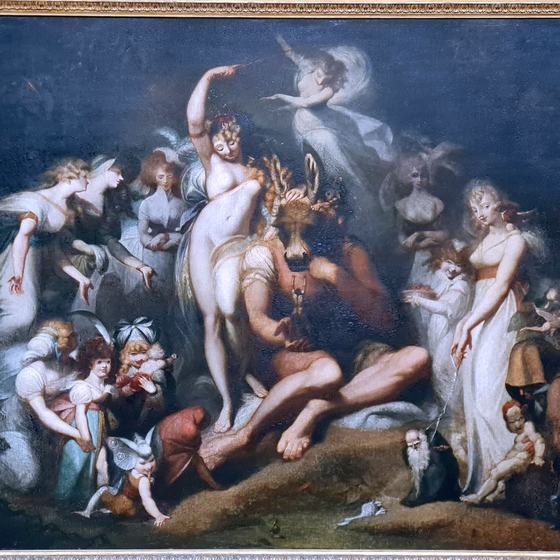
Landscape became one of the period’s great arenas, but Romantic art was never only landscape. Henry Fuseli painted dreams and literary terror. William Blake fused poetry, image and handmade print into prophetic books. J. M. W. Turner made ancient history, war, slavery, fire, steam and weather collide. John Constable turned familiar fields and skies into complex public pictures. Samuel Palmer imagined rural abundance with visionary intensity, while John Martin and Francis Danby offered apocalypses to mass audiences. Watercolour and printmaking were not supporting media: they changed who could make, buy and circulate ambitious art.[1] [2]
The period also unfolded within revolution, war, industrialisation and empire. Country estates, working fields, naval vessels, colonial wealth, railways and growing cities formed the material world behind its images. Romantic feeling did not float free of politics. Awe before a storm, nostalgia for an old warship or delight in a pastoral valley could express uncertainty about modern change while also hiding the labour and violence on which Britain’s wealth depended.
Approximately 1770–1850 is a useful visual-arts span, but it is not a fixed border. Fuseli’s Nightmare appeared at the Royal Academy in 1782. Blake developed illuminated printing in the later 1780s. Turner and Constable were born in 1775 and 1776, while Palmer’s visionary Shoreham work belongs mainly to the later 1820s and early 1830s. Turner continued making radical paintings into the 1840s, and Martin’s great judgement pictures extend into the early 1850s. Romantic practices therefore overlap with Neoclassicism at the beginning and Victorian art at the end.[1] [2]
The movement crossed media and disciplines. Poetry by Blake, Wordsworth, Coleridge, Byron, Shelley and Keats shaped expectations about nature, imagination and political freedom. Gothic fiction and Shakespeare offered artists states of fear, guilt and supernatural encounter. Music and theatre demonstrated how an artwork might overwhelm an audience over time. A British Library account usefully treats Romanticism as a range of developments across art, literature, philosophy and music rather than a sealed style.[3]
British Romanticism was also European. Swiss-born Johann Heinrich Füssli remade himself as Henry Fuseli in London after years in Rome. Turner studied Claude Lorrain, Dutch marine painting, Venetian colour and contemporary Continental art. British watercolours and Constable’s large landscapes transformed French painting during the 1820s. The label describes a powerful British formation, not artistic isolation.
Even “British” requires explanation. The Kingdom of Great Britain included England, Scotland and Wales; the 1801 union created the United Kingdom of Great Britain and Ireland. National identities remained distinct, sometimes resistant and unevenly represented. Scottish artists helped manufacture an internationally popular image of Highland wilderness. Turner toured Wales in the 1790s. Irish-born Francis Danby developed his career through Bristol and London. A responsible survey must not use “British” as an elegant substitute for English.
Revolution, reaction and a changing world
The age of Romanticism was an age of political possibility and fear. The American Revolution challenged imperial authority. Many British writers initially welcomed the French Revolution as the beginning of a freer order, then confronted the Terror, European war and domestic repression. Government anxiety about sedition affected publishing and association. Blake’s small workshop in Lambeth existed within this charged political world.[3]
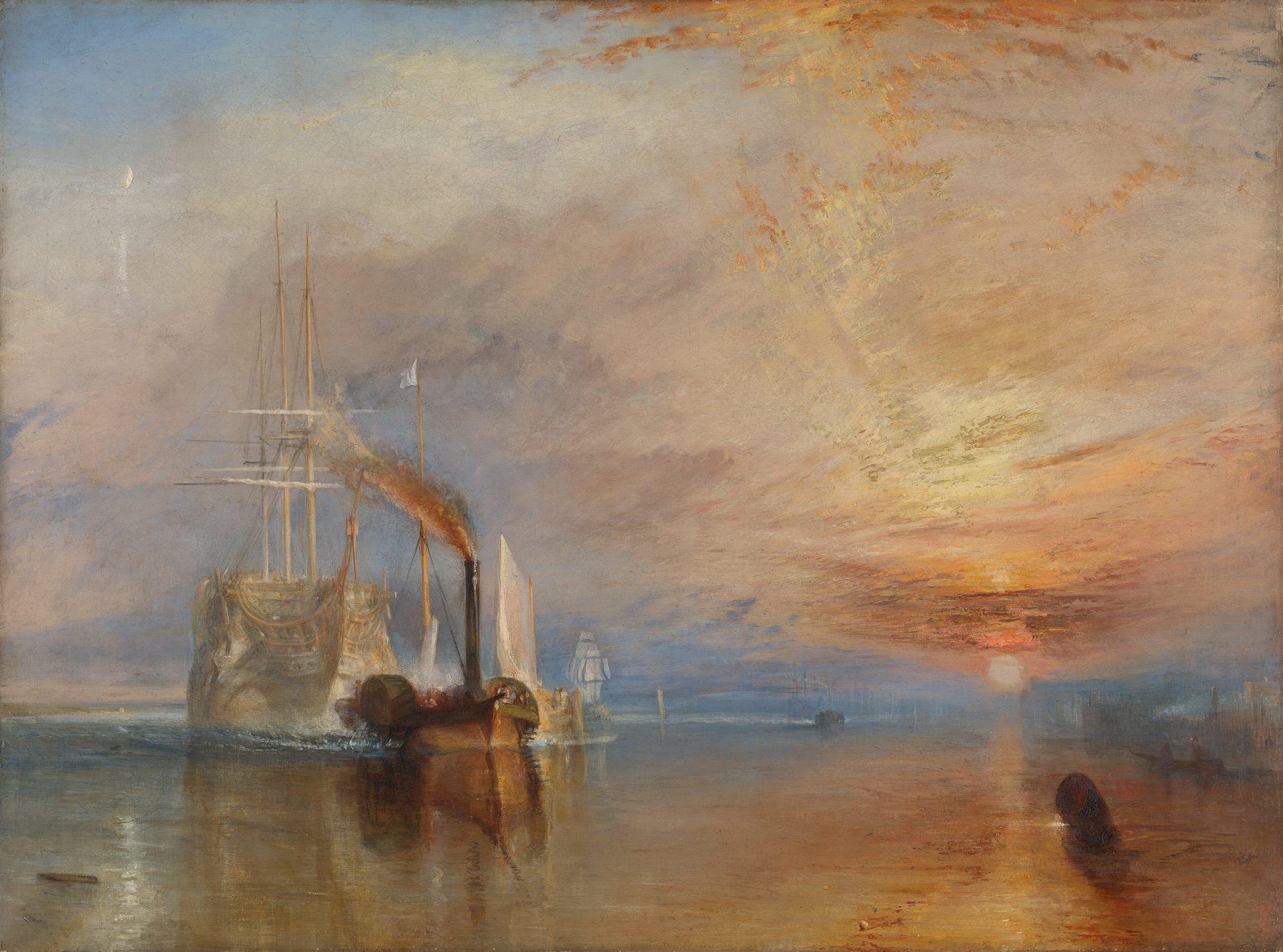
War shaped artistic mobility and subjects. The Revolutionary and Napoleonic conflicts restricted Continental travel, elevated naval victories and intensified debate about national identity. Trafalgar became a storehouse of patriotic memory. Turner could paint battle, shipwreck and peace while remaining alert to what military glory cost. When he later pictured the Temeraire being towed to destruction, the remembered age of sail met the industrial present.
Industrialisation changed both town and country. Factories, mines, canals, steamships and railways rearranged time and space. Agricultural improvement and enclosure reshaped rural work and access to land. Expanding print markets and exhibitions created new audiences, while finance connected artistic patronage to commercial and imperial wealth. Turner’s career spanned revolution, war, empire, mechanisation, political reform and the transition from sail to steam.[27]
Romantic artists did not respond with one politics. Blake attacked tyranny and religious hypocrisy through prophetic myth. Constable was personally conservative and attached to the Anglican Church, yet his late landscapes can register severe political and emotional pressure. Turner’s modern subjects do not offer an uncomplicated programme for or against technology. Romantic art is strongest when contradiction remains visible: exhilaration can coexist with dread, reform with nostalgia, national pride with imperial violence.
Nor did Romanticism simply reject Enlightenment reason. Constable studied meteorology and wrote weather conditions on sketches. Turner mastered perspective and used new pigments and transport. Blake’s criticism of reductive empiricism took the form of technically ingenious books. Fuseli built impossible bodily states through disciplined drawing. Romanticism questioned whether measurement and rational explanation were sufficient; it did not require ignorance of either.
The sublime, picturesque and beautiful
Three aesthetic terms help distinguish the period’s landscapes and experiences. They overlap, but they are not synonyms.
The sublime concerns forces that seem to exceed safe comprehension. Edmund Burke connected it with terror, danger, darkness, vastness and power. A viewer can feel threatened and attracted at once, provided the encounter occurs from relative safety. Romantic landscape made mountains, cataracts, storms, fires and seas vehicles for awe, but the sublime could also inhabit nightmare, battle, industrial speed or biblical apocalypse.[5]
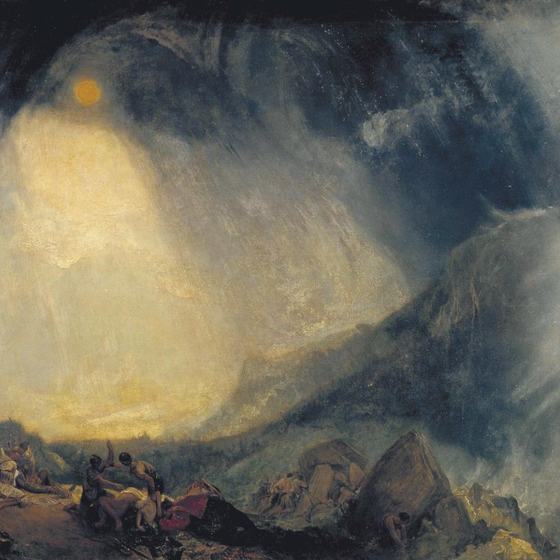
Scale alone is not enough. Turner may reduce people to specks before a snowstorm, but he can also make a narrow band of colour carry boundless danger. Martin builds vast architecture and geological collapse around tiny figures. Fuseli brings terror into a bedroom, replacing physical immensity with the oppressive weight of a dream. The sublime is a relation between work and beholder rather than a checklist of cliffs and clouds.
The picturesque originally meant scenery fitted to become a picture. Eighteenth-century theorists and travellers valued roughness, irregularity, variety, broken ground, old trees and ruins. The picturesque directed tourists through Wales, Scotland and the Lake District, encouraging them to select views through established landscape conventions.[4] [6] A ruined cottage might improve a composition even if ruin meant hardship for its inhabitants.
That tension is essential. Picturesque looking could bring neglected British places into art while filtering them through taste. A traveller learned where to stand, what to frame and which signs of modern life to omit. Constable’s Lake District visit is revealing because the region’s literary and tourist prestige did not automatically suit him. A Louvre drawing record notes the area’s association with early English literary Romanticism and Constable’s discomfort with scenery that seemed to lack human activity.[21]
The beautiful generally promised harmony, softness and manageable pleasure. Pastoral art could imagine repose and abundance rather than terror. Yet Palmer’s swelling grain and moonlit orchards show that pastoral beauty can become strange and visionary. The useful question is not which label wins, but how an image moves among comfort, roughness and fear.
Academies, watercolour and print
The Royal Academy, founded in 1768, offered training, professional recognition and an annual exhibition that shaped public careers. Its hierarchy favoured history painting over landscape and ranked oil above watercolour. Turner entered its school young and rose rapidly. Fuseli became an Academician, professor and keeper. Constable was not elected a full member until 1829. Blake exhibited only intermittently and found little institutional reward.
Exhibitions encouraged scale and legibility. A picture hung high on a crowded wall had to command attention. Constable’s “six-footers” raised local rivers to the dimensions associated with history painting. Turner used brilliant colour, titles and literary quotations to guide response. Martin built enormous scenes that could function almost like public entertainment. Romantic individualism was therefore partly produced inside competitive institutions.
Watercolour developed an alternative public sphere. It had long served topography, travel, design and amateur instruction, but artists expanded its scale, density and prestige. Dr Thomas Monro’s evening circle gave Turner, Thomas Girtin and others access to works they copied and coloured together. Girtin’s broad washes and weighty architecture helped free watercolour from the look of a tinted outline, while Turner pushed it toward extraordinary atmospheric complexity.[8] [10]
Practitioners still felt marginalised by the Academy. In 1804 they formed the Society of Painters in Water Colours to mount dedicated annual exhibitions and sell their work.[9] Large, highly finished watercolours could now compete as independent works rather than preliminary notes. Specialist collecting preserved both exhibition pieces and more private sketches, allowing modern viewers to compare different functions within the medium.[13]
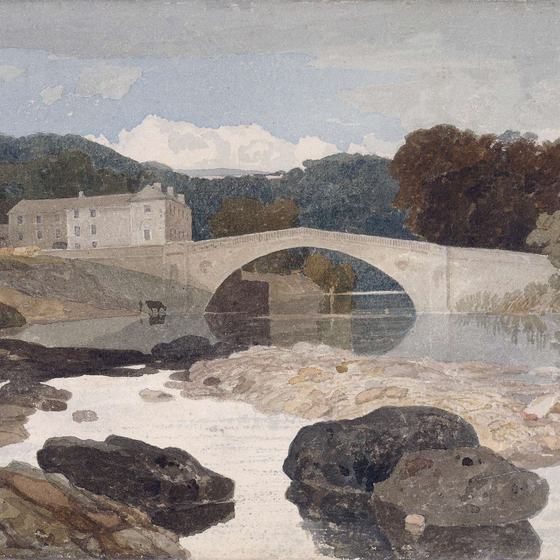
John Sell Cotman’s work demonstrates the reach of regional networks. He travelled through Wales, Yorkshire and Normandy, taught in Norwich and later at King’s College London, and produced etchings and architectural publications.[11] Norwich became an important artistic centre rather than a provincial afterthought. The watercolour tradition grew through teaching, patronage, travel, publishing and family correspondence.
The medium’s physical logic encouraged experimentation. Transparent wash lets the paper act as light. Opaque bodycolour can rebuild highlights. Scratching reveals a lower layer; gum creates shine; blotting and lifting interrupt a wash. Constable’s cloud studies may look spontaneous, but they involve decisions about reserved paper, graphite structure, wetness and timing.[7]
Printmaking was equally structural. It multiplied an image while changing its tones and textures. Blake used relief etching to print words and designs from one plate, then coloured impressions by hand. Turner’s Liber Studiorum used etching and mezzotint to classify kinds of landscape and circulate his authority. Constable collaborated with David Lucas on English Landscape Scenery, seeking to communicate what he called the “chiaroscuro of nature.”[12] Martin’s mezzotints carried his apocalyptic architecture to audiences far beyond the original canvases.
Fuseli and the theatre of nightmare
Henry Fuseli’s career makes British Romanticism’s international character impossible to ignore. Born Johann Heinrich Füssli in Zurich, he trained for the ministry, translated Winckelmann and moved to London in 1764. Eight years in Rome immersed him in Michelangelo and antique art. Back in Britain, he painted Shakespeare, Milton, Homer and dreams, became a Royal Academician and taught generations of artists.[37]
His pictures begin in drawing. The British Museum’s Roman album shows how he fused monumental bodies, sharp contour and large zones of darkness.[38] Anatomical exaggeration does not represent technical failure. Tense limbs and unstable poses turn the body into an instrument of feeling. Stage-like lighting and compressed space make a literary instant confront the viewer.
Looking closely at The Nightmare
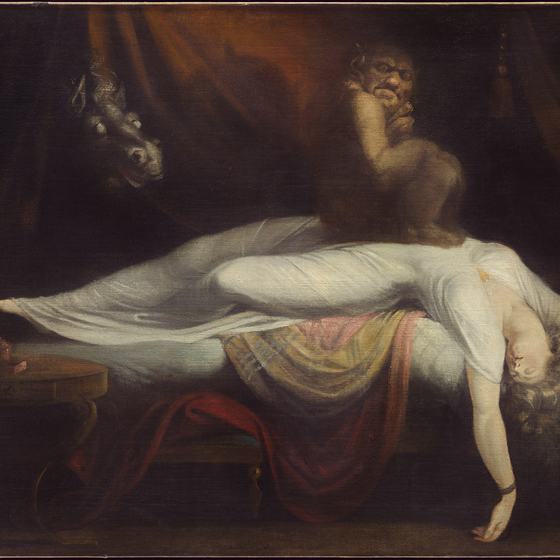
In the 1781 Nightmare, a woman in white collapses backwards across a bed, her head and arm hanging toward the floor. A squat incubus sits on her torso and looks outward. From behind a curtain, the staring head of a horse thrusts into the room. The image does not show what the sleeper sees at a safe distance; dream pressure appears to occupy her body.[36]
The bed resembles a stage. Red curtain and concentrated light expose the woman while darkness withholds an ordinary explanation. The incubus is both weight and spectator. The horse makes a visual pun on “night-mare,” but its bulging eyes also intensify our own intrusive looking. Terror and erotic display become difficult to separate.
The painting’s 1782 Academy exhibition caused a sensation, and engraved reproduction made the design famous. A later Frankfurt version compresses the composition still further. German scholarship places it at the opening of Schwarze Romantik, or dark Romanticism, and traces its afterlife in Gothic and horror imagery.[39] Fuseli did not paint a clinical diagram of sleep paralysis; he created a durable theatre for desires and fears that resist rational narration.
Blake’s illuminated universe
William Blake was poet, painter, printmaker and publisher at once. He trained as a commercial engraver and depended throughout his life on reproductive work, illustration and a small number of patrons. Yet his most original books resist the division between author and illustrator. Words grow among vines, flames and bodies; colour changes emphasis; page sequence creates an argument.
Blake developed relief etching in the later 1780s. He wrote and drew a design in an acid-resistant material on copper, allowing the surrounding plate to be bitten away so text and image printed together. He and Catherine Blake then printed, coloured and bound the books in their home. Different copies could vary substantially in ink, palette, order and finish.[32] [34]
That workshop control was both aesthetic and practical. It reduced dependence on conventional publishers and allowed radical work to circulate in small numbers. Blake’s illuminated books address child exploitation, poverty, racial inequality, tyranny and religious hypocrisy while building a private mythology of Urizen, Los, Orc and Albion.[31] Their difficulty is purposeful: systems that claim total authority are made to confront competing voices and visual contradictions.
There is No Natural Religion responds to rational empiricism in the compact form of a philosophical tract. One sequence appears to state the limits of sense perception; another contests those limits through poetic imagination. The British Museum’s object history also shows how complex Blake bibliography can be, since impressions were printed, assembled and sometimes confused with later facsimiles.[33] A Blake book is a material object with a production history, not an immaterial poem plus decoration.
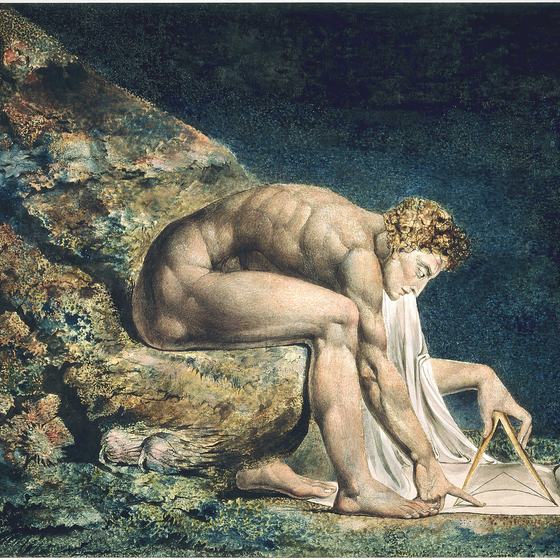
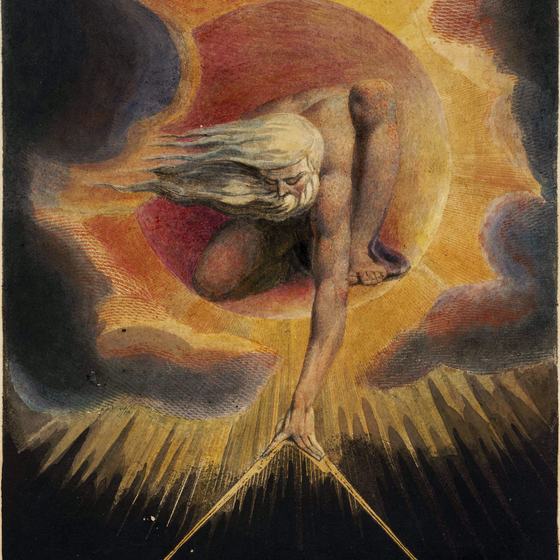
Blake’s political meanings rarely fit party slogans. He responded intensely to the American and French Revolutions but distrusted systems that replaced one tyranny with another. Biblical imagery could attack priestly power while preserving prophetic religion. Newton becomes a magnificent but limited figure, bent over geometry while the textured world exceeds his compass. The critique is not of intelligence itself; it is of a reason that mistakes its instrument for the whole of reality.
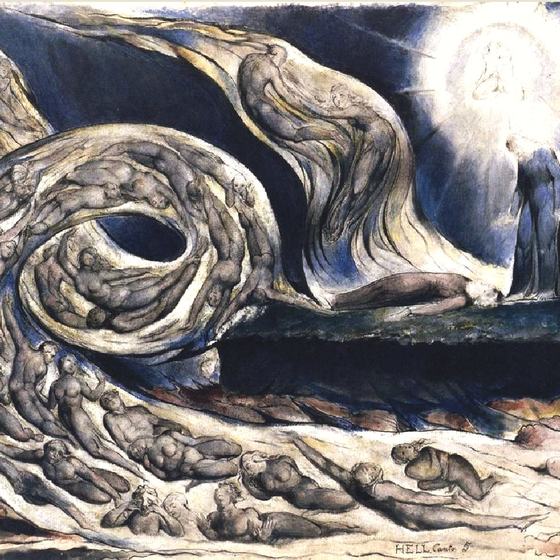
His late career brought renewed patronage from John Linnell and contact with younger admirers including Samuel Palmer. From 1824 Blake made more than one hundred watercolours inspired by Dante, then began engravings that remained unfinished at his death.[35] The whirlwind carrying Paolo and Francesca turns reading into motion: bodies, flame and circular force bind moral judgement to sympathy.
Blake’s small audience during his lifetime helped construct the myth of a solitary prophet. He was indeed independent and poor, but not socially sealed. Catherine’s labour, commercial engraving, print shops, publishers, patrons, artists and the Ancients all belong to his history.[32] Romantic genius was made through relationships even when its imagery insisted on vision.
Essential works
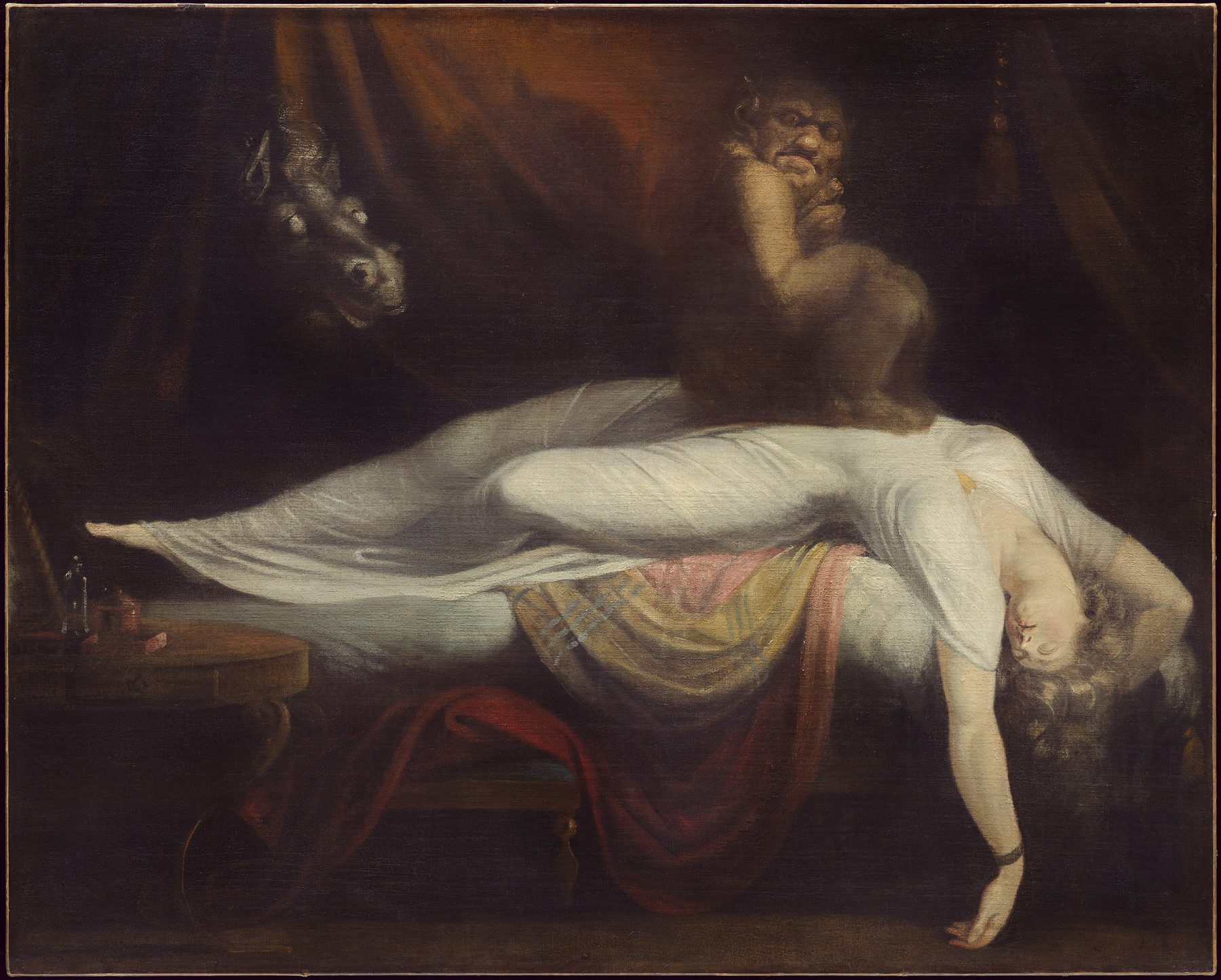
The Nightmare
Henry Fuseli, 1781
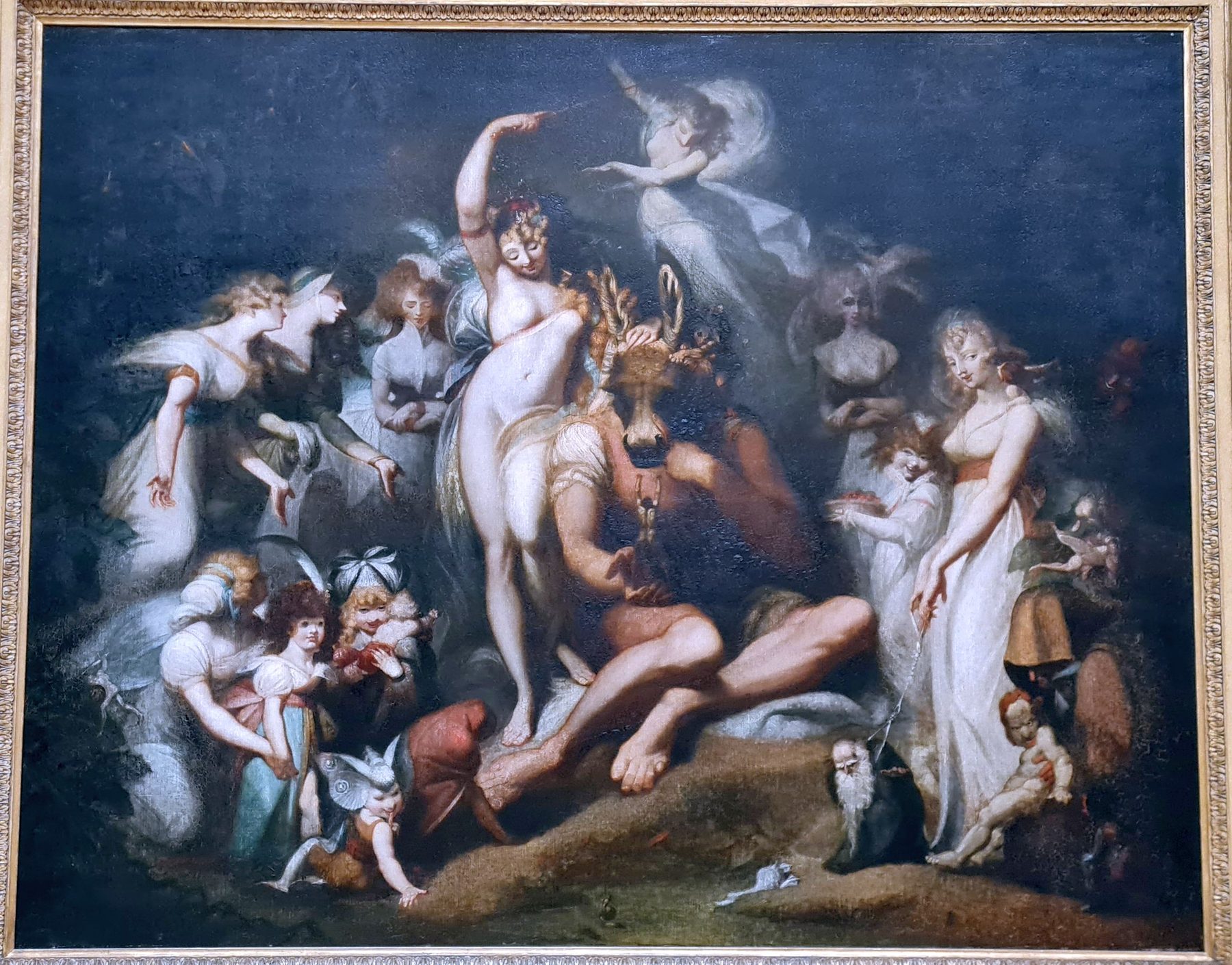
Titania and Bottom
Henry Fuseli, c. 1790
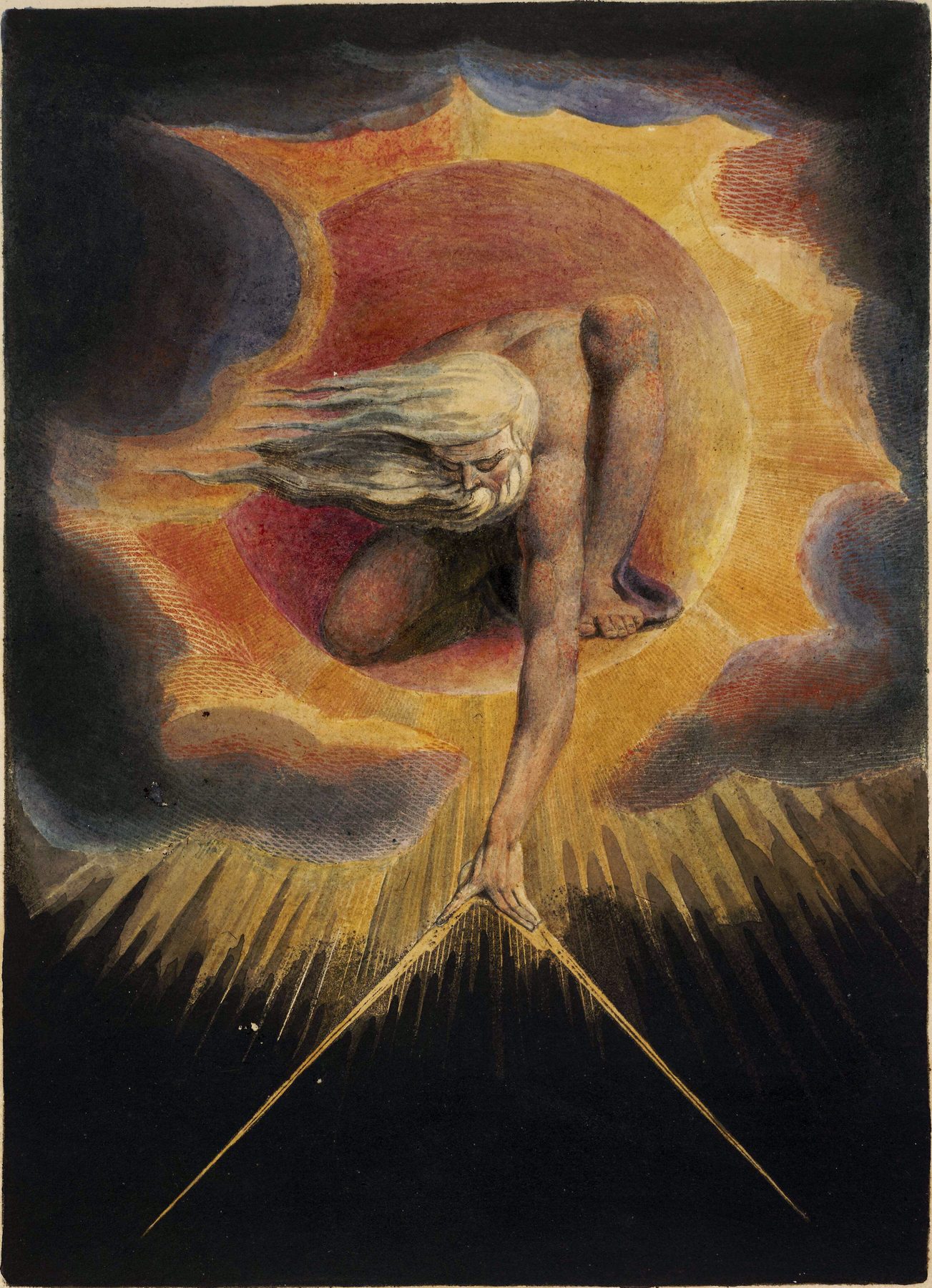
The Ancient of Days
William Blake, 1794
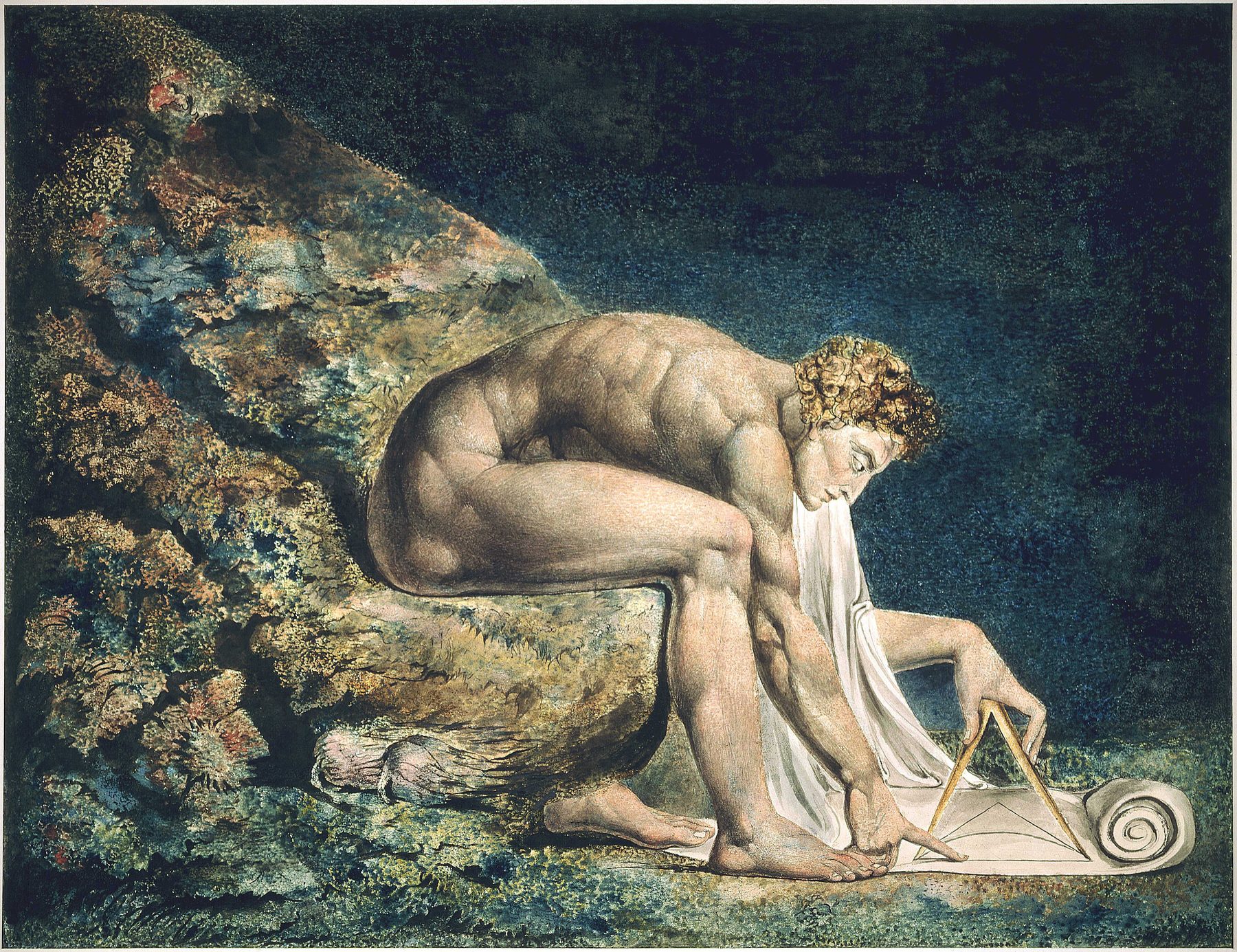
Newton
William Blake, 1795–c. 1805
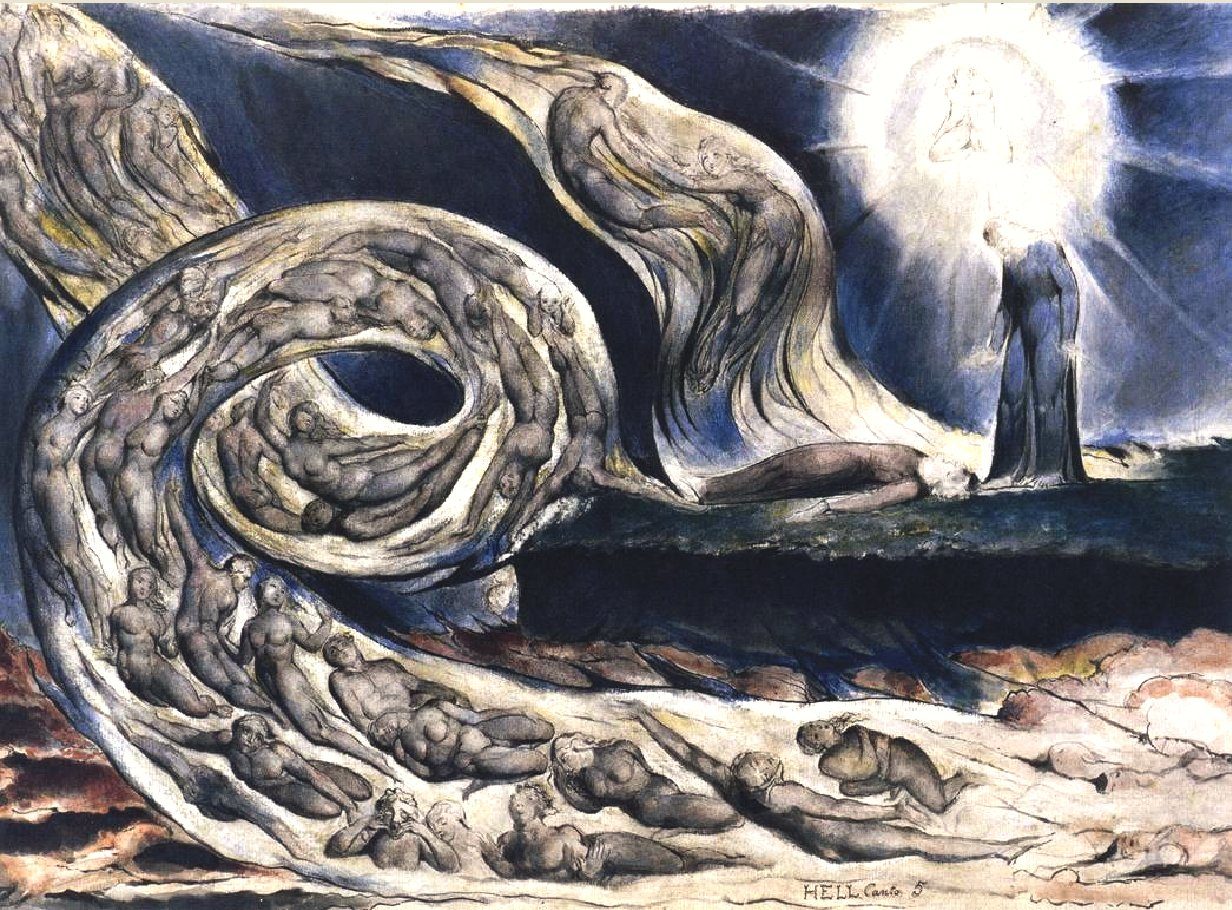
The Whirlwind of Lovers
William Blake, 1824–27
Follow the movement through four stages
–1795
Gothic imagination and revolutionary foundations
Fuseli, Blake and de Loutherbourg test nightmare, prophecy, literature and the sublime as revolution unsettles inherited orders.
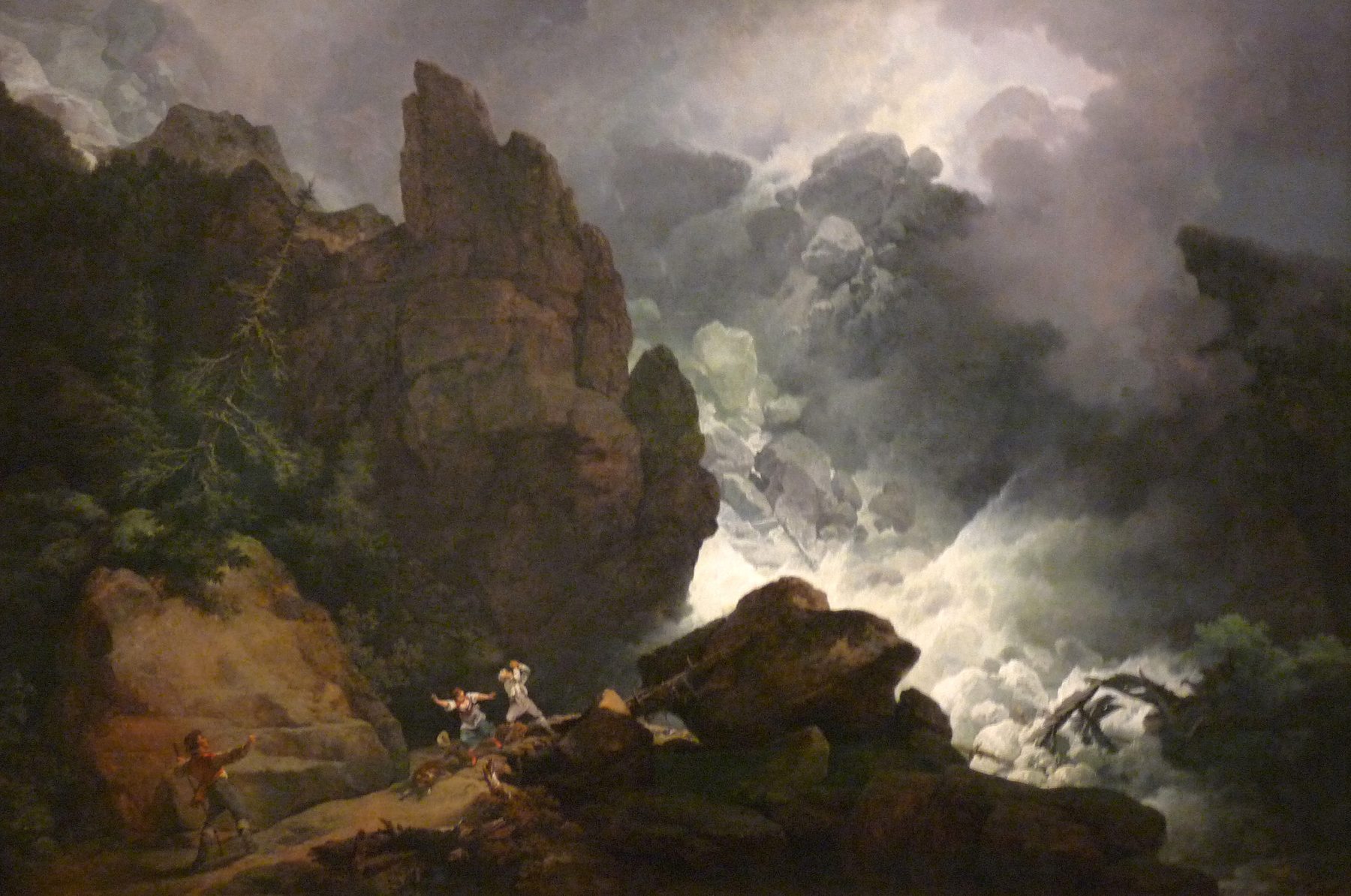
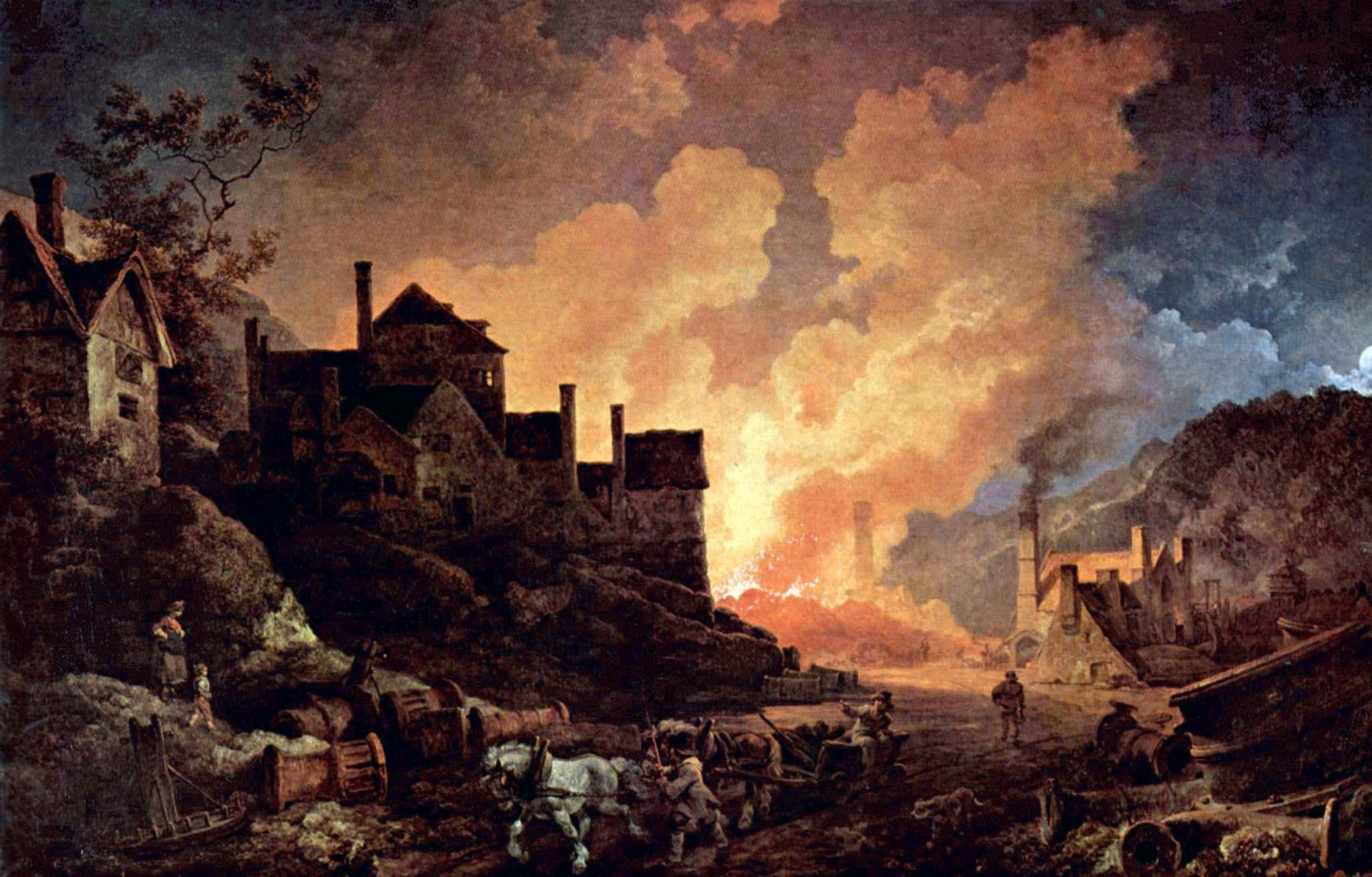
–1815
Watercolour, war and the British sublime
Turner, Girtin and Cotman enlarge landscape ambition while travel, print and Napoleonic conflict reshape artistic experience.
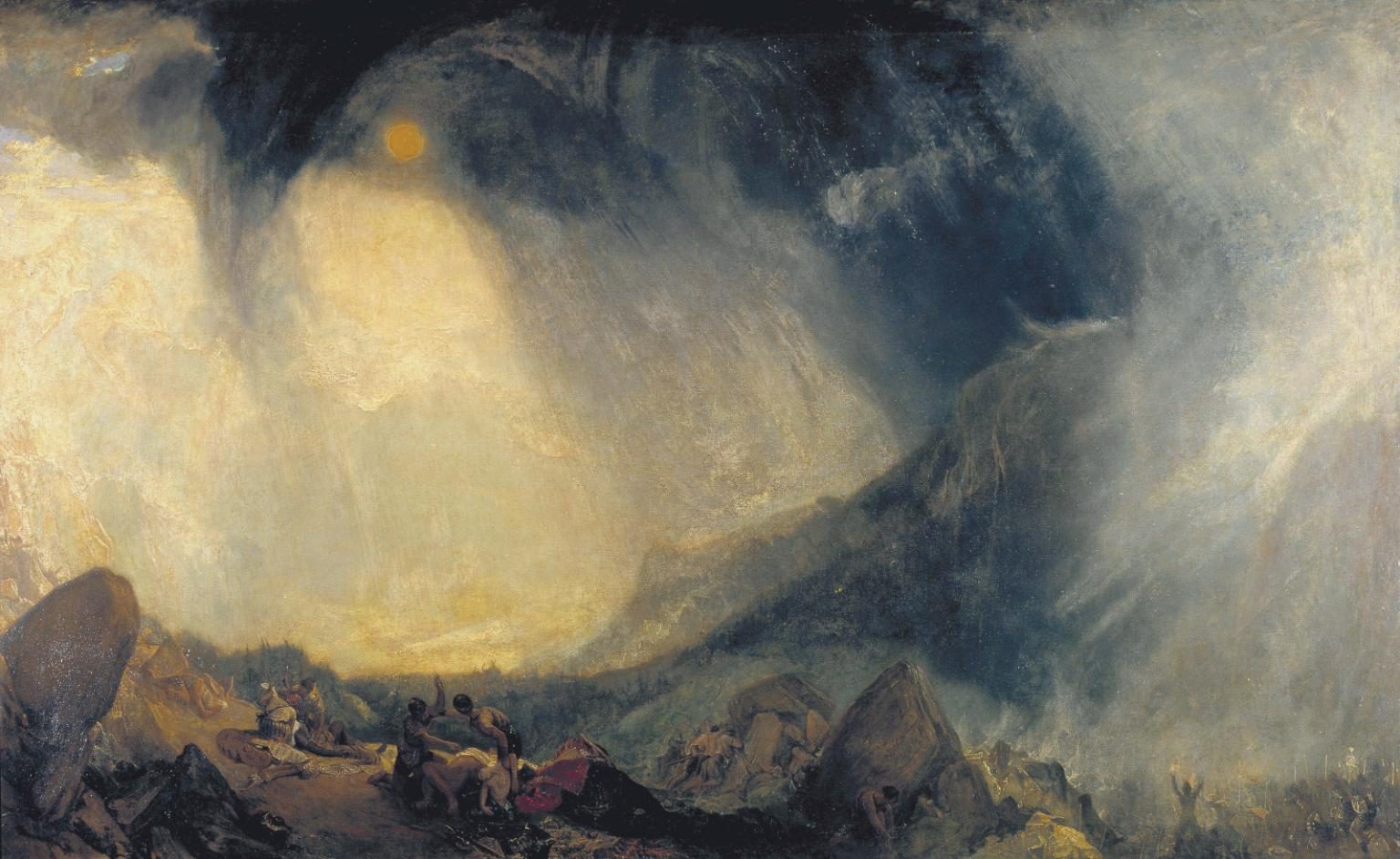
–1835
Landscape, vision and public spectacle
Constable’s worked countryside, Palmer’s Shoreham and the apocalypses of Martin and Danby create different publics for Romantic seeing.
–1855
Modernity, memory and late transformations
Turner brings slavery, steam and naval memory into atmospheric history while Martin, the Nasmyths and others extend Romantic practices into the Victorian era.
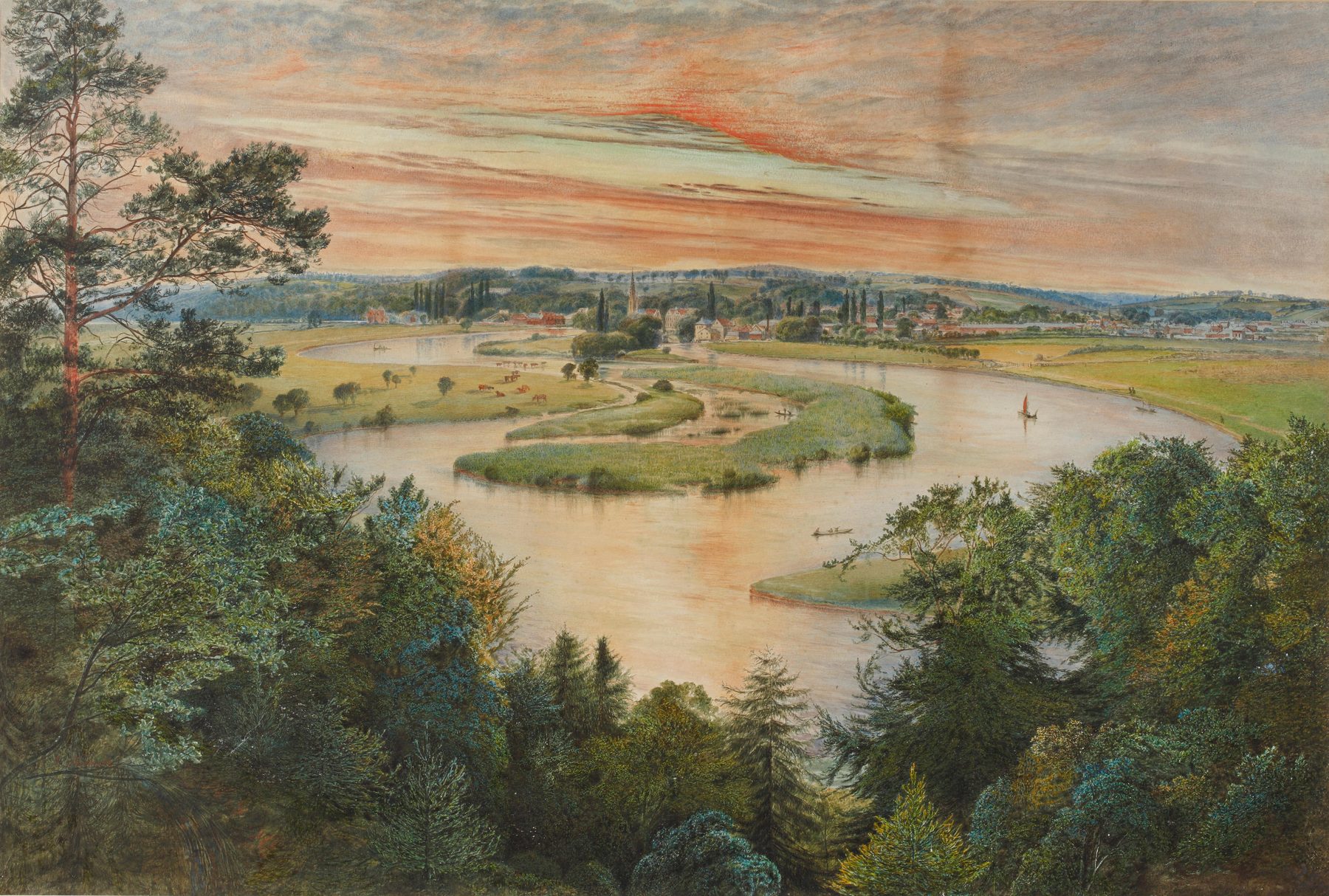
Turner: history inside the modern world
J. M. W. Turner entered the Royal Academy Schools at fourteen and developed one of the longest, most varied careers in British art. He painted oils and watercolours, travelled repeatedly, ran a private gallery, organised print projects, accepted commissions and taught perspective.[23] The working-class son of a barber became an institutional insider without surrendering experimentation.
Turner’s early training grew from topography and watercolour, but his ambitions reached history painting. Claude Lorrain offered luminous distance and ordered landscape; Dutch marine painters supplied weather and working ships; Titian and Venetian art demonstrated colour’s expressive power. Turner transformed these inheritances rather than abandoning them. His landscapes could carry biblical, classical, military or contemporary events.[22]
Modern life was not an intrusion into his art. Fire, coal, steamships, railways, whaling, finance and reform became subjects. The title “painter of light” catches one achievement but risks making illumination detached from history. In Turner, light may expose catastrophe, consume architecture, dissolve a warship or propel a train.
Looking closely at The Fighting Temeraire
Exhibited in 1839, The Fighting Temeraire shows a veteran of Trafalgar being towed along the Thames toward the breakers. Turner paints the sailing ship pale and almost weightless. A compact steam tug pulls ahead, dark against a furnace-like sunset. Moon and sun, sail and steam, memory and utility occupy one impossible but persuasive evening.[25]
The picture is not documentary. Turner altered the tow’s direction and appearance, suppressed practical details and made the sunset carry symbolic force. The Temeraire appears larger, nobler and more ghostly than the tug that controls it. Yet the tug’s energy is undeniable. Nostalgia does not cancel technological change; the painting makes loss and movement inseparable.
Naval glory also belongs to imperial and military history. The work can mourn an admired ship while prompting harder questions about the national memory it served. Why does the warship become pure and luminous only when its labour is over? What histories disappear when sunset converts military power into beauty?
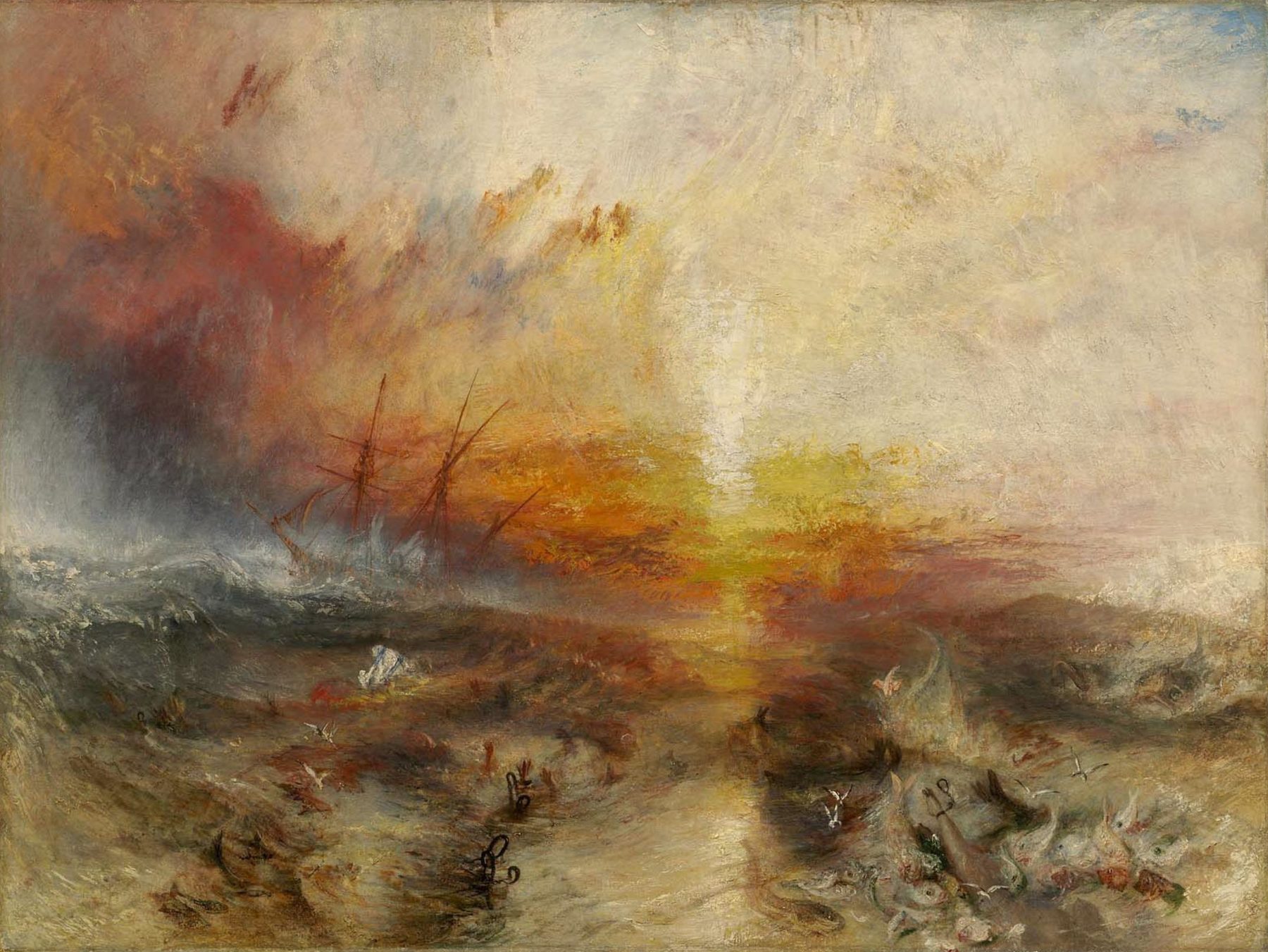
Looking closely at Slave Ship
Turner exhibited Slave Ship in 1840 with lines from his own poem and during an international anti-slavery convention in London. The painting draws on the 1781 Zong massacre, in which the crew of a British slave ship threw more than one hundred enslaved people overboard and the owners sought insurance compensation for their deaths.[26]
A typhoon burns across the horizon. The ship retreats into red and gold distance while shackled limbs struggle in turbulent water among fish and birds. Colour refuses stable separation: sunset, blood, fire and storm contaminate one another. The beautiful surface cannot make the event safe.
That difficulty is the painting’s ethical centre. It condemns a commerce that turned people into insurable cargo, yet it also risks turning Black death into sublime spectacle for gallery viewers. Recent research stresses insurance as more than background, placing the image within Turner’s financial and patronage world.[29] Look at where the ship is going, whose bodies remain near us and whether visual pleasure sharpens or weakens moral attention.
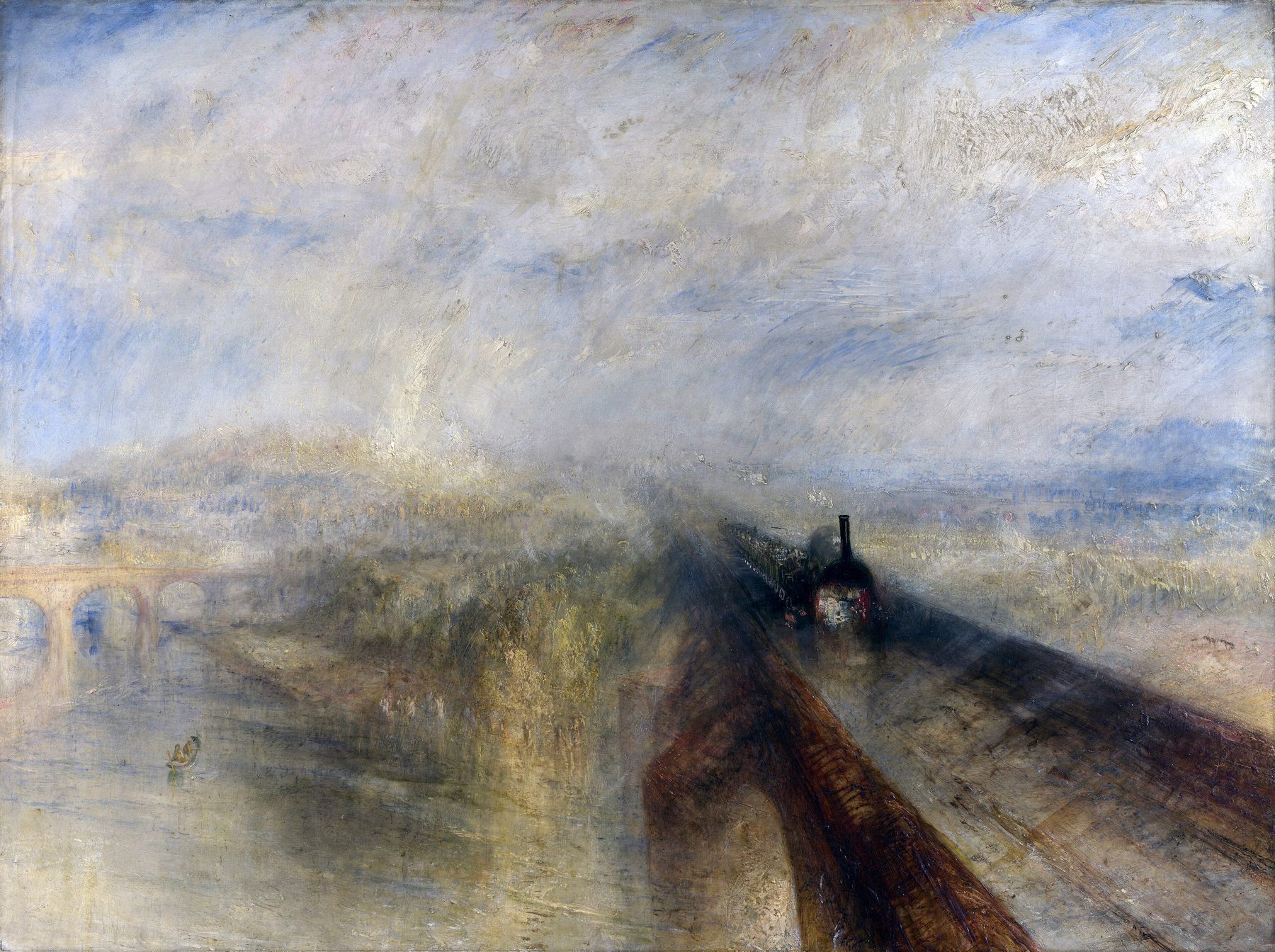
Looking closely at Rain, Steam, and Speed
In 1844 Turner made the Great Western Railway a large Academy subject. A locomotive advances over Isambard Kingdom Brunel’s Maidenhead Viaduct through rain and steam. The bridge’s diagonal drives the eye toward the engine; fields, water and an older road bridge blur around it. A hare, once clearer than it is today, runs along the track as a measure of natural speed.[24]
The train is dark and concentrated, the surrounding world fluid. Turner does not simply declare technology evil. He used rail travel and was fascinated by modern transport. Nor is the work a neutral celebration. Open third-class wagons, the threatened hare and the train’s nearly face-like front make speed both thrilling and alarming. Nature and mechanism share the same unstable atmosphere.
Constable: observation and the worked landscape
John Constable built his career around places he knew intimately, especially the Stour valley on the Suffolk–Essex border. His father owned mills and traded corn, so rivers, locks, barges and weather were parts of a working economy rather than untouched scenery. Constable’s attachment to local landscape differed from Turner’s constant travel, but it was no less ambitious.[14]
He studied old masters including Claude, Rubens and Ruisdael, read art theory and drew outdoors. Small oil sketches and watercolours recorded rapidly changing effects. Finished exhibition canvases were then developed in the studio through many studies, full-size sketches and revisions.[15] Direct observation and pictorial construction worked together; one does not cancel the other.
Constable’s practice makes the word “naturalism” difficult. His broken touches can give leaves, water and cloud an immediate sparkle, yet his large compositions are carefully ordered. He moved trees, adjusted figures and selected weather. White highlights that critics mocked as “Constable’s snow” make wet surfaces and foliage flicker under gallery light. The sensation of freshness is a deliberate achievement.
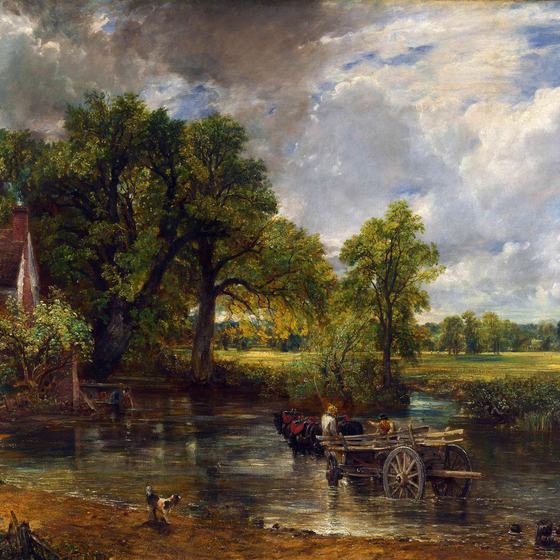
Looking closely at The Hay Wain
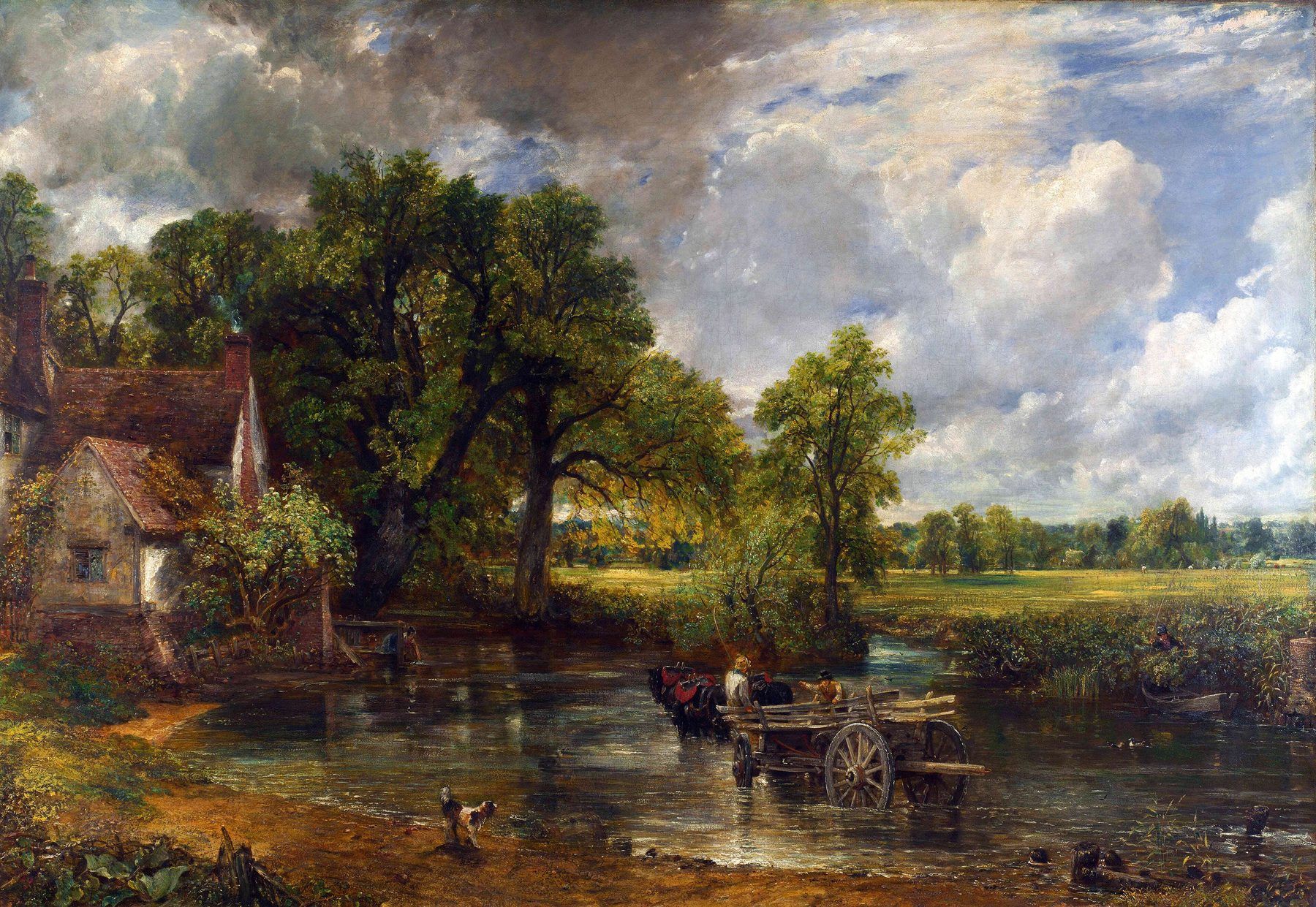
Exhibited in London in 1821, The Hay Wain shows a wagon crossing shallow water near Willy Lott’s cottage. A dog watches from the bank; men work around the vehicle; a broad meadow opens beneath a moving sky. The location was real and familiar, but the scene was assembled into a large public landscape.[17]
The wagon is probably travelling to collect hay rather than carrying it, despite the later title. Water cools its wheels before field work. The cottage, trees and river form a shaded enclosure at the left, while light opens the distance. Red accents lead through the predominantly green and brown field. Clouds do not decorate the scene; their shifting illumination makes every surface temporary.
The picture has become an icon of timeless English countryside. That reputation can obscure labour, property and change. Mills, navigation and agricultural production sustained Constable’s family world. The workers are small and peaceful, and conflict over enclosure or rural poverty stays outside the frame. The painting preserves a beloved place by turning its working order into harmony.
Its international history complicates national ownership. Constable struggled for recognition at home, but The Hay Wain won major praise and a gold medal at the Paris Salon of 1824. French writers urged artists to learn from its attention to nature, and Delacroix reconsidered colour and surface after encountering Constable’s work.[17] [30] “English landscape” became a resource for French Romanticism.
Clouds, notes and the science of change
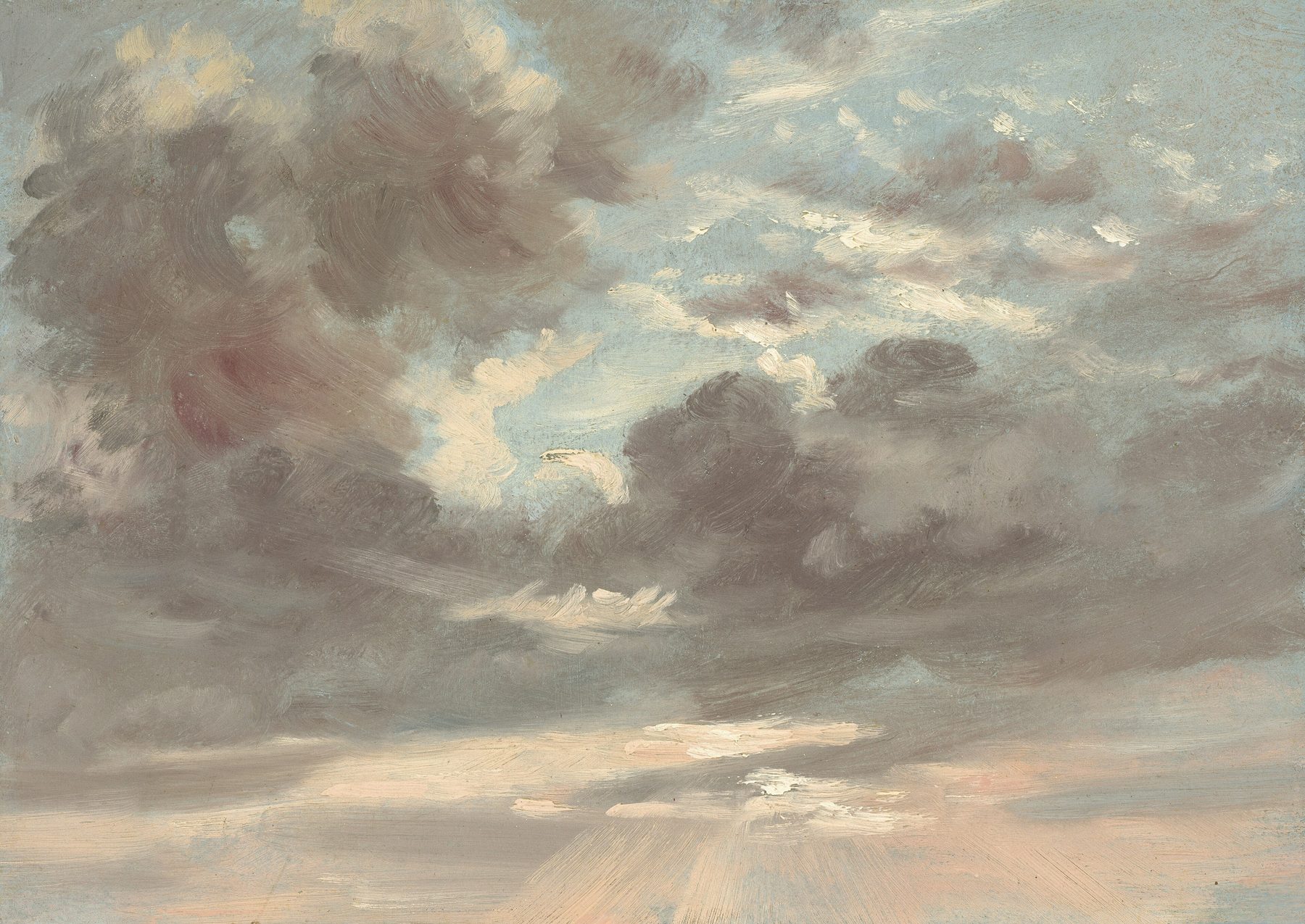
At Hampstead in 1821 and 1822, Constable made an intense group of cloud studies, sometimes writing date, time, wind and weather on the reverse. They are not simply private expressions of mood. Meteorological observation, memory, painting speed and material experiment meet on small supports.[16]
Watercolour allowed him to reserve paper for light and drag washes across graphite. Oil let him work opaquely and scrape back. A French museum study emphasises movement, variation and instability in his skies rather than treating them as fixed cloud “types.”[20] The annotations make passing weather historical: this formation, at this hour, under this wind.
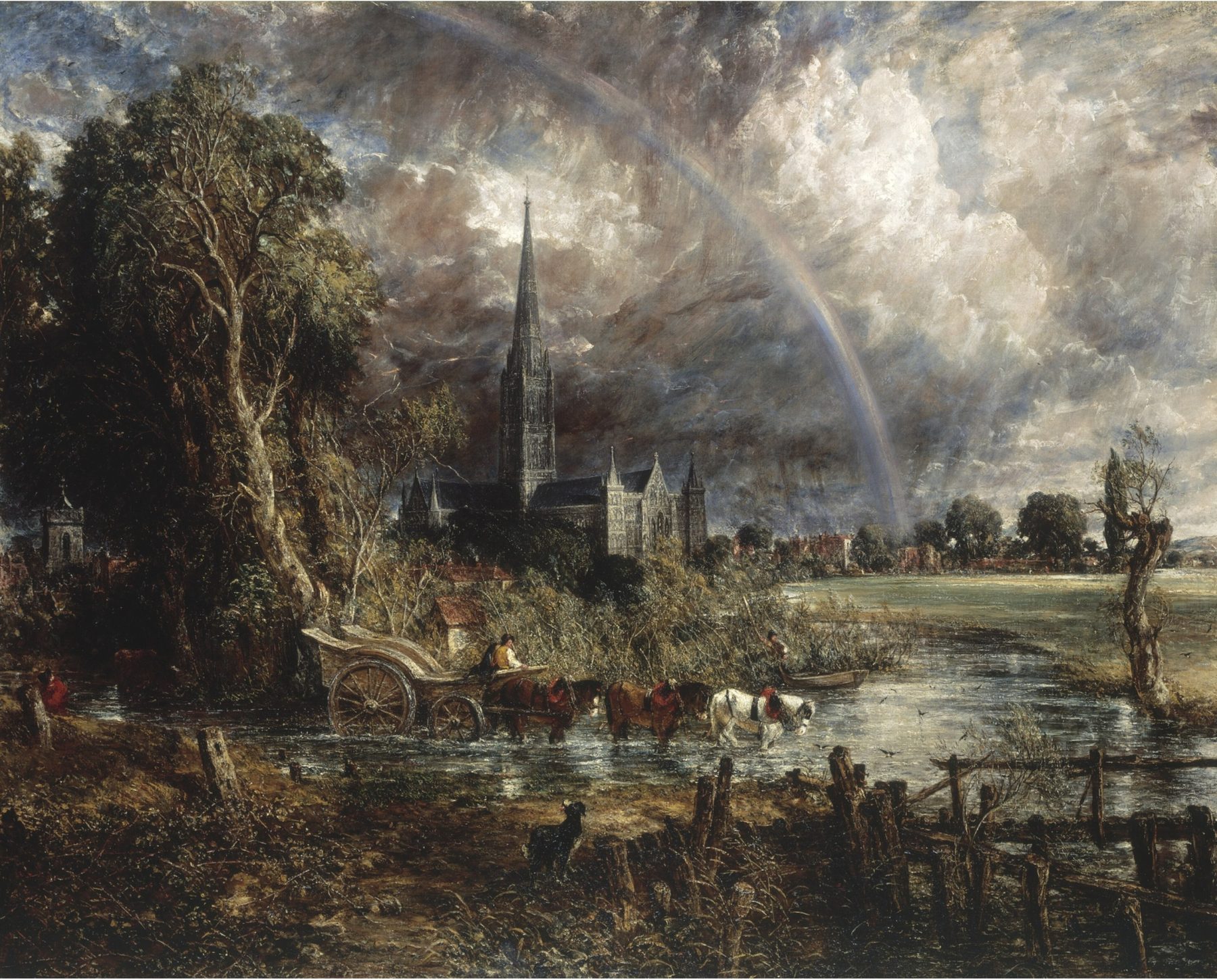
Constable’s late public landscapes transform such studies. Salisbury Cathedral from the Meadows places the church under a violent storm and spans the sky with a rainbow. When the work was exhibited in 1831, Constable attached lines from James Thomson’s The Seasons in which hope follows catastrophe.[18] The painting has been read through grief after his wife’s death, his concern for the Anglican Church and debates surrounding political reform. No single key exhausts it. Personal, religious and public weather overlap.[19]
Turner and Constable are often cast as opposites: Turner as imagination and Constable as observation, fire against water, travel against home. The contrast helps only to a point. Both studied old masters, sketched directly, constructed exhibition effects and revised modern landscape. Their rivalry was real enough for critics and hanging committees, but the larger achievement belongs to their different ways of making weather carry history.
Girtin, Cotman and Palmer
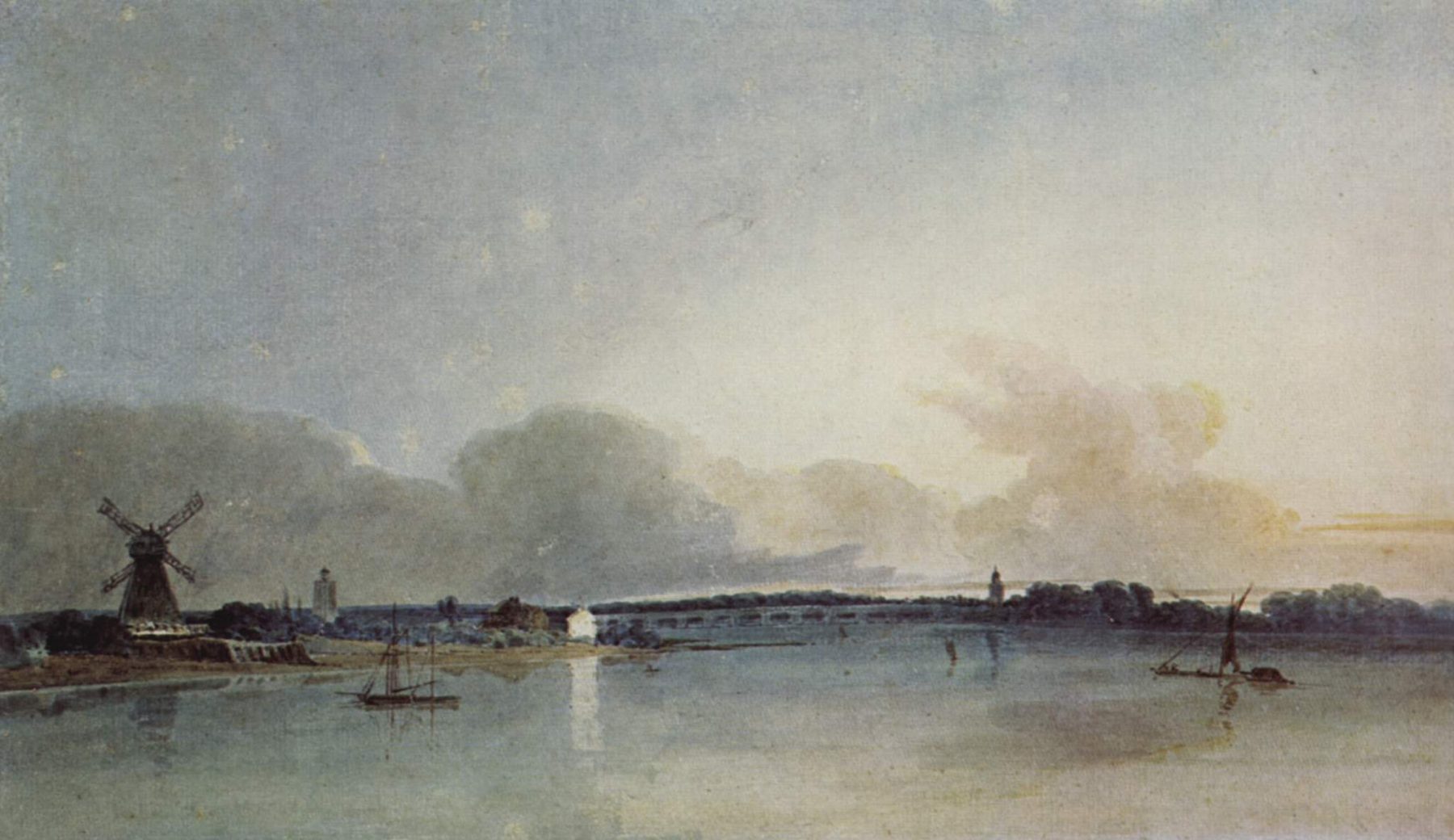
The familiar pairing of Turner and Constable can obscure an exceptionally rich landscape culture. Thomas Girtin, Turner’s near contemporary, gave watercolour new breadth and gravity before dying at twenty-seven. He worked through Monro’s circle, travelled, made aquatints and created the Eidometropolis, a panoramic view of London.[10] Turner’s reported tribute—that if Girtin had lived, he would have starved—may be too polished to trust literally, but it captures later recognition of a serious rival.
Girtin let large washes establish weather and mass instead of merely filling a pen outline. Architecture sits within atmosphere, and unpainted paper can become sky or water. His work helped make watercolour capable of scale, weight and public ambition. The 1804 society formalised a change artists had already begun.
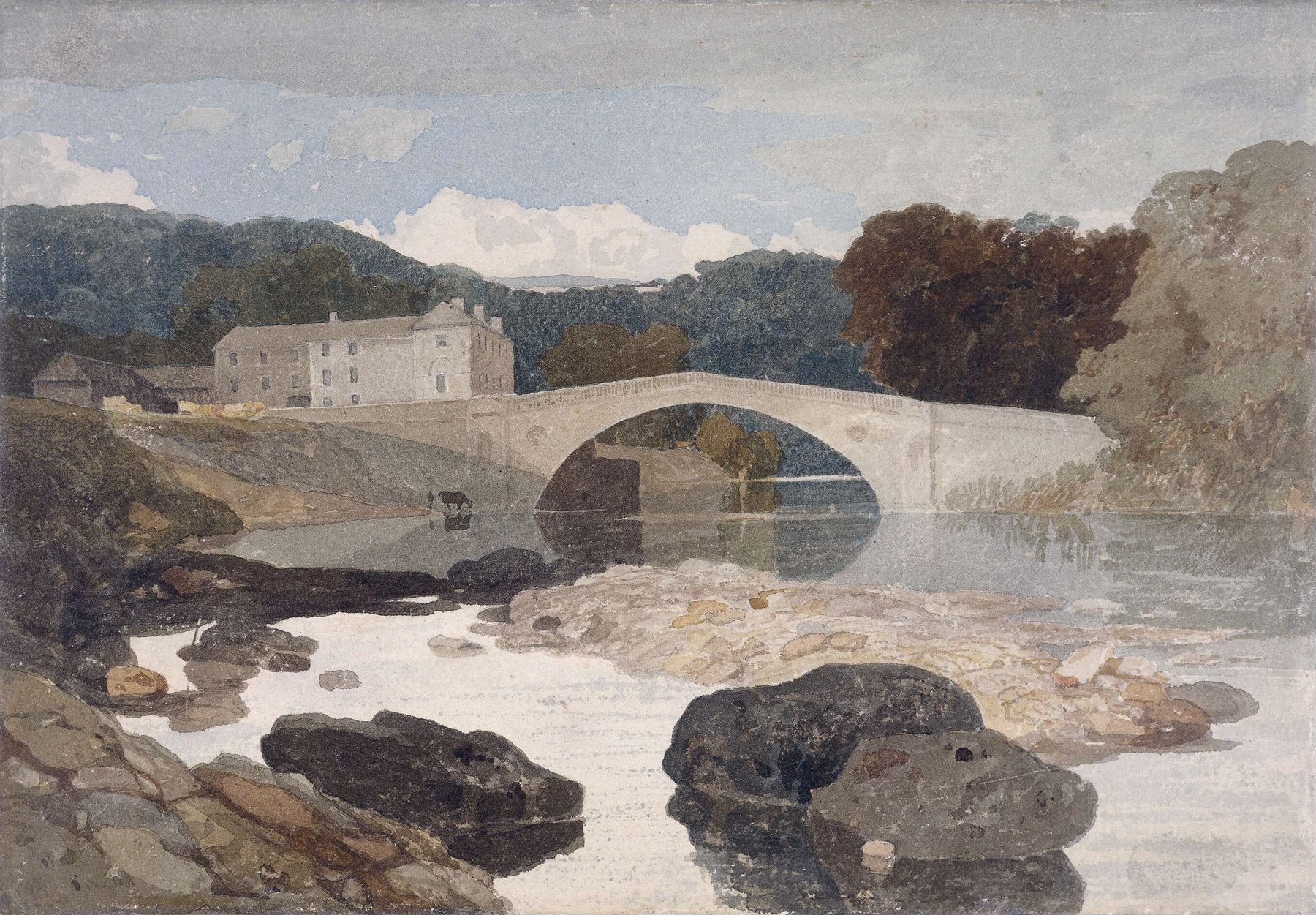
Cotman’s landscapes often seem built from interlocking planes. In the famous Greta drawings, rocks, water and trees become broad tonal shapes without losing topographical identity. His Norwich teaching, northern tours and Normandy publications show how Romantic art could grow through regional schools, antiquarian study and repeated travel rather than a London-only circle.[11]
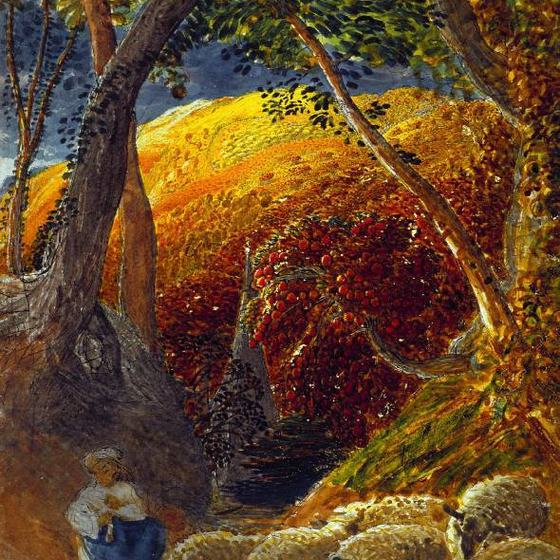
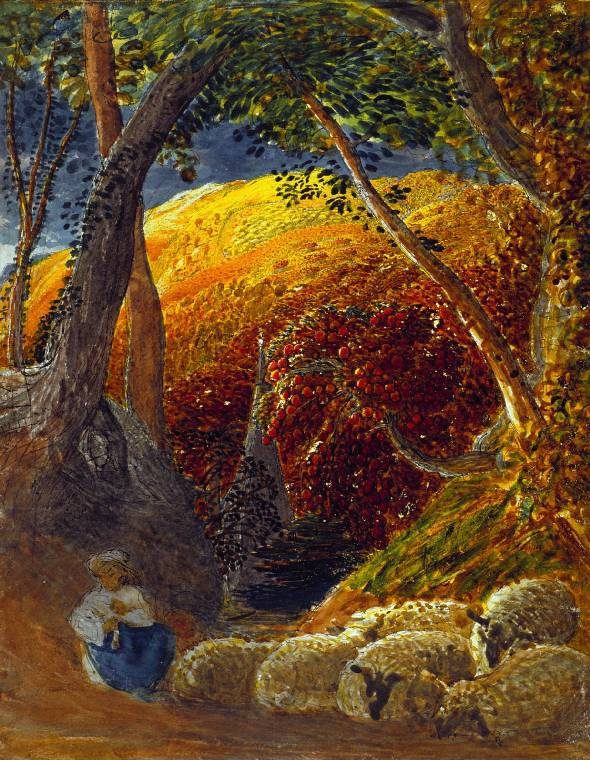
Samuel Palmer belongs to a younger, more private current. He met Blake in 1824 through John Linnell and soon transformed conventional picturesque landscape into dense visionary pastoral. At Shoreham in Kent, Palmer and the loosely connected Ancients admired Blake, early art and rural life. They were a small fellowship, not a mass movement.
Looking closely at The Valley Thick with Corn
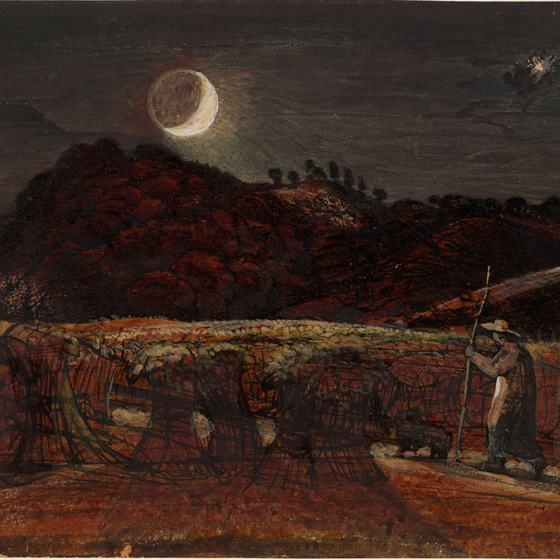
Palmer’s 1825 drawing takes its title from Psalm 65. Enormous ears of grain crowd the foreground, a reclining reader rests on the slope, and distant land rises without conventional perspective. Sepia ink, gum and varnish make the surface dark, rich and almost enamelled.[40]
The grain is too large for neutral observation. Abundance becomes a way of seeing, and the small human figure seems sheltered inside it. The reader has been associated with Christian in Bunyan’s Pilgrim’s Progress, linking cultivated field to spiritual journey. Yet Palmer’s close attention to tree, bank and material surface prevents the scene from becoming an abstract emblem.
In related works he combined white gouache, yellow watercolour, gum and tiny marks to make foliage shine.[41] His pastoral world imagined divine fruitfulness and a simplicity before industrial change, but Shoreham was not outside agricultural economics. Later travel, marriage and market demand altered his style.[42] The intense early works were largely forgotten until their recovery in the 1920s helped shape British Neo-Romanticism.
Martin, Danby and popular apocalypse
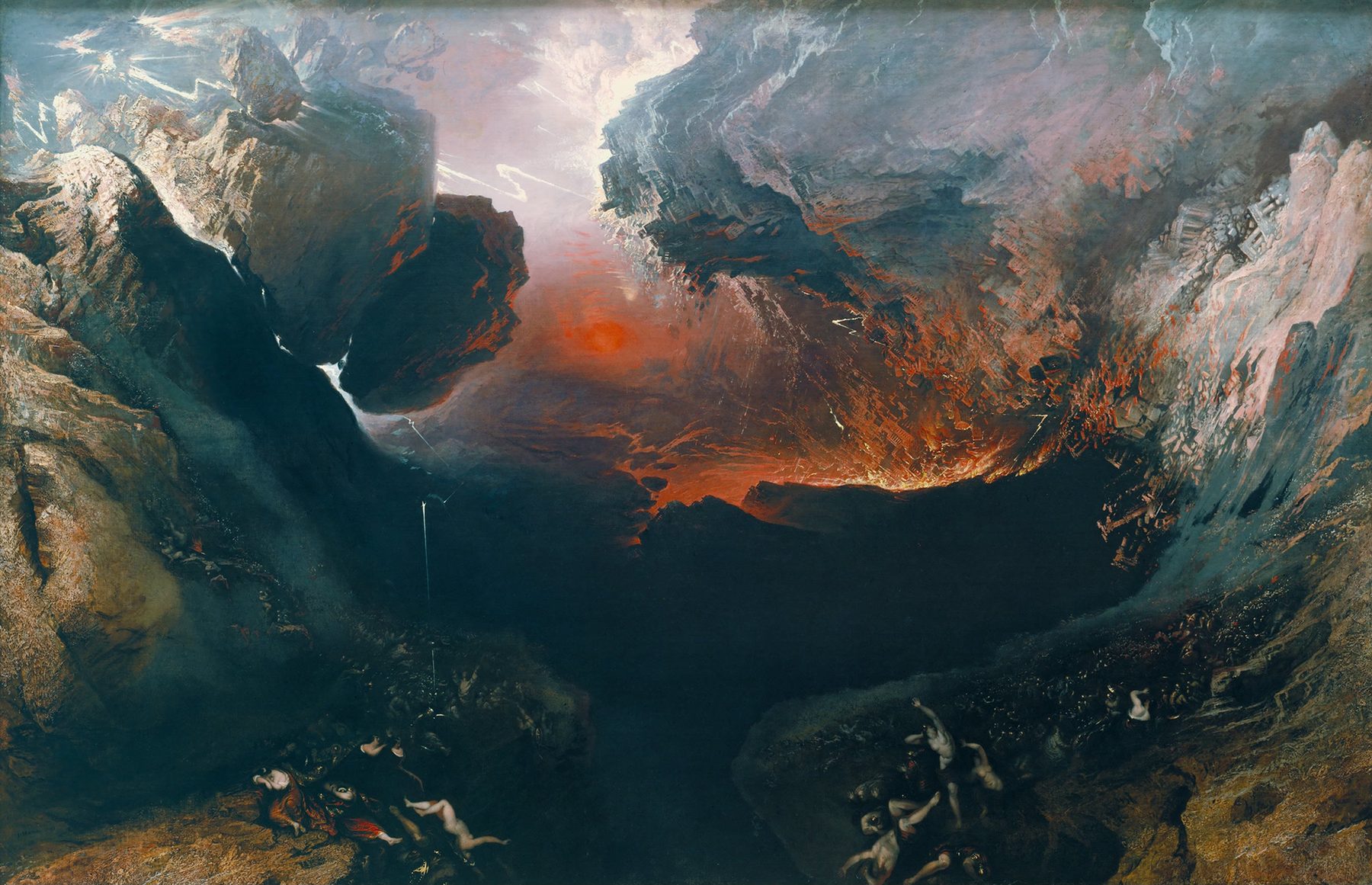
John Martin painted biblical cities, floods, judgement and geological destruction on a scale designed to overwhelm. Academic critics sometimes treated his popularity as vulgar spectacle. Audiences encountered the paintings not only in conventional galleries but in theatres, music halls and civic venues, at times under dramatic lighting. Prints extended their circulation.[43]
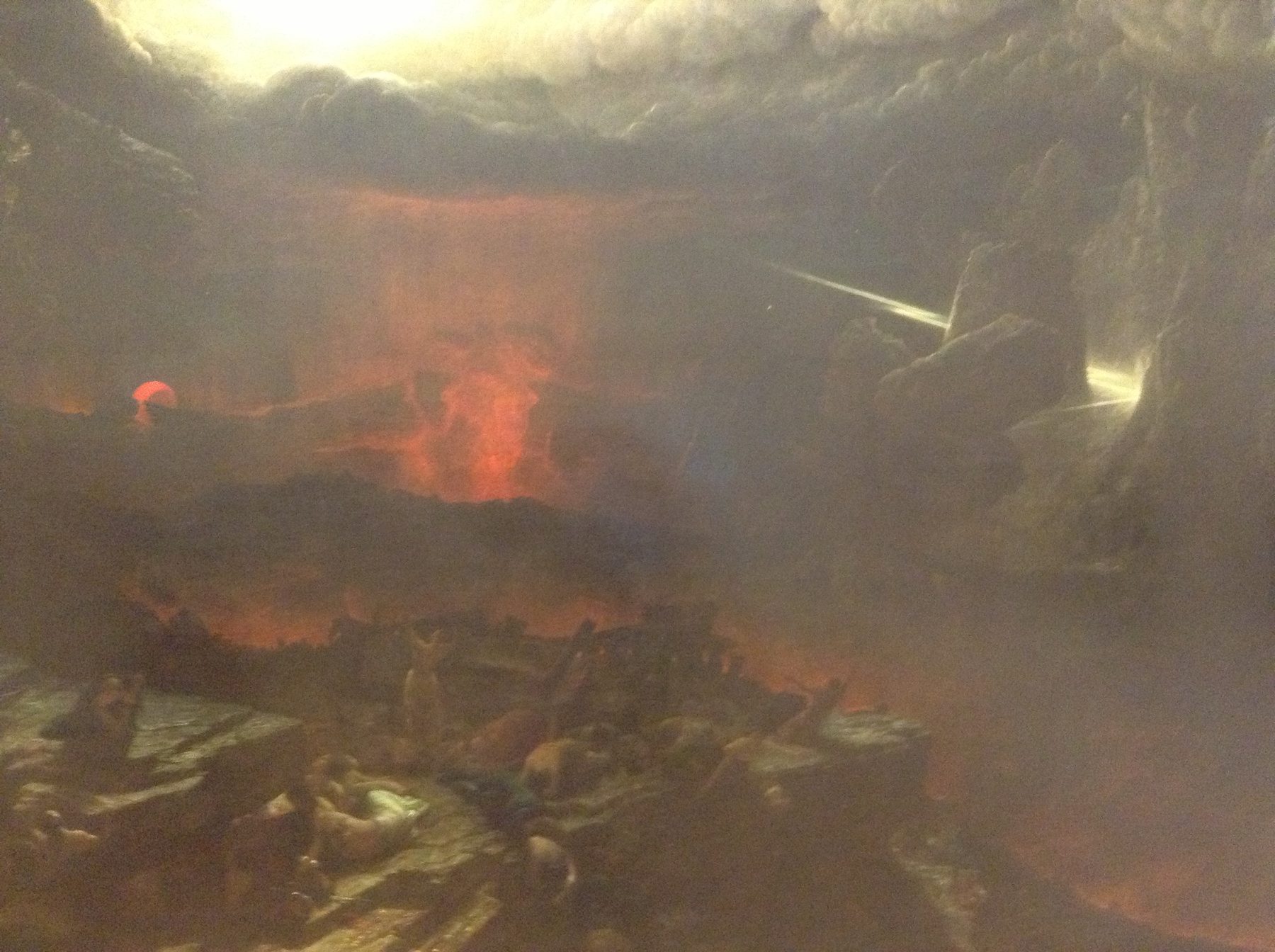
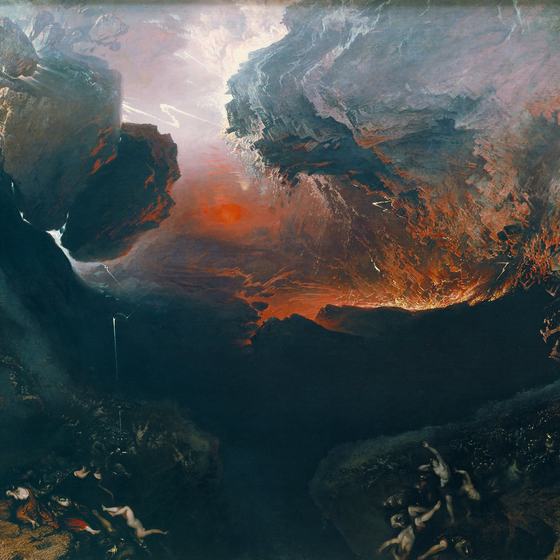
The Great Day of His Wrath makes the earth collapse into itself under a blackened sun and blood-red light. Mountains, buildings and people tumble through a space with no secure ground. Tiny bodies establish scale but cannot master it.[44] Martin’s precise architecture makes destruction more frightening because an entire designed world is being undone.
His work belongs to Romanticism’s history of modern spectatorship. Panoramas, dioramas, exhibition halls and reproductive prints created large publics for immersion. Martin’s apocalypses were not failed academic history paintings; they were successful experiments in how an image could operate as an event.
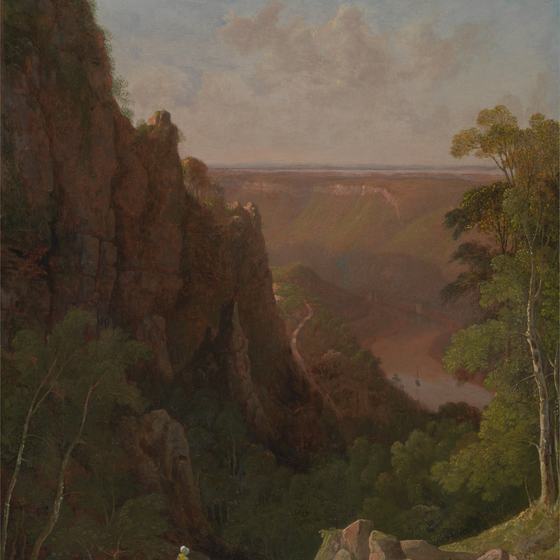
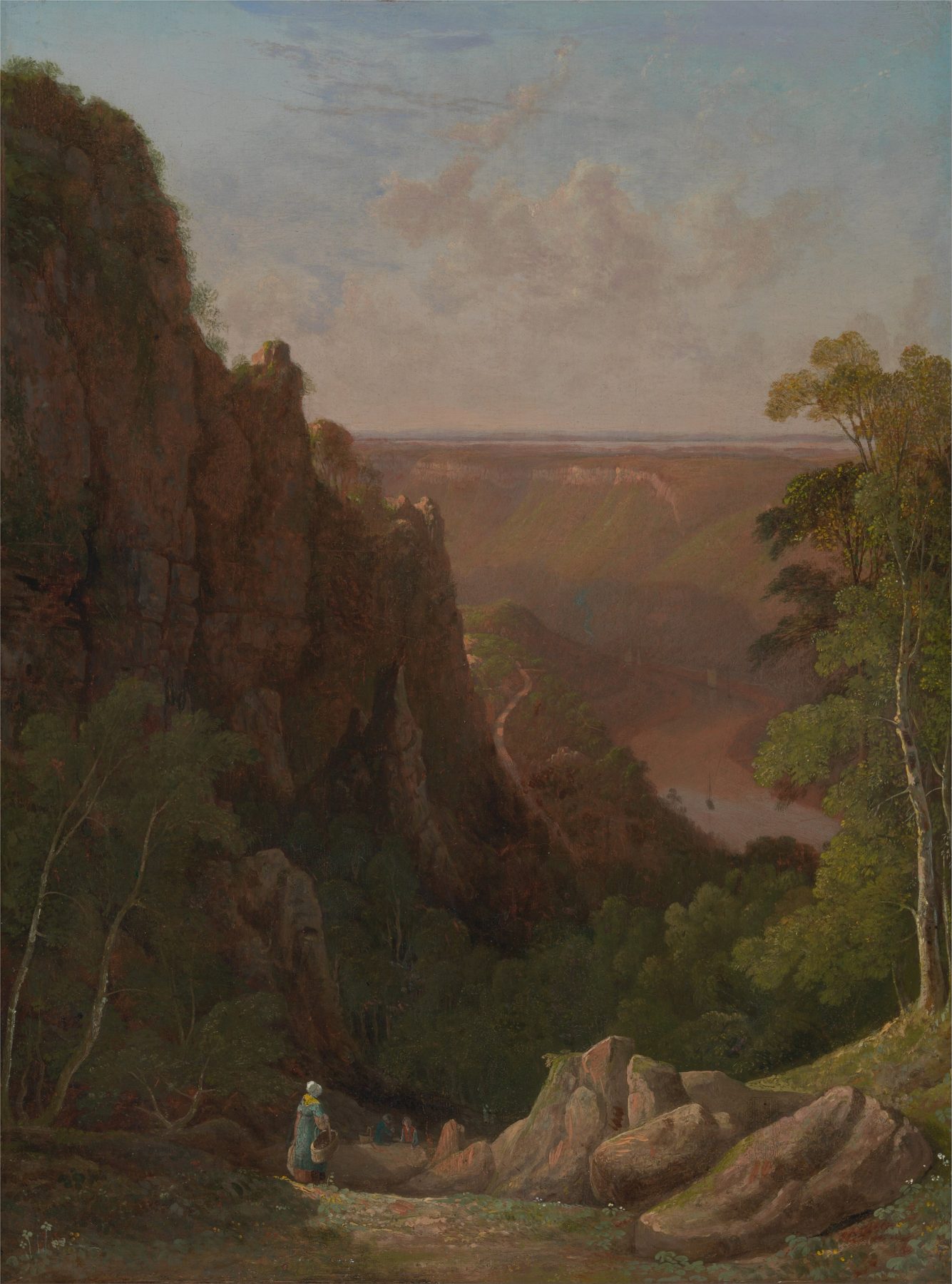
Francis Danby offers another geography. Born in Ireland, he became central to the Bristol School before winning London attention with catastrophic and poetic landscapes. The Opening of the Sixth Seal turns the biblical end of the world into fractured earth, blackened sun and terrified bodies.[45] His intimate views of Leigh Woods and huge apocalypses show that quiet observation and spectacle could belong to one career.
Scotland, Wales and the problem of “British” art
Romantic landscape helped viewers imagine nations. In Scotland, artists and writers transformed lochs, glens, castles and Highland distances into signs of history and identity. Sir Walter Scott’s literature was especially powerful. National Galleries of Scotland describes a Romantic image formed through writers and painters such as Jacob More and Alexander Nasmyth, then projected to international audiences.[46]
These images were not transparent descriptions. A Highland represented as sublime wilderness might be shaped by estate ownership, clearance, military roads, tourism and changing ecology. A current national display deliberately contrasts the popular “land of the mountain and the flood” with a harsher social reality.[47] Romantic emptiness can be a historical effect.
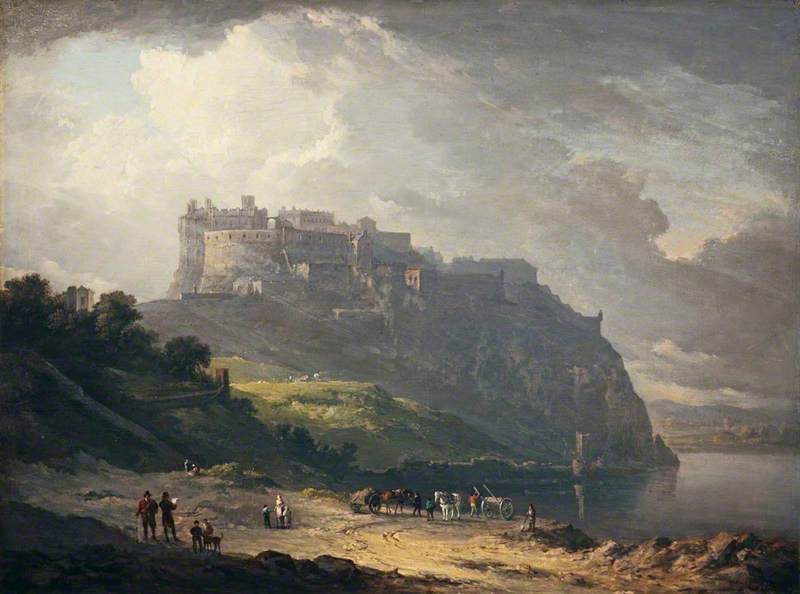
Alexander Nasmyth joined landscape to teaching, engineering and improvement. His Edinburgh Castle and the Nor’ Loch reconstructs water that had already been drained from the centre of a modernising city.[48] The picture makes memory visible while new institutions and urban projects transform the site. Romanticism here is not escape from modernity but an imaginative response to it.
Nasmyth’s household also functioned as a landscape school. He trained his daughters and sons. Charlotte Nasmyth painted landscapes and exhibited at the Royal Academy, Royal Scottish Academy, Royal Hibernian Academy and Royal Manchester Institution.[50] Her career makes clear that family training could create professional networks even when national histories concentrated on fathers and sons.
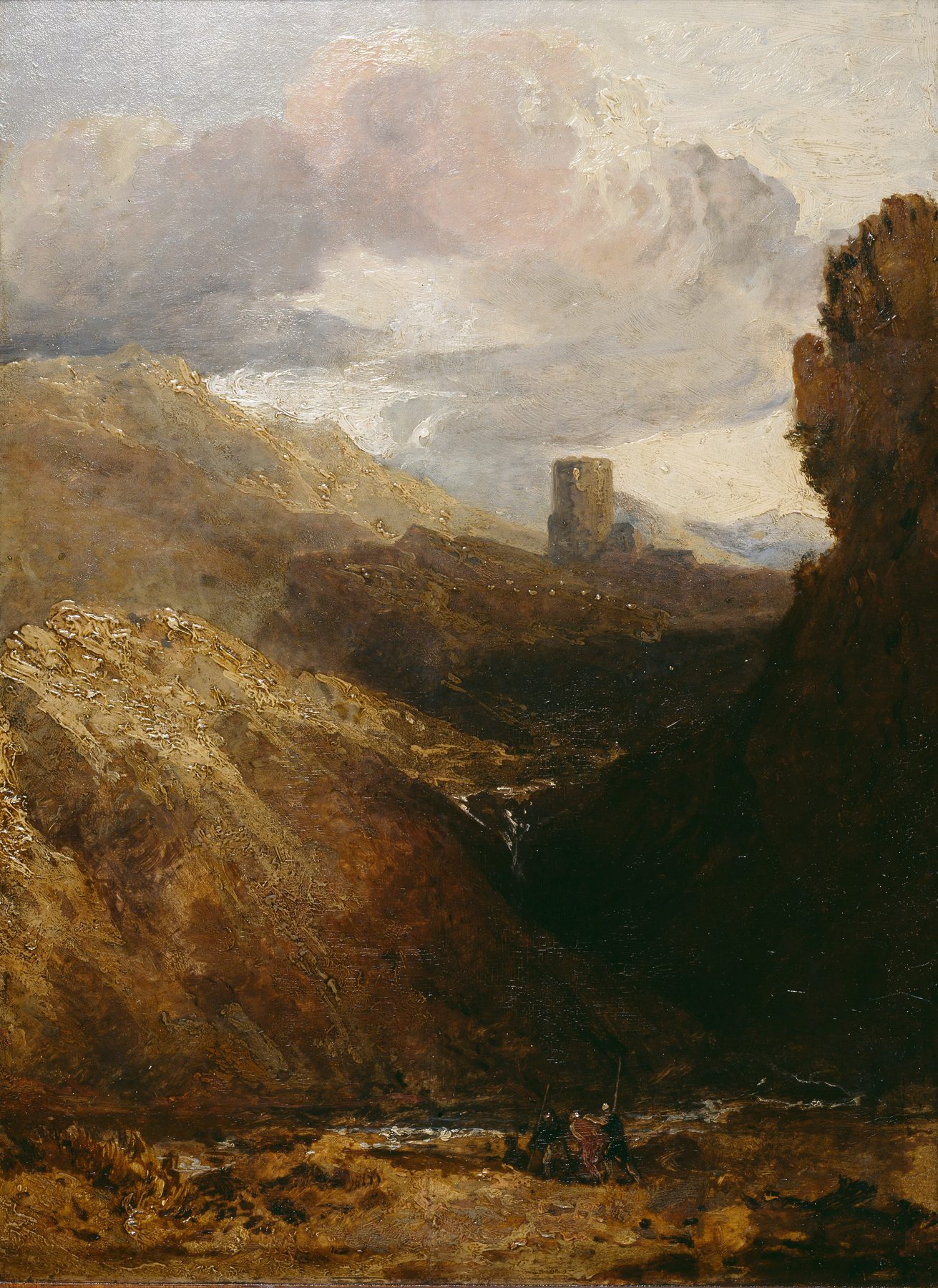
Wales became a major destination for picturesque and sublime travel. Mountains, ruined castles and waterfalls offered scenery that seemed both remote and historically charged. Turner’s tours in the 1790s supplied drawings and watercolours long before easier travel and lightweight equipment. Museum Wales traces his development from early Welsh topography to later seascapes and atmospheric experiment.[6]
This travel altered perception as well as recording places. Guidebooks and aesthetic theory taught visitors which falls, valleys and ruins deserved attention. The resulting market supported local views, prints and tours, but it could turn living landscapes into consumable sequences. A British account must hold regional inspiration beside the power of metropolitan artists and publishers to define what counted as Scotland or Wales.
Ireland complicates the category further. The 1801 union did not erase colonial power, political violence or Irish identity. Danby can be described as Irish-born and active in British art institutions without converting that history into an uncomplicated national inclusion. “British Romanticism” should mark the institutional field while allowing artists to exceed it.
Danby’s career is therefore more than a footnote to an English narrative. His movement from County Wexford through Bristol to London shows how artists crossed political and artistic borders while retaining histories that metropolitan labels can flatten. The Irish setting of his birth, the Bristol networks that sustained him and the national institutions that now interpret his work all belong to its meaning.[45]
Women and the landscape field
Women worked throughout Romantic Britain, but access to training, exhibition, travel and professional identity was unequal. Angelica Kauffman and Mary Moser were founding Royal Academicians in 1768, yet no woman was elected to full membership after them until the twentieth century. Life drawing restrictions and social expectations affected the prestigious fields women could enter.
Landscape watercolour provided one important route. It could be learned through family or private instruction, practised during travel and shown within sociable networks. The same association with amateur accomplishment that opened access could make serious work easier to dismiss. Recent Courtauld research brings together Harriet Lister, Lady Mary Lowther, Amelia Long and Elizabeth Batty, ranging from accomplished amateurs to artists seeking formal recognition.[49]
Their presence changes the story. Lake District and Continental travel were not exclusively male. Nor was observation from a garden or estate necessarily a minor subject. Watercolour choices about scale, paper, wash and route belong to the same history as Girtin and Constable. The difference lies partly in which works institutions bought, published and remembered.
Charlotte Nasmyth’s exhibitions demonstrate ambition inside a family school.[50] Other women’s work remains difficult to attribute because albums were dispersed or names lost through marriage and inheritance. The answer is not to invent a hidden female canon, but to make archival survival and institutional exclusion part of Romantic art’s structure.
Empire, slavery and the sea
British Romantic art developed during a major expansion of maritime and imperial power. Marine painting represented dockyards, battles, trade and naval ceremony. A Yale exhibition argues that the genre was inseparable from Britain’s rise as a maritime empire and places Turner’s early Trafalgar imagery within that tradition.[28]
The sea could appear as universal nature while carrying specific commercial and military histories. Ports and ships linked Britain to India, the Caribbean, Africa and the Americas. Colonial wealth supported collecting and country houses. Enslaved labour produced commodities circulating through British markets. Landscape and marine painting need not depict a plantation to exist inside that economy.
Turner’s Slave Ship makes the connection explicit. Parliament ended the British slave trade in 1807 and slavery in much of the empire in 1833, but abolition did not undo wealth, racism or coercive labour. The Zong murders became a legal dispute over insurance rather than a murder prosecution. Turner’s storm converts that logic into visual catastrophe.[26] [29]
The painting must be approached with double attention. It is a powerful abolitionist indictment, and its beauty can make viewers feel the moral horror of a world in which profit survives human death. At the same time, enslaved people appear as fragmented bodies within a sublime seascape. Romantic colour does not automatically restore their individuality. Looking responsibly means refusing both to dismiss the painting’s protest and to let protest excuse aesthetic distance.
Reception and legacy
British Romantic art entered later history unevenly. Turner achieved fame and left a vast bequest, but his late work was often mocked before later modernists valued its looseness and colour. Constable’s French impact preceded his full domestic reputation. Crossing-Channel exchange in the 1820s and 1830s affected Delacroix and later landscape traditions, challenging any account in which France simply exported Romanticism to Britain.[30]
Blake was remembered as a poet and eccentric before scholars, collectors and artists reconstructed his visual achievement. Palmer’s early Shoreham work remained largely private until the twentieth century. Fuseli’s nightmare imagery travelled through prints, Surrealism and horror cinema; German dark-Romantic exhibitions make that legacy especially visible.[39] Martin’s popular spectacle helped anticipate cinema even as museums hesitated over his status.[43]
Romantic landscape also shaped American art. Thomas Cole, born in industrial Lancashire, studied Turner, Constable and Claude in Britain before becoming central to the Hudson River School. Later British Neo-Romantics including Paul Nash and Graham Sutherland recovered Blake and Palmer while responding to modern war and threatened landscape.[12] [40]
The legacy is therefore not a single path toward Impressionism or abstraction. It includes environmental art, fantasy illustration, film, national tourism, modern watercolour and recurring debates about whether landscape reveals or disguises history.
How to look at British Romantic art
Begin by asking what kind of experience the work offers. Is it sublime, picturesque, beautiful, pastoral, Gothic or some unstable mixture? Notice whether fear feels safely contained.
Find the human scale. A tiny figure may make mountain or architecture overwhelming. A worker may establish a field as productive land. An absent population may be as significant as a visible one.
Study weather as structure. Clouds, rain, sunset, smoke and fire often direct time and attention rather than merely supply mood. In Constable they may begin from dated observation; in Turner they can bind modern events to elemental force.
Look at medium and process. Reserved paper is not white paint. A mezzotint’s darkness comes from a worked plate. Blake’s hand colouring makes one copy differ from another. A studio canvas may grow from many outdoor studies.
Ask what history enters the landscape. A ruined castle, working mill, railway, warship or empty Highland carries political and economic relations. Beauty can preserve memory while simplifying it.
Finally, consider audience. Was the work made for an Academy wall, a watercolour society, a private book, a print subscriber or a travelling spectacular display? Romantic feeling was shaped by how and where people gathered to experience it.
Artists and places to know
J. M. W. Turner
painter, watercolourist and printmaker who made atmosphere carry ancient history, war, empire, slavery and industrial modernity.
John Constable
landscape painter whose Suffolk subjects join close observation, old-master study, rural labour and large exhibition construction.
William Blake
poet-printmaker whose illuminated books unite radical prophecy, biblical interpretation and control over material production.
Henry Fuseli
Swiss-born, Rome-trained London painter of literary and dream subjects whose theatrical bodies shaped dark Romanticism.
Samuel Palmer
Blake-influenced artist whose Shoreham drawings and watercolours turn pastoral observation into visionary abundance.
John Martin
painter and printmaker of popular biblical apocalypse and immersive spectacle.
Further artists and places
Thomas Girtin
short-lived innovator who gave watercolour new breadth, atmosphere and public ambition.
John Sell Cotman
Norwich-associated watercolourist, teacher and printmaker whose landscape forms can become powerfully abstracted tonal structures.
Francis Danby
Irish-born Bristol and London artist of intimate woodland landscapes and vast catastrophic scenes.
Alexander Nasmyth
Scottish landscape painter, teacher and engineer who helped construct a Romantic image of national place.
Charlotte Nasmyth
Scottish landscape painter trained in her father’s family school and active across several exhibition institutions.
London
Royal Academy, publishers, private galleries, commercial exhibitions and the workshops of Blake, Fuseli and Turner.
The Stour valley
Constable’s working landscape of mills, barges, cottages, locks and fields.
Hampstead
a site of Constable’s cloud studies and late views around expanding London.
Shoreham, Kent
Palmer’s visionary pastoral centre and meeting place for the Ancients.
Wales
crucial to Turner’s early tours and the British taste for sublime and picturesque scenery.
The Lake District
literary Romantic landscape, tourist destination and a revealing test of Constable’s preference for inhabited country.
The Scottish Highlands
a landscape made internationally iconic through Romantic literature, tourism and painting, often at the cost of social complexity.
Edinburgh
a centre where landscape, literature, improvement and national institutions met.
Bristol
the setting for Danby and a regional landscape circle connected to urban, Atlantic and political histories.
Paris
the site of Constable’s 1824 success and a major centre for British–French Romantic exchange.
Major artists directory
| Name | Nationality | Key Works |
|---|---|---|
| Alexander Nasmyth | Scottish | Edinburgh Castle and the Nor’ Loch |
| Amelia Long | English | Landscape studies |
| Charlotte Nasmyth | Scottish | Marlow Lock from Cookham Dean |
| David Cox | English | The Junction of the Severn and the Wye |
| Francis Danby | Irish | The Opening of the Sixth Seal, The Avon Gorge |
| Harriet Lister | English | Lake District watercolours |
| Henry Fuseli | Swiss · British | The Nightmare, Titania and Bottom |
| J. M. W. Turner | English | Snow Storm: Hannibal and his Army Crossing the Alps, The Fighting Temeraire, Slave Ship, Rain, Steam, and Speed, Dolbadarn Castle |
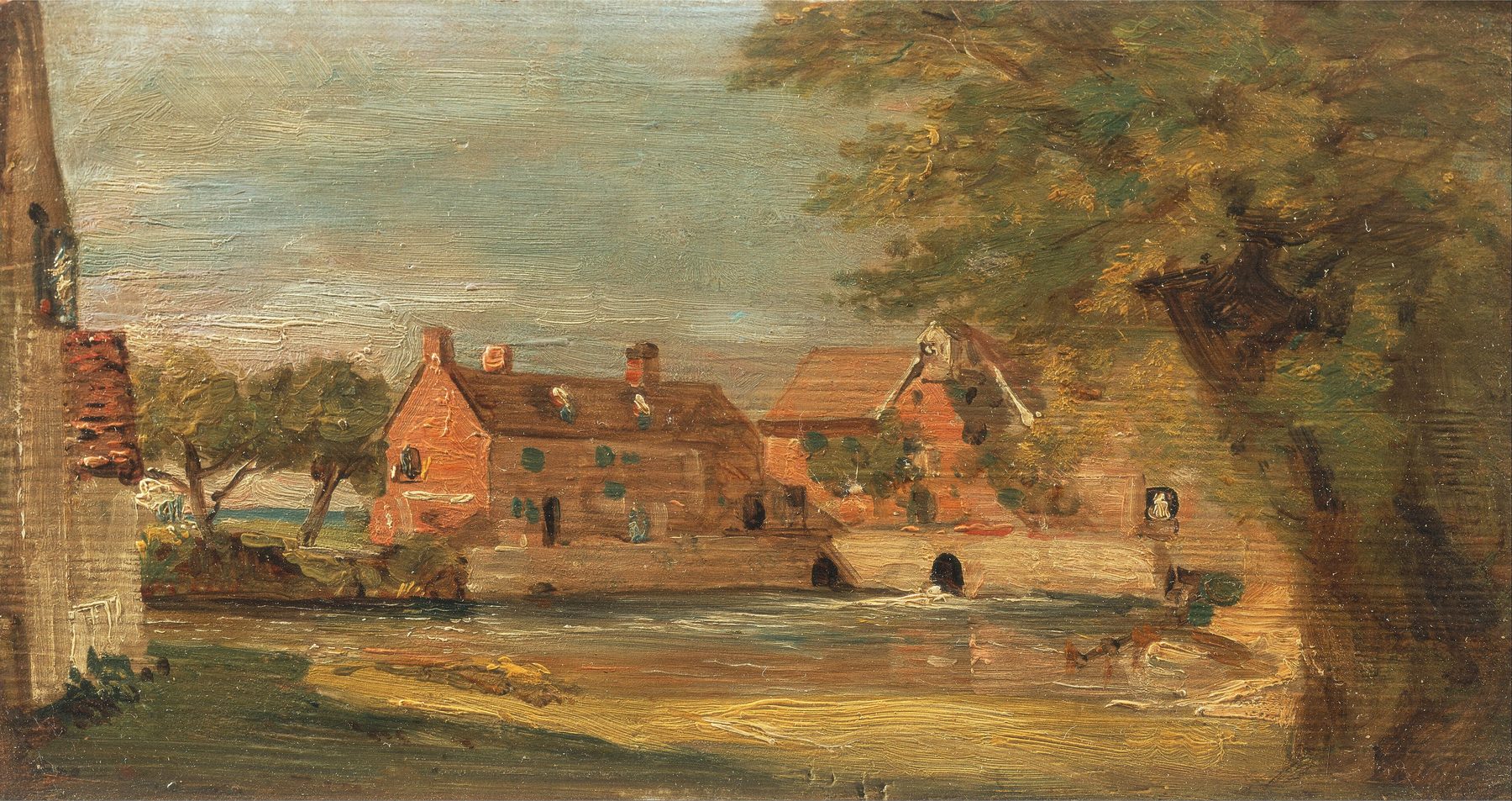
| John Constable | English | The Hay Wain, Salisbury Cathedral from the Meadows, Cloud Study: Stormy Sunset, Flatford Mill |
| John Linnell | English | Portrait of William Blake, The Eve of the Deluge |
| John Martin | English | The Great Day of His Wrath |
| John Robert Cozens | English | Lake of Albano, The Devil’s Bridge |
| John Sell Cotman | English | Greta Bridge |
| Philip James de Loutherbourg | French · British | An Avalanche in the Alps, Coalbrookdale by Night |
| Richard Parkes Bonington | English | North French Coast, Near Rouen |
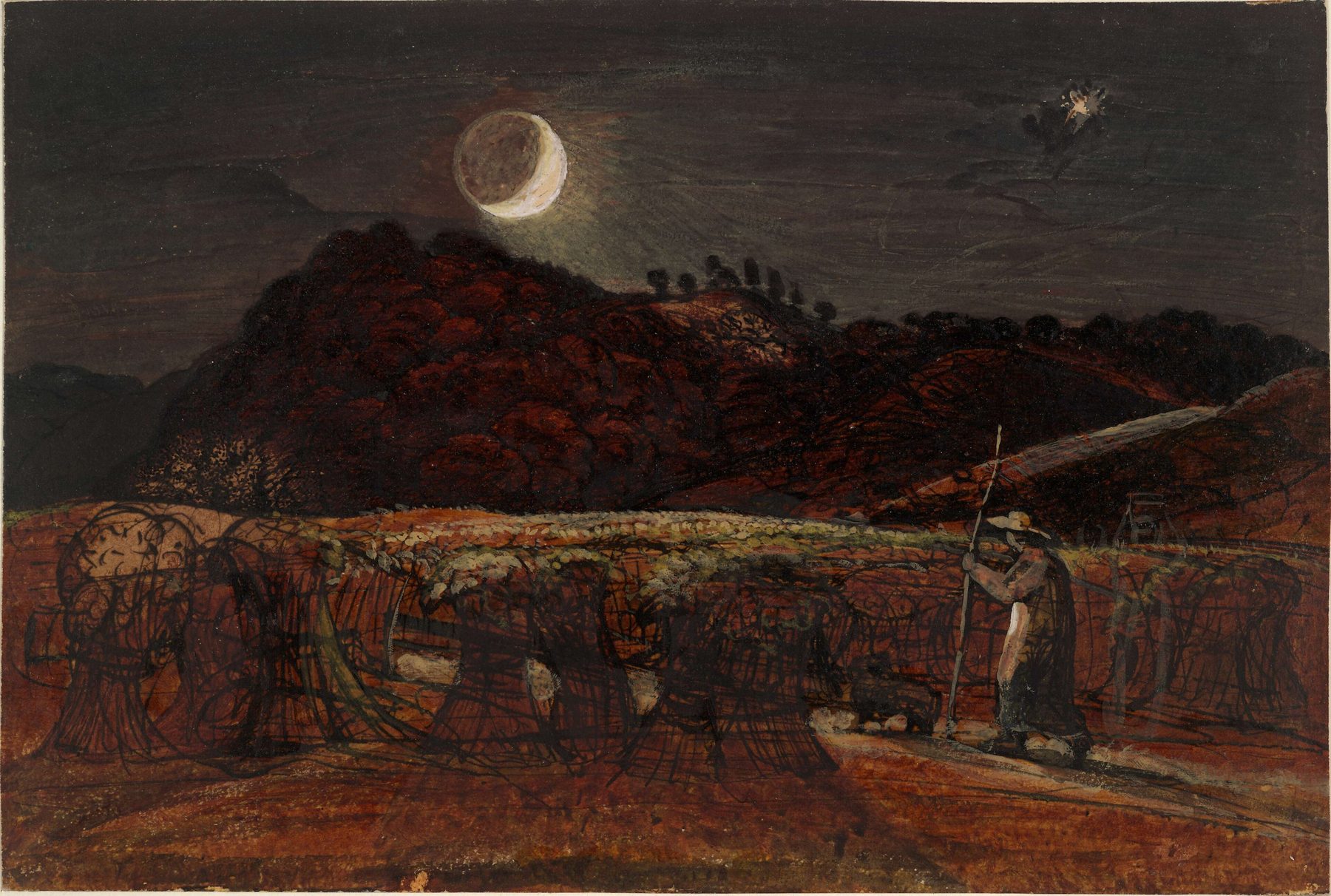
| Samuel Palmer | English | A Cornfield by Moonlight with the Evening Star, The Magic Apple Tree |
| Thomas Girtin | English | The White House at Chelsea |
| William Blake | English | The Ancient of Days, Newton, The Whirlwind of Lovers |
Where to see British Romantic art
These collections provide complementary routes through oil painting, watercolour, print, books, regional landscape and modernity. Displays and loans change, so check current collection information before travelling.
Tate Britain
London, United Kingdom
The Turner Bequest, major Constables, Blake, Palmer, Martin and British landscape make this the broadest single starting point.
Turner and British Romantic artOfficial collection informationNational Gallery
London, United Kingdom
Home to The Fighting Temeraire, Rain, Steam, and Speed, The Hay Wain and other defining public landscapes.
Turner and ConstableOfficial collection informationVictoria and Albert Museum
London, United Kingdom
Outstanding holdings of Constable studies, British watercolour, design and works that reveal process behind exhibition pictures.
Watercolour and working processOfficial collection informationBritish Museum
London, United Kingdom
Exceptional Blake, Fuseli drawings, prints, books and watercolours place Romantic image-making inside material and reproductive culture.
Prints, drawings and booksOfficial collection informationYale Center for British Art
New Haven, United States
A deep collection across Turner, Constable, Blake, Girtin, Cox and Romantic print and watercolour traditions.
British art across mediaOfficial collection informationNational Galleries of Scotland
Edinburgh, United Kingdom
Scottish Romantic landscape, Alexander and Charlotte Nasmyth, national image-making and later critical reinterpretation.
Scotland and national landscapeOfficial collection information
Landmark British Romanticism exhibitions
Six exhibitions that changed how the movement’s media, international exchange and popular audiences are understood.
Romantic Vision: Responses to Change
Yale Center for British Art
A cross-media exhibition connecting British, European and American Romantic art with literature and music.
William Blake
Metropolitan Museum of Art, New York
A major reassessment of Blake as visual artist, printmaker and maker of illuminated books.
Romantic Watercolor: The Hickman Bacon Collection
Dulwich Picture Gallery and Yale Center for British Art
An important survey of British watercolour as collecting field, exhibition medium and technical practice.
The Romantic Landscape Print
Yale Center for British Art
A focused account of printmaking as a central vehicle for Romantic landscape and personal expression.
Crossing the Channel
Tate Britain, Minneapolis Institute of Art and Metropolitan Museum of Art
A landmark demonstration that British and French Romantic painting developed through reciprocal exchange.
John Martin: Apocalypse
Tate Britain
A major recovery of Martin’s biblical spectacle, print circulation and relationship with mass audiences.
Frequently Asked Questions
No. The name gathers several generations, media and regional networks. Artists did not share a manifesto or uniform appearance, and some would not have described themselves as Romantics.
Approximately 1770–1850 is a useful visual-arts span, with the most concentrated period around 1790–1840. It overlaps with Neoclassicism, the Gothic revival and early Victorian art.
Landscape is central, especially in Turner, Constable and watercolour, but the movement also includes Blake’s books, Fuseli’s dream pictures, literary illustration, history painting, biblical apocalypse, printmaking and public spectacle.
Not simply. He used modern transport and repeatedly made steam power, fire and industry worthy subjects. Rain, Steam, and Speed presents exhilaration and threat together rather than delivering a straightforward rejection.[24]
He made many outdoor studies, but his major exhibition landscapes were built in the studio through drawings, oil sketches and full-size studies. Their freshness is constructed from sustained observation.[15]
Discussion
Which Romantic landscape feels most changed when you ask who worked, owned, travelled through or was excluded from it? Compare the apparent harmony of The Hay Wain, the industrial velocity of Rain, Steam, and Speed, Palmer’s abundant Shoreham and the emptiness of a Highland view.
Reader Insights
Look for workers, travellers, tiny spectators and absent communities before reading landscape as empty nature.
Ask whether cloud, rain, fire or smoke records observation, directs time or turns a modern event into elemental history.
Reserved paper, hand colouring, mezzotint darkness and exhibition-scale oil each create a different kind of Romantic encounter.
Join the Conversation
Which British Romantic work changes most when labour, ownership, travel or empire returns to view?
References
- National Galleries of Scotland, “Romanticism”, nationalgalleries.org. View Source
- Yale Center for British Art, “Romantic Vision: Responses to Change”, britishart.yale.edu. View Source
- British Library, “The Romantics”, britishlibrary.cn. View Source
- National Gallery London, “Picturesque”, nationalgallery.org.uk. View Source
- National Galleries of Scotland, “Sublime”, nationalgalleries.org. View Source
- Amgueddfa Cymru–Museum Wales, Uncommon Ground education pack, museum.wales. View Source
- Victoria and Albert Museum, “What is watercolour?”, vam.ac.uk. View Source
- Metropolitan Museum of Art, “Watercolor Painting in Britain, 1750–1850”, metmuseum.org. View Source
- Royal Watercolour Society, “Our History”, royalwatercoloursociety.co.uk. View Source
- British Museum, “Thomas Girtin”, britishmuseum.org. View Source
- British Museum, “John Sell Cotman”, britishmuseum.org. View Source
- Yale Center for British Art, “The Romantic Landscape Print: The Chiaroscuro of Nature”, britishart.yale.edu. View Source
- Yale Center for British Art, “Romantic Watercolor: The Hickman Bacon Collection”, britishart.yale.edu. View Source
- Victoria and Albert Museum, “John Constable: an introduction”, vam.ac.uk. View Source
- Victoria and Albert Museum, “John Constable's sketches”, vam.ac.uk. View Source
- Metropolitan Museum of Art, “Cloud Study”, metmuseum.org. View Source
- National Gallery London, “The Hay Wain”, nationalgallery.org.uk. View Source
- Amgueddfa Cymru–Museum Wales, “Salisbury Cathedral from the Meadows”, museum.wales. View Source
- Tate Papers, “Constable and the Dynamics of Vision”, dig-305-artwork-alt-text-c8b04f.up.railway.app. View Source
- Musée du Louvre, “Étude de ciel”, arts-graphiques.louvre.fr. View Source
- Musée du Louvre, “Paysage de hautes collines et montagnes à Langdale”, collections.louvre.fr. View Source
- Yale Center for British Art, “J. M. W. Turner: Romance and Reality”, britishart.yale.edu. View Source
- National Gallery of Art Washington, “Joseph Mallord William Turner”, nga.gov. View Source
- National Gallery London, “Rain, Steam, and Speed”, nationalgallery.org.uk. View Source
- National Gallery London, “The Fighting Temeraire”, nationalgallery.org.uk. View Source
- Museum of Fine Arts Boston, “Slave Ship”, collections.mfa.org. View Source
- Tate, Turner's Modern World, shop.tate.org.uk. View Source
- Yale Center for British Art, “Spreading Canvas: Eighteenth-Century British Marine Painting”, britishart.yale.edu. View Source
- Yale Center for British Art, “Turner Symposium”, britishart.yale.edu. View Source
- Metropolitan Museum of Art, “Crossing the Channel”, metmuseum.org. View Source
- Metropolitan Museum of Art, “William Blake 1757–1827”, metmuseum.org. View Source
- Metropolitan Museum of Art, “William Blake”, metmuseum.org. View Source
- British Museum, “There is No Natural Religion”, britishmuseum.org. View Source
- British Museum, “William Blake”, britishmuseum.org. View Source
- British Museum, “The Whirlwind of Lovers”, britishmuseum.org. View Source
- Detroit Institute of Arts, “The Nightmare”, dia.org. View Source
- British Museum, “Henry Fuseli”, britishmuseum.org. View Source
- British Museum, “Fuseli Roman Album”, britishmuseum.org. View Source
- Städel Museum, “Johann Heinrich Füsslis Nachtmahr”, stories.staedelmuseum.de. View Source
- Ashmolean Museum, “The Valley Thick with Corn”, ashmolean.org. View Source
- Morgan Library and Museum, “Samuel Palmer”, themorgan.org. View Source
- Amgueddfa Cymru–Museum Wales, “A Magnificent Romantic Landscape”, museum.wales. View Source
- Tate, “John Martin curatorial walkthrough”, dig-305-artwork-alt-text-c8b04f.up.railway.app. View Source
- Tate, “The Great Day of His Wrath”, artsandculture.google.com. View Source
- National Gallery of Ireland, “The Opening of the Sixth Seal”, nationalgallery.ie. View Source
- National Galleries of Scotland, “Romantic Scotland”, nationalgalleries.org. View Source
- National Galleries of Scotland, “Romance and Reality: Scotland 1800–1895”, nationalgalleries.org. View Source
- National Galleries of Scotland, “Edinburgh Castle and the Nor' Loch”, nationalgalleries.org. View Source
- Courtauld Gallery, “A View of One's Own”, courtauld.ac.uk. View Source
- National Galleries of Scotland, “Charlotte Nasmyth”, nationalgalleries.org. View Source
- Image references 51–75: open-access reproductions and institutional collection records.
View 25 image sources
01 · commons.wikimedia.org02 · commons.wikimedia.org03 · commons.wikimedia.org04 · commons.wikimedia.org05 · commons.wikimedia.org06 · commons.wikimedia.org07 · commons.wikimedia.org08 · commons.wikimedia.org09 · commons.wikimedia.org10 · commons.wikimedia.org11 · commons.wikimedia.org12 · commons.wikimedia.org13 · commons.wikimedia.org14 · commons.wikimedia.org15 · commons.wikimedia.org16 · commons.wikimedia.org17 · commons.wikimedia.org18 · commons.wikimedia.org19 · commons.wikimedia.org20 · commons.wikimedia.org21 · commons.wikimedia.org22 · commons.wikimedia.org23 · commons.wikimedia.org24 · commons.wikimedia.org25 · commons.wikimedia.org