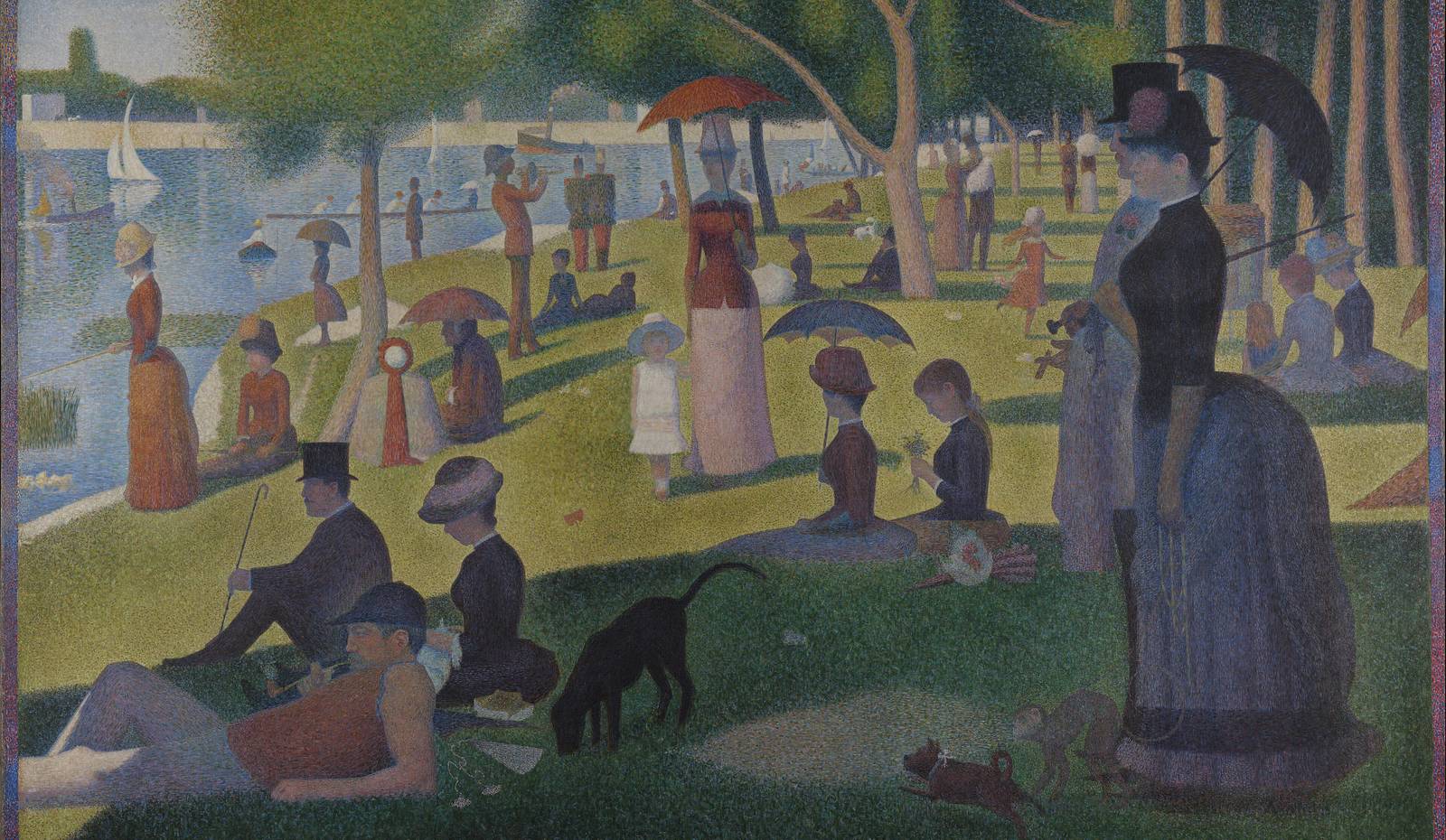
Image reference: Georges Seurat, A Sunday on La Grande Jatte—1884.
At a Glance
- Core periodc. 1884–1906, with longer European afterlives
- NationsFrance · Belgium · Netherlands · Britain
- Principal centresParis · Brussels · Seine suburbs · northern ports · Mediterranean coast
- Major forumsSociété des Artistes Indépendants · eighth Impressionist exhibition · Les XX
- Known fordivided colour · complementary contrast · planned composition · modern leisure · labour
- Key artistsSeurat · Signac · Cross · Luce · Pissarro · Angrand · Van Rysselberghe · Boch
- Central tensionshared theory and exhibitions produced highly individual pictures
Contents
- Where Neo-Impressionism fits
- Independence before a movement
- The exhibition of 1886 and the name
- What divided colour actually does
- Seurat before the dots
- A Sunday on La Grande Jatte
- Signac after Seurat
- Brussels and an international network
- From Van Gogh to Matisse and beyond
- Artists and places to know
Where Neo-Impressionism fits
Camille Pissarro
Principal careerGeorges Seurat
Principal careerPaul Signac
Principal careerHenri-Edmond Cross
Principal careerMaximilien Luce
Principal careerCharles Angrand
Principal careerThéo van Rysselberghe
Principal careerAnna Boch
Principal careerLucien Pissarro
Principal careerHenry van de Velde
Principal careerGeorges Lemmen
Principal careerJan Toorop
Principal careerNeo-Impressionism began with a paradox. Its painters wanted colour to appear more luminous, yet they reached for discipline rather than spontaneity. They studied how neighbouring hues affect one another, separated pigments into distinct marks and built large compositions through prolonged preparation. At the same time, their pictures show riverside crowds, factories, harbours, cafés, circuses, farm workers and imagined communities. A method often described as scientific became a way to picture the unstable social world of the late nineteenth century.
The name belongs to a historical network, not simply to any painting made from dots. Félix Fénéon coined “Neo-Impressionism” in 1886 to identify a new tendency around Georges Seurat. “Divisionism” describes its characteristic separation of colour into juxtaposed touches. “Pointillism” refers more narrowly to a dot-like mark. The distinction matters because the painters used points, short hatches, rectangles, commas and mosaic-like strokes, sometimes within the same career.[1] [2] [3]
Neo-Impressionism's practical history runs from the independent exhibitions of 1884 through the first years of the twentieth century. Seurat and Paul Signac established its central principles; Camille and Lucien Pissarro, Henri-Edmond Cross, Maximilien Luce, Charles Angrand and Albert Dubois-Pillet developed different versions. The movement travelled quickly to Belgium, where Théo van Rysselberghe, Anna Boch, Georges Lemmen, Willy Finch and Henry van de Velde responded through the exhibition society Les XX. Its colour experiments later mattered to Matisse and many other modern artists, but this afterlife did not follow one straight road.[1] [2]
Neo-Impressionism was born from Impressionism and from dissatisfaction with it. Monet, Renoir, Pissarro and their colleagues had made contemporary life, shifting atmosphere and visible brushwork central to advanced painting. The younger artists inherited their high-keyed palette, interest in outdoor light and commitment to modern subjects. They did not simply continue the older painters' rapid, apparently immediate handling. They wanted firmer structure, more systematic colour relationships and pictures capable of joining sensation to permanence.[2] [4]
The prefix “Neo” therefore signals both descent and argument. Signac later constructed a lineage running from Delacroix's colour, through the Impressionists' fragmented touch, to the deliberate division of colour. That account defended the new group against the charge that its technique was an arbitrary novelty. It was also retrospective advocacy. Signac organised selected predecessors into a history that made Neo-Impressionism appear the logical completion of nineteenth-century colour painting.[33]
Nor was the movement a total rejection of tradition. Seurat trained at the École des Beaux-Arts, copied and studied earlier art, drew from plaster casts and developed monumental figure compositions. Bathers at Asnières and A Sunday on La Grande Jatte are radical partly because their scale and deliberation recall history painting while their subjects belong to modern suburban life. The stillness of Seurat's figures, his frieze-like arrangements and his repeated profiles can evoke ancient relief, Renaissance order or popular illustration at once.
“Post-Impressionism” is a broader later category that includes artists as different as Seurat, Cézanne, Gauguin and Van Gogh. Neo-Impressionism is more specific. It names artists connected by exhibitions, debate, divided colour and personal relations, even when they disagreed about technique and politics. Pointillism, by contrast, is not an adequate substitute for either category. A field of artists cannot be defined by the shape of one brushmark.
Independence before a movement
The decisive encounter came in 1884. That year, the official Salon rejected Seurat's Bathers at Asnières. A vast temporary exhibition of refused works brought together artists who wanted a more durable alternative to jury control. Seurat and Signac met through this independent activity, and on 11 June a group including Angrand, Cross, Dubois-Pillet, Seurat and Signac founded the Société des Artistes Indépendants. Its first winter exhibition opened in December.[5] [6]
The society eventually adopted a memorable principle: no admission jury and no awards. That did not guarantee critical attention, good hanging positions, sales or mutual agreement. It did create a recurring public forum in which artists could exhibit without persuading an academic jury that their work met official standards. The organisation was not a private club for one style. Its open structure allowed incompatible forms of art to appear together, which made the task of critics especially important.
Signac was largely self-taught and had begun under the influence of Monet. Seurat brought a more academic formation and an unusually slow process of construction. The differences between them were productive. Signac learned from Seurat's methodical separation and balance; Seurat adopted a brighter palette. Their friendship joined practice to discussion and gave the new art two contrasting personalities: one reserved and determined, the other expansive, sociable and increasingly skilled at organisation.[7] [8]
Angrand and Dubois-Pillet were not peripheral names added after the fact. Angrand's sombre early paintings and luminous drawings show a highly individual control of value. Dubois-Pillet, an army officer as well as a painter, helped organise the new society while facing official unease about his artistic associates. Cross, who had adopted an English version of his surname to distinguish himself from another painter, moved from darker naturalism toward divided colour. A movement was forming through an institution before it possessed a settled public name.
The Société des Artistes Indépendants also changed the geography of artistic authority. The official Salon remained powerful, but it was no longer the only repeated, large-scale public test. Artists could plan for another exhibition, compare works over successive years and build reputations without a prize. The apparently technical history of divided colour is inseparable from this practical freedom to show it.
The exhibition of 1886 and the importance of a name
The eighth and final Impressionist exhibition opened in May 1886. Seurat displayed A Sunday on La Grande Jatte—1884, surrounded by work from Signac and Camille and Lucien Pissarro. Its size, static figures and densely divided surface seemed to interrupt the exhibition from within. It belonged to the Impressionist story and announced that the story had changed.[5] [10]
Some established Impressionists strongly resisted the younger artists. Camille Pissarro supported them and called his new approach “scientific Impressionism,” hoping that a more ordered method could renew his practice. The exhibition was therefore not a calm transfer of authority between generations. It exposed disputes about membership, spontaneity, theory and the future of a movement that was holding its last group display.
Félix Fénéon made the new tendency easier to perceive. In Les Impressionnistes en 1886, he described Seurat and his associates with a precision equal to their method and used the term Neo-Impressionism. Naming did not merely attach a label to something already complete. It gathered several painters into a critical formation, distinguished them from older Impressionists and offered readers a way to interpret unfamiliar surfaces.[34]
Fénéon would remain essential. He wrote criticism, owned works, helped inventory Seurat's studio after the artist's death and later worked as a dealer. He was also an anarchist who spent years employed at the French War Office, a combination that warns against tidy accounts of avant-garde identity. His advocacy and collecting helped secure Seurat's reputation when the paintings were still little known beyond a small French and Belgian circle.[9] [30]
The group did not accept every name critics applied. “Pointillist” could sound mocking and reduce an aesthetic programme to patient stippling. “Chromo-luminarism” and “Divisionism” more accurately directed attention toward colour and light. Yet even the artists' preferred vocabulary carried claims that must be examined rather than repeated. A term such as “scientific” advertised rigour, but it did not transform a picture into an experiment whose result another painter could reproduce exactly.
What divided colour actually does
The basic procedure is easy to see and difficult to summarise. Instead of mixing every desired colour thoroughly on the palette, the artist places distinct touches beside one another. A blue next to an orange can make both appear more intense. Blue and yellow marks seen at a distance may suggest a greenish field without becoming the same material mixture as green paint. The surface can alternate between separate particles and a more continuous sensation.
Michel-Eugène Chevreul's research on simultaneous contrast provided an important foundation. While directing dye work at the Gobelins manufactory, he studied complaints about colour and recognised that a hue's appearance changes according to its neighbours. A grey beside a strong colour can seem tinged with that colour's complement; two adjacent colours can heighten their difference. Nineteenth-century technical literature spread his account widely beyond textile production.[31]
The American physicist and amateur painter Ogden Rood supplied another widely discussed source. His Modern Chromatics distinguished the behaviour of material pigments from coloured light and made optical research accessible to artists. This distinction is crucial. Mixing blue and yellow paint is a subtractive material process: pigments absorb and reflect different parts of the light reaching them. Combining beams or rapidly changing sensations of coloured light is not the same event.[32] [35]
Neo-Impressionist theory sometimes slid between these categories. Artists and sympathetic critics spoke of colours mixing in the viewer's eye, producing exceptional purity and luminosity. In practice, adjacent strokes may interact, vibrate or partly fuse according to distance, size, lighting and the viewer's vision. They do not reliably disappear into a perfectly blended third colour. The visible failure to fuse completely is often what gives the paintings their energy.
Charles Henry added a more ambitious aesthetic psychology. He associated rising directions and warm, bright combinations with gaiety, and descending directions or dark combinations with sadness. Seurat's late scenes of entertainment test these proposals through strong curves, diagonals and colour dominants. Yet a viewer need not experience the prescribed emotion. The theory helped the artist make decisions; it does not close interpretation.[4] [36]
Several practical variables mattered as much as a colour wheel:
- the size and shape of each mark;
- the distance from which a work was expected to be seen;
- the proportion of one hue to another;
- the tone beneath or between strokes;
- the scale of the canvas;
- the direction and rhythm of handling;
- the relation between the painted field, border and frame;
- the stability of the pigments themselves.
Signac later insisted that division did not require a point. The mark could be any clear, unblended form proportionate to the scale of the work. His argument explains why Cross's large rectangles and Signac's mature mosaic strokes remain Neo-Impressionist. It also exposes the limits of “Pointillism” as a movement name.[33]
No artist followed a single recipe unchanged. Seurat varied his handling between drawings, small outdoor panels, figure studies, seascapes and monumental interiors. Signac's early touches became broader and more assertive. Cross allowed larger blocks of intense colour to build decorative expanses. Pissarro abandoned a method he found too slow and restrictive. Shared principles generated difference.
Seurat before the dots
Georges Seurat was born in Paris in 1859 and died in 1891 at only thirty-one. His public career lasted roughly a decade, yet his working range was wider than the famous formula suggests. He made large modern figure paintings, small panels painted along the Seine and northern coast, densely worked Conté crayon drawings, portraits, studies of labour and nocturnal entertainment.[9]
The drawings are fundamental. On textured Michallet paper, Conté crayon catches the raised fibres and leaves recessed areas lighter. By pressing, layering, rubbing or barely touching the sheet, Seurat could make people and buildings emerge from grainy darkness. Nurses, street sweepers, café singers and isolated figures appear as zones of light rather than bodies bounded by continuous outline. These are not colour paintings translated into black. They form an independent investigation of visibility.[14]
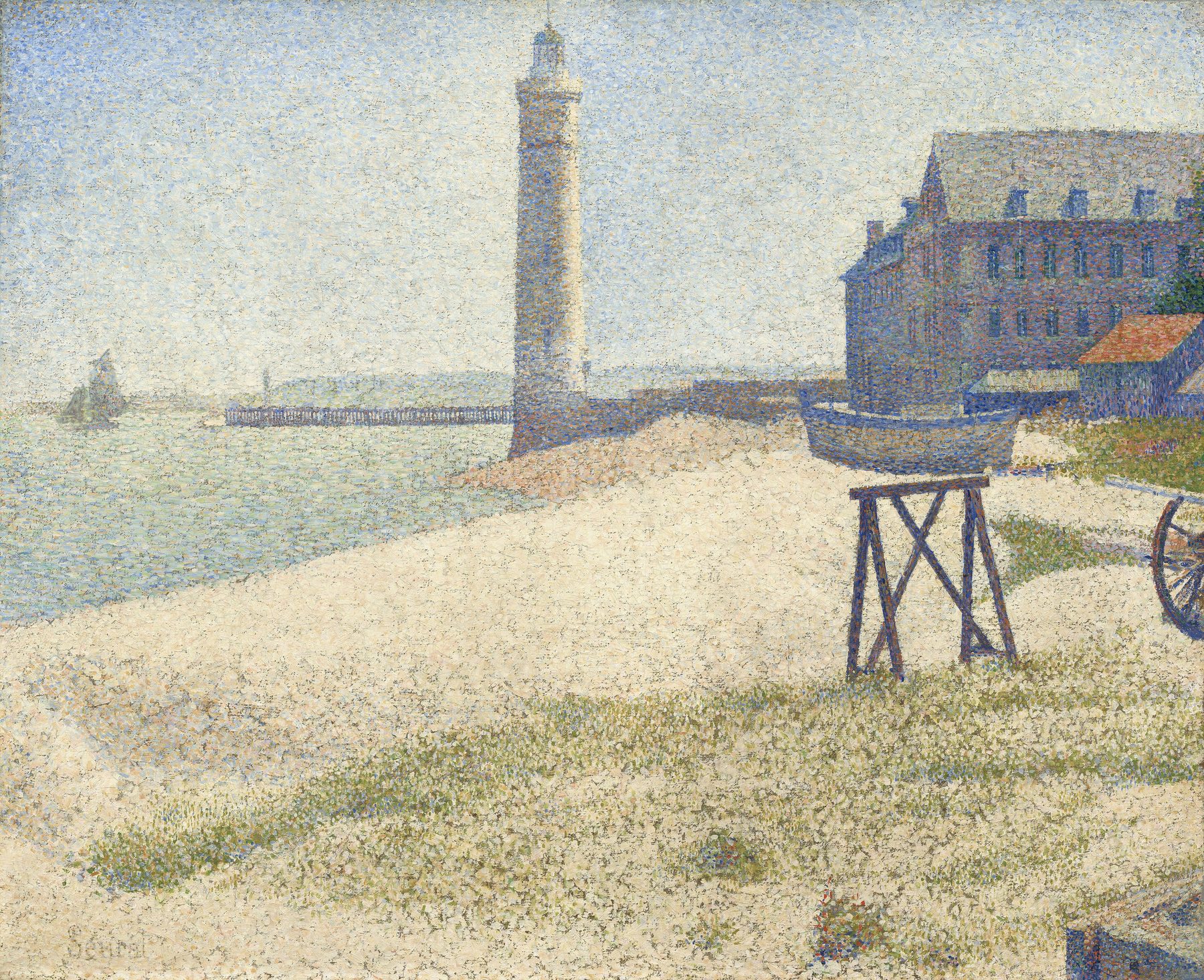
Small oil panels served another purpose. Seurat called such works croquetons. Painted outdoors, they registered coasts, rivers, changing atmosphere and compositional possibilities with greater speed than his large canvases. At Honfleur and other Channel ports, horizon, pier and lighthouse become carefully weighted geometries without losing the sensation of weather and distance.[19]
This movement between quick panel, tonal drawing and deliberate canvas unsettles the contrast between Impressionist immediacy and Neo-Impressionist calculation. Seurat needed firsthand looking. He also needed the studio, where studies could be compared, figures repositioned and a modern scene made as constructed as a mural.
Bathers at Asnières
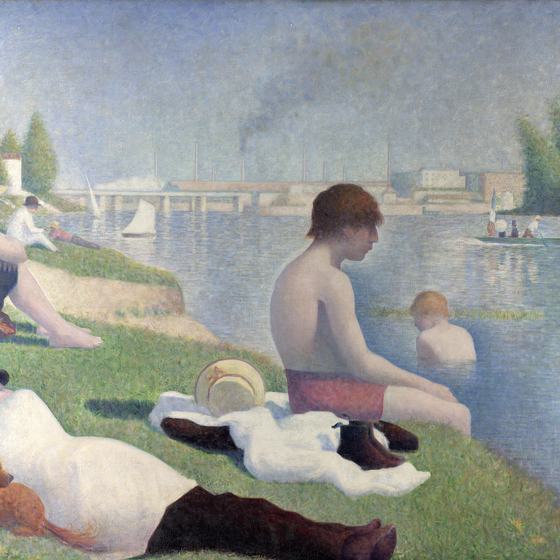
Bathers at Asnières was Seurat's first great public statement. Painted in 1883–84, it is approximately two metres high and three metres wide. Men and boys rest beside the Seine at Asnières and Courbevoie. Bridges, boats, chimneys and the factories of Clichy locate their leisure within an industrial suburb rather than an untouched countryside.[11]
The figures' clothes and setting suggest working- or lower-middle-class identities, though no occupation can be proved from appearance alone. A seated young man in a sleeveless vest faces the water; another reclines in boots and bowler hat; a boy stands in the river and cups his hands to call. Across the water, a small bourgeois couple travels under a parasol. The contrast is spatial and social without becoming a simple political cartoon.
Seurat gave this ordinary recreation the scale associated with history painting. Profiles, smooth contours and intervals make the bathers resemble a frieze. Each is physically near the others and psychologically separate. The hot, hazy atmosphere feels suspended, while factory smoke and river traffic mark a world of labour and movement around their stillness.
The apparent simplicity was extensively prepared. Seurat made oil panels of the location and many drawings of individual figures. He brought observed light and topography into a composition developed in the studio. Some passages use broad or swept handling; divided accents were added or strengthened as his method evolved. The painting is therefore a record of transition rather than a finished demonstration of textbook pointillism.
The official Salon rejected it in 1884. Its independent display linked Seurat to the artists who would found the new society. Rejection did not make the painting radical by itself, but it changed the route through which the public encountered its scale, class implications and unfamiliar stillness.[6] [11]
A Sunday on La Grande Jatte
Across the Seine from Asnières lay the island of La Grande Jatte, a site of middle-class recreation. Seurat worked on his second monumental composition from 1884 to 1886, making numerous drawings, figure studies and painted panels. When it appeared at the last Impressionist exhibition, its controlled surface and nearly life-size social types seemed at once new, archaic and strangely immobile.[10] [12]
The picture is organised through verticals: tree trunks, parasols, standing bodies and the severe profile of the foreground woman. Curves repeat through bustles, umbrellas, a monkey's tail, a dog's back and the shoreline. Boats move across the distance; a child runs; a man plays a horn; yet the whole gathering seems held in a slow visual grid. Tonal figure studies reveal how Seurat developed individual presences before embedding them in that field.[20] He turned a Sunday crowd into something between contemporary observation, theatre and procession.
The foreground couple dominates without becoming heroic. Their profile presentation makes them both specific and emblematic. Elsewhere, clothing offers clues about class and fashion, but the figures resist full stories. They rarely meet one another's gaze. The scene can feel harmonious from afar and socially estranged at closer attention. Readings have ranged from celebration of leisure to caricature, critique and dreamlike suspension. No single verdict accounts for its emotional reserve.
Divided colour complicates that reserve. Close to the canvas, faces, grass and clothing break into small marks that assert the labour of painting. At a distance, broader forms return, but the surface never becomes invisible. The viewer repeatedly negotiates between people represented in a park and coloured particles arranged on cloth.
Seurat later added a painted border composed in relation to the adjacent colours. This edge creates a transition between the depicted scene and its physical frame. It also makes the work less like an open window and more like a self-contained colour object. The boundary participates in the image rather than merely containing it.
What visitors see today is not exactly the colour relationship shown in 1886. Technical study has demonstrated that zinc yellow changed, turning brilliant yellow, orange and yellow-green passages toward ochre, brown and olive. Fénéon noticed deterioration soon after Seurat's death. The discovery matters beyond conservation: “luminosity” is not a permanent essence guaranteed by theory. It depends on materials exposed to time.[12] [13]
The painting's later fame can make its early precarity disappear. It was not continuously available to a mass public after Seurat's death. Collectors and advocates helped preserve, document and circulate his work. When Helene Kröller-Müller built a major Neo-Impressionist collection in the early twentieth century, she joined the history of the movement's reception, not simply its ownership.[49]
Essential works
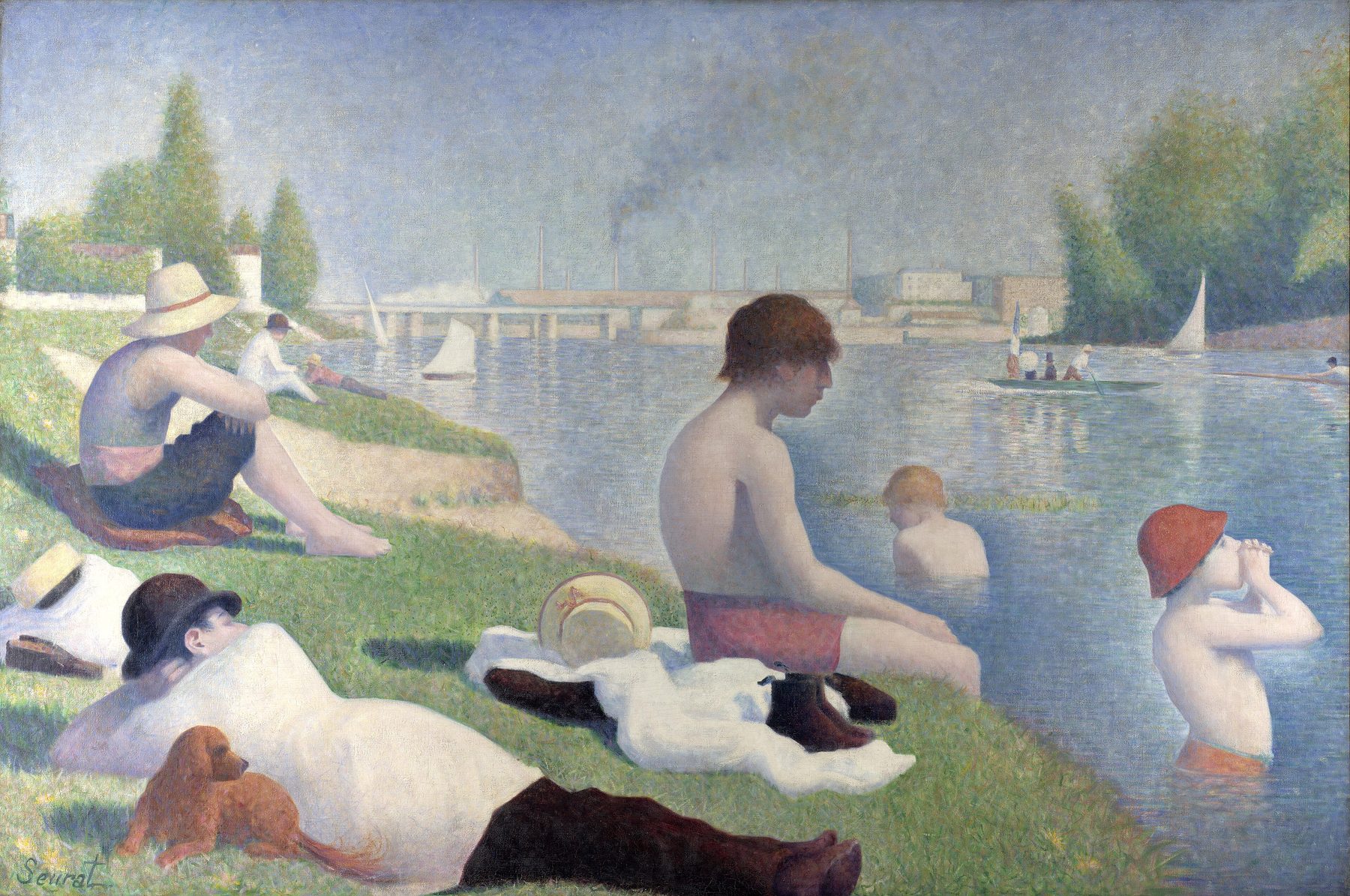
Bathers at Asnières
Georges Seurat, 1883–84
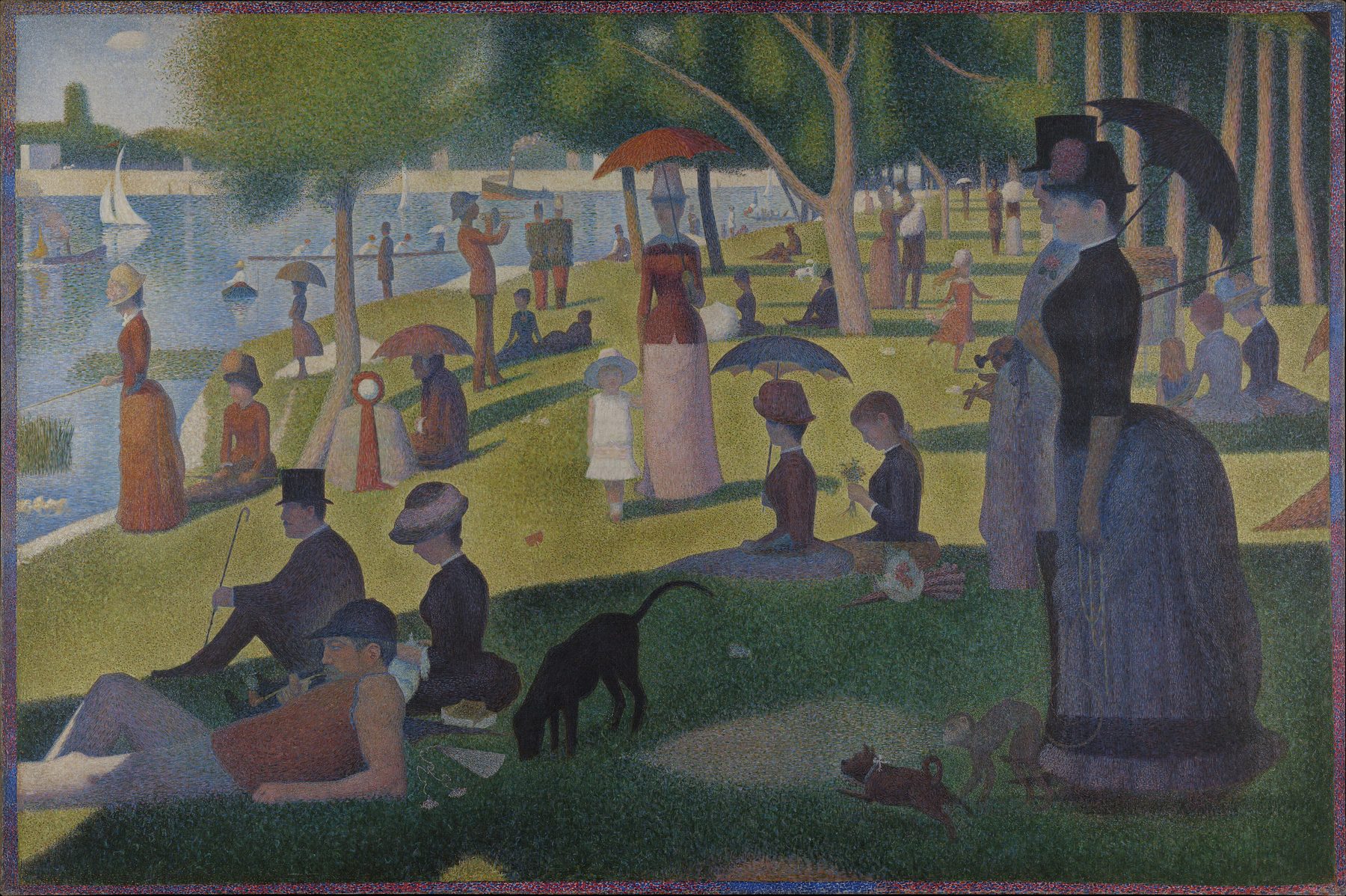
A Sunday on La Grande Jatte—1884
Georges Seurat, 1884–86
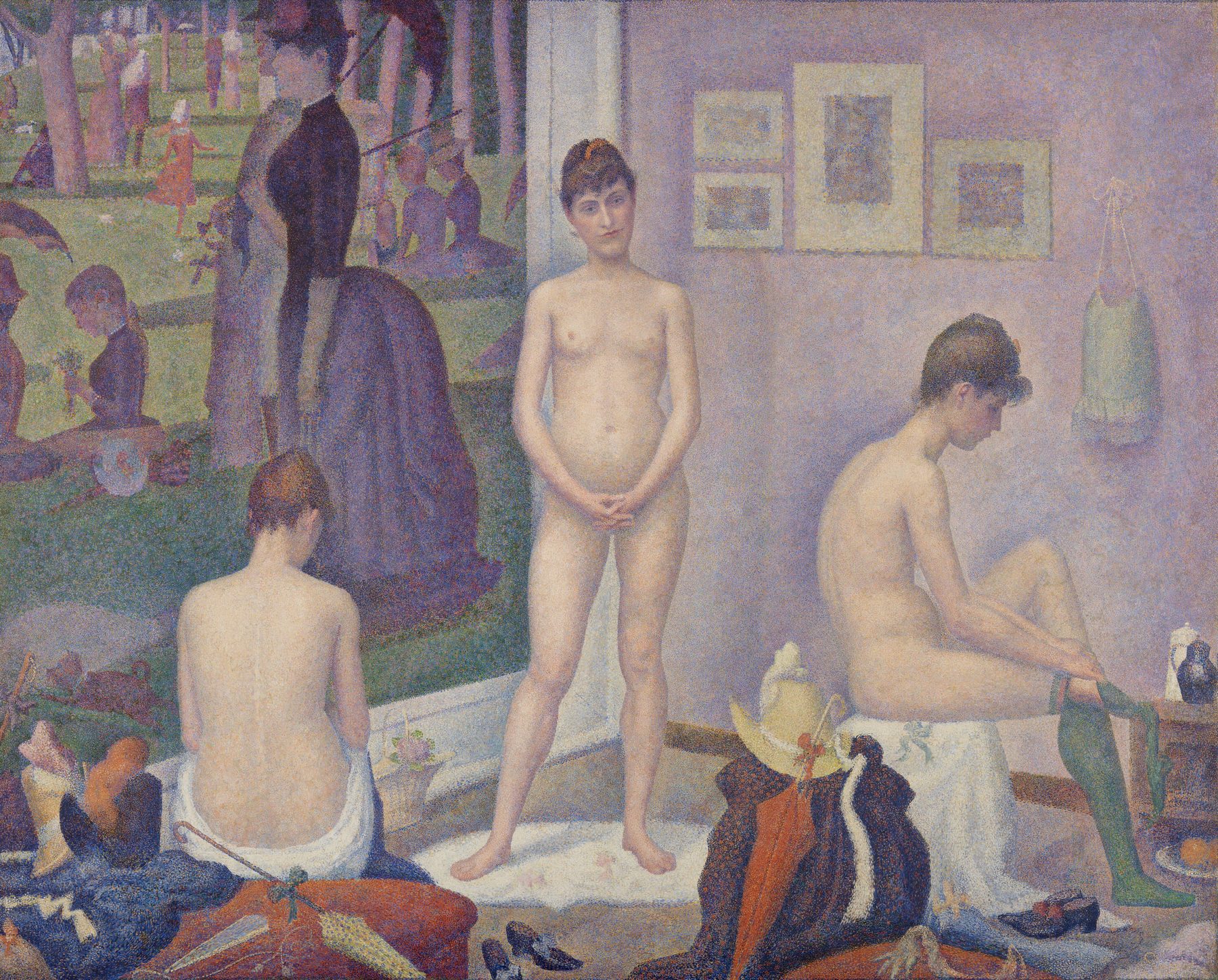
Models (Poseuses)
Georges Seurat, 1886–88
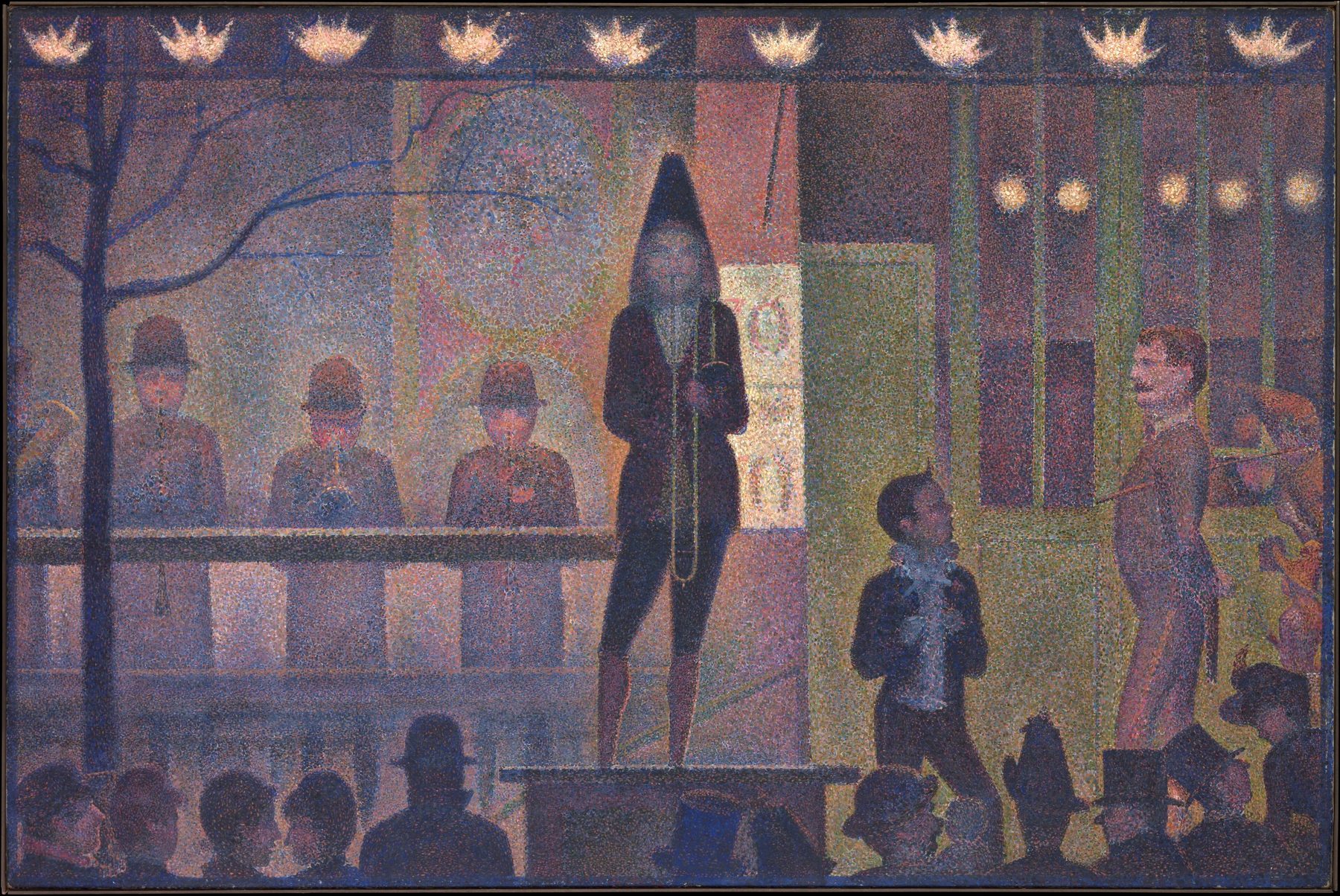
Circus Sideshow
Georges Seurat, 1887–88
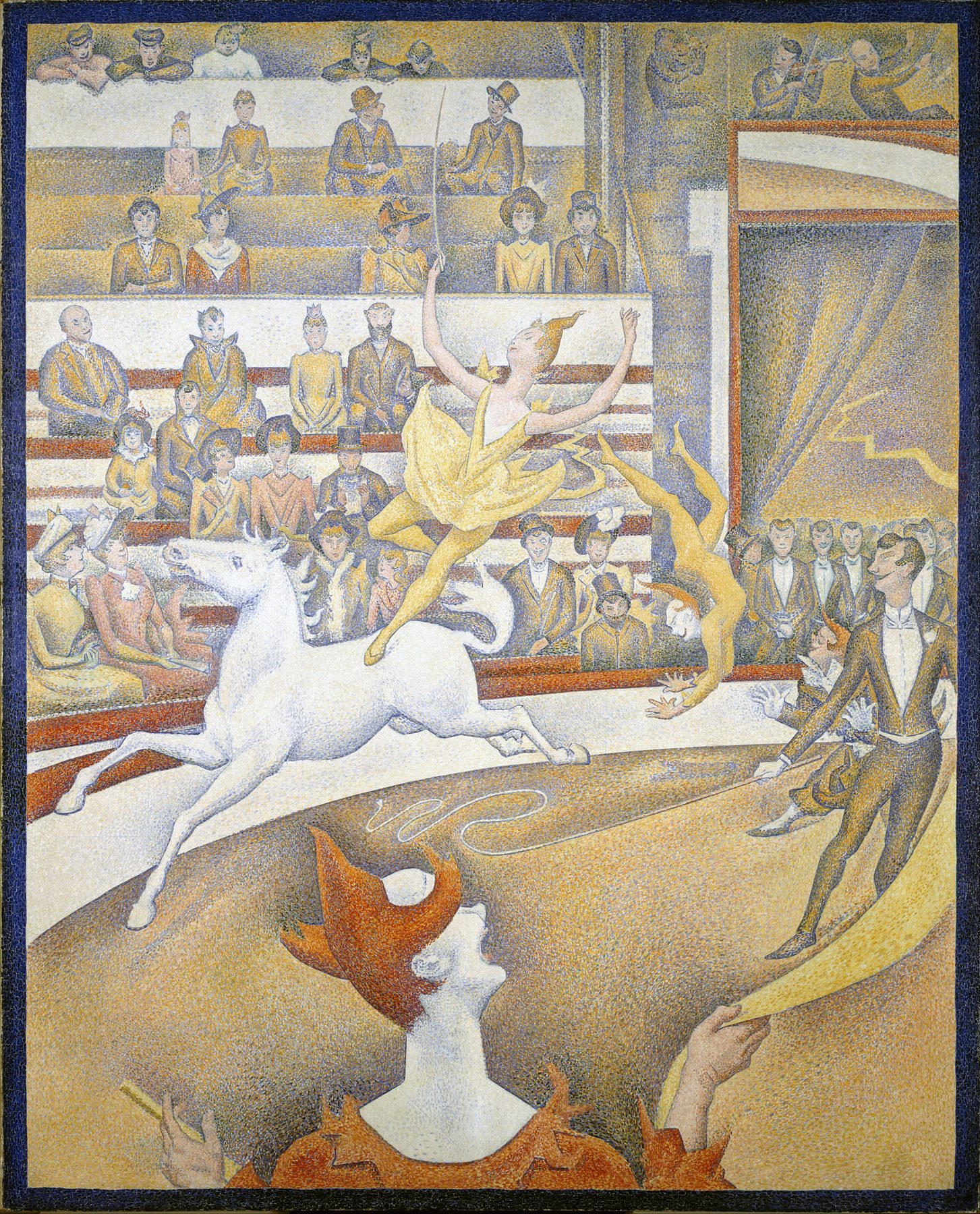
The Circus
Georges Seurat, 1890–91
Models, sideshows and circuses
Critics could dismiss divided colour as suitable for landscape but incapable of flesh, volume or serious figure painting. Seurat answered with Models in 1886–88. Three nude poses occupy the studio: a standing figure, a seated figure from behind and another arranging a stocking. A partial version of La Grande Jatte hangs on the wall, turning the artist's earlier public spectacle into the background of private labour.
The same model may appear in three successive positions rather than three women occupying one instant. This temporal uncertainty makes the studio a place of analysis. The back view recalls Ingres's Valpinçon Bather, yet Seurat replaces smooth academic finish with divided colour. Tradition is quoted and materially reconstructed, not discarded.[15]
Seurat then moved toward commercial entertainment. Circus Sideshow, also called Parade de cirque, depicts the outdoor attraction meant to draw customers into a travelling circus. Musicians and a trombone player appear under gaslights while a crowd forms dark bands below. The main spectacle is withheld: viewers see the advertisement and those watching it.
Unlike the sunny park, this is a restricted nocturnal world. Horizontal tiers flatten space; gaslights punctuate the gloom; silhouettes appear almost cut from the coloured atmosphere. The repeated dots do not produce cheerful brilliance. They create smoke, artificial light and social distance. The work demonstrates that divided colour could make darkness as powerfully as sunlight.[16]
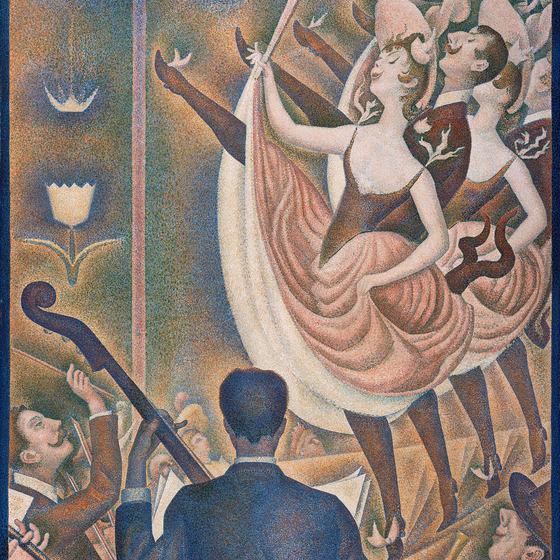
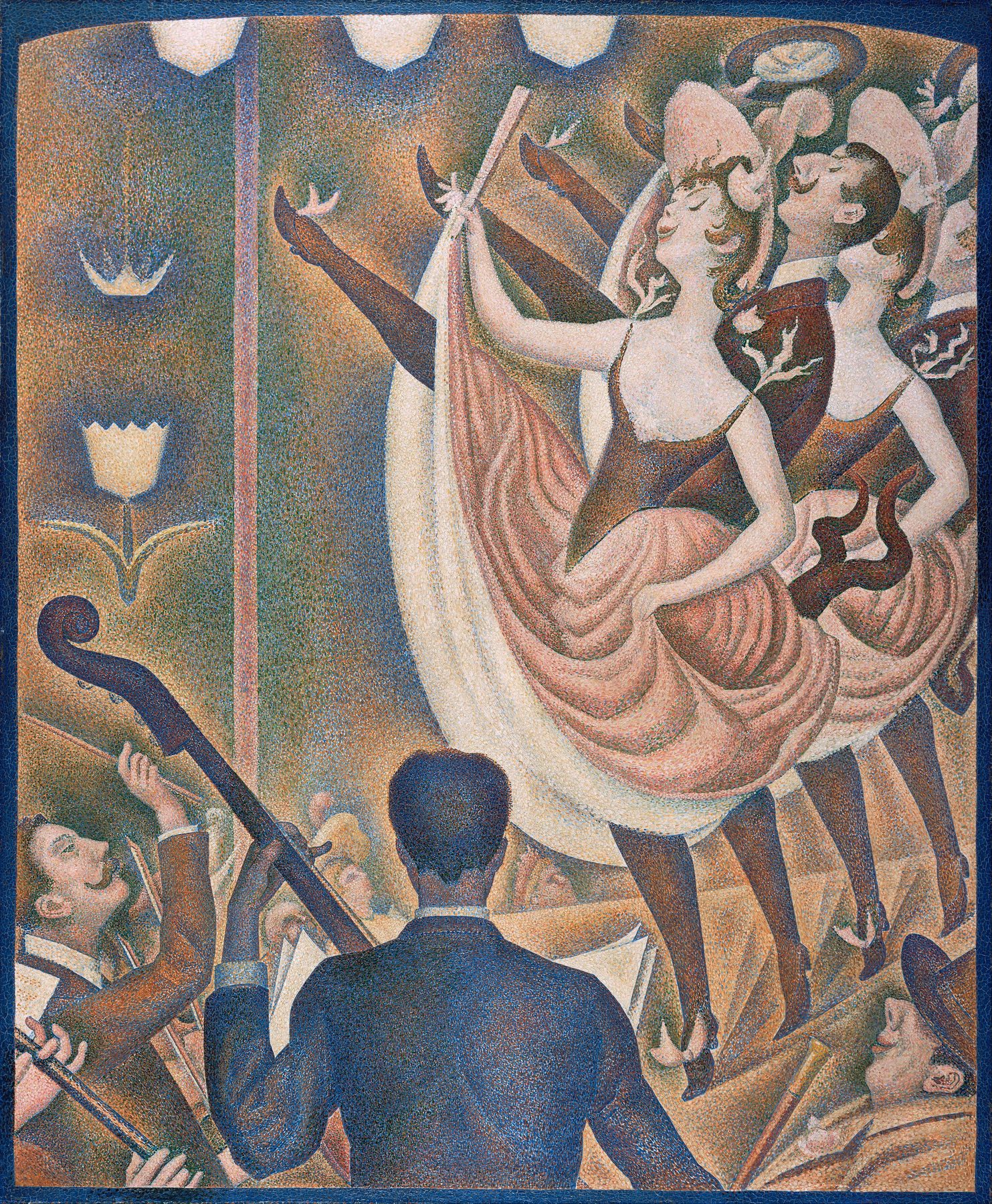
In Le Chahut, dancers and musicians are organised by rising diagonals and repeated kicks. Caricatural profiles, moustaches and angular gestures turn a popular dance into an almost mechanical pattern. The prescribed association between ascending lines and gaiety becomes unstable: exhilaration can also look forced, commercial and grotesque.
The Circus of 1890–91 pushes the contrast further. The ring is made from spiralling horse, acrobat and whip; the seating behind forms a rigid architecture of classed spectators. Bright whites, yellows and oranges dominate, contained by a dark painted border and a blue-toned frame. Performance appears spontaneous, but its movement is calculated through curves and counter-curves.[17]
The canvas was unfinished when Seurat exhibited it at the Indépendants in March 1891. He died days later, probably from diphtheria. Visible incompletion makes it dangerous to treat every passage as his final solution. Preparatory drawings of the clown and horsewoman show how carefully individual figures were developed, while the exposed state preserves the transition from design to divided surface.[18]
These late paintings change the standard story. Seurat was not only the painter of bourgeois Sunday leisure. He examined admission, display, spectatorship, popular bodies and artificial illumination. He made modern entertainment appear ordered enough to study and strange enough to resist easy pleasure.
Signac and a movement after Seurat
Paul Signac met Seurat when both were in their early twenties. His first paintings had been shaped by Impressionism and outdoor observation rather than formal academic training. Seurat's example encouraged him to organise touches and colour contrasts more deliberately. Their exchange was reciprocal, and Signac's independent temperament prevented him from becoming a mere follower.[21] [23]
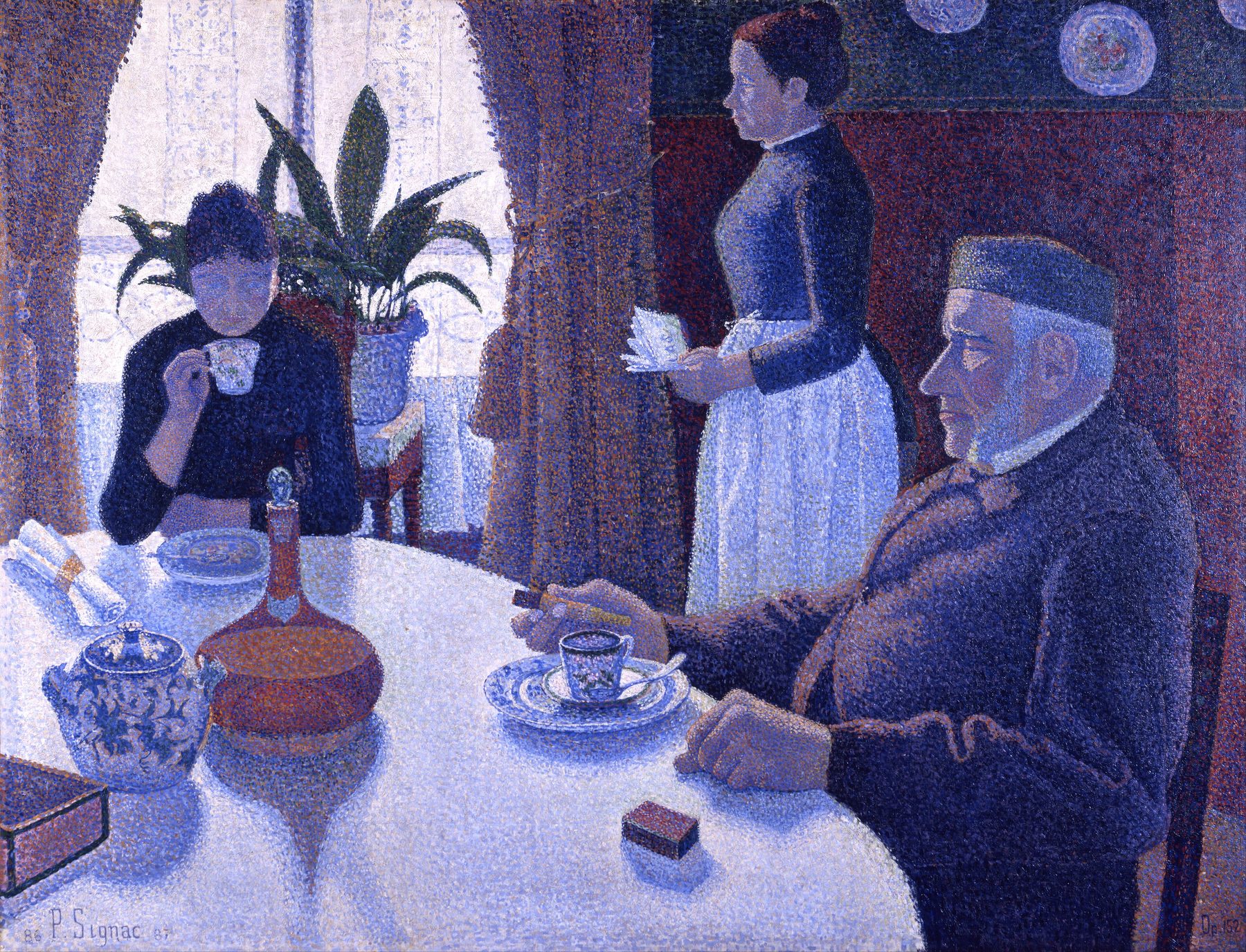
Early figure paintings reveal how severe the new discipline could appear. In The Dining Room, a woman, man and maid occupy a bourgeois interior without conversational warmth. Small marks and pale light do not dissolve the room; they make its surfaces and silences more exact. Domestic routine becomes as constructed as Seurat's public park.
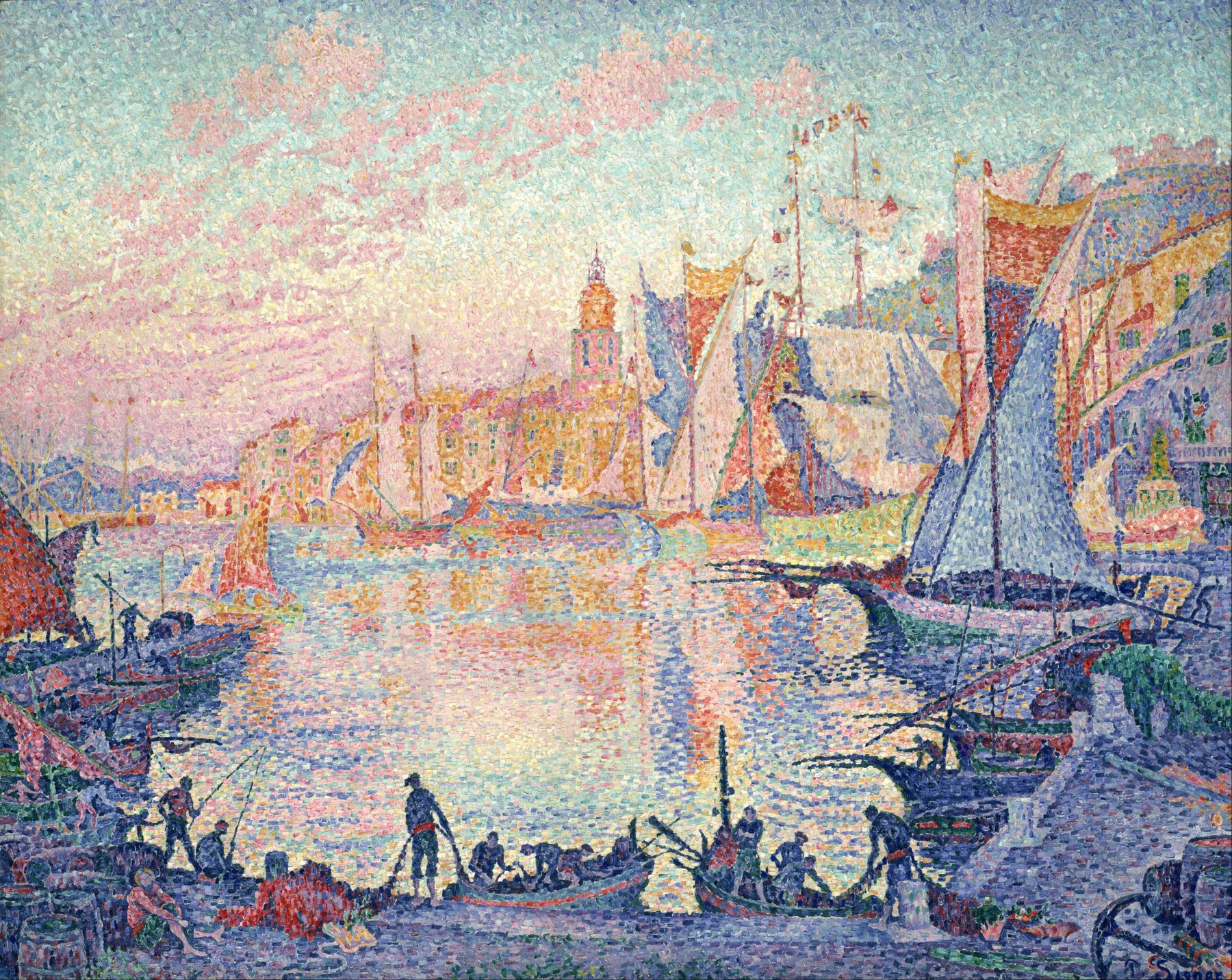
The sea offered Signac a more expansive subject. An enthusiastic sailor, he travelled the French coasts, the Mediterranean and later many European ports. Masts, sails, reflections and harbour architecture provided ready-made verticals and diagonals. Water divided light into moving colour before the painter divided it again on canvas. The repeated opus numbers in his titles announced deliberate organisation while also borrowing the language of music.[21] [22]
Watercolour became increasingly important. Transparent patches, white paper and quick notation allowed Signac to record ports without reproducing the dense labour of a large oil. These sheets should not be treated as minor versions of paintings. They made travel, serial looking and colour structure portable. The movement's geography expanded through boats, letters, exhibitions and works on paper.
Seurat's sudden death left no agreed successor, but Signac became the movement's most persistent advocate. He helped order the studio inventory, acquired important works, corresponded across France and Belgium, served the Indépendants and defended living colleagues. His collection included Seurat, Cross and younger artists whose colour he admired. Advocacy, administration and ownership became part of Neo-Impressionism's survival.[8] [26] [27]
His treatise D'Eugène Delacroix au néo-impressionnisme, published in developed form at the end of the 1890s, defined division as a method of separating colour elements so that purity, contrast and proportion could operate. Signac explicitly argued that the point was not compulsory. A clear stroke suited to a work's scale could take different forms. This defence came after years of practice and debate; it codified a history that had never been quite as orderly as its summary.[33]
Women at the Well and In the Time of Harmony
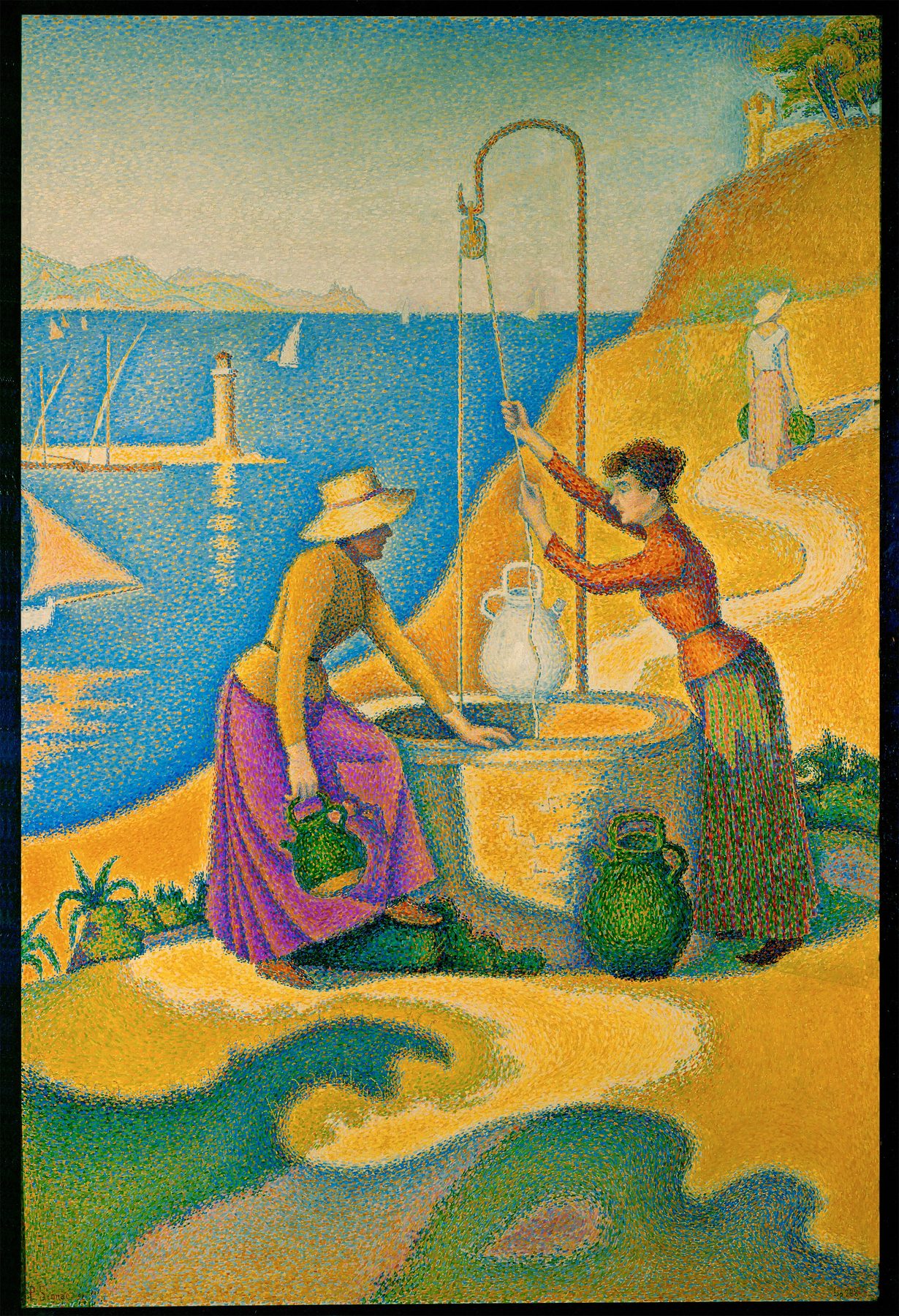
After settling at Saint-Tropez, Signac imagined Mediterranean life through large decorative compositions. Women at the Well, Opus 238 shows two women drawing water under intense colour. The scale and acid relationships make it appear that light is generated by paint rather than simply falling upon objects. Curving bodies and vessels become part of an arabesque more than a narrated rural incident.[24]
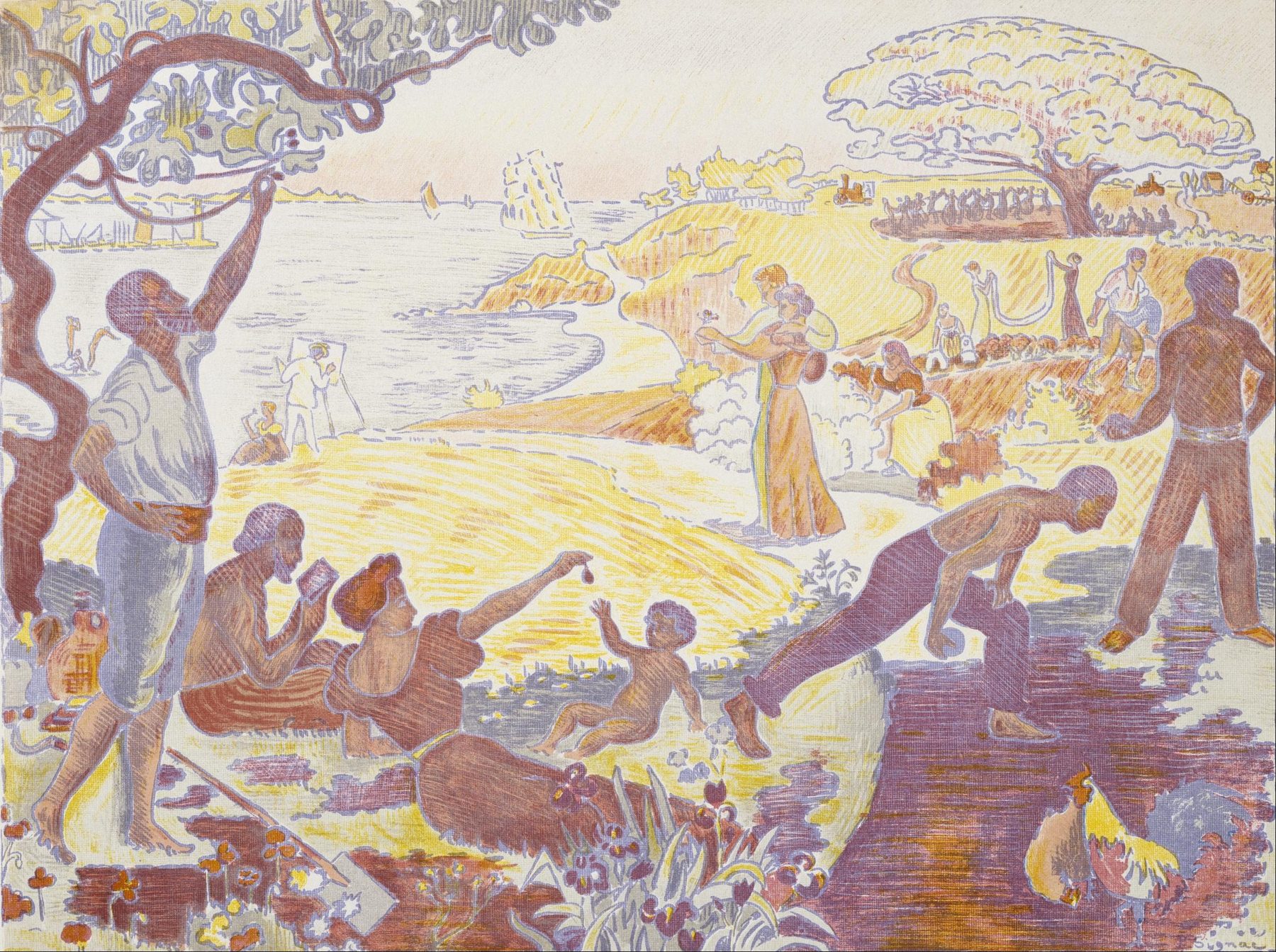
The subject developed alongside In the Time of Harmony, an ambitious vision of a future community originally associated with the age of anarchy. People read, work, play, embrace and rest beside the sea. There is no central ruler, battle or miracle. Collective well-being appears through ordinary activity distributed across a luminous landscape.
It would be mistaken to call this a neutral idyll. Signac's anarchism gave social harmony a political horizon. Yet the painting is not a diagram of institutions to come, and its Mediterranean abundance can feel removed from the conflict required to achieve it. Utopia enters through organisation: no figure dominates, work and leisure coexist, and colour differences are balanced without becoming identical.
After Seurat, Signac's marks grew larger and more mosaic-like. The change was not a surrender of principle. It shifted emphasis from the promise of optical fusion toward the beauty of the separated stroke. Colour could remain visibly constructed while creating distance, weather and decorative unity. That openness helped make his later work important to younger painters.
Follow the movement through four stages
–1886
Independence, encounter and a new name
Seurat, Signac, Angrand, Cross and Dubois-Pillet build an exhibition network before Fénéon gives the tendency its durable name.
–1891
Seurat and the movement’s first public phase
Monumental leisure, studio labour, artificial light and performance test divided colour across radically different settings.
–1900
Mediterranean colour and international expansion
After Seurat’s death, Signac, Cross, Luce, Pissarro and the Belgian circle enlarge the movement’s marks, places and politics.
–1906
Mature mosaics and modernist afterlives
Ports, southern landscapes and increasingly independent colour carry Neo-Impressionist practice toward Fauvism and other selective inheritances.
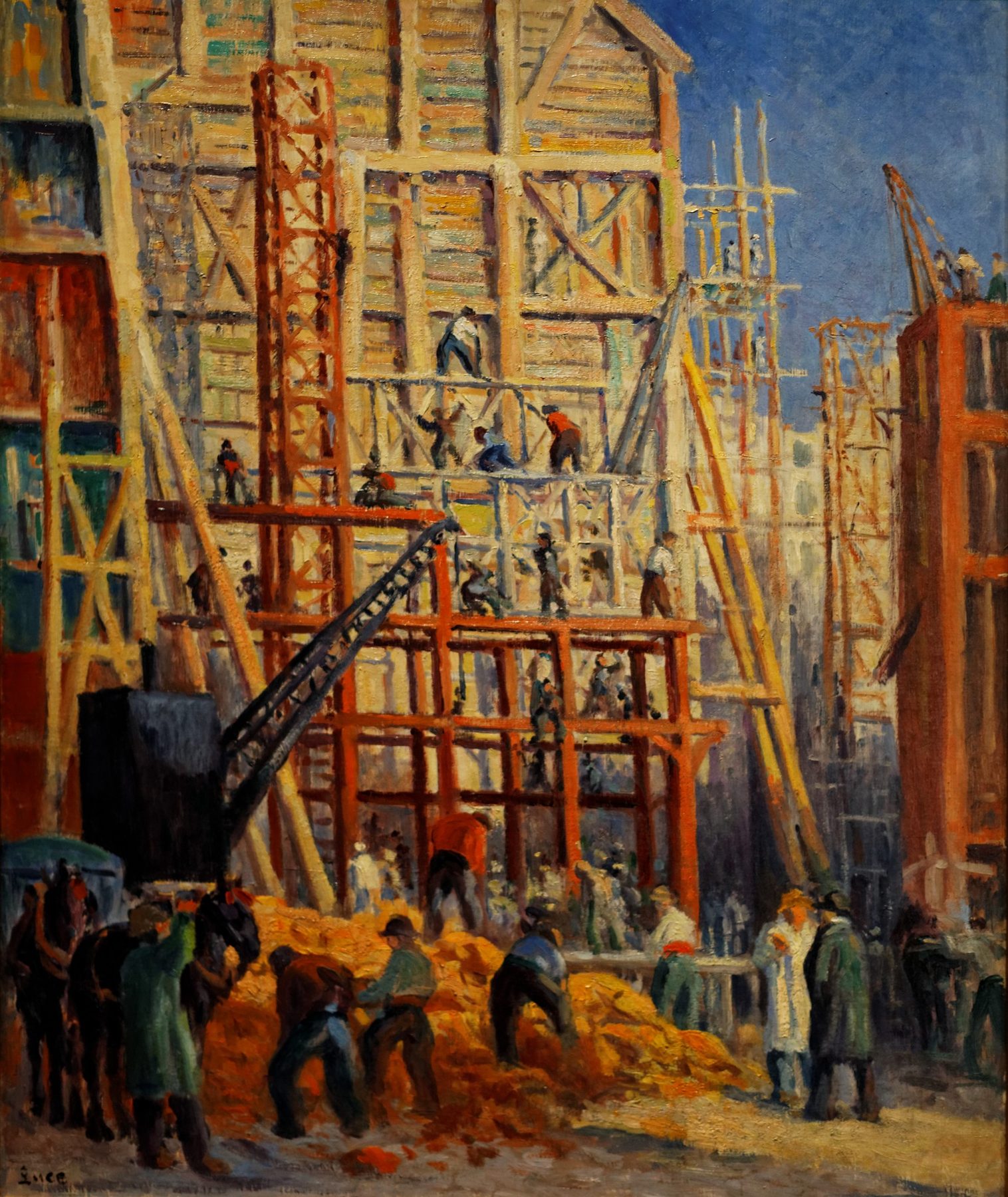
Cross, Luce, Pissarro and other French paths
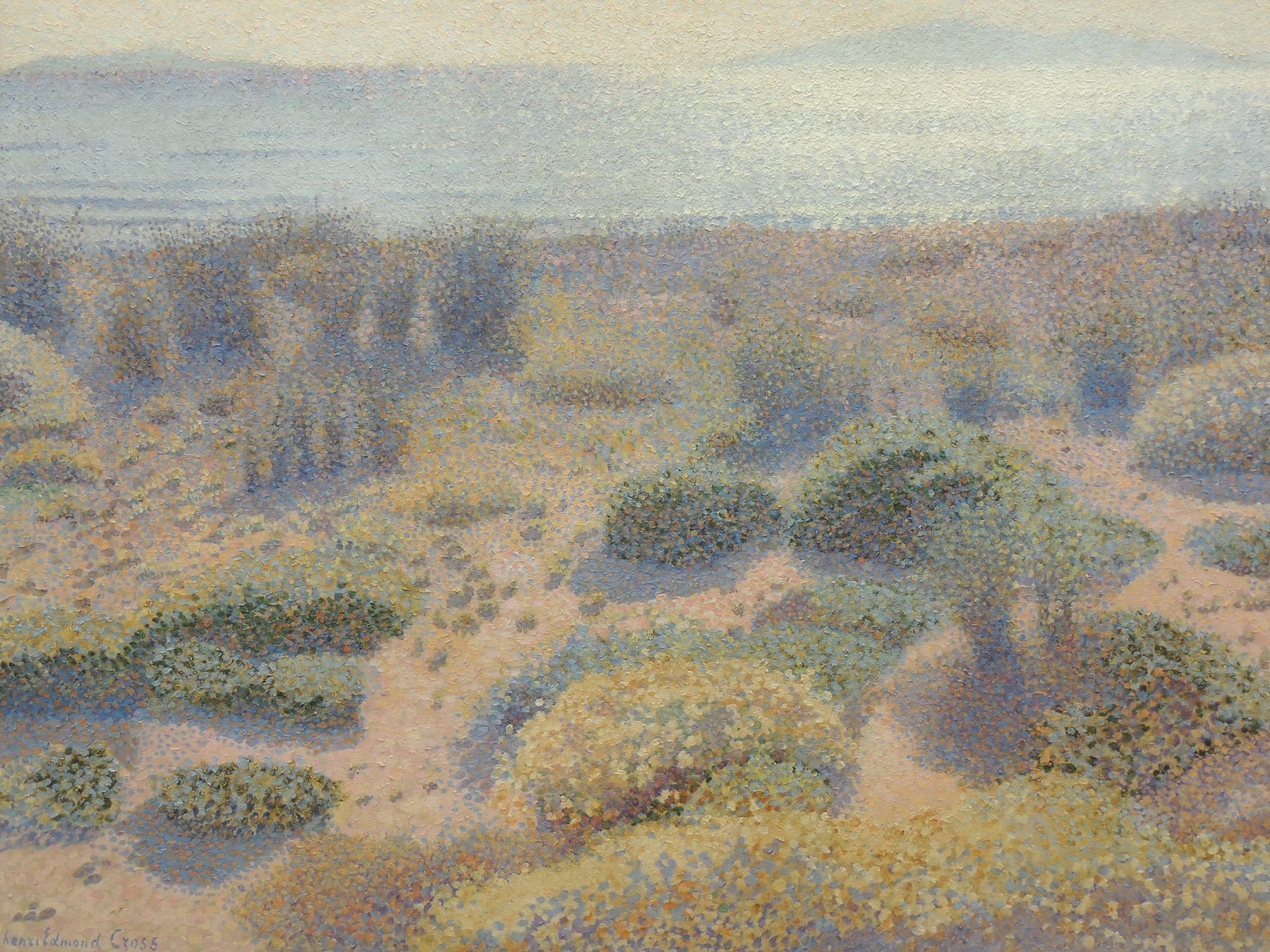
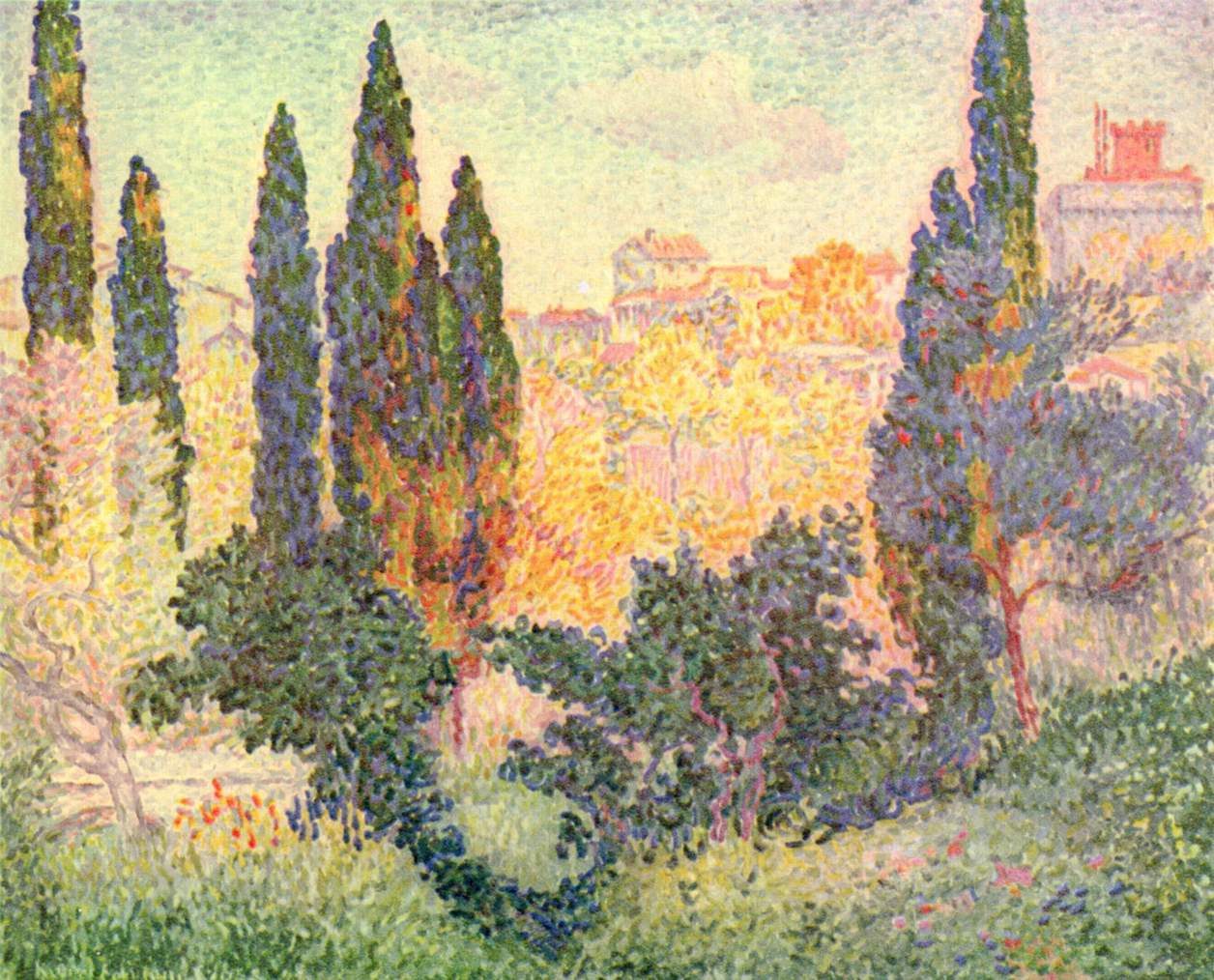
Henri-Edmond Cross was a founding participant in independent exhibition before adopting divided colour around the early 1890s. Poor health encouraged his move to the Mediterranean coast, where he and Signac worked within visiting distance. In Cross's mature paintings, small points often yield to rectangular or tessellated touches. Forms remain legible, but intense colour spreads across the canvas as an autonomous rhythm.[1]
The Evening Air
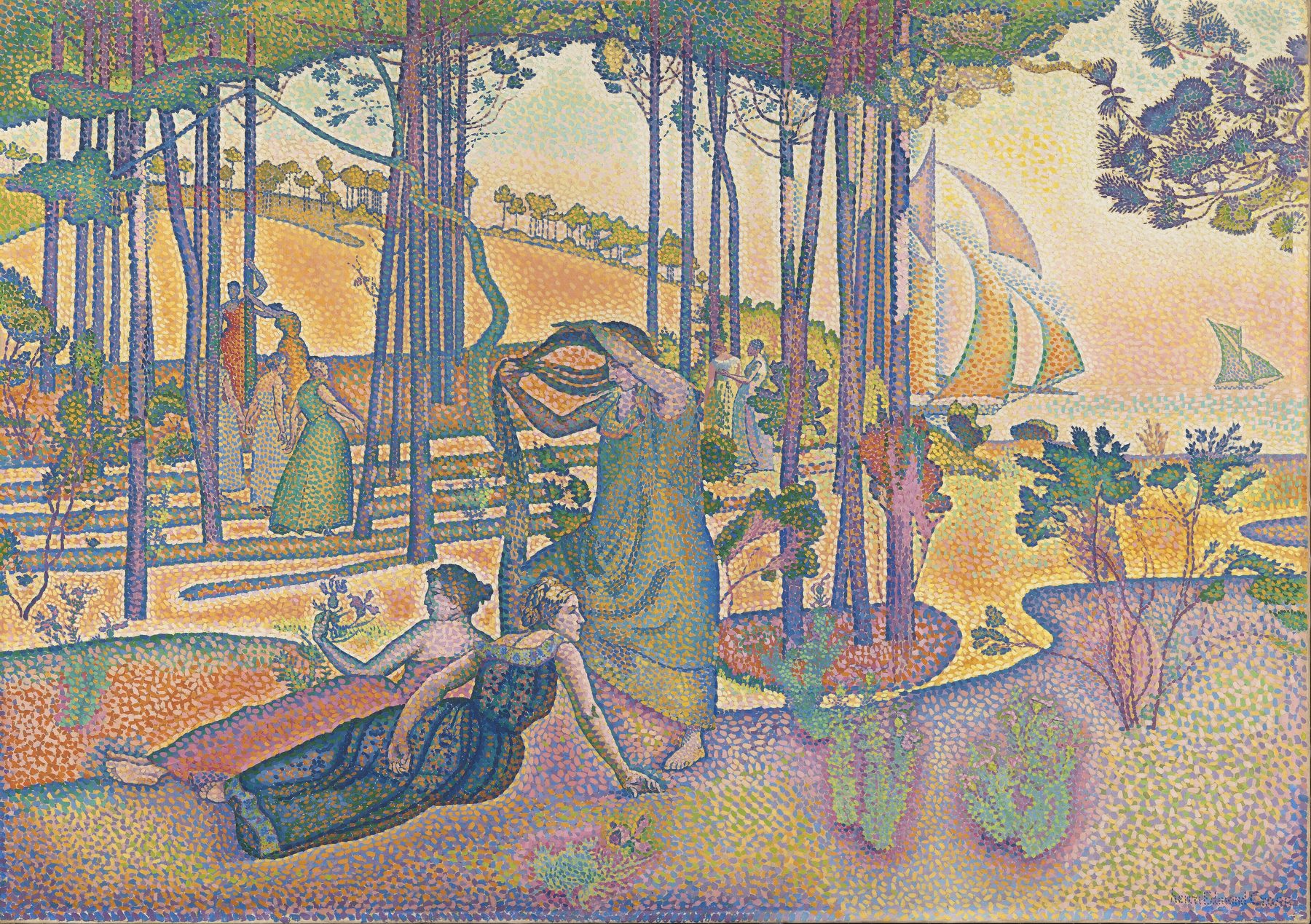
The Evening Air, painted around 1893, answers Signac's wish to create a decorative monument to the southern landscape. Figures rest, dance or move quietly among trees at the end of the day. Horizontals and verticals balance one another, and action seems suspended. The work does not record one fleeting sunset. It constructs an ideal duration in which bodies and landscape share a measured calm.[25]
The large format required larger marks. Pink, orange, violet, blue and green rectangles make a mosaic that remains active even at viewing distance. Cross retained division while changing its scale. The result is both classical and experimental: an ordered pastoral whose colour refuses naturalistic subordination.
Signac later hung the painting in the dining room of his Saint-Tropez house. There Matisse saw it near other advanced works. Domestic display became a link in artistic transmission. A painting could influence the future not only at a public exhibition but through hospitality, collecting and sustained looking.[25] [26]
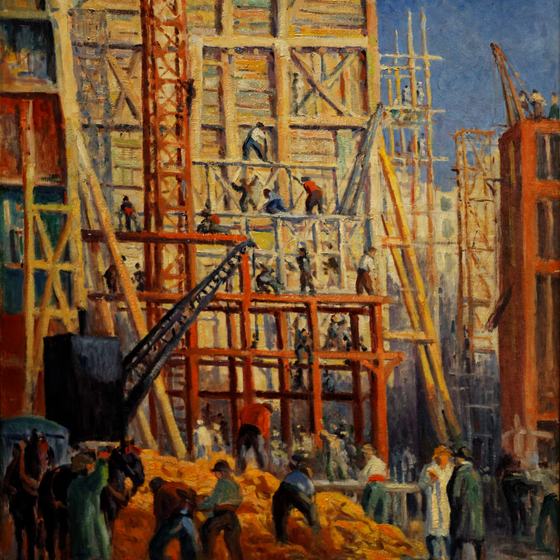
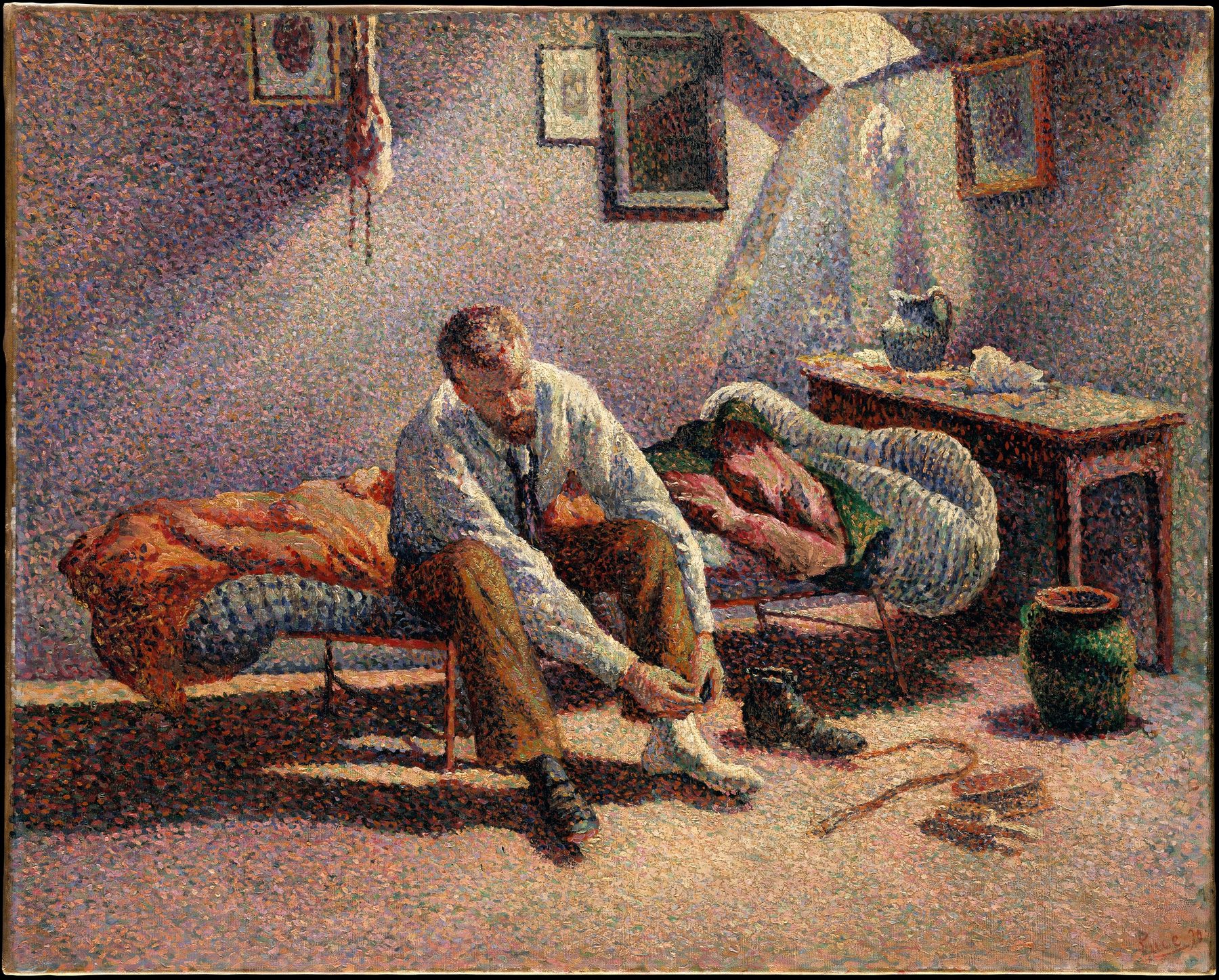
Maximilien Luce brought another range of experience. Trained through graphic and craft work, he painted construction sites, factories, steel production, streets, crowds and workers at leisure. Division gave smoke, furnaces and urban night a charged atmosphere. His art contradicts the belief that the method belonged chiefly to placid parks and ports.
Luce also contributed images to the anarchist press. Jean Grave's weekly Les Temps Nouveaux gathered work by Luce, Pissarro, Signac, Cross, Angrand, Van Rysselberghe and others. Prints made political ideas cheaper and more mobile than large oils. They also required collaboration among artist, editor, printer and distributor.[28]
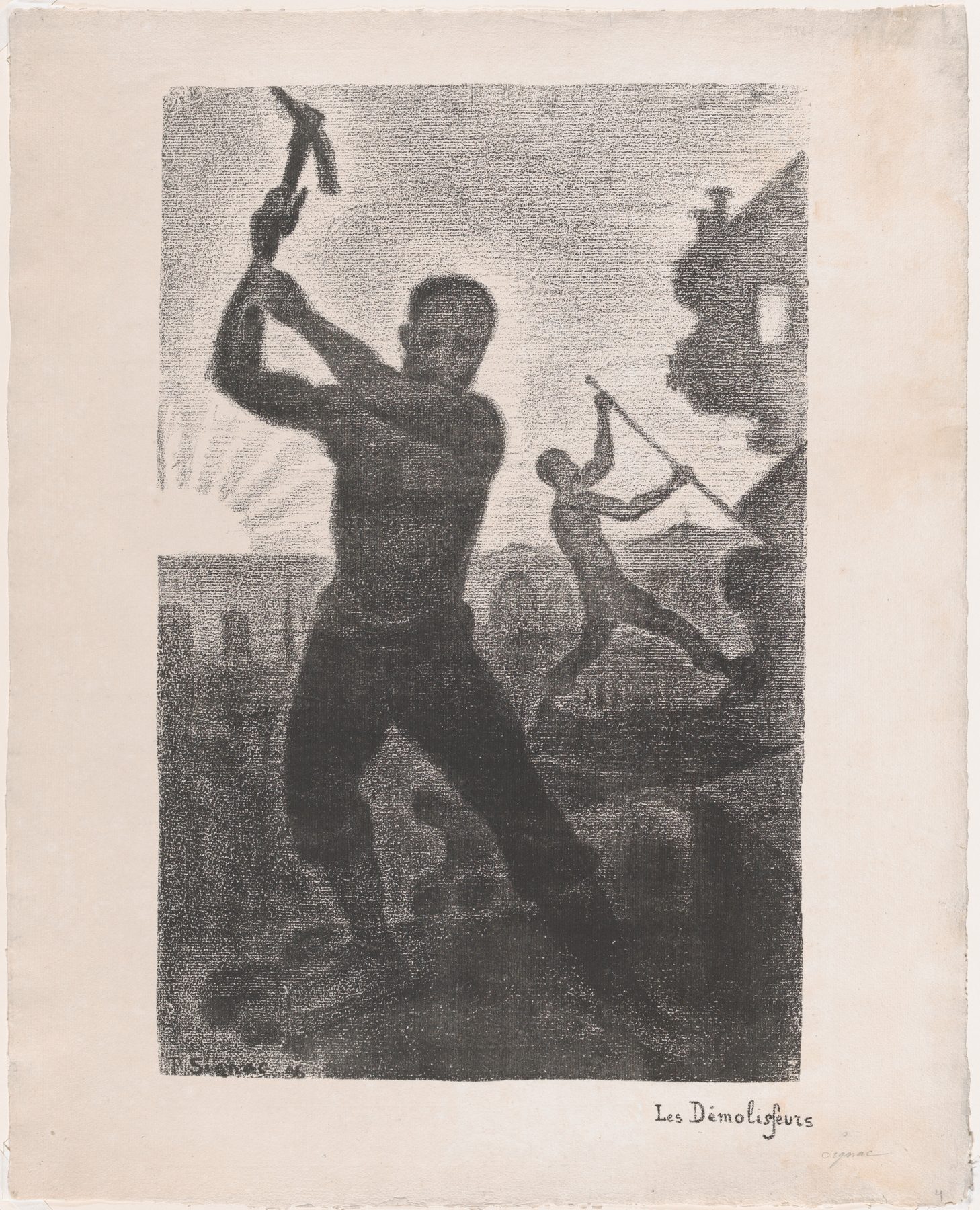
Signac's The Wreckers makes its politics unusually direct. A powerful worker swings a pickaxe against the existing order while a rising sun announces another future. Grave published the lithograph, and Signac later developed the image in painting. Here symbolism is overt enough to justify political reading. Its clarity should not be projected onto every sailboat or sunlit field.[29]
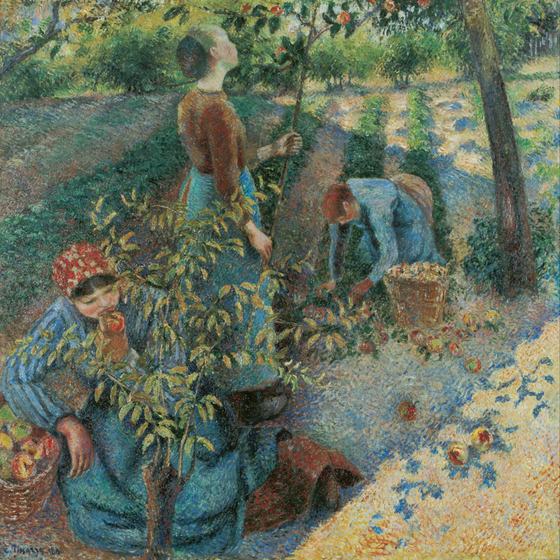
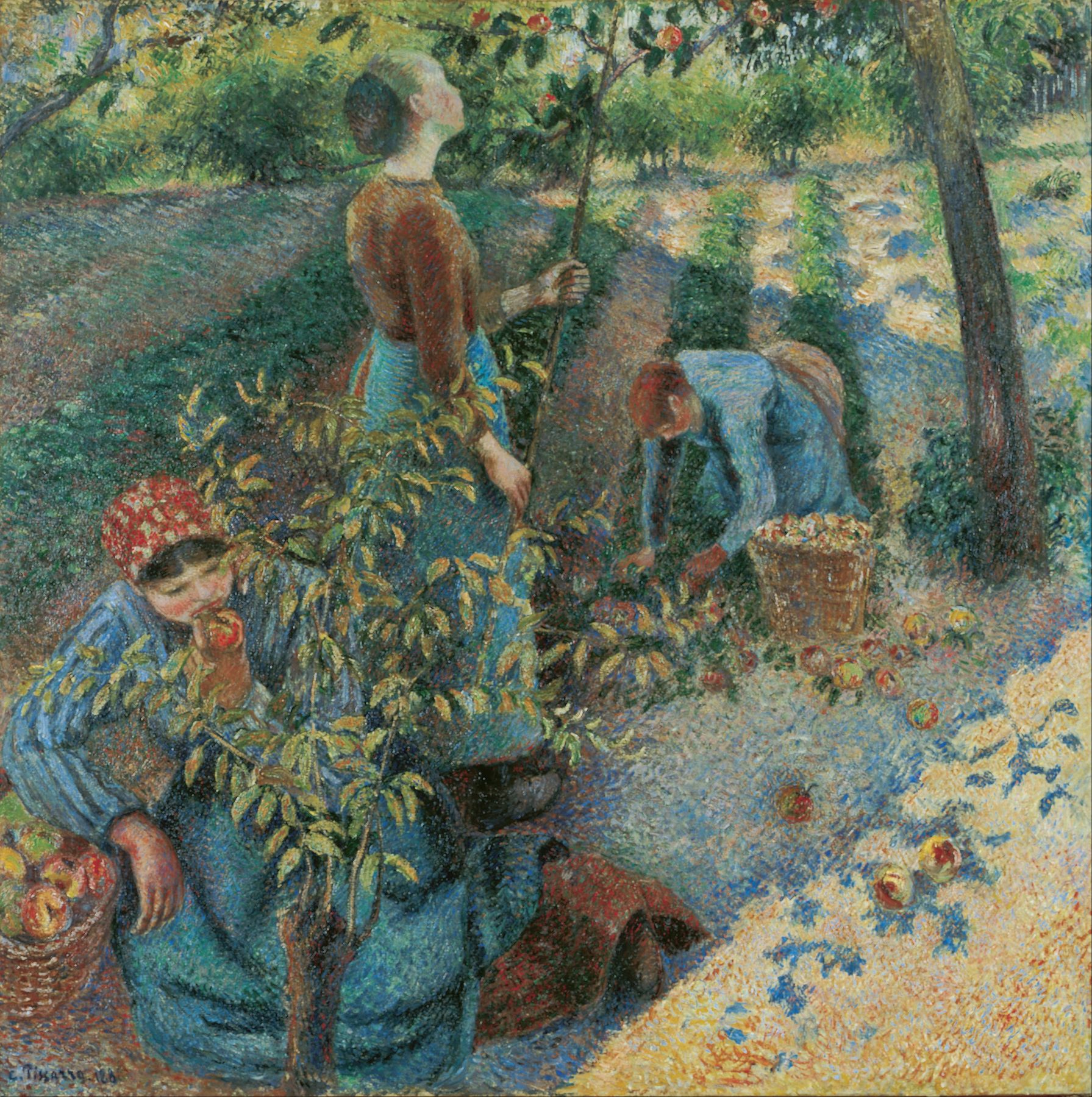
Camille Pissarro occupied a special place because he belonged to the founding Impressionist generation. In the mid-1880s he embraced what he called scientific Impressionism, adopting divided touches in rural scenes and supporting Seurat and Signac at the 1886 exhibition. His participation gave the young tendency continuity with Impressionism, but it also intensified conflict among old colleagues.[42]
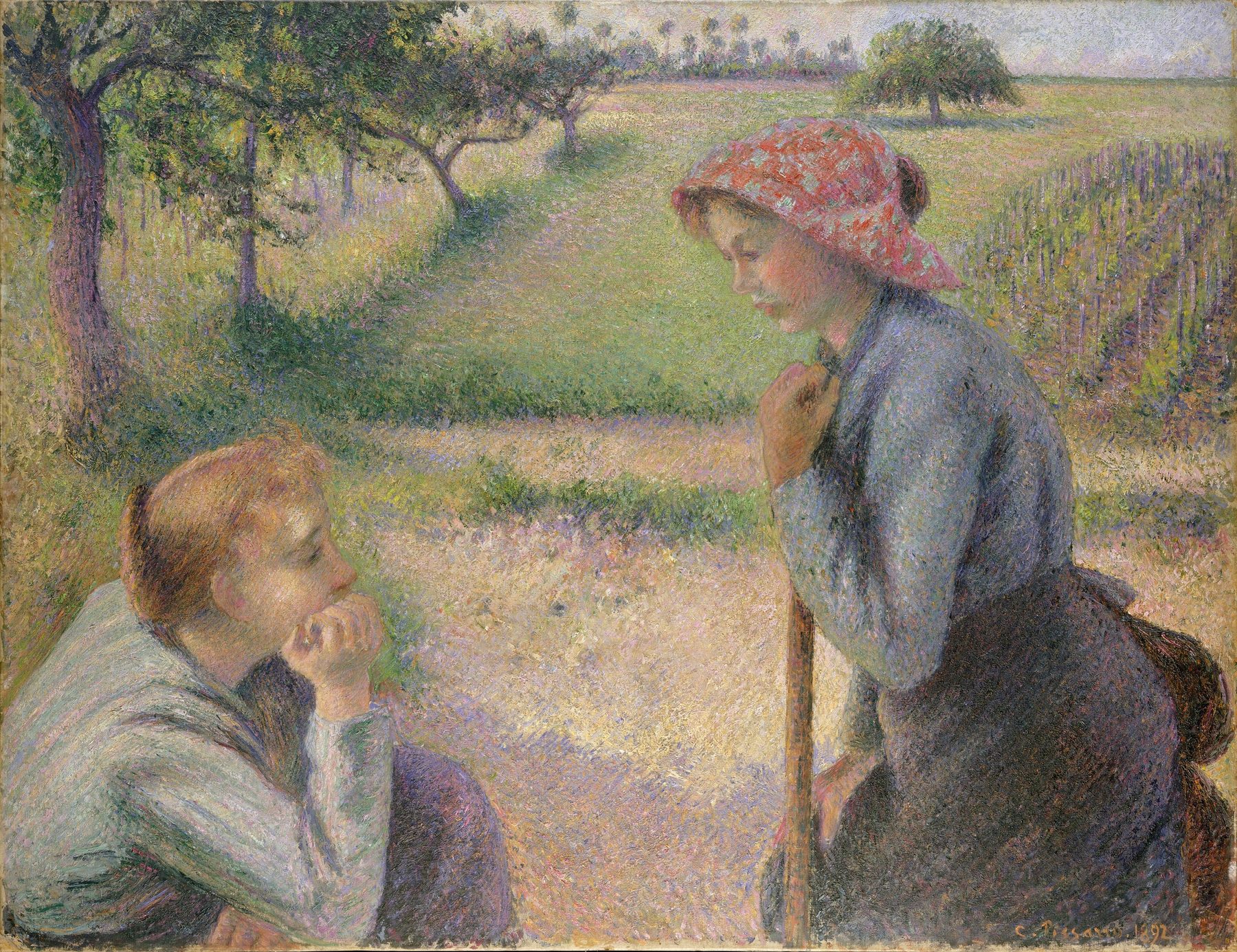
Pissarro's commitment was brief. The method was laborious, sales were difficult and its rules constrained the changing effects he wanted to paint. By about 1890 he was moving away from regular division. Later works retained smaller hatches and complementary contrasts without following a strict pointillist surface. Two Young Peasant Women combines deliberate repeated strokes with a monumental rural rest.[43]
His anarchism shaped his sustained attention to farm labour and cooperative life, but the peasants are not illustrations of a party platform. They possess bodily weight and duration rarely granted to anonymous workers in high art. Pissarro's departure also demonstrates that leaving the technique did not erase what an artist had learned from it.
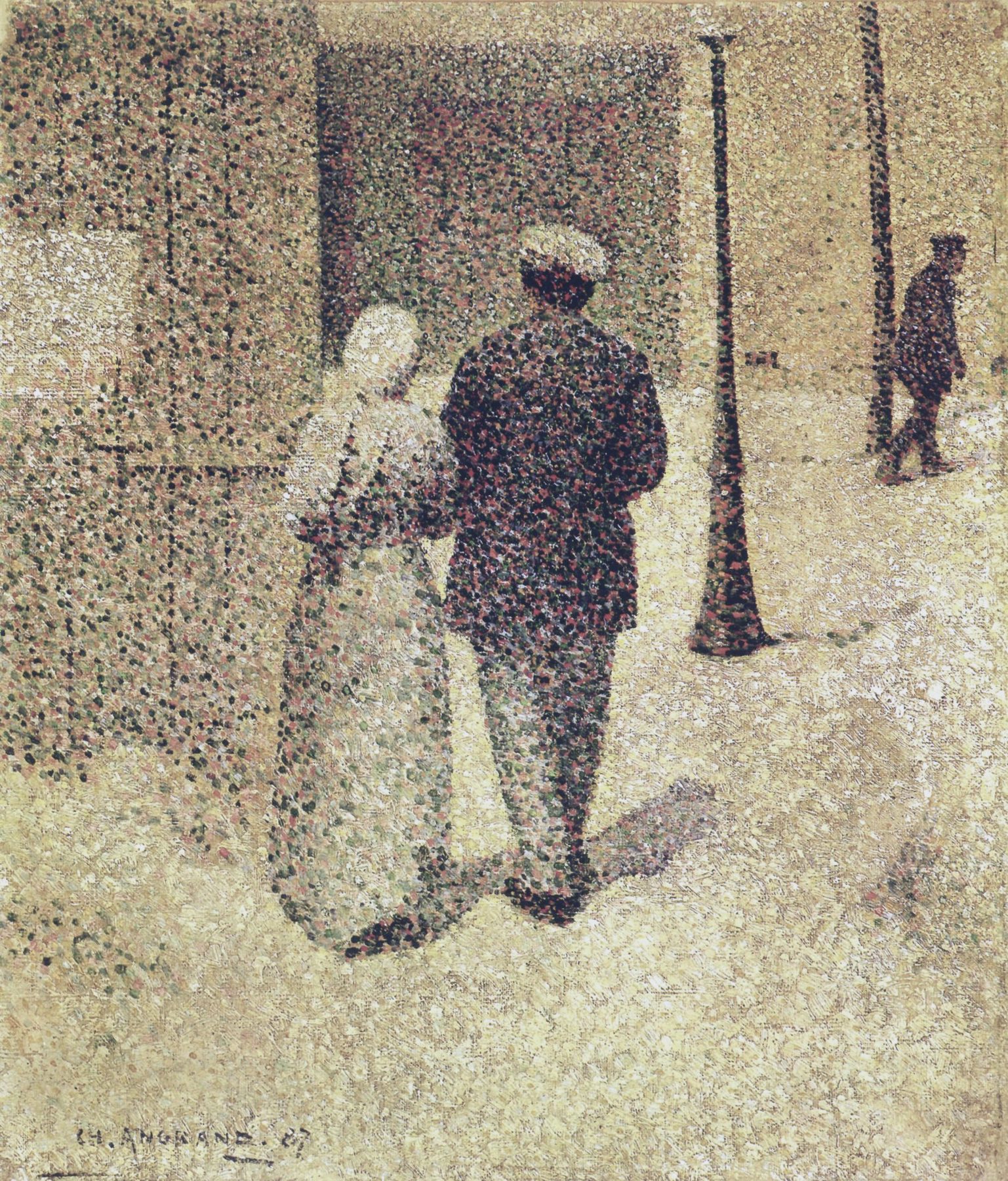
Charles Angrand created city outskirts, rural scenes and remarkably luminous black drawings. His tonal subtlety complicates a colour-centred definition of the group. Albert Dubois-Pillet made landscapes and still lifes while helping secure the institutional framework of the Indépendants. Louis Hayet experimented with divided colour and then resisted being absorbed into a collective identity. Neo-Impressionism was held together by repeated encounter, not permanent stylistic obedience.
Brussels and an international network
The movement became international almost immediately. The Brussels society Les XX, or Les Vingt, invited advanced artists from abroad to exhibit with its twenty members. When Seurat's La Grande Jatte appeared there in 1887, Belgian artists encountered its scale and surface directly. Brussels became a second centre rather than a distant echo of Paris.[2] [3]
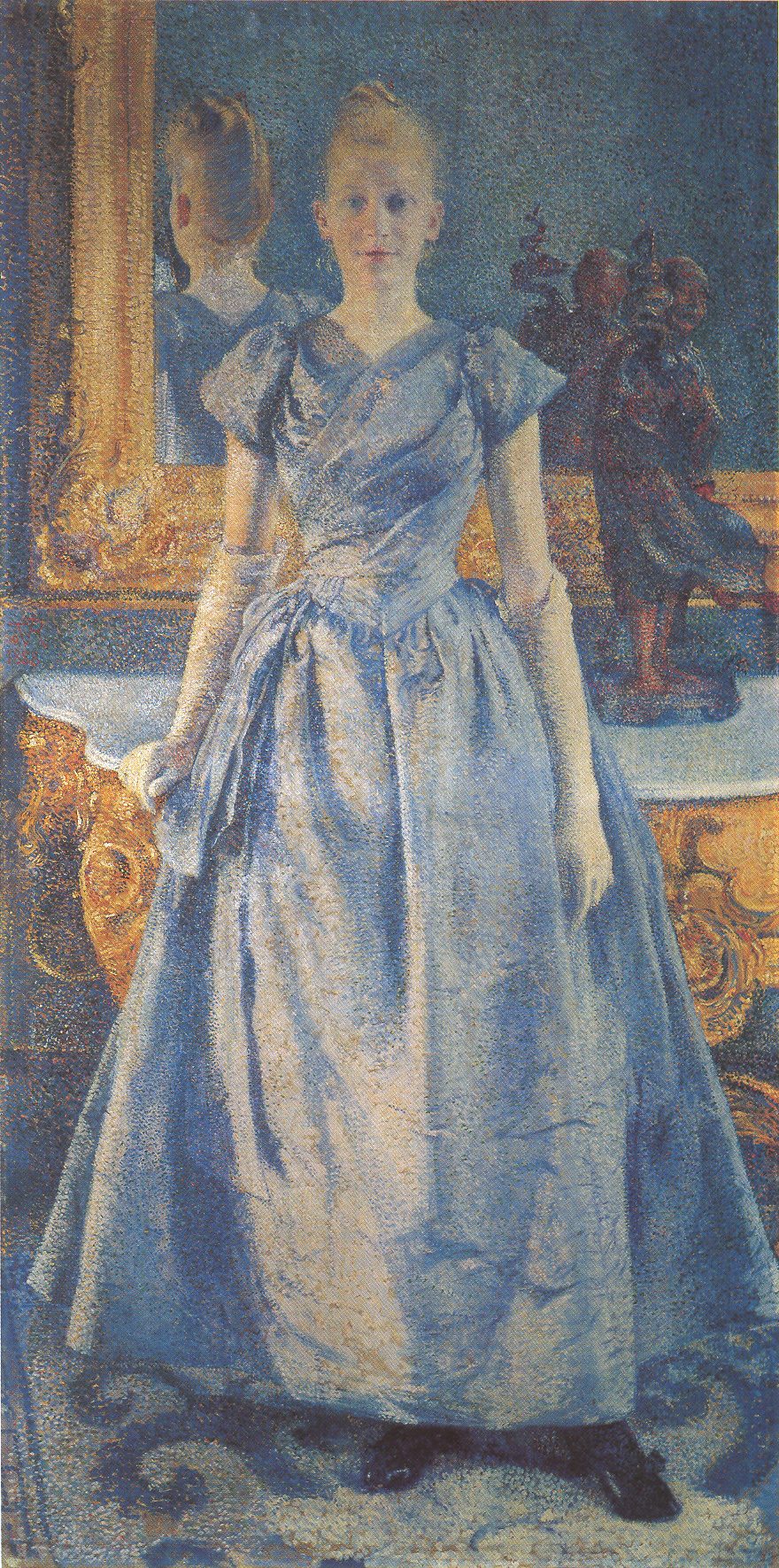
Théo van Rysselberghe had helped found Les XX in 1883. He travelled widely, saw Seurat's work in Paris and became close to Signac. Divided colour entered his landscapes and, unusually, ambitious portraits. In group portraits, separate touches model faces, clothing and interior light while preserving the social relations among writers, musicians and artists. The technique could organise likeness and intellectual community, not only anonymous types.[37] [41]
Van Rysselberghe also carried ideas through travel and friendship. He sailed with Signac, worked in France, visited Pissarro and helped introduce the method to Belgian and Dutch contexts. By the later 1890s he loosened his adherence, another reminder that historical importance does not require lifelong doctrinal consistency.
Georges Lemmen used small, controlled marks in portraits and domestic interiors before moving toward decorative synthesis. Willy Finch connected Belgian practice to Finland. Henry van de Velde passed from Neo-Impressionist painting toward design and architecture, where the organisation of line, colour and environment took new forms. Jan Toorop experimented with division through Belgian contacts before developing a Symbolist linear language. These paths cannot be collapsed into one national style.[39]
Letters between Signac and Octave Maus, the organiser and critic closely associated with Les XX, reveal how exhibitions were negotiated across borders. Artists discussed invitations, shipments, loyalties and aesthetic strategy. The spread of Neo-Impressionism was not an abstract diffusion of ideas across a map. It depended on people doing the administrative work of an avant-garde.[40]
Anna Boch
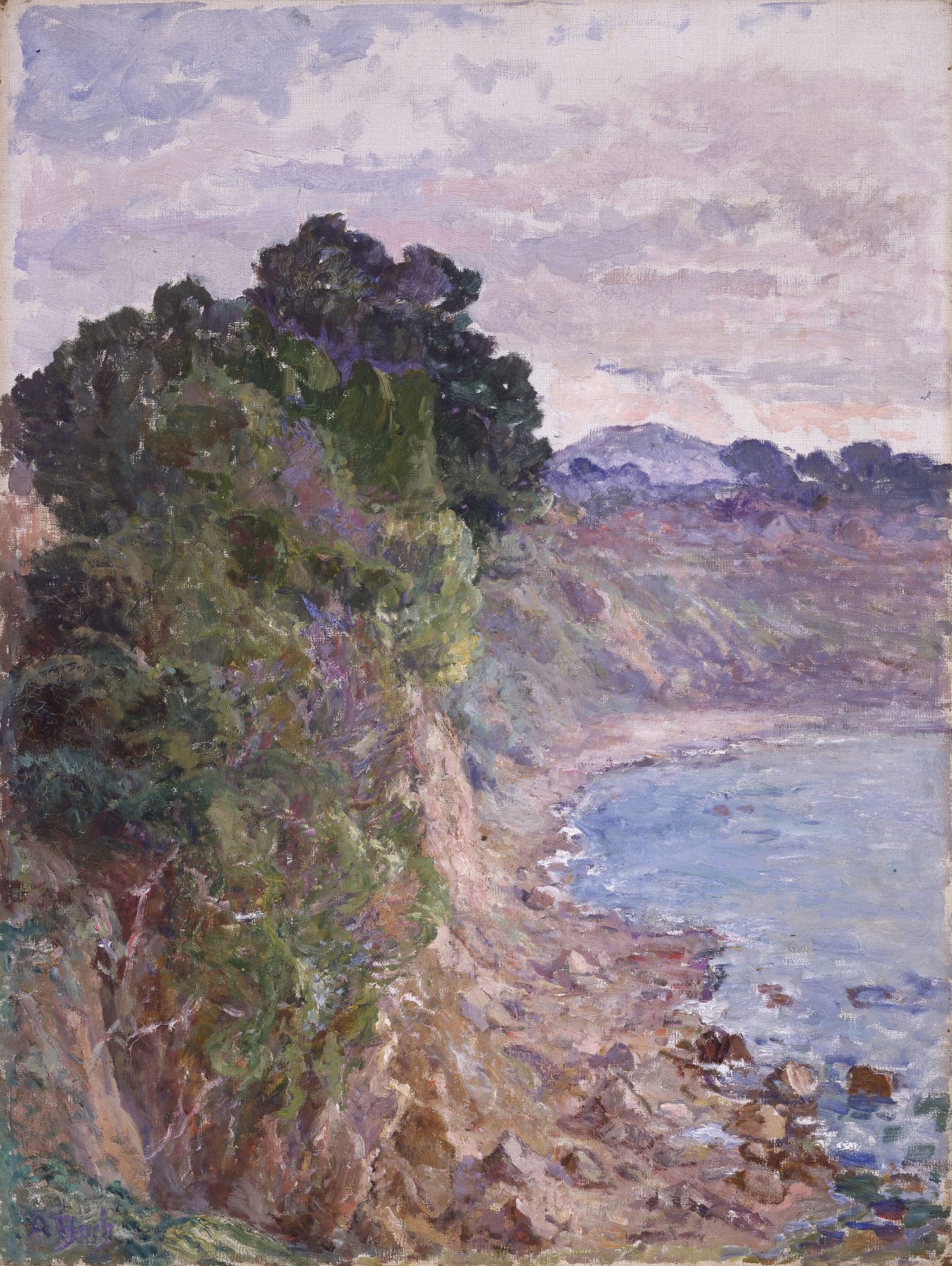
Anna Boch joined Les XX in 1885 and made her first Neo-Impressionist works later in the decade. She had studied with Isidore Verheyden, maintained a serious musical life and exhibited landscapes, coasts and interiors. Her divided touch was one phase within a long practice rather than her only artistic identity.[38]
Boch was also a perceptive collector. She acquired works by Seurat, Signac, Gauguin and Vincent van Gogh, including Van Gogh's The Red Vineyard. This role has sometimes overshadowed her painting. Artist and patron were not opposing identities: her own practice helped inform what she recognised in the work of colleagues, while family wealth gave her possibilities unavailable to most painters.
Belgian Neo-Impressionism therefore exposes several kinds of labour within a movement: making pictures, organising exhibitions, hosting concerts, buying works, writing criticism and carrying ideas between cities. Paris remained crucial, but it did not possess all authority.
Politics, labour and anarchist hopes
Several central Neo-Impressionists were anarchists or close to anarchist circles. Signac, Pissarro, Luce, Cross, Angrand and Fénéon held different forms of sympathy; Jean Grave's publications connected some of them to a wider political culture. Their opposition to jury authority at the Indépendants could resonate with anti-hierarchical ideals, although the society included members with many political views.[22] [28] [30]
Anarchism in late nineteenth-century France was not one uniform position. It included revolutionary, communist-anarchist, educational and gradualist currents. Artists disagreed about violence, organisation and the relation between present struggle and future harmony. Friendship did not erase these differences.
The paintings likewise vary. Luce's industrial and working-class subjects engage visible structures of labour. Pissarro's rural figures imagine dignity outside metropolitan capitalism. Signac's decorative future distributes useful activity and pleasure through a community. Cross's southern pastorals can suggest a life freed from urban competition. Yet formal equality among colour marks does not automatically represent political equality among people.
It is tempting to say that separate hues coexist without losing identity just as anarchist individuals might cooperate without a state. The analogy can illuminate an artist's hopes, but it becomes misleading when treated as a universal key. Painters balanced colours through their own authority; pictures do not organise themselves. A colour method can serve a utopia, a portrait, a commercial harbour or an apolitical exercise.
The movement also operated within markets. Artists needed dealers, collectors and exhibitions. Signac bought colleagues' work; Boch's fortune supported collecting; Fénéon later dealt art; La Grande Jatte eventually entered a major American museum collection. Political criticism and commodity circulation coexisted. The contradiction is historical, not evidence that one side must have been insincere.
Women within the Neo-Impressionist world
Women appear throughout Neo-Impressionist pictures as bathers, models, promenaders, workers, readers and inhabitants of imagined communities. Their repeated presence does not prove equal access to artistic careers. Studio training, freedom to travel, exhibition networks, money and social respectability remained unequally distributed.
Anna Boch offers the strongest corrective to a male-only account because she participated as painter, exhibitor and collector. Other women entered the extended network at different moments. Jeanne Selmersheim-Desgrange painted gardens, flowers and domestic Mediterranean scenes with divided colour and shared her life with Signac in the twentieth century. Lucie Cousturier, a painter, writer and collector, learned from Neo-Impressionist practice and later wrote about Seurat, Signac and Cross. Their roles belong more fully to the movement's continuation than to its founding moment.
Representation still requires scrutiny. The nude models in Seurat's studio worked in an economic relationship rarely preserved in titles. Signac and Cross imagined women within harmonious Mediterranean societies, but those scenes were constructed by male artists with particular ideals of beauty, labour and leisure. A woman's calm pose can indicate compositional order without revealing her experience.
The movement's social history is therefore larger than adding overlooked names. It asks who could enter a studio as author, model, visitor or collector; who could travel safely; whose correspondence survived; and whose work museums acquired. Neo-Impressionism's promise of a more equal future was formed within an unequal present.
Italian Divisionism: related but distinct
In Italy, Giovanni Segantini, Gaetano Previati, Giuseppe Pellizza da Volpedo, Angelo Morbelli and others also separated colour into visible strokes. They studied overlapping scientific sources and participated in international exhibitions. The name Divisionism makes the family resemblance obvious, but the Italian formation had different critics, galleries, regional settings and mixtures of Symbolism, social concern and spiritual ambition.
Segantini's Spring Pastures, for example, uses slender strokes of pure adjacent colour to make an Alpine landscape luminous. The observed rural world is also symbolic and lyrical. Light becomes a vehicle for inner or spiritual meaning rather than evidence of adherence to Seurat's exact method.[47]
Pellizza's The Fourth Estate gives the distinction monumental force. A crowd of workers advances from shadow into light, led by two men and a woman carrying a child. Pellizza developed the composition for about a decade through studies and earlier versions. Small lines of colour build its surface, while Renaissance works informed the gestures and grand arrangement.[46]
The picture unites divided technique, labour politics, local models and the tradition of monumental figure composition. It is related to French Neo-Impressionism without belonging to the Seurat-Signac circle. Calling every divided canvas Neo-Impressionist would erase the institutions and ideas that made Italian Divisionism historically specific.
The distinction also improves looking. French artists were not uniquely “scientific,” and Italian artists were not merely emotional Symbolists. Both groups joined theory to artistic judgement. Their differences lie in networks, emphasis and use, not in a clean division between reason and feeling.
From Van Gogh to Matisse and beyond
Van Gogh met Signac and encountered Seurat's work after arriving in Paris in 1886. He brightened his palette and experimented with separated complementary strokes. A Seine landscape by Signac and examples by Seurat could be studied near his own rapidly changing work. Van Gogh regarded Seurat as a leader of the young avant-garde, but he did not adopt uniform points or submit expression to a fixed system.[44]
His example shows how influence works through selection. Short strokes, complementary contrasts and a lighter palette could be detached from Neo-Impressionist compositional restraint. The receiving artist changes what is received.
The same is true of Henri Matisse. In 1904 he worked near Signac at Saint-Tropez and knew Cross's art. Luxe, calme et volupté uses divided touches to construct bathers in a Mediterranean landscape, but its marks are broad, colours increasingly independent and drawing deliberately fluid. The painting belongs to a threshold from Neo-Impressionism toward Fauvism.[45]
Signac and Cross demonstrated that pure colour could be enlarged, intensified and made decorative. Younger painters learned from that freedom while rejecting its full theoretical discipline. Fauvism was not the inevitable conclusion of Seurat's dots. It emerged from many sources, of which mature Neo-Impressionism was one.
Later artists also responded to the movement's modular surface, colour contrast and tension between whole and part. Orphism, Futurism and forms of abstraction found different uses for divided colour and rhythmic structure. The history extends as far as Paul Klee in exhibitions devoted to its legacy, but extension should not imply continuous membership. Influence is not the same as identity.[48] [50]
The movement's posthumous life depended on interpretation and collecting. Signac and Fénéon preserved Seurat's work and argument. Helene Kröller-Müller acquired an exceptional group while the art was still relatively recent. Museums later made La Grande Jatte, Bathers, The Circus and Signac's ports into landmarks of modernism. Canon formation has its own agents and chronology.[27] [49]
A method for looking
Neo-Impressionist paintings reward movement by the viewer. Begin far enough away for the scene to cohere. Then approach until separate marks become undeniable. Step back again. The change is not a distraction from the subject; it is one of the work's subjects.
1. Identify the kind of mark
Is it a point, comma, hatch, rectangle or irregular patch? Does its size change between face, sky and water? Uniformity can create stillness; variation can direct movement. Do not decide that a work is more authentic because its dots are smaller.
2. Look for complements and neighbours
Find orange near blue, red near green or yellow near violet. Notice whether the pair heightens brightness, creates a neutral vibration or refuses to fuse. Then examine quieter relationships among colours close in hue. The system involves proportion as much as opposition.
3. Separate light from pigment
A painted yellow is material, not sunlight itself. Ask which passages represent illumination and which make the surface appear luminous through contrast. If colour looks brownish or olive, remember that unstable pigments may have altered. Present appearance and original intention are related but not identical.[13]
4. Trace the composition beneath the touch
Repeated verticals stabilise La Grande Jatte. Curves animate The Circus. Horizontal bands hold Circus Sideshow at a distance. Division does not replace drawing and structure; it works through them.
5. Examine borders and frames
Where a painted border survives, compare its colours with the adjacent image. Does it intensify, neutralise or turn the scene inward? The transition from canvas to surrounding wall was an artistic problem, not an afterthought.[12] [17]
6. Ask who is working and who is watching
The movement repeatedly pictures labour and leisure: bathers rest near factories; musicians advertise a circus; spectators watch performers; peasants pause in fields; harbour workers occupy luminous coasts. Social position is often suggested but rarely explained. Avoid inventing biographies from clothing alone.
7. Reconstruct the exhibition
Imagine La Grande Jatte among the last Impressionists, or in Brussels before Les XX. Think of a large Signac beside many unrelated works at the Indépendants. Scale, neighbouring pictures and critical language affected the first encounter.
8. Keep theory and experience in conversation
Chevreul, Rood and Henry can explain artistic choices, but they cannot dictate your sensation. If a “gay” rising line feels tense or a harmonious park feels alienated, that response is evidence worth considering. A theory becomes historically interesting where the painting exceeds it.
Artists and places to know
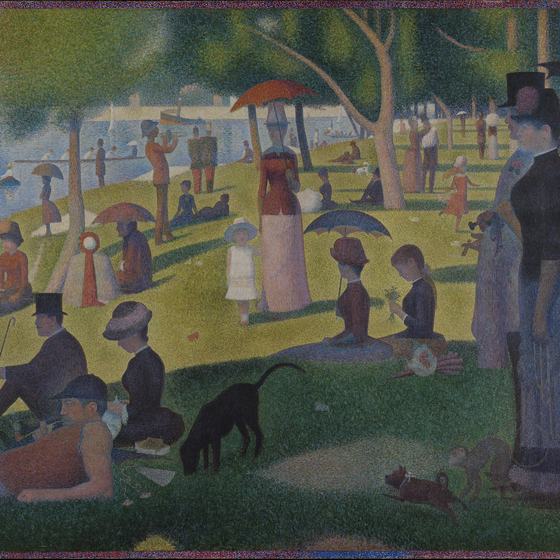
Georges Seurat
The movement's formative painter. Remember the tonal drawings and coastal panels alongside the monumental canvases. His achievement lies in joining intense preparation, modern social subjects and a surface that never fully disappears.
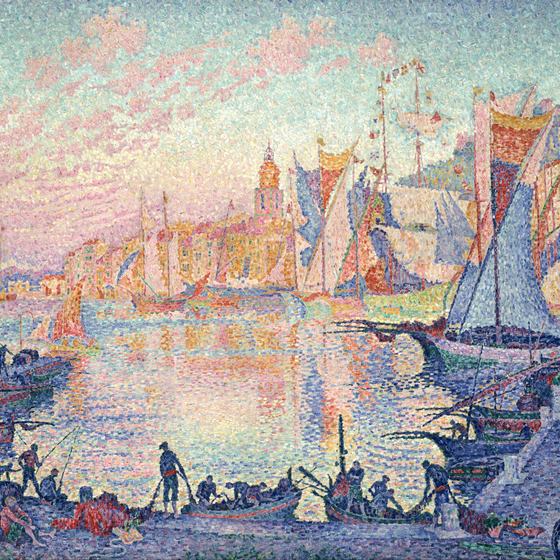
Paul Signac
Painter, sailor, watercolourist, collector, writer and organiser. He kept the movement active after 1891 and transformed its tiny touches into larger fields of colour. Saint-Tropez was both subject and meeting place.
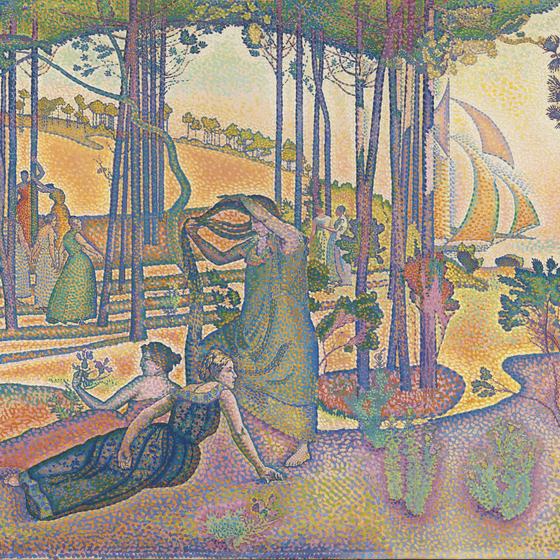
Henri-Edmond Cross
A major creator of Mediterranean decorative Neo-Impressionism. His mosaic-like strokes and utopian calm helped younger artists imagine colour beyond naturalistic description.
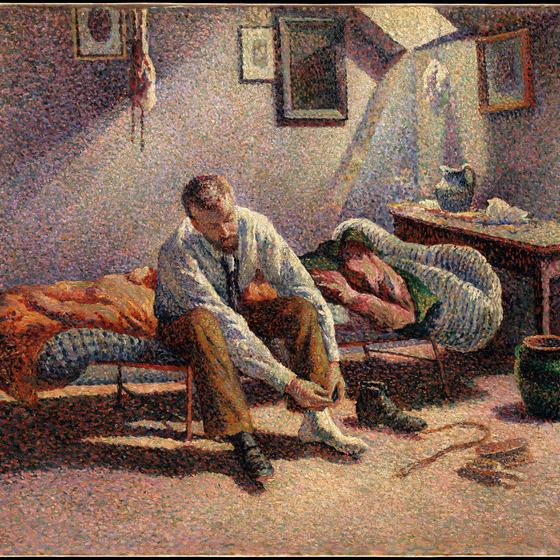
Maximilien Luce
Painter of workers, streets, factories, construction and industrial light. His prints and political affiliations connect the movement to anarchist publishing and urban labour.
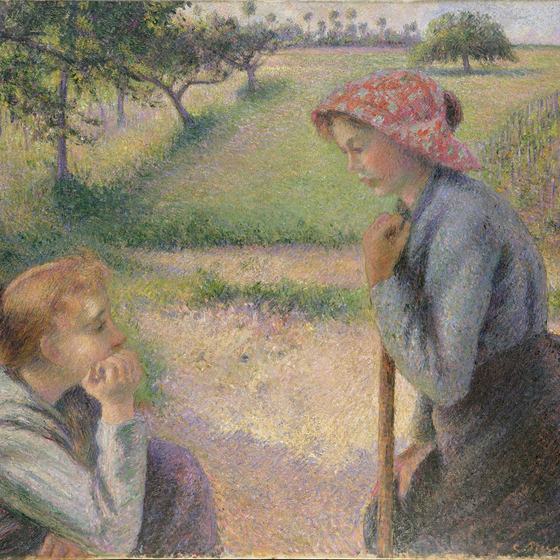
Camille Pissarro
The senior Impressionist who briefly embraced division and then carried some of its lessons into later rural paintings. His change of mind is part of the history, not a failure of commitment.
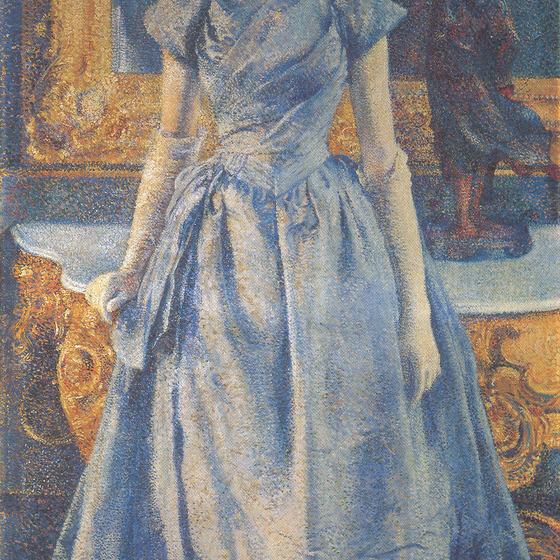
Théo van Rysselberghe and Anna Boch
Two distinct Belgian careers within Les XX. Van Rysselberghe made divided colour support portraiture and international exchange. Boch combined artistic production, music, exhibition and collecting.
Further artists and places
Charles Angrand and Albert Dubois-Pillet
Founding independent exhibitors whose work and organisation broaden the story beyond two leaders. Angrand's black drawings are especially valuable for questioning a purely chromatic definition.
- Asnières and Courbevoie: industry, river recreation and the social geography behind Seurat's first large canvas.
- La Grande Jatte: the island where modern leisure became a monumental and ambiguous stage.
- The Salon des Indépendants: the repeated non-juried forum that allowed the movement to develop publicly.
- Brussels: Les XX made it the movement's vital second centre.
- Saint-Tropez and Le Lavandou: southern light, maritime travel, decoration and the later work of Signac and Cross.
- Northern ports: Honfleur, Gravelines and other coastal towns where Seurat tested horizon, atmosphere and geometry.
Major artists directory
| Name | Nationality | Key Works |
|---|---|---|
| Albert Dubois-Pillet | French | The Banks of the Marne at Dawn, The Towers, Saint-Sulpice |
| Anna Boch | Belgian | Cliffs at Sanary |
| Camille Pissarro | Danish · French | Two Young Peasant Women, Apple Picking |
| Charles Angrand | French | Couple in the Street |
| Georges Lemmen | Belgian | The Beach at Heist, Portrait of Mme Lemmen |
| Georges Seurat | French | Bathers at Asnières, A Sunday on La Grande Jatte—1884, Models (Poseuses), Circus Sideshow, The Circus, The Lighthouse at Honfleur, View of Le Crotoy from Upstream, Le Chahut |
| Henri-Edmond Cross | French | The Evening Air, The Beach at Vignasse, Cypresses at Cagnes |
| Henry van de Velde | Belgian | Twilight, Tropon poster |
| Jan Toorop | Dutch | Broek in Waterland, The Sea |
| Jeanne Selmersheim-Desgrange | French | Saint-Tropez landscapes |
| Lucie Cousturier | French | Portraits, Mediterranean landscapes |
| Lucien Pissarro | French · British | The Stour at Stratford St Mary, Landscape |
| Maximilien Luce | French | The Construction Site, Morning, Interior |
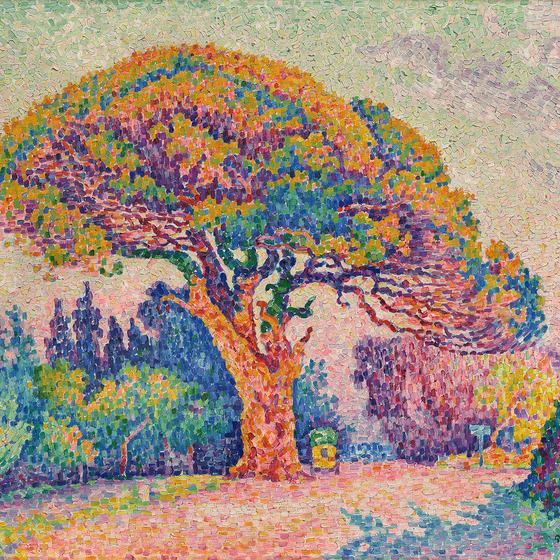
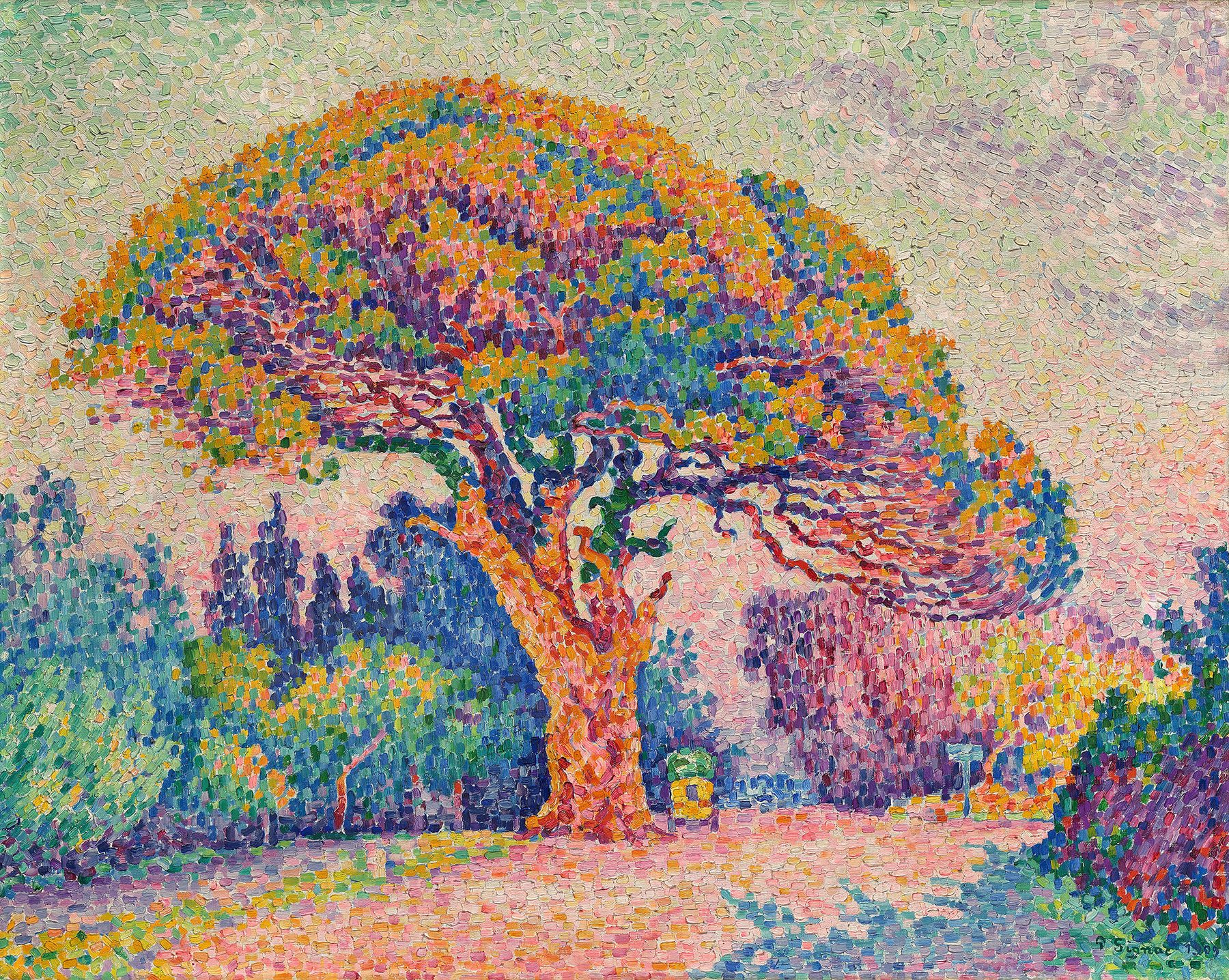
| Paul Signac | French | The Dining Room, Opus 152, Women at the Well, In the Time of Harmony, The Port of Saint-Tropez, The Pine at Saint-Tropez, The Wreckers |
| Théo van Rysselberghe | Belgian | Portrait of Alice Sèthe |
| Willy Finch | Belgian · Finnish | The Road to Nieuport, Coastal landscapes |
Where to see Neo-Impressionist art
These collections provide complementary routes through monumental Seurat canvases, divided colour, drawing, collecting and later influence. Displays and loans change, so check current information before travelling.
Art Institute of Chicago
Chicago, United States
Home to A Sunday on La Grande Jatte and the deepest technical and historical resources devoted to its making and material change.
La Grande Jatte and Seurat researchOfficial collection informationNational Gallery
London, United Kingdom
Bathers at Asnières anchors a concentrated route through Seurat, suburban modernity and the transition from Impressionism.
Bathers at AsnièresOfficial collection informationMusée d'Orsay
Paris, France
Major Seurat, Signac and Cross paintings include The Circus, Women at the Well and The Evening Air.
French Neo-ImpressionismOfficial collection informationMetropolitan Museum of Art
New York, United States
Circus Sideshow, Signac, Cross, Pissarro and extensive works on paper reveal the movement across media.
Seurat and the wider circleOfficial collection informationKröller-Müller Museum
Otterlo, Netherlands
An exceptional early collection of Seurat, Signac, Van Gogh and related modern art, including Le Chahut and key studies.
Collecting and European afterlivesOfficial collection informationMuseum of Modern Art
New York, United States
Seurat drawings and modernist afterlives place Neo-Impressionist structure and divided colour within twentieth-century art.
Drawings and modern legacyOfficial collection information
Landmark Neo-Impressionism exhibitions
Six exhibitions that reshaped understanding of Seurat, Signac, drawing, material colour and the movement’s international reach.
The Grande Jatte at 100
Art Institute of Chicago
A centenary reassessment joining historical interpretation to conservation and technical examination.
Neo-Impressionism: The Circle of Paul Signac
Metropolitan Museum of Art, New York
A broad survey of Seurat, Signac, Cross, Luce, Pissarro, the Belgian circle and longer influence.
Signac 1863–1935
Grand Palais, Van Gogh Museum and Metropolitan Museum
The first major Signac retrospective in decades restored the full range of oil, watercolour, drawing and print.
Neo-Impressionism: From Seurat to Paul Klee
Musée d'Orsay, Paris
A wide European account traced selective legacies beyond the movement’s usual French and Belgian frame.
Georges Seurat: The Drawings
Museum of Modern Art, New York
A landmark exhibition established the tonal drawings as a central and independent part of Seurat’s achievement.
Neo-Impressionism and the Dream of Realities
Phillips Collection, Washington
The exhibition reconnected divided colour with Symbolist poetry, music, Arcadia and contemplative experience.
Frequently Asked Questions
No. Neo-Impressionism names a movement and network. Divisionism names the separation of colour into distinct touches. Pointillism describes the use of dot-like marks. Some Neo-Impressionist paintings are pointillist, but many use hatches, rectangles or broad mosaic strokes.
Seurat and Signac developed its central painting practices through exchange beginning in 1884, while other artists and exhibition organisers helped create the field. Félix Fénéon coined the name in 1886 and gave the new art critical coherence. No single act created every part of the movement.
Artists had used stippling and small marks long before him. Seurat's innovation lay in joining divided handling to systematic colour relationships, monumental composition and modern subjects. Even he did not paint every work with regular dots.
They interact perceptually and may partly fuse at a distance, but they do not become material mixtures in the viewer's eye. Much depends on mark size, colour proportion, viewing distance, lighting and individual vision. Visible vibration can be more important than complete fusion.
Its artists studied and adapted contemporary colour and perception theories. Their pictures were not controlled scientific experiments, and some claims confused coloured light with pigment. “Scientific” described an aspiration toward method and order as much as verified procedure.
It brought monumental scale, modern leisure, long preparation and divided colour together in a work that dominated the 1886 exhibition. Its balance between social scene and abstract surface made a new direction in painting publicly unavoidable.
No. Several important artists and Fénéon had anarchist commitments or friendships, but their positions differed and the international network included many other political outlooks. Political context should guide interpretation without becoming a code imposed on every work.
He found its slow procedure and restrictions increasingly incompatible with his needs, while the paintings were difficult to sell. He moved away from regular division but retained lessons about complementary colour and repeated touch.
Les XX invited foreign avant-garde artists to Brussels. Seurat's work, especially La Grande Jatte in 1887, made a powerful impact. Van Rysselberghe, Boch, Lemmen, Finch and Van de Velde then developed distinct responses, supported by travel and correspondence with France.
It is closely related through divided colour and shared scientific sources, but it developed through different Italian critics, exhibitions, subjects and combinations of Symbolism and social art. It is clearer to treat it as a parallel formation.
It was one important source. Signac and Cross showed Matisse and others how separated colour could become broad, intense and decorative. Fauvism also drew from many other artists and visual traditions, so the connection is influence rather than inevitability.
Some pigments changed. Zinc yellow darkened and altered yellows, oranges and greens. Conservation research allows viewers to understand that the surviving surface is historical material, not a perfectly preserved statement of 1886 colour.
Discussion
When you look at a Neo-Impressionist painting, do you experience its separated marks as a disciplined order, a field of movement, or both? Consider where you stand, how the image changes as you approach, and whether knowing the artist's theory alters what you actually see.
Reader Insights
Step back until the scene coheres, then approach until the separate marks become undeniable. The transition is part of the work.
Look for complements and quieter colour relationships, asking whether adjacent marks intensify, neutralise or refuse to fuse.
Trace verticals, curves, borders and figure rhythms beneath the touch: division works through composition rather than replacing it.
Join the Conversation
Do Neo-Impressionist marks feel like disciplined order, a field of movement, or both?
References
- Le Néo-impressionnisme, de Seurat à Paul Klee — Musée d'Orsay (in French), musee-orsay.fr. View Source
- Neo-Impressionism: The Circle of Paul Signac — Metropolitan Museum of Art, metmuseum.org. View Source
- Le néo-impressionnisme — Musée des impressionnismes Giverny (in French), mdig.fr. View Source
- Après l'impressionnisme, du néo-impressionnisme au fauvisme — Musée d'Orsay (in French), musee-orsay.fr. View Source
- 1886 – Huitième exposition — Ministère de la Culture (in French), culture.gouv.fr. View Source
- Notre Histoire — Salon des Indépendants (in French), salondesindependants.fr. View Source
- Radiance: The Neo-Impressionists — National Gallery of Victoria, ngv.vic.gov.au. View Source
- Paul Signac et ses amis — Institut national d'histoire de l'art (in French), inha.fr. View Source
- Georges-Pierre Seurat — Museum of Modern Art, moma.org. View Source
- Seurat and the Making of La Grande Jatte — Art Institute of Chicago, archive.artic.edu. View Source
- Georges Seurat: Bathers at Asnières — National Gallery London, nationalgallery.org.uk. View Source
- The Grande Jatte at 100 — Art Institute of Chicago, artic.edu. View Source
- Conservation at the Art Institute of Chicago, artic.edu. View Source
- Georges Seurat: The Drawings — Museum of Modern Art, moma.org. View Source
- Poseuse de dos — Musée d'Orsay (in French), musee-orsay.fr. View Source
- Circus Sideshow — Metropolitan Museum of Art, metmuseum.org. View Source
- Le Cirque — Musée d'Orsay (in French), musee-orsay.fr. View Source
- The Clown and The Horsewoman: two studies for Circus — Musée d'Orsay, musee-orsay.fr. View Source
- The Lighthouse at Honfleur — National Gallery of Art, nga.gov. View Source
- Young Woman: Study for La Grande Jatte — Kröller-Müller Museum, krollermuller.nl. View Source
- Signac 1863–1935: Master Neo-Impressionist — Metropolitan Museum of Art, metmuseum.org. View Source
- Paul Signac 1863–1935: Paintings, Watercolors, Drawings, and Prints — Metropolitan Museum of Art, resources.metmuseum.org. View Source
- The Dining Room, Opus 152 — Kröller-Müller Museum, krollermuller.nl. View Source
- Femmes au puits, Opus 238 — Musée d'Orsay (in French), musee-orsay.fr. View Source
- L'Air du soir — Musée d'Orsay (in French), musee-orsay.fr. View Source
- Questions à Marina Ferretti Bocquillon et Charlotte Hellman — Musée d'Orsay (in French), musee-orsay.fr. View Source
- Signac collectionneur catalogue extract — Musée d'Orsay (in French), musee-orsay.fr. View Source
- Les Temps Nouveaux (1895–1914) — Musée d'Orsay (in French), musee-orsay.fr. View Source
- Paul Signac: The Wreckers — Metropolitan Museum of Art, metmuseum.org. View Source
- Félix Fénéon — Metropolitan Museum of Art, metmuseum.org. View Source
- Traité des matières colorantes — Paul Schützenberger via CNAM (in French), cnum.cnam.fr. View Source
- Picturing France 1830–1900 — National Gallery of Art, nga.gov. View Source
- D'Eugène Delacroix au néo-impressionnisme — Paul Signac (in French), fr.wikisource.org. View Source
- Les Impressionnistes en 1886 — Félix Fénéon (in French), fr.wikisource.org. View Source
- Modern Chromatics — Ogden N. Rood, openlibrary.org. View Source
- Introduction a une esthétique scientifique — Charles Henry (in French), books.google.com. View Source
- Theo van Rysselberghe — Kunstmuseum Den Haag (in Dutch), kunstmuseum.nl. View Source
- Boch Anna — Ministère de la Culture (in French), culture.gouv.fr. View Source
- Belgium: Van de Velde, Van Rysselberghe and Lemmen — Kröller-Müller Museum, krollermuller.nl. View Source
- Paul Signac letters to Octave Maus — Royal Museums of Fine Arts of Belgium (in French), fine-arts-museum.be. View Source
- Théo van Rysselberghe — National Gallery London, nationalgallery.org.uk. View Source
- Cézanne et Pissarro 1865–1885 — Musée d'Orsay (in French), musee-orsay.fr. View Source
- Two Young Peasant Women — Metropolitan Museum of Art, metmuseum.org. View Source
- Gallery texts: Seurat, Signac and Van Gogh — Van Gogh Museum, vangoghmuseum.nl. View Source
- Henri Matisse (1869–1954) — Metropolitan Museum of Art, metmuseum.org. View Source
- Il Quarto Stato returns to the Galleria d'Arte Moderna — Comune di Milano / Museo del Novecento (in Italian), museodelnovecento.org. View Source
- Spring Pastures — Pinacoteca di Brera, pinacotecabrera.org. View Source
- Neo-Impressionism — Guggenheim Museum Bilbao, guggenheim-bilbao.eus. View Source
- The Seurats of Helene Kröller-Müller — Kröller-Müller Museum, krollermuller.nl. View Source
- Neo-Impressionism From Seurat to Paul Klee — Musée d'Orsay, musee-orsay.fr. View Source
- Image references 51–74: open-access reproductions and institutional collection records.
View 24 image sources
01 · commons.wikimedia.org02 · commons.wikimedia.org03 · commons.wikimedia.org04 · commons.wikimedia.org05 · commons.wikimedia.org06 · commons.wikimedia.org07 · commons.wikimedia.org08 · commons.wikimedia.org09 · commons.wikimedia.org10 · commons.wikimedia.org11 · commons.wikimedia.org12 · commons.wikimedia.org13 · commons.wikimedia.org14 · commons.wikimedia.org15 · commons.wikimedia.org16 · commons.wikimedia.org17 · commons.wikimedia.org18 · commons.wikimedia.org19 · commons.wikimedia.org20 · commons.wikimedia.org21 · commons.wikimedia.org22 · commons.wikimedia.org23 · commons.wikimedia.org24 · commons.wikimedia.org
More ART Movements