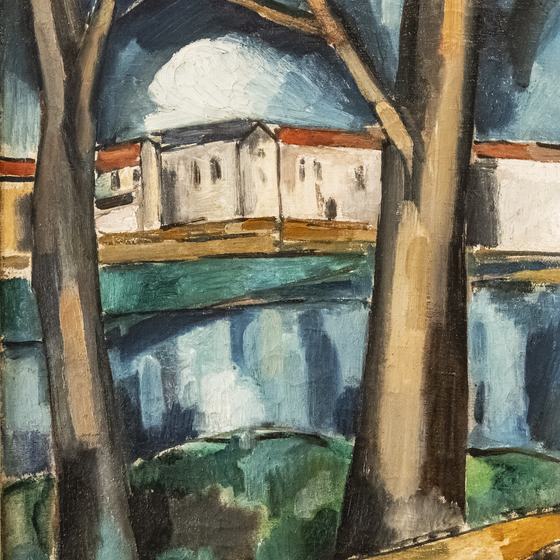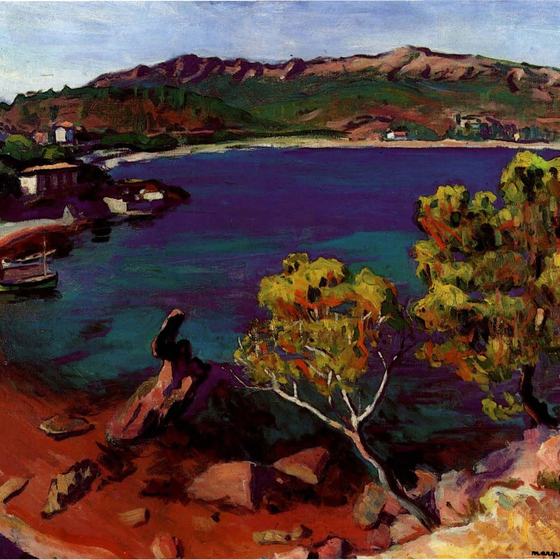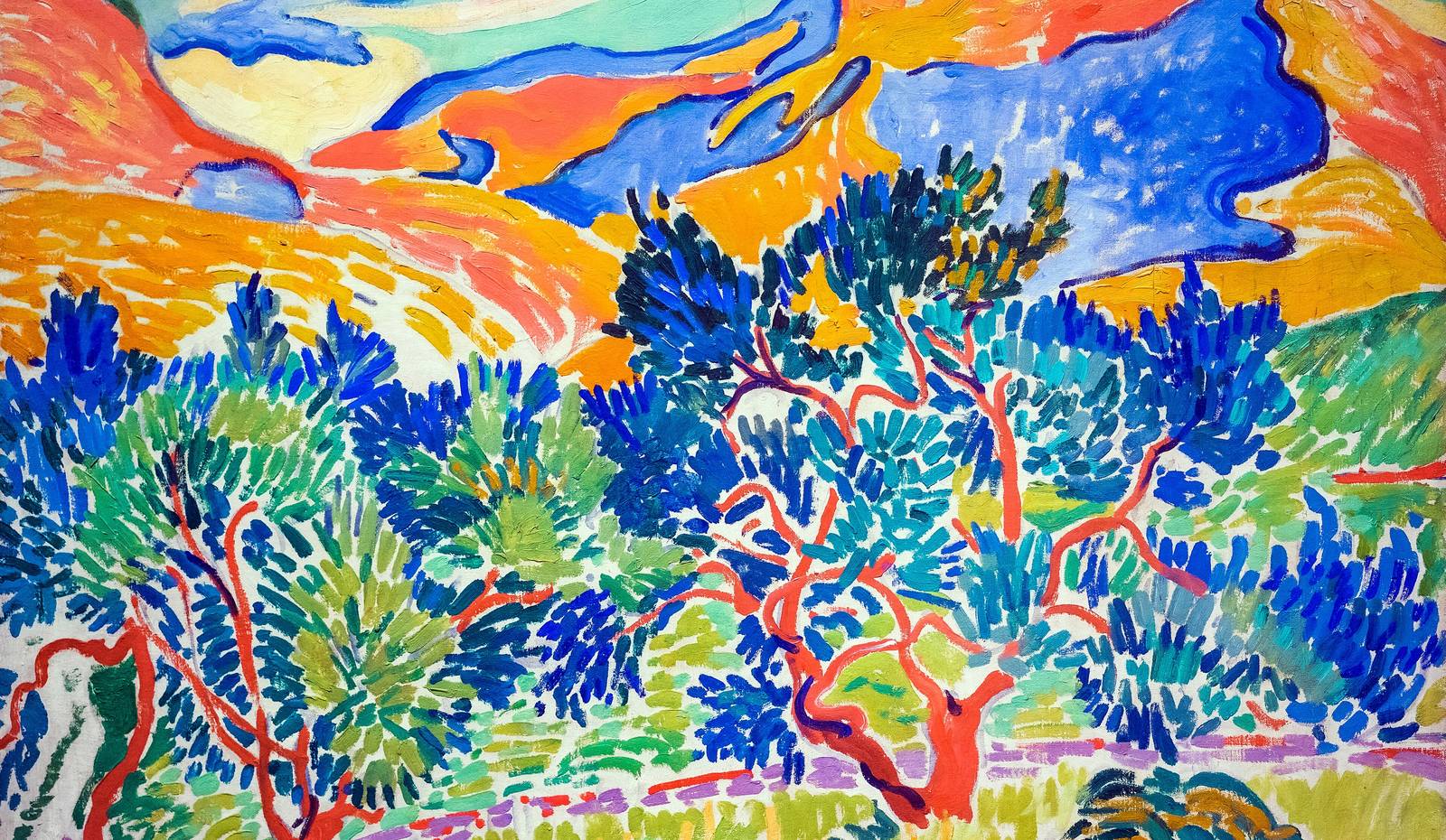
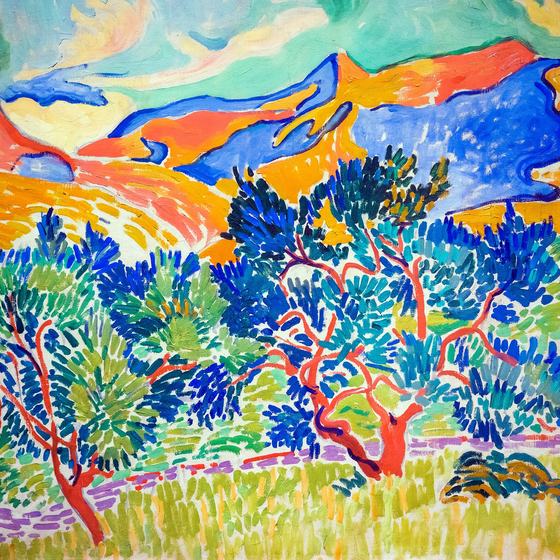
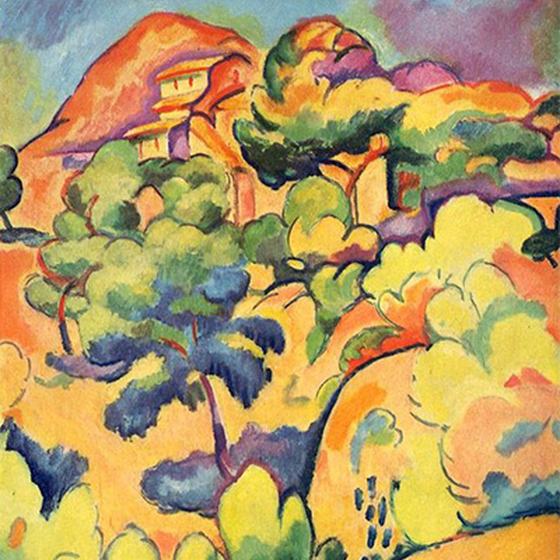
Image reference: Mountains at Collioure by André Derain.
At a Glance
- Core periodapproximately 1904–1908
- Nationalityprincipally French, with Dutch and wider European connections
- Principal centresParis · Collioure · Chatou · Le Havre · London · L’Estaque · La Ciotat
- Known fornon-naturalistic colour · visible paint handling · simplified form · compressed space · strong contour
- Core artistsHenri Matisse · André Derain · Maurice de Vlaminck
- Important distinctiona loose, short-lived formation, not one technique or an official group
Contents
- Where Fauvism fits
- Why “wild beasts”?
- Roads toward colour
- The summer at Collioure
- Essential works
- Artists to know
- How Fauve paint works
- Four stages
- African and Oceanic arts
- How to recognise Fauvist art
Where Fauvism fits
Henri Matisse
Principal careerAndré Derain
Principal careerMaurice de Vlaminck
Principal careerAlbert Marquet
Principal careerCharles Camoin
Principal careerHenri Manguin
Principal careerGeorges Rouault
Principal careerKees van Dongen
Principal careerRaoul Dufy
Principal careerOthon Friesz
Principal careerGeorges Braque
Principal careerFauvism gave colour a new authority. In paintings made mainly between 1904 and 1908, skies can turn green, faces divide into opposing bands, water flashes yellow or red, and visible brushstrokes refuse to imitate a smooth world. These decisions were not simply explosions of emotion. Colour could build light, join or separate planes, give weight to a figure and hold an entire composition in balance.[1] [2]
The name suggests a more organised movement than history provides. Henri Matisse, André Derain and Maurice de Vlaminck were its central painters, but they never issued a Fauvist manifesto or maintained a membership society. Other artists entered through friendships, shared teachers, exhibitions, dealers and visits to the same places. Some stayed near the experiments for years; others passed through rapidly. “Fauvism” is therefore most useful as the name of an encounter: several overlapping networks discovered that observed colour no longer had to control painted colour.[3] [4]
Why “wild beasts”?
The label came from an exhibition review, not the artists. At the third Salon d'Automne in Paris in 1905, Gallery VII brought together paintings by Matisse, Derain, Vlaminck, Manguin, Camoin and Marquet. Near them stood two conventionally modelled sculptures by Albert Henri Marque. The critic Louis Vauxcelles compared the contrast to “Donatello among the wild beasts”—Donatello chez les fauves. The insult was memorable, and les Fauves became the name.[8] [17]
Several details are easily lost in retelling. Marque was a sculptor, not the painter Albert Marquet. Vauxcelles was describing a visual collision between Renaissance-like sculpture and an “orgy of pure tones,” not announcing a programme. Gallery VII contained thirty-nine works by six painters, while the Salon as a whole displayed more than sixteen hundred objects. It was a juried marketplace and public spectacle, not a Fauve exhibition planned as collective revolt.
The phrase nevertheless did useful cultural work. It made unfamiliar pictures sound instinctive, dangerous and animal. Hostile readers could dismiss their makers as uncivilised; admirers could embrace freedom from academic restraint. The metaphor also sounded masculine. Later histories turned energetic paint into evidence of male virility, helping to hide the women who modelled, made art, kept businesses and created the movement's market.[5] [7]
No artist woke up at the Salon and formally joined “Fauvism.” The category hardened afterward through criticism, exhibitions, collecting and museum catalogues. This explains both its power and its porous edges. A useful account must ask not just who appears on a Fauve list, but when, where and through which relationship.
A scandal made in public
The Salon d'Automne was itself a new institution. Founded only in 1903, it offered a younger alternative to the official Salon and deliberately mixed painting with sculpture, decorative arts and retrospective exhibitions. Its autumn date also distinguished it from the independent and official spring exhibitions. The 1905 organisers did not set out to launch Fauvism, but the placement of strongly coloured paintings together made comparison unavoidable.[8] [9]
That setting matters because the paintings were not first encountered as the calm sequence now offered by a museum. Visitors entered a crowded building, moved among more than a thousand works and heard opinions being formed around them. Critics wrote for newspapers and illustrated journals; collectors assessed unfamiliar names; artists watched one another's reception. A room could become an event because selection, hanging and commentary temporarily made separate careers look collective.
The controversy also reveals that viewers did recognise what the paintings represented. Their shock did not depend on total illegibility. A hat, face, harbour or hillside remained clear enough for colour's departure from convention to register. If the pictures had been pure chromatic noise, the green facial passages and orange skies could not have seemed transgressive. Fauvism placed radical decisions inside familiar genres, allowing the public to measure the distance between expectation and painted fact.[16] [17]
Nor was ridicule the only response. The Steins' purchase of Woman with a Hat converted a notorious submission into private endorsement, while photographs, reviews and later displays kept the story in circulation. Scandal became one route by which a market for difficulty formed. Yet the famous insult should not be mistaken for instant success: most painters still depended on modest sales, family labour and dealers willing to show uncertain work.[33] [46]
Before 1905: several roads toward colour
There was no single starting classroom. Matisse, Marquet, Manguin, Camoin, Puy and Rouault had studied with the Symbolist painter Gustave Moreau at the École des Beaux-Arts. Moreau encouraged individual invention more than imitation of his own mysterious subjects. His students remained strikingly unlike one another: Rouault developed dark religious and social images, while Marquet often preferred firm drawing and restrained harmony.
Derain and Vlaminck formed a separate partnership at Chatou, west of Paris. They painted the Seine, roads, bridges and working suburbs and shared a studio in a former restaurant. Their friendship was combative and energising. Farther north, Raoul Dufy, Othon Friesz and the younger Georges Braque emerged from the port city of Le Havre. Salons, galleries and rail travel eventually connected these circles.[6] [28]
Their common resources were Post-Impressionist, but not interchangeable. Vincent van Gogh showed how directional brushwork and intensified colour could charge an ordinary road or field. Paul Gauguin offered flatter zones, emphatic contour and decorative pattern. Paul Cézanne modelled volume and pictorial order through colour relations. Georges Seurat and Paul Signac divided hues into separate touches so optical mixture could happen in the viewer's eye.
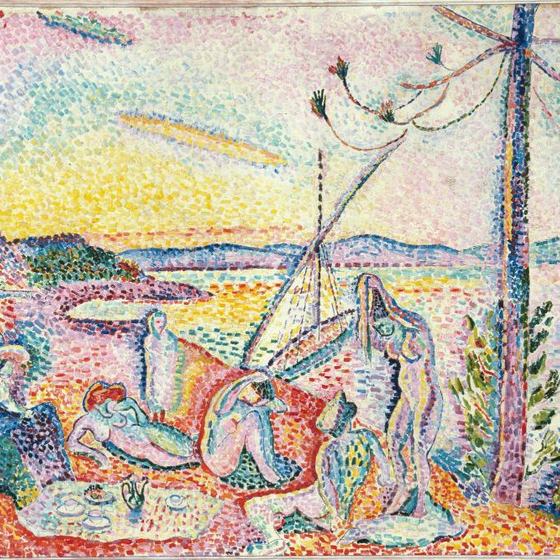
Matisse learned especially through Neo-Impressionism. During 1904 at Saint-Tropez, he worked near Signac and painted Luxe, calme et volupté. Its title comes from Baudelaire, while its pastoral bathers and systematic spots of intense pigment convert the Mediterranean into a measured colour field. The painting is a threshold rather than a finished Fauve formula: Matisse would retain the lesson that adjacent hues activate one another while loosening divisionism's method.[10] [20]
Vlaminck responded more forcefully to Van Gogh. Retrospective exhibitions in Paris in 1901 and 1905 confirmed the value of urgent touch, saturated complementary colour and landscape as a record of sensation. Yet Vlaminck's later claim that Fauvism was simply a way of being, breathing and acting should be handled with care. His cultivated image as instinctive anarchist obscures study, exhibitions, dealers and sustained work.[23] [24]
Fauvism did not replace its predecessors as one style superseding another. It recombined their questions. How could a painting preserve the sensation of a motif without reproducing its local colours? Could separate touches create a stable surface instead of atmospheric recession? How much description could be removed before a harbour, face or room ceased to hold together?
The summer at Collioure
In 1905 Henri Matisse invited Derain to Collioure, a Catalan-speaking fishing town on the Mediterranean near the Spanish border. Over approximately nine weeks they worked around its beaches, harbour, hills, castle and densely packed houses. Their exchange has become Fauvism's origin story, but it was a collaboration rather than a shared recipe.[11] [13]
Derain arrived in July and produced roughly thirty canvases, twenty drawings and many sketches before returning to Paris. Matisse made fewer oils but numerous watercolours and drawings. Both shifted between media. A colour relationship tried rapidly on paper could reappear in oil; an ink contour could clarify a form that paint had dissolved. Fauvism developed through drawing and watercolour as well as the celebrated canvases.[12] [15]
Collioure's light mattered. Pale stone, red roofs, deep water and hard sun offered a different visual climate from Paris. Yet yellow-green sea and red tree trunks are not recordings of weather. Derain wrote of “discharging light” and eliminating deep shadow. Colour became an active equivalent for intensity rather than an inventory of what lay before him.
In Fishing Boats, Collioure, boats, masts, shore and buildings are distributed through broken bands of orange, blue, green, pink and white. Exposed canvas sparkles between marks. The boats remain recognisable, but the eye cannot settle into a smoothly receding harbour. Dark uprights and diagonals hold the field while separated hues make the surface flicker. The apparent speed of execution conceals a clear decision about structure.[13]
Derain's Le Faubourg de Collioure organises the beach through a steep diagonal of pulled-up boats and red masts. Figures and nets are abbreviated, while the royal castle anchors the distance. Some marks retain divisionist separation; others expand into broad patches. Letters to Vlaminck show Derain thinking explicitly about whether divided touch still served him. What looks spontaneous was also debated.[15]
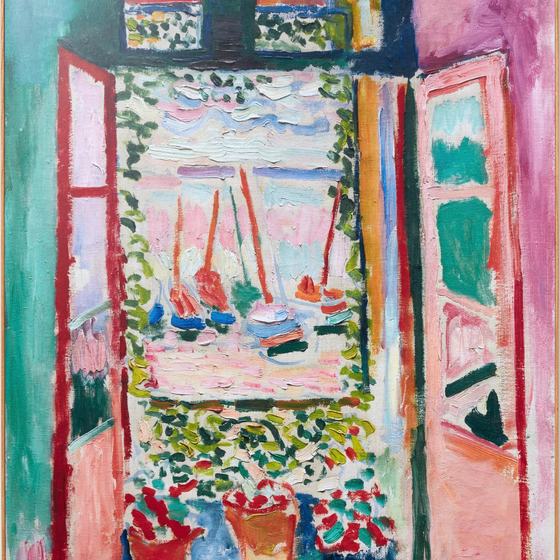
Matisse's Collioure pictures often hold colour in a more encompassing rhythm. In Open Window, Collioure, the casement is a frame inside the canvas, but interior, window, balcony and harbour interpenetrate. Vertical shutters in green, blue and violet open onto pink water, orange masts and small boats. No neutral passage separates near from far. Each colour is intensified by what touches it.
White ground is crucial in such works. Leaving canvas visible does not necessarily mean an unfinished rush. Gaps can operate like light and keep heavy pigment from sealing the surface. Elsewhere, Matisse lays thin washes beside loaded strokes or uses a dark arabesque to recover a shape. There is no single Fauve thickness.[20]
Twenty-four Fauvist works to know
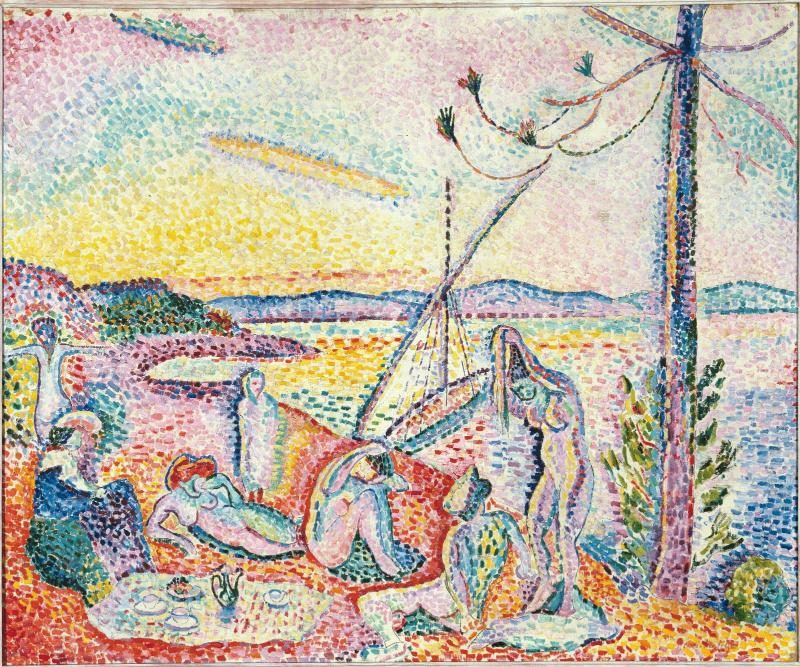
Luxe, calme et volupté
Henri Matisse, 1904
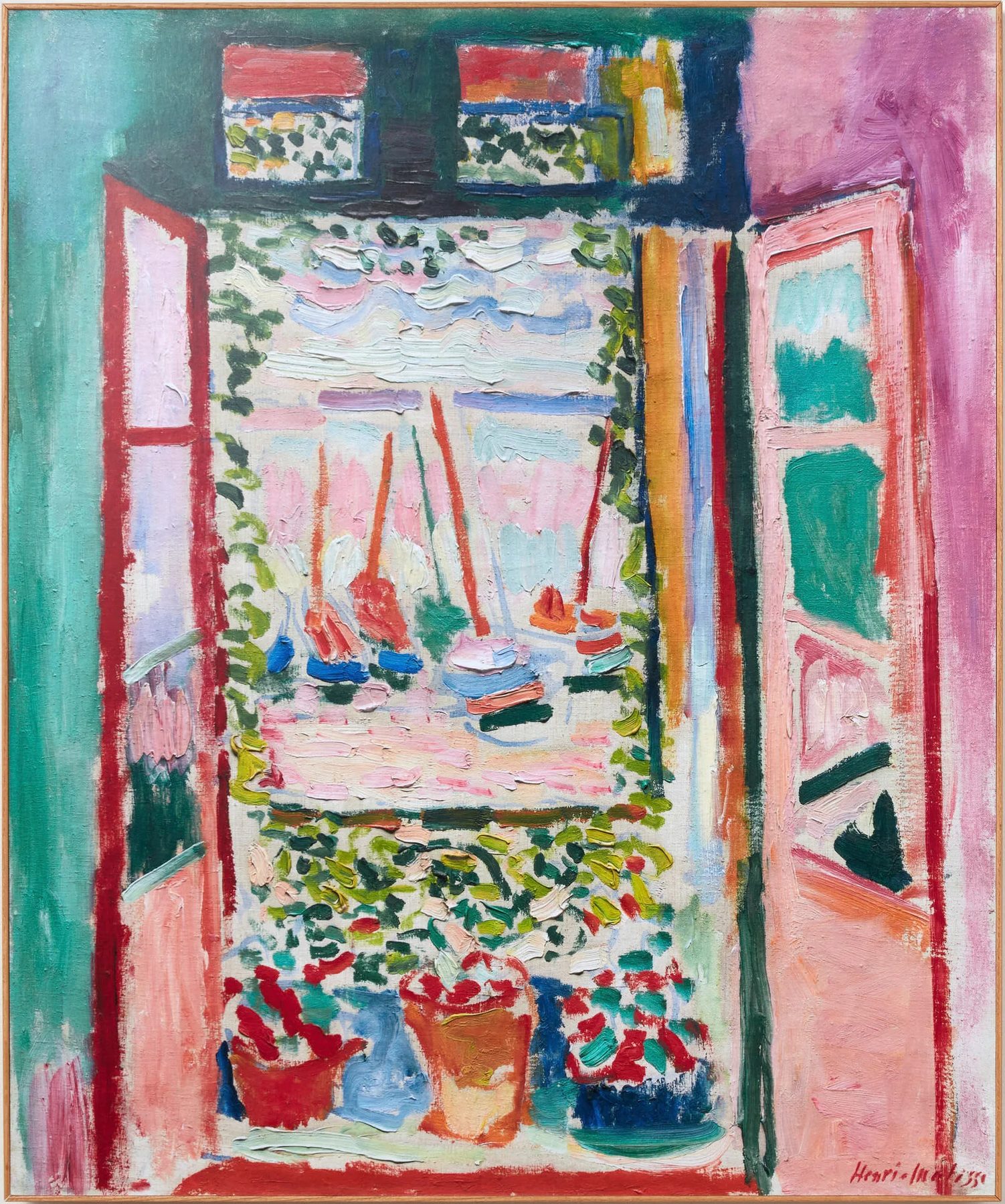
Open Window, Collioure
Henri Matisse, 1905
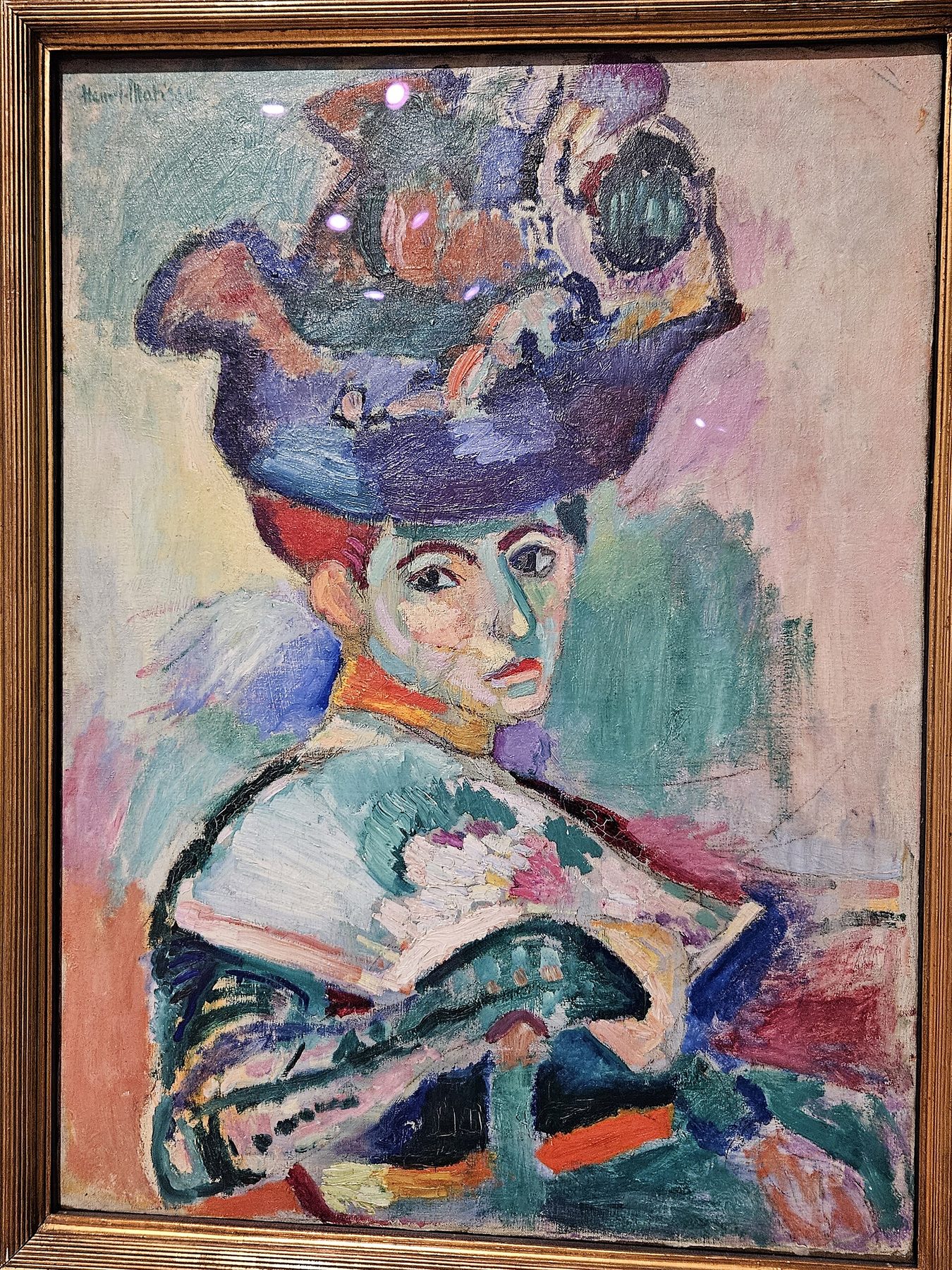
Woman with a Hat
Henri Matisse, 1905
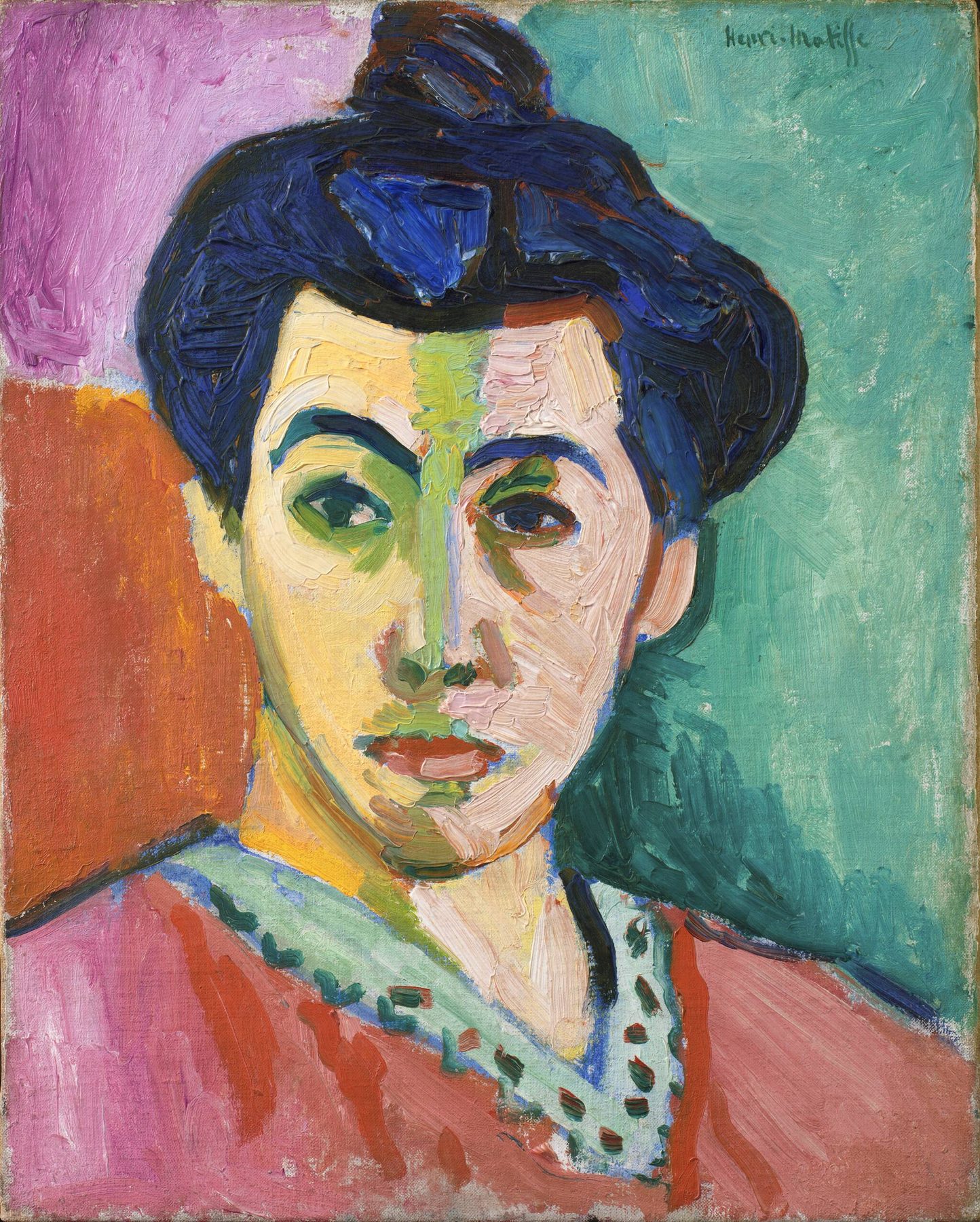
Portrait of Madame Matisse: The Green Line
Henri Matisse, 1905
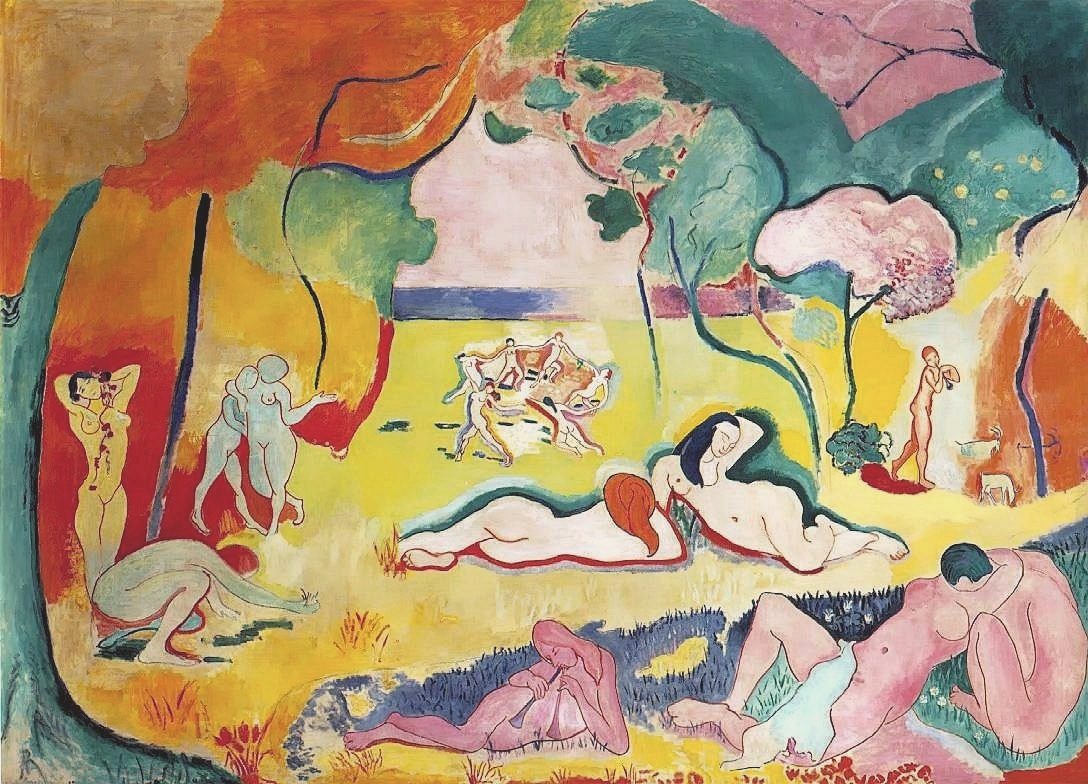
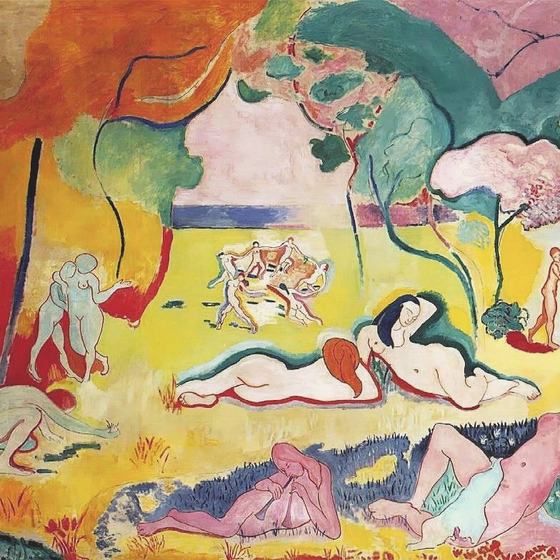
Le Bonheur de vivre
Henri Matisse, 1905–06
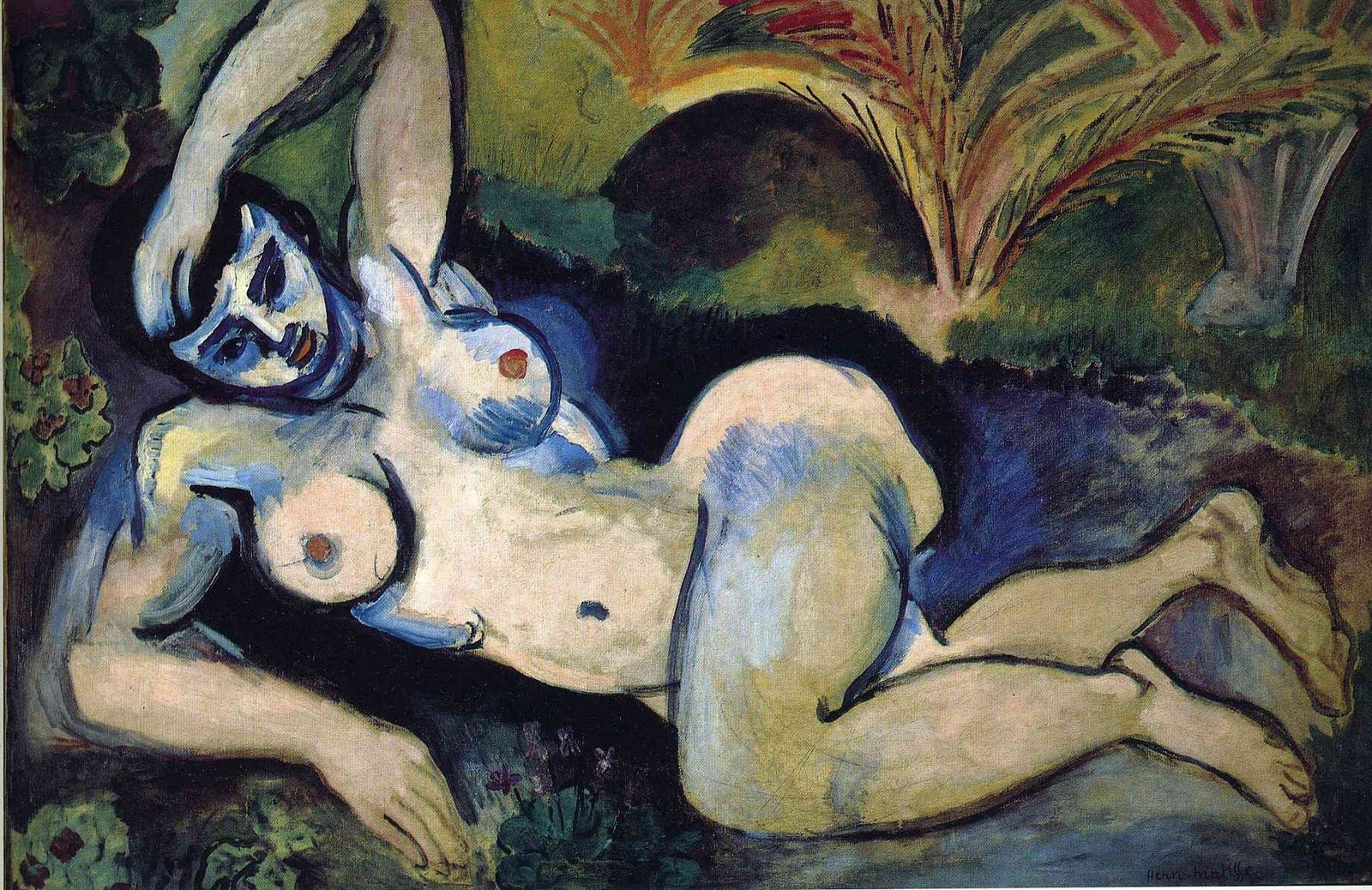
Blue Nude: Memory of Biskra
Henri Matisse, 1907
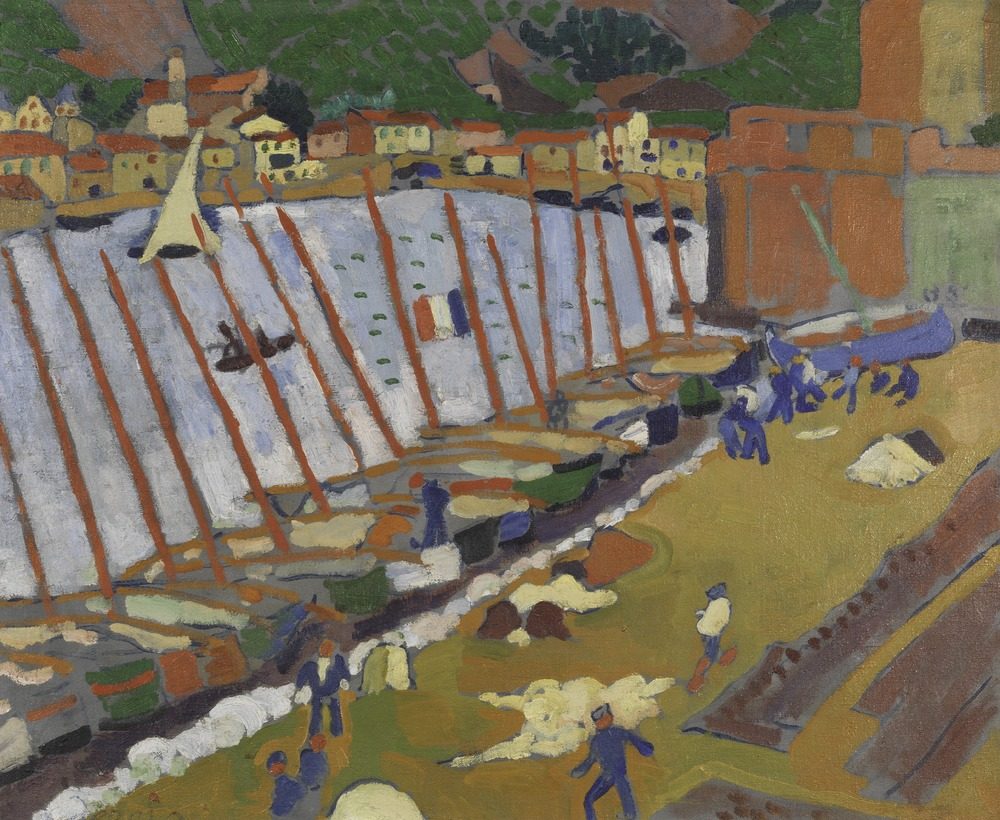
Le Faubourg de Collioure
André Derain, 1905
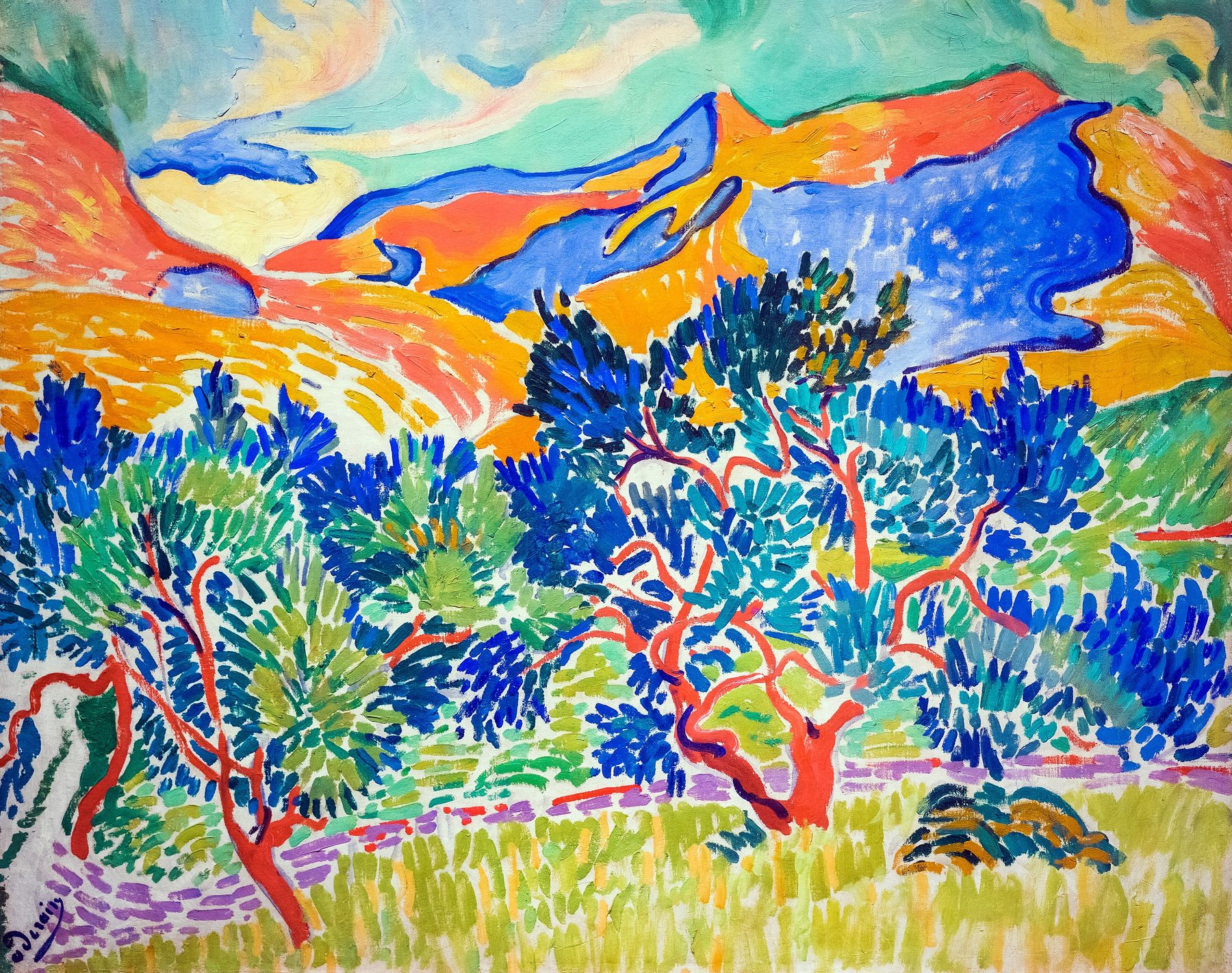
Mountains at Collioure
André Derain, 1905
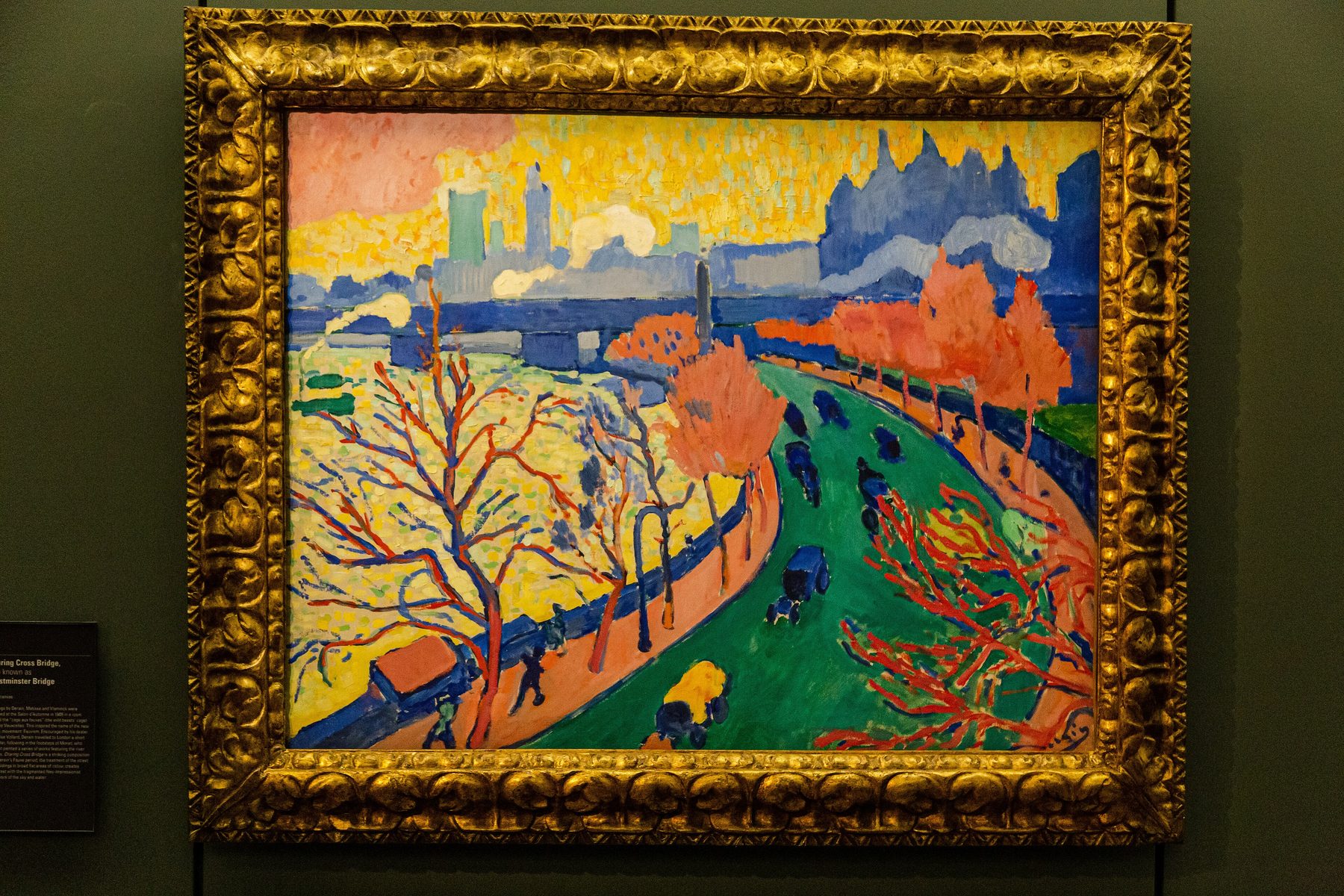
Charing Cross Bridge
André Derain, 1906
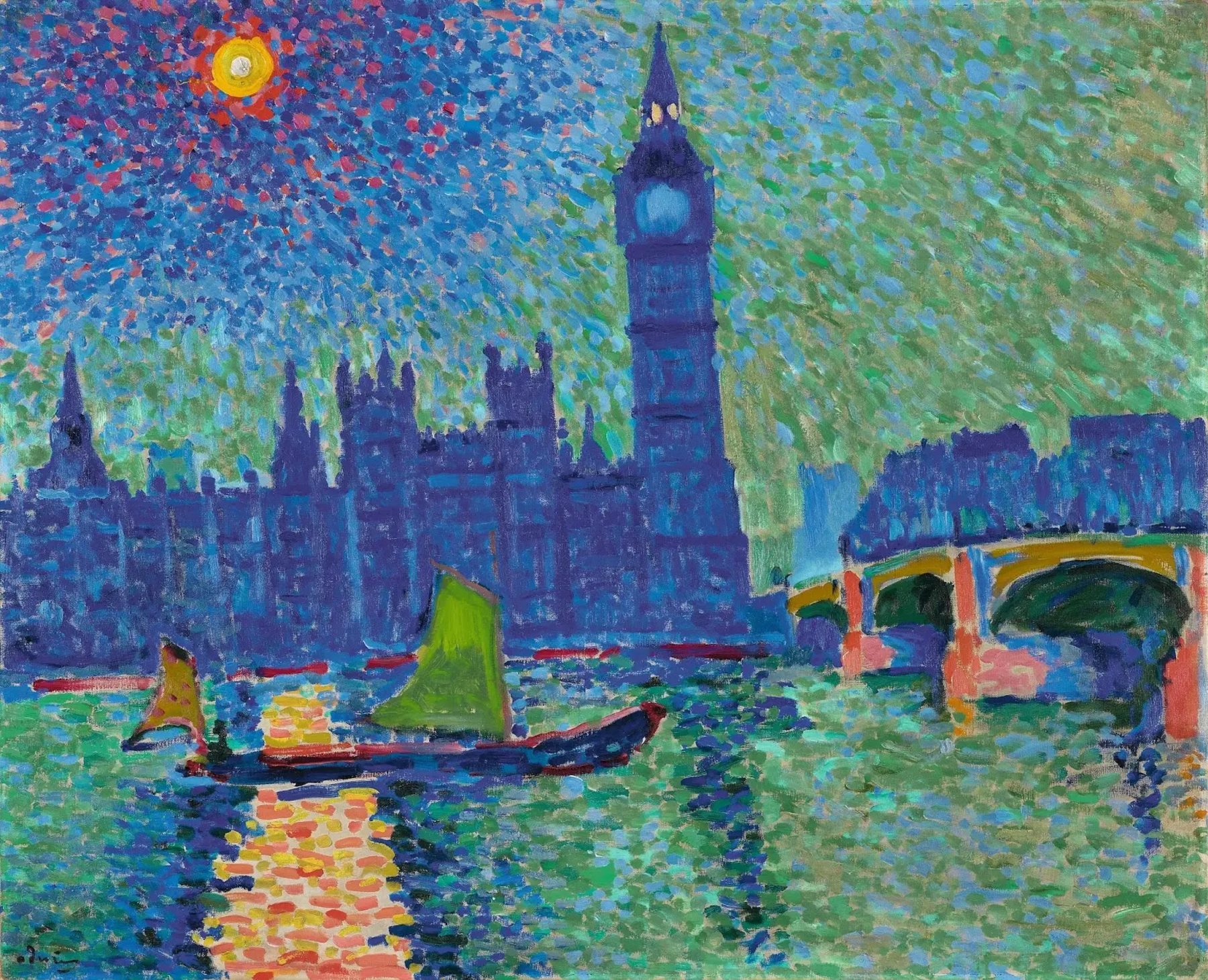
Big Ben
André Derain, 1906
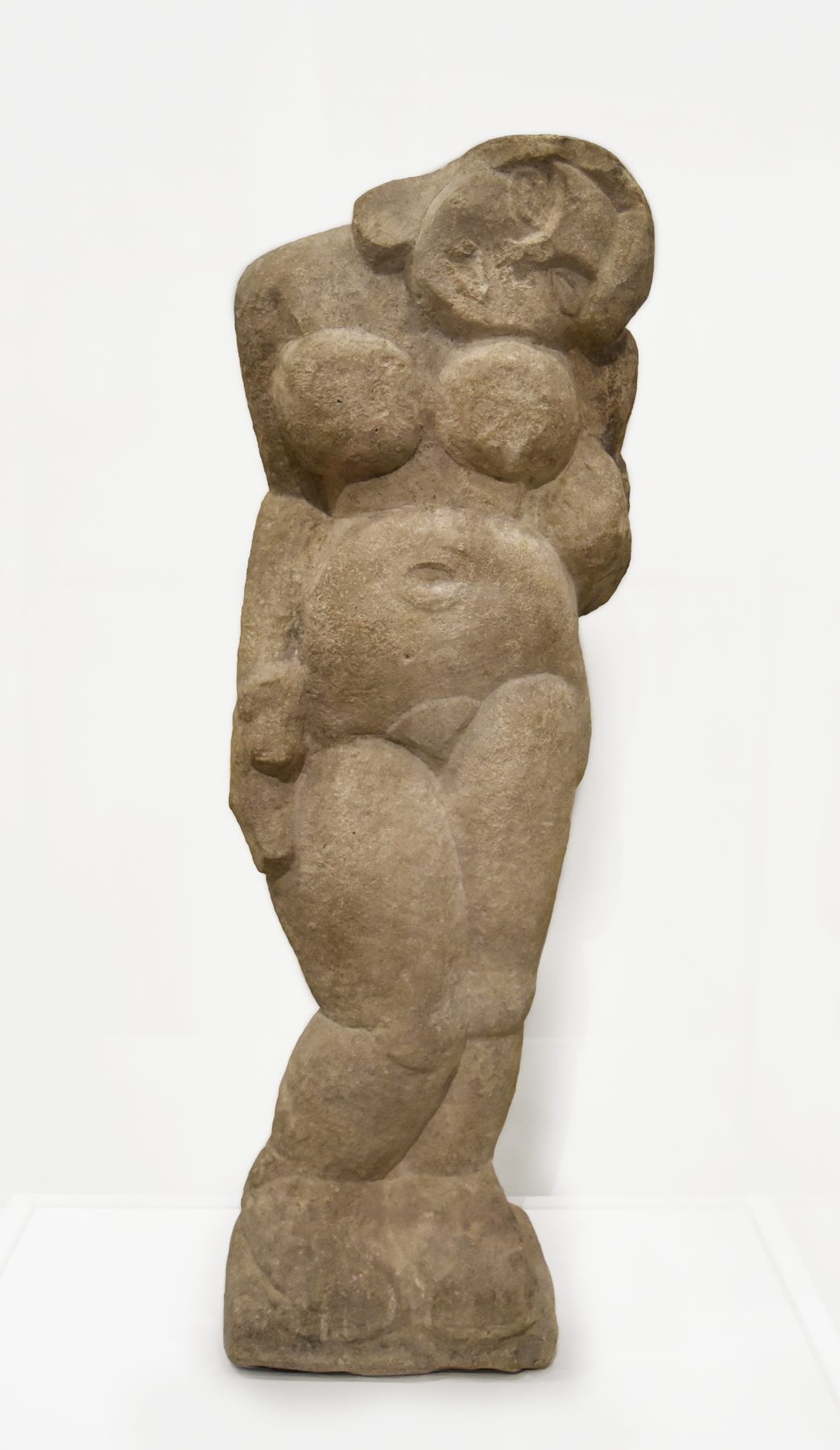
Standing Nude
André Derain, 1907
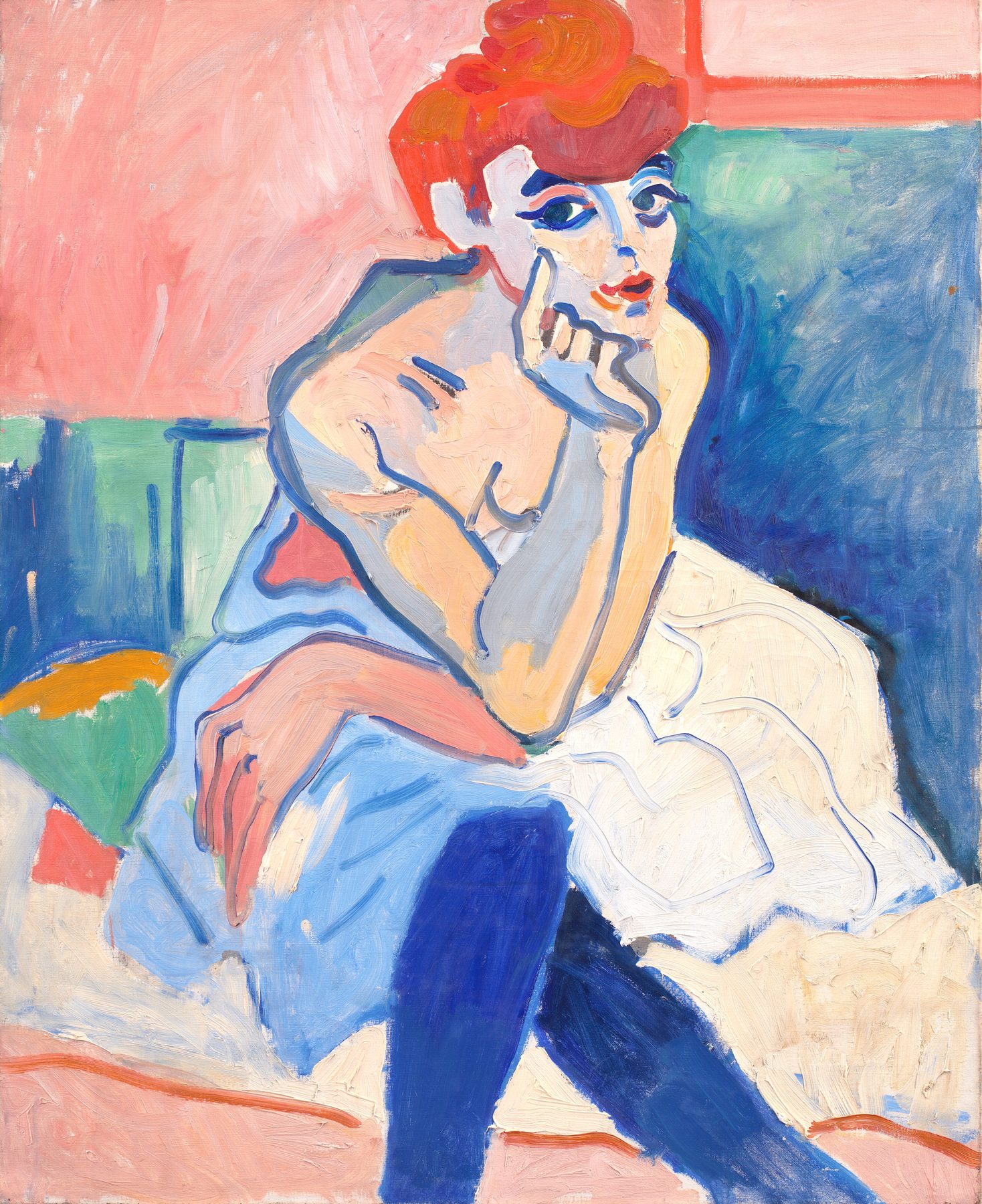
Woman in a Chemise
André Derain, 1906
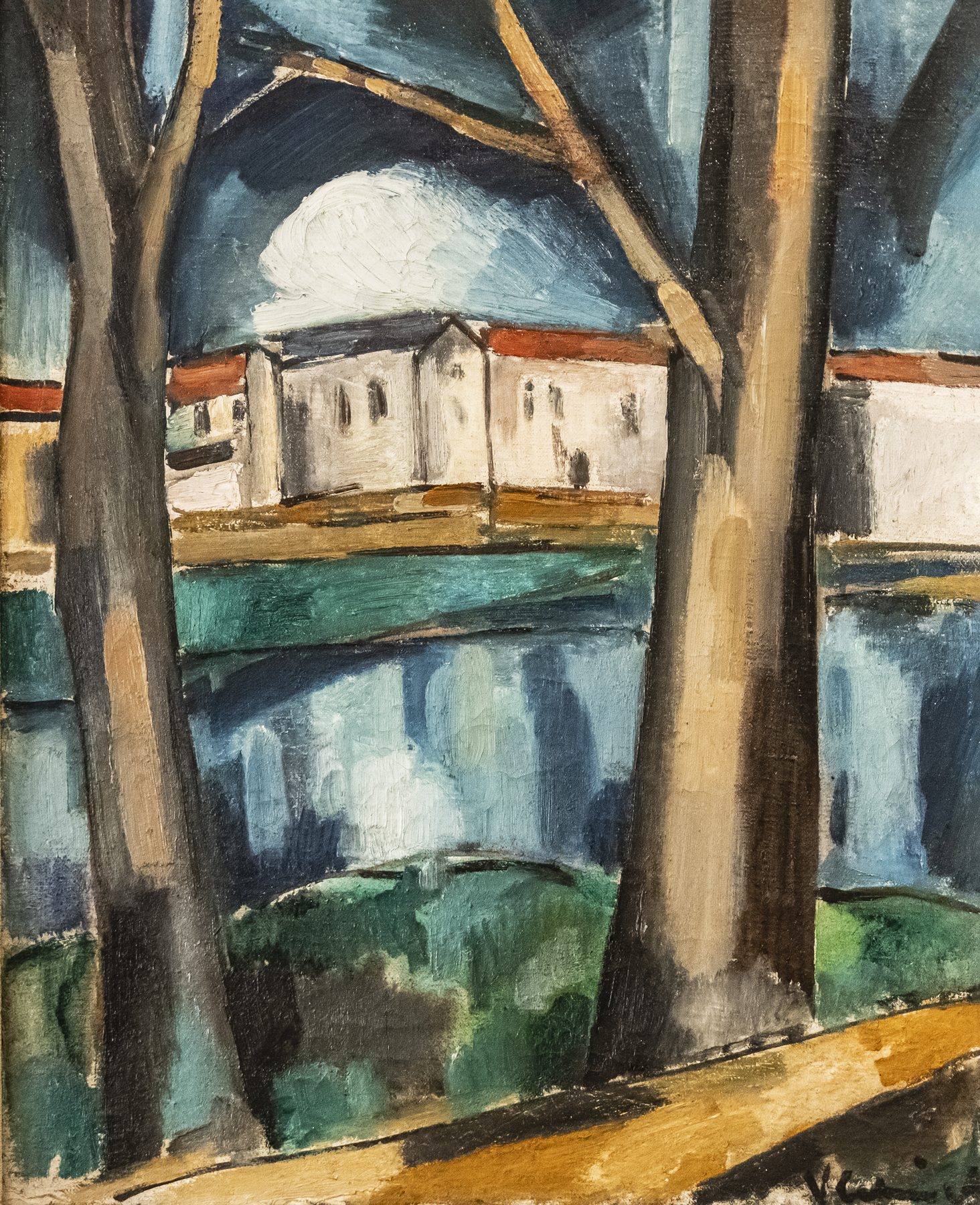
View of Chatou
Maurice de Vlaminck, c. 1907
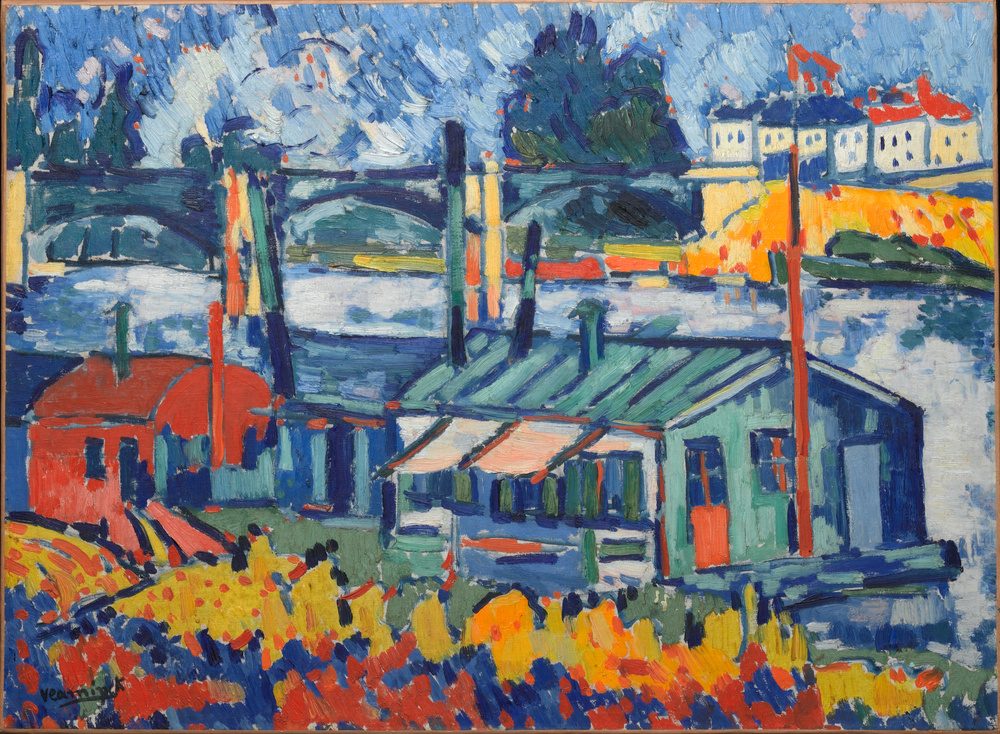
Pont de Chatou
Maurice de Vlaminck, c. 1905
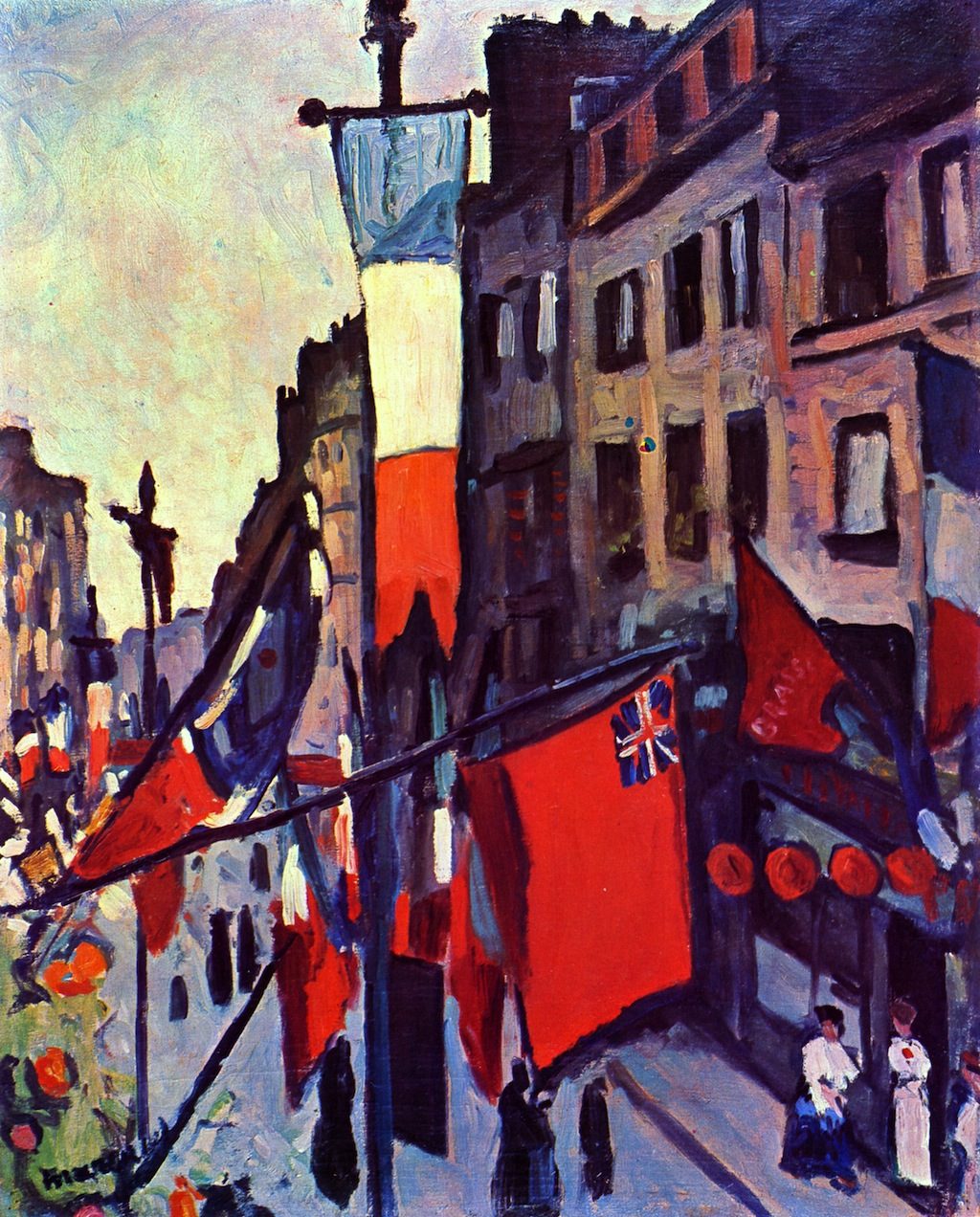
The Fourteenth of July at Le Havre
Albert Marquet, 1906
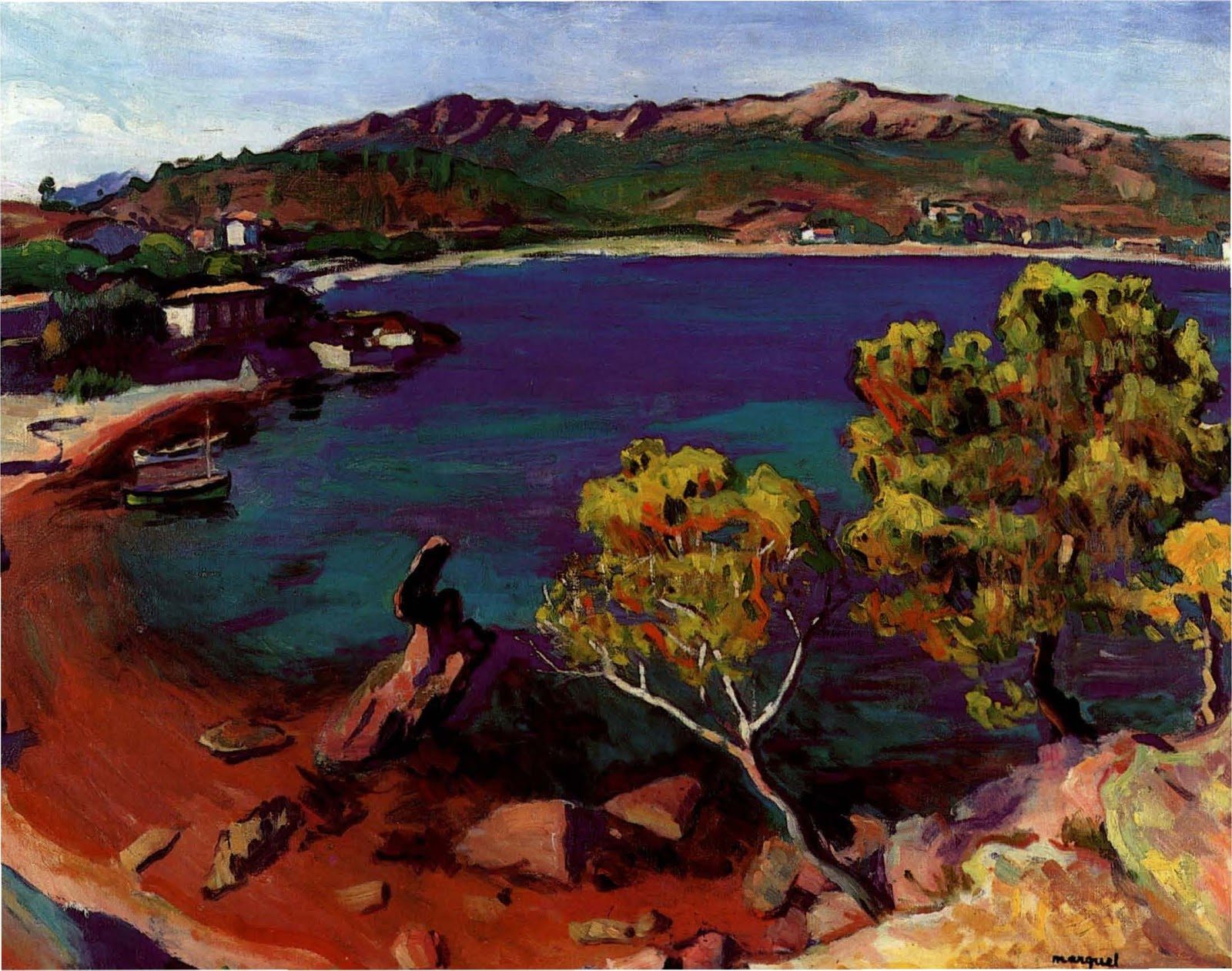
Landscape of the Midi
Albert Marquet, 1906
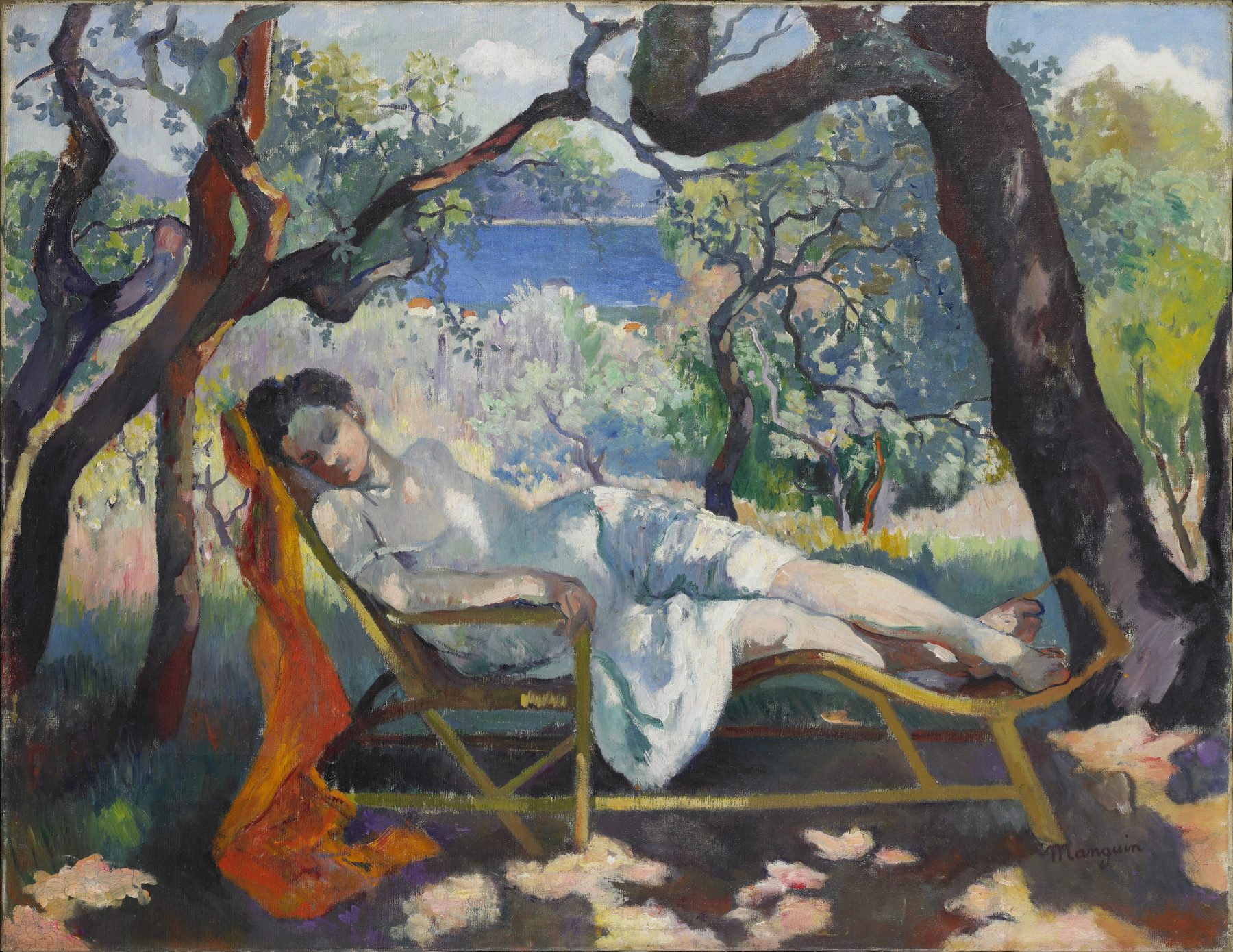
La Sieste (Jeanne at Rest)
Henri Manguin, 1905
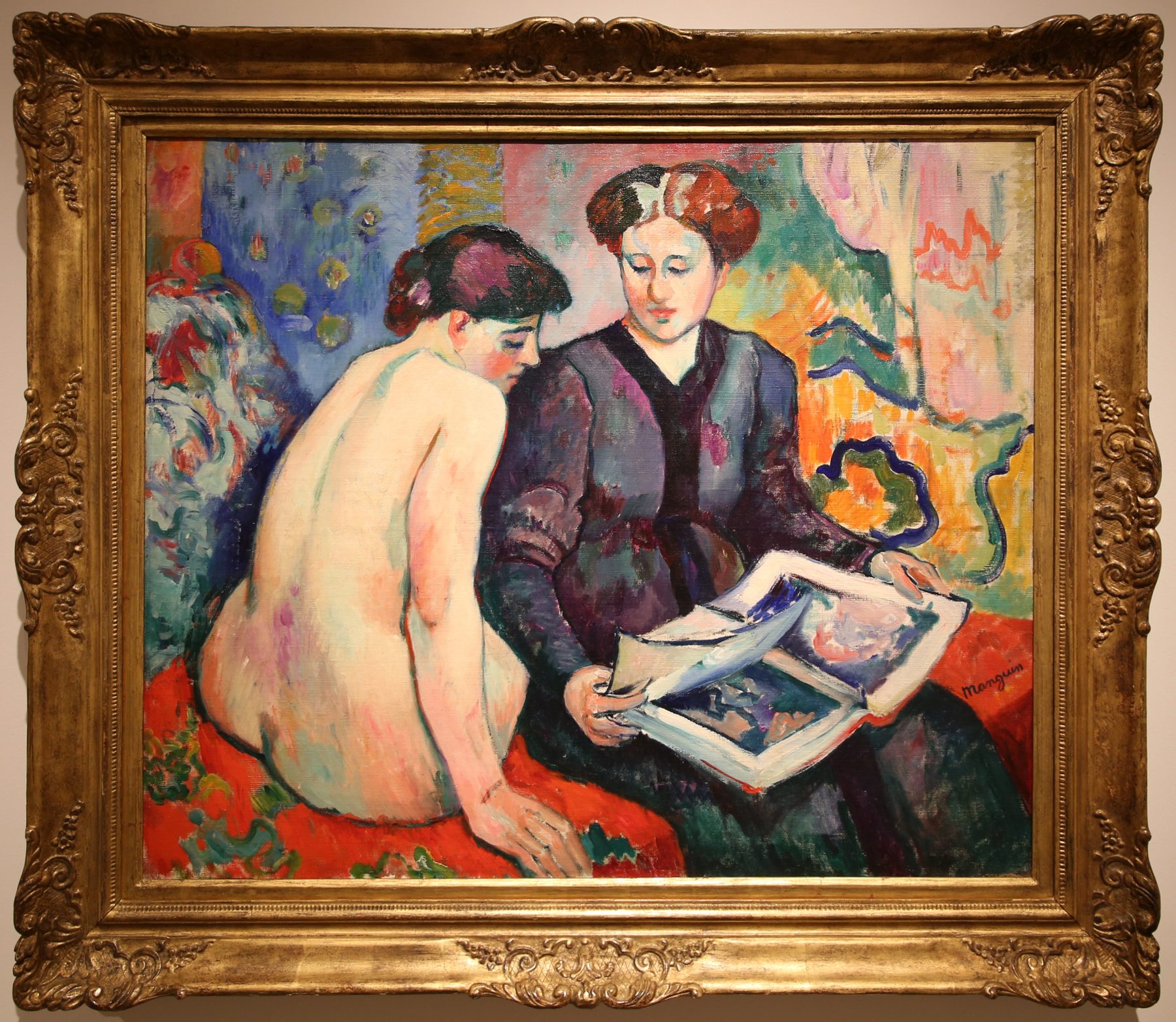
The Prints
Henri Manguin, 1905
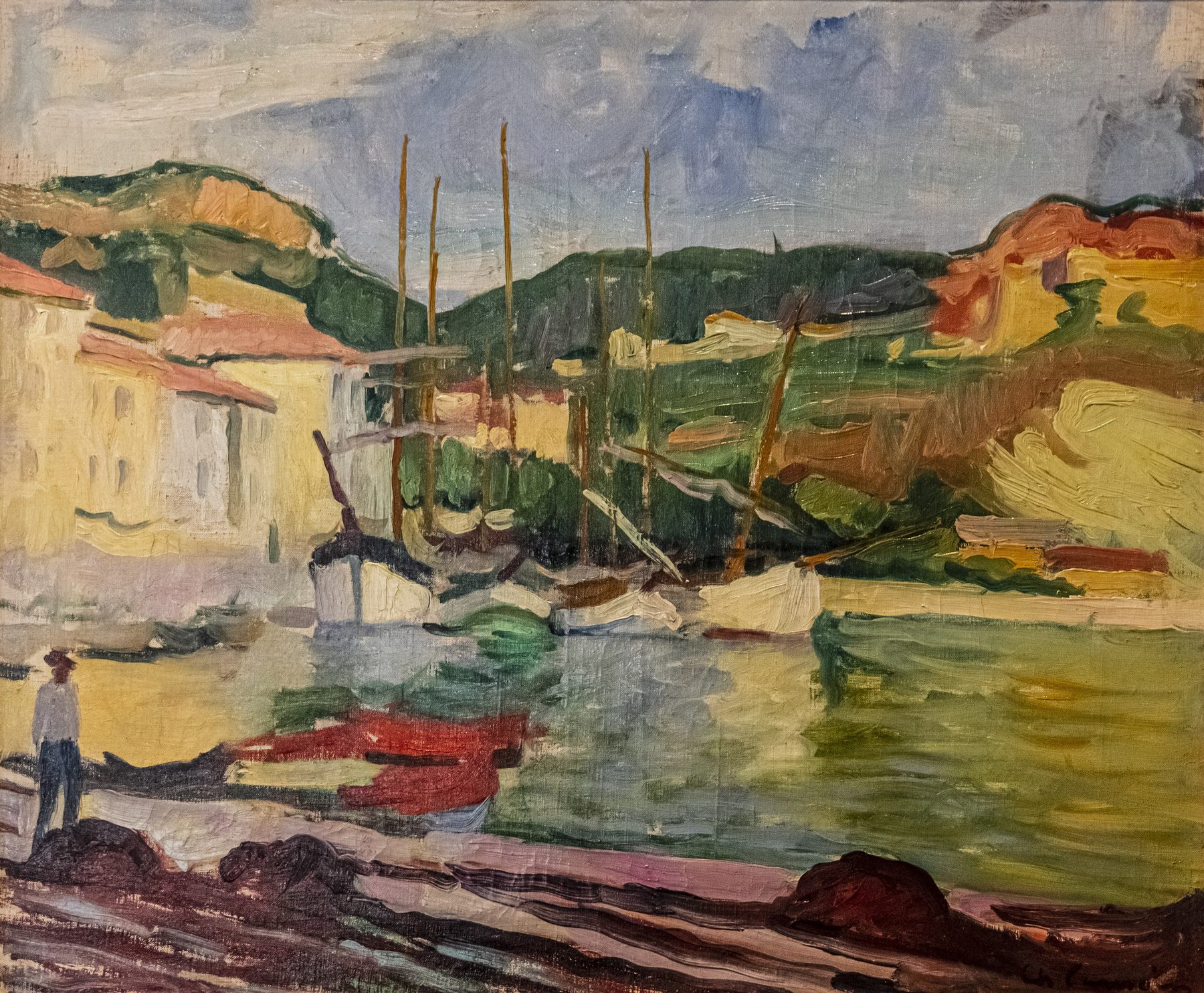
The Port of Cassis at Sunrise
Charles Camoin, 1905
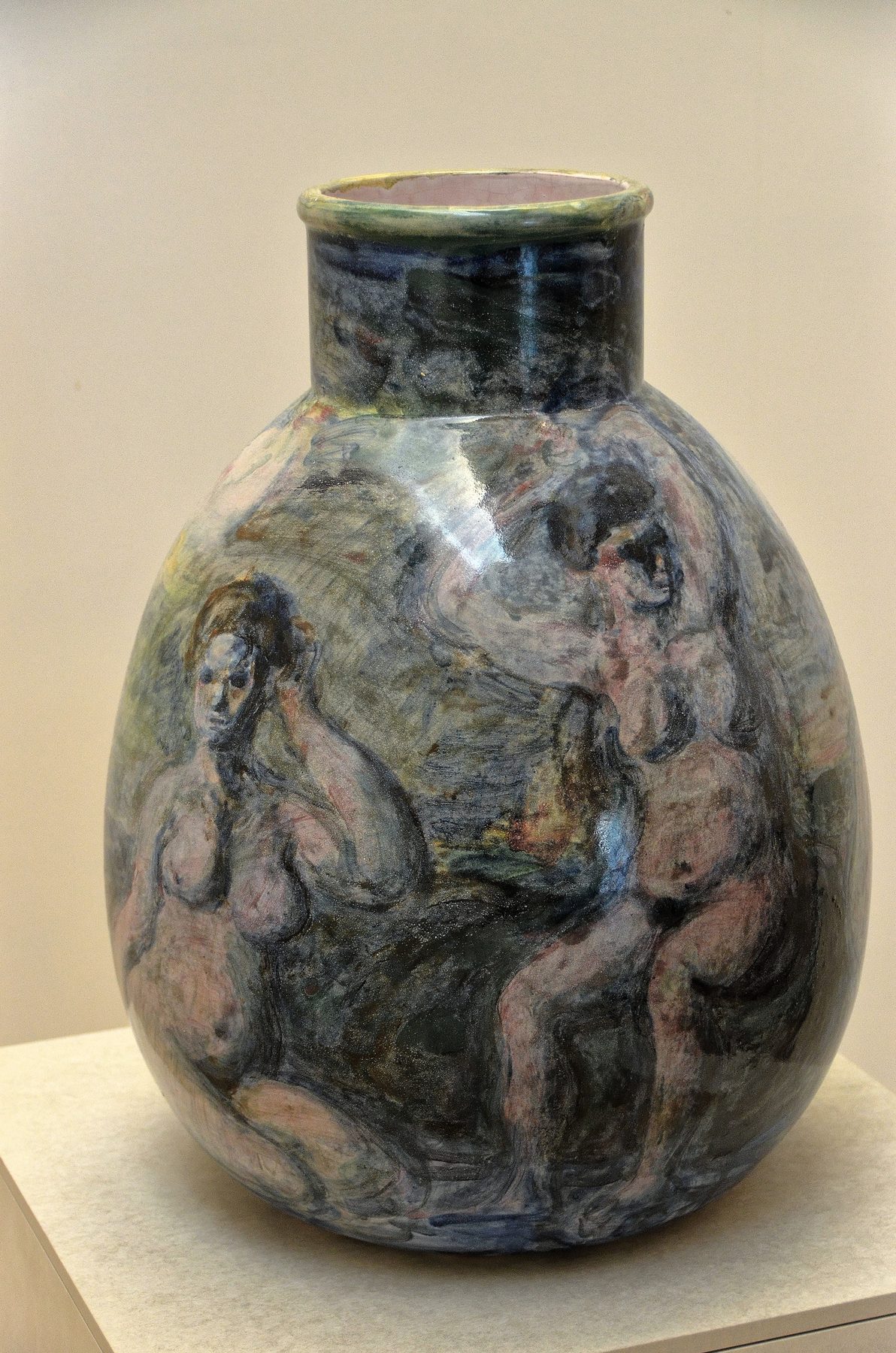
Vase: Four Women in a Landscape
Georges Rouault, c. 1907
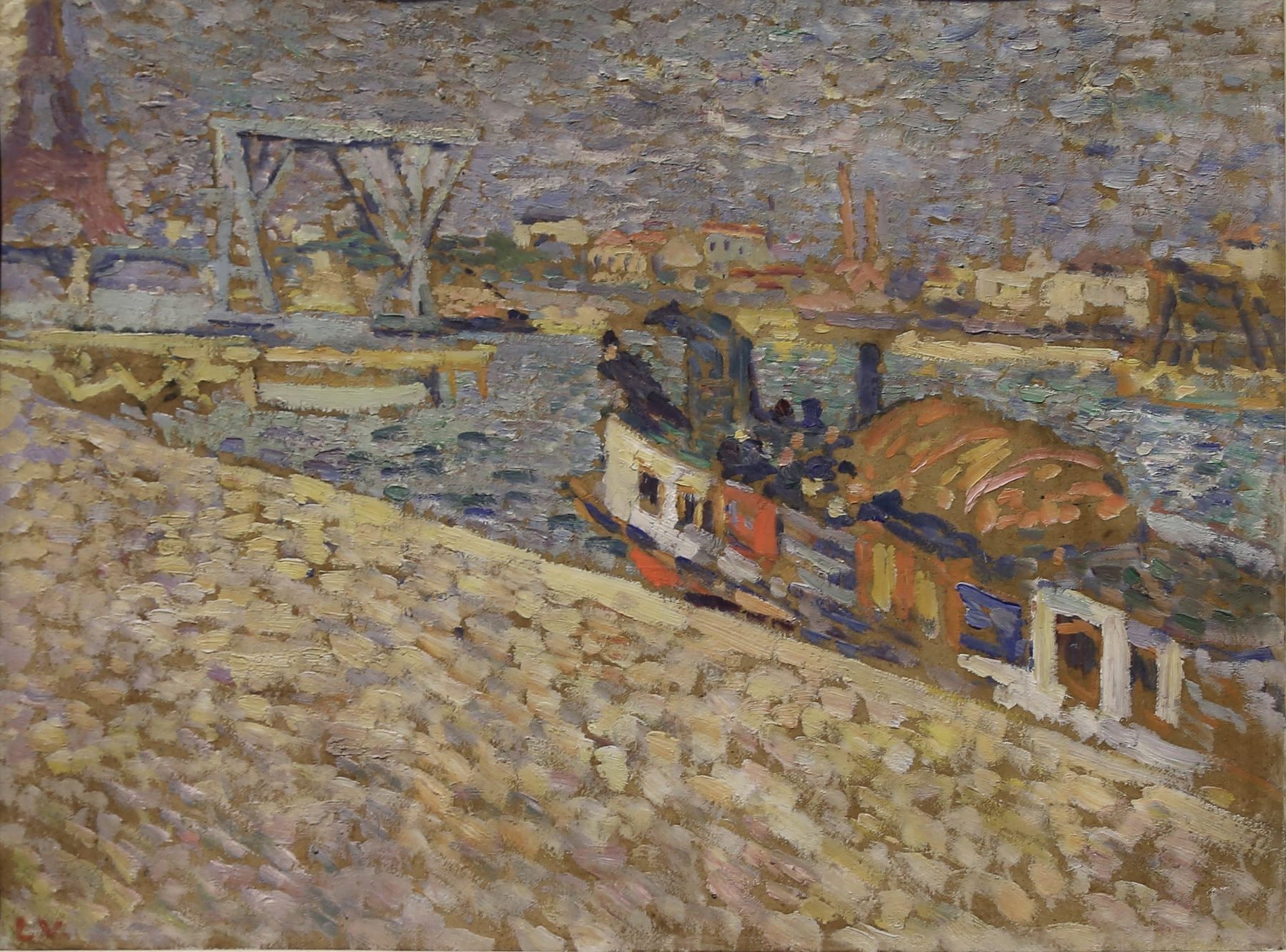
Le Bateau-Mouche
Louis Valtat, 1905
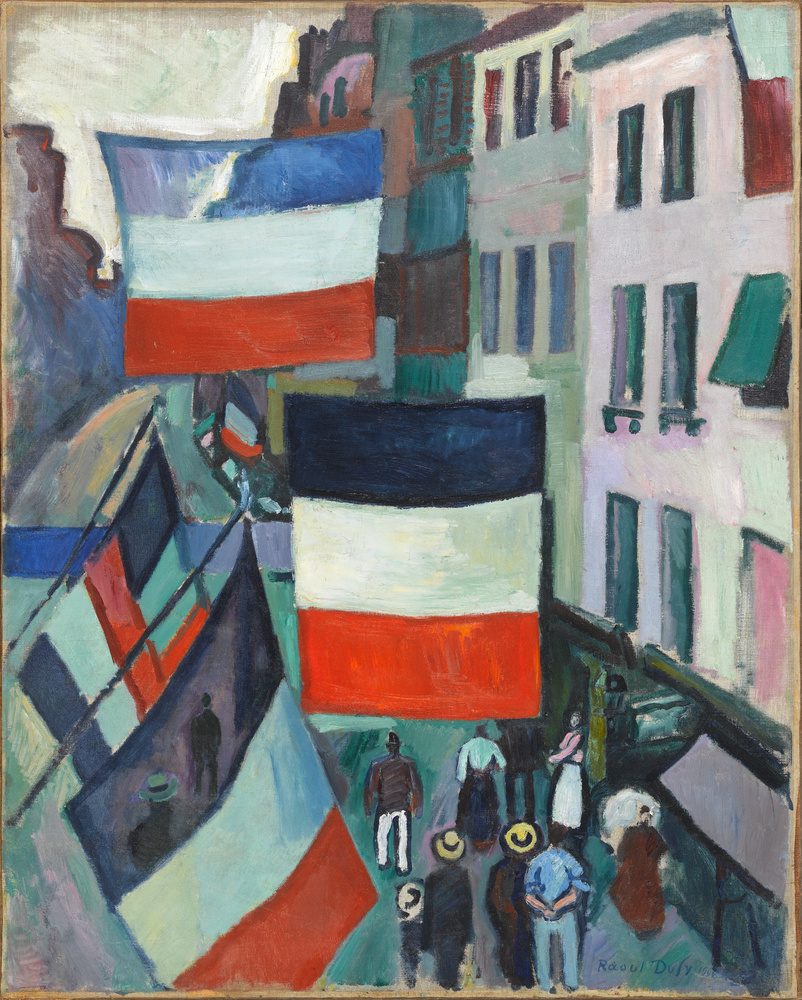
The Flag-Decorated Street
Raoul Dufy, 1906
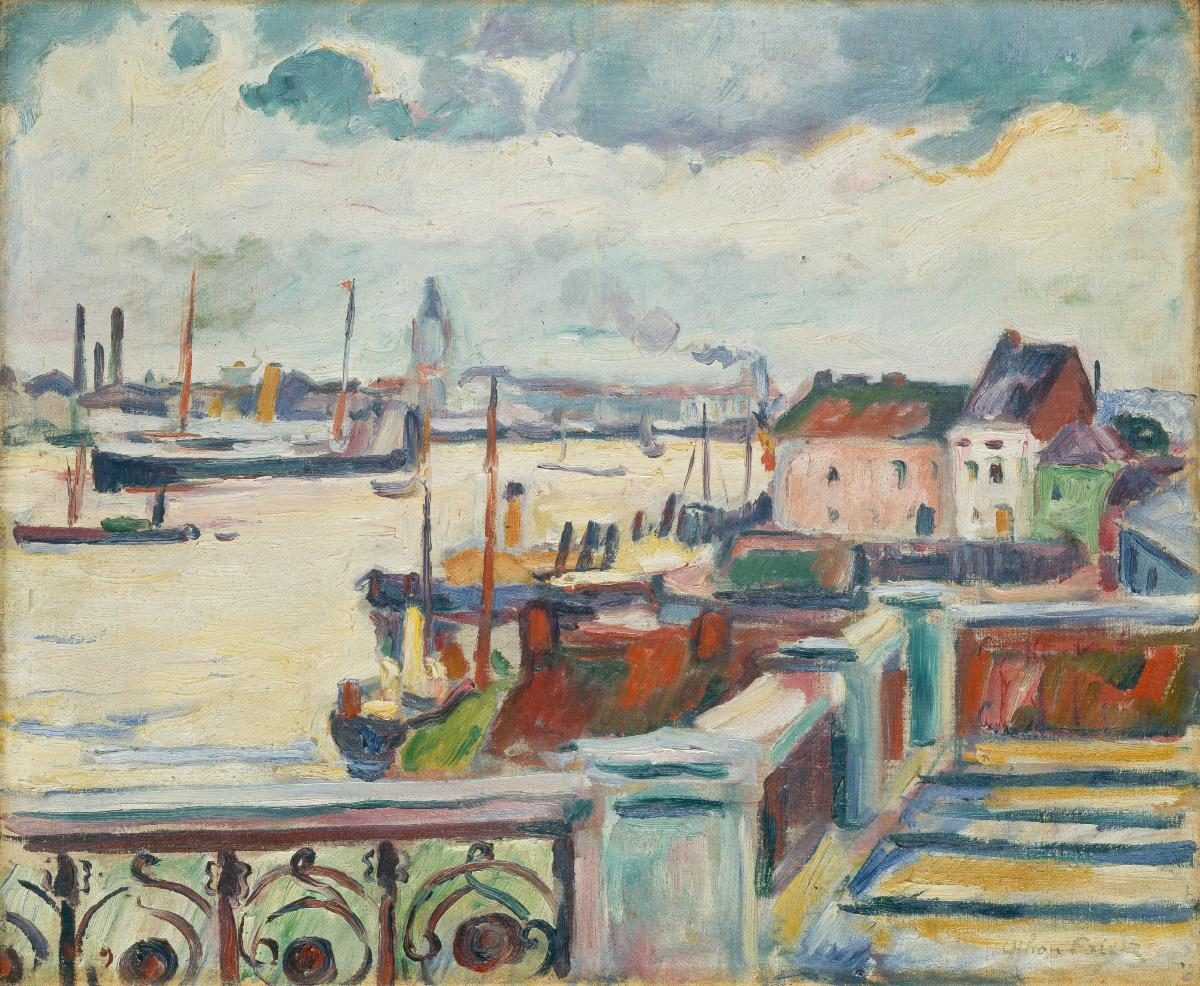
Port of Antwerp
Othon Friesz, 1906
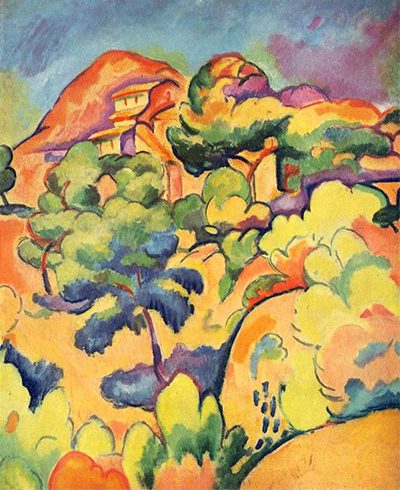
Landscape at La Ciotat
Georges Braque, 1907
Amélie Matisse: model, maker and organiser
The Collioure story depends on Amélie Matisse. Local models were difficult to find, especially for nude study, so she posed repeatedly for Matisse and Derain—in clothes, a patterned robe and, privately at early hours, without them. She appears across oils, watercolours and drawings. Her stillness made their rapid-looking experiments possible.[12] [14]
Her role extended beyond posing. Amélie managed family, household and business pressures during years when Matisse sold little. Her training and work in fashion and textiles contributed income and a material environment of hats, fabric, pattern and colour. The vast hat in Woman with a Hat was not a random studio prop; current research treats her as a maker with her own visual intelligence.[7] [17]
Calling her a muse is inadequate when it turns labour into passive inspiration. Her body, clothing, time and organisational work entered Fauvism's production. Recognising this does not transfer authorship of the canvases. It makes their conditions of authorship more accurate.
The scandal of Woman with a Hat
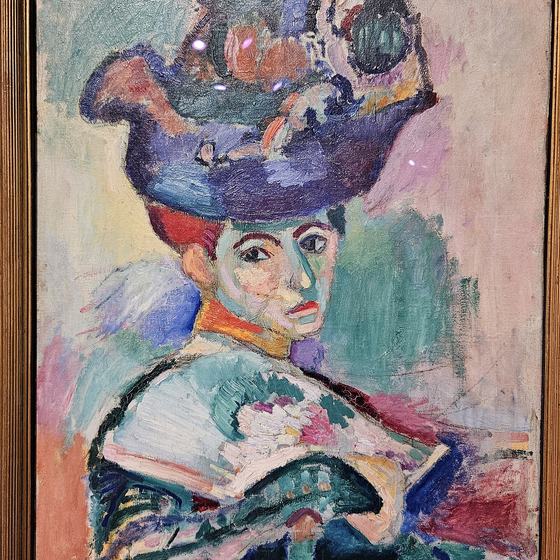
Matisse painted Woman with a Hat in 1905 and sent it to the Salon despite advice that its roughness might humiliate him. Amélie sits in three-quarter view holding a fan. Her enormous hat rises through strokes of blue, orange and green; her dress, gloves, chair and background barely separate through conventional contour. The portrait looked unfinished to viewers accustomed to modelled flesh and controlled surface.[16]
The face caused particular offence. Green crosses forehead and nose; yellow, mauve, pink and grey distribute planes that should, by academic convention, be joined through flesh-coloured transitions. These are not random substitutions. Cool and warm patches turn the head, establish the brim's shadow and connect face to surrounding paint. The sitter remains psychologically present while naturalistic likeness loses its monopoly.
Visible revisions add instability. Strokes seem to test one another rather than disappear beneath a final polish. That process is one reason a reproduction can domesticate the work: when reduced to a colourful icon, the struggle between portrait, material and revision becomes neat. Its original scandal involved not just hue but the refusal to hide painting's construction.
Leo and Gertrude Stein bought the picture on the Salon's last day. Leo described it as both powerful and a repellent smear, capturing how collecting can begin in disagreement rather than instant admiration. The purchase supplied money and validation while moving the painting into an apartment visited by an international circle. Controversy became a route to sustained visibility.[17] [47]
The green stripe and the whole surface
Matisse's Portrait of Madame Matisse: The Green Line, probably painted after Collioure in autumn 1905, is more compressed. Amélie's face fills the canvas. A green vertical divides it, with warmer flesh-red and yellow on one side and cooler pink and blue on the other. The stripe can read as shadow, central axis and an independent colour boundary at once.[18]
The painting demonstrates why “arbitrary colour” is only half a definition. Green may be nonlocal, yet its position is exact. Remove it and the head loses both division and unity. The orange-red background on one side and green on the other reverse the facial contrasts, locking figure and ground together. Fauve colour gains force through relation and proportion, not brightness alone.
Nor does colour abolish drawing. Contours around hair, brow and clothing remain firm. In many Fauve works line and hue compete: a dark boundary can stop a plane from dissolving, while a neighbouring colour can take over the work normally done by outline. Looking closely means following those negotiations.
Le Bonheur de vivre: colour becomes a world
Painted between late 1905 and spring 1906, Le Bonheur de vivre greatly expanded Fauvism's ambition. Its monumental landscape contains reclining nudes, lovers, musicians and a ring of dancers. The subject belongs to a long Arcadian tradition—an imagined golden age of harmony between humanity and nature—but Matisse refuses continuous Renaissance space.[19]
Yellow ground surrounds orange, pink and blue bodies. Trees bend as coloured contours, and figures alter scale without obeying distance. A pair in the foreground appears enormous beside a standing figure nearby; dancers at the centre form a compact emblem rather than a correctly receding group. The landscape is a stage of chromatic intervals.
This discontinuity is purposeful. Each figure carries a different rhythm of rest, embrace, music or dance. Curves repeat across bodies, branches and shoreline. Instead of natural depth unifying them, colour and line do. The canvas proposes pleasure as a constructed pictorial order, not a scene witnessed outdoors.
Its display at the 1906 Salon des Indépendants shocked even viewers prepared by the previous autumn. Leo and Gertrude Stein acquired it and installed it in their rue de Fleurus apartment. There it became a reference point for visitors including artists who did not accept Matisse's solution. Its later fame should not obscure the strange scale shifts and friction that still prevent the paradise from becoming merely decorative.[19] [22]
Vlaminck and the force of Chatou
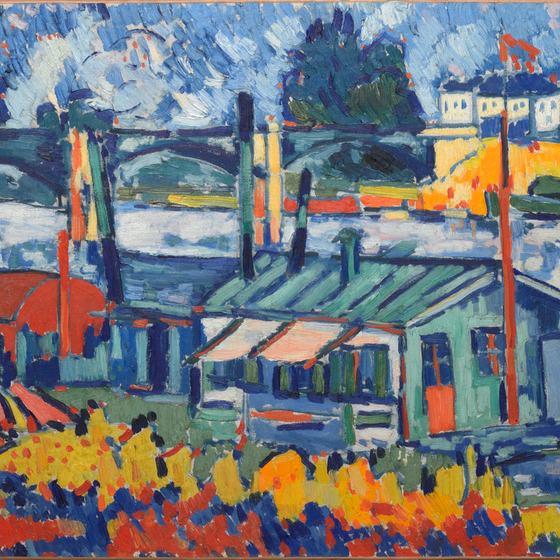
Vlaminck did not join Matisse and Derain in Collioure. He believed the light at Chatou could provide all he needed. This refusal helps prevent southern France from becoming the movement's only geography. His roads, riverbanks, barges and houses transform a modern suburb through red, blue, yellow and green pressure.[23]
In paintings such as Autumn Landscape and Tugboat on the Seine, Chatou, trunks or outlines can become dark scaffolds while short strokes churn around them. A road may rise sharply through the field, pulling the viewer forward. Industrial smoke, boats and river traffic coexist with trees. Fauvism here belongs to commuting, labour and metropolitan expansion, not an escape from modern life.[2] [25]
Vlaminck often applied paint more densely than Matisse's open Collioure surfaces. His Van Gogh-derived directional marks can make vegetation or sky appear compressed by internal force. Yet he was not a human embodiment of paint squeezed directly from a tube. His work depended on seeing exhibitions, arguing with Derain, showing at salons and accepting dealer support.
Ambroise Vollard visited Chatou and bought a large body of Vlaminck's work, then presented it in 1907. The transaction helped convert the painter's outlaw identity into a marketable artistic personality. Instinct and commerce were not opposites; each intensified the story told about the other.[24]
Derain in London
Vollard also commissioned Derain to paint London in 1906. Claude Monet's Thames pictures had already made fog, bridges and Parliament a modern French subject. Derain did not simply repaint them in brighter colours. He worked through sketches, return visits and memory, building roughly twenty-nine London canvases whose organisation varies markedly.[1] [27]
In Charing Cross Bridge or The Pool of London, the river can become a yellow field crossed by blue and green; red barges, black towers and curling smoke create traffic-like rhythm. High viewpoints compress distance. Where Monet dissolves architecture into atmosphere, Derain often makes colour bands compete with the city's solid engineering.
London exposes the weakness of explaining Fauvism as a direct response to Mediterranean sunshine. Grey weather, remembered motifs, a dealer's commission and an older artist's precedent all entered the pictures. Fauve colour could invent the experience of a modern city after the artist had left it.
Derain's practice was intellectually wide. He drew, carved, collected prints and objects, photographed and later returned to older European traditions. His early reputation as a wild colourist was real but incomplete. Even during the Fauve years, structural and archaic interests pulled against pure optical intensity.[31]
Artists to know
Henri Matisse
Matisse gave Fauvist colour its most searching pictorial authority. Portrait, interior, landscape and Arcadian figure painting became laboratories in which hue could build structure rather than merely describe appearances. [16] [20]
Georges Braque
Braque’s intense 1906–07 colour phase belongs fully to Fauvism even as Cézannist structure points toward Cubism. L’Estaque and La Ciotat reveal transition without reducing these works to preliminaries. [28] [30]
Major artists directory
| Name | Nationality | Key Works |
|---|---|---|
| Albert Marquet | French | The Fourteenth of July at Le Havre, Landscape of the Midi |
| André Derain | French | Mountains at Collioure, Charing Cross Bridge, Big Ben |
| Charles Camoin | French | The Port of Cassis at Sunrise, Mediterranean landscapes |
| Georges Braque | French | Landscape at La Ciotat, Olive Tree near L’Estaque, Landscape at L’Estaque |
| Georges Rouault | French | Vase: Four Women in a Landscape, Circus and religious paintings |
| Henri Manguin | French | La Sieste, The Prints |
| Henri Matisse | French | Woman with a Hat, Blue Nude: Memory of Biskra, Open Window, Collioure |
| Jacqueline Marval | French | The Odalisques, Women in interiors |
| Jean Puy | French | Leisure scenes, Landscapes |
| Kees van Dongen | Dutch-French | Woman with Large Hat, Paris nightlife portraits |
| Louis Valtat | French | Le Bateau-Mouche, Fauvist landscapes |
| Marie Laurencin | French | Group of Artists, Portraits and figure compositions |
| Maurice de Vlaminck | French | Pont de Chatou, View of Chatou, Autumn Landscape |
| Othon Friesz | French | Port of Antwerp, The Regatta at Antwerp |
| Raoul Dufy | French | The Flag-Decorated Street, Regatta scenes |
| Émilie Charmy | French | The Artist’s Bedroom, Landscapes and nudes |
A movement of uneven membership
The three central painters do not exhaust Fauvism. Albert Marquet's urban and coastal scenes often use decisive drawing and economical colour rather than dissonant saturation. Charles Camoin and Henri Manguin brought southern landscapes, portraits and interiors into the Salon network. Jean Puy combined high colour with figure and domestic subjects. Georges Rouault's heavy contours and moral seriousness place him near the group historically while distinguishing his aims.[1] [6]
Kees van Dongen added nightlife, fashion and sexualised metropolitan portraiture. Louis Valtat had used intense colour before the 1905 naming and complicates any origin fixed at Collioure. Jean Metzinger briefly made divided high-colour paintings before moving toward other experiments. The category expands when it tracks exchange, but loses value if every colourful French painting becomes Fauvist.
The Le Havre painters entered after encountering the 1905 work. Dufy, Friesz and Braque brought their own experience of Impressionist coastal sites. Dufy's colour gradually separated from graphic outline in a way that would sustain a long decorative career. Friesz often retained denser modelling. Their involvement shows the label attracting artists rather than defining a closed founding membership.[27] [28]
Even Matisse tried to police this informal boundary. Berthe Weill's support helped position Dufy as a Fauve against Matisse's reluctance to admit him to the circle. That disagreement is revealing: a movement without rules could still involve status, gatekeeping and competing narratives.[34]
Braque at L'Estaque
Braque came late to Fauvism and left early. In L'Estaque during 1906–07 he sought intense southern colour at a site already inseparable from Cézanne. The Large Trees uses a high horizon and climbing ground, but its greens, ochres and blues are more controlled than Derain's Collioure contrasts. Trees become heavy boundaries around compressed houses and rocks.[30]
At the Hôtel Mistral, Braque, Dufy, Friesz and Marquet worked from related terraces and gardens. Shared motifs allow differences to emerge. Braque increasingly locks the scene into interdependent volumes; colour remains strong, but structure tightens. Cézanne's death in 1906 and major 1907 retrospective sharpened this direction.[29]
By 1908 Braque's L'Estaque paintings had moved toward the faceted construction that led into Cubism. It is tempting to call the Fauve phase merely preparation, but that makes later art determine the value of earlier work. Colour taught Braque how to compress a landscape before muted planes reorganised that compression.
How Fauve paint works
There is no single material checklist. Some canvases retain pale or bare ground. Others carry dense, tactile paste. Marks may be separate and mosaic-like, broad and flat, streaked, stained or sharply outlined. One artist can change method inside a single picture. “Direct colour from the tube” describes a possibility, not a complete technique.[6] [7]
Five operations recur:
- Complement: reds beside greens or oranges against blues make both appear more intense.
- Substitution: a nonlocal hue replaces expected flesh, water or sky colour while preserving pictorial function.
- Construction: adjacent fields create volume or depth without smooth light-to-dark modelling.
- Rhythm: repeated colours lead the eye between separate objects and across open canvas.
- Material declaration: visible strokes and gaps insist that the scene is pigment on a support.
Colour does not carry a fixed emotional code. Blue is not always sad, red violent or green unnatural in the same way. Meaning arises from scale, placement, neighbouring hues and subject. Matisse's green stripe stabilises; Vlaminck's blue-black trunk blocks and redirects; Derain's yellow river opens an urban space.
Apparent spontaneity is another trap. Matisse revised laboriously to achieve what he later called “apparent simplicity.” Derain's correspondence records technical thought, and Salon submissions involved selection and strategy. A visible stroke can be fast without the painting being intellectually unplanned.[15] [21]
More than colourful landscapes
Harbours and roads dominate popular memory because they make chromatic transformation easy to demonstrate. Fauvism also addressed portraits, family rooms, still life, nightlife, nudes, theatre crowds and imagined antiquity. These subjects connect the movement to Belle Époque social life.[5]
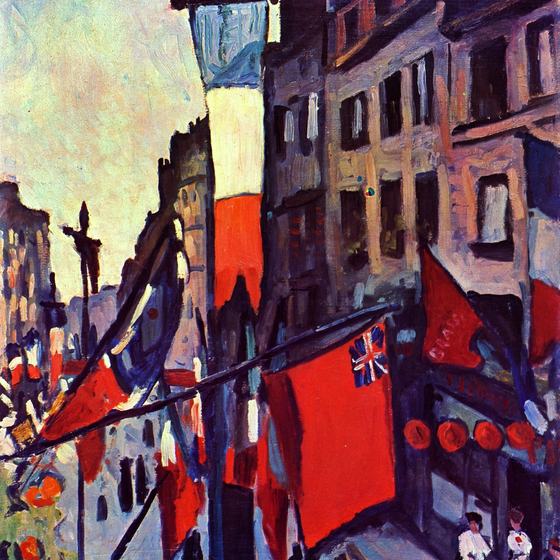
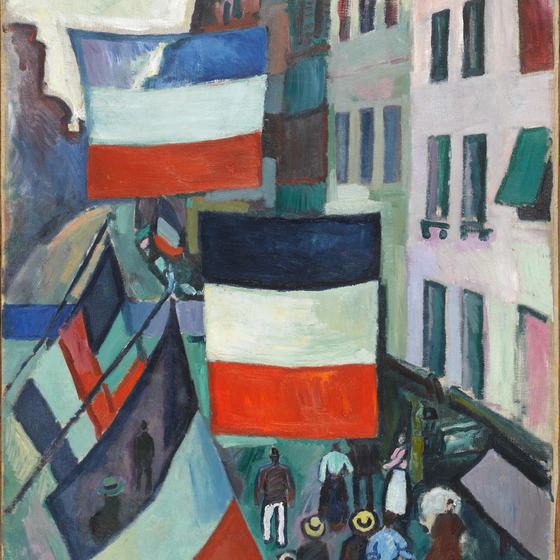
Kees van Dongen's urban figures relate colour to electric illumination, makeup and commodified spectacle. Manguin and Matisse painted family intimacy and sensual leisure. Marquet recorded posters, streets and ports. Dufy responded to flags and fashionable crowds. Their motifs belong to advertising, tourism, rail travel and an expanding urban audience as much as to timeless nature.
Modern mobility shaped the geography. Trains carried artists and middle-class travellers from Paris toward Normandy and the Mediterranean; steamships and rail networks connected London and French ports. Painters often revisited places already converted into artistic destinations by Impressionists and Cézanne. Fauvism renewed landscape inside a growing tourist economy rather than finding untouched territory.[7] [14]
The movement also crossed media. Matisse's large 1906 woodcut Nu de profil sur une chaise longue translates force into black cut marks and exposed paper. Without high-keyed pigment, broad contour, incision and contrast retain Fauve energy. Sculpture similarly became a way to test the body's weight and distortion.[44] [45]
Drawing, print and sculpture
Fauvism is usually reconstructed from oil paintings because colour made the movement publicly identifiable. Its artists, however, used drawing to decide how much visual information a form required. Matisse's ink lines could compress a face or body into a continuous contour; Derain's studies moved between observation, caricatural economy and the memory of older art. A sheet was not merely preparation for a more important canvas. It offered a separate test of speed, pressure, interval and omission.
Watercolour performed another kind of experiment. Its transparent washes made the white sheet an active light source and encouraged colours to remain separate. At Collioure, Matisse and Derain alternated among watercolour, drawing and oil rather than progressing neatly from sketch to finished picture. The exposed canvas of their oils can be understood partly through this traffic between media: unpainted support might separate two hues just as white paper keeps adjoining washes luminous.[11] [12]
Printmaking removed brilliant pigment but intensified the relation of solid and void. In a woodcut, the artist cuts away what will remain uninked; the block prints a reversed design, and every black passage declares physical contact between matrix, ink and paper. Matisse's reclining nude uses this constraint to make anatomy broad, abrupt and rhythmical. The result demonstrates that Fauve directness did not depend on a rainbow palette.[45]
Sculpture changed the problem again. A painted contour can flatten a body, whereas clay and carving force the artist to confront mass, turning and balance. Matisse repeatedly modelled figures while working on paintings, using one medium to disturb habits learned in another. Derain's sculpture drew on European, African and Oceanic objects without resolving them into a single source. The compressed torso and frontal stance of his carved figures should be read through that unequal field of encounter as well as through formal simplification.[39] [44]
These works also challenge the assumption that Fauvism had one signature appearance. Black ink, brown wood, white paper and modelled clay can carry related questions even when saturated colour is absent. What connects them is an economy of means, a willingness to expose process and a search for forms that remain convincing after conventional description has been removed.
Follow Fauvism through four stages
Several roads toward colour
Matisse’s work near Signac at Saint-Tropez and the separate Chatou partnership of Derain and Vlaminck bring divisionism, Van Gogh, Gauguin and Cézanne into new combinations.
Collioure and the Salon scandal
Matisse and Derain test colour, exposed ground and compressed space at Collioure before Gallery VII of the Salon d’Automne turns several connected careers into a public event.
A wider and uneven formation
Derain paints London, Vlaminck sustains Chatou, and artists from the Moreau and Le Havre circles adapt Fauvist colour to portraiture, ports, spectacle and domestic life.
–1908
Structure, sculpture and divergent futures
Braque and Friesz work in the south, Matisse turns toward monumental figure problems, and the loose formation separates into Cubist, classical, decorative and Expressionist futures.
Dealers, collectors and domestic display
Public scandal alone could not sustain an avant-garde. Dealers found buyers, organised small exhibitions and turned critical attention into careers. Berthe Weill had shown Matisse and other emerging artists before the 1905 Salon. Her gallery presented shifting combinations afterward and helped audiences see a formation rather than isolated provocations.[33]
Weill worked with limited resources and promoted unknown artists, including many women, while later dealer histories celebrated wealthier men. Vollard could purchase a painter's stock or commission a series; Weill's repeated small exhibitions created continuity. Both shaped Fauvism, but through different economic capacities and curatorial choices.[35]
The Stein family supplied another kind of infrastructure. Gertrude and Leo, and their brother Michael with his wife Sarah, bought pictures while they were still relatively inexpensive. Their Paris apartments opened on Saturdays to artists, writers and visitors. New work circulated through conversation before museums endorsed it.[46]
Sarah Stein became an especially committed student and advocate of Matisse. She and Michael collected his work, helped support the Académie Matisse and later carried their collection to California. Treating “the Steins” as a single patron erases differences of taste and labour within the family. It also hides how domestic hospitality became a medium of international art history.[48]
Russian collectors expanded the circuit further. Sergei Shchukin assembled major works by Matisse and Derain and later commissioned Matisse's Dance and Music. Those monumental panels lie beyond Fauvism's strict years, yet their radical colour grew from its experiments. Moscow display and later museum history helped make French modernism an international rather than solely Parisian story.[50]
Women around Fauvism
The conventional Fauve roll call is almost entirely male, but this does not mean women were absent from its world. Amélie Matisse's work as model, textile maker, household organiser and business partner has already appeared. Berthe Weill made a market. Sarah Stein learned, collected and taught others how to look. Women were active participants even where the title “artist” was withheld from them.
Women painters also worked through overlapping galleries and salons. Émilie Charmy entered Weill's circle and developed forceful colour in landscapes, interiors and the nude. Jacqueline Marval exhibited from 1901, knew Matisse, Marquet, Camoin and Rouault, and worked with Weill and Vollard. Her colour could be acidic and simplified without duplicating the pure-tone violence of Gallery VII.[36] [37]
Marie Laurencin moved in later Parisian circles and absorbed lessons from Fauve and Cubist colour while developing a distinct palette. Recent exhibitions include Charmy and Laurencin to expose gaps in the canon. That does not justify inserting them into the 1905 room or calling every work Fauvist. Precise adjacency is more valuable than honorary membership.[35]
The wild-beast metaphor contributed to their omission. Critics and later writers imagined innovation as masculine aggression, then described women as muses, companions or minor colourists. Restoring specific work—painting, dealing, textile design, hosting and accounting—shows that the movement's social production was wider than its branded brotherhood.
African and Oceanic arts: influence under empire
Around 1905–06, Vlaminck, Derain and Matisse began collecting or closely studying African and Oceanic objects. A Fang mask passed through Vlaminck's and Derain's collections. Derain wrote excitedly after seeing ethnographic displays at the British Museum and copied Māori objects. Matisse purchased a Vili figure from the present-day Democratic Republic of the Congo and showed it within his avant-garde circle.[38] [42]
These encounters helped make abstraction of the body, frontal presence and simplified volume available as modern artistic problems. Derain's carved Standing Nude joins African and Oceanic references to Cézanne's bathers and other forms of archaic sculpture. Matisse's figure work likewise moved between painting and sculpture.
The old umbrella term “primitivism” is now recognised as problematic. It compresses many cultures into an imagined stage before modernity. A Fang reliquary figure or mask was not invented as a formal exercise for a Paris studio; it belonged to an ancestral system with specific makers, materials and community functions. European artists normally selected appearance while disregarding those meanings.[40]
The route of access was also political. Objects entered Paris and London through colonial administrators, commercial ships, dealers and ethnographic museums. European ownership might be documented while African authorship vanished. Fauve innovation remains significant, but the story changes when the unequal system that made its sources available is included.[41]
This context prevents two opposite errors. Influence should not be denied because it complicates a heroic modernism, and African art should not be reduced to raw material for European achievement. The relevant history contains already sophisticated African abstraction, colonial displacement, modernist selection and later museum reinterpretation.
When did Fauvism end?
There was no meeting at which the Fauves dissolved. The years 1907–08 brought diverging choices. Cézanne's posthumous retrospective strengthened attention to mass and structure. Braque moved toward Cubism with Picasso. Derain reduced his palette and pursued archaic, classical and later realist forms. Vlaminck's landscapes darkened and became more Cézannist. Dufy found a graphic, decorative relation between line and colour.[26] [30]
Matisse did not abandon colour, but it is misleading to call his entire later career Fauvist. Blue Nude: Memory of Biskra of 1907 is a powerful boundary. Blue and green shadows still refuse naturalistic flesh, while the twisted reclining body carries sculptural weight. Matisse developed the pose through clay and painting, turning from the open light of Collioure toward a more monumental problem of figure and surface.[43] [44]
His 1908 “Notes of a Painter” looked back at the controversies while articulating a broader art of expression, balance and essential character. The essay is not a Fauve manifesto retroactively binding the group. It is Matisse explaining a personal practice as his work moved onward.[21] [22]
The short duration was productive. Because Fauvism had no bureaucracy to defend, artists could use it as an intense learning phase. Its ending does not prove failure; it shows colour opening problems that required different next steps.
Different futures after the Fauve moment
The central artists did not travel along a single evolutionary road. Matisse made colour, pattern and pictorial balance the basis of a career extending for nearly half a century. Interiors, odalisques, mural commissions and late paper cut-outs transformed rather than repeated the solutions of 1905. Calling all of this work Fauvist would make the term so broad that it ceased to explain change.[21] [32]
Derain's trajectory was more visibly discontinuous. After the London series and his intense engagement with African and Oceanic objects, he restricted his colours and revisited Cézanne, early Italian painting and classical figure traditions. His later realism once looked like a betrayal of modernism because histories were written as a march toward abstraction. A less teleological view treats it as an argument with the very freedom Fauvism had opened: how might modern painting recover gravity, craft and historical memory without simply returning to academic convention?[31]
Vlaminck likewise moved toward darker landscapes and more substantial modelling. His later self-mythology continued to sell the personality of the rebellious Fauve even when the paintings no longer resembled his high-colour Chatou work. Biography, market identity and style therefore changed at different speeds.
Marquet retained an economical relation between line, tone and open surface, especially in views of ports and cities. Dufy developed bright fields held by agile graphic contours across painting, textiles and large decorative projects. Rouault's stained-glass-like boundaries served religious compassion and social judgement. Braque's structural compression fed Cubism. These divergent futures show why Fauvism is best understood as a concentrated intersection. It supplied durable resources, but no obligation to preserve the look of Gallery VII.
Fauvism and Expressionism
Fauvism and German Expressionism developed at approximately the same time. Die Brücke formed in Dresden in 1905, and its artists also pursued intensified colour, simplified bodies, printmaking and anti-academic freedom. French works were exhibited, reproduced and collected in Germany. Matisse, Derain and Vlaminck became important examples for Kirchner, Heckel, Schmidt-Rottluff, Kandinsky, Jawlensky and others.[49]
Influence does not make the movements identical. Brücke had a more explicit group structure and a powerful woodcut culture. German and Russian artists combined French colour with Munch, local traditions, metropolitan anxiety, inwardness and different social networks. Fauve harmony could be adapted toward greater psychological or spiritual tension, though neither French serenity nor German anguish was absolute.[26]
Kees van Dongen provided personal connections between French and German circles. Kandinsky and Jawlensky encountered Fauve work in Paris and transformed high colour around Murnau. Museum Folkwang founder Karl Ernst Osthaus collected French and German modernists early, allowing influence to operate through actual display rather than an abstract chain of styles.[49]
Fauvism's longer legacy
The movement's deepest achievement was to make relational colour credible as an independent constructor of pictorial experience. A face could remain a face after green replaced brown shadow. A river could hold space when yellow opposed blue. A landscape could be built from intervals that declared their material existence.[18]
Expressionism, Orphism and abstraction extended that freedom in different directions. Later painters found permission in Matisse's whole-surface balance, Vlaminck's pressure or Derain's chromatic architecture. Yet not every vivid palette descends neatly from Fauvism. Artists across many cultures had used non-naturalistic colour long before 1905, and twentieth-century colour developed through multiple technical and intellectual histories.
The canon itself has continued to change. Mid-century exhibitions fixed a familiar list of male painters and iconic canvases. Recent research examines dealers, models, women artists, mass culture, colonial collecting and the differences within the group. This expansion does not dilute formal analysis. It explains why these surfaces appeared, who made their careers possible and what their freedom cost or concealed.[5] [35]
How to recognise and look at Fauvist art
Start with documentation rather than colour alone. A bright painting from 1906 is not automatically Fauvist. Check the artist, date, exhibition network and relation to Paris, Chatou, Collioure, Le Havre or the other working sites.
Then use six questions:
- What does colour do? Follow how one hue changes its neighbour, models a face, opens distance or repeats across the surface.
- Where is the canvas visible? Pale gaps may function as light, breath or structural separation.
- How are line and colour divided? A contour may contain a plane, conflict with it or arrive after the colour.
- What remains from the motif? Boats, roads, hats and bodies anchor experiment even when local colour disappears.
- How is modern life present? Look for tourism, ports, posters, industry, fashion, nightlife and rail-accessible leisure.
- Who made the encounter possible? Models, family, dealers, collectors and colonial collections belong to the object's history.
Do not judge success by maximum saturation. Marquet can be Fauve-adjacent through economical structure; Braque's muted L'Estaque work can reveal the movement's transition; a black-and-white Matisse woodcut can preserve its physical directness. The relevant freedom lies in reorganising representation, not meeting a brightness quota.
Where to see Fauvism
Paris remains central. The Centre Pompidou holds major works by Matisse, Derain, Vlaminck and related artists; the Musée d'Art Moderne and Musée de l'Orangerie add important collections and historical contexts. In southern France, Collioure preserves the landscape of the 1905 partnership, while the Matisse museums at Nice and Le Cateau-Cambrésis place Fauvism inside a much longer career.
Outside France, SFMOMA's Woman with a Hat, Copenhagen's Green Line and the Barnes Foundation's Le Bonheur de vivre create an exceptional three-work route through portrait, colour structure and monumental Arcadia. The Metropolitan Museum and MoMA in New York, National Gallery of Art in Washington, Kunstmuseum Basel and Museum Folkwang in Essen hold or study major paintings and networks. Their dispersed locations are part of the history of collectors who internationalised the movement.[16] [19]
Where to see Fauvism
Centre Pompidou
Paris, France
Major paintings by Matisse, Derain, Vlaminck and their wider circle, together with documentary material on French modernism.
Musée d’Art Moderne de Paris
Paris, France
A strong route into Fauvist painting and its place within the Paris avant-garde.
Musée de l’Orangerie
Paris, France
The Walter-Guillaume collection places major Fauvist and related works within the collecting history of modern French painting.
Musée Matisse Nice
Nice, France
Matisse’s Fauvist breakthrough appears within the full arc of his long career and his sustained engagement with colour.
Musée Matisse Le Cateau-Cambrésis
Le Cateau-Cambrésis, France
A substantial Matisse collection in the artist’s birthplace, including painting, drawing, sculpture and print.
San Francisco Museum of Modern Art
San Francisco, USA
Home of Woman with a Hat, one of the defining pictures of the 1905 Salon scandal.
Statens Museum for Kunst
Copenhagen, Denmark
Holds The Green Line and other works that make Matisse’s portrait colour especially clear.
Barnes Foundation
Philadelphia, USA
Le Bonheur de vivre provides an exceptional encounter with Fauvist colour on an ambitious Arcadian scale.
Museum of Modern Art
New York, USA
Important Fauvist works by Matisse, Vlaminck, Braque and Derain, plus the landmark 1976 catalogue.
Museum Folkwang
Essen, Germany
An important collection for following the exchange between French colour and German Expressionism.
Past exhibitions
Third Salon d’Automne, Gallery VII
Grand Palais, Paris
The juried exhibition whose hanging and critical reception produced the name “Fauves.”
The “Wild Beasts”: Fauvism and Its Affinities
Museum of Modern Art, New York
A landmark survey and catalogue that established a durable chronology, membership map and field of comparison.
Matisse, Derain and Friends
Kunstmuseum Basel
A major reassessment of the Paris avant-garde from 1904 to 1908, expanding the story through gender, mobility and the art market.
Vertigo of Color: Matisse, Derain, and the Origins of Fauvism
Metropolitan Museum of Art, New York
A focused reconstruction of the 1905 Collioure partnership through paintings, drawings and watercolours.
Frequently Asked Questions
Fauvism is the name given to a loose group of early twentieth-century painters who used non-naturalistic colour, visible brushwork and simplified form to reconstruct rather than imitate visual experience.
Approximately 1904–1908 is a practical range. The 1905 Salon d'Automne supplied the name, while individual artists moved in different directions by 1907–08.
No one formally founded it. Matisse, Derain and Vlaminck are its central figures; the wider formation emerged through several existing circles and exhibitions.
Critic Louis Vauxcelles compared Renaissance-like sculpture by Albert Marque with “Donatello among the wild beasts” when reviewing Gallery VII at the 1905 Salon d'Automne.[3]
They sometimes used strong, relatively unmixed pigment, but methods varied. Thin stains, exposed canvas, divided strokes, outlines and dense impasto can all appear.
No. It may depart from observed colour, but its placement builds light, form, rhythm and balance. The green in Matisse's portraits is structurally exact even when it is not literal flesh colour.
No. The artists painted portraits, interiors, still lifes, nudes, nightlife, family scenes, ports, streets and imaginary Arcadian compositions as well as landscapes.
No. They overlapped chronologically and exchanged ideas, especially about colour and distortion, but their groups, local contexts and artistic priorities differed.[49]
Yes, briefly. His 1906–07 L'Estaque landscapes belong to his Fauve phase, though Cézannist structure already points toward the Cubism he soon developed.
Women such as Émilie Charmy and Jacqueline Marval made related work in overlapping networks, but the category requires care. Women also shaped Fauvism decisively as models, makers, dealers and collectors.[36]
It was an experimental convergence rather than a permanent institution. Cézanne, Cubism, sculpture and individual ambitions opened different routes, while colour remained central to many later careers.
Discussion
Which Fauve painting most clearly demonstrates that colour can build rather than merely decorate? Does knowing Amélie Matisse's labour change how you see her portraits? Where should a museum draw the boundary between a Fauvist, an adjacent painter and an artist influenced by the movement? And can the freedom of these paintings be celebrated fully without also explaining the dealers, gender structures and colonial collections that helped produce their history?
Reader Insights
A bright picture from 1906 is not automatically Fauvist. Check the artist, date, exhibition network and relation to Paris, Chatou, Collioure, Le Havre or the other working sites.
Ask what each hue does: builds light, models a face, opens distance, repeats a rhythm or changes the colours touching it.
Models, family, dealers, collectors and colonial collections belong to the history of these surfaces as surely as pigment and brushwork.
Join the Conversation
Which Fauvist painting most clearly demonstrates that colour can build rather than merely decorate—and where should the movement’s boundaries be drawn?
References
- “Fauvism,” Metropolitan Museum of Art, metmuseum.org. View Source
- “Fauvism,” National Gallery of Art, Washington, nga.gov. View Source
- “Fauve,” National Gallery, London, nationalgallery.org.uk. View Source
- “Fauvism,” Museum of Modern Art, moma.org. View Source
- “Matisse, Derain und ihre Freunde,” Kunstmuseum Basel, (German; consulted in German). View Source
- Matisse, Derain and Friends gallery booklet, Kunstmuseum Basel, kunstmuseumbasel.ch. View Source
- “Matisse, Derain und ihre Freunde” media release, Kunstmuseum Basel, (German; consulted in German). View Source
- “Le fauvisme et ses influences sur l’art moderne,” Centre Pompidou, (French; consulted in French). View Source
- L’heure fauve, Centre Pompidou, (French; consulted in French). View Source
- “Henri Matisse,” Centre Pompidou, (French; consulted in French). View Source
- “Vertigo of Color” exhibition tour, Metropolitan Museum of Art, metmuseum.org. View Source
- “Vertigo of Color” visiting guide, Metropolitan Museum of Art, metmuseum.org. View Source
- “André Derain: Fishing Boats, Collioure,” Metropolitan Museum of Art, metmuseum.org. View Source
- “Collioure in Color,” Metropolitan Museum of Art, metmuseum.org. View Source
- “Le Faubourg de Collioure,” Centre Pompidou, (French; consulted in French). View Source
- “Femme au chapeau (Woman with a Hat),” San Francisco Museum of Modern Art, sfmoma.org. View Source
- “Matisse's Femme au chapeau: From Scandal to Icon,” San Francisco Museum of Modern Art, sfmoma.org. View Source
- “Portrait of Madame Matisse: The Green Line,” Statens Museum for Kunst, open.smk.dk. View Source
- “Le Bonheur de vivre (The Joy of Life),” Barnes Foundation, collection.barnesfoundation.org. View Source
- “Henri Matisse (1869–1954),” Metropolitan Museum of Art, metmuseum.org. View Source
- “Henri Matisse,” Museum of Modern Art, moma.org. View Source
- “Exhibition Themes: Matisse, Radical Invention,” Art Institute of Chicago, archive.artic.edu. View Source
- “Les Coteaux de Rueil,” Centre Pompidou, (French; consulted in French). View Source
- “Une rue de Marly-le-Roi,” Centre Pompidou, (French; consulted in French). View Source
- “Maurice de Vlaminck: Autumn Landscape,” Museum of Modern Art, moma.org. View Source
- The “Wild Beasts”: Fauvism and Its Affinities, Museum of Modern Art, moma.org. View Source
- Les Fauves exhibition catalogue, Museum of Modern Art, assets.moma.org. View Source
- “Braque–Laurens: A Dialogue,” Centre Pompidou, (French; consulted in French). View Source
- “Georges Braque's The Terrace at the Hôtel Mistral,” Metropolitan Museum of Art, metmuseum.org. View Source
- “Georges Braque: The Large Trees, L'Estaque,” Museum of Modern Art, moma.org. View Source
- “André Derain,” Musée de l'Orangerie, (French; consulted in French). View Source
- “Henri Matisse,” Musée de l'Orangerie, (French; consulted in French). View Source
- “Berthe Weill, galeriste d'avant-garde,” Musée de l'Orangerie, (French; consulted in French). View Source
- “Berthe Weill: Gallery Owner of the Avant-Garde,” Musée de l'Orangerie, musee-orangerie.fr. View Source
- “Matisse, Derain and Friends,” Kunstmuseum Basel, kunstmuseumbasel.ch. View Source
- “Marval Jacqueline,” French Ministry of Culture, (French; consulted in French). View Source
- “Nu étendu,” Musée Paul Dini, (French; consulted in French). View Source
- “Etude pour Luxe I,” Centre Pompidou, (French; consulted in French). View Source
- André Derain sculpture guide, Centre Pompidou, (French; consulted in French). View Source
- “African Influences in Modern Art,” Metropolitan Museum of Art, metmuseum.org. View Source
- “African Art, New York, and the Avant-Garde,” Metropolitan Museum of Art, metmuseum.org. View Source
- “Masque Fang,” Centre Pompidou, centrepompidou.fr. View Source
- “Henri Matisse: A Retrospective,” Museum of Modern Art, moma.org. View Source
- The Sculpture of Matisse, Museum of Modern Art, moma.org. View Source
- “What is print?,” Victoria and Albert Museum, vam.ac.uk. View Source
- “The Steins Collect: About the Exhibition,” Metropolitan Museum of Art, metmuseum.org. View Source
- “The Steins Collect” research summary, Metropolitan Museum of Art, metmuseum.org. View Source
- “Sarah Stein,” San Francisco Museum of Modern Art, sfmoma.org. View Source
- “The Ecstasy of Colour,” Museum Folkwang, museum-folkwang.de. View Source
- The Unknown Shchukin: More Than Modern Art, Pushkin State Museum of Fine Arts, pushkinmuseum.art. View Source
- Image references 51–74: open-access reproductions and institutional collection records.
View 24 image sources
01 · commons.wikimedia.org02 · commons.wikimedia.org03 · commons.wikimedia.org04 · commons.wikimedia.org05 · commons.wikimedia.org06 · commons.wikimedia.org07 · commons.wikimedia.org08 · commons.wikimedia.org09 · commons.wikimedia.org10 · commons.wikimedia.org11 · commons.wikimedia.org12 · commons.wikimedia.org13 · commons.wikimedia.org14 · collection.centrepompidou.fr15 · commons.wikimedia.org16 · commons.wikimedia.org17 · commons.wikimedia.org18 · commons.wikimedia.org19 · commons.wikimedia.org20 · commons.wikimedia.org21 · commons.wikimedia.org22 · commons.wikimedia.org23 · commons.wikimedia.org24 · moma.org