 by Tom Gurney
Tom Gurney BSc (Hons) is an art history expert with over 20 years experience
Published on August 14, 2026 / Updated on August 14, 2026
Email: tomgurney1@gmail.com / Phone: +44 7429 011000
Introduction
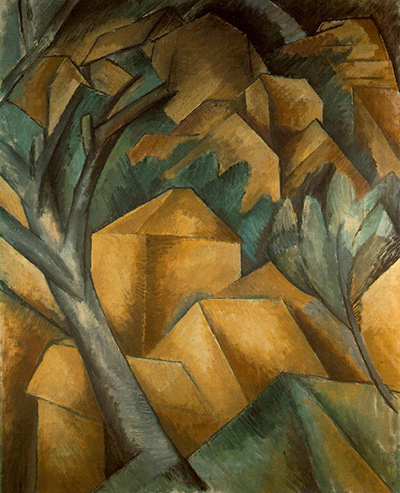
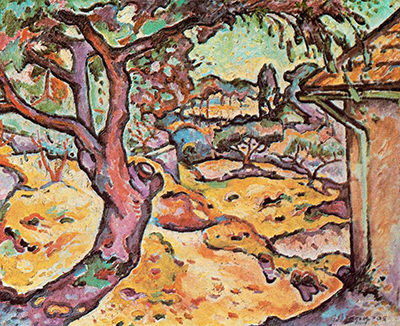
In 1906, Georges Braque gave a landscape an unusually precise centre of gravity simply through its name. Olive Tree near L'Estaque identifies one natural form, then places it in relation to the Mediterranean village where Paul Cézanne had worked in and around the landscape.[3][4] The title makes the tree more than an item in a view: it becomes the idea around which the landscape is understood.
That artistic question deserves priority because the painting acquired a second, very different history more than a century later. The Musée d'Art Moderne de Paris records the canvas in its collection as L'olivier près de l'Estaque, inventory AMVP 2521, and also names it among five paintings stolen from the museum in 2010.[1][5] Its disappearance is an important fact in the life of the object. Yet the theft can easily eclipse the quieter significance of a young painter selecting a tree, a place and a compact horizontal field during his first sustained encounter with the Mediterranean landscape.
At a Glance
- ArtistGeorges Braque[1]
- TitleOlive Tree near L'Estaque[1]
- Date1906[1]
- MediumOil on canvas[1]
- Dimensions50 × 61 cm[1]
- CollectionMusée d'Art Moderne de Paris/Navigart, AMVP 2521[1]
- SignificanceThe 1906 tree and landscape while handling its 2010 museum-theft history with documentary restraint
Contents
- Introduction
- The Paris museum painting
- Braque's first L'Estaque campaign
- Why an olive tree could organise a landscape
- Colour before the geometric turn
- Two paintings with the same title
- Donation, theft and the limits of the record
- A painting held together by its subject
The Paris museum painting
The museum dates L'olivier près de l'Estaque to 1906. It is an oil painting on canvas measuring 50 by 61 centimetres, with G. Braque signed at lower left. The same record associates it with the collection of Germaine Henry and Robert Thomas and says it entered the museum through the Henry-Thomas donation in 1984.[1] Those details establish the particular object behind the English title Olive Tree near L'Estaque.
Its proportions matter in a modest but useful way. At just over half a metre across, the canvas has an intimate scale, while its width gives the landscape a lateral field. Against that horizontal orientation, the title introduces a form associated with rootedness, upward growth and branching extension. The exact arrangement remains the painting's own, but the relation between a spreading landscape and a named tree already defines a productive pictorial problem: how can a single organic form organise a wider place?
Braque's title answers first through selection. It could have identified the canvas only by its district, as many landscapes are. Instead, it moves from a particular kind of tree to a geographic relation: an olive tree, near L'Estaque. The place supplies the larger setting; the tree gives that setting a focus. The wording allows the landscape to be local without becoming a general view of the locality.
Braque's first L'Estaque campaign
The date places the painting at a decisive moment in Braque's early career. At the Salon d'Automne of 1905, he encountered the work of Henri Matisse, André Derain and other painters whom critics had labelled the Fauves. K20's account of Braque describes that encounter as a key experience. Their use of pure, luminous colour challenged both the local appearance of objects and the conventions of illusionistic perspective.[2]
Braque began experimenting with those possibilities in 1906. He worked in Antwerp with his friend Othon Friesz during the summer, then travelled south. K20 places him at L'Estaque for four months beginning in October; the Metropolitan Museum of Art describes the stay as extending through part of autumn and the following winter.[2][4] The four-month duration is important. L'Estaque was more than the setting for one isolated excursion. It offered a sustained field of motifs and decisions in which Braque could test what newly liberated colour might do to a landscape.
K20 says that he painted the harbour as well as inland houses, streets and trees during this stay. It also emphasises the role of mixed tones in his palette.[2] That range complicates any formula in which Fauvism means a uniform blaze of unmixed pigment. Braque was participating in a short, intense phase of colour experiment, but he retained the freedom to adapt its means to different subjects.
Two other museum paintings help locate the campaign while preserving the individuality of the Paris canvas. The Art Institute of Chicago identifies its separate Landscape at L'Estaque, also dated 1906, as a work from Braque's first trip. Its account connects the attraction of Provence with the region's clear light and with admiration for Cézanne, who had painted around L'Estaque until his death that year.[3] The Met's Boats on the Beach at L'Estaque is another distinct 1906 canvas; its harbour subject anchors the museum's account of Braque following both Cézanne and Derain to the village.[4]
Together, these records show a painter moving between coast and inland terrain, among motifs that already possessed a modern artistic history. They also guard against treating one L'Estaque painting as a description of another. The Chicago road, the Met's boats and the Paris olive tree belong to separate canvases. Their shared value lies in revealing how many kinds of landscape Braque tested during the same southern season.
Why an olive tree could organise a landscape
A tree gives a painter several kinds of order at once. It grows from a fixed point while extending in multiple directions. It belongs to the ground, rises into the surrounding space and gathers irregular parts into one recognisable whole. Those general properties make a tree especially useful when colour and brushwork are beginning to carry more of a picture's structure.
The title of Braque's painting directs attention to that potential without dictating a diagram. The olive tree can be understood as a hinge between particular place and pictorial organisation. As a named local form, it keeps the painting attached to L'Estaque. As a complex natural structure, it gives the painter an alternative to a landscape ordered chiefly by distant recession or a single horizon. Trunk, growth and spread are implicit in the kind of motif named, even though the title gives no licence to reconstruct their exact painted shapes.
This is where the work's 1906 context becomes especially revealing. K20 explains that, in the movement from late Impressionism toward Fauvism, a painting could increasingly become a structure of coloured surfaces and brushstrokes. Colour gained independence from the appearance of things in nature, while outlines no longer carried the whole burden of defining objects.[2] A named tree could therefore remain recognisable and local while participating in an arrangement whose colours and marks possessed their own pictorial force.
Recognition and construction can reinforce each other. The title supplies a firm subject, but it leaves open how the painting turns that subject into relations across a surface. In a conventional landscape, a tree might work mainly as an element within a view, helping to frame distance or establish scale. Braque's Fauvist moment made another emphasis available: the tree could become the means by which the painted field was built, its organic identity sustained through colour relations and material marks freed from faithful local colouring.
The horizontal format strengthens the question. A wider field encourages movement across the landscape, while the named tree concentrates attention. One tendency expands; the other gathers. Their tension gives the modest canvas conceptual breadth. The subject is neither an anonymous stretch of country nor a detached botanical specimen. It is a tree understood through its relation to a place, and a place made graspable through the selection of a tree.
Colour before the geometric turn
Braque's later role in the development of Cubism can distort the way his 1906 landscapes are read. The chronology restores their independence. K20 places the stronger shift toward elementary geometric forms, relief-like space and a reduced range of browns, greys and greens after Braque encountered the major Cézanne retrospective in 1907 and returned to southern France.[2] Olive Tree near L'Estaque belongs to the preceding campaign.
Cézanne was already a vital precedent, as the Art Institute's account makes clear, and that precedent could coexist with Fauvist colour.[3] In 1906, the productive problem lay in joining the two: the freedom to release colour from literal description and the desire to give a landscape coherent pictorial organisation. The result deserves to be approached as a completed Fauvist inquiry in its own historical present.
The distinction also clarifies what “construction” can mean at this date. Here it describes the act of making every part of a painting contribute to an organised surface, well before cubes, facets or suppressed colour defined the discussion. By choosing an olive tree as the declared subject, Braque had a motif capable of holding unity and irregularity together. The landscape could be structured without becoming architectural, and colour could organise without surrendering its expressive presence.
Two paintings with the same title
The Paris work is sometimes vulnerable to confusion because another 1906 Braque canvas carries the same title. Christie's records a L'Olivier près de l'Estaque measuring 60 by 73 centimetres, signed and dated at lower right. Its provenance includes Galerie Kahnweiler and Galerie Nathan before its acquisition by a private owner in 1962.[6]
Those facts identify a larger, separate painting. The museum canvas is 50 by 61 centimetres, signed at lower left and catalogued as AMVP 2521 through the Henry-Thomas donation.[1] Keeping the two objects apart is more than a technical correction. It preserves two distinct histories and prevents the richer auction account of one work from being silently attached to the other. Shared title, artist and year show that the olive-tree motif occupied Braque more than once while the dimensions, signatures and collection histories distinguish two canvases.
Donation, theft and the limits of the record
The Paris painting's documented modern history is concise. It belonged to the Germaine Henry and Robert Thomas collection and entered the Musée d'Art Moderne through the Henry-Thomas donation in 1984. Its inventory number secures its identity within the museum's catalogue.[1]
The museum's institutional chronology records the next major event. In 2010, five paintings were stolen from its collection: works by Picasso, Matisse, Braque, Modigliani and Léger. Braque's L'Olivier Près de l'Estaque is named explicitly.[5] That museum statement establishes the theft, while the current catalogue preserves the work's collection identity.
The published museum entries give no later outcome for the Braque. They leave its subsequent physical fate unstated. A continuing catalogue record expresses ownership, documentation and scholarly identity; by itself, it offers no certificate of present custody. The distinction allows the history to remain exact. The canvas was recorded among the works taken in 2010, and claims of recovery, destruction or present whereabouts would go beyond the museum's account.
Documentary restraint also protects the painting from its notoriety. Details of burglary and speculation about value can turn an artwork into a token in a crime story. Here, the more enduring history begins in 1906: Braque had arrived at L'Estaque during his intense Fauvist phase and chosen an olive tree as the organising subject of a compact landscape.
A painting held together by its subject
Olive Tree near L'Estaque joins two histories that require different kinds of attention. Its catalogue history depends on exact dimensions, inventory, donation and a carefully delimited account of the 2010 theft. Its artistic history depends on understanding what a named natural form could offer Braque as colour gained a new structural freedom.
The title keeps that artistic problem in view. It binds a singular tree to a celebrated place, allowing local recognition and pictorial organisation to coexist. Seen within the autumn 1906 campaign, the canvas belongs fully to Braque's Fauvist achievement: an inquiry into how colour, surface and a chosen motif could make a landscape cohere. Its later disappearance changed the conditions under which the object can be encountered. The painting's historical significance still begins with the act of making a tree carry the landscape.
Related Pages
Frequently Asked Questions
In 1906, Georges Braque gave a landscape an unusually precise centre of gravity simply through its name.
The museum dates L'olivier près de l'Estaque to 1906.
The title keeps that artistic problem in view.
Discussion
In 1906, Georges Braque gave a landscape an unusually precise centre of gravity simply through its name.
Reader Insights
In 1906, Georges Braque gave a landscape an unusually precise centre of gravity simply through its name.
Recognition and construction can reinforce each other.
The title keeps that artistic problem in view.
Join the Conversation
Share the visible detail or source that most changed your reading.
References
- Musée d'Art Moderne de Paris / Navigart, “L'olivier près de l'Estaque”
- Kunstsammlung Nordrhein-Westfalen, “Georges Braque”
- Art Institute of Chicago, “Landscape at L'Estaque”
- The Metropolitan Museum of Art, “Boats on the Beach at L'Estaque”
- Musée d'Art Moderne de Paris, “Major dates”
- Christie's, “L'Olivier près de l'Estaque (Olive Tree near L'Estaque), lot 932448”