 by Tom Gurney
Tom Gurney BSc (Hons) is an art history expert with over 20 years experience
Published on August 14, 2026 / Updated on August 14, 2026
Email: tomgurney1@gmail.com / Phone: +44 7429 011000
Introduction
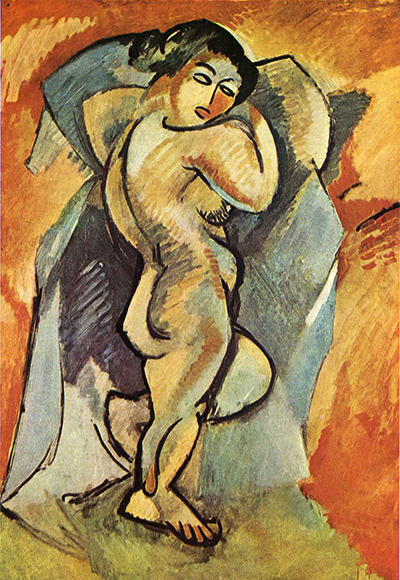
Georges Braque’s Large Nude refuses to settle into a single relation with gravity. The body can seem upright, yet its orientation also suggests reclining, a view from above or, in a later recollection by Henri Matisse, a seated woman. None of those readings fully cancels the others. Braque made the uncertainty structural: the nude is held by a setting that resembles drapery, an opening and a shallow cavity at once. Body and surroundings remain distinct, while related operations of coloured planes, contours, hatching and shifting light bind them into a continuous pictorial system.[1]
That instability makes the painting more than a record of Braque’s encounter with the radical art of 1907. It is a sustained answer developed from the winter of 1907 through June 1908, during months in which Cézanne’s bathers, Matisse’s Blue Nude and Picasso’s studio paintings posed different challenges to the modern nude. Braque held those examples in productive tension without combining them into a finished system. On this monumental canvas, 140 centimetres high and 100 centimetres wide, he tested how a figure might occupy space when outline, colour and ground cease to perform their customary separate tasks.[1]
At a Glance
- ArtistGeorges Braque[1]
- TitleLarge Nude[1]
- DateWinter 1907–08[1]
- MediumOil on canvas[1]
- Dimensions140 × 100 cm[1]
- CollectionCentre Pompidou, Musée national d’art moderne[1]
- AccessionAM 2002-127[1]
- SignificanceThe 1907-08 nude at the collision of Cezanne, Fauvism, figure painting and the emerging Cubist problem
Contents
- Introduction
- A painting made over months
- Cézanne, Matisse and Picasso
- Two canvases, one recurring problem
- A figure without one stable pose
- The blue cavity and the ochre field
- Hatching, light and continuity
- Exchange in both directions
- From private ownership to the national collection
- An unresolved turning point
A painting made over months
The Centre Pompidou records the work as Grand Nu, an oil on canvas made between winter 1907 and June 1908. Braque signed it at the lower right, while an inscription on the reverse dates it to June 1908. Those facts matter because the painting is sometimes treated as if it were an instantaneous reaction to a single revelation. Its documented history instead describes an extended process. Braque began the inquiry after seeing several demanding approaches to the nude, developed more than one composition, and was still working on this canvas in late April.[1]
The scale also changes the nature of the experiment. At 140 by 100 centimetres, the nude occupies a large vertical field, giving the inquiry an authority beyond a small study in formal simplification. The body has to establish its weight, direction and place across a substantial surface. Yet Braque denies it a stable stage. The surrounding forms press close, and the painting’s spatial cues pull in competing directions. Monumentality and uncertainty coexist: the figure commands the canvas without securing a single pose or a clearly measurable setting.
This is an early turning point, although it is misleading to read it as mature Cubism already achieved. Braque was still carrying forward colour as an independent constructive force while asking increasingly severe questions about volume and pictorial space. The result belongs to a transition in which the answer is being discovered through the act of painting.[6]
Cézanne, Matisse and Picasso
Cézanne provided the longest historical pressure. Bathers occupied him across roughly two hundred works, and three large paintings of female bathers dominated the final decade of that inquiry. The Philadelphia Museum of Art’s The Large Bathers, made around 1900–06, is the largest and last of those ambitious late canvases.[3][4] For younger painters, this sustained project showed that the nude could be treated as part of an encompassing pictorial structure. Bodies, landscape and the organisation of the surface could be made mutually dependent through the painting’s construction.
Braque’s Large Nude draws on Cézanne’s wider inquiry without reproducing one composition. The importance of the bathers lies in the problem they made newly urgent: how can bodily volume and its environment belong to the same order? Braque transfers that question from Cézanne’s groups in landscape to a single figure compressed within an uncertain setting. The precedent is therefore structural, with no borrowed pose required.
Matisse’s Blue Nude (Souvenir de Biskra) supplied a more immediate challenge in 1907. Matisse developed that painting through a transposition from a terracotta sculpture, moving bodily form between three-dimensional modelling and a deliberately pared-back painted language. Its exhibition provoked scandal, but its deeper relevance for Braque was its refusal to preserve the nude as an untouched academic ideal.[5] The body could be rebuilt through the decisions of a modern medium. Braque’s response remained his own: no copied palette or posture is needed to connect the works.
Picasso’s challenge was encountered at close range. The Centre Pompidou places Braque’s earliest verifiable arrival at Picasso’s studio within the final weeks of 1907, from late November through December. The encounter brought him before Les Demoiselles d’Avignon and an initial state of Three Women.[1] Picasso’s large 1907 canvas compressed five women into a space organised by angular lines and flat geometric planes, putting established conventions of bodily volume and spatial recession under extraordinary strain.[2] Braque could hardly ignore that confrontation. Even so, it was one force within a wider field that included Cézanne, Matisse and his own developing investigations.
Two canvases, one recurring problem
After the studio visit, Braque began a composition of one woman represented in three positions. Drawings preceded the painting, which appeared at the Salon des Indépendants between March and May 1908. The canvas is now lost; whether it was destroyed remains uncertain.[1] This work must be kept separate from Large Nude. The exhibited composition multiplied one figure across three positions, whereas the surviving Pompidou canvas concentrates ambiguity within a single body and its surrounding space.
The chronology makes the distinction decisive. A diary entry dated 27 April 1908 documents Large Nude in Braque’s studio while work on it was continuing. The June inscription on the reverse places its development beyond the opening of the Salon and close to Braque’s departure for L’Estaque. The Pompidou suggests that he may have taken the painting south and reworked it there, although the location of every final decision remains unresolved.[1]
The two canvases nevertheless arose from a shared problem. How could a painter convey a body turning in space once one fixed view no longer seemed adequate? In the missing Salon work, separate positions addressed the question sequentially across the composition. In Large Nude, orientation becomes condensed and unresolved. Any known set of viewpoints remains uncharted. The body’s entire spatial status becomes uncertain.
A figure without one stable pose
At first, the vertical format and the figure’s extension encourage an upright reading. Other cues loosen that assumption. The body can appear to recline or to be observed from above, while Matisse’s much later memory of a seated young woman adds another plausible orientation.[1] His recollection cannot settle the pose, especially decades after the painting was made. It is valuable precisely because it demonstrates how thoroughly the image resists a single description.
The ambiguity works as a spatial condition, free of any hidden correct answer. It changes the reader’s relation to the painted body. A conventional standing nude would imply a floor and an upright viewing position; a reclining one would call for a supporting surface; an overhead view would reorganise depth. Braque allows traces of these spatial expectations to remain without supplying the setting that would confirm any of them. Gravity seems present, but its direction cannot be securely plotted.
The surrounding forms intensify the effect. They can recall folds of classical drapery, an association that would place the nude within a long pictorial tradition. Yet they also appear as solidified sides of an opening shaped to receive the body’s volumes.[1] This second reading makes the environment less like fabric hanging behind a model and more like a constructed enclosure. Neither account is complete. Drapery becomes spatial mass; an opening acquires the pressure of a material surround.
The blue cavity and the ochre field
Braque encloses the figure in a bluish cavity. Beyond it lies a less determinate field of abstract planes, darker and more red-ochre than the coloured planes used within the body.[1] These nested zones establish differences without producing conventional foreground, middle distance and background. The figure is close to the surface, the cavity holds it, and the outer field seems to extend behind that enclosure. Each spatial cue is immediately complicated by the painting’s material continuity.
A heavy blue contour gives the body an emphatic boundary. Outline here does more than describe an edge. It asserts the figure’s coherence at the very moment when colour and touch connect it to the surround. Blue recurs as an environmental force in the cavity, so the contour both separates body from setting and ties the two together. The distinction is maintained, then placed under pressure.
Warm and cool relations carry part of the modelling that academic painting might have assigned to gradual tonal shading. Their alternation makes colour active across the whole surface. The darker red ochre beyond the cavity becomes an active spatial field, while the cooler blue carries more than anatomical description. Each helps organise distance, volume and adjacency. The Fauvist liberation of colour survives, redirected toward a more integrated construction of figure and field.
This is why the painting’s historical position cannot be described as a neat passage from colour to geometry. Colour itself performs geometric and spatial work. Curved contours organise the body, coloured planes give it volume, and related chromatic pressures continue outside it. The emerging structure depends on the very intensity that a simple account of Braque abandoning Fauvism would remove.[6]
Hatching, light and continuity
The handling of the surface provides another transition between body and ground. Hatching is tight on the nude and broadens as it approaches the edges of the canvas. That change in density lets Braque concentrate the figure without enclosing it inside a wholly separate technique. The marks open outward while remaining part of a continuous field.[1]
The Centre Pompidou describes an almost imperceptible passage from the figure, constructed through coloured planes and curved contours, to the rear ground, where variations of light become more prominent.[1] The effect preserves the nude while establishing a graduated relation: contour and denser marks hold the body together, while the surrounding treatment expands and modulates. Figure and environment have different emphases, yet no hard procedural divide isolates one from the other.
That continuity is the canvas’s central achievement. Braque constructs the body and its space together. The figure’s volumes help generate the cavity around it, and the pressure of that cavity affects how the body can be read. Background ceases to be passive support. It participates in the same act of construction.
Exchange in both directions
Braque’s late-1907 encounter with Picasso is indispensable, while the later exchange moved in both directions. The Pompidou proposes that Braque’s compact, geometrised paintings from his 1908 L’Estaque period influenced Picasso in return. It also suggests that Large Nude weighed on Picasso’s completion of Three Women.[1] These remain informed institutional interpretations, leaving any claim that one canvas caused every change in another unproved.
They nevertheless correct a one-directional story. Braque and Picasso were approaching related problems through different routes, comparing consequences and responding to each other’s advances. By autumn 1908, their close dialogue would develop step by step into the partnership central to Cubism.[6] Large Nude belongs just before that sustained daily exchange was fully established. Its value lies in showing Braque already acting as an inventor within the conversation.
The canvas also preserves the plurality of that invention. Cézanne’s long investigation of bathers made body and setting a structural unity; Matisse showed how a modern nude could move between sculptural and painted form; Picasso forced a new confrontation with compressed space and angular construction. Braque turned these pressures into a distinctive experiment in unstable orientation, chromatic volume and an active surrounding field. Influence becomes a network of problems and replies, free from any chain with a single origin.
From private ownership to the national collection
The painting’s later history begins clearly in 1922, when the poet Louis Aragon bought it at the third sale of stock sequestered from the dealer Daniel-Henry Kahnweiler. André Breton helped advise him, and the sale catalogue listed the canvas under the title Baigneuse. Aragon appears to have sold it to the collector and designer Marie Cuttoli around 1928, though the Pompidou preserves uncertainty around that date. Cuttoli retained it until 1962–63, when the couturier and gallerist Alex Maguy acquired it. Following Maguy’s death in 1999, the work entered France’s national collection through the Alex Maguy-Glass dation of 2002. Its inventory number is AM 2002-127.[1]
The title can cause confusion because other Braque works also circulate as large nudes or bathers. The National Gallery of Art’s Large Nude is a much later brown-chalk drawing from 1927, while Tate’s Bather, also known as Baigneuse, is an oil on board dated 1925.[7][8] Neither is the monumental 1907–08 canvas discussed here.
An unresolved turning point
Large Nude matters because it keeps several possibilities alive while making them interact. The body is monumental but spatially unsettled. A forceful blue outline declares its edge, even as blue migrates into the cavity that encloses it. Warm and cool planes construct volume across figure and setting. Dense hatching opens toward the perimeter, and changes of light carry the work from bodily form into an indeterminate outer field.
The painting therefore records neither the last moment of Fauvism nor a completed Cubist formula. It is an active collision point. Cézanne’s structural bathers, Matisse’s transformed nude, Picasso’s compressed figures and Braque’s own months of revision meet on a surface where the divisions between upright and reclining, drapery and opening, contour and environment remain deliberately unstable. By making the body and its world emerge together, Braque turned uncertainty into a method of construction.
Related Pages
Frequently Asked Questions
Georges Braque’s Large Nude refuses to settle into a single relation with gravity.
The Centre Pompidou records the work as Grand Nu, an oil on canvas made between winter 1907 and June 1908.
The painting therefore records neither the last moment of Fauvism nor a completed Cubist formula.
Discussion
Georges Braque’s Large Nude refuses to settle into a single relation with gravity.
Reader Insights
Georges Braque’s Large Nude refuses to settle into a single relation with gravity.
The surrounding forms intensify the effect.
The painting therefore records neither the last moment of Fauvism nor a completed Cubist formula.
Join the Conversation
Share the visible detail or source that most changed your reading.
References
- Centre Pompidou — Grand Nu
- Museum of Modern Art — Pablo Picasso, Les Demoiselles d’Avignon
- National Gallery — Paul Cézanne, Bathers (Les Grandes Baigneuses)
- Philadelphia Museum of Art — Paul Cézanne, The Large Bathers
- Centre Pompidou — “The Secret History of Henri Matisse’s Blue Nudes”
- Kunstsammlung Nordrhein-Westfalen — Georges Braque
- National Gallery of Art — Georges Braque, Large Nude
- Tate — Georges Braque, Bather