 by Tom Gurney
Tom Gurney BSc (Hons) is an art history expert with over 20 years experience
Published on August 14, 2026 / Updated on August 14, 2026
Email: tomgurney1@gmail.com / Phone: +44 7429 011000
Introduction
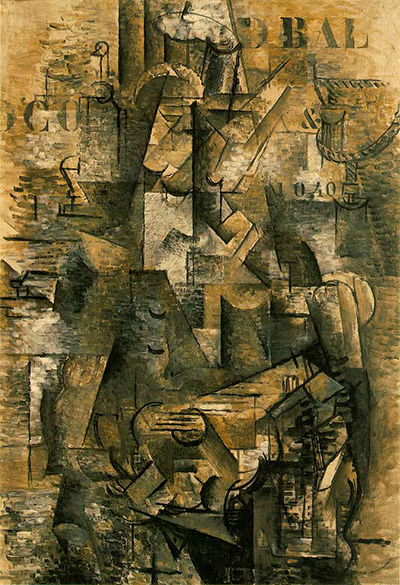
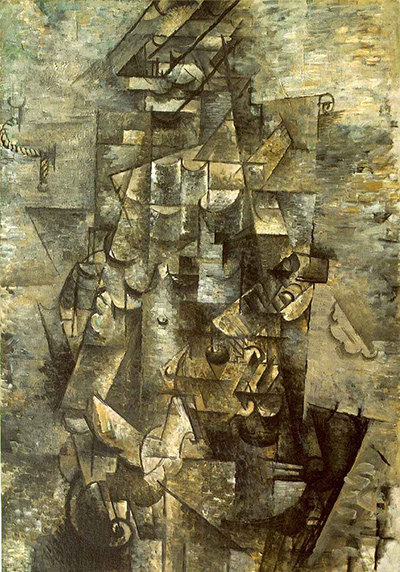
In Georges Braque's Man with a Guitar, recognition is distributed unevenly. A small nail and a hanging coil of rope are comparatively direct; the musician occupying the tall canvas is much harder to hold together. The eye receives a profile, an angle that may be an elbow and the round opening of a guitar, yet these clues stop short of closing around a continuous body. Each discovery makes the subject more plausible without making it complete.
That imbalance is the painting's point of entry. Braque constructed an open figure from different degrees of likeness, not an ordinary body hidden behind a geometric screen. Some marks identify objects quickly, others fluctuate between several spatial roles, and the guitarist exists through the effort of relating them. Looking becomes an extended negotiation between what the title promises and what the painted field permits.
At a Glance
- ArtistGeorges Braque[1]
- TitleMan with a Guitar[1]
- DateCéret, summer 1911–early 1912[1]
- MediumOil on canvas[1]
- Dimensions45 3/4 × 31 7/8 in. (116.2 × 80.9 cm)[1]
- CollectionThe Museum of Modern Art, New York[1]
- Object number175.1945[1]
- SignificanceThe nearly indecipherable musician while preserving the work's material and spatial logic
Contents
- Introduction
- The exact painting
- Recognition begins at the edge
- When a solid becomes an interval
- Representation at its limit
- Céret and the shared experiment
- Why a musician?
- A modern object's passage
- Similar titles, different works
- The figure that never closes
The exact painting
Braque began the picture at Céret in summer 1911 and brought it to completion by early 1912. It is an oil on canvas measuring 116.2 by 80.9 centimetres, now in the Museum of Modern Art in New York as object 175.1945. MoMA acquired it in 1945 through the Lillie P. Bliss Bequest by exchange.[1] Its dimensions matter: this is a substantial upright canvas, large enough to encourage the expectation of a human presence at something approaching bodily scale.
The title supplies the broadest orientation—a man and an instrument—while the record leaves the sitter unnamed. Calling the work a portrait would therefore imply knowledge beyond the surviving evidence. The vertical format likewise leaves open whether the guitarist stands, sits or belongs to a particular interior. Braque gives the viewer a category of subject, then makes the act of finding it central to the encounter.
MoMA places the work at a high point of Analytic Cubism. By 1911, Braque and Pablo Picasso were testing ways of representing things without rebuilding the continuous, perspectival world expected of European easel painting. They retained reality while seeking a new way to articulate bodies, objects and space after fixed viewpoint and naturalistic recession had lost their authority.[1]
Recognition begins at the edge
MoMA's account first directs attention to the left, where a nail and looped rope retain a striking degree of ordinary likeness. They seem to belong to a different register from the fractured musician. The nail can be understood as a small object attached to a surface; gravity gives the rope a downward logic. Together they offer a momentary sense that there is a wall in front of us and a tangible cord hanging from it.[1]
That local certainty governs only a small zone. Anne Umland, in MoMA's audio commentary, explains that the painting rewards slow concentration because a line may appear to advance and then to withdraw. A passage read as solid can turn into an opening; something resembling cast shadow can acquire the presence of a plane.[2] The nail and rope provide an accessible foothold, while the surrounding structure follows different spatial rules.
The musician emerges in stages. MoMA identifies a profile towards the upper centre. It proposes the direction of a head while withholding the detail required for a likeness. A sharp turn elsewhere has been read as the bend of an elbow, an appropriately cautious identification because the angle floats free of a fully bounded arm. Lower down, the guitar's sound hole gives the instrument its most economical sign.[1] Profile, joint and circular opening act like separated syllables of a word that the viewer can pronounce without ever seeing written in full.
This sequence changes the meaning of difficulty. Legibility comes in several grades. The profile is less emphatic than the rope; the elbow is more provisional than the sound hole. The title helps these fragments converge upon a guitarist, while the field keeps them from becoming a diagram of one pose. To insist on a complete anatomy would suppress the very intervals through which Braque reorganises representation.
The same reserve applies beyond MoMA's cue list. It may be tempting to assign every diagonal to a string, every curve to a hand or shoulder, and every darker area to clothing or furniture. Such certainty would turn looking into labelling. Braque preserves enough specificity for recognition to continue, while making the gaps between recognisable parts carry visual force.
When a solid becomes an interval
Traditional modelling normally gives a body an outside and a volume. Light describes a surface; shadow helps that surface turn away; perspective locates the whole form in a continuous depth. Man with a Guitar breaks this sequence apart. According to MoMA, brown, green and grey facets appear to pass through one another, alternately registering as surface and empty space before loosening into an atmospheric ground.[1]
The reduced colour range is therefore an active spatial device. A sharply separated flesh tone could isolate the musician from his surroundings, while stable local colours could distinguish instrument, clothing and room. Braque withholds those easy partitions. Closely related hues allow a plane associated with the body to migrate into the setting, or an apparent gap to gain enough tonal weight to come forward. Colour no longer confirms where one thing ends and another begins.
Umland's account of solids turning into voids gives this instability a useful precision.[2] A form can appear substantial because of its angled edges and tonal change; a second reading can make the same configuration seem like the space between forms. Neither reading needs to cancel the other. The painting's shallow depth is built from their alternation.
This also explains why the surface never simply disappears behind the subject. A projecting line can suggest an edge in depth, then announce itself as paint laid across canvas. A shadow can describe volume, then flatten into a visible patch. The viewer is repeatedly sent into the proposed scene and returned to the support on which that scene has been made. Braque replaces the window-like coherence of perspective with an environment whose spatial claims must be tested one by one.
The tall format intensifies the effect. It encourages fragments to gather vertically around a person, yet the shallow network refuses the spacious enclosure that a body would ordinarily occupy. Figure and setting share the same compressed field. The man is present neither as an intact mass placed before a background nor as a disposable pretext for pattern. He persists as a changing relation among signs.
Representation at its limit
MoMA explicitly insists that the picture remains representational. The distinction matters because near-indecipherability and nonrepresentation are different conditions. The title, profile, elbow, sound hole, rope and nail continue to refer beyond the canvas; they carry more than the formal identities of circles, angles and tonal patches.[1]
At the same time, reference now requires construction. A circle becomes a sound hole partly because the title establishes a guitar and because nearby fragments can sustain that possibility. A line becomes a profile through placement and relation, with little detailed resemblance. Meaning accumulates across the picture instead of residing securely inside a complete outline.
The work consequently sets two thresholds against each other. If every clue fused into one stable guitarist, the old hierarchy of figure and surrounding space would return. If all reference vanished, the friction between the painted marks and the world they evoke would disappear. Braque maintains the more demanding middle state: resemblance remains indispensable, yet has ceased to control the entire organisation.
This is why slow looking is more than advice about patience. It is part of the work's structure. Recognition occurs in time. The viewer locates the rope, shifts towards the profile, descends towards the instrument, loses a connection and tries another route. K20's account of Analytic Cubism similarly emphasises the searching movement of the eye and a pictorial order assembled from multiple views instead of a single fixed position.[3] Successive surveys yield different relations as attention moves.
Why a musician?
Musical instruments were deeply embedded in Braque's life and Cubist practice. K20 records that he played violin, flute, piano and especially accordion, and that instruments had appeared in his still lifes since 1908.[3] Their recognisable components offered fertile material: a sound hole, strings, neck or curved body could continue to signal an instrument after its contour had been opened and dispersed.
Music also unfolds through time, making it an illuminating—but limited—analogy for the painting. The guitarist is understood through successive relations instead of one complete view. Any one-to-one translation of plane into note, or of composition into visual score, would exceed the evidence. The useful comparison lies in sequence: one fragment alters how another is read, and the whole remains dependent on active memory.
A nearby painting shows how varied Braque's musical language could be. In Homage to J. S. Bach, made during winter 1911–12, parts of a violin coexist with stencilled letters and imitation wood grain. MoMA describes recognisable subject matter there as appearing in brief flashes within compressed Analytic space.[6] The comparison helps define Man with a Guitar. Here the nail and rope, in place of lettering or faux wood, establish the strongest contrast between lifelike depiction and fractured form. The two paintings belong to the same moment without becoming versions of one formula.
A modern object's passage
The painting's early ownership follows the network that enabled Cubism to circulate. MoMA records that Daniel-Henry Kahnweiler acquired it directly from Braque in 1911 and sold it to the collector Wilhelm Uhde before 1914. During the First World War, the French government seized it as enemy property. It was sold at Hôtel Drouot in May 1921, although the buyer at that sale remains unknown.[1]
Marcel Fleischmann is associated with the canvas around 1924. It later passed through Paul Drey in New York and was placed on extended loan to MoMA from 1939 before the museum acquired it in 1945.[1] More than an ornamental list of owners, this history traces the movement of an experimental Parisian picture through wartime confiscation, Swiss collecting and the institutional formation of modern art in the United States. The documented gap after the forced sale also cautions against turning provenance into a seamless story.
Similar titles, different works
Two nearby objects are easily confused with the MoMA oil. Pablo Picasso painted his own Man with a Guitar in 1912 at Sorgues; that separate canvas belongs to the Philadelphia Museum of Art.[4] Braque also made a work titled Guitar in 1913, now at MoMA as object 304.1947. Its cut-and-pasted paper, drawing and gouache on prepared canvas make it a different medium and object from the large 1911–12 oil.[5]
The distinctions matter historically. Picasso's title belongs to the dialogue between the two artists while leaving Braque's canvas and its unnamed sitter separate. Braque's later Guitar belongs to the material turn towards pasted paper, when literal fragments of the everyday world transformed the relation between object and support. Man with a Guitar reaches its own radical result entirely through paint.
The figure that never closes
The musician remains compelling because he is neither securely possessed nor finally lost. The nail and rope establish one kind of visibility; profile, elbow and sound hole establish others. Between them, planes advance and retreat, apparent substance becomes interval, and the canvas alternately opens and declares its flatness.
Braque asks the viewer to recognise while stopping short of completion. The title guides attention, yet leaves many fragments disobedient. Curatorial clues help the figure emerge while preserving its resistance to a diagram. Historical context places it within Analytic Cubism, though the label remains secondary to the precise experience of space changing status under the eye.
That sustained uncertainty is more exacting than either realism or pure abstraction. Man with a Guitar keeps a person and an instrument active while denying them continuous possession of the field. The painting's achievement lies in this held-open relation: the visible world survives through a form of looking alert to how easily an object can become a space, and a space can become paint.
Related Pages
Frequently Asked Questions
In Georges Braque's Man with a Guitar, recognition is distributed unevenly.
Braque began the picture at Céret in summer 1911 and brought it to completion by early 1912.
That sustained uncertainty is more exacting than either realism or pure abstraction.
Discussion
In Georges Braque's Man with a Guitar, recognition is distributed unevenly.
Reader Insights
In Georges Braque's Man with a Guitar, recognition is distributed unevenly.
At the same time, reference now requires construction.
That sustained uncertainty is more exacting than either realism or pure abstraction.
Join the Conversation
Share the visible detail or source that most changed your reading.
References
- Museum of Modern Art, “Man with a Guitar,” Céret, summer 1911–early 1912, 175.1945; current object record, collection text and provenance research. https://www.moma.org/collection/works/79048
- Anne Umland, “Georges Braque, Man with a Guitar,” Museum of Modern Art audio commentary. https://www.moma.org/audio/21
- Kunstsammlung Nordrhein-Westfalen, Georges Braque: Inventor of Cubism, current institutional sections on Analytic Cubism, Braque and Picasso, and Braque and music. https://www.kunstsammlung.de/en/braque/
- Philadelphia Museum of Art, “Pablo Ruiz y Picasso, Man with a Guitar,” 1912. https://www.philamuseum.org/objects/51090
- Museum of Modern Art, “Georges Braque, Guitar,” 1913, 304.1947. https://www.moma.org/collection/works/36110
- Museum of Modern Art, “Georges Braque, Homage to J. S. Bach,” winter 1911–12, 544.2008. https://www.moma.org/collection/works/116275