 by Tom Gurney
Tom Gurney BSc (Hons) is an art history expert with over 20 years experience
Published on August 14, 2026 / Updated on August 14, 2026
Email: tomgurney1@gmail.com / Phone: +44 7429 011000
Introduction
Georges Braque and Pablo Picasso did not make Cubism in a shared studio or under a joint signature. They brought different artistic formations to their own canvases. Yet from autumn 1908 until the First World War, each repeatedly carried his day's work into the other's orbit. Comparison, criticism and response became part of the act of painting.
That arrangement creates the central difficulty in telling their story. To call Braque a follower ignores the landscape experiments and technical proposals he brought into the exchange. To make him the solitary inventor merely reverses the distortion. The most accurate account preserves three things together: Cubism developed reciprocally; each artist made identifiable decisions; and their shared language widened through many other artists, writers, dealers and sources.
At a Glance
- ArtistGeorges Braque
- GuideCubism and Picasso
- FocusBraque and Picasso’s reciprocal Cubist experiment from 1907 to 1914, including its Analytic and Synthetic phases.
- Key topicsA meeting was not an origin; The partnership takes shape; Analytic Cubism and the pressure of resemblance; Two innovations, two categories
- OverviewGeorges Braque and Pablo Picasso did not make Cubism in a shared studio or under a joint signature.
Contents
- Introduction
- A meeting was not an origin
- The partnership takes shape
- Analytic Cubism and the pressure of resemblance
- Two innovations, two categories
- Synthetic Cubism: a different construction
- Beyond two studios
- The interruption of 1914
A meeting was not an origin
Guillaume Apollinaire introduced Braque to Picasso by late 1907. Musée national Picasso-Paris dates the meeting to November, when Les Demoiselles d'Avignon could be seen in Picasso's Bateau-Lavoir studio. Picasso subsequently encountered Braque's own recent work.[4] The exchange mattered, although the dramatic dialogue later attached to the visit is too unstable to carry its history.
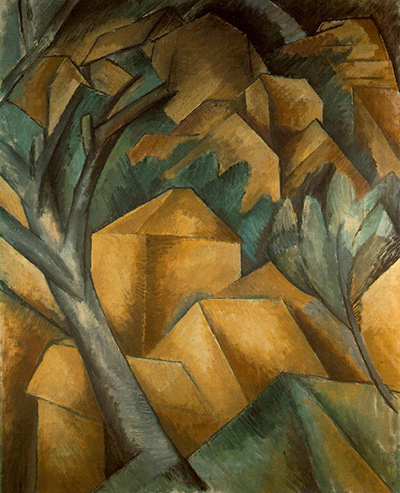
Braque was not an empty vessel at the moment of introduction. His Fauvist landscapes had already established him in the Paris art world, and he was turning towards the constructive example of Paul Cézanne. Repeated work at L'Estaque had made landscape a testing ground for compacted form and an alternative to conventional recession. Picasso, meanwhile, had been breaking apart and rebuilding the human figure. The two artists arrived at their conversation by different routes.[1][6]
Nor did those routes exhaust Cubism's sources. Cézanne's simplified forms and shifting spatial relations were crucial, but African and Oceanic sculptures also informed early Cubist experiments. Many such works had reached Paris after seizure from territories colonised by France and were displayed in ethnographic museums or reproduced without their cultural histories. MoMA notes that Cubist artists appropriated formal qualities while showing little awareness of the objects' original contexts.[7] The movement cannot be reduced to a self-contained European succession from Cézanne to Braque and Picasso.
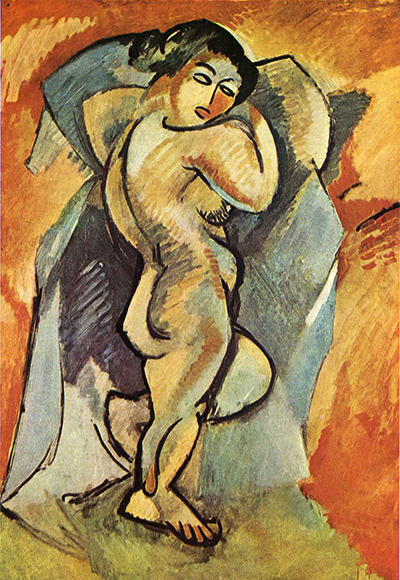
The late-1907 meeting therefore marks contact, not a sudden invention. During 1908 Braque continued his own investigations, including a large figure and the landscapes he painted at L'Estaque. He reduced details, tightened buildings and trees into interlocking structures, and made the space of the picture increasingly independent of ordinary perspective.[1][6]
Daniel-Henry Kahnweiler exhibited the L'Estaque group in Paris in November 1908 after it had been rejected by the Salon d'Automne jury. Critical language about cubes became part of the naming of Cubism. The exhibition was a public threshold for Braque and for the emerging movement, though no single review or set of landscapes can serve as Cubism's birthday.[1][2][3]
The partnership takes shape
The first meeting and the sustained collaboration belong to different moments. K20 and the Metropolitan Museum of Art place the intensive partnership from autumn 1908. By 1909 Braque and Picasso were visiting one another with exceptional frequency, seeing unfinished work and testing their own decisions against the other's response.[1][3]
They retained separate studios. That physical separation made the exchange more, rather than less, consequential: each artist had time to absorb an idea, alter it and return with a proposition of his own. The process was neither joint authorship nor a sequence of instructions from a master to an assistant. It resembled a rapid conversation conducted through finished and unfinished pictures.[5]
At first, landscape carried much of Braque's spatial research, while Picasso's experiments often centred on figures. Still life then became especially useful to both. Bottles, glasses, instruments, newspapers and tabletops could be recognised from small cues, rearranged repeatedly and tested without the narrative expectations attached to a history painting. Ordinary objects gave the artists a stable vocabulary on which to perform unstable operations.[1][2]
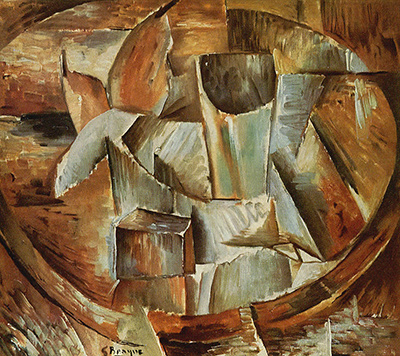
The movement from landscape towards still life also concentrated their experiment. A landscape contains strong conventions for near and far, horizon and atmosphere. A tabletop brings its elements close to the support and to one another. Its edge can tilt upwards; the neck of an instrument can connect separate zones; the rim of a glass can be shown as curve, oval or interruption. The subject became a compact laboratory in which every alteration could be compared with the partner's latest solution.[1][2]
This did not make the objects neutral. Musical instruments evoked handling and performance; newspapers carried contemporary words; café vessels belonged to a recognisable social world. Braque and Picasso stripped away much anecdotal detail while retaining enough signs for those associations to remain available. Their increasing formal rigour depended upon things the viewer already knew, even when the picture refused to arrange those things conventionally.[2][3]
Conventional perspective assumes a fixed viewer, a consistent light source and forms seen from one position. Braque and Picasso loosened all three. They reduced and fractured objects, aligned facets at incompatible angles and placed those facets within shallow, relief-like space. A passage might belong to an object, then merge with the surrounding field; a contour could begin decisively and dissolve before enclosing anything.[1][2][7]
The phrase “multiple viewpoints” describes part of this change, but it should not be taken as a literal display of every side. The paintings combine visual, tactile and remembered information that exceeds a single glimpse. One curve may preserve an instrument, a dark oval may imply a bottle opening, and a diagonal may make a tabletop tilt towards the viewer. Recognition emerges through distributed evidence instead of a continuous illusion.[2][7]
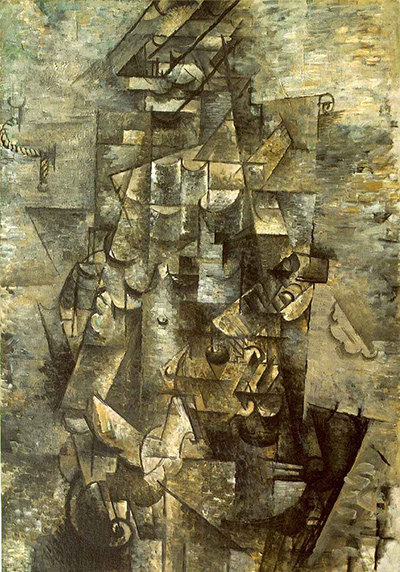
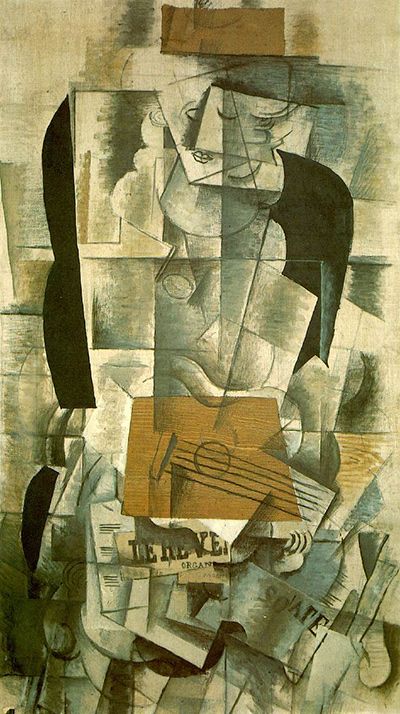
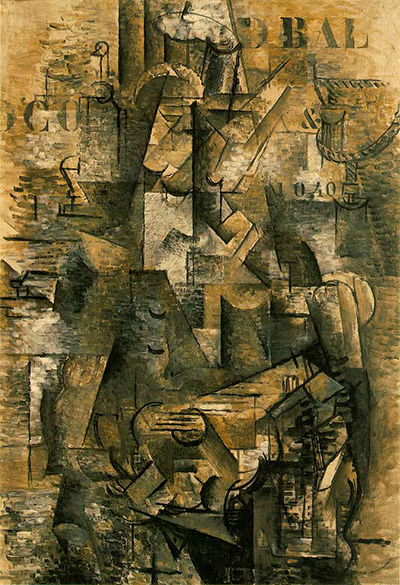
Braque and Picasso often restricted their palettes to ochres, browns, greys, blacks and subdued greens. With fewer contrasts of hue, value, edge, hatching and overlap carried more of the spatial work. The result did not abolish the subject. It made instruments, vessels, faces and rooms appear intermittently, as if the viewer's act of recognition were occurring inside the painting.[1][2][5]
Analytic Cubism and the pressure of resemblance
The work of roughly 1910–12 is commonly called Analytic Cubism. The term gathers paintings in which small overlapping planes, compressed space and reduced colour seem to break a subject into components and reassemble it. These traits intensified through continual comparison, yet the label was not a studio rule followed by Braque and Picasso. It is a later historical convention, and its boundaries remain porous.[2][7]
In summer 1911 the two worked near one another at Céret in the French Pyrenees. They continued to use separate supports and signatures, but compared their work and debated new possibilities. Some paintings from this close phase became difficult to distinguish because both artists suppressed conspicuous personal flourishes in favour of a disciplined common vocabulary.[5] “Some” is essential: similarity does not erase authorship or make every canvas interchangeable.
The Met points to an equally sized pair from 1911—Braque's Bottle and Clarinet and Picasso's Pedestal Table with Wine Glasses, Cup, and Mandolin—as evidence of their convergence around shallow space and a small number of identifying clues.[3] The comparison is valuable precisely because the works remain separately attributed. Common dimensions and related problems expose the intensity of the exchange; they do not turn two paintings into a single collective object.
Convergence could also sharpen difference. Faced with the same pressure on legibility, one artist might preserve a contour that the other dissolved, thicken a plane the other left transparent, or choose a word where the other retained an object fragment. The shared language made such decisions newly consequential. Individual agency appears inside the comparison rather than outside it.
As facets multiplied, another problem arose. A pictorial language could become so internally consistent that the object nearly disappeared. Neither artist simply crossed into pure abstraction. Profiles of instruments, stair-like forms, partial faces and fragments of lettering continued to give the viewer something to test against the surrounding ambiguity.[2][3][5][6]
Letters were especially effective because they belonged to a different representational system. A painted syllable or newspaper masthead could be read even when the object beside it remained uncertain. It also asserted the flatness of the support: a stencilled character does not recede like a modelled bottle. Braque's commercial lettering, faux-bois passages and craft-derived procedures became particular contributions to the shared vocabulary; Picasso adopted and redirected related devices.[3][6][8]
The introduction of a device did not settle its meaning. A letter could anchor a word, behave as a shape, evoke advertising or interrupt an illusion. Faux bois could demonstrate artisanal skill while declaring itself a counterfeit. Once a procedure passed between the two artists, it generated alternatives rather than a standard house style. Collaboration accelerated the number of questions each innovation could be made to answer.[3][8]
This give-and-take complicates any hunt for a permanent leader. Braque often opened a material or spatial possibility; Picasso might press it in a different direction or combine it with an experiment of his own. At other points Picasso's decisions posed the challenge. Influence moved back and forth, and the significance of an idea often became visible through the partner's response.[8]
Two innovations, two categories
The year 1912 shows why precise categories matter. In spring Picasso made Still Life with Chair Caning. He incorporated oilcloth printed with a chair-cane pattern into an oval painting and surrounded the support with rope. The Metropolitan Museum of Art describes it as the first Cubist collage.[8][9]
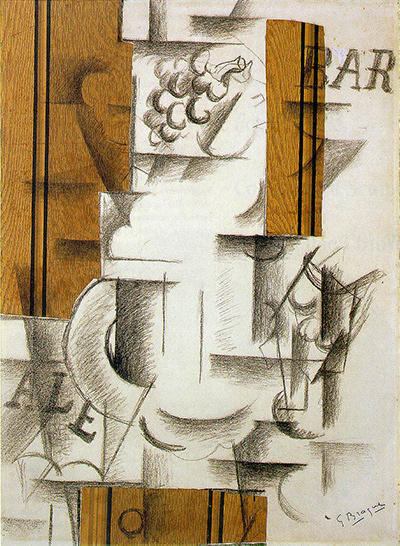
In September, while working at Sorgues near Avignon, Braque made Fruit Dish and Glass. He cut pieces from mass-produced faux-bois wallpaper and pasted them into a charcoal-and-gouache drawing on paper. According to Braque, it was his first papier collé; the Met also identifies it as the first Cubist example of that pasted-paper form.[3][9]
These statements are compatible. Picasso's work joins printed oilcloth and rope to a painting. Braque's joins cut wallpaper to a work on paper. “Collage” can function as the wider category, while papier collé identifies construction with pasted paper. Awarding one artist an undifferentiated first would erase the material distinction that made the two experiments useful.[8][9]
The sequence also reveals the character of the partnership. The spring collage was Picasso's decision; Braque's September work used a distinct operation rather than merely repeating it. Each introduced a different kind of actual material. Once the works entered their conversation, both artists could explore the consequences: a manufactured pattern might be itself, imitate another substance and stand for part of a represented object at the same time.[3][8][9]
The change was larger than the insertion of unusual matter. Cut edges could organise a composition without being painted; printed colour arrived ready-made; a scrap of newspaper carried words from contemporary life; a drawn contour could pass across an actual sheet and assign it a new identity. The picture no longer had to choose between representation and physical fact. It could make their contradiction productive.[2][7][9]
Synthetic Cubism: a different construction
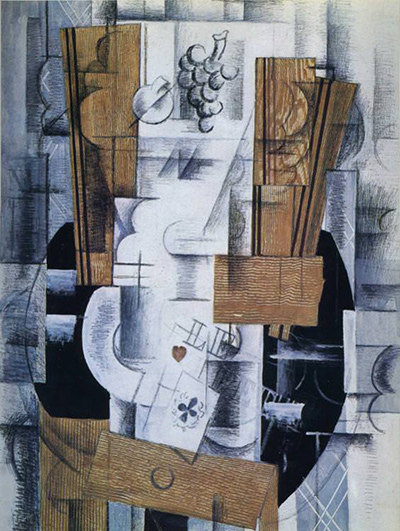
These developments contributed to what became known as Synthetic Cubism. From 1912 to 1914, forms often grew larger and more clearly bounded, colour broadened, and paper, typography, construction and painted imitations entered new combinations. The change was gradual. Analytic works already assembled signs, and Synthetic works could still fracture or withhold their subjects.[2][7][8]
Synthetic Cubism was not a retreat to easy representation after an adventure in abstraction. It shifted the question. Instead of asking only how a continuous object might be distributed through facets, the artists could ask how a few signs and materials might construct the idea of an object. A curve, a word and a patterned plane might be enough to establish a guitar or table, even when none supplied a conventional depiction.[2][7]
The new methods also made differences within the partnership more visible. Braque's experience with decorative finishes informed his attention to simulated surfaces, printed wallpaper and material harmony. Picasso's constructions and collisions among heterogeneous things pushed other tensions. Such distinctions describe tendencies within an exchange, not fixed national characters or personality types. Technical decisions provide firmer evidence than stories about the quiet Frenchman and the volatile Spaniard.[1][8][9]
By the final prewar years, Cubism contained far more colour and variety than the near-monochrome Analytic stereotype suggests. Painting, drawing, construction and pasted paper interacted. Words could be descriptive, topical or punning; found material could introduce everyday manufacture; a broad plane could state the flat surface and imply depth at the same instant.[3][7][8]
Beyond two studios
Braque and Picasso created Cubism's central shared language, but they did not constitute the whole movement. Juan Gris, Fernand Léger, Robert and Sonia Delaunay, Albert Gleizes, Jean Metzinger, Marie Laurencin and others adopted, disputed and transformed Cubist principles. Artists exhibiting in the Paris salons gave the movement a public visibility different from the relatively private dealer system around Braque and Picasso.[2][7]
This public wing changed Cubism's social form. The annual salons placed large groups of pictures before critics and general audiences, while reviews and manifestos connected the new painting to contemporary arguments about perspective, time, mathematics and perception. Gleizes and Metzinger's Du Cubisme, published in 1912, helped turn practices developed across several studios into an articulated movement.[6][7] “Cubism” consequently named a contested field, not simply the private idiom of Braque and Picasso.
Gris developed tightly delineated planes and rhythmic patterns, bringing his own clarity to Analytic and Synthetic construction. Léger used forceful oppositions of curved and angular forms, light and dark, to build a distinct account of modern experience. Their work was development rather than a delayed imitation of two founders.[3]
The wider field also changes the meaning of “partnership.” Braque and Picasso's intense exchange created a powerful engine of invention, while public exhibitions, reproductions, criticism and other studios carried Cubist devices into new aesthetic and political settings. The movement soon affected sculpture and architecture and supplied resources for later abstraction, Constructivism, Dada and Surrealism.[2][7][8]
The interruption of 1914
In August 1914 Braque was mobilised for military service. His departure ended the sustained working arrangement with Picasso and closed the paired prewar sequence conventionally used to define their Cubist partnership.[1][6][8]
The endpoint should be stated with equal care. War terminated the near-daily exchange; it did not retroactively divide every innovation into a winner's and a follower's column. Nor did all friendship simply disappear. Musée Picasso records that the two remained friends in later years, although the prewar working unit never re-formed.[4]
Braque's later career would draw conclusions from Cubism without remaining confined to it. Picasso took other routes, and Gris, Léger and many further artists continued to alter the movement's possibilities. Those divergences do not weaken the importance of 1908–14. They show how historically specific the partnership had been.
Cubism emerged when two independently formed artists allowed response to become part of invention. Their paintings were separately made, yet neither man's development can be understood as though the other were absent. Braque's landscapes, spatial discipline and material proposals mattered; Picasso's figure experiments, constructions and transformations mattered; each made the other's discoveries consequential in new ways.
The partnership therefore offers a model of authorship more demanding than either solitary genius or anonymous collaboration. It preserves names, dates and material firsts while recognising that an idea can acquire its force through exchange. Cubism belongs to Braque and Picasso together at its core, to the many artists who changed it, and to a history of sources broader—and more troubled—than the story of two studios alone.
Related Pages
Frequently Asked Questions
Georges Braque and Pablo Picasso did not make Cubism in a shared studio or under a joint signature.
Guillaume Apollinaire introduced Braque to Picasso by late 1907.
The partnership therefore offers a model of authorship more demanding than either solitary genius or anonymous collaboration.
Discussion
Georges Braque and Pablo Picasso did not make Cubism in a shared studio or under a joint signature.
Reader Insights
Georges Braque and Pablo Picasso did not make Cubism in a shared studio or under a joint signature.
Letters were especially effective because they belonged to a different representational system.
The partnership therefore offers a model of authorship more demanding than either solitary genius or anonymous collaboration.
Join the Conversation
Share the visible detail or source that most changed your reading.
References
- Kunstsammlung Nordrhein-Westfalen, Georges Braque: Inventor of Cubism, institutional Braque-centred account of the early sequence and close exchange from autumn 1908. https://www.kunstsammlung.de/en/braque/
- Sabine Rewald, “Cubism,” Metropolitan Museum of Art, institutional movement history. https://www.metmuseum.org/fr/essays/cubism
- Metropolitan Museum of Art, “Leonard A. Lauder Cubist Collection,” institutional announcement and research summary on the partnership, signs, materials, Gris and Léger. https://www.metmuseum.org/fr/press-releases/lauder-announcement-2013-news
- Musée national Picasso-Paris, “Picasso et Braque,” institutional account of the late-1907 introduction, reciprocal encounter and later friendship. https://www.museepicassoparis.fr/fr/picasso-et-le-cubisme
- Guggenheim Museum Bilbao, “Bottles and Glasses, Paris,” institutional guide on separate studios, frequent comparison, Céret and co-development. https://www.guggenheim-bilbao.eus/en/learn/schools/teachers-guides/bottles-and-glasses-paris
- Centre Pompidou, Cubism, institutional educational dossier on Braque's 1908 threshold, changing space, signs and the 1914 endpoint. https://mediation.centrepompidou.fr/education/ressources/ENS-cubisme_en/cubisme_en.html
- Museum of Modern Art, “What Is Cubism?”, “Analytic and Synthetic Cubism,” and “Before and Beyond Cubism,” current term resources on co-development, phase limits, wider artists and African/Oceanic sources in colonial context. https://www.moma.org/collection/terms/cubism/what-is-cubism ; https://www.moma.org/collection/terms/cubism/analytic-and-synthetic-cubism ; https://www.moma.org/collection/terms/cubism/before-and-beyond-cubism
- Museum of Modern Art, Picasso and Braque: Pioneering Cubism, exhibition record and 1989 institutional press release. https://www.moma.org/calendar/exhibitions/1730 ; https://www.moma.org/docs/press_archives/6703/releases/MOMA_1989_0070_72.pdf?2010=
- Metropolitan Museum of Art, Cubism and the Trompe l'Oeil Tradition, exhibition overview; and “Georges Braque: Fruit Dish and Glass,” object record and essay. https://www.metmuseum.org/press-releases/cubism-2022-exhibitions ; https://www.metmuseum.org/art/collection/search/490612