 by Tom Gurney
Tom Gurney BSc (Hons) is an art history expert with over 20 years experience
Published on August 14, 2026 / Updated on August 14, 2026
Email: tomgurney1@gmail.com / Phone: +44 7429 011000
Introduction
Georges Braque went to L'Estaque before the great Cézanne retrospective of 1907. That fact changes the familiar story. He did not walk into one exhibition as a Fauvist and emerge as a Cubist carrying a new geometric formula. By October 1906, Cézanne's example had already helped draw him to the village near Marseille. What happened over the next two years was a deepening encounter: first with a place and a body of work, then with the concentrated retrospective, and finally with pictorial problems Braque made decisively his own.[1][2]
The distinction matters because influence is easily mistaken for imitation. Braque learned from Cézanne that colour could construct solidity, that a landscape need not submit to one vanishing point, and that the relations among houses, trees, roads and intervals could take priority over a seamless view. He did not become Cézanne's pupil in any literal sense. Their relationship passed through paintings, exhibitions and a shared southern site. Its importance lies in what Braque changed.
At a Glance
- ArtistGeorges Braque
- GuideBraque and Cézanne
- FocusWhat Braque learned from Cézanne in Provence and how he transformed rather than copied that example.
- Key topicsL'Estaque before Braque; Structure within Fauvist colour; What the 1907 retrospective intensified; Several landscapes, not one interchangeable series
- OverviewGeorges Braque went to L'Estaque before the great Cézanne retrospective of 1907.
Contents
- Introduction
- L'Estaque before Braque
- Structure within Fauvist colour
- What the 1907 retrospective intensified
- Several landscapes, not one interchangeable series
- From Cézannian precedent to a Cubist threshold
- A durable influence without discipleship
L'Estaque before Braque
Cézanne returned many times to L'Estaque and made the coast a sustained testing ground. The village offered sea, hills, pines, roofs and industrial structures, but repetition did not produce a standard composition. It allowed him to reconsider how depth might be built across a flat support. The Metropolitan Museum of Art describes his landscapes as organised through layered planes, while his still lifes give the relationships among objects priority over conventional single-point perspective.[7]
One early L'Estaque view makes the long history tangible. Cézanne painted Landscape with Red Roof, or The Pine at L'Estaque in 1875–76. The Musée de l'Orangerie notes that his stays there were numerous and that the site inspired many of his sea views. The painting was shown in a Cézanne retrospective at the Salon d'Automne in 1904, evidence that this work was publicly available as an artistic precedent before the larger posthumous exhibition three years later.[7]
Braque's choice of L'Estaque was therefore more than a search for Mediterranean light. He was travelling into a landscape already altered by another painter's attention. Centre Pompidou places his stay from October 1906 into early 1907 and states that Cézanne inspired the destination.[2] Braque could stand before the same broad environment without needing to repeat any one canvas. The inheritance was a way of treating place as a pictorial problem.
Structure within Fauvist colour
Braque reached the south during a brief, intense engagement with Fauvism. In a Pompidou harbour painting titled L'Estaque, made in October–November 1906, fragmented touches and strong contrasts make colour an active construction rather than a neutral coating for local objects.[2] Cézanne's relevance did not cancel that discovery. It encouraged Braque to ask how liberated colour could also establish weight and order.
The Large Trees, painted at L'Estaque in 1906–07, shows the two impulses meeting before the 1907 memorial retrospective exerted its fullest effect. MoMA places the work within Braque's strongest Fauvist period, yet identifies Cézanne's influence in its climbing hillside, high horizon and attention to the structural roles of foreground rocks and houses. The museum also distinguishes its controlled hues and contours from the looser handling and more strident colour associated with other Fauvist paintings.[3]
This is not mature Cubism waiting to be renamed. It is more useful as evidence that Braque's change had begun inside Fauvism. Colour remained expressive, but it increasingly had to answer to the organisation of the whole field. A hillside could climb rather than recede gently; a high horizon could reduce the amount of distant release; rocks and buildings could serve as anchors instead of picturesque incidents. Cézanne offered no recipe, but he demonstrated that sensation and structure need not be opposites.
What the 1907 retrospective intensified
Cézanne died in 1906. At the 1907 Salon d'Automne, a large posthumous retrospective brought his work together in Paris and had a powerful effect on younger artists. K20 describes Braque's encounter as a key experience, followed by intensive study and another journey south. Centre Pompidou likewise connects the exhibition with his simplification of forms, changing perspective and more restrained colour.[1][2]
The scale of the encounter mattered. Seeing many works together could reveal recurring decisions that a single painting could not: the building of volume through adjacent colour, the refusal to make every contour airtight, the pressure between deep landscape and painted surface, and the persistent adjustment of forms to one another. The lesson was not that nature consisted literally of a few perfect solids. It was that a painting could establish its own coherent relations without pretending to be a transparent window.
Cézanne's constructive colour was especially important. Subtle gradations could model an object without depending on a single theatrical light source. Colour could also carry the eye across a boundary, making one zone answer another. The result does not abolish depth; it makes depth variable. Some forms advance, some recede, and some remain insistently attached to the surface on which they are painted.[3][7]
Contour posed a related problem. A continuous outline can isolate a thing and make it seem whole before the eye has tested its place in the surrounding space. When a boundary opens, neighbouring paint can participate in the form, while the same interval also declares the canvas beneath the scene. Braque developed this exchange between object and field through broken edges, short parallel marks and small unpainted passages. Such devices do not make representation disappear. They make recognition depend on relations extending beyond a closed silhouette.[1][3]
Braque made these possibilities more severe. K20 traces his increasing reliance on browns, greens, greys and blues as he moved towards proto-Cubism.[1] A restricted palette did not mean colour had ceased to matter. On the contrary, fewer and closer tones allowed differences of value, edge and plane to do more structural work. The chromatic freedom acquired through Fauvism was reorganised rather than discarded.
Several landscapes, not one interchangeable series
The surviving L'Estaque paintings record different stages and procedures. They cannot safely be treated as versions of one object.
In early 1908, Braque returned in Paris to a viaduct motif he had previously painted in the south. Centre Pompidou records that its Le Viaduc à L'Estaque was reconstructed in the studio and from memory. Architecture becomes the organising material: arches, houses, roofs and intervals are recomposed into a compressed landscape.[4] Memory did not merely supply a missing view. It gave Braque distance from immediate appearance, allowing the motif to be rebuilt around selected relations.
That procedure belongs to this particular Pompidou canvas. It should not be projected onto every work from L'Estaque. Braque still travelled south and continued to work from its terrain. What changed was his willingness to let observation pass through selection, recollection and studio construction.
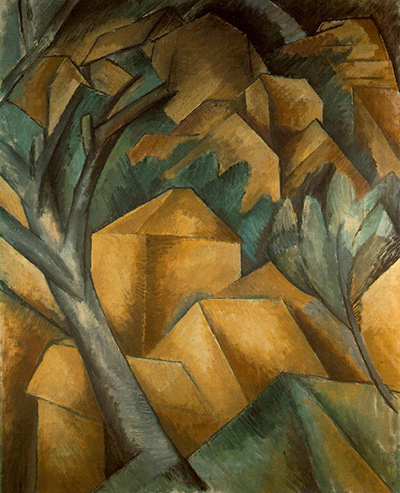
MoMA's Road near L'Estaque, painted in late summer 1908, makes another set of decisions. The museum identifies Cézanne's progressive colour gradations, flattened and difficult-to-enter space, and an area of unpainted canvas interrupting one tree limb. It also points to the work's restricted palette, crowded space and sharp geometric forms.[3] The exposed interval is small but conceptually important. An outline no longer has to seal a tree from its surroundings; surface and represented form can communicate across a gap.
The Metropolitan Museum's Trees at L'Estaque, also from summer 1908, provides a third comparison. Here, the Met describes a reverse-perspectival pressure in which sculptural forms push towards the viewer instead of receding smoothly. Light and shade no longer model the scene naturalistically. A tree trunk reads through a cylindrical cue, while a more distant element takes on a cubic one.[5] These geometric hints help recognition, but they do not reduce the whole painting to cylinders and cubes. They operate within a larger reorganisation of space.
Houses at L'Estaque, now associated with the Hermann and Margrit Rupf Foundation at Kunstmuseum Bern, belongs to the same 1908 architectural campaign.[6] Its presence alongside the road, trees and several viaducts should sharpen rather than blur distinctions. Each painting tests how a recognisable place can be compacted into a surface; each has its own date, collection and configuration. The shared inquiry is more important than an invented master template.
From Cézannian precedent to a Cubist threshold
By 1908, Braque had moved beyond respectful continuation. Cézanne's landscapes often preserve a measured tension among observation, depth and surface. Braque made the pressure more abrupt. Buildings crowd one another, conventional recession becomes unreliable, and planes relate with increasing independence from a stable viewpoint. The subject remains legible—roads, roofs, trees and viaducts persist—but it no longer governs every pictorial decision.
The public reception of the 1908 landscapes helped connect this transformation with the emergence and naming of Cubism. Braque's November exhibition at Daniel-Henry Kahnweiler's Paris gallery became an important threshold, and critical references to “cubes” gathered around the new work.[1][5] No single canvas can bear the title of first Cubist painting without qualification. What the campaign demonstrates is a sustained shift in the relationship between solid form, surrounding interval and literal surface.
Nor can Cézanne alone explain that shift. By late 1908, Braque's increasingly close exchange with Pablo Picasso was crucial. Early Cubism also drew on African and Oceanic sculpture, much of it encountered in Paris after colonial seizure and removal from original contexts.[8] Cézanne supplied a profound European precedent, but Cubism emerged from several histories and from reciprocal experimentation, not a straight line of descent from one master to one follower.
This wider context makes Braque's agency clearer. He selected from Cézanne rather than receiving a complete system. From constructive colour he developed denser planar organisation. From variable contour he developed more radical exchanges between object and field. From landscapes that question one-point perspective he moved towards spaces whose parts can press forward, overlap or remain unresolved. The results were recognisably indebted and unmistakably different.
A durable influence without discipleship
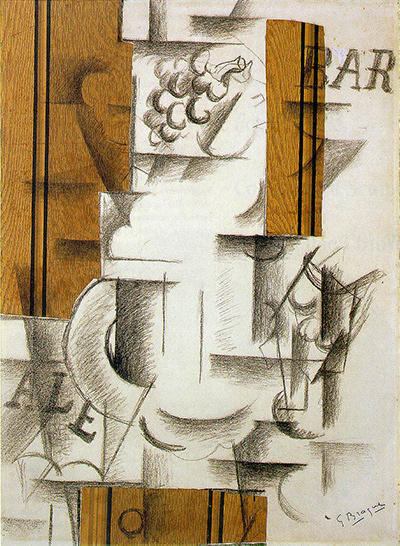
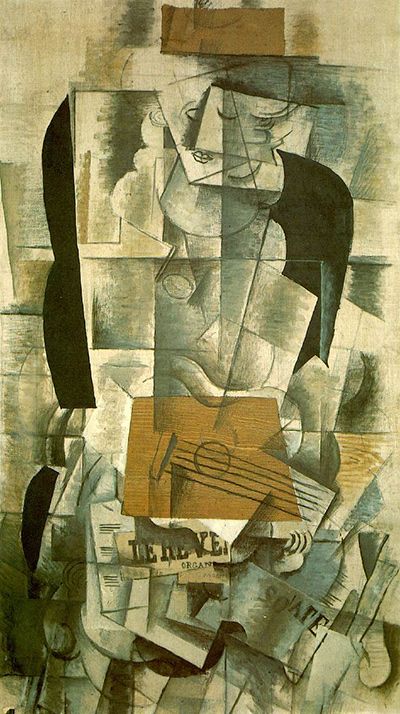
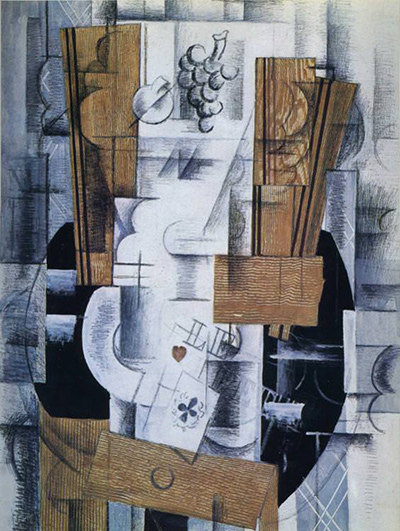
The Cézannian dialogue did not end when landscape ceased to dominate Braque's work. Still life offered another field in which objects could be made solid through colour while their relationships disturbed ordinary perspective. Fruit, vessels and tables carried questions Cézanne had pursued, but Braque subjected them to Cubist fragmentation, lettering, imitation materials and pasted paper. Continuity lay in the problem, not in a repeated appearance.
That is why the relationship between Braque and Cézanne cannot be contained by the familiar geometry slogan. Cylinders, spheres and cones say too little about high horizons, constructive colour, open boundaries, layered depth, memory and the pressure of the painted surface. They also make influence sound passive, as though Braque merely applied instructions.
L'Estaque tells a more convincing story. Braque chose Cézanne's terrain while still a Fauvist, absorbed the concentrated force of the 1907 retrospective, then separated the example into usable questions. In 1908 he rebuilt those questions through distinct landscapes and brought them to the edge of Cubism. Cézanne gave him neither a finished style nor permission to copy. He gave Braque a precedent for making perception answer to the internal life of a painting—and Braque changed the terms of the answer.
Related Pages
Frequently Asked Questions
Georges Braque went to L'Estaque before the great Cézanne retrospective of 1907.
Cézanne returned many times to L'Estaque and made the coast a sustained testing ground.
L'Estaque tells a more convincing story.
Discussion
Georges Braque went to L'Estaque before the great Cézanne retrospective of 1907.
Reader Insights
Georges Braque went to L'Estaque before the great Cézanne retrospective of 1907.
The surviving L'Estaque paintings record different stages and procedures.
L'Estaque tells a more convincing story.
Join the Conversation
Share the visible detail or source that most changed your reading.
References
- Kunstsammlung Nordrhein-Westfalen, “Georges Braque,” current exhibition resource on Fauvism, Cézanne, proto-Cubism and the 1908–14 chronology. https://www.kunstsammlung.de/en/braque/
- Centre Pompidou, “Le fauvisme et ses influences sur l'art moderne” and “L'Estaque,” French educational dossier and object record on Braque's 1906 Cézanne-directed site choice, Fauvist colour and the 1907 transition. https://mediation.centrepompidou.fr/education/ressources/ENS-Fauvisme/ ; https://www.centrepompidou.fr/en/ressources/oeuvre/cGb4p6
- Museum of Modern Art, “The Large Trees” and “Road near L'Estaque,” object records and gallery labels on the separated 1906–07 and late-summer 1908 paintings. https://www.moma.org/collection/works/78668 ; https://www.moma.org/collection/works/78787
- Centre Pompidou, “Le Viaduc à L'Estaque,” object record and catalogue analysis for the exact early-1908 studio-and-memory version. https://www.centrepompidou.fr/en/ressources/oeuvre/GyFi3gC
- Metropolitan Museum of Art, “Trees at L'Estaque,” object record and essay on the summer-1908 painting, reverse space, modelling and reception. https://www.metmuseum.org/art/collection/search/490578
- Kunstmuseum Bern, “Houses at l'Estaque,” current digital-guide identity record for the 1908 painting. https://guide.kunstmuseumbern.ch/en/artwork/1039
- Musée de l'Orangerie, “Landscape with Red Roof, or The Pine at L'Estaque,” and Metropolitan Museum of Art, “Paul Cézanne (1839–1906),” on Cézanne's repeated L'Estaque practice, constructive colour, layered space and posthumous reception. https://www.musee-orangerie.fr/en/artworks/paysage-au-toit-rouge-ou-le-pin-lestaque-196017 ; https://www.metmuseum.org/fr/essays/paul-cezanne-1839-1906
- Museum of Modern Art, “What Is Cubism?” and “Before and Beyond Cubism,” current term resources on co-development and the wider, colonially conditioned source field. https://www.moma.org/collection/terms/cubism/what-is-cubism ; https://www.moma.org/collection/terms/cubism/before-and-beyond-cubism