


 by Tom Gurney
Tom Gurney BSc (Hons) is an art history expert with over 20 years experience
Published on August 14, 2026 / Updated on August 14, 2026
Email: tomgurney1@gmail.com / Phone: +44 7429 011000
Introduction
Georges Braque's paintings are often approached through one extraordinary episode: the years in which he and Pablo Picasso developed Cubism. That episode deserves its importance, but it can distort the shape of a career that began with luminous coastal landscapes and continued for decades through tactile still lifes, inhabited studios, billiard tables, birds and late views of Normandy. Braque did not spend the rest of his life repeating the discoveries of 1911. He repeatedly changed the terms on which an object, a room or a patch of colour could become believable in paint.
The sequence below is selective rather than complete, and it is not a ranking. It follows seventeen paintings or painted ensembles through six broad transitions. One additional work, Fruit Dish and Glass, is deliberately included even though it is a paper construction. That exception matters because the act of pasting patterned paper onto a support altered what Braque could subsequently ask oil painting to do.
Dates and labels help with orientation, but the boundaries remain porous. Fauvist colour did not simply vanish when forms grew more geometric. Cubist questions about surface, space and recognition survived long after the close partnership with Picasso. Musical instruments, tables and studio objects returned in new materials and at new scales. The most revealing map is therefore not a procession of styles. It is a chain of changing pictorial problems.
At a Glance
- ArtistGeorges Braque
- GuidePaintings
- FocusA selective map of Braque’s paintings across Fauvism, Cubism, papier collé, still life and the late studios.
- Key topics1906–07: colour on the southern coast; 1907–08: rebuilding the figure and the landscape; 1909–12: objects become clues; 1912–14: actual paper, then painting after paper
- OverviewGeorges Braque's paintings are often approached through one extraordinary episode: the years in which he and Pablo Picasso developed Cubism.
Contents
- Introduction
- 1906–07: colour on the southern coast
- 1907–08: rebuilding the figure and the landscape
- 1909–12: objects become clues
- 1912–14: actual paper, then painting after paper
- 1917–39: scale, surface and the studio
- 1944–56: tables, studios and birds
- A career of changing pictorial facts
Browse Georges Braque Paintings
1906–07: colour on the southern coast
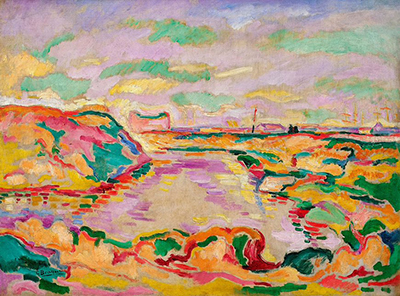
Braque's mature work first took shape through travel. After encountering the paintings of Henri Matisse, André Derain and other Fauves, he worked with Othon Friesz in Antwerp and then in the south of France. The brief Fauvist phase was not merely a colourful preface to Cubism. It taught Braque that colour could build the image instead of obediently filling local objects.
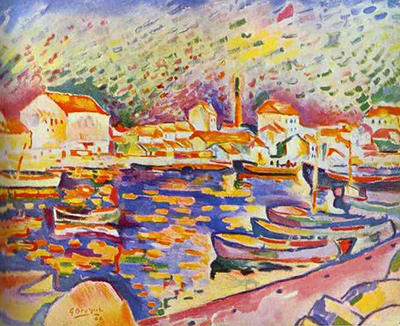
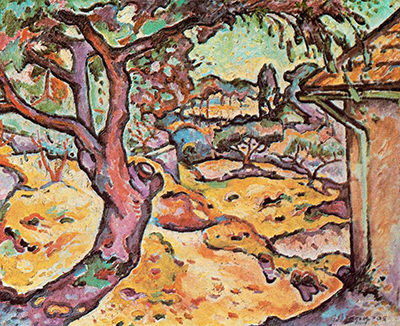
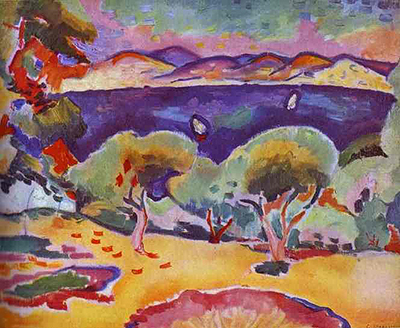
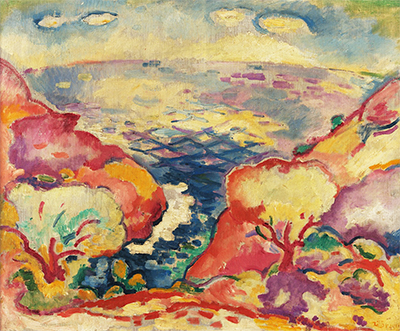
In L'Estaque, painted in October and November 1906, orange intensifies beside blue, while yellow meets violet and red meets green. The Centre Pompidou describes fragmented touches and changing strokes that differentiate the movements of water, sky and autumn atmosphere.[3] The harbour remains recognisable, yet colour has acquired an organising force of its own. Rather than covering a pre-existing drawing, the brushmarks establish rhythms through which the place is experienced.
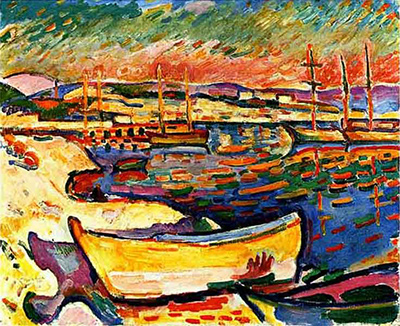
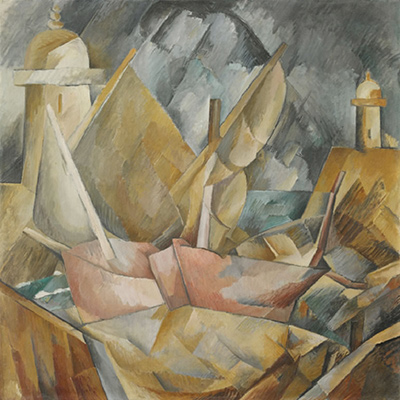
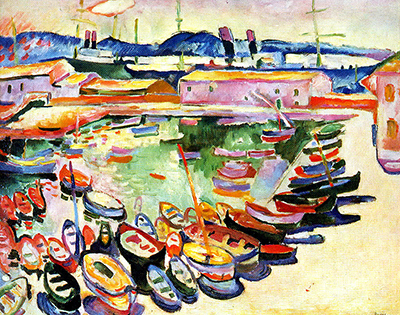
The Port of La Ciotat of spring 1907 carries that experiment forward. The National Gallery of Art identifies a golden tonality, largely non-descriptive colours and strokes whose contours begin to act independently. Open ground and sky still sustain depth, and the foreground boats retain weight. At the same time, masts divide the composition into broken vertical bands, while distant boats become cryptic strokes.[4] The painting is neither a naturalistic harbour view nor a Cubist construction. Its interest lies in the pressure between the two: liberated colour begins to consolidate rather than dissolve the scene.
That pressure makes the southern campaigns a genuine foundation. Braque learned that a landscape could remain attached to a particular coast while also functioning as an arrangement of intervals, contrasts and material touches. Cubism would radically reorganise those elements, but it did not begin from colourless theory.
1907–08: rebuilding the figure and the landscape
The following change has several contexts, not one cause. Braque saw the major Paul Cézanne retrospective at the 1907 Salon d'Automne, encountered Picasso's Les Demoiselles d'Avignon, and worked amid exchanges that also involved Matisse and André Derain. Cézanne's example encouraged him to treat natural forms as structured masses; Picasso's and Matisse's figure paintings sharpened the challenge of the monumental nude. Institutional accounts rightly present this as a field of encounters rather than the solitary invention of a ready-made style.[1][2]
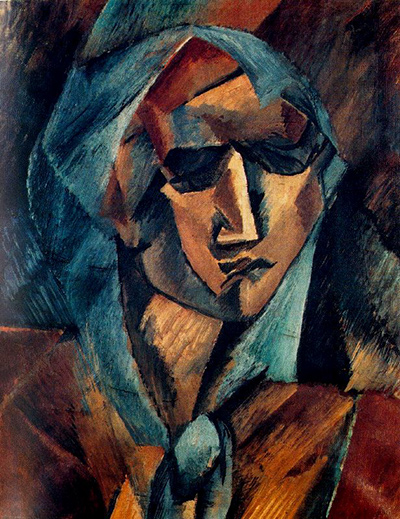
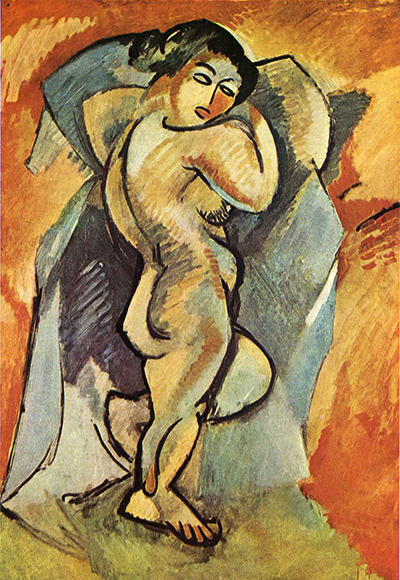
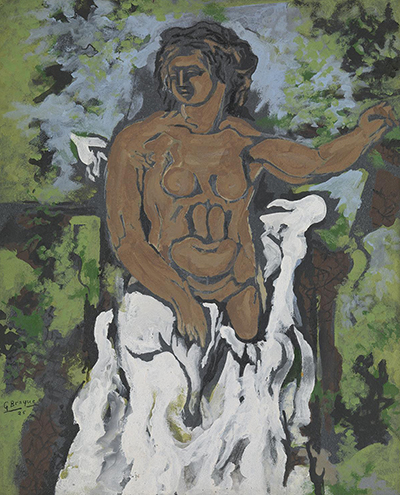
Large Nude, begun in winter 1907 and completed by June 1908, transfers the problem from coast to body. At 140 by 100 centimetres, it confronts the viewer at a scale very different from the small harbour paintings. The Centre Pompidou describes deformed anatomy, a mask-like face, and the treatment of space through volumes and planes; it also places Cézanne's bathers, Matisse's Blue Nude and Braque's visit to Picasso's studio within the work's history.[5] The body remains singular and weighty, but it no longer occupies a neutral container. Figure and surrounding space are being made answerable to the same constructive pressure.
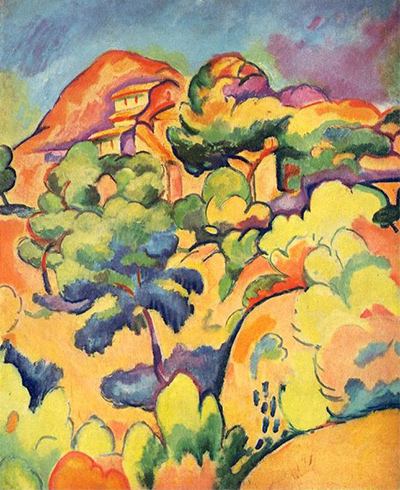
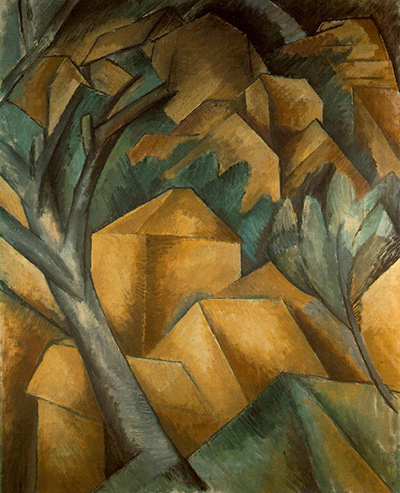
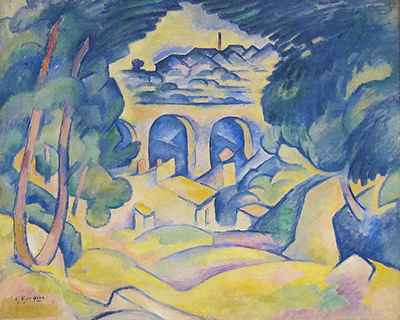
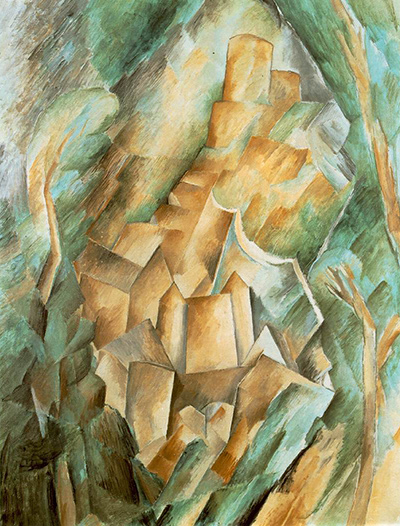
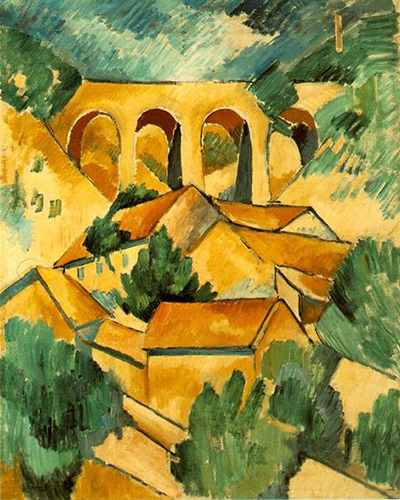
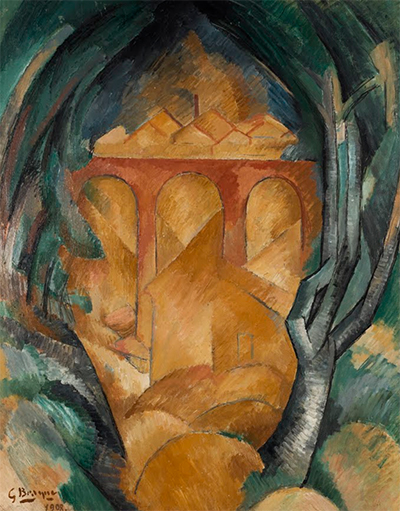
In the 1908 Houses at L'Estaque, now in the Hermann and Margrit Rupf Foundation at Kunstmuseum Bern, architecture becomes the test. The museum's current records identify the oil painting as a 73 by 59.5 centimetre work, inventory Ge 006.[6] Across Braque's landscapes of this moment, browns, greys and greens replace the earlier chromatic flare; houses, trees and slopes are layered into a shallow framework rather than ordered by a single vanishing point.[2] The important change is not that buildings turn into cubes. It is that their volumes and the intervals around them become mutually dependent. A house can read as solid, yet its edge also participates in the larger surface pattern.
These two paintings make 1907–08 a threshold rather than a tidy stylistic box. One rebuilds the body; the other compresses the landscape. Both ask how much observed reality can be transformed before recognition fails—and how painting might acknowledge its flat support without giving up mass and depth.
1909–12: objects become clues
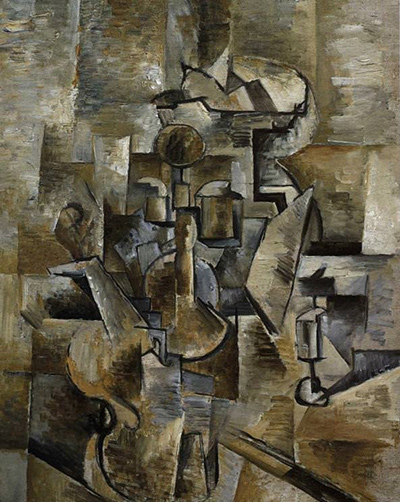
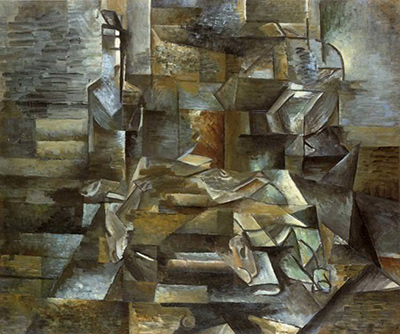
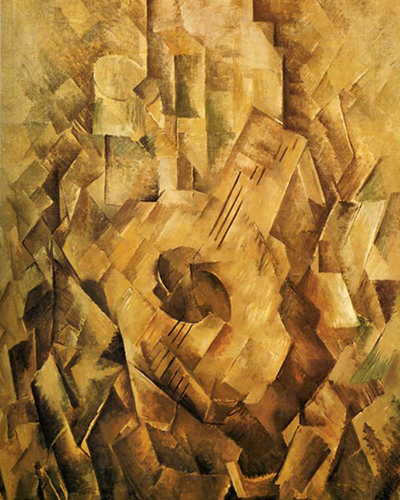
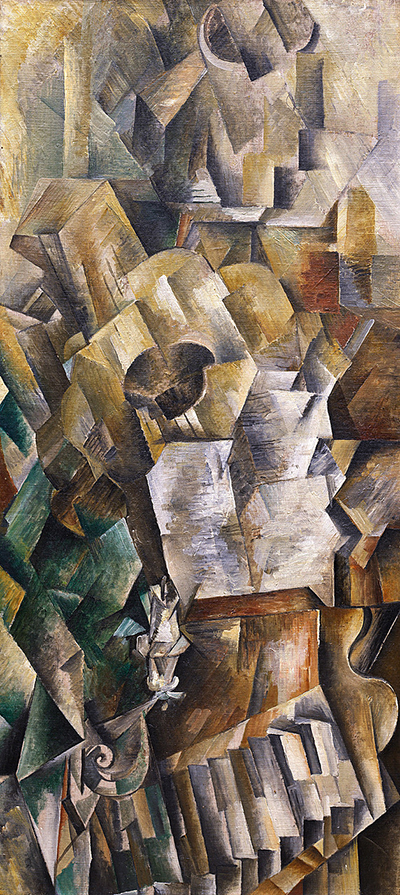
By late 1909, still life offered Braque a controlled field in which familiar things could be taken apart and reconnected. Still Life with Metronome belongs to a group of five music-themed still lifes made between late 1909 and early 1910. Its present title needs a qualification: the Met notes that the work acquired the specific metronome designation roughly thirty years after it was painted, while Braque's dealer Daniel-Henry Kahnweiler called it Still Life with Mandolin; the central instrument is more precisely a mandola.[7]
That unstable naming is appropriate to the painting's visual problem. According to the Met, the off-centre trapezoid of the metronome conveys depth while the mandola emerges from overlapping, dissolved forms.[7] These objects were familiar enough to give contemporary viewers a foothold. Braque could therefore make recognition intermittent without abandoning it. A fragment did not have to reconstruct the whole object immediately; it could remain a clue held in relation to other clues.
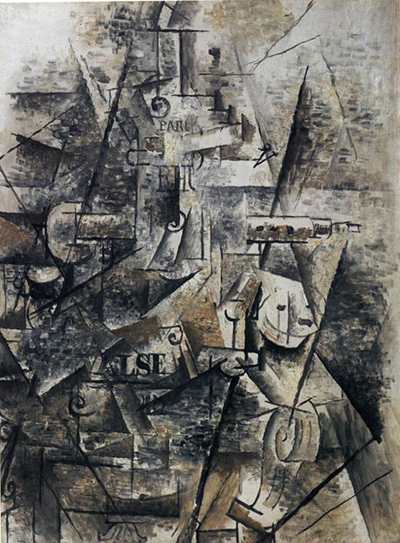
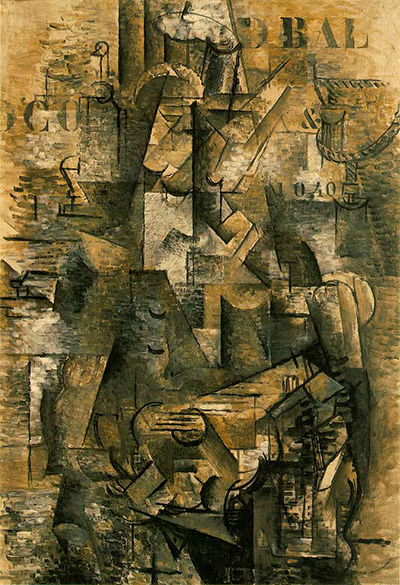
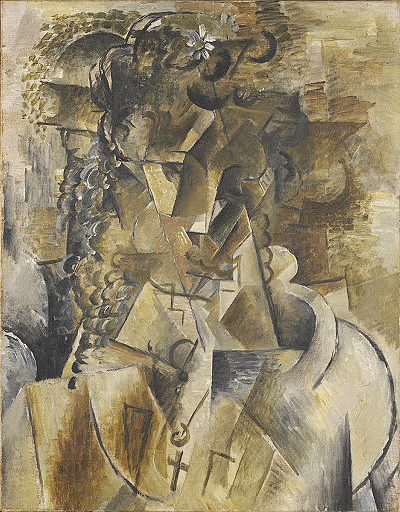
The method reaches a new intensity in The Portuguese of 1911–12. A guitarist is distributed through a shallow field of facets, strings, curves, letters and numbers. Stencilled poster fragments introduce the impersonal regularity of public signage into an oil painting. They are readable as characters while remaining incomplete as a message, and their flatness competes with the shifting depth around them.[2] The musician is not erased, but finding him becomes an activity rather than an instant recognition.
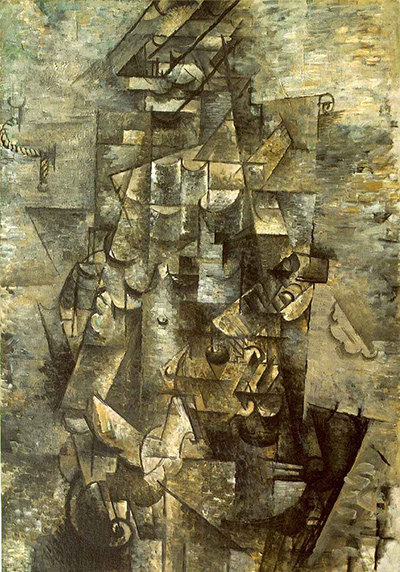
Man with a Guitar, painted at Céret from summer 1911 into early 1912, makes the disparity between kinds of representation especially clear. MoMA contrasts a readily legible nail and rope with the nearly indecipherable figure of the guitarist. Brown, green and grey facets seem to pass through one another, oscillating among surface, void and atmospheric depth; the museum nevertheless stresses that the picture is not abstract.[8] Braque did not move in a simple direction from realism to nonrepresentation. He placed different degrees of legibility beside one another and made their disagreement productive.
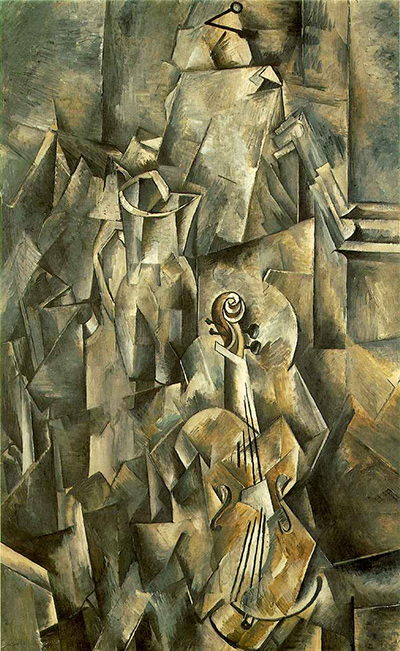
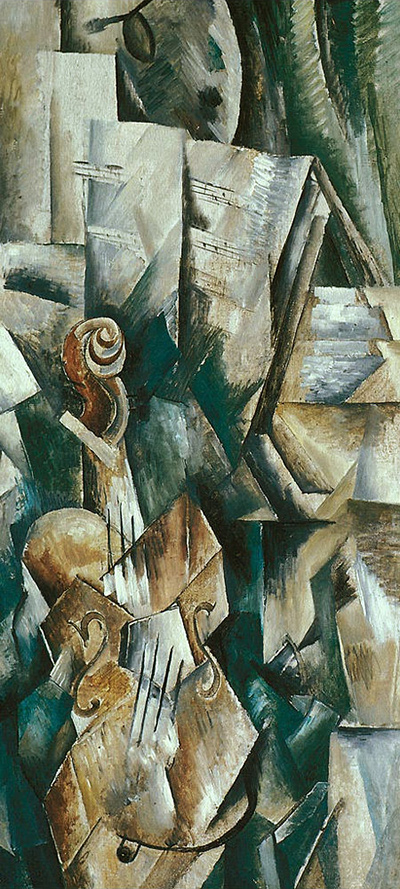
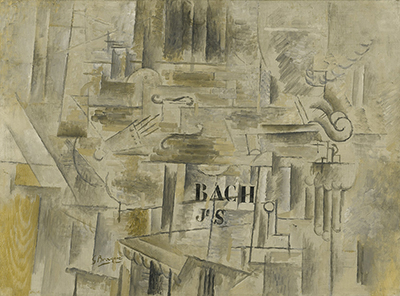
In Homage to J. S. Bach, made in winter 1911–12, parts of a violin flicker within a compressed field of tans and greys. The inscriptions BACH, J and S are as immediately recognisable as the instrument is elusive. Braque also introduced imitation wood grain into Cubism here, drawing on skills learned during his training in decorative house painting.[9] A name, a simulated material and fragmented violin parts coexist without pretending to have been seen in the same way. The painting's subject is therefore carried by several registers at once: linguistic reference, tactile illusion and partial depiction.
Braque and Picasso developed this language through exceptionally close exchange. Treating that partnership as reciprocal is more accurate than awarding Cubism to either man alone. It also leaves room for individual decisions. Braque's stencils, musical signs and faux wood were not anonymous features of a movement; they were precise interventions into the relation between the depicted object and the physical canvas.
1912–14: actual paper, then painting after paper
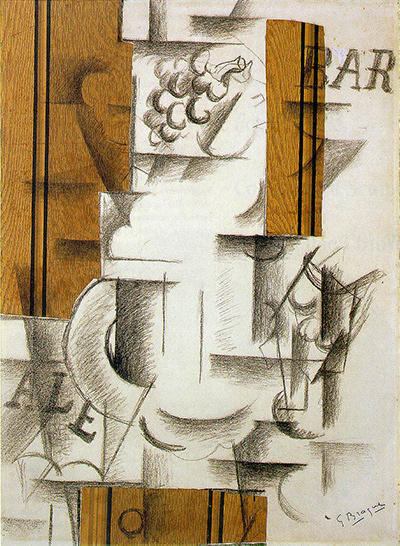
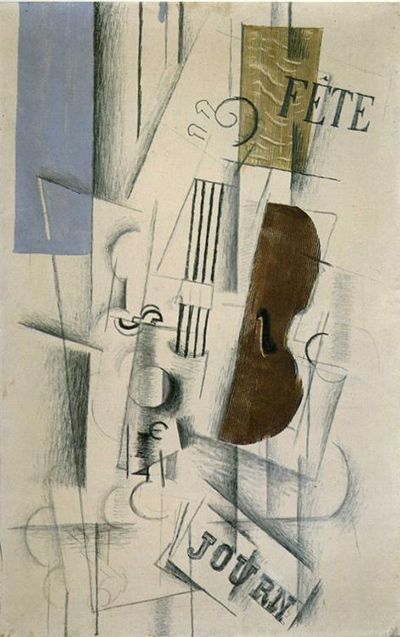
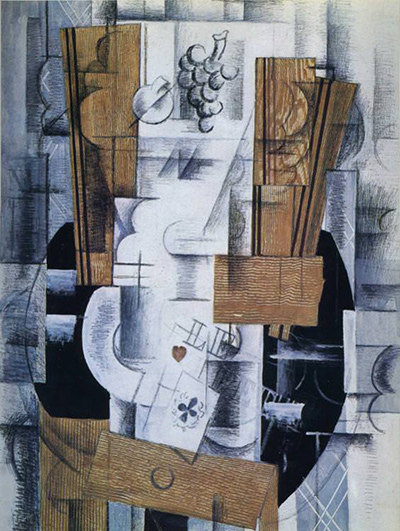
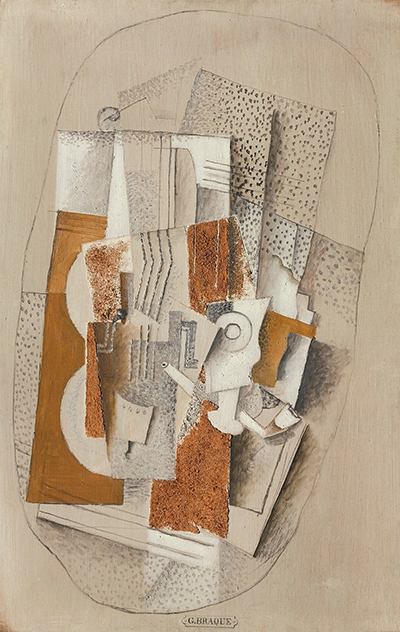
The decisive break came at Sorgues in autumn 1912. Fruit Dish and Glass is the one non-painting in this sequence. Braque combined charcoal and gouache with pieces of printed wallpaper on paper, then attached the completed sheet to paperboard. In the Met's account, this became his first papier collé, or pasted-paper construction.[10] That defined claim should not be expanded into the assertion that he single-handedly invented every form of collage.
The pasted wallpaper matters because its printed faux-wood pattern is neither an illusion painstakingly painted nor a literal piece of the furniture it evokes. It is a manufactured surface moved into a new setting. Charcoal lines can propose a fruit dish or glass across and around it, while the paper remains visibly a separate material. Shape and colour no longer need to arrive together as attributes of one represented object. An external fragment can become a structural component of the work.
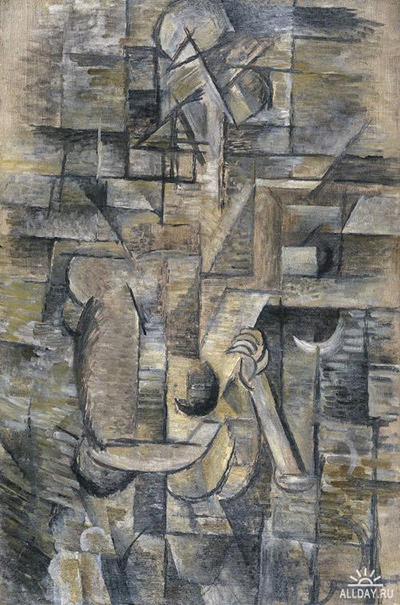
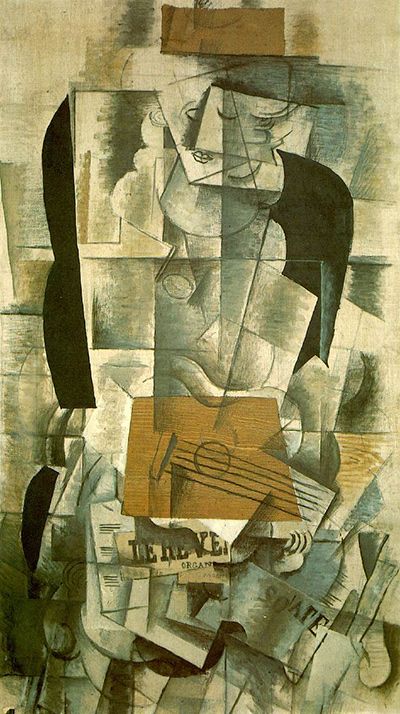
This is why a paper construction belongs in a guide to Braque's paintings. It changes the paintings that follow. Woman with a Guitar, made at Sorgues in autumn 1913, is unequivocally a painting—oil and charcoal on canvas, with no pasted paper. Yet the Centre Pompidou explains that it absorbs the lessons of the papiers collés rather than transcribing them literally. A faux-wood guitar, black curves of a chair, a more recoverable face, a rectilinear grid and fragments referring to a newspaper and a musical score gradually yield a female musician.[11]
Compared with the near-disappearance of the figure in 1911, larger and more continuous forms now return. They appear cut, layered or set against one another as if painting had learned from the directness of paper. The move sometimes called Synthetic Cubism was therefore not a retreat from experiment into easy legibility. It was a new way to construct an image from fewer, broader and more materially differentiated signs.
1917–39: scale, surface and the studio
The First World War interrupted Braque's work. He enlisted in 1914, was severely wounded in 1915 and did not resume painting until 1917.[1] That chronology matters, but it does not explain the later art as a direct symptom of injury. What the paintings demonstrate is a renewed engagement with Cubist discoveries under changed conditions: larger formats, richer colour, denser interiors and an increasingly tactile surface.
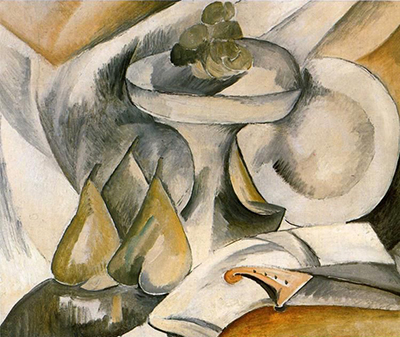
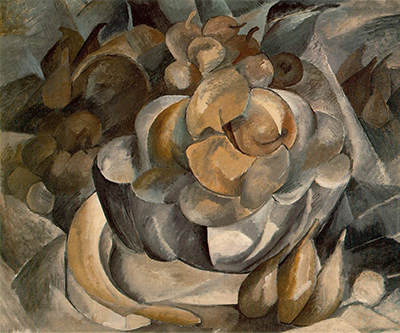
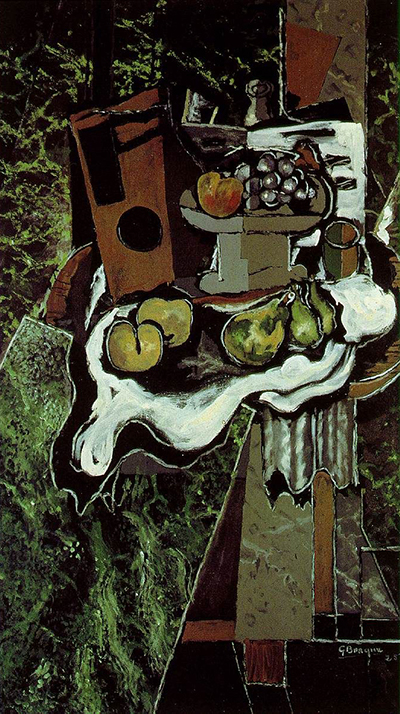
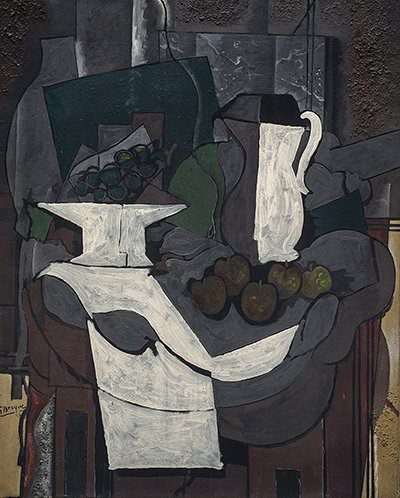
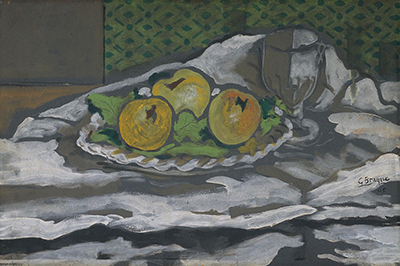
Fruit on a Tablecloth and Fruit Dish of 1925 makes the shift unmistakable. This vertical canvas is more than 1.3 metres high. A white cloth isolates a grouping of musical instrument, score, fruit dish and autumn fruit, while rectangular and rounded forms answer one another. The Centre Pompidou emphasises the work's theatrical emergence of objects against dark ground and, above all, its mosaic of simulated green and grey marbles. Those faux surfaces recall both Braque's decorative training and the doubled material games of the prewar pasted papers.[12] Cubism persists here as a method for reinventing space, not as the return of 1911's small facets.
In The Bowl of Grapes of 1926, material texture is literal as well as imitated. Braque mixed pebbles and sand into the oil paint. The Peggy Guggenheim Collection describes a structuring grid softened by broad curves and clusters of circular forms, with heavy contours, tilted planes and discontinuous background lines recalling Cézanne.[13] The result brings visual construction into contact with bodily expectation: a bowl, grapes and table-like planes feel substantial even when perspective refuses to settle.
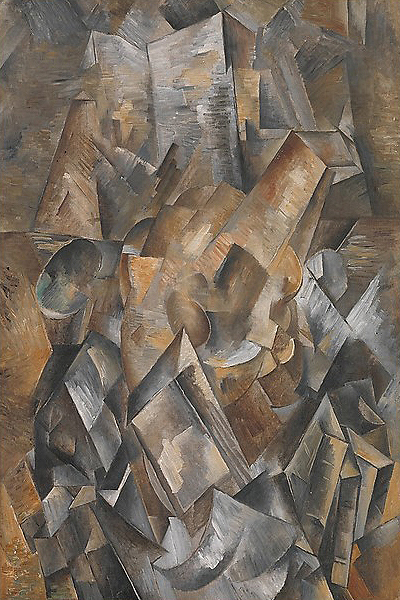
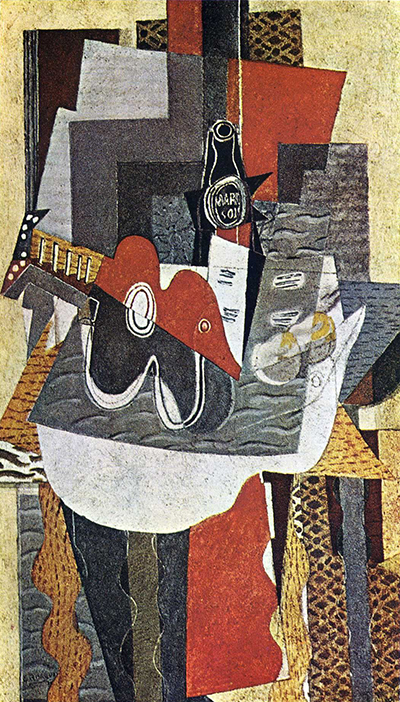
Music remains present in Guitar and Bottle of Marc on a Table of 1930, but the instrument no longer dissolves like the guitarist's instrument of 1911. The Cleveland Museum of Art places the oil-and-sand canvas among Braque's large still lifes of 1928–32, noted for rich textures and vivid colour. A bottle of marc, sheet music, a glass fruit bowl and apples join the guitar on a white tablecloth.[14] Recurring subjects make the transformation easier to see. Braque can revisit an instrument without repeating the pictorial language through which it was once represented.
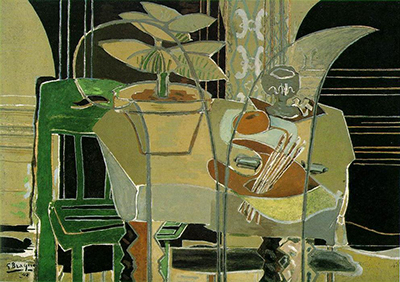
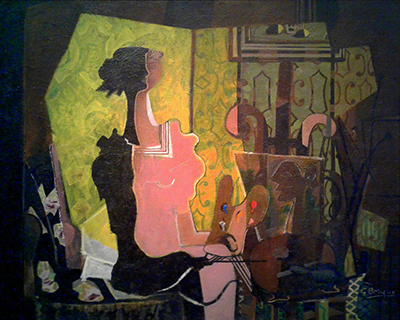
Woman Seated at an Easel of 1936 broadens the still-life world into an inhabited studio. The Met identifies a seated female artist holding palette and brush in Braque's Varengeville studio; oil mixed with sand gives the large canvas its material surface.[15] Figure, easel and surrounding objects occupy one integrated field. The painter at work is recognisable, yet she is not isolated from the studio as a conventional portrait sitter. The room becomes an extension of the activity it contains.
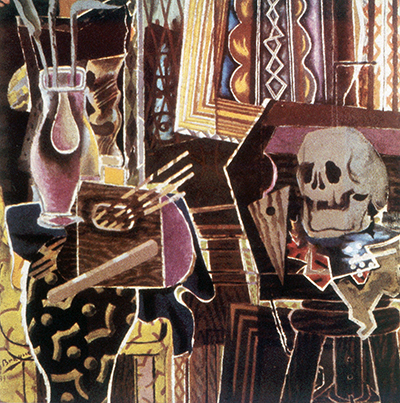
By 1939, the studio could also carry historical unease. Vase, Palette, and Skull gathers an easel, palette, vase, furniture and frames into overlapping surfaces, with sand and carefully rendered wood grain intensifying their material differences. The Kreeger Museum notes the ominous force a skull can acquire in a painting made just before the occupation of France, but it also records Braque's later insistence that his skulls were apolitical.[16] Both facts should remain in view. The object can evoke mortality and impending danger without becoming a cipher with one authorised political solution.
Taken together, these works overturn the idea of a diluted post-Cubist Braque. The prewar questions survive, but their terms expand. Flatness can coexist with volume, simulated marble with actual sand, familiar objects with ambiguous rooms. The studio is no longer merely the place where a painting was made; it has become one of the painting's most demanding subjects.
1944–56: tables, studios and birds
The late paintings push spatial contradiction into larger sequences. The Billiard Table of 1944 begins a group of seven paintings that Braque developed between 1944 and 1952. In this first canvas, the green table is seen obliquely and seems to fold towards the viewer; the wall behind it bends in sympathy. Sand in the paint gives the green field a rough-soft equivalent for billiard cloth, while crossed cues and imagined ball trajectories activate the surface.[17] A familiar piece of furniture becomes an arena in which the room itself can be bent and reopened.
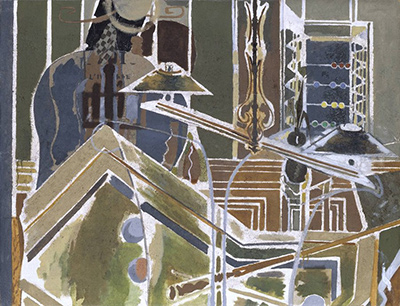
Braque's numbered Ateliers move from a game table to the accumulated world of making. Atelier IX was worked in 1952–53, then revised and completed for exhibition in spring 1956. The Centre Pompidou identifies it as the conclusion to a sequence of eight canvases begun in 1949.[18] Easel, palette, brushes, jar, stool, sculpture, lamp and table remain available as studio signs, but they overlap with a bird that crosses the measured room. The museum's analysis describes layers seeming to develop both behind and in front of the canvas surface.[18] The studio becomes less a record of furniture than a space in which material objects, remembered images and imagined presences can interpenetrate.
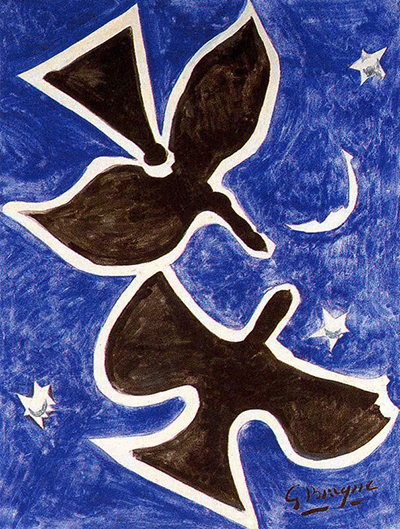
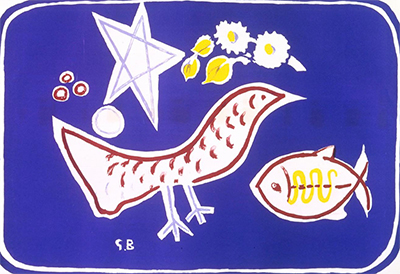
While Atelier IX was still developing, Braque accepted a public commission that changed the scale and setting of the bird motif. The Louvre's Les Oiseaux of 1953 is not one portable canvas. It is a three-part ceiling made for the Salle Henri II, commissioned in June and installed around the middle of July. The central oil-on-canvas component alone measures approximately 3.46 by 5.05 metres and belongs with two related inventory components.[19] A sign that can hover ambiguously inside the private studio is here projected into architecture above a public room.
The birds should not be reduced to a single spiritual code. Their significance changes with placement. In Atelier IX, the bird enters a dense interior of tools, furniture and paintings; at the Louvre, birds organise an overhead ensemble whose meaning depends on bodily movement through an architectural setting. The motif is continuous, but its pictorial job is not.
A career of changing pictorial facts
Seen across these works, Braque's career is held together less by one appearance than by one persistent question: what can count as a pictorial fact? In 1906, a colour contrast can establish the vibration of a harbour. In 1908, the edge of a house can build both volume and surface pattern. In 1911, a string, letter or nail can preserve a subject within fractured space. In 1912, a piece of wallpaper can enter the work as itself and as something else. Later, sand, faux marble, furniture, studio tools and bird signs give painting new kinds of material and spatial evidence.
This continuity is why the late work should not be treated as an appendix to Cubism, and why the early Fauvist paintings deserve more than a glance on the way to it. Each period changes the balance among recognition, touch, colour, depth and the literal support. Braque's paintings do not offer one solution repeated across six decades. They show a painter returning to a small world of coasts, instruments, fruit, tables and rooms—and making that world newly uncertain each time.
Related Pages
Frequently Asked Questions
Georges Braque's paintings are often approached through one extraordinary episode: the years in which he and Pablo Picasso developed Cubism.
Braque's mature work first took shape through travel.
This continuity is why the late work should not be treated as an appendix to Cubism, and why the early Fauvist paintings deserve more than a glance on the way to it.
Discussion
Georges Braque's paintings are often approached through one extraordinary episode: the years in which he and Pablo Picasso developed Cubism.
Reader Insights
Georges Braque's paintings are often approached through one extraordinary episode: the years in which he and Pablo Picasso developed Cubism.
The decisive break came at Sorgues in autumn 1912.
This continuity is why the late work should not be treated as an appendix to Cubism, and why the early Fauvist paintings deserve more than a glance on the way to it.
Join the Conversation
Share the visible detail or source that most changed your reading.
References
- Museum of Fine Arts, Houston, “The Museum of Fine Arts, Houston, is Sole U.S. Venue for Georges Braque Retrospective,” institutional career chronology and exhibition resource. https://www.mfah.org/press/museum-fine-arts-houston-sole-us-venue-georges-braque-retrospective
- Kunstsammlung Nordrhein-Westfalen, Georges Braque: Inventor of Cubism, current institutional resource on Fauvism, Proto-Cubism, Analytic Cubism, Braque and Picasso, and Le Portugais. https://www.kunstsammlung.de/en/braque/
- Centre Pompidou, “L'Estaque,” October–November 1906, AM 4297 P. https://www.centrepompidou.fr/en/ressources/oeuvre/cGb4p6
- National Gallery of Art, “The Port of La Ciotat,” 1907, 1998.74.6. https://www.nga.gov/artworks/106383-port-la-ciotat
- Centre Pompidou, “Grand Nu,” winter 1907–June 1908, AM 2002-127. https://www.centrepompidou.fr/en/ressources/oeuvre/crd6AR
- Kunstmuseum Bern, “Houses at l'Estaque,” digital guide; and Complete Collection List, 6 July 2026, entry for Häuser in L'Estaque, Ge 006. https://guide.kunstmuseumbern.ch/en/artwork/1039 and https://www.kunstmuseumbern.ch/en/api/files/2026-07/Gesamtliste_Sammlung_6.7.2026_1.pdf?_rsc=5zQUHQRiZn8hwFE2
- Metropolitan Museum of Art, “Still Life with Metronome (Still Life with Mandola and Metronome),” Paris, late 1909, 2025.616.13. https://www.metmuseum.org/art/collection/search/490581
- Museum of Modern Art, “Man with a Guitar,” Céret, summer 1911–early 1912, 175.1945. https://www.moma.org/collection/works/79048
- Museum of Modern Art, “Homage to J. S. Bach,” winter 1911–12, 544.2008. https://www.moma.org/collection/works/116275
- Metropolitan Museum of Art, “Fruit Dish and Glass,” Sorgues, autumn 1912, 2016.237.33. https://www.metmuseum.org/art/collection/search/490612
- Centre Pompidou, “Femme à la guitare,” autumn 1913, AM 3487 P. https://www.centrepompidou.fr/en/ressources/oeuvre/cKx5bbn
- Centre Pompidou, “Fruits sur une nappe et compotier,” 1925, AM 2700 P. https://www.centrepompidou.fr/en/ressources/oeuvre/cgjzXer
- Peggy Guggenheim Collection, “The Bowl of Grapes,” 1926, 76.2553 PG 8. https://www.guggenheim-venice.it/en/art/works/the-bowl-of-grapes/
- Cleveland Museum of Art, “Guitar and Bottle of Marc on a Table,” 1930, 1975.59. https://www.clevelandart.org/art/1975.59
- Metropolitan Museum of Art, “Woman Seated at an Easel,” 1936, 1996.403.12. https://www.metmuseum.org/art/collection/search/486742
- Kreeger Museum, “Vase, Palette, and Skull,” 1939, 1963.3. https://www.kreegermuseum.org/about-us/collection/painting/Georges-Braque_Vase-Palette-and-Skull
- Centre Pompidou, “Le Billard,” 1944, AM 2604 P. https://www.centrepompidou.fr/en/ressources/oeuvre/cAzRAE
- Centre Pompidou, “Atelier IX,” 1952–spring 1956, AM 1982-99. https://www.centrepompidou.fr/fr/ressources/oeuvre/cabkjo
- Musée du Louvre, “Plafond: Les oiseaux,” 1953, INV 20379 and related ensemble records. https://collections.louvre.fr/en/ark:/53355/cl010065746