 by Tom Gurney
Tom Gurney BSc (Hons) is an art history expert with over 20 years experience
Published on August 14, 2026 / Updated on August 14, 2026
Email: tomgurney1@gmail.com / Phone: +44 7429 011000
Introduction
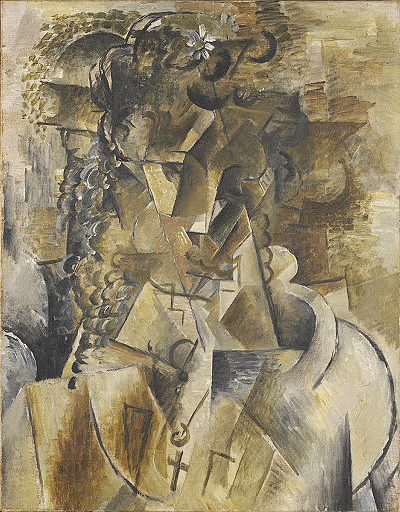
Georges Braque’s Girl with a Cross makes a human presence depend on a remarkably small set of clues. A necklace, curling hair, the bridge of a nose and a single eye remain available within an unsettled field of facets. The cross hanging from the necklace sharpens that recognition. Yet these details never join into a sealed head or a continuous body. They appear, weaken and re-enter the surrounding structure as attention moves across the painting.
That unequal visibility gives the work its peculiar force. The figure is specific enough to be encountered as a person, while incomplete enough to keep every act of identification provisional. A round white ceramic pot intensifies the tension. In the Kimbell Art Museum’s account, the vessel has greater painted solidity than the woman and occupies an area where a shoulder might be expected.[1] An everyday vessel therefore helps to make the missing continuation of the body perceptible. Recognition occurs through an exchange among what survives, what recedes and what another object leads the viewer to expect.
At a Glance
- ArtistGeorges Braque[1]
- TitleGirl with a Cross[1]
- Date1911[1]
- MediumOil on canvas[1]
- Dimensions55 × 43 cm (21 5/8 × 16 15/16 in.)[1]
- CollectionKimbell Art Museum[1]
- AccessionAP 1989.02[1]
- SignificanceThe Kimbell figure to examine how bodily cues survive within an Analytic Cubist field
Contents
- Introduction
- The Exact Kimbell Painting
- Recognition Begins with Vestiges
- A Head That Appears and Recedes
- What Thin Scumbling Contributes
- The Cross as a Bodily Coordinate
- The Pot and the Expected Shoulder
- Figure and Space Share the Field
- Presence, Absence and Movement
- The 1910–12 Cubist Experiment
The Exact Kimbell Painting
The Kimbell identifies Girl with a Cross as an oil on canvas made by Braque in 1911. The canvas measures 55 by 43 centimetres and carries the accession number AP 1989.02.[1] These compact dimensions matter to the painting’s encounter: the dispersed signs belong to a relatively concentrated surface, and their relations can be held together without turning the work into a broad narrative scene.
The title supplies two anchors, “girl” and “cross.” It leaves the sitter unnamed. The museum record offers no biography, exact age, social role or relationship between the subject and the artist.[1] The painting consequently works differently from a portrait whose identity can organise every feature. Here, subjecthood has to be built from the surviving pictorial evidence. The title helps the eye seek a female figure, while the listed cues determine how far that search can responsibly go.
Recognition Begins with Vestiges
The Kimbell calls the bodily details “vestiges”: an eye, the bridge of a nose, a cascade of curls and a necklace with a cross.[1] The word is useful because each element carries recognitional power without behaving like a fully enclosed part. An eye can establish the idea of a face. A nose bridge can suggest its orientation. Curls can extend the possible boundary of a head. A hanging necklace implies a neck and upper body even when their contours remain uncertain.
These clues work cumulatively. Any one of them could remain an isolated mark or shape; together they encourage a human reading. Their different roles also keep recognition active over time. Facial cues establish orientation, hair broadens the head’s reach, and the pendant draws attention downward. The viewer constructs a relation among separated signs, then tests that relation against adjacent facets.
Such recognition is graded. The museum’s singular “eye” sets a precise limit, as does its selection of the nose bridge from the larger facial structure.[1] The evidence gives fragments that point beyond themselves. Braque can therefore sustain the category of a figure while withholding the conventional outline that would gather every part into one anatomy. The strength of the links among cues matters more than the quantity of body parts available for naming.
A Head That Appears and Recedes
In the Kimbell’s description, the head—or its disembodied details—emerges like an apparition among highlighted and shaded facets.[1] “Apparition” captures a visual condition of uncertain emergence. It describes the way a presence can gather without acquiring a firm perimeter. The term need carry no supernatural story. Its value lies in the unstable threshold between becoming visible and returning to the wider field.
Highlight and shade help produce that threshold. A change in value may give a local cue enough distinction to register as part of the head. A neighbouring facet may then connect that same cue to the surrounding construction. Light and dark are consequently doing more than modelling a continuous volume. They distribute degrees of legibility across the surface.
This arrangement prevents the head from behaving as an isolated object set before a passive background. Its details share the same faceted language as their surroundings. A passage can contribute to facial orientation at one moment and to the broader pictorial rhythm at another. The head gains presence through temporary alignments, then loses some of that presence when attention follows another sequence of planes.
What Thin Scumbling Contributes
The Kimbell characterises the facets as thinly scumbled and atmospheric.[1] A scumble, in the National Gallery’s general definition, is a thin layer of lighter-toned paint laid over an underlying colour; its thinness allows a measure of translucency.[4] Applied to the Kimbell’s object-specific description, that definition helps explain how a surface may both cover and disclose.
Scumbling can soften a hard division between adjoining areas because the underlying colour remains active through the upper layer. In Girl with a Cross, the effect described by the museum belongs to the painting’s broader pattern of emergence. A bodily cue may become clear enough to be recognised while retaining contact with tones around or beneath it. Atmosphere here concerns the condition of edges and transitions, separate from depicted weather or a literal haze surrounding the sitter.
This technique also complements the highlighted and shaded facets. Value changes establish local differences; a thin, partly translucent application can keep those differences from turning into wholly separate blocks. The painting can articulate an eye or a curl while preserving continuity across the field. Surface handling and recognition thus serve the same argument: presence gathers by degrees.
The Cross as a Bodily Coordinate
The cross is both a feature named in the title and a pendant identified by the Kimbell on the figure’s necklace.[1] Its importance begins with that double status. Words direct attention towards a compact sign, and the sign helps organise the figure. Because a necklace belongs in relation to a neck and upper body, the cross contributes positional information as well as recognition.
Its hanging relation carries more evidence here than an expanded symbolic story. The museum treats the cross as a listed visual cue; sitter identity and devotional meaning remain undocumented.[1] That boundary leaves the pendant’s pictorial work in the foreground. It becomes one of the few shapes capable of stabilising the human reading, even as the body around it remains dispersed.
The title also changes the hierarchy among the surviving cues. Eye and nose bridge might seem more immediately anatomical, yet the cross receives the work’s verbal emphasis. That emphasis encourages movement between name and image: the viewer searches for the pendant, locates its relation to the necklace, and gains another entry into the upper body. The named object becomes a coordinate within a field whose anatomy cannot be traced continuously.
The Pot and the Expected Shoulder
At the right, the Kimbell identifies what appears to be a round white ceramic pot. It describes the vessel as more solidly painted than the woman and observes that it occupies the space where her shoulder might be expected.[1] The contrast introduces a second kind of recognisability. The pot gains coherence as an object at the point where the body loses continuity.
Roundness, whiteness and ceramic material make the vessel relatively definite in the museum’s account. Its greater solidity still belongs to the Cubist field, while giving the eye a firmer term against which to register the figure’s dispersal. The woman and the pot therefore establish an asymmetry. One appears through scattered personal cues, while the other consolidates around object identity.
The shoulder relation is especially revealing. Once the face, hair and necklace suggest an upper body, the eye anticipates continuation. The pot enters that anticipated zone. It makes the absent shoulder legible because an expectation has already been formed. The vessel’s position activates the gap even without a drawn outline of the missing body part.
This relation is spatial and pictorial. The pot never has to become a shoulder, and the woman never has to transform into ceramic matter. Their force comes from occupying competing roles within the same area. The vessel is seen as a vessel, the figure is retained as a figure, and their proximity unsettles the border that would usually separate them.
Presence, Absence and Movement
The Kimbell gathers the painting’s effects under presence, absence and movement, describing their dissolution into a single “space-time diagram.”[1] As museum interpretation, the phrase offers a concise metaphor for simultaneous pictorial relations. It gains clarity when each term is returned to the canvas’s recognitional structure.
Presence comes from the eye, nose bridge, curls and cross. Absence enters through the unclosed body and the shoulder area occupied by the pot. Movement arises as attention travels among these cues, follows changes of value and experiences forms emerging or receding. The movement belongs to looking: it requires no literal action by the sitter and no scientific account of time.
All three conditions operate together. A cue can establish presence while its open boundary preserves absence. The next shift of attention can weaken that cue and strengthen another. Braque turns recognition into a sequence of adjustments, even though the material surface is encountered at once. The figure persists because the viewer can repeatedly rebuild her from relations that never become final.
The 1910–12 Cubist Experiment
The painting’s 1911 date places it within the concentrated exchange between Braque and Pablo Picasso that the Kimbell later examined in Picasso and Braque: The Cubist Experiment, 1910–1912. The 2011 exhibition, jointly organised with the Santa Barbara Museum of Art, assembled sixteen paintings and twenty works on paper to explore that experimental dialogue.[2]
Girl with a Cross was among the works selected. The exhibition opened at the Kimbell from 29 May to 21 August 2011, then appeared in Santa Barbara from 17 September 2011 to 8 January 2012.[2][3] This later grouping supplies a precise historical frame: the canvas belongs to a short period in which sustained exchange accompanied intensive experiments with figure, object and space.
The context leaves Braque’s authorship intact and keeps this painting’s evidence distinct. Its particular achievement lies in the coordination of a sparse female cue set, a named pendant, atmospheric faceting and a comparatively solid pot. The broader partnership helps locate the experiment; the Kimbell object record explains how this canvas conducts it.
From Kahnweiler to the Kimbell
The Kimbell’s provenance begins with Daniel-Henry Kahnweiler in Paris. The canvas then belonged to Rolf de Maré by 1923 and remained with him until 1947. The museum records César Mange de Hauke by 1947 and Edith K. Bralove by 1959, with her ownership continuing to 1972.[1]
On 25 October 1972, the painting appeared as lot 66 at Sotheby Parke-Bernet in New York. Its subsequent chain runs through George P. Livanos and Acquavella Galleries before the Kimbell Art Foundation purchased it in 1989.[1] The careful “by” dates in the museum record preserve the difference between a documented state of ownership and an exact transfer date.
That chain brings the painting into a public museum collection. It also returns attention to the authority of the individual object: a compact 1911 oil with an established accession identity and a remarkably concentrated interpretive problem. The girl remains available through an eye, a nose bridge, curls and a cross, while every surrounding device tests how little continuity a figure requires.
The pot clarifies the stakes. Its solidity makes a bodily gap tangible; its occupation of the expected shoulder zone binds object recognition to human recognition. Facets and scumbling then keep both terms within one surface. Girl with a Cross endures as an encounter with presence built from intervals—strong enough to establish a person, open enough to make seeing her an active, renewable act.
Related Pages
Frequently Asked Questions
Georges Braque’s Girl with a Cross makes a human presence depend on a remarkably small set of clues.
The Kimbell identifies Girl with a Cross as an oil on canvas made by Braque in 1911.
The pot clarifies the stakes.
Discussion
Georges Braque’s Girl with a Cross makes a human presence depend on a remarkably small set of clues.
Reader Insights
Georges Braque’s Girl with a Cross makes a human presence depend on a remarkably small set of clues.
At the right, the Kimbell identifies what appears to be a round white ceramic pot.
The pot clarifies the stakes.
Join the Conversation
Share the visible detail or source that most changed your reading.
References
- Kimbell Art Museum, “Girl with a Cross,” collection record, AP 1989.02. https://kimbellart.org/collection/ap-198902
- Kimbell Art Museum, “Picasso and Braque: The Cubist Experiment, 1910–1912,” exhibition record. https://kimbellart.org/exhibition/picasso-and-braque
- Santa Barbara Museum of Art, “Picasso and Braque: The Cubist Experiment, 1910–1912,” exhibition press document. https://content.sbma.net/website/exh-pressreleases/03braque.pdf
- National Gallery, London, “Scumble,” glossary. https://www.nationalgallery.org.uk/paintings/glossary/scumble