 by Tom Gurney
Tom Gurney BSc (Hons) is an art history expert with over 20 years experience
Published on August 14, 2026 / Updated on August 14, 2026
Email: tomgurney1@gmail.com / Phone: +44 7429 011000
Introduction
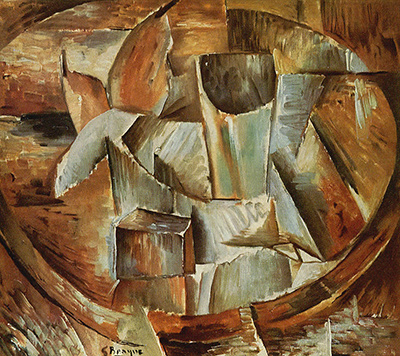
Georges Braque's Glass on a Table gathers an unremarkable set of things into a demanding pictorial problem. A Tate-derived description identifies a wine glass and pears on an oval table.[2] Those words promise an easily grasped still life. The painting's Cubist setting changes the terms of that promise: objects remain available to recognition while their outlines, volumes and spatial relations cease to form one settled scene.
The resulting uncertainty is productive. A glass may be found, lost within the surrounding structure and found again; the table can suggest a support in depth while also asserting a shape across the canvas. Recognition and construction alternate. Braque keeps the everyday world present, yet he prevents any single view from possessing it completely.
At a Glance
- ArtistGeorges Braque[1]
- TitleGlass on a Table[1]
- Date1909–10[1]
- MediumOil on canvas[1]
- Dimensions33.1 × 37.2 cm[1]
- CollectionTate[1]
- AccessionT05028[1]
- SignificanceA small early Cubist still life makes an oval table, glass, pears and box oscillate between recognition and structure
Contents
- Introduction
- The exact Tate painting
- An oval with two roles
- Why the glass is difficult
- Recognition takes time
- An early point in Analytic Cubism
- A late-1909 comparison
- A provenance with visible gaps
- A similar title, a separate object
- The ordinary world held open
The exact Tate painting
Braque painted Glass on a Table, also known as Le Verre sur la table, in 1909–10. It is an oil on canvas measuring 33.1 by 37.2 centimetres and belongs to Tate under accession T05028.[1][2] The support is only slightly wider than it is tall. Its modest dimensions make the work markedly different from the large vertical figure paintings that would follow during the most compressed phase of Analytic Cubism.
The scale matters because a still life does not need a broad stage. Table, vessel and fruit can be brought into close relation inside a small rectangle, so that the identity of each thing depends intensely on its neighbours. The viewer cannot simply survey a roomy arrangement from a distance. Every cue participates in the pressure between a tabletop scene and a self-contained pictorial structure.
The painting entered Tate in 1988 through a bequest from Sir Antony Hornby administered by the Friends of the Tate Gallery.[2] That history and the accession number are useful safeguards, since Braque made several works with similar English titles. T05028 always denotes this small 1909–10 canvas.
An oval with two roles
The oval table offers the broadest organising clue. In conventional perspective, the top of a round table appears as an ellipse, giving the eye a horizontal surface on which objects can stand. Yet an oval can also be read directly as a curve laid across a flat rectangle. It therefore belongs at once to the represented furniture and to the painting's design.
That dual role helps explain why the setting can feel intelligible without becoming spatially secure. The table tells us what kind of place this is, but it does not have to behave like a platform seen from one fixed position. Its contour can gather glass and pears into a still life while contributing to the network that loosens the division between object and surrounding space.
Braque's choice is especially apt for Cubism because the ellipse is already a translation. A circular top seen obliquely becomes an oval in a picture; change the viewpoint and its apparent proportions change too. The table thus raises a basic question before any other object is considered: does the viewer encounter a stable piece of furniture, a record of shifting views, or an independent curve on canvas? The painting sustains all three possibilities.
Why the glass is difficult
A wine glass is a peculiar kind of solid. Unlike opaque fruit, it is recognised through a boundary that encloses visible space. Its material permits the surroundings to remain active through it, so its identity depends upon relationships as much as mass. That quality makes a glass unusually compatible with a method that opens contours and allows adjacent areas to exchange spatial roles.
The title gives the vessel priority, but it does not turn the work into a puzzle with one final solution. Knowing that a glass is present encourages the eye to connect partial cues. Those connections remain provisional because the same configuration can participate in the larger geometry of the picture. The object becomes legible through structure while the structure prevents it from closing into a fully separate thing.
The pears supply another order of recognition. Fruit carries associations of weight, rounded volume and contact with a surface. These ordinary expectations help the viewer imagine a tabletop even when conventional recession has weakened. At the same time, the pears need no symbolic explanation. Their pictorial value comes from the contrast between the familiar category of fruit and the transformed relations through which that category survives.
Glass and pears therefore perform complementary work. The vessel encourages attention to enclosure and transparency; the fruit encourages attention to mass and support. Braque can subject both to the same spatial reorganisation without erasing the difference between them. The still life remains a field of distinct material expectations, even as its components become inseparable from the painting's formal order.
Recognition takes time
Kunstsammlung Nordrhein-Westfalen describes Analytic Cubism as a practice that abandoned a fixed viewer's position, uniform space and a single light source. Braque and Pablo Picasso built pictures from varied views, closely related planes and the searching movement of the spectator's eye.[3] This context clarifies why Glass on a Table cannot be exhausted by naming its contents.
The nouns arrive quickly: table, glass, pears. Their relations take longer. Attention may first use the oval to establish a support, then treat it as part of the surface pattern. The glass can serve as the principal object named by the title, then become a set of relations among surrounding forms. The pears can restore a sense of tangible still life, only for that solidity to enter the same constructed field.
Each reading modifies the others. If the table comes forward as a flat curve, the objects appear less securely placed. If the fruit regains weight, the curve again suggests a support beneath it. If the glass is understood as an enclosure of space, areas around and within it become newly important. Seeing proceeds through revision rather than instant confirmation.
This temporal aspect separates Cubist ambiguity from simple obscurity. Difficulty alone could leave the viewer without a route. Braque retains familiar categories so that perception has something to test. The work's structure repeatedly supplies and withdraws coherence, turning recognition into an activity that unfolds across successive passes.
An early point in Analytic Cubism
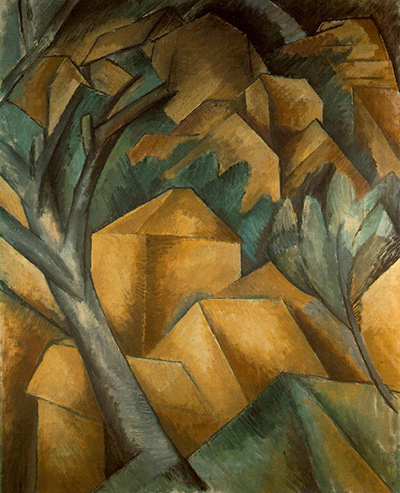
The date 1909–10 places the canvas near the beginning of the phase commonly called Analytic Cubism. In the preceding L'Estaque landscapes, Braque had reduced buildings and terrain to geometric masses, weakened central perspective and brought distant and near forms into a tightly constructed surface. K20's account explains that he then transferred this fragmentation of pictorial space to still life and the figure.[3]
The change of genre was consequential. A landscape offers depth, distance and architecture; a tabletop gathers graspable things near the body. Bringing Cubist construction into still life made its challenge immediate. A viewer already knows how a glass should occupy space and how fruit should rest on a table. Departures from those expectations can register with unusual force.
Braque and Picasso were developing this language through close, reciprocal exchange. K20 describes their almost daily contact from autumn 1908 and their step-by-step development of Cubism together.[3] That collaboration provides the historical setting for T05028 without reducing the painting to a contest over invention. Its particular achievement lies in how economically Braque makes a few domestic objects carry a new account of seeing.
The early date also sets a limit. Glass on a Table precedes the denser musician paintings of 1911, where figures and instruments can approach the threshold of indecipherability. It should not be read backwards through every later Cubist device. Here the concise inventory and small format preserve a relatively direct exchange between the thing recognised and the structure that unsettles it.
A late-1909 comparison
Braque's Still Life with Metronome, now at the Metropolitan Museum of Art, offers a useful neighbouring case. Made in Paris in late 1909, it is a much larger vertical oil, 81 by 54.1 centimetres, and one of five music still lifes Braque produced between late 1909 and early 1910.[4] The Met describes it as an early Analytic work in which a metronome and mandola emerge among rudimentary shapes and overlapping planes.
The museum also notes that familiar instruments helped contemporary viewers grasp Cubism's innovations.[4] T05028 makes a related demand with another vocabulary. Tableware and fruit need no specialist identification. Their familiarity allows transformation to become legible: the viewer can sense how far ordinary spatial expectations have been revised because the objects themselves remain known.
The comparison also emphasises Braque's range within a narrow span of time. One painting uses the cultural familiarity of musical instruments on a tall support; the other condenses vessel, fruit and table into a small near-square field. Early Cubism was already a flexible method, calibrated to the recognition cues offered by each subject.
A provenance with visible gaps
The painting's early history begins with Daniel-Henry Kahnweiler's Paris gallery and Wilhelm Uhde, who owned it by 1914. The French government sequestrated it during the First World War and retained it until the sale of Uhde's collection at the Hôtel Drouot on 30 May 1921. T05028 appeared as lot 11 and sold for 420 francs; the buyer is unidentified in the surviving Tate provenance record.[2]
That absence becomes important in the next part of the chain. George Isarlov listed the work in 1932, under the title “La Verre” and the date 1910, without naming a collection. It later belonged to the critic and curator Robert Lebel, yet the accessible record supplies neither the source nor the date of his acquisition. Arthur Tooth & Sons held the painting in London in November 1955, and Antony Hornby acquired it the following month.[2]
The sequence gives the work a substantial afterlife while resisting false completeness. It passed through the dealer and collector networks that supported early Cubism, then through wartime state seizure and a forced dispersal whose immediate outcome remains unknown. The later Lebel gap shows that even a well-documented museum object can retain unresolved decades. Its arrival at Tate in 1988 concludes the institutional chain without repairing what the record cannot establish.
A similar title, a separate object
Tate also holds Glass and Plate of Apples, a distinct Braque work dated 1925 and identified as N04166.[5] The shared words “glass” and “table” can cause confusion when titles are shortened or translated. Date and accession keep the histories apart: the painting discussed here is always the small 1909–10 canvas T05028.
The ordinary world held open
Glass on a Table derives its force from a compact balance. The title and the surviving object description keep wine glass, pears and table within reach. The oval offers a support and an independent curve; the vessel suggests an enclosure made partly from surrounding space; the fruit recalls mass and contact. None of these cues needs to settle permanently into one perspectival arrangement.
Braque makes recognition durable enough to guide the eye and unstable enough to demand repeated looking. The painting never has to choose between an everyday still life and an autonomous construction. Its achievement is the sustained movement between them. Within a canvas scarcely wider than a sheet of paper, familiar things become a way to experience seeing as revision: an object forms through its relations, loosens again, and remains present all the while.
Related Pages
Frequently Asked Questions
Georges Braque's Glass on a Table gathers an unremarkable set of things into a demanding pictorial problem.
Braque painted Glass on a Table, also known as Le Verre sur la table, in 1909–10.
Braque makes recognition durable enough to guide the eye and unstable enough to demand repeated looking.
Discussion
Georges Braque's Glass on a Table gathers an unremarkable set of things into a demanding pictorial problem.
Reader Insights
Georges Braque's Glass on a Table gathers an unremarkable set of things into a demanding pictorial problem.
Each reading modifies the others.
Braque makes recognition durable enough to guide the eye and unstable enough to demand repeated looking.
Join the Conversation
Share the visible detail or source that most changed your reading.
References
- Tate, “Georges Braque, Glass on a Table, T05028,” canonical object identifier; Tate Archive, “Acquisition of … (T05028) Glass on a Table 1909–10,” TG 4/2/131/3; and Tate, Tate Collection metadata, official historical repository. https://www.tate.org.uk/art/artworks/braque-glass-on-a-table-t05028 ; https://archive.tate.org.uk/Record.aspx?id=TG+4%2F2%2F131%2F3&src=CalmView.Catalog ; https://github.com/tategallery/collection
- Open Art Data, “Tate Provenance Research Project: Paintings, Sculpture and Works on Paper,” reproduction of Tate provenance data for Georges Braque, Glass on a Table, T05028. https://www.openartdata.org/2019/06/tate-provenance-research-project_23.html
- Kunstsammlung Nordrhein-Westfalen, Georges Braque: Inventor of Cubism, sections on Proto-Cubism, Analytic Cubism and Braque's exchange with Picasso. https://www.kunstsammlung.de/en/braque/
- Metropolitan Museum of Art, “Georges Braque, Still Life with Metronome (Still Life with Mandola and Metronome),” Paris, late 1909, 2025.616.13. https://www.metmuseum.org/art/collection/search/490581
- Tate, “Georges Braque, Glass and Plate of Apples, N04166,” 1925. http://www.tate.org.uk/art/artworks/braque-glass-and-plate-of-apples-n04166