 by Tom Gurney
Tom Gurney BSc (Hons) is an art history expert with over 20 years experience
Published on August 14, 2026 / Updated on August 14, 2026
Email: tomgurney1@gmail.com / Phone: +44 7429 011000
Introduction
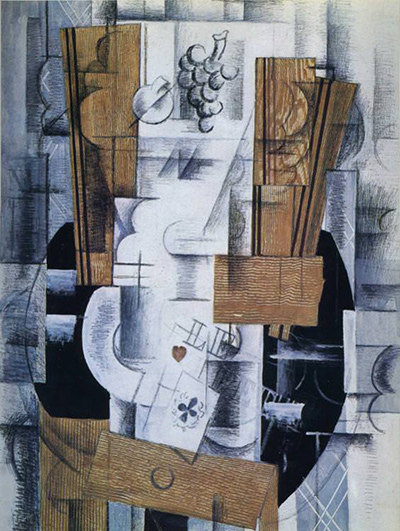
A playing card enters a painting with a peculiar advantage: it is already flat. Its printed face belongs to an everyday object, yet its shape can sit almost flush with the canvas. In Georges Braque's Fruit Dish and Playing Cards, cards join grapes, tablecloth motifs, letters and imitation wood across overlapping facets. Centre Pompidou describes those elements spreading over the painted surface like a fan.[1]
The effect can suggest assembly, but the material facts point elsewhere. Braque used oil heightened with pencil and charcoal on canvas. No card, newspaper or wallpaper appears in the recorded medium. Made in early 1913, only months after his first experiments with pasted paper, the work asks what painting could learn from physically combining separate sheets.
At a Glance
- ArtistGeorges Braque[1]
- TitleFruit Dish and Playing Cards (Compotier et cartes)[1]
- Date[Early 1913][1]
- MediumOil heightened with pencil and charcoal on canvas[1]
- Dimensions81 × 60 cm[1]
- CollectionCentre Pompidou, Musée national d’art moderne[1]
- AccessionAM 2701 P[1]
- SignificanceThe exact Pompidou object and examine the table edge, cards, drawing and painted surface in early 1913
Contents
- Introduction
- One canvas behind several names
- A painting changed by pasted paper
- Facets opening like a fan
- Drawing holds the pieces in play
- The table approaches the canvas
- Wood created with a painter's tool
- From Compotier et verre back to paint
- Three card still lifes kept distinct
- Flat signs, mobile space
One canvas behind several names
Centre Pompidou catalogues the painting as Compotier et cartes, literally Fruit Dish and Cards. The English title used here expands the orientation to Fruit Dish and Playing Cards. Braque made the canvas in Paris in early 1913. It measures 81 by 60 centimetres, bears his signature and has the inventory number AM 2701 P. Paul Rosenberg gave it to the museum in 1947.[1]
Its former titles range from the broad Nature morte to the highly specific Composition à l'As de Trèfle. Other versions include Nature morte aux cartons à jouer, Nature morte au jeu de cartes and Les Deux Cartes à jouer.[1] The sequence shows catalogue attention shifting among the whole still life, the activity of cards and individual details.
One historical title names an ace of clubs. That label belongs to the record of reception; Centre's current description simply identifies playing cards. It supplies no rank for a second card. The distinction matters because a title can preserve an earlier act of recognition without serving as a complete inventory of what every viewer must see.
The movement from generic “still life” to “two playing cards” measures the balance between uncertainty and legibility. Braque gives the eye enough everyday signs to begin naming things, while their connections remain unsettled. The current title keeps fruit dish and cards together as anchors.
A painting changed by pasted paper
Centre places the canvas directly after a decisive technical change. Braque and Picasso had developed pasted-paper procedures a few months earlier, and those experiments soon affected Braque's painting.[1] Separate sheets had offered ready-made colour, pattern, lettering and texture. They also made a physical edge capable of acting as a depicted boundary.
In Compotier et cartes, oil, pencil and charcoal assume those possibilities. A painted area may evoke a manufactured surface; a contour may seem as abrupt as the boundary of a cut piece; letters carry prior associations with print. The variety belongs to one canvas, even when the organisation recalls parts brought together.
That return to paint changes the question. A pasted sheet openly declares its own substance. Painted imitation asks the eye to recognise a material that is absent. The card becomes especially effective because its depicted flatness approaches the flatness of the support. It can appear as an object resting within the still life and as a compact sign laid across the composition.
The Metropolitan Museum of Art connects such paradoxes with the Cubists' revival of trompe l'oeil, the tradition of pictorial deception. Braque's training as a painter-decorator gave him practical knowledge of simulated wood and other finishes. His Cubism turned those craft effects into devices that reveal artifice at the same moment they imitate matter.[2]
Facets opening like a fan
Centre's fan comparison offers a way to understand the whole without forcing it into a conventional room. A fan holds distinct segments in a common structure. As it opens, each segment overlaps its neighbour while contributing to a broader sweep. Braque's still-life elements likewise spread across the surface, linked without settling into a single continuous volume.[1]
The analogy also gives the composition direction without fixing a viewing path. Cards, fruit, cloth, letters and wood-like texture become points of recognition among the facets. Each sign makes a local passage more legible. Their combined arrangement keeps the eye moving across the canvas and resists smooth recession.
Centre says that the facets are superimposed through an interplay of transparency and opacity.[1] A transparent effect can imply one plane continuing through another; an opaque field can interrupt that continuity. Used together, the two cues create a space that alternately opens and closes. Overlap suggests depth, while the broad spread across the canvas keeps recalling the physical surface.
The result preserves the ordinary category of still life while changing its internal logic. A fruit dish and cards remain available to recognition. They cease to depend upon a unified setting in which every object occupies one measurable position.
Drawing holds the pieces in play
Charcoal has a precise role in Centre's account: it contours the facets.[1] The line can separate one passage from another, yet separation alone never guarantees stable space. A boundary may belong to a card, a painted plane, a patch of imitation material or the structural rhythm shared by several signs.
Pencil accompanies charcoal as a heightening medium, while oil provides the painted field. This combination allows drawing and painting to remain visibly different kinds of statement. Line can announce an edge with speed and economy. Paint can make that edge seem transparent, opaque, material or atmospheric.
Their cooperation gives the work clarity without making it conventionally descriptive. The charcoal contour helps the eye recover parts, but the superimposed facets prevent those parts from locking together like pieces of a solved puzzle. Recognition stays active because every line answers two demands: it distinguishes a form and contributes to the larger surface design.
Letters intensify that double role. Centre identifies their presence but gives no securely decoded word.[1] Before they are read, letters are short strokes and angles compatible with the drawn framework. Once recognised as writing, they point beyond the canvas towards print and ordinary communication. Their category becomes meaningful before any recoverable sentence.
The table approaches the canvas
The title and tablecloth motifs establish a table-based still life, but Centre's description leaves the furniture itself largely open. The strongest spatial clue is the relation between those motifs and the fan-like spread over the painting's surface. Pattern can suggest cloth extending beneath objects while also behaving as pattern on canvas.
The Met explains that Cubist painters often tipped tabletops almost vertically, bringing the represented support towards the plane of the picture. They combined the traditional tabletop still life with forms of trompe l'oeil organised around a frontal board. The viewer could therefore move mentally between looking down at things on a table and looking straight at a painting on a wall.[2]
That convention illuminates Braque's canvas without supplying an exact piece of furniture. An implied tabletop gives cards and fruit somewhere to gather. Its approach to the picture plane makes their support coincide increasingly with the actual surface on which Braque worked. Table and tableau—the French word for a picture—begin to converge.
The card sharpens this convergence. Unlike a rounded fruit or vessel, it needs little fictive depth to retain its identity. Its flat shape can belong plausibly to the tabletop and to the frontal design. The tablecloth motif performs a similar exchange between depicted fabric and painted pattern.
Wood created with a painter's tool
Imitation wood introduces another kind of doubleness. Centre names it among the textures that help deceive the eye and mind.[1] The paint suggests grain and timber while the actual material remains oil on canvas. A surface associated with furniture or panelling becomes a sign inside the still life.
Claire Le Thomas places this device within Braque's training as a painter-decorator. Her GrandPalaisRmn essay connects Cubist cards with the games and leisure of café life, then explains that Braque's faux-bois veins in this work were made by drawing the teeth of a comb through fresh paint.[4] A practical decorating method therefore enters ambitious modern painting without losing its craft identity.
The social and material associations reinforce one another. Cards evoke recreation; faux bois recalls inexpensive decorative finishes used in homes and cafés. Braque gives both a pictorial task. They help a viewer recognise objects while exposing how recognition can arise from printed convention, repeated pattern or skilled imitation.
The combed effect also complicates the idea of spontaneity. Its grain may resemble natural wood, yet the likeness results from a tool and repeatable motion. Braque can summon material through a procedure that openly belongs to manufacture and decoration.
From Compotier et verre back to paint
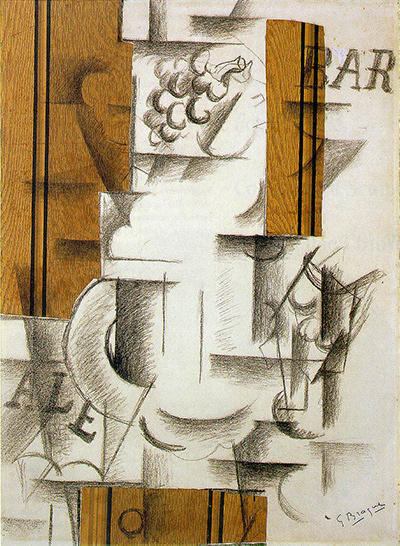
A Musée des Beaux-Arts de Lyon and Centre Pompidou dossier describes Compotier et cartes as the translation into painting of Braque's Compotier et verre, the first papier collé he made in September 1912. It calls the later work enriched by further experiments and calmer than the earlier version.[3]
The relation is best understood as transformation. The earlier work had brought an actual sheet with imitation-wood pattern into a drawing. In the 1913 canvas, painted texture, line and flat signs carry that discovery into oil. Physical difference among materials becomes a repertoire of pictorial differences.
This return also explains why the active painting can feel materially diverse despite its concise medium list. Braque had learned what a ready-made surface could contribute: a firm edge, a prior pattern, an association with everyday life and a challenge to illusion. Paint now stages those effects while preserving the freedom to merge them through transparency.
The comparison needs no claim of simple progress. Paper and paint offered distinct possibilities, and Braque moved between them. Compotier et cartes records one turn in that exchange, where the memory of cutting and combining sheets changes how a canvas is built.
Three card still lifes kept distinct
Braque had used playing cards before. The Metropolitan Museum of Art's Candlestick and Playing Cards on a Table dates from spring 1910. It is an oval oil painting, 64.8 by 54 centimetres, catalogued as 1997.149.12. The Met identifies a table corner, brass candlestick and cards within its compressed tonal structure.[5] Those details belong to the earlier canvas, whose fragments emerge through a different Cubist language.
The Art Institute of Chicago holds another work from 1913, Still Life with Glass, Dice, Newspaper and Playing Card. That much smaller painting measures 34.6 by 23.8 centimetres and consists of oil on canvas mounted on hardboard; its reference number is 1989.51.1.[6] Its title names a glass, dice, newspaper and one card, none of which expands the inventory of Centre's AM 2701 P.
The three works share an artist and a card subject, yet their identities remain precise. The 1910 Met canvas is oval and earlier. The Chicago painting has its own support and compact group of titled objects. Centre's Paris canvas is the 81-by-60-centimetre fruit dish and cards, given by Rosenberg in 1947.
Flat signs, mobile space
Fruit Dish and Playing Cards turns ordinary recognition into a sustained visual question. Cards, grapes, cloth motifs, letters and wood-like texture offer immediate points of contact. Fan-like facets, charcoal contours and exchanges between transparency and opacity keep those points from resolving into one stable arrangement.
The canvas gains much of its energy from things that resemble other surfaces. A card resembles printed paper; faux bois resembles timber; tablecloth motifs resemble patterned fabric; letters resemble fragments of communication. Oil, pencil and charcoal carry every one of these associations.
Braque's table consequently hovers between support and surface. It gathers the still life while approaching the plane of the canvas. The playing cards make that ambiguity vivid because their everyday form is flat before the painter begins. They belong easily to both readings: objects in the world and signs in a painting.
Related Pages
Frequently Asked Questions
A playing card enters a painting with a peculiar advantage: it is already flat.
Centre Pompidou catalogues the painting as Compotier et cartes, literally Fruit Dish and Cards.
Braque's table consequently hovers between support and surface.
Discussion
A playing card enters a painting with a peculiar advantage: it is already flat.
Reader Insights
A playing card enters a painting with a peculiar advantage: it is already flat.
The title and tablecloth motifs establish a table-based still life, but Centre's description leaves the furniture itself largely open.
Braque's table consequently hovers between support and surface.
Join the Conversation
Share the visible detail or source that most changed your reading.
References
- Centre Pompidou, Compotier et cartes.
- Metropolitan Museum of Art, Cubism and the Trompe l'Oeil Tradition.
- Musée des Beaux-Arts de Lyon and Centre Pompidou, Braque/Laurens, un dialogue.
- GrandPalaisRmn, Histoire par l'image, Claire Le Thomas, Aspects populaires du cubisme.
- Metropolitan Museum of Art, Georges Braque, Candlestick and Playing Cards on a Table.
- Art Institute of Chicago, Georges Braque, Still Life with Glass, Dice, Newspaper and Playing Card.