 by Tom Gurney
Tom Gurney BSc (Hons) is an art history expert with over 20 years experience
Published on August 14, 2026 / Updated on August 14, 2026
Email: tomgurney1@gmail.com / Phone: +44 7429 011000
Introduction
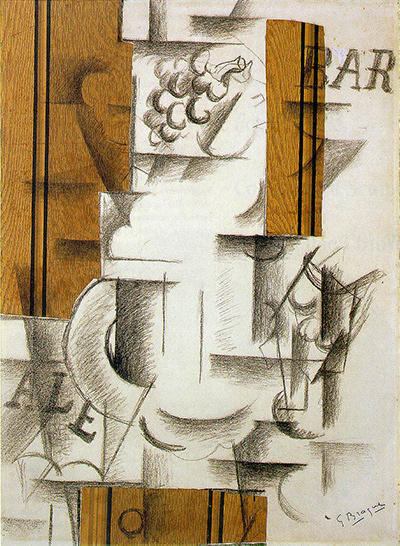
In the autumn of 1912, Georges Braque placed three pieces of imitation-wood wallpaper around a charcoal still life. The gesture appears modest: a few cuttings attached to a sheet. Its consequences are far larger. Each piece remains manufactured paper, displays a printed fiction of timber and participates in the representation of a table. The material tells the truth about being paper while lying about being wood.[1][2]
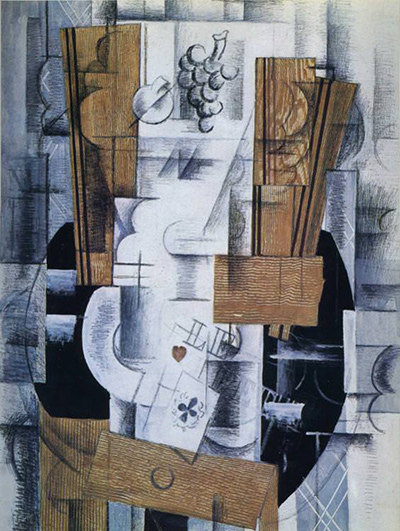
Fruit Dish and Glass makes that contradiction productive. Charcoal and gouache belong to Braque's hand; the repeated grain arrived from a factory. A title names two familiar objects, yet their identities emerge within a construction shared by drawing, print, cut edges and a physical support. The work asks representation to operate through materials that already possessed an image before the artist chose them.
At a Glance
- ArtistGeorges Braque[1]
- TitleFruit Dish and Glass[1]
- DateSorgues, autumn 1912[1]
- MediumCharcoal and cut-and-pasted printed wallpaper with gouache on paper; mounted on paperboard[1]
- Dimensions24 3/4 × 18 in. (62.9 × 45.7 cm)[1]
- CollectionThe Metropolitan Museum of Art, New York[1]
- Object number2016.237.33[1]
- SignificanceWhy faux-bois wallpaper in this 1912 work changes the status of representation and real material
Contents
- Introduction
- The exact object
- Three offcuts and two named objects
- An inexpensive image of an expensive surface
- From decorator's craft to chosen paper
- When form and colour part company
- A table made from several kinds of truth
- September 1912 at Sorgues
- Competition within exchange
- Why “first papier collé” is precise
The exact object
The Metropolitan Museum of Art identifies the work as Fruit Dish and Glass, made at Sorgues in autumn 1912. Its materials unite charcoal and gouache with cut-and-pasted printed wallpaper on paper; the sheet is mounted on paperboard. It measures 24 3/4 by 18 inches, or 62.9 by 45.7 centimetres. Its accession number is 2016.237.33, and the Met classifies it as a drawing.[1]
That full description prevents several easy misunderstandings. This is no oil painting on canvas. It also contains no wooden veneer. A paper sheet carries hand-applied charcoal and gouache, while three manufactured wallpaper fragments sit upon it. The paperboard named in the record is the mount, a further physical layer beyond the working sheet and its additions.
The classification as a drawing is revealing. Pasted matter has entered the work, though drawing remains its structural language. Braque has expanded what a drawing can contain without giving up the immediacy of line. Material assembly and graphic construction share the same field.
The medium also contains a sequence of labour. A manufacturer printed the faux-bois repeat before Braque encountered the roll. Braque selected and cut the three pieces, joined them to the working sheet and developed their relations with charcoal and gouache. The paperboard belongs to the object's present physical construction as recorded by the Met, though the record gives no date for that mounting. Keeping these stages distinct prevents every visible or material decision from being assigned to one moment or one maker.
This layered identity gives the object an unusual rhythm of prior and present action. The wallpaper brings a design completed elsewhere; charcoal responds within the studio; pasting fixes a relation between them. An existing product becomes part of a newly composed drawing without losing evidence of its earlier manufacture.
Three offcuts and two named objects
The Met describes Braque using three wallpaper offcuts to frame a hand-drawn still life.[1] “Frame” here concerns their organising role within the composition. The pieces are part of the artwork itself; they are no conventional timber surround. Their number is exact, while their individual sizes, coordinates and order fall outside the written account.
The title secures a fruit dish and a glass as the subjects to be recovered. It gives the eye two nouns before their forms become fully coherent. Charcoal supplies cues and relations; the cut papers create areas whose boundaries can support, interrupt or reorient those cues. Recognition develops through cooperation between naming and construction.
This procedure differs from filling completed outlines with local colour. A wallpaper cutting arrives as a whole field of pattern and tone. Its edge results from Braque's intervention, while everything inside that edge was mechanically repeated before the work began. The fragment can organise several drawn signs at once, leaving its pictorial identity open.
Three separate pieces also turn one commercial design into a small family of new shapes. Their common origin establishes continuity, while cutting gives each a distinct boundary. The repeated grain can tie distant parts of the construction together even when the pieces perform different pictorial jobs. Unity comes partly from manufacture and partly from Braque's decision to distribute the material across the drawing.
The Met's account gives the group a double function. The three offcuts frame the still life, while a separate Met discussion assigns the manufactured wood pattern and supplied colour to the tabletop.[1][2] An element can therefore organise the image and evoke one of its represented materials. Its contribution exceeds any single depicted part.
An inexpensive image of an expensive surface
Faux bois means imitation wood. In this work, the grain is printed on wallpaper. The Met traces a hierarchy of substitutions: machine-made wallpaper offered a cheap alternative to wood graining painted by a skilled decorator; that artisanal imitation was itself cheaper than tongue-and-groove oak panelling.[1]
The wallpaper thus reaches Braque already twice removed from the costly surface it evokes. Oak becomes painted simulation; painted simulation becomes a mass-produced printed substitute. The sheet remains a genuine commercial product, while the material advertised by its pattern is absent.
Centre Pompidou's account of the September episode adds precision. The roll showed printed wood veins and the apparent relief of mouldings, conveyed through black lines of different thicknesses.[5] These effects were designed for an interior, where paper could masquerade as fitted woodwork. Braque cut the decorative fiction away from that setting and inserted it into another system of signs.
Its low price matters without becoming an aesthetic verdict. The product belonged to ordinary manufacture, and its regular pattern existed independently of artistic gesture. Once selected, cut and pasted, that anonymous repeat acquired a particular place within one work. Commodity design and individual composition became visibly intertwined.
The hierarchy of substitutes also complicates originality. The wallpaper manufacturer copied the appearance of decorative graining; the decorator's graining copied oak; Braque then used the printed copy within a still life. His act creates no new wood pattern. It creates new conditions for reading the one already there. Originality shifts from inventing every mark toward choosing how a pre-existing image will operate.
From decorator's craft to chosen paper
Braque understood imitation surfaces through training as a painter-decorator. The Met records that his grandfather and father worked as housepainters and that he learned techniques for simulating wood, marble and architectural finishes. He never practised the trade professionally, though its methods stayed available to him. During 1911–12, he began introducing lettering and painted faux bois into Cubist pictures.[3]
Painted wood grain and printed wallpaper create related deceptions through different operations. With painted faux bois, the artist makes each imitative mark. Wallpaper supplies its grain in advance. The creative sequence shifts toward selection, cutting, orientation, placement and the drawing added around or across a ready-made pattern.
This continuity with decorative craft gives the 1912 experiment a practical history. Braque recognised the wallpaper's illusion because he knew how such surfaces were made and used. He also understood the gap between material and appearance: paint could seem like wood, and paper could seem like decorated panelling. Papier collé converted that occupational knowledge into a new relation between an artwork and an industrial product.
The change still leaves the hand active. Braque chooses a portion of the roll, determines its boundary and joins it to charcoal and gouache. Manufacture supplies one voice; composition decides how that voice enters the whole.
When form and colour part company
A Centre Pompidou educational account describes Fruit Dish and Glass as the combination of a drawn armature with pieces of faux-bois paper. Its concise conclusion is that forms and colours become separate.[4] The exact medium helps explain what this means.
Charcoal can establish a structural cue without carrying the colour associated with it. Wallpaper can bring tone and pattern without being confined inside a completed drawn object. A cutting may contribute colour to the field while several lines assign it a pictorial function. Shape, surface and identity can arise from different physical operations.
Separation still permits cooperation. The printed paper and drawn armature meet on one support, and gouache introduces another hand-applied element. The work avoids a rigid division in which charcoal owns every form and wallpaper owns every colour. Its force lies in making those systems independently perceptible while allowing them to construct a still life together.
In a conventionally painted object, contour, hue and material appearance can arrive through the same passage of paint. Here those functions can be distributed. A charcoal relation may prompt recognition; a printed field supplies surface character; gouache adjusts the hand-made register; the title stabilises the object category. Representation becomes a coordination among partial contributions.
That distribution also gives colour greater mobility. Since the wallpaper's tone belongs first to a cut sheet, it can serve the composition before it serves any single named object. Drawing can then recruit part of that field for the table or surrounding structure. The colour retains a physical boundary created by cutting, while its pictorial reach depends on adjacent signs.
The difference also changes revision. A brushstroke can be adjusted mark by mark. A printed fragment brings a continuous block whose design is fixed, though its outline and position remain open choices. Moving or recutting the fragment alters many visual relations at once. Composition becomes an act of joining units with distinct origins.
A table made from several kinds of truth
The Met's 2013 announcement interprets the mechanically printed wallpaper as representing the texture and colour of a wooden table.[2] That role creates a chain of identities. Physically, the element is paper. Visually, its pattern imitates wood. Within the still life, it evokes furniture. Across the composition, its cut boundary helps order charcoal signs.
Each identity is valid at a different level. Touch would confirm paper, cultural recognition reads faux bois, and pictorial relation proposes a table. The work gains complexity because these readings remain available together. The fragment never has to become timber in order to make wood present as an idea.
This is a peculiar form of realism. The artwork includes an actual object from everyday life, but that object is itself a counterfeit surface. Literal matter arrives wrapped in representation. Braque exposes both facts by leaving manufactured pattern and hand drawing in open contact.
Flatness and spatial suggestion also coexist. A pasted sheet declares the plane on which it lies. The table association encourages a sense of support for the fruit dish and glass. The fragment can hold attention near the surface and contribute to an imagined furnishing at the same time. Space becomes a relation produced by signs, without requiring a continuous illusionistic interior.
September 1912 at Sorgues
Centre Pompidou places the discovery at the beginning of September 1912. Braque saw a roll of faux-bois wallpaper in the window of an Avignon colour merchant while working at nearby Sorgues. During a brief stay by Picasso in Paris, Braque bought the paper, cut pieces from it and set them into structures drawn in charcoal.[5]
The Met's current record gives the same essentials: mass-produced faux-bois wallpaper purchased in Avignon and incorporated into charcoal drawings during September.[1] The account connects a specific shop product to a specific working place. An object designed for domestic decoration became the trigger for a change in Cubist construction.
After Picasso returned, Braque showed him an initial group of papiers collés. Picasso's letter of 9 October referred to the recent experiments with paper and textured substances. By 30 November, Daniel-Henry Kahnweiler's contract with Braque listed drawings enhanced with imitation-wood paper, imitation marble or other accessories in a category of their own.[5]
The contract gives the experiment a practical consequence beyond studio conversation. Kahnweiler treated paper-enhanced drawings as a recognisable class of work, separate enough to name in commercial documentation. His wording also anticipates extension: wood, marble and other accessories leave the procedure open to more than one roll or pattern. A single discovery was already becoming a repeatable way of working.
The speed is striking. Within roughly three months, a roll glimpsed in a shop window had generated a set of works, entered the artists' exchange and acquired documentary recognition from their dealer. The sequence also shows experimentation becoming a repeatable practice, while Fruit Dish and Glass retains its place at the beginning.
Competition within exchange
The Met presents one sharper edge to this story. Its object record says Braque waited until Picasso had left Avignon before using the wallpaper, framing the delay as an effort to gain a competitive advantage.[1] The sequence of absence and purchase also appears in Centre Pompidou's account, followed by Braque's prompt showing of the works and Picasso's response.[5]
The distinction between event and motive matters. Braque acted during Picasso's absence; the Met interprets the timing competitively. The subsequent showing and letter place that action back inside a continuing exchange. Innovation could carry rivalry and collaboration together.
A historic MoMA account of the partnership similarly presents Cubism as a visual language generated through sustained dialogue, while distinguishing Picasso's May 1912 collage from Braque's September papier collé.[6] The separate discoveries circulated quickly because each artist watched the other's work closely.
Braque later recalled that making the papier collé produced a powerful shock for him and an even greater one for Picasso when he revealed it.[2] The memory conveys how consequential he considered the experiment. It also remains his retrospective testimony, preserving the energy of the moment without turning private response into measurable fact.
Why “first papier collé” is precise
According to Braque's account as presented by the Met, Fruit Dish and Glass was his first papier collé.[1] The Met's Lauder announcement calls it the first Cubist papier collé, and Centre Pompidou's educational text gives it the same foundational place.[2][4] MoMA's 1989 chronology likewise names Braque's September work as the first pasted-paper construction after distinguishing it from Picasso's earlier collage.[6]
The phrase identifies a material procedure. Papier collé foregrounds cut paper joined to a support and made active within drawing. Keeping that category attached preserves the historical claim's meaning. The achievement concerns this particular coordination of wallpaper, charcoal, gouache and paper.
Priority supplies context, though the object's importance survives beyond a date. Its enduring innovation lies in the relations it establishes: factory repeat beside handmade line, a cheap decorative substitute inside fine art, actual paper carrying fictional wood, and independent colour working with drawn form. The technique became significant because those relations could generate further works.
The first designation therefore leads back to construction. It marks the point when Braque converted a printed commodity into a flexible pictorial unit, allowing materials with prior identities to enter the making of an image.
From announced collection to Met accession
The work belongs to the Leonard A. Lauder Cubist Collection. The Met announced the larger collection in 2013 and described Fruit Dish and Glass as one of its landmarks.[2] The current object record gives the final public credit: Leonard A. Lauder Cubist Collection, Gift of Leonard A. Lauder, 2016.[1]
That credit explains the accession number 2016.237.33 and the work's present institutional identity. It also places a paper-based experiment within a collection assembled around major Cubist developments. The current evidence establishes this gift context, leaving earlier ownership stages beyond the account available here.
The Met's classification of the object as a drawing remains apt at the close. Braque's innovation enlarged drawing through an attached commercial surface. Its importance rests in material precision, with charcoal, gouache, wallpaper, paper and paperboard retaining distinct roles.
Paper becomes an active proposition
The three modest cuttings changed what paper could assert inside a work of art. Their wallpaper declares an industrial origin through repeatable grain and presents an imitation learned from decorative interiors. Together they structure a still life made legible by drawing and title. As table, frame, colour field and commodity fragments, they keep several identities in circulation.
Braque's gesture was economical because he added material already rich in information. The sheet brought pattern, tone, social use and a history of substitution. Cutting removed it from the wall; pasting gave it new neighbours; charcoal asked it to participate in a fruit dish, glass and table.
The result makes reality and illusion interdependent. Physical paper strengthens awareness of the artwork as an object, while its printed wood deepens the play of appearances. Hand and machine remain distinguishable, yet each helps the other produce form. That unstable agreement is the lasting force of Braque's first papier collé.
Related Pages
Frequently Asked Questions
In the autumn of 1912, Georges Braque placed three pieces of imitation-wood wallpaper around a charcoal still life.
The Metropolitan Museum of Art identifies the work as Fruit Dish and Glass, made at Sorgues in autumn 1912.
The result makes reality and illusion interdependent.
Discussion
In the autumn of 1912, Georges Braque placed three pieces of imitation-wood wallpaper around a charcoal still life.
Reader Insights
In the autumn of 1912, Georges Braque placed three pieces of imitation-wood wallpaper around a charcoal still life.
That distribution also gives colour greater mobility.
The result makes reality and illusion interdependent.
Join the Conversation
Share the visible detail or source that most changed your reading.
References
- Metropolitan Museum of Art, “Fruit Dish and Glass.” https://www.metmuseum.org/art/collection/search/490612
- Metropolitan Museum of Art, “Metropolitan Museum Announces Gift of Major Cubist Collection Comprising 78 Works by Picasso, Braque, Gris, and Léger from Leonard A. Lauder and Creation of New Research Center for Modern Art.” https://www.metmuseum.org/fr/press-releases/lauder-announcement-2013-news
- Metropolitan Museum of Art, “Cubism and the Trompe l'Oeil Tradition — Visiting Guide.” https://www.metmuseum.org/fr/exhibitions/cubism-trompe-loeil/visiting-guide
- Centre Pompidou, Braque et Picasso: les papiers collés. https://www.centrepompidou.fr/media/document/d2/8f/d28f7b45fc841adfae4582252b6d4c84/normal.pdf
- Centre Pompidou, “Violon et pipe.” https://www.centrepompidou.fr/fr/ressources/oeuvre/cpgXbgx
- Museum of Modern Art, “Picasso and Braque: Pioneering Cubism.” https://assets.moma.org/documents/moma_press-release_327550.pdf