 by Tom Gurney
Tom Gurney BSc (Hons) is an art history expert with over 20 years experience
Published on August 14, 2026 / Updated on August 14, 2026
Email: tomgurney1@gmail.com / Phone: +44 7429 011000
Introduction
Georges Braque's public standing was never secured by a single triumph. It changed as galleries, critics, museums and governments found new uses for his work. An experiment that looked puzzling in 1908 could later appear foundational. A painter once praised for restraint could also be recognised as an audacious inventor. The same career could be condensed into Cubism, then reopened to include still lifes, pasted papers, studios, birds and austere late landscapes.
Public memory remains selective, and that matters. Each exhibition places certain works in view and leaves others at the edges. Each retrospective proposes a shape for the career. Prizes and official honours enlarge an artist's public status, although they cannot settle the meaning of the art. Braque's legacy emerged through this continuing movement between challenge, authority and reassessment.
At a Glance
- ArtistGeorges Braque
- GuideExhibitions and Legacy
- FocusThe 1908 Kahnweiler exhibition, interwar and postwar retrospectives, honours, critical standing and later legacy.
- Key topicsA November Exhibition with a Long Afterlife; How “Cubes” Became Cubism; Recognition Between the Wars; The Demands of “Le Patron”
- OverviewGeorges Braque's public standing was never secured by a single triumph.
Contents
- Introduction
- A November Exhibition with a Long Afterlife
- How “Cubes” Became Cubism
- Recognition Between the Wars
- The Demands of “Le Patron”
- Maeght, Venice and MoMA
- At Home in the Louvre
- Retrospectives Reopen the Career
- What Braque Left in View
A November Exhibition with a Long Afterlife
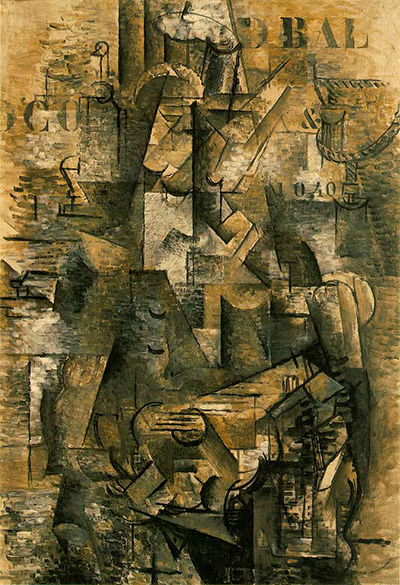
Braque's solo exhibition at Daniel-Henry Kahnweiler's Paris gallery ran from 9 to 28 November 1908. The surviving catalogue bears the title Exposition Georges Braque and identifies a text signed by Guillaume Apollinaire.[2] Centre Pompidou records 27 canvases in the small gallery and likewise credits Apollinaire with the preface.[3] Those modest facts describe an event whose later reputation became immense.
The Metropolitan Museum of Art now presents the display as the first Cubist exhibition.[1] That formulation belongs to retrospective art history. The catalogue title and its basic record offer no finished movement. Visitors encountered Braque's recent work before “Cubism” possessed the stable meaning it would acquire. The distinction gives the exhibition much of its interest: it was historically consequential while its consequences were still unclear.
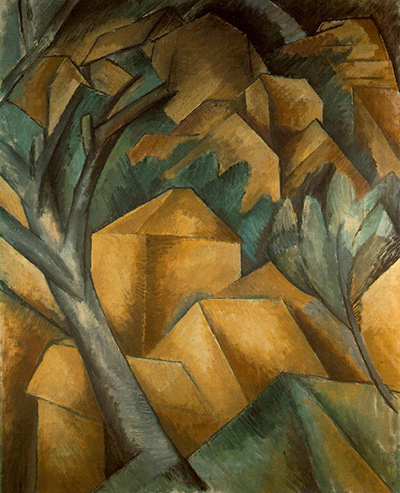
One work can anchor the event without turning it into a reconstructed checklist. LaM records Maisons et arbre as catalogue number 13 in the Kahnweiler show.[4] Centre Pompidou, by contrast, states that the presence of Les Instruments de musique among the 27 canvases remains unverified.[3] The difference is instructive. The exhibition is firmly documented; the identity of every object demands its own evidence.
The catalogue's short span and the gallery's intimate scale also sharpen the later transformation. A concentrated presentation by a relatively young painter became a reference point for one of modern art's largest narratives. Its importance grew through repetition—in reviews, books, collections and later exhibitions—far beyond the show's physical scale.
How “Cubes” Became Cubism
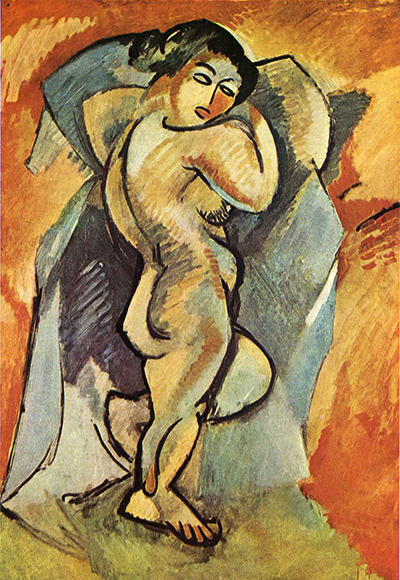
The works shown around 1908 unsettled familiar expectations of landscape. The Met describes forms pushing outward and light losing its traditional task of modelling natural depth. It also recalls criticism that Braque's landscapes were filled with little cubes.[1] Centre Pompidou connects the vocabulary of cubes with the later fortune of the word Cubism.[3]
This sequence is more revealing than a simple naming anecdote. Critical language can change function. A word that reduces unfamiliar paintings to a geometric oddity may gradually become a category broad enough to organise artists, exhibitions and histories. The label gains authority as institutions repeat it, even though the art preceded the settled definition.
Braque's partnership with Pablo Picasso remains central to that development. The pair's sustained exchange turned individual experiments into a shared investigation of representation, space and pictorial signs.[15] Yet the 1908 exhibition belongs to a moment when that history was still forming. Calling it Cubist today identifies the direction that later viewers recognise; it cannot reproduce precisely what every visitor understood then.
The gap between event and label protects Braque from two distortions. One would make him the solitary inventor of a movement built through collaboration. The other would treat him as a supporting figure in somebody else's story. His exhibition demonstrates genuine initiative. The subsequent history of Cubism demonstrates exchange. Both belong in the account.
Recognition Between the Wars
After the First World War, Braque returned to a public art world that had changed around him. A second solo exhibition ran at Léonce Rosenberg's Galerie de l'Effort Moderne from 5 to 31 March 1919. In 1922, an invited Salon d'Automne display placed the Canephorae before a prominent public audience. His first exhibition with the dealer Paul Rosenberg followed from 2 to 21 May 1924.[5]
These appearances marked more than commercial continuity. They showed that Braque could be received through work made after the intense pre-war exchange with Picasso. The 1922 figures, with their classical emphasis, complicated any expectation that his value rested solely on Analytical Cubism. The dealer change in 1924 also placed his developing still lifes within a stronger international market, although sales history alone cannot explain their artistic standing.
The retrospective at the Kunsthalle Basel from 9 April to 14 May 1933 gave that standing a different form. Guggenheim's chronology credits Carl Einstein with the catalogue preface, while LaM's exhibition history independently confirms the dates.[4][5] A retrospective asks viewers to see development across time. By 1933, Braque's career could be presented as a substantial historical sequence while he continued to work.
American recognition soon added another dimension. MoMA's 1949 catalogue chronology records first prize for The Yellow Tablecloth at the 1937 Carnegie Exhibition in Pittsburgh. It also lists Braque retrospectives in Chicago, Washington and San Francisco in 1939.[7] These historical museum records offer a selective map of American opinion. Even so, the movement from a small Paris gallery to a three-city retrospective sequence shows how far his institutional reach had expanded.
The formats themselves carried meaning. A dealer's solo show concentrated attention on new work and helped sustain a market. A salon invitation placed Braque inside a larger public institution. A retrospective invited comparison among phases that had once seemed incompatible. A prize singled out one painting, while a touring survey claimed that the career deserved sustained attention. Reception grew through this mixture of close advocacy and widening public frameworks. Each framework made a different Braque available.
The Demands of “Le Patron”
Braque's growing authority acquired a memorable critical label. Kunstsammlung Nordrhein-Westfalen reports that Apollinaire assigned him the ambivalent role of “patron” in 1912—a touchstone for Cubism whose quiet reliability seemed to contrast with the volatility of the avant-garde.[15] Jean Paulhan returned to the phrase from another historical position when he published Braque le patron in 1943.[5]
The two moments should remain separate. Apollinaire wrote while Cubism was being forged. Paulhan's book appeared during the German occupation of France, when cultural continuity carried a more charged significance. Their shared word gathers different expectations around Braque: rigour, steadiness, independence and a capacity to sustain modern painting without theatrical self-promotion.
Such praise also creates pressure. “Le patron” can turn a working artist into an emblem of composure or national character. MoMA's 1949 retrospective material praised qualities of discretion, labour and French continuity in explicitly historical terms.[8] Those values illuminate the reception of Braque, though they remain the values of particular writers and institutions. They cannot define his personality completely, still less domesticate the formal risks in his work.
The label endures because it contains a productive contradiction. Braque could be represented as stable precisely because his paintings had helped destabilise inherited space. The public image of a measured craftsman became one way of absorbing a radical achievement into cultural memory.
The timing of Paulhan's book deepened that contradiction. Published in occupied Paris, it placed Braque's artistic authority inside a period when ideas of French continuity carried exceptional weight.[5] The title could reassure readers by making modern painting seem durable, disciplined and culturally rooted. Yet Braque's authority came from invention, including forms that earlier audiences had found disorienting. The language of steadiness therefore preserved a radical history even as it made that history easier to honour.
Maeght, Venice and MoMA
Postwar recognition arrived through several kinds of institution in quick succession. Braque's first exhibition with Galerie Maeght ran from 30 May to 30 June 1947.[5][10] The following year, the Venice International Art Exhibition resumed after the wartime interruption. La Biennale's history records an award to Braque in 1948 as the event renewed its international survey of modern art.[9]
Centre Pompidou supplies the precise connection. Its account of Le Billard states that the painting earned Braque first prize for foreign painting at the 24th Venice Biennale.[10] The distinction joined a late painting to international recognition without reducing the award to a lifetime tribute. Braque's postwar work was being judged as current art.
MoMA's retrospective extended that visibility across the Atlantic. Its current archive dates the New York exhibition from 29 March to 12 June 1949 and identifies an accompanying book produced with the Cleveland Museum of Art.[6] The contemporary press release described more than 100 works across painting, collage, drawing, print and sculpture. It promoted the event as the largest exhibition of Braque's work yet held in the United States.[8]
The promotional language deserves its historical setting. Scale carried an argument: Braque could support a survey spanning early experiments, the Cubist partnership, pasted papers, interwar transformations and recent work. The collaboration between New York and Cleveland also placed that argument within a museum network, beyond a single dealer's programme.
Yet the retrospective did more than enlarge a reputation. By bringing many periods and media together, it invited comparison across the career. The artist known for a decisive avant-garde episode emerged as a maker who repeatedly tested texture, object, sign and space. Institutional recognition widened when the work itself could be seen as wider.
Its cross-media range was especially important. Painting still dominated Braque's public identity, yet the 1949 display also presented collage, drawing, print and sculpture.[8] That arrangement connected the celebrated Cubist experiments with continuing material curiosity. It allowed viewers to encounter invention as a habit extending across formats and decades. The retrospective thereby changed the question from whether Braque retained his early importance to how later work transformed the problems first made visible before the war.
At Home in the Louvre
The Louvre gave Braque's national standing an unusually visible setting. In 1953, it commissioned Les Oiseaux for the ceiling of the Henri II antechamber. The museum places that project within a tradition of ceiling commissions awarded to living artists.[11] The complete history of the decoration belongs to the work itself; in the story of reception, the commission marks a threshold. Modern painting entered a palace museum through a work made for its architecture.
Braque returned in 1961 with the exhibition Chez lui au Louvre.[11] The title—“at home in the Louvre”—made institutional belonging part of the presentation. The Museum of Fine Arts, Houston describes him as the first living artist granted an exhibition there.[13] That distinction is the museum's formulation, but its larger implication is clear: a painter once associated with scandalous cubes had become a figure through whom France could represent modern art within a national collection.
Official honour reached its highest ceremonial form after Braque died on 31 August 1963. The French Ministry of Culture records his national funeral on 3 September. André Malraux delivered the memorial address in the Louvre's Cour Carrée.[12] The setting joined state, museum and artistic memory in one public event.
Ceremony created no unanimous judgement. It revealed the scale of Braque's official status. The progression from Kahnweiler's gallery to the Louvre is therefore striking without becoming a simple victory story. Early opposition, selective praise, market support, retrospective interpretation and government honour all shaped different versions of the artist.
Retrospectives Reopen the Career
Posthumous exhibitions have continued to revise those versions. The 2013–14 retrospective began at the Grand Palais, travelled to Houston and concluded in Bilbao.[13][14] Houston presented it as a comprehensive survey intended to bring Braque's achievement to audiences who often knew him less readily than Picasso.[13] That comparison expressed a curatorial concern without claiming a universal hierarchy.
Bilbao assembled about 250 pieces and covered every period of the career. Its structure moved from Fauvism and Cubism through pasted paper, still life and the Canephorae to wartime interiors, billiard tables, studios, birds and final landscapes. It also included Braque's engagements with ballet, music and poetry.[14] The breadth challenged a familiar compression: co-founder of Cubism, followed by a long aftermath.
The museum explicitly described the exhibition as an effort to restore Braque to the place it believed he deserved in art history.[14] That is valuable evidence of curatorial purpose. It also proves that institutional honour and sustained visibility are different things. An artist may receive prizes, a Louvre exhibition and a national funeral while later museums still feel that the career has been seen too narrowly.
Kunstsammlung Nordrhein-Westfalen approached the problem from another direction in 2021–22. Its exhibition concentrated on the turbulent years from 1906 to 1914 and gathered roughly 60 works. The museum stated that Braque had received too little attention in Germany and made the critical re-examination of attributions part of its task.[15] The geographic limit matters. The claim concerns German attention, while the work on attributions shows legacy operating through scholarship as well as display.
Together, the two retrospectives demonstrate complementary forms of recovery. One expands outward across the whole career. The other concentrates on a short period and tests the accuracy of what has been assigned to it. Both treat reputation as revisable.
Their different scales also reveal two meanings of completeness. Bilbao sought breadth, gathering periods and activities that a Cubism-centred summary tends to separate. Düsseldorf sought density, slowing the early years down enough to examine rapid stylistic change and contested attribution.[14][15] Breadth restores neglected continuity; concentration tests the details from which that continuity is built. A durable legacy needs both. It depends on ambitious synthesis and on the willingness to revise individual judgements.
What Braque Left in View
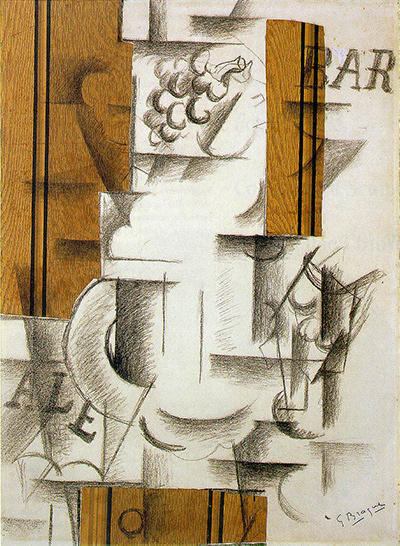
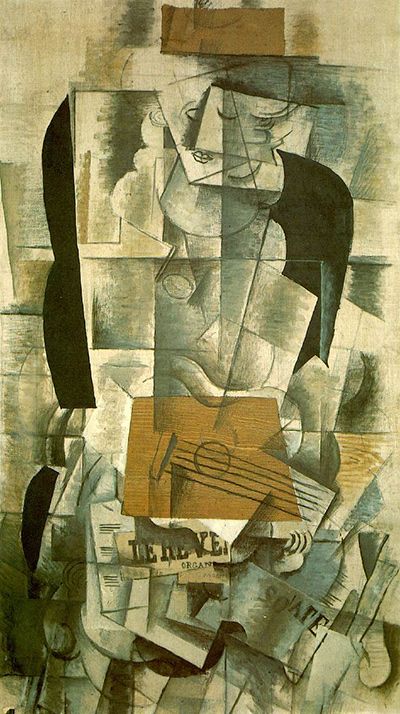
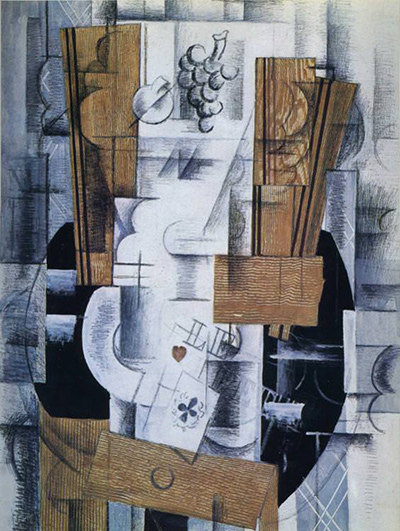
Braque's legacy begins with a collaborative revolution in painting. Cubist construction and papier collé changed how an image could organise objects, surfaces, fragments and signs. His later achievement broadened those questions through tactile still lifes, densely layered studios, birds reduced to emblems and landscapes of remarkable economy.[14][15]
The legacy also includes a way of working that resists an easy public myth. Braque's measured persona encouraged the language of authority and continuity. His art kept shifting beneath those descriptions. It moved among media, revised recurring motifs and allowed recognisable things to hover between object and sign.
Exhibitions made different parts of that achievement visible at different times. Kahnweiler's gallery exposed a new pictorial problem. Interwar dealers and retrospectives established duration. Venice and MoMA asserted international stature. The Louvre and the national funeral gave official form to cultural honour. Later retrospectives reopened what those honours had compressed.
No single comparison with Picasso can contain that history. Their partnership remains indispensable, while Braque's independent decades remain equally real. His standing survives through the continuing effort to hold both truths together—and through institutions willing to look again.
Related Pages
Frequently Asked Questions
Georges Braque's public standing was never secured by a single triumph.
Braque's solo exhibition at Daniel-Henry Kahnweiler's Paris gallery ran from 9 to 28 November 1908.
No single comparison with Picasso can contain that history.
Discussion
Georges Braque's public standing was never secured by a single triumph.
Reader Insights
Georges Braque's public standing was never secured by a single triumph.
Postwar recognition arrived through several kinds of institution in quick succession.
No single comparison with Picasso can contain that history.
Join the Conversation
Share the visible detail or source that most changed your reading.
References
- Metropolitan Museum of Art, Trees at L'Estaque
- Metropolitan Museum of Art, Thomas J. Watson Library, Exposition Georges Braque: du 9 au 28 novembre 1908
- Centre Pompidou, Les Instruments de musique
- LaM, Maisons et arbre
- Guggenheim Museum Bilbao, Georges Braque chronology
- Museum of Modern Art, Georges Braque, 1949 exhibition archive
- Museum of Modern Art and Cleveland Museum of Art, Georges Braque (1949)
- Museum of Modern Art, 1949 retrospective press release
- La Biennale di Venezia, “The post-war period and the '60s”
- Centre Pompidou, Le Billard
- Musée du Louvre, Les Oiseaux de Braque
- French Ministry of Culture, “National funeral of Georges Braque”
- Museum of Fine Arts, Houston, Georges Braque: A Retrospective
- Guggenheim Museum Bilbao, Georges Braque retrospective
- Kunstsammlung Nordrhein-Westfalen, Georges Braque: Inventor of Cubism