 by Tom Gurney
Tom Gurney BSc (Hons) is an art history expert with over 20 years experience
Published on August 14, 2026 / Updated on August 14, 2026
Email: tomgurney1@gmail.com / Phone: +44 7429 011000
Introduction
Georges Braque returned to still life because its modest objects could sustain remarkably ambitious questions. A glass, bottle, instrument or bowl already carried a familiar shape and a known use. Once that recognition had taken hold, Braque could divide the contour, tilt the table, shift the viewpoint or make the painted surface assert its own physical substance. The ordinary thing became a measure of everything the picture changed around it.
This continuity joined works of radically different appearance. The compressed browns and greys of Analytic Cubism, the pasted papers of 1912, the fuller pedestal-table paintings of the 1920s and the expansive billiard interiors of the 1940s all establish different relations among object, surface and space. Still life endured as Braque's most adaptable testing ground: a genre in which material presence and pictorial uncertainty could sharpen one another.[1][7][8]
Recurrence gave Braque a way to compare unlike solutions across time. A tabletop might first appear as a set of broken cues, later as a tipped pedestal, and eventually as the dominant structure of an interior. Wood could arrive as tonal paint, printed imitation or carefully simulated grain. Each return carried a memory of earlier procedures while changing the terms of the encounter. The history of these still lifes is therefore a history of revision, with the same broad category repeatedly opened to a new material or spatial demand.
At a Glance
- ArtistGeorges Braque
- GuideStill Lifes
- FocusWhy still life remained Braque’s central laboratory from early Cubism through sand paintings and wartime vanitas.
- Key topicsObjects That Could Bear Experiment; Recognition Under Pressure; When the Surface Acquired Its Own Materials; Rebuilding the Table after 1917
- OverviewGeorges Braque returned to still life because its modest objects could sustain remarkably ambitious questions.
Contents
- Introduction
- Objects That Could Bear Experiment
- Recognition Under Pressure
- When the Surface Acquired Its Own Materials
- Rebuilding the Table after 1917
- Painted Marble, Pebbles and Sand
- The Reach of the Hand
- Still Life under Historical Pressure
- When the Table Became the Room
- Why Still Life Endured
Objects That Could Bear Experiment
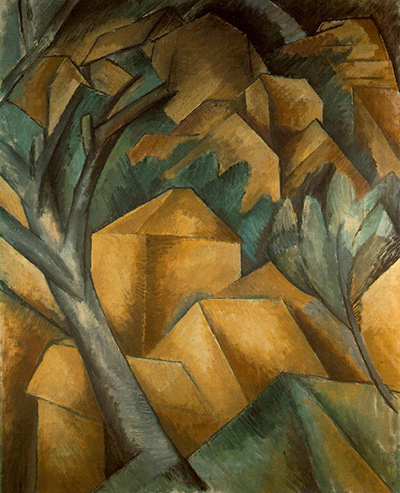
Braque's move towards still life grew from the geometric reorganisation of his landscapes. From 1908, forms developed at L'Estaque and elsewhere became flatter, more faceted and less dependent on a single vanishing point. Kunstsammlung Nordrhein-Westfalen describes a gradual transfer of this fragmentation into still life and the figure. From autumn that year, musical instruments entered Braque's repertoire alongside jugs, bottles and fruit.[1]
These objects offered an unusual combination of stability and flexibility. A bottle remains identifiable through a neck, an edge or a printed label; an instrument can emerge from a curve, strings, a sound hole or a fragment of musical notation. Such cues survive even when the surrounding space breaks apart. Recognition gives the experiment force, since the viewer senses both the object and the transformation imposed upon it.
The Metropolitan Museum of Art makes this function especially clear in its account of Still Life with Metronome, painted in Paris in late 1909. A mandola and metronome belonged to the familiar culture of domestic music-making. Their presence helped contemporary viewers grasp the painting's more difficult spatial inventions.[2] Familiarity served as an entry point, while the structure around those things remained restless.
Musical objects were especially productive because their identity combines shape, use and rhythm. A curved body, taut line or fragment of notation can call an instrument to mind before a complete silhouette appears. Yet the same principle applies to fruit, vessels and bottles. Their repeated forms create expectations, and Braque's adjustments become legible against those expectations. Still life could therefore be radical without surrendering every connection to daily experience.
Recognition Under Pressure
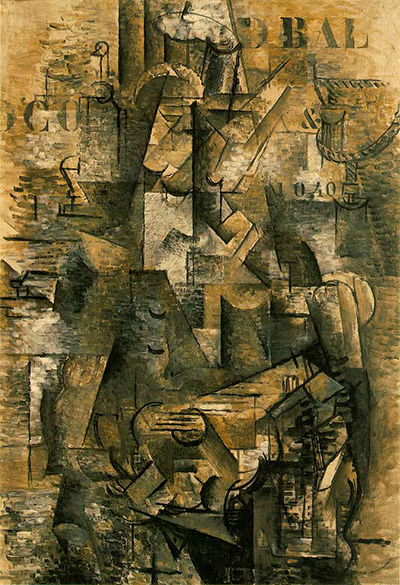
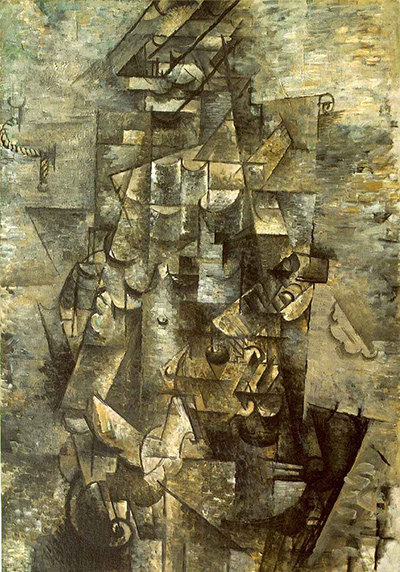
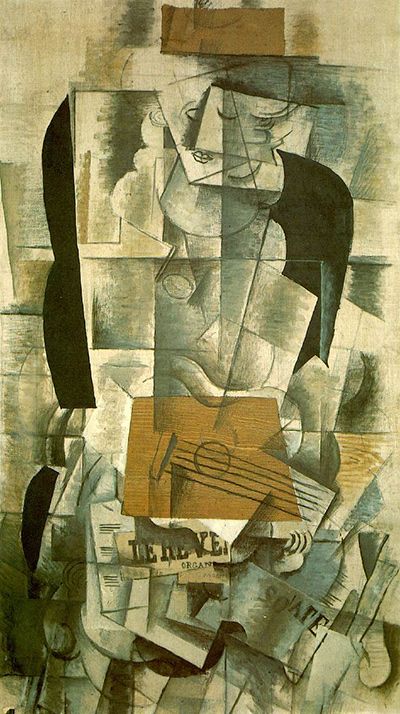
During the Analytic Cubist years, Braque and Pablo Picasso abandoned the idea that one fixed viewpoint should organise an entire scene. Braque's still lifes gather several views within a shallow field, with reduced colour and fragmented forms giving the surface its rhythm. Natural light, depicted illumination and ordinary depth cease to agree; the picture constructs a world governed by its own relations.[1]
An object in this setting arrives piece by piece. A curve may suggest an instrument before its body becomes clear. A straight edge can belong to a table, a sheet of paper or the boundary of another plane. Letters retain their flat graphic presence while also pointing towards labels, newspapers, music or café life. Seeing unfolds as an accumulation of clues, and certainty remains provisional.
That slowness gives early Cubist still life a temporal quality. The eye moves among partial signs, revises an assumption and discovers a second possible alignment. Braque preserved enough resemblance for recognition to continue, while the painting withheld the coherent room that ordinary perspective promises. The object feels present through repeated acts of identification, beyond any single seamless likeness.
This balance also explains the restricted palette. Ochres, browns, greys and whites bind many facets into a compact structure, reducing the power of local colour to separate one thing cleanly from another.[1] Colour becomes architectural. Its restraint concentrates attention on how a plane meets the next plane and how a familiar contour dissolves into the surrounding field.
The tabletop is crucial within this compressed setting. Traditionally, it establishes a horizontal stage and locates each thing at a measurable distance. Braque turns that stabilising device into part of the puzzle. An edge may tilt upwards, merge with an object or become indistinguishable from the picture's own boundary. The familiar setting survives through scattered agreements, while depth has to be assembled from overlapping signals. What once contained the still life now participates in its uncertainty.
When the Surface Acquired Its Own Materials
In 1912, the still-life experiment moved from the representation of surfaces to the incorporation of manufactured matter. Braque began cutting and pasting printed papers into drawings and paintings, combining wallpaper, newsprint, sheet music and programme fragments with charcoal additions. These sheets arrived with their own patterns, words and cultural associations already in place.[1]
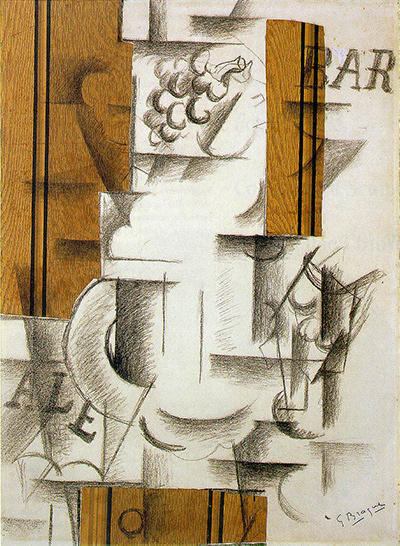
The decisive example is Fruit Dish and Glass, made at Sorgues in autumn 1912. The Met records charcoal, gouache and three pieces of mass-produced faux-bois wallpaper on paper. Braque later remembered it as his first papier collé, or pasted-paper work.[3] The wallpaper was itself a layered proposition: machine-printed paper imitating artisan-painted wood grain, which in turn imitated timber panelling.
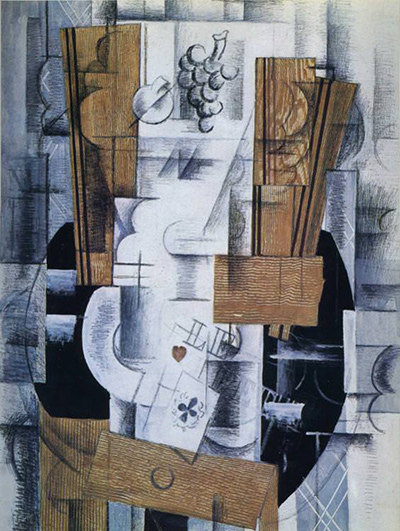
Once placed in the composition, the material occupied several realities at once. It was an actual sheet with a cut edge, a manufactured imitation of wood and a component in a hand-drawn still life. A strip could frame a vessel, evoke a tabletop or behave as an independent rectangle. The physical seam gave the surface literal relief, yet its pictorial meaning remained mobile.
Drawing remained essential. Charcoal extended across printed areas, connected separate fragments and completed forms that the papers only began. Actual matter therefore deepened representation while remaining part of it. The viewer met the cheap wallpaper as a real product and as an illusionistic sign, while the hand-drawn fruit dish depended on both levels. Still life had become a place where the picture could reveal its construction and preserve its represented world at the same time.[3]
This change also expanded the temporal life of each fragment. Wallpaper had been designed for an interior before it entered the studio; newsprint and programmes carried information from a specific everyday world. Cutting interrupted those first purposes, yet traces of manufacture and circulation remained. Braque could use them as shape, texture and cultural residue at once. The still life now gathered objects whose represented existence sat beside the prior histories of its physical materials.[1]
Rebuilding the Table after 1917
Braque resumed painting after his First World War service, severe injury and long recovery. The Table of 1918 marks an important change in scale and tone. The Philadelphia Museum of Art connects its sensuous surface to the painter-decorator training Braque had received from his father, especially the craft of simulating wood grain and marble.[4]
The work also initiated a decade-long group of pedestal-table paintings. Still-life elements sit on a tipped wooden table whose top behaves almost like a picture within the picture.[4] The pedestal offers a firm central form, yet its raised plane pushes the objects towards the viewer and unsettles ordinary depth. Fuller contours and decorative pleasure return without restoring a conventional room.
This phase is often associated with the wider postwar “return to order,” when many European artists renewed contact with classical form and established genres. Braque's still lifes reveal a more entangled movement. Volume grows, colour broadens and traditional objects become prominent, while the tipped table, simulated surfaces and competing orientations preserve lessons learned through Cubism.
The shift also changed the emotional register of the genre. Prewar still lifes often make recognition feel arduous; the pedestal-table works allow fruit, instruments and vessels to assume greater visual weight. Their abundance and crafted surfaces create pleasure. Spatial uncertainty survives within that richness, becoming a framework for the objects' renewed presence.
The pedestal itself becomes a bridge between solidity and display. Its narrow base suggests furniture with weight, while the raised top brings the arrangement close to the picture plane. Objects seem presented for sustained attention, almost ceremonially, yet their common domestic character remains intact. Braque found a structure capable of carrying grandeur without converting a bowl or instrument into an elevated symbol. The genre gained monumentality through scale, contour and surface.
Painted Marble, Pebbles and Sand
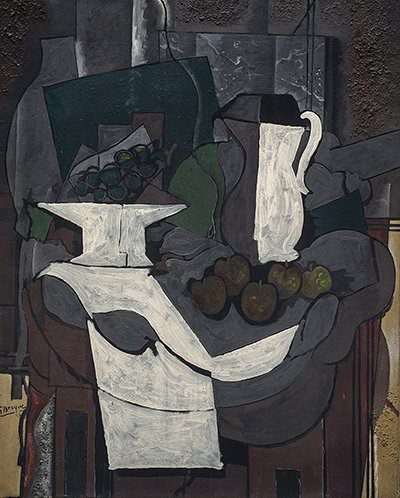
Two paintings from the mid-1920s show how Braque carried material experiment into works made entirely or principally with paint. Centre Pompidou's Fruits sur une nappe et compotier of 1925 presents a traditional ensemble of instrument, music, fruit dish, autumn fruit and white cloth on a monumental scale. Isabelle Monod-Fontaine describes its mosaic of faux marble as a reminder of Braque's decorative apprenticeship and of the texture play developed in earlier pasted papers.[5]
Here marble is simulated in oil. The painted plates suggest the raised surface of a table and, at the same time, the uprights of a fireplace. Traditional abundance occupies a space that continues to shift between possible constructions. Centre Pompidou characterises this as an invention from Cubist premises, with classicising objects held inside a deliberately disconcerting architecture.[5]
In The Bowl of Grapes of 1926, imitation gives way to actual granular additions. The Peggy Guggenheim Collection records oil with pebbles and sand on canvas. Broad frontal planes keep the objects distinct, while a firm grid is softened by curves, circular clusters and textural variation in peripheral areas.[6] The work belongs to a wider family of pedestal-table and mantelpiece subjects developed from about 1918 to 1929.
The contrast matters. Painted marble invites the eye to recognise a depicted substance; sand and pebbles give the canvas a substance of its own. Both procedures make surface central, and both retain ambiguity between thing and sign. A vessel can appear weighty while its setting tips forward; a granular passage can feel physically assertive while serving a pictorial rhythm. Braque's mature still life grew from the exchange between these experiences.
These works also complicate the idea of finish. Smooth illusion, visible imitation and granular interruption share the same canvas, allowing a passage to appear polished in one sense and materially resistant in another. Braque's surface records several kinds of labour: the decorator's knowledge of how marble looks, the painter's organisation of colour and contour, and the addition of matter whose texture remains physically present. The still life becomes an encounter among crafted likeness, actual substance and the eye's desire to join them.
The Reach of the Hand
The late 1920s and 1930s brought another rebalancing. A Kemper Art Museum study of Still Life with Glass describes these years as a period of experiment that resists easy classification. In the 1930 canvas, overlapping planes, separated contours and volumes, varied textures and fragmented perspectives create a conflict between flatness and bodily presence.[7]
Kemper's account places Braque's interest in still life close to the reach of the hand. Objects invite imagined touch because they have edges, weight, texture and an interval from one another. At the same time, the painted structure denies easy possession. A tabletop can rise almost vertically; a volumetric glass can occupy more than one orientation; a flat letter can indicate a newspaper that lacks a complete depicted shape.[7]
This tension became especially productive during the 1930s. Material presence meant more than thick pigment. It could arise through the separation of contour from volume, a conflict among viewpoints, the contrast of matte and granular passages, or the charged gap between adjacent things. Flatness remained visible throughout, giving tactile suggestion a resistance that ordinary illusion would smooth away.
The Phillips Collection's exhibition devoted to 1928–45 traced a movement from intimate late-1920s interiors towards larger, more vivid spaces in the 1930s and more personal versions of daily life in the 1940s.[8] Braque also allowed completion to remain extended in time. The four paintings known as the Rosenberg Quartet stayed together in his studio at different stages as he reworked them over several years.[8]
Material methods varied from canvas to canvas. Phillips records powdered quartz and sand in named 1930s paintings, while another work uses painted and incised patterns to enliven layered fabrics.[8] No single recipe defines the period. The recurring aim lies in making surface, object and surrounding space feel mutually dependent.
Scale alters that relationship. In an intimate arrangement, a glass or pipe can seem available to the hand; in a larger canvas, the table and its surrounding interior begin to approach the viewer's own bodily field. Bold pattern and stronger colour add another kind of proximity, even as contradictory viewpoints frustrate a secure position. Braque's objects become more emphatic without becoming easier to place. Their physical suggestion grows alongside the instability of the space between them.
Long reworking contributes to this effect. A painting that remains active over months or years carries adjustments made at different moments, and Phillips's account of the Rosenberg Quartet makes that duration concrete.[8] Revision can thicken a surface, alter a contour or change the balance between one object and another. Still life offered a contained world in which those shifts could accumulate without requiring a new subject each time.
Still Life under Historical Pressure
By the end of the 1930s, the studio itself entered this material and spatial problem. The Kreeger Museum's Vase, Palette, and Skull of 1939 condenses easel, vase, palette, furniture and frames into overlapping surfaces. Sand adds texture, while carefully painted wood grain recalls Braque's decorative craft.[9] The artist's tools join the still life, making painting's own activity part of the represented world.
The skull intensifies the work's historical resonance. Painted as Europe approached war, it invites association with vanitas traditions and mortality. Kreeger also records Braque's later insistence that his skull paintings were apolitical.[9] These positions create a tension between historical atmosphere and declared intention. The work carries the pressure of its moment while withholding a single decipherable programme.
During the occupation, modest domestic things acquired similarly divided meanings. Phillips notes that trays, washstands and tightly grouped objects prompted contrasting responses: some viewers saw disengagement from public events, while others understood the still-life realm as a space of creative freedom during tragic years.[8] The disagreement belongs to the history of these paintings. Familiar things could register enclosure, persistence and imaginative independence without resolving themselves into political emblems.
Their modesty gave them historical force of a particular kind. Bread, vessels and household furniture belong to routines that continue under pressure. In a compressed interior, such things can suggest scarcity, privacy, endurance or retreat, yet those meanings arise through context and interpretation. Braque's still lifes preserve the density of that situation by keeping their objects concrete and their implications open. The genre holds public history at the edge of domestic experience.
When the Table Became the Room
Braque's first billiard painting transformed the scale of the genre. Centre Pompidou records the year of Le Billard as a bracketed 1944 and identifies it as the first of seven canvases, begun in his Paris studio after his return from Varengeville in autumn that year.[10] The green table appears obliquely and folds towards the viewer; the brown wall behind it undergoes a related deformation.
The tabletop now dominates the interior. Earlier works had tipped a compact platform carrying fruit, vessels or instruments. Here the playing surface behaves as an architectural force, drawing wall, floor and surrounding fragments into its movement. Sand gives the paint a rough yet soft consistency that Centre compares with billiard felt.[10] Material and spatial transformation become inseparable.
This enlargement carries the still-life inquiry towards Braque's later studio paintings. The billiard table remains an ordinary manufactured object with a clear purpose, but its proportions and angles reorganise the whole room. The genre has moved from objects within reach to an environment that seems to turn around the viewer.
The game introduces movement into the interior even when the balls appear still. Possible trajectories belong to the table's function, while the folded surface makes the viewer feel a more immediate spatial motion. Braque had long used the eye's passage among fragments as a kind of duration. The billiard paintings enlarge that experience: looking now follows a field designed for action, with material texture and abrupt geometry giving the room its momentum.
Why Still Life Endured
Across these changes, Braque kept returning to things whose identities could survive extraordinary treatment. Their familiarity made fragmentation legible. Their surfaces welcomed imitation, paper, sand, pebbles, quartz and incision. Their tables could function as platforms, tilted planes or structures large enough to absorb the room.
Still life gave Braque continuity without sameness. It could be austere or sensuous, intimate or monumental, materially literal or painted as illusion. Above all, it allowed an object to feel insistently present while the space containing it remained open to revision. That unresolved relation sustained the genre from the first Cubist experiments to the threshold of the great postwar studio paintings.
Related Pages
Frequently Asked Questions
Georges Braque returned to still life because its modest objects could sustain remarkably ambitious questions.
Braque's move towards still life grew from the geometric reorganisation of his landscapes.
Still life gave Braque continuity without sameness.
Discussion
Georges Braque returned to still life because its modest objects could sustain remarkably ambitious questions.
Reader Insights
Georges Braque returned to still life because its modest objects could sustain remarkably ambitious questions.
Two paintings from the mid-1920s show how Braque carried material experiment into works made entirely or principally with paint.
Still life gave Braque continuity without sameness.
Join the Conversation
Share the visible detail or source that most changed your reading.
References
- Kunstsammlung Nordrhein-Westfalen, “Georges Braque”
- Metropolitan Museum of Art, “Still Life with Metronome (Still Life with Mandola and Metronome)”
- Metropolitan Museum of Art, “Fruit Dish and Glass”
- Philadelphia Museum of Art, “The Table”
- Centre Pompidou, “Fruits sur une nappe et compotier”
- Peggy Guggenheim Collection, “The Bowl of Grapes”
- Kemper Art Museum, “Georges Braque, Nature morte et verre (Still Life with Glass), 1930”
- The Phillips Collection, “Georges Braque and the Cubist Still Life, 1928–1945”
- The Kreeger Museum, “Vase, Palette, and Skull”
- Centre Pompidou, “Le Billard”