 by Tom Gurney
Tom Gurney BSc (Hons) is an art history expert with over 20 years experience
Published on August 14, 2026 / Updated on August 14, 2026
Email: tomgurney1@gmail.com / Phone: +44 7429 011000
Introduction
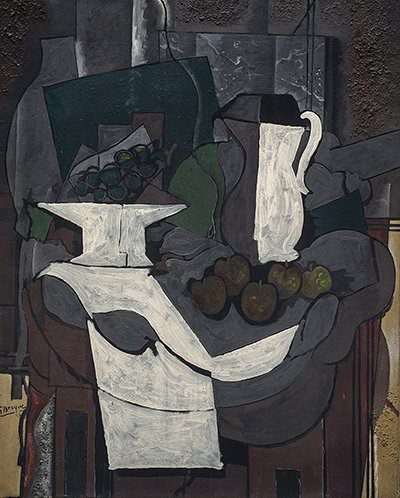
Sand changes what a still life can be before it changes what it depicts. In Georges Braque's The Bowl of Grapes, oil, pebbles and sand share the canvas, giving physical texture to a subject built around a familiar vessel and fruit. The Peggy Guggenheim Collection describes a rigorous grid softened by broad curves and groups of circular forms, with sand enriching peripheral areas through changes in texture.[1] Painted shape and actual grit belong to one carefully organised surface.
This material presence works alongside a second kind of weight. Heavy contours make objects seem voluminous; tilted planes, inconsistent perspective and broken background lines make their setting unstable. The painting can therefore feel substantial without becoming spatially fixed. Its bowl and grapes have force as objects, yet the structure around them continues to shift.
At a Glance
- ArtistGeorges Braque[1]
- TitleThe Bowl of Grapes[1]
- Date1926[1]
- MediumOil with pebbles and sand on canvas[1]
- Dimensions100.6 × 81.8 cm[1]
- CollectionPeggy Guggenheim Collection, Venice[1]
- Accession76.2553 PG 8[1]
- SignificanceThe 1926 Peggy Guggenheim still life through grapes, vessel, pebbles, sand and weighty surface
Contents
- Introduction
- The Venice Painting and Its Two Titles
- Pebbles, Sand and the Meaning of Surface
- A Grid Under Curved Pressure
- What Earlier Collage Left Behind
- Among Guéridons and Mantelpieces
- Five Echoes of Cézanne
- Painted Marble and Added Grit
- Weight Without Spatial Rest
The Venice Painting and Its Two Titles
The Peggy Guggenheim Collection holds the work as accession 76.2553 PG 8. It dates to 1926, measures 100.6 × 81.8 centimetres and carries the exact medium “oil with pebbles and sand on canvas.” Its full credit places it in the Peggy Guggenheim Collection, Venice, within the Solomon R. Guggenheim Foundation.[1]
The English title, The Bowl of Grapes, gives the subject immediate clarity. The original French title, Le Compotier de raisins, names a fruit dish or bowl with grapes. Both titles identify the same painting. They secure two elements—the vessel and its fruit—while leaving the rest of the composition to be understood through the museum's formal account.
This restraint matters in a still life, where familiar motifs can tempt a long inventory. Here the strongest evidence concerns material and organisation. Bowl and grapes provide recognition; grid, curve, contour and granular texture explain how that recognition is constructed.
Pebbles, Sand and the Meaning of Surface
The medium turns the canvas into more than a carrier for depicted things. Sand and pebbles introduce material differences that exist physically, while oil continues to describe forms. The painting thus places represented substance beside actual substance: grapes and bowl belong to pictorial space, and grains belong to the object that occupies the viewer's world.
Peggy Guggenheim's analysis gives sand a precise role. Added to pigment in peripheral areas, it produces textural variation.[1] The edges of the composition consequently participate in the material argument. Texture varies across the field, so the surface cannot be understood as one uniform skin.
Oil, sand and pebbles also address different senses. Colour and drawn boundaries are available to sight; grit carries an implied resistance and roughness. The material fact invites an awareness of touch while remaining part of a painting made for looking. This doubled address gives the surface its unusual authority: it describes a world of objects and declares its own constructed body at the same time.
The pebbles require a different degree of precision. Their presence is guaranteed by the medium, but their distribution is undocumented. They can be discussed as part of the painting's granular constitution without turning them into a mapped sequence of accents. This distinction keeps the physical fact vivid while preserving the limits of the record.
Material addition also changes the meaning of “weight.” No measured mass is at issue. Weight emerges through the conjunction of tangible grit, dense contour and the voluminous presence attributed to the represented objects. The bowl and grapes acquire gravity through both substance and form.
A Grid Under Curved Pressure
The museum describes the organisation of shape and line as rigorous and complex.[1] A structuring grid establishes order, but broad curves and grouped circular forms soften it. Rectilinear discipline remains visible while rounded elements work against its severity.
The grapes make this relation especially apt at the level of subject. Their grouping naturally suggests repeated roundness, though assigning each circular form to an individual grape would exceed the written account. The bowl adds another curved idea. Together, title and analysis allow the central motif to be understood as a pressure of rounded forms within a framework that retains its angular logic.
“Softened” is the crucial term. The curves preserve the grid while resisting complete submission to it. They modify its tempo, easing some divisions and concentrating energy elsewhere. The surface becomes a negotiation between repeated boundaries and swelling forms.
This interplay produces coherence without a single stable viewpoint. A grid can imply continuity across the canvas, while grouped circles create concentrated density. Broad curves connect or redirect those concentrations. The composition holds together as a network of relations, with no room reconstructed in consistent depth.
What Earlier Collage Left Behind
Braque returned from military service in 1917 and developed subjects and procedures rooted in his prewar work. Peggy Guggenheim's account stresses that his collage practice of the 1910s provided formal innovations for paintings of the 1920s.[1] The Bowl of Grapes shows that inheritance through broad, frontal planes that remain relatively discrete.
Such planes recall collage's ability to assemble a composition from distinct units. Their separateness keeps the canvas surface prominent, even when they construct recognisable objects. Colour and decorative pattern can increase their sensuous appeal, while frontal presentation prevents them from dissolving into seamless atmospheric depth.[1]
The 1926 object remains a painting with granular additions. Its link with collage lies in the organisation of forms, the visibility of the surface and the productive meeting of different material registers. Paper is unnecessary for collage's lessons to remain active.
This continuity also complicates any simple account of a retreat from Cubism. Traditional fruit and vessel subjects have returned with fullness and colour, while frontal planes and unstable relations preserve habits formed through earlier experiment. Familiarity and construction reinforce each other.
The difference between discrete planes and isolated fragments is important. Peggy Guggenheim's description allows the planes to retain individual presence while contributing to one rigorous composition. They behave like parts placed into relation. Grid, contour and curve keep those parts answerable to a larger order, converting the legacy of assembly into a painterly syntax.
Among Guéridons and Mantelpieces
By subject, Peggy Guggenheim places the painting among Braque's guéridon—round pedestal-table—and mantelpiece works of about 1918–29.[1] The approximate range describes a sustained family of still-life settings. It gives the 1926 canvas a historical neighbourhood without forcing every work into one fixed sequence or identical interior.
The Philadelphia Museum of Art provides a useful starting point. Its The Table of 1918 initiated a decade-long group in which still-life elements occupy the tipped surface of a wooden pedestal table. That painting also revived Braque's decorator-trained simulation of wood grain and marble after his wartime recovery.[2]
By the middle of the next decade, Braque could treat the support beneath a still life as both a subject and an organising device. A pedestal table offers a compact platform; a mantelpiece offers another horizontal support within an interior. In either family, the represented surface can tilt toward the plane of the canvas, bringing objects forward while loosening ordinary perspective.
The grouping therefore clarifies a durable question in Braque's work: how can a few domestic things occupy a support that remains legible while also becoming part of the painting's larger geometry? The Bowl of Grapes answers through frontal planes, a governing grid and curves that press against it.
The approximate dates also reveal persistence. From the postwar return to painting through the late 1920s, table and mantelpiece settings offered Braque a recurring laboratory for support, frontality and object presence. Repetition of a subject family enabled change within it. The 1926 canvas belongs to that sustained investigation while making physical grit one of its defining terms.
Five Echoes of Cézanne
Peggy Guggenheim explicitly relates the canvas to Paul Cézanne's still lifes through five traits: heavy contours, voluminous objects, tilted planes, inconsistent perspective and discontinuous background lines.[1] Taken together, they describe a balance between physical presence and spatial disturbance.
Heavy contours give the bowl and grapes boundaries capable of carrying visual force. Volume makes the objects feel ample within those boundaries. Yet tilted planes disturb the support beneath them, and inconsistent perspective prevents every part from obeying one vantage point. Discontinuous lines weaken the background's claim to form a seamless enclosure.
The Cézanne comparison concerns a way of building pictorial experience. Objects gain solidity while their relations remain mobile. A bowl may feel round and weighty even as its supporting plane rises; fruit may gather into a compact presence while the setting shifts around it. Stability resides in the things themselves more strongly than in the space that contains them.
This is also where grid and curve acquire historical depth. The grid organises, contours consolidate, and curves give volume. Tilt and discontinuity then unsettle the order. The painting's force comes from their coexistence, which the museum identifies as reminiscent of Cézanne without tying Braque to a single prototype.
Each of the five traits contributes a different pressure. Contour separates, volume expands, tilt lifts, inconsistent perspective multiplies possible viewpoints, and discontinuity interrupts the background. Their combination prevents the comparison from becoming a vague statement of influence. Cézanne matters here through an exact set of formal problems that Braque carries into his own materials and geometry.
Painted Marble and Added Grit
One year earlier, Braque approached material richness through another method. The Centre Pompidou's Fruits sur une nappe et compotier of 1925 is oil on canvas whose green and grey passages imitate a mosaic of marbles.[3] Its stone effect is made entirely through paint. The Bowl of Grapes incorporates pebbles and sand into its medium.
The comparison reveals two parallel choices. Painted imitation can make oil masquerade as a polished or mottled substance; granular addition can make texture an actual property of the object. Each asks the eye to negotiate between what the painting represents and what its surface physically is. They are alternatives within Braque's material practice, free from any hierarchy of authenticity.
A Lyon and Centre Pompidou dossier places the 1920s work within a wider respect for material and skilled craft, alongside the continuing memory of Cubism.[4] That combination suits the 1926 canvas. Its material richness feels deliberate and sensuous, while the frontal planes, tilted supports and inconsistent perspective keep earlier spatial questions alive.
Craft in this context joins control with experiment. The grid and heavy contours establish command; the added grains disrupt an entirely smooth finish; the perspective remains deliberately unsettled. Material care therefore supports the painting's tensions. It gives them a palpable vehicle while leaving them unresolved by polish alone.
Weight Without Spatial Rest
The bowl and grapes anchor the painting through title, contour and volume. Pebbles and sand make its surface physically varied. The grid supplies discipline; broad curves and circular groupings temper that discipline; tilted planes and broken background lines deny the setting a final stability.
These qualities converge in a still life that feels weighty yet mobile. Material gathers on the canvas, objects press forward, and space opens into competing relations. Braque gives ordinary fruit and a vessel palpable presence, then surrounds them with an order flexible enough to keep looking active. The physical surface and the represented world meet without becoming the same thing.
Related Pages
Frequently Asked Questions
Sand changes what a still life can be before it changes what it depicts.
The Peggy Guggenheim Collection holds the work as accession 76.2553 PG 8.
These qualities converge in a still life that feels weighty yet mobile.
Discussion
Sand changes what a still life can be before it changes what it depicts.
Reader Insights
Sand changes what a still life can be before it changes what it depicts.
This continuity also complicates any simple account of a retreat from Cubism.
These qualities converge in a still life that feels weighty yet mobile.
Join the Conversation
Share the visible detail or source that most changed your reading.
References
- Peggy Guggenheim Collection, “The Bowl of Grapes”: https://www.guggenheim-venice.it/en/art/works/the-bowl-of-grapes/
- Philadelphia Museum of Art, “The Table”: https://www.philamuseum.org/objects/51209
- Centre Pompidou, “Fruits sur une nappe et compotier”: https://www.centrepompidou.fr/fr/ressources/oeuvre/cgjzXer
- Musée des Beaux-Arts de Lyon and Centre Pompidou, Braque/Laurens, un dialogue, exhibition dossier: https://www.mba-lyon.fr/sites/mba/files/medias/images/2019-12/dpresse_expo_Braque_Laurens.pdf