 by Tom Gurney
Tom Gurney BSc (Hons) is an art history expert with over 20 years experience
Published on August 14, 2026 / Updated on August 14, 2026
Email: tomgurney1@gmail.com / Phone: +44 7429 011000
Introduction
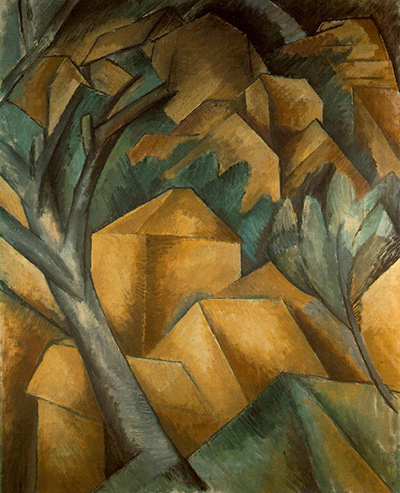
Georges Braque's Houses at L'Estaque presents architecture without granting it the usual comforts of landscape. Walls and roofs retain weight, yet the view stops short of opening naturally behind them. Forms gather upward, each pressing against the next. Trees join the same packed construction instead of framing a distant settlement. The painting remains a recognisable place, but place has begun to behave like the material structure of a picture.
That contradiction gives the work its historical force. Painted in 1908, it stands between the liberated colour of Braque's Fauvist landscapes and the more fragmented language later known as Analytic Cubism. It is tempting to see the buildings as a set of cubes and leave the explanation there. Braque's more consequential achievement was to make solid form and flat surface operate at once.
At a Glance
- ArtistGeorges Braque[1]
- TitleHouses at L'Estaque[1]
- Date1908[1]
- MediumOil on canvas[1]
- Dimensions73 × 59.5 cm[1]
- CollectionHermann and Margrit Rupf Foundation, Kunstmuseum Bern[1]
- InventoryGe 006[1]
- SignificanceThe 1908 Bern landscape compresses houses and trees at the Fauvism-to-Cubism threshold
Contents
- Introduction
- Identifying the Bern painting
- A landscape built towards the surface
- What changed after Fauvism
- The 1908 exhibition and the “little cubes” problem
- A threshold, not mature Analytic Cubism
Identifying the Bern painting
The work discussed here is the canvas in the Hermann and Margrit Rupf Foundation at Kunstmuseum Bern. The museum's current collection list records the German title Häuser in l'Estaque, the date 1908, oil on canvas, dimensions of 73 by 59.5 centimetres, and inventory number Ge 006. The museum's English guide calls it Houses at l'Estaque; Maisons à l'Estaque is the familiar French form of the same title.[1]
Its presence in Bern also belongs to the early history of Cubist collecting. Kunstmuseum Bern describes the Rupf Collection as a permanent loan closely connected with the dealer Daniel-Henry Kahnweiler. Hermann Rupf began buying through Kahnweiler around 1907 as the gallery's first client.[2] That context helps explain how a radical work associated with Kahnweiler's Paris circle reached a Swiss collection, although it cannot establish the canvas's complete chain of ownership.
Exact identification matters because several 1908 landscapes have very similar names. The LaM in Villeneuve-d'Ascq owns Maisons et arbre—Houses and Tree—a separate oil measuring only 40.5 by 32.5 centimetres and numbered 979.4.16.[6] The Met's Trees at L'Estaque, Centre Pompidou's Le Viaduc à L'Estaque and MoMA's Road near L'Estaque are also distinct works. They illuminate the same burst of experimentation, but none supplies the Bern canvas's dimensions, collection history or individual forms.
A landscape built towards the surface
John Elderfield's catalogue entry for the Bern painting offers the most detailed object-specific account. It describes volumes placed in a space so flattened and compressed that the masses become difficult to imagine as complete three-dimensional bodies. They have fronts and modelled faces, but seem to lack the room required for backs. The result is neither an ordinary recession nor a completely flat pattern. It resembles a shallow relief whose projections remain bound to the plane supporting them.[3]
The drawing reinforces that pressure. A strong vertical-and-horizontal framework organises the canvas, while forms build one above another without the customary softening of aerial perspective. Shapes higher in the composition retain their tonal force even when they are supposed to be farther away. Their visual strength helps pull distance forward.[3] The eye can still distinguish houses, foliage and tree trunks, but it cannot distribute them comfortably into foreground, middle distance and background.
Braque also prevents local textures from separating into self-contained zones. Elderfield notes that parallel hatched strokes pass across the surface regardless of whether they describe architecture, leaves or trunks. One kind of touch can therefore do two jobs. It can model a particular mass through changes of light and dark, and it can remind the viewer that every mass belongs to the same continuous painted field.[3]
Contours behave in a similarly double manner. They remain more enclosing than they would in Braque's later Cubist paintings, so the principal masses stay coherent. At selected points, however, an edge opens or its shading continues into an adjacent plane. The eye is encouraged to move across the join and onward through the picture. A house can hold together as architecture while also becoming one interval in the larger construction.
The encounter between buildings and vegetation is central to this effect. Houses might ordinarily supply measured geometry while trees interrupt it with organic irregularity. Elderfield's account describes a stricter exchange. Browns, greens and greys distinguish houses, foliage and trunks as broad classes, yet the common hatching and shallow arrangement prevent those classes from occupying separate visual worlds.[3] A trunk contributes a vertical stress to the framework governing a wall; foliage becomes another modelled mass within the architecture.
The trees consequently do more than identify a Mediterranean landscape. They test whether unlike things can be made equivalent without becoming identical. A trunk and a house retain different shapes while undergoing comparable operations: enclosing and opening contours, light-dark modelling, close stacking and repeated touch. Their differences remain legible inside a pictorial order that is stronger than the ordinary distinction between nature and construction.
This explains why the canvas is more radical than the shorthand “houses made from cubes” suggests. A collection of fully independent blocks could still sit inside conventional perspective. Braque instead makes the blocks inseparable from the shallow space among them. Solidity is preserved, then denied the deep setting in which it would normally make sense.
Light is also prevented from restoring a conventional scene. It articulates faces and edges without becoming one atmospheric illumination that places every form at a measurable distance. The painting's upper masses can remain as forceful in value as those lower down. Such refusals make depth feel physically compacted: the viewer is given enough modelling to expect recession, then repeatedly brought back to the surface that carries it.[3]
What changed after Fauvism
Only a short time separates this restricted painting from Braque's Fauvist south. In 1906 and 1907 he had used intense, often non-naturalistic colour to turn harbours and hillsides into animated surface compositions. By 1908, brown, green and grey carried much more of the burden. In the Bern work, Elderfield explains, these colours broadly distinguish houses, foliage and tree trunks, while modulation of light and dark builds their mass.[3]
Colour has changed function rather than lost importance. Where it had produced vivid contrast across a coastal view, it now helps classify and connect a limited number of forms. The close range keeps attention on weight, interval and the relation of one plane to another. MoMA's Road near L'Estaque, painted in late summer 1908, offers a related but separate solution: its museum label likewise identifies a restricted palette, crowded space and sharp geometric forms.[7] Seen as a group, these landscapes show Braque pursuing several versions of a common problem rather than mechanically repeating one formula.
L'Estaque made that transformation unusually visible because Braque had already worked there during his Fauvist phase. The subject remained while the painting changed profoundly. Harbours, roads, houses and trees could be revisited as colour, contour and depth acquired new responsibilities. The continuity of place acts almost like a control: the difference lies in Braque's way of constructing a location. K20's chronology follows exactly this passage from the colour-led southern campaigns to landscapes assembled from layered geometric planes.[4]
Paul Cézanne was crucial to that change. Braque saw the large memorial retrospective at the 1907 Salon d'Automne and returned to L'Estaque, a place Cézanne had repeatedly painted. K20's account describes Braque moving towards geometric forms, layered and faceted spaces, reduced colour and a weakened dependence on central perspective.[4] Influence here becomes transformation rather than imitation.
Elderfield locates the most important Cézannist lesson in the relation between modelled planes and the flat support. Cézanne could break a contour and allow adjacent zones to pass into one another through shifts of hue and value. Braque adapted that principle, relying more severely on light and dark and restricting the chromatic range.[3] The borrowed problem becomes a different system. Where Cézanne's transitions can retain a complex vibration of colour, Braque drives architecture towards an austere framework of masses.
Cézanne was one condition among several. Braque's recent Fauvist practice remained close enough to be actively rejected and retained: colour was subdued, but the habit of making the entire surface rhythmically present survived. Contemporary exchanges with other painters and the concentrated work of the southern campaigns also mattered. The canvas is an active transformation within a network of experiments, far beyond the application of one master's lesson.
The 1908 exhibition and the “little cubes” problem
Braque submitted his new landscapes to the 1908 Salon d'Automne, where they were rejected, and Kahnweiler presented the radical group in Paris that November. The Met securely identifies its own Trees at L'Estaque as one of the works in that display and describes a reverse-perspectival effect in which sculptural forms push outward rather than recede.[5] Elderfield's catalogue associates the Bern painting with the rejected and subsequently exhibited group.[3]
The exhibition is often folded into a crisp origin story for the word “Cubism.” The evidence is less tidy. Elderfield writes that the Bern Houses at L'Estaque was probably the landscape Henri Matisse disparaged in 1908 as being composed of petits cubes. He then distinguishes that reported remark, made in the context of the Salon jury, from critic Louis Vauxcelles's later review of Braque's Kahnweiler exhibition.[3] “Probably” is doing essential work: it signals a historical proposal rather than an established object label.
There is a further complication. LaM's different, much smaller Maisons et arbre bears a collector's inscription asserting that it was rejected from the Salon and was the first painting Matisse called Cubist. LaM also documents that canvas in Kahnweiler's November exhibition as catalogue number 13.[6] The inscription is valuable evidence for the history of the claim, but cannot settle which work Matisse saw or remembered.
The safest conclusion is also the most revealing. The language of cubes arose around Braque's 1908 landscapes as a group, because viewers were trying to describe an unfamiliar relation among geometry, solid form and compressed space. Assigning the entire birth of Cubism to a single canvas turns a contested reception history into a legend. The Bern work belongs near the centre of that history without needing to monopolise it.
Even as a group label, “cubes” captures only the most conspicuous feature. It names the block-like masses but misses the instability of their setting. A true cube implies measurable sides, a back and a position in coherent space. Elderfield's description emphasises how stubbornly Braque's masses resist such completion in imagination.[3] The critical nickname registered a new geometry, but the painting's deeper innovation lies in making that geometry answer to a surface that refuses transparent depth.
A threshold, not mature Analytic Cubism
Later terminology can blur what is particular about Houses at L'Estaque. Elderfield calls its phase Cézannist or Sculptural Cubism. The volumes remain broad and weighty, and enclosing contours still matter. From 1909 onward, Braque would divide objects into smaller units, let neighbouring planes interpenetrate more extensively, reduce the independence of local colour and create the unstable atmospheric fields associated with Analytic Cubism.[3][4]
The Bern landscape already makes those later developments possible. Its perspective no longer acts as a transparent container. Its hatching unifies unlike things. Its broken edges let one plane enter the logic of another, and its restricted colours identify forms while keeping them bound to the surface. Houses and trees remain sufficiently distinct to anchor the work in a specific kind of terrain. It approaches abstraction through reconstruction while its subject endures.
That distinction also separates the canvas from mature Analytic Cubism. In the Bern work, recognition begins with relatively large categories—a house, foliage, a trunk—and the tension comes from the way those substantial units crowd the support. In later paintings, much smaller signs and facets can migrate across the boundaries of objects, forcing recognition to occur more slowly. Houses at L'Estaque prepares that development by loosening the bond between solid and setting, while stopping short of dissolving the landscape into a dispersed field.
This is why the painting rewards attention beyond its place in a naming story. Braque goes beyond reducing a village to geometry. He asks what happens when architecture's solidity is made to serve the solidity of the canvas itself. The view of L'Estaque is still there, but it has ceased to be a window onto orderly depth. It has become a compact pictorial structure—one in which every house, trunk, interval and stroke helps rebuild the place on the surface.
Related Pages
Frequently Asked Questions
Georges Braque's Houses at L'Estaque presents architecture without granting it the usual comforts of landscape.
The work discussed here is the canvas in the Hermann and Margrit Rupf Foundation at Kunstmuseum Bern.
This is why the painting rewards attention beyond its place in a naming story.
Discussion
Georges Braque's Houses at L'Estaque presents architecture without granting it the usual comforts of landscape.
Reader Insights
Georges Braque's Houses at L'Estaque presents architecture without granting it the usual comforts of landscape.
Colour has changed function rather than lost importance.
This is why the painting rewards attention beyond its place in a naming story.
Join the Conversation
Share the visible detail or source that most changed your reading.
References
- Kunstmuseum Bern, “Houses at l'Estaque,” current digital guide; and Complete Collection List, 6 July 2026, entry for Häuser in l'Estaque, Ge 006. https://guide.kunstmuseumbern.ch/en/artwork/1039 and https://www.kunstmuseumbern.ch/en/api/files/2026-07/Gesamtliste_Sammlung_6.7.2026_1.pdf?_rsc=5zQUHQRiZn8hwFE2
- Kunstmuseum Bern, “Kahnweiler & Rupf: A friendship between Paris and Bern,” current institutional collection-history resource. https://www.kunstmuseumbern.ch/en/ausstellung/kahnweiler-rupf
- John Elderfield, European Master Paintings from Swiss Collections: Post-Impressionism to World War II (New York: The Museum of Modern Art, 1976), p. 92, catalogue entry for Houses at L'Estaque. https://assets.moma.org/documents/moma_catalogue_2445_300297548.pdf
- Kunstsammlung Nordrhein-Westfalen, Georges Braque: Inventor of Cubism, current institutional sections on Fauvism, Cézanne and Proto-Cubism. https://www.kunstsammlung.de/en/braque/
- Metropolitan Museum of Art, “Trees at L'Estaque,” L'Estaque, summer 1908, 2025.616.10. https://www.metmuseum.org/art/collection/search/490578
- LaM, “Maisons et arbre,” summer 1908, 979.4.16. https://www.musee-lam.fr/fr/maisons-et-arbre-3
- Museum of Modern Art, “Road near L'Estaque,” L'Estaque, late summer 1908, 103.1943. https://www.moma.org/collection/works/78787