 by Tom Gurney
Tom Gurney BSc (Hons) is an art history expert with over 20 years experience
Published on August 14, 2026 / Updated on August 14, 2026
Email: tomgurney1@gmail.com / Phone: +44 7429 011000
Introduction
On 3 September 1963, two days after Georges Braque died in Paris, France held national funeral rites for him at the Louvre. André Malraux delivered the memorial address in the Cour Carrée. The setting joined two distant points in Braque's life: the son of a decorative painter, first trained in the practical craft of finishes and surfaces, had become the modern artist invited to paint a ceiling for the Louvre a decade earlier.[7][8]
The journey between those points was neither straight nor confined to Cubism. Braque moved from Argenteuil to Le Havre and then Paris; travelled repeatedly to the Channel coast, Provence and the French Pyrenees; formed an exceptionally close working relationship with Pablo Picasso; survived a severe First World War wound; and rebuilt his career through still life, figures, theatre, prints, books, sculpture and large late series. Public honours eventually surrounded a life that had begun in a family trade.
That long span matters because Braque's biography is often compressed into the years 1908–14. Those years transformed modern painting, yet they occupied a small portion of a career lasting almost six decades. His life after the Picasso partnership was not an afterword. It brought different dealers, poets, architects and places into his work, while old questions about objects, materials and space continued under altered historical conditions.
At a Glance
- ArtistGeorges Braque
- GuideBiography
- FocusBraque’s life from decorative training and the Cubist partnership through war injury, postwar studios, honours and death.
- Key topicsArgenteuil, Le Havre and the decorative trade; Fauvism and the southern journeys; Braque, Picasso and the Cubist years; War, injury and the return to painting
- OverviewOn 3 September 1963, two days after Georges Braque died in Paris, France held national funeral rites for him at the Louvre.
Contents
- Introduction
- Argenteuil, Le Havre and the decorative trade
- Fauvism and the southern journeys
- Braque, Picasso and the Cubist years
- War, injury and the return to painting
- The interwar artist
- Varengeville and the 1930s
- Recognition and the late series
- Death, funeral and burial
Argenteuil, Le Havre and the decorative trade
Braque's life began at Argenteuil-sur-Seine, northwest of Paris, on 13 May 1882. His father, Charles, worked in decorative building painting, a trade also associated with Braque's grandfather. In 1890 the family settled in Le Havre, the Norman port whose commercial life and active artistic community would shape his youth.[1][2][4]
Between 1897 and 1899 he studied painting at Le Havre's École des Beaux-Arts. He also entered his father's business and continued with another decorative contractor. These parallel forms of education placed easel painting beside the discipline of a working craft: preparing surfaces, handling materials and producing convincing imitations for architectural interiors. Such training later became relevant to his use of graining, stencils and textured matter, although the connection was a resource he chose to reactivate, never an automatic path to Cubism.[1][3][4]
At eighteen, in 1900, Braque moved to Paris. He continued his apprenticeship with a decorator and attended municipal art classes in the Batignolles district. Military service brought him back to Le Havre in 1901–02. Once released, he returned to Paris, settled in Montmartre and spent a short period in Léon Bonnat's studio at the École des Beaux-Arts in 1903 before resuming study at the Académie Humbert. In 1904 he rented a studio in the rue d'Orsel and committed himself more fully to painting.[1][2]
This was an education assembled from several worlds rather than a single academy. Braque knew the procedures of a building trade, attended formal and informal classes, visited museums and galleries, and entered the dense artistic life of Montmartre. Friendships with painters from Le Havre, especially Othon Friesz and Raoul Dufy, connected his new Paris existence to the city in which he had grown up. By 1905 he was working independently, still searching for a language that could make his practical knowledge and his ambitions as a painter cohere.
Le Havre itself was developing an unusually active modern-art culture. The Cercle de l'Art Moderne was founded there in 1906, and Braque joined Friesz and Dufy in its annual exhibitions through 1909.[2] His professional formation therefore ran in two directions at once: Paris supplied museums, studios, dealers and the international avant-garde, while the Norman port remained a place of friendship, exhibition and return. That pattern of departure and renewed attachment would recur later with Varengeville.
Fauvism and the southern journeys
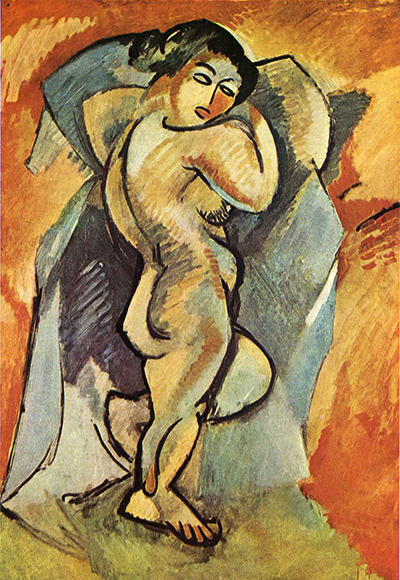
The 1905 Salon d'Automne provided a decisive encounter. Paintings by Henri Matisse, André Derain, Maurice de Vlaminck and others demonstrated that colour could be freed from ordinary description. For Braque, then twenty-three, Fauvism offered a way out of the darker, more conventional landscapes he had been making. Its force lay in colour relations and openly worked surfaces, qualities that could organise a picture without disguising the act of painting.[2][3][5]
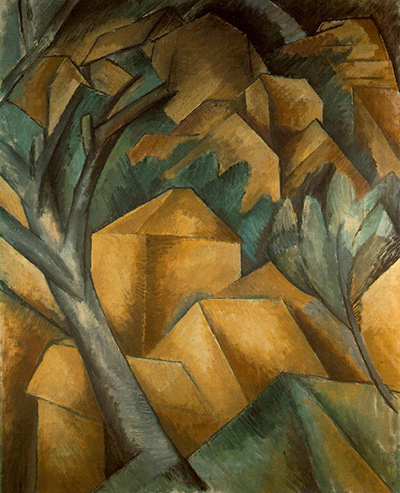
Travel turned that encounter into practice. During the summer of 1906 Braque worked in Antwerp with Friesz. In October he went to L'Estaque, near Marseille, a place already inseparable from Paul Cézanne's example. Braque returned north to exhibit at the Salon des Indépendants in spring 1907, where six Fauvist landscapes were shown, and then worked again in the south, at La Ciotat and L'Estaque.[2][3]
The Fauvist phase was brief, but it established Braque professionally and intellectually. Dealers began to take notice, and the landscapes showed that a recognisable coast, harbour or hillside could be remade through an independent order of colour. By autumn 1907 his attention was shifting toward the structural lessons of Cézanne. The large posthumous Cézanne retrospective in Paris intensified that interest, while the southern terrain allowed him to test how buildings, trees and slopes might be joined into a compact pictorial construction.[1][3][5]
Another encounter entered this transition. In late November 1907, Guillaume Apollinaire brought Braque to Picasso's studio at the Bateau-Lavoir, where he saw Les Demoiselles d'Avignon in progress or newly completed. The meeting did not instantly produce Cubism, and Braque's own engagement with Cézanne and landscape was already active. It opened a dialogue that would become sustained during the following year.[2][5]
Braque, Picasso and the Cubist years
In spring and summer 1908 Braque returned to L'Estaque and produced landscapes built from closely packed forms and a restricted palette. The Salon d'Automne jury rejected the group he submitted. Daniel-Henry Kahnweiler responded by giving him a solo exhibition at his small Paris gallery in November, with a catalogue preface by Apollinaire. Critical remarks about the pictures' cubes soon became part of the naming history of Cubism. The exhibition was a public landmark, though no single show can contain the movement's beginning.[1][2][5]
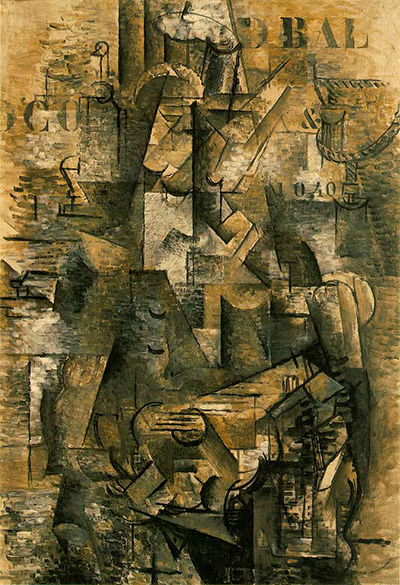
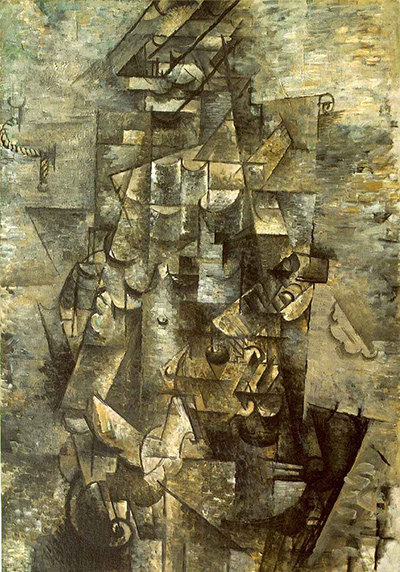
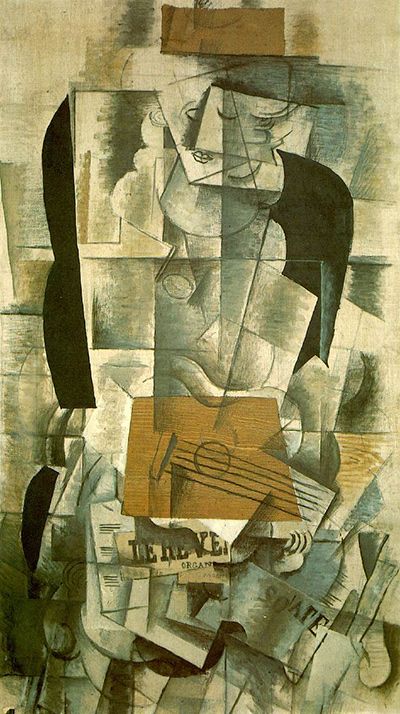
From autumn 1908, Braque and Picasso entered a working exchange of unusual intensity. They visited each other's studios, discussed new pictures and repeatedly answered one another's decisions. Their paintings moved away from a stable viewpoint and continuous recession, building objects and figures from intersecting planes within compressed space. At times their works became difficult to distinguish. Their development was reciprocal; reducing it to a leader-and-follower story obscures what each artist achieved through the exchange.[3][4][5]
The collaboration also transformed Braque's daily life. He worked at La Roche-Guyon in 1909, returned to L'Estaque in 1910 and joined Picasso at Céret in 1911. Around this time Marcelle Lapré became his companion. By the early 1910s they had formed a household, and she was commonly known as Marcelle Braque long before their civil marriage. Their relationship endured for the rest of his life.[2]
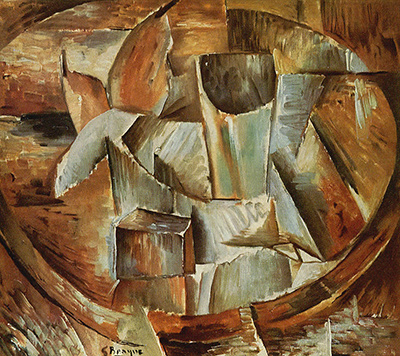
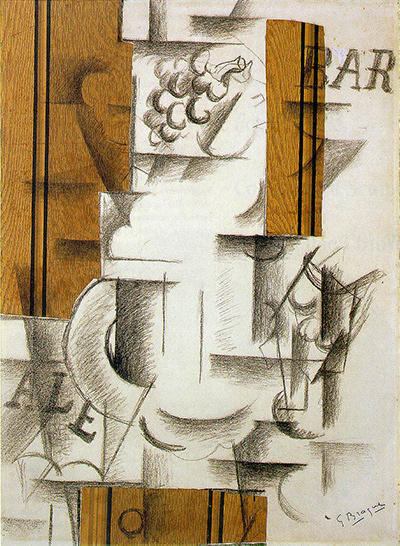
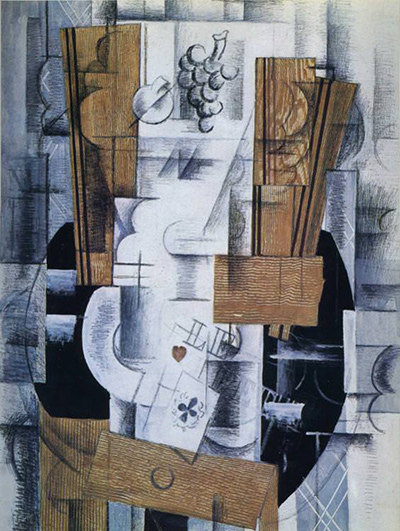
The pictures changed quickly. Braque introduced stencilled letters and numbers by 1911, allowing the flat certainty of typography to coexist with unstable represented forms. During the summer of 1912 he worked near Picasso at Sorgues. In September, after encountering wood-grain wallpaper in Avignon, he cut and pasted patterned pieces into Fruit Dish and Glass, his first papier collé. That precise category matters: pasted paper was one innovation within the wider history of collage, not a claim to every practice gathered under the later term.[2][4][5]
Braque and Picasso continued to exchange ideas as their work grew more colourful and incorporated the lessons of pasted paper into painting. Their daily partnership ended abruptly with the outbreak of the First World War and never resumed in its earlier form.
Cubism was also moving beyond the privacy of two studios. In 1912 Braque exhibited at the Sonderbund in Cologne and in connection with the Blaue Reiter in Munich. His work reached the United States through the 1913 Armory Show in New York.[1] These appearances placed him within an increasingly international argument about modern art even as Kahnweiler's close dealer network kept many of the newest paintings away from the large Paris salons. By 1914 the language developed with Picasso had already entered a wider public history.
War, injury and the return to painting
Braque was mobilised in August 1914 and assigned to the French infantry. In November he was sent to the front on the Somme. On 11 May 1915 he was seriously wounded at Carency, in the Artois sector, and underwent a long period of treatment and convalescence.[1][2][5]
The injury created a genuine break in his working life. It has also attracted stories that make trauma explain everything he painted afterward. Braque spent much of 1916 recovering and resumed painting in 1917. His later art developed after severe bodily experience, a changed European culture and the end of an intimate collaboration. Those circumstances shaped the setting of his return without supplying a single cause for everything that followed.[1][2][5]
Intellectual work preceded or accompanied the return to the easel. In 1917 Pierre Reverdy's review Nord-Sud published Braque's Thoughts and Reflections on Painting. He also grew closer to Juan Gris and Henri Laurens, friendships that belonged to a different postwar network from the pre-1914 exchange with Picasso. In March 1919, Léonce Rosenberg presented a solo exhibition of Braque's still lifes at the Galerie de l'Effort Moderne. His friendship with the composer Erik Satie began around the same period.[1][2]
The exhibition restored Braque to public view, but his return was more than a revival of his prewar manner. He retained lessons from Synthetic Cubism while enlarging colour, scale and the material presence of objects. Tables, fruit dishes, instruments and papers remained central because they could sustain complex spatial relations. They now shared the career with figures, theatrical commissions and work in other media.
The interwar artist
During the early 1920s Braque's standing rose rapidly. At the 1922 Salon d'Automne, the monumental female figures known as the Canéphores prompted discussion of a new classical inspiration. Their dense forms belonged to the widespread postwar interest in antiquity and monumental figuration, while their proportions and construction preserved connections with Braque's recent work. The classical strand expanded his subjects without requiring a clean renunciation of Cubism.[2][5]
Theatre brought a different scale and social setting. Braque designed scenery and costumes for productions associated with Serge Diaghilev's Ballets Russes, the choreographer Léonide Massine and the Paris entertainments organised by Étienne de Beaumont. Les Fâcheux and Salade appeared in 1924, Zéphire et Flore in 1925 and Les Sylphides in 1926. These projects placed colour, movement and constructed space around performers rather than within the limits of a canvas.[2][5]
His professional circle also changed. Paul Rosenberg became his principal dealer in the mid-1920s, succeeding the earlier relationships with Kahnweiler and Léonce Rosenberg. Braque commissioned Auguste Perret to create a house-studio near Parc Montsouris in Paris, completed around 1924–25. Architecture now framed his working life as directly as rented Montmartre rooms once had.[1][2][5]
Marcelle remained at the centre of that domestic history. The couple had shared a life and household since the early 1910s; their legal marriage took place on 23 March 1926.[2] They remained together until Braque's death. The duration of the relationship is clear, while its privacy leaves little basis for assigning particular works to Marcelle's influence.
Braque's artistic activity widened further. Wood engravings for Satie's Le Piège de Méduse, sculptural experiments and collaborations with writers made books and prints increasingly important. In the early 1930s, Ambroise Vollard commissioned an illustrated edition of Hesiod's Theogony. Braque's response extended through etching and sculpture, bringing the origins of the Greek gods into a linear, tactile language distinct from his painting.[1][2][5]
Several of those directions had opened soon after the war. In 1920 Braque made wood engravings for Satie's play and produced an early standing female sculpture. Two years later, as the Canéphores brought him renewed attention, he left Montmartre for Montparnasse.[1] The move placed his domestic and professional life within a district that had become a new centre of Parisian art. Painting remained his principal activity, but sculpture, the printed page and performance had become durable parts of the life around it.
Varengeville and the 1930s
Around 1930, the architect Paul Nelson built Braque a house and studio at Varengeville-sur-Mer on the Normandy coast. Varengeville became a seasonal home, a site of work and eventually the landscape of Braque's final years.[1][2][5]
The move did not mean withdrawal from public life. A major retrospective opened at the Kunsthalle Basel in 1933, followed by Carl Einstein's monograph. In 1937 Braque received first prize from the Carnegie Institute for The Yellow Cloth. His paintings of the decade continued to centre on still life while bringing in palettes, women, musicians and richly ornamental interiors. The subject range complicates any idea that his postwar career settled into one formula.[1][2][5]
When the Second World War began, Varengeville was already part of Braque's working life. He remained in France during the occupation, with both Paris and the Normandy coast forming part of his wartime geography. His work continued under conditions of shortage and violence. Skulls, fish, tables, dark interiors and a small number of figures entered austere compositions, but their historical atmosphere does not make every object a fixed political symbol.[1][2][5]
The years also deepened relationships with writers. Jean Paulhan's book Braque le Patron presented the painter as an authoritative figure for a younger generation, while Braque later formed a close friendship with René Char. Such connections mattered to the illustrated books and print projects of the postwar period, joining images to poetry without subordinating one medium to the other.
Recognition and the late series
In 1944 Braque began the cycle of billiard-table paintings that occupied him through 1949. The subject offered a large, bounded surface that could tilt, bend and gather partial views while remaining tied to a familiar game. In 1947 he first exhibited with Aimé Maeght, his final dealer, and met René Char. The following year he received a major painting prize at the Venice Biennale, where his recent work was given prominent attention.[1][2][5]
Around 1949 he began the eight paintings called the Ateliers. These studio interiors gathered palettes, tables, vessels and fragments of furniture into spaces where signs and things could change status. A bird form appeared among them and soon became a major late motif. The sequence continued into the mid-1950s, showing an artist in his seventies still organising ambitious bodies of work rather than repeating isolated easel subjects.[2][5][6]
Official honours increasingly accompanied this activity. Braque was made a Commander of the Légion d'honneur in 1951. In 1953 he accepted a commission for the ceiling of the Salle Henri II at the Louvre. The three-part ensemble was commissioned in June and installed in July, carrying birds into an architectural setting above the viewer.[1][7]
Completed in 1953, the Louvre project has a biographical importance beyond its motif.[7] Braque had begun with decorated walls and apprenticeship work; now his painting entered the fabric of France's principal historic museum. The commission brought the long relationship between decorative craft and fine art in his life into public view.
Varengeville received a more local architectural contribution in 1954, when Braque designed stained glass for the church of Saint-Valery.[1] The work joined his late interest in birds and public decoration to the village where he lived for part of each year. Parisian recognition and coastal attachment were no longer opposing poles: the Louvre ceiling and the church windows each carried his forms beyond a movable canvas, while the studio at Varengeville remained a place for private work.
Bird imagery continued from 1954 into 1962. At the same time, Braque returned to landscape around Varengeville. The long, low paintings of 1955–63 brought earth, sky, fields and coastal horizons back into a career that had begun with places. Museums now recognise these late landscapes alongside the Fauvist and Cubist work, countering the older habit of treating everything after 1914 as decline or coda.[2][5][6]
Death, funeral and burial
Braque continued to divide his time between Paris and Varengeville until the end of his life. He died in Paris on 31 August 1963, aged eighty-one. On 3 September the national funeral took place at the Louvre, where Malraux delivered the official tribute. Braque was then buried in the cemetery at Varengeville-sur-Mer, the coastal village that had become his home and final landscape.[2][8]
The ceremony confirmed an extraordinary public position, yet the path to it had crossed very different kinds of labour and recognition. Braque had been an apprentice decorator, art student, Fauvist traveller, experimental partner, infantryman, convalescent, theatre designer, printmaker, sculptor and painter of studios and horizons. Dealers and poets changed around him; Paris, Provence and Normandy supplied distinct working environments; two wars divided the century he inhabited.
His life is therefore larger than the familiar comparison with Picasso. Their collaboration remains indispensable, and Braque's first papier collé remains a precise material milestone. The biography surrounding those achievements reveals a more extensive pattern: practical training became an enduring store of knowledge; travel repeatedly opened new phases; war interrupted work without dictating its meaning; and later studios, books, public commissions and landscapes carried invention far beyond the Cubist partnership.
The distance between the Le Havre apprenticeship and the Louvre funeral can look like a simple ascent from craft to national honour. Braque's work resists that hierarchy. Decorative skill stayed active inside his most radical art, and the prestige of late commissions did not replace the private discipline of returning to a table, a room, a bird or a horizon. Across eighty-one years, the circumstances changed; the act of rebuilding a world from tangible means remained central.
Related Pages
Frequently Asked Questions
On 3 September 1963, two days after Georges Braque died in Paris, France held national funeral rites for him at the Louvre.
Braque's life began at Argenteuil-sur-Seine, northwest of Paris, on 13 May 1882.
The distance between the Le Havre apprenticeship and the Louvre funeral can look like a simple ascent from craft to national honour.
Discussion
On 3 September 1963, two days after Georges Braque died in Paris, France held national funeral rites for him at the Louvre.
Reader Insights
On 3 September 1963, two days after Georges Braque died in Paris, France held national funeral rites for him at the Louvre.
The exhibition restored Braque to public view, but his return was more than a revival of his prewar manner.
The distance between the Le Havre apprenticeship and the Louvre funeral can look like a simple ascent from craft to national honour.
Join the Conversation
Share the visible detail or source that most changed your reading.
References
- Centre Pompidou, Musée national d'art moderne, Georges Braque: Éléments biographiques, institutional chronology prepared for the 1982 centenary exhibition. https://www.centrepompidou.fr/media/document/8e/d9/8ed959c0ce5de05cd6e9e0b6c5aa79df/normal.pdf
- Guggenheim Museum Bilbao, “Georges Braque,” current institutional artist chronology. https://www.guggenheim-bilbao.eus/en/the-collection/artists/braque-georges
- Kunstsammlung Nordrhein-Westfalen, Georges Braque: Inventor of Cubism, institutional resource on training, Fauvism and the close Braque–Picasso exchange. https://www.kunstsammlung.de/en/braque/
- San Francisco Museum of Modern Art, “Georges Braque,” institutional artist biography. https://www.sfmoma.org/artist/Georges_Braque/
- Guggenheim Museum Bilbao, Georges Braque, institutional retrospective research dossier. https://prensa.guggenheim-bilbao.eus/src/uploads/2014/05/Dossier-Braque-EN.pdf
- Museum of Fine Arts, Houston, “Georges Braque: A Retrospective,” institutional whole-career overview. https://www.mfah.org/art/exhibitions/georges-braque-retrospective
- Musée du Louvre, “Plafond: Les oiseaux,” collection record for the three-part 1953 ceiling ensemble. https://collections.louvre.fr/en/ark:/53355/cl010065746
- French Ministry of Culture, “Funérailles nationales de Georges Braque,” cultural-history record; and POP, Médiathèque du patrimoine et de la photographie, “Tombe de Georges Braque,” heritage record. https://www.culture.gouv.fr/nous-connaitre/decouvrir-le-ministere/histoire-du-ministere/ministere-de-la-culture-60-ans-d-action-en-500-dates/1963-09-03-Funerailles-nationales-de-Georges-Braque ; https://pop.culture.gouv.fr/notice/memoire/AP66P00525