 by Tom Gurney
Tom Gurney BSc (Hons) is an art history expert with over 20 years experience
Published on August 14, 2026 / Updated on August 14, 2026
Email: tomgurney1@gmail.com / Phone: +44 7429 011000
Introduction
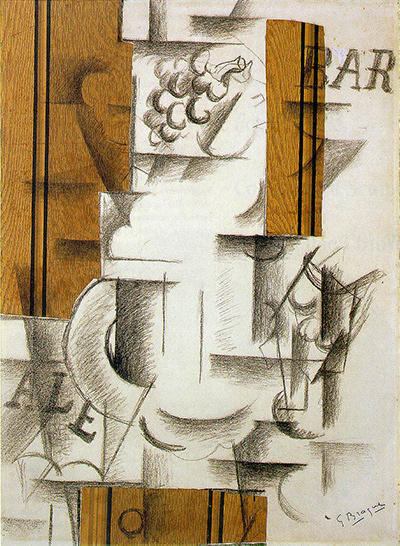
A piece of patterned paper changed the terms of Cubist painting. Once Georges Braque began cutting and pasting manufactured wallpaper into his drawings in September 1912, an element could occupy several states at once. It remained a physical sheet, carried a printed imitation of wood and helped construct a fruit dish, table or surrounding space. The eye could recognise each function without settling permanently on any one of them.
This development belongs to a close exchange between Braque and Pablo Picasso, yet its history becomes clearer when two related terms keep their distinct emphases. Musée national Picasso-Paris describes Picasso's Still Life with Chair Caning of spring 1912 as the first collage in art history. The Metropolitan Museum of Art identifies Braque's Fruit Dish and Glass, made that September, as his first papier collé.[3][4] Each claim names a different work and a differently bounded practice. Their compatibility opens a richer question than a contest for priority: what happened when Cubist signs became pieces of the material world?
At a Glance
- ArtistGeorges Braque
- GuidePapier Collé and Collage
- FocusThe distinction between papier collé and collage, and the roles of wallpaper, newspaper, faux bois and typography in Synthetic Cubism.
- Key topicsCollage as a broad field; Where papier collé fits; Picasso's spring 1912 collage; Braque's first papier collé
- OverviewA piece of patterned paper changed the terms of Cubist painting.
Contents
- Introduction
- Collage as a broad field
- Where papier collé fits
- Picasso's spring 1912 collage
- Braque's first papier collé
- From painted grain to printed wallpaper
- September and October: exchange in motion
- What pasted paper can do
- Cutting, joining and drawing
- Newspaper and the double life of words
Collage as a broad field
The word collage comes from the French verb coller, meaning to glue. In the Museum of Modern Art's current definition, it describes both a technique and a work made by arranging fragments of paper or other materials and affixing them to a support. Drawing and painting can remain part of the result. Paper is common, while the category also accommodates cloth, rope and many other substances.[1]
That breadth matters for early Cubism. A newspaper cutting, a length of cord and a piece of printed oilcloth differ in texture, manufacture and cultural association. Collage gathers them under the shared act of placing an existing material within an artwork. The fragment arrives with qualities made beyond the artist's studio: a pattern, a headline, a price, a previous purpose. Cutting and positioning it give those inherited qualities a new set of relations.
The material remains recognisable as material. At the same time, it can enter a depicted object, break apart a contour or function as a coloured plane. Collage therefore introduces reality in a surprisingly unstable form. A real scrap supplies tangible presence, though its pictorial identity depends on the marks and shapes around it.
An existing fragment also changes the meaning of artistic authorship. The artist selects a substance whose pattern or language has already been designed by someone else, then determines how much of it survives, which way it turns and what surrounds it. Manufacture and composition become visible as separate stages. A regular factory pattern may meet an uneven charcoal line; anonymous print may be drawn into a singular object. The borrowed element carries its former life into a newly made whole.
Where papier collé fits
Papier collé means pasted paper. MoMA gives a useful plain-language description in its account of Juan Gris's Breakfast: a collage composed from papers that have been pasted down. In this practical formulation, papier collé occupies part of the larger collage field.[2]
Historical usage carries further nuances. A MoMA catalogue published in 1983 proposed that collage often introduces a foreign or literal element into painting or drawing, whereas papier collé commonly uses paper to build pictorial structure. The same account immediately acknowledged how difficult the dividing line can be.[9] That qualification is essential. Artists and museums have applied the terms with varying degrees of precision, and individual works frequently blur the tidy distinction.
The phrase still has value. It focuses attention on paper as a constructive substance: its thinness, edge, colour, printed pattern and capacity to accept new drawing. It also helps preserve the difference between Picasso's use of oilcloth and rope in spring 1912 and Braque's use of cut wallpaper that autumn. The categories overlap, while their material emphases illuminate separate discoveries.
Picasso's spring 1912 collage
Picasso's spring still life combines oil paint and painted signs with a piece of oilcloth printed to resemble woven chair cane. A rope encloses the oval composition. The Musée Picasso account grants the work that historical priority and stresses the challenge created by bringing manufactured matter into a pictorial object.[3]
The insert contains a layered deception. It is genuine oilcloth, yet its caning is printed. The pattern represents a woven surface through industrial reproduction, then participates in a painted still life. The rope has another literal presence, even as it behaves like a frame. These materials make the boundary between image and thing newly uncertain.
The work establishes one kind of collage: existing substances enter into dialogue with painted illusion. Its oilcloth is distinct from the imitation-wood wallpaper Braque soon adopted. Keeping those materials separate allows the two innovations to retain their individual logic.
Braque's first papier collé
According to the Met's account of Braque's own recollection, Fruit Dish and Glass was his first papier collé. He made it at Sorgues in September 1912 using charcoal, gouache and cut pieces of mass-produced wallpaper printed with a faux-bois pattern.[4] A historic MoMA chronology places this event four months after Picasso's first collage and explicitly distinguishes the two categories.[9]
Here the material puzzle shifts. The pasted element is real paper, though the grain printed on it is an imitation of wood. Charcoal lines then assign the cut pieces a role within a Cubist still life. Material, imitation and depiction converge: paper presents a manufactured image of timber while helping the drawing evoke furnishings and objects.
The two claims of precedence can therefore stand together. Musée Picasso's “first collage” concerns Picasso's spring work and its oilcloth-and-rope construction. The Met's “first papier collé” concerns Braque's September work and pasted wallpaper. The 1983 MoMA catalogue gives the same sequence, with an interval of about four months.[3][4][9]
Such precision reveals more than a single trophy ever could. Picasso and Braque were exploring how actual materials might unsettle pictorial convention through different procedures. Their experiments met, diverged and fed back into one another.
From painted grain to printed wallpaper
Braque's choice of faux-bois paper grew from practical knowledge. His father and grandfather worked as painter-decorators, and his own training included lettering and methods for imitating wood and other costly surfaces. By 1911–12 he was introducing painted wood grain and typographic signs into Cubist pictures.[5]
Three states deserve careful separation. In painted faux bois, brushwork and specialist tools make paint resemble timber. In printed faux-bois wallpaper, a factory-made sheet carries a repeatable image of grain. Real wood would be timber itself. Braque's 1912 innovation used the middle state: physical paper bearing an industrially printed simulation.
The Met traces an economic sequence within decorative practice. Machine-made wallpaper offered a cheaper substitute for artisan-painted wood graining, which had itself supplied a less costly alternative to oak panelling.[4] Once placed in a Cubist construction, this modest commodity acquired unusual complexity. Its pattern arrived ready-made, its support stayed visibly thin and its cut outline resulted from Braque's decisions.
The shift from painted grain to printed paper also changed the artist's task. A painted imitation develops mark by mark. Wallpaper brings an existing field that can be selected, cut, rotated and joined to drawing. The manufactured repeat encounters the irregular pressure of charcoal and the particular edge of each fragment. Selection and placement become as consequential as painted description.
September and October: exchange in motion
Centre Pompidou's account places Braque's discovery at the beginning of September 1912. He noticed a roll of faux-bois wallpaper in an Avignon colour merchant's window, bought it while Picasso was briefly away, and set cut pieces into a charcoal structure. He showed the new works when Picasso returned. On 9 October, Picasso wrote to Braque in terms that referred to their recent experiments with paper and textured materials.[6]
The chronology conveys speed. Within weeks, a shop-bought decorative product entered an exchange already concerned with lettering, simulated surfaces and constructed forms. It also resists a simple relay in which one artist hands a finished invention to the other. Centre Pompidou presents the paper experiments as part of the artists' continuing exchange, with Braque showing his new constructions and Picasso responding soon afterward.[6]
Braque's wallpaper episode remains a distinct initiative within that dialogue. Picasso's earlier oilcloth collage forms part of the immediate context; Braque's paper constructions opened another path; subsequent works by both artists expanded the possibilities. Cubist invention here appears as a sequence of close, differentiated responses.
What pasted paper can do
Pasted paper carries several kinds of information before it depicts anything. It has a thickness, colour, edge and surface. Wallpaper adds a repeated pattern; newsprint adds columns, type and topical language. The artist can align those qualities with a represented object, let them collide with it or hold the relationship in suspension.
MoMA's account of Braque's Still Life with Tenora from 1913 explains this productive instability. The work combines newspaper, wallpaper and wood-grained paper with charcoal, chalk and pencil. Pasted shapes cross or contradict drawn contours, pressing awareness back toward the flat support even as fragments suggest instruments and still-life objects.[7]
This is why literal material supplies no simple escape from illusion. A wood-grain print is physically present as paper and illusionistic as grain. Its boundary may help form a table in one area, cut through another motif elsewhere and operate as an abstract shape across the whole composition. Drawing laid over the sheet can give it an identity that its original manufacturer never anticipated.
Cutting, joining and drawing
Papier collé preserved the choices associated with composition and introduced a different sequence of them. A sheet had to be chosen, cut, turned and placed. Its outline could echo a depicted form, interrupt one or establish a broad interval around several smaller signs. Charcoal might stop at the edge, continue across it or contradict the printed pattern. Each decision changed the balance between the fragment's physical identity and its pictorial work.
The seam between paper and support is especially important. A painted passage can disguise where one depicted surface ends and another begins. A pasted edge declares a physical division, even when it also proposes the rim of a table or the side of an instrument. The viewer encounters a genuine boundary and a represented boundary in the same place. When those boundaries diverge, recognition becomes an active negotiation.
MoMA's discussion of Still Life with Tenora emphasises this effect: the contours of the papers pursue relations that differ from those of the drawn motifs.[7] Such divergence allows one fragment to connect several parts of the composition without settling into a single depicted role. A patterned strip may suggest a material surface, supply tonal contrast and bind distant charcoal marks together.
The ready-made pattern also changes how repetition works. Printed grain repeats with mechanical regularity, while drawn lines vary through pressure and movement. Their meeting preserves two kinds of making inside one work. The factory sheet supplies recurrence; Braque's cuts interrupt it; charcoal reorients the result. Papier collé turns the difference between manufactured repeat and handmade variation into a compositional resource.
Newspaper and the double life of words
Newsprint expanded the method beyond decorative pattern. Its paper has a material tone and texture; its columns and headlines introduce fragments of language from daily commerce, politics and entertainment. A cutting can work as a pale or dark plane while a few legible letters pull the mind toward another setting.
Braque already understood letters as constructed signs through his decorative training. In Cubist work, typography can label, advertise, pun, interrupt a contour or anchor a broad horizontal. The Met's guide also cautions, in effect, that fragmented language encourages viewers to invent connections. A demonstrated allusion carries different weight from an attractive guess.[5]
One later Braque example shows how exact evidence can clarify the difference. The Met's discussion of Bottle, Glass, and Newspaper from 1914 identifies two cuttings from Le Journal. A car advertisement remains upright, while a tract hostile to feminism appears upside down and partly obscured. Their selection and orientation make textual content relevant to the work, yet inversion and concealment leave the artist's stance unresolved.[8]
The example prevents two opposite simplifications. Printed words carry more than decoration when their identity and placement can be established. They also resist conversion into a universal code. In many instances, partial letters matter through scale, weight and rhythm alongside whatever verbal meaning survives. Cubist typography operates between reading and seeing.
That distinction also separates physically pasted print from a painted or drawn representation of print. A newspaper named in an artwork's title may be depicted through charcoal or oil, while another work incorporates an actual cutting. The visual subject alone cannot determine the material procedure.
A rapidly widening repertoire
Braque's use of paper diversified during 1913 and 1914. Centre Pompidou's Violon et pipe, made in the winter of 1913–14, combines charcoal, graphite and chalk with several pasted papers. One newspaper fragment bears the date 28 December 1913, providing a secure earliest limit for that component. The museum's account traces a broader move from imitation-wood wallpaper toward varied textures, newsprint and colour.[6]
MoMA's Still Life with Tenora likewise mixes printed and painted papers. These sheets contribute contrasting surfaces and establish shapes whose edges follow their own logic.[7] The range shows how quickly the initial faux-bois experiment became a flexible method. Paper could arrive from domestic decoration, newspapers or specially prepared stock; each kind brought a different relation between pre-existing design and new pictorial use.
Expansion preserved the first discovery. The wallpaper of September 1912 had exposed a basic principle: a borrowed sheet could retain its previous identity while acquiring several new ones. Later materials increased the number of voices in that conversation.
Different papers also created different kinds of time. Wallpaper could evoke a durable domestic surface and the repeat of industrial production. Newspaper arrived stamped by the day, carrying matter whose topical life might fade quickly. Painted paper could be prepared for the composition itself. Bringing these temporal registers together allowed a still life to contain both enduring pictorial conventions and the passing texture of modern print culture.
Synthetic Cubism as a useful convention
Art historians commonly place these developments within the transition from Analytic to Synthetic Cubism. The Philadelphia Museum of Art explains that both labels entered later art-historical vocabulary. Its account associates the Synthetic phase of roughly 1912–14 with collage and papier collé, the assembly of more elemental fragments, renewed colour and a continuing play with illusion.[10]
The term helps describe a change of emphasis. Analytic Cubism had often broken objects into densely interrelated facets within restricted colour. Synthetic procedures could build an image from selected signs, larger shapes and actual materials. Recognition sometimes becomes quicker, though the relation among object, word and surface remains unsettled.
The labels describe overlapping tendencies, with permeable boundaries between them. Painted imitation continued beside pasted matter. Fragmentation remained available after larger signs appeared. Some works used paper, while others pursued related questions entirely through paint, charcoal or graphite. September 1912 marks a decisive material event within this development, without imposing one instant transformation on every work.
The Philadelphia museum's own timeline uses the terms papier collé and collage broadly around Braque's September experiment.[10] That usage reinforces the need for flexible terminology. “Synthetic Cubism” can orient the history, provided it remains an explanatory convention and leaves individual objects fully distinct.
The word synthetic can mislead if it suggests a tidy resolution. These works continue to make perception uncertain. Their synthesis lies in construction: separate signs, surfaces and fragments are assembled into an image whose identities emerge through relation. A curve may prompt the idea of a glass, a printed band may establish a tabletop, and a group of letters may evoke a newspaper. Each clue is economical, yet the whole remains open to several readings.
This economy distinguishes increased legibility from a return to conventional depiction. The object may become easier to name while its substance grows harder to classify. A viewer recognises a violin or bottle through a few selected cues, then encounters paper whose physical presence unsettles the imagined space. Synthetic construction can clarify the subject and deepen the material puzzle in the same instant.
Matter becomes a sign
Braque's papier collés altered Cubism through an economical gesture: placing a cut sheet within a drawing. The consequences spread far beyond glue and paper. Factory pattern entered fine art; decorative craft met avant-garde composition; words moved between public language and abstract form; flat material could suggest space while declaring its own surface.
Collage names the broad field of affixed fragments. Papier collé brings the constructive role of pasted paper into focus. Picasso's spring-1912 oilcloth-and-rope collage and Braque's September wallpaper construction mark related advances whose separate identities sharpen the history. Their proximity reflects collaboration; their materials reveal distinct choices.
Above all, the technique made a Cubist sign materially plural. One fragment could be paper, imitation wood, furniture, spatial plane and graphic interval within a single composition. The viewer's movement among those identities became part of the work. Synthetic Cubism grew through that mobility: images assembled from things already carrying meanings, transformed by the new company they kept.
Related Pages
Frequently Asked Questions
A piece of patterned paper changed the terms of Cubist painting.
The word collage comes from the French verb coller, meaning to glue.
Above all, the technique made a Cubist sign materially plural.
Discussion
A piece of patterned paper changed the terms of Cubist painting.
Reader Insights
A piece of patterned paper changed the terms of Cubist painting.
MoMA's account of Braque's Still Life with Tenora from 1913 explains this productive instability.
Above all, the technique made a Cubist sign materially plural.
Join the Conversation
Share the visible detail or source that most changed your reading.
References
- Museum of Modern Art, “Collage.” https://www.moma.org/collection/terms/collage
- Museum of Modern Art, “Juan Gris: Breakfast.” https://www.moma.org/collection/works/35572
- Musée national Picasso-Paris, “Picasso and Cubism.” https://www.museepicassoparis.fr/en/picasso-biography/picasso-cubism/
- Metropolitan Museum of Art, “Fruit Dish and Glass.” https://www.metmuseum.org/art/collection/search/490612
- Metropolitan Museum of Art, “Cubism and the Trompe l'Oeil Tradition — Visiting Guide.” https://www.metmuseum.org/fr/exhibitions/cubism-trompe-loeil/visiting-guide
- Centre Pompidou, “Violon et pipe.” https://www.centrepompidou.fr/fr/ressources/oeuvre/cpgXbgx
- Museum of Modern Art, “Still Life with Tenora.” https://www.moma.org/collection/works/38330
- Metropolitan Museum of Art, “Feminine / Masculine: Cubist Collage.” https://www.metmuseum.org/perspectives/feminine-masculine-cubist-collage
- Museum of Modern Art, The Modern Drawing: 100 Works on Paper from The Museum of Modern Art. https://www.moma.org/documents/moma_catalogue_1699_300296451.pdf
- Philadelphia Museum of Art, “Picasso and the Avant-Garde in Paris.” https://www.philamuseum.org/exhibitions/picasso-and-the-avant-garde-in-paris