 by Tom Gurney
Tom Gurney BSc (Hons) is an art history expert with over 20 years experience
Published on August 14, 2026 / Updated on August 14, 2026
Email: tomgurney1@gmail.com / Phone: +44 7429 011000
Introduction
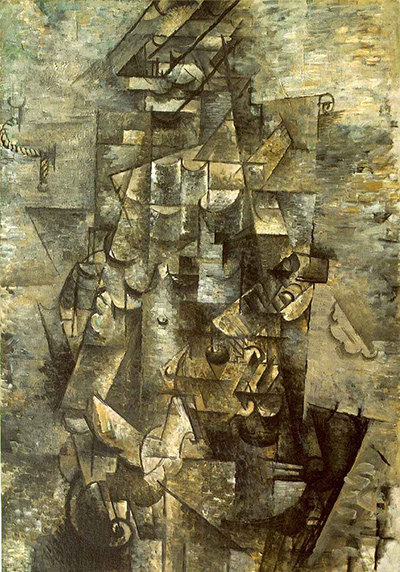
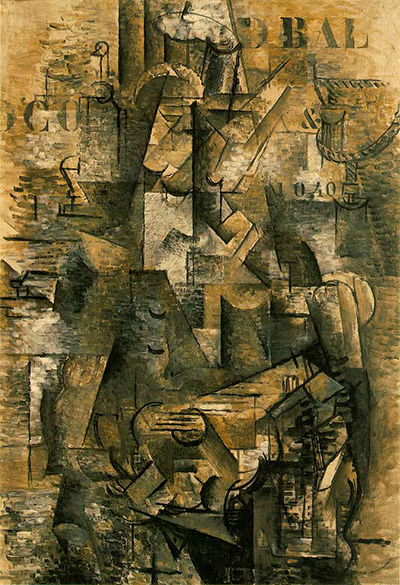
Georges Braque's The Portuguese begins with a contradiction. Its title appears to identify a person, yet the painting refuses the ordinary assurances of portraiture. No face settles into a likeness. No body maintains a continuous outline. A musician is present, but he has to be found through scattered relations among curves, shaded planes, instrument parts, letters and numbers. Recognition arrives piece by piece and never becomes final.
The painting is also known as Le Portugais and L'Émigrant—The Emigrant. The current institutional caption dates it to 1911–12 and records it as an oil on canvas measuring 116.7 by 81.5 centimetres. It belongs to the Kunstmuseum Basel, where it entered as a gift from the collector Raoul La Roche.[1] These facts establish a large, upright figure painting. They do not establish who the man was, whether he considered himself an emigrant, or whether Braque intended a documentary portrait.
That distinction is essential. The Portuguese is not difficult because its subject has disappeared. It is difficult because Braque makes the act of identifying that subject part of the work.
At a Glance
- ArtistGeorges Braque[1]
- TitleThe Portuguese[1]
- Date1911/12[1]
- MediumOil on canvas[1]
- Dimensions116.7 × 81.5 cm[1]
- CollectionKunstmuseum Basel[1]
- SignificanceBraque's major high Analytic Cubist musician painting through its signs, stencils and unstable figure
Contents
- Introduction
- Finding the musician
- A remembered subject, not a recorded scene
- High Analytic Cubism
- Letters that refuse to stay in place
- On the threshold of collage
- Music as subject and structure
- Braque, Picasso and individual invention
- A portrait held open
Finding the musician
The most useful place to begin is not the face but the guitar. In the lower central area, a dark outlined oval or circle crossed by horizontal lines supplies the painting's firmest representational clue: a sound hole and strings. A lighter rectangle extends diagonally from this cluster and can be read as the instrument's fretboard.[3] Once these parts are related to one another, the title's musician becomes plausible. The guitar does not emerge as an intact object; it gives the eye a point from which to test the rest of the field.
Above it, darker planes suggest the centre of a torso. Forms at either side can be understood as upper arms, while semicircular turns help to indicate shoulders. A lighter triangular rise offers a possible path towards a neck and head.[3] Yet these signs never join into a stable anatomy. The eye can propose a figure, lose it, and reconstruct it differently a moment later.
The face is especially resistant. Curved strokes might suggest eyelids, a nose, a moustache or a chin, but their relationships are too uncertain to fix even the basic features.[3] This is why calling the painting a portrait can be misleading. A conventional portrait offers the face as the principal guarantee of identity. Here, the face is among the least secure parts of the man. The guitar tells us more reliably that someone is present than any facial mark tells us who he is.
The method resembles reading a sentence from a few surviving words. One clue establishes a provisional context; nearby clues become more intelligible because of it. The sound hole helps to organise the strings and fretboard. The instrument makes a torso and arms more likely. The title encourages the remaining marks to gather around a guitarist. But each connection remains revisable. Braque gives enough information to sustain representation without allowing it to harden into illustration.
A remembered subject, not a recorded scene
The conventional title has a source, although it needs careful handling. Smarthistory reports that Braque told his dealer Daniel-Henry Kahnweiler in a letter that the subject was a Portuguese guitar player he had seen aboard a ship in Marseille. The same account warns that this encounter is unlikely to explain every feature of the finished painting.[3]
The distinction between an originating memory and a literal scene matters. A loop of rope in the upper right can support a maritime association. It has also been interpreted as a curtain tie, suggesting an interior—perhaps a café.[3] Neither reading settles the location. Braque was no longer working directly from a model or transcribing one uninterrupted view. He could retain a guitarist, a shipboard recollection, a looped line and fragments associated with public entertainment without making them components of a single optically consistent moment.
Nor does the title securely identify the individual. “Portuguese” may preserve how Braque remembered or described the performer, but the canvas supplies no independent biography. “The Emigrant” adds another historical title, not evidence about the man's journey or legal status. The responsible reading keeps the titles attached to the work while refusing to turn them into a life story for an unnamed person.
This reserve does not make the subject unimportant. On the contrary, the unstable relation between the named man and the unconfirmed likeness is one of the painting's central tensions. Braque asks what minimum set of signs can continue to carry a human subject when continuous contour, consistent lighting and fixed viewpoint have been withdrawn.
High Analytic Cubism
John Elderfield's MoMA catalogue describes The Portuguese as one of Braque's major figure paintings of 1911 and a key work of high Analytic Cubism.[2] By this point, the more rounded masses of earlier Cubist paintings had been broken into smaller shaded facets. A strong linear framework gives the composition structure, but the modelling no longer gathers neatly around self-contained objects. Figure and surroundings participate in the same narrow, active field.
The reduced colour range contributes to that effect. Kunstsammlung Nordrhein-Westfalen's account of Braque's Analytic Cubism identifies ochre, brown, grey and white as characteristic tones, replacing the local colour and unified illumination expected in traditional illusionistic painting.[1] In The Portuguese, colour does not separate flesh, clothing, instrument and setting into readily named zones. Small differences of light and dark instead make forms seem to advance, recede, dissolve and reassemble.
This is a very shallow kind of space, but it is not simply flat. Elderfield emphasises that the painting opens and spreads its subject across the picture plane while retaining an unstable sensation of depth.[2] A shaded facet may read as part of the man's body, then as a plane beside him, then as a mark belonging to the canvas's larger structure. Braque does not replace illusion with a diagram. He makes literal surface and suggested depth continually interfere with one another.
The process also explains why “multiple viewpoints” is only a partial description. The painting does not merely place several clear views of one guitar or person side by side. It distributes incomplete signs through an environment in which object and surrounding space are difficult to separate. Looking becomes temporal: the viewer finds, tests and revises connections rather than receiving the subject in a single glance.
For that reason, The Portuguese never becomes entirely nonrepresentational. The musician does not vanish into a pattern with no referent. Guitar strings, sound hole, possible limbs, a possible head, a rope loop and written signs continue to exert representational pressure.[2][3] The work approaches the limit at which a figure can remain intelligible, but the effort to recover that figure is part of its meaning.
Letters that refuse to stay in place
The most consequential elements may be the ones that do not belong to the musician's body at all. Standardised letters, numbers and an ampersand appear among the shaded planes. They are immediately recognisable as signs, yet they do not combine into an uninterrupted message. The viewer knows what kind of thing each character is while lacking enough information to complete the statement with certainty.[3]
Elderfield's catalogue reconstructs two groups as fragments of posters advertising [GRAN]D BAL and [GRAN]D CO[NCERT].[2] The brackets are important. Braque gives portions of words rather than two legible announcements. “Ball” and “concert” connect the guitarist to popular entertainment, but they do not function like a caption that names him or explains the setting.
The stencilled characters also behave differently from the guitar and figure. A painted sound hole suggests a round opening in an instrument. A shaded plane can imply an edge turning in space. A block letter arrives already flat and standardised. It belongs simultaneously to language, to the commercial world of printed or painted notices, and to the physical surface carrying the paint.
That difference produces a remarkable spatial exchange. At first the crisp signs can appear to sit on top of the fluctuating field, pinning the surrounding facets behind them. Then their straight edges begin to rhyme with the painting's linear framework, and the letters seem to enter the very space they had exposed as illusion. The grid can rise towards them as readily as they can recede into it.[2] Braque therefore does more than place typography over a Cubist picture. He uses typography to make surface and depth alternately declare and unsettle each other.
Elderfield identifies The Portuguese as the first appearance of stencilled lettering in Braque's work.[2] That is a precise, source-bound claim—not a universal priority claim for lettering across the history of art. Its importance lies in what this particular use accomplishes. The stencil carries the impersonal regularity of public signage into a handmade oil painting. It is readable at the level of individual characters but incomplete at the level of language. It insists on the canvas as an object while remaining entangled in depicted space.
The numerals and ampersand intensify the same problem. They promise information—a price, date, conjunction or sequence—without supplying a complete statement. Like the visual clues to the guitarist, they require the viewer to infer relationships. Yet no final solution gathers every sign into a single code. The painting's language is partial by design.
On the threshold of collage
The letters help to explain why The Portuguese stands close to a major material change in Cubism. The painting is entirely oil on canvas; no newspaper, wallpaper or printed label has been pasted onto it.[1] It must not be mistaken for a collage or a papier collé. Nevertheless, the copied poster fragments bring a kind of outside material into the logic of the picture. They refer not only to represented objects but to signs already circulating in modern public life.
Elderfield argues that this use of stencilled, externally derived lettering prepares for collage.[2] The transition is conceptual before it becomes literal. Once a commercial sign can confront painted illusion as a flat, standardised element, the next question is whether the artist needs to imitate such material at all. Braque's papiers collés of 1912 would answer with actual patterned and printed paper. Kunstsammlung Nordrhein-Westfalen's chronology accordingly places high Analytic Cubism, the first pasted papers and Synthetic Cubism in a rapid sequence between 1911 and 1914.[1]
Yet The Portuguese is more than a stepping stone whose value lies in what came next. Its tension depends on the fact that the letters are still painted. They belong materially to the same oil surface as the guitarist's elusive body, even while they evoke a different mode of making and a different social world. The canvas catches Cubism at a point when representation is testing the boundary between depicting an external thing and incorporating the visual language of that thing.
Music as subject and structure
Braque's choice of a musician was not incidental. He played the violin, flute, piano and especially the accordion, and musical instruments recur throughout his Cubist work.[1] Their parts are well suited to a system based on incomplete but recognisable signs: strings can survive as parallel lines, a sound hole as a dark curve, a neck as a projecting rectangle. An instrument can remain identifiable after its continuous body has been dismantled.
Music also offered a useful comparison for a painting that suggests more than it states. Cramer and Grant note that music has internal structures of tone and rhythm without referring concretely in the manner of naturalistic description.[3] The Portuguese does not need to be turned into a visual score for that analogy to matter. Its parts gain force through sequence and relation. A line becomes a string because of the sound hole it crosses; a shape becomes an arm because a guitar requires someone to hold it; a broken word activates the social setting of performance.
At the same time, the musical subject keeps the canvas connected to ordinary experience. This is not geometry detached from life. It contains the memory of a performer, the recognisable anatomy of a guitar, the language of balls and concerts, and the visual residue of public signs. Braque's abstraction remains tethered to a modern world of instruments, entertainment, travel, advertisements and acts of looking.
Braque, Picasso and individual invention
The painting belongs to the period of Braque's closest exchange with Pablo Picasso. Kunstsammlung Nordrhein-Westfalen describes the two artists as meeting and comparing work almost daily while they abandoned fixed viewpoint, uniform space and a consistent light source.[1] Smarthistory pairs The Portuguese with Picasso's Ma Jolie to show just how close their late Analytic language could become: both centralise a nearly lost musician and use a limited range of clues to keep representation alive.[3]
That closeness should not turn either painter into the other's assistant, nor should it be converted into a contest over who invented Cubism alone. Their exchange was reciprocal, but their decisions were not anonymous. In The Portuguese, the stencil is a distinctly consequential Braque intervention. It changes the relation between the represented musician, the pictorial field and the canvas as a made object.[2]
The absence of a conventional likeness likewise does not erase authorship. Braque selected which signs would remain, how far the figure could dissolve, and where standardised characters would interrupt the facets. The painting's uncertainty is constructed with unusual precision.
A portrait held open
What, then, does The Portuguese allow the viewer to know? It allows recognition without possession. A guitar can be found, then a musician. A loop of rope may summon a ship or a curtain. Fragments of BAL and CONCERT suggest public music without naming an exact venue. The title preserves an encounter, but not a verifiable identity. Every gain in legibility opens another uncertainty.
That is why the painting rewards sustained looking without becoming a puzzle to be solved. If every mark could be assigned one stable meaning, the surface would stop moving between body, space, sign and material support. If nothing could be recognised, the tension would disappear for the opposite reason. Braque maintains the musician at the threshold between presence and loss.
The stencilled letters make that threshold visible in its most radical form. They are both readable and incomplete, flat and spatially entangled, painted marks and references to the world beyond painting. Around them, the guitarist continually forms and disperses. The Portuguese does not ask the viewer to choose between representation and abstraction. It shows how one can remain active inside the other—and how a painting can acknowledge its own physical surface without surrendering the world it represents.
Related Pages
Frequently Asked Questions
Georges Braque's The Portuguese begins with a contradiction.
The most useful place to begin is not the face but the guitar.
The stencilled letters make that threshold visible in its most radical form.
Discussion
Georges Braque's The Portuguese begins with a contradiction.
Reader Insights
Georges Braque's The Portuguese begins with a contradiction.
Elderfield's catalogue reconstructs two groups as fragments of posters advertising [GRAN]D BAL and [GRAN]D CO[NCERT].
The stencilled letters make that threshold visible in its most radical form.
Join the Conversation
Share the visible detail or source that most changed your reading.
References
- Kunstsammlung Nordrhein-Westfalen, Georges Braque: Inventor of Cubism, current institutional exhibition resource: object caption for Le Portugais (L'Émigrant) and sections on Analytic Cubism, Braque and Picasso, and Braque and music. https://www.kunstsammlung.de/en/braque/
- John Elderfield, European Master Paintings from Swiss Collections: Post-Impressionism to World War II (New York: The Museum of Modern Art, 1976), p. 98, catalogue entry for The Portuguese. https://assets.moma.org/documents/moma_catalogue_2445_300297548.pdf
- Charles Cramer and Kim Grant, “Georges Braque and Pablo Picasso: Two Cubist Musicians,” Smarthistory, 23 March 2020. https://smarthistory.org/georges-braque-pablo-picasso-two-cubist-musicians/