 by Tom Gurney
Tom Gurney BSc (Hons) is an art history expert with over 20 years experience
Published on August 14, 2026 / Updated on August 14, 2026
Email: tomgurney1@gmail.com / Phone: +44 7429 011000
Introduction
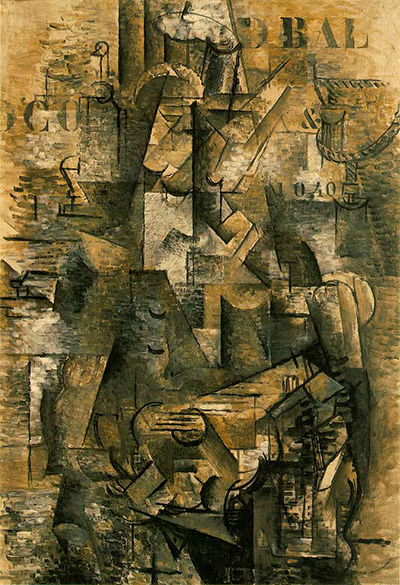
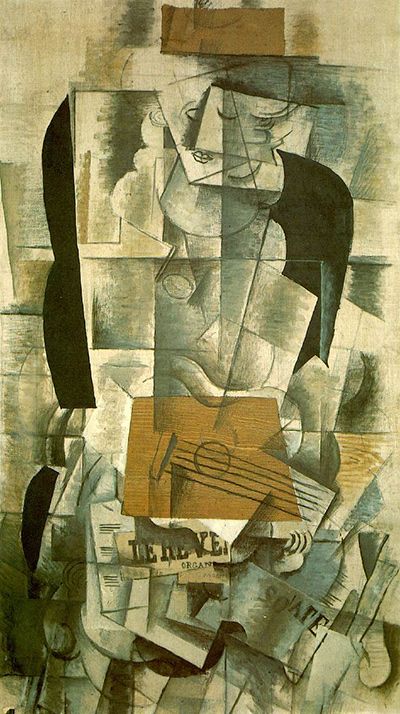
The woman in Georges Braque's canvas arrives by degrees. A guitar with the appearance of wood, the black curves of an armchair and a face with lowered or closed eyes emerge from a strict framework of horizontal and vertical elements. Each clue is recognisable, yet none releases the figure from the surrounding geometry. Centre Pompidou describes a slow act of reconstruction: the viewer gathers a woman and her instrument from signs embedded in an orthogonal grid.[1]
That delayed recognition gives Woman with a Guitar its peculiar vitality. The work comes after Braque's experiments with cut and pasted papers, and its forms can look assembled or sharply cut. Its actual medium is oil and charcoal on canvas. Painting has absorbed the structural lessons of collage, then turned them into another kind of illusion.
At a Glance
- ArtistGeorges Braque[1]
- TitleWoman with a Guitar[1]
- Date[Autumn 1913][1]
- MediumOil and charcoal on canvas[1]
- Dimensions130 × 73 cm[1]
- CollectionCentre Pompidou, Musée national d’art moderne[1]
- AccessionAM 3487 P[1]
- SignificanceThe 1913 Pompidou canvas makes painting behave like collage without becoming literal collage
Contents
- Introduction
- One work, many titles
- An autumn date with open edges
- A painting that remembers paper
- The grid begins to release a figure
- A face assembled from rectangles
- Wood made entirely with paint
- Words between dream and awakening
- Four nearby works, four different identities
- Recognition without resolution
One work, many titles
Centre Pompidou's current French title is Femme à la guitare, translated here as Woman with a Guitar. The work was made at Sorgues in 1913, measures 130 by 73 centimetres and bears Braque's signature. It entered the national collection in 1957 as a gift from Raoul La Roche and carries the inventory number AM 3487 P.[1]
Its earlier titles record how difficult the subject could be to stabilise. Centre lists La joueuse de guitare and Figure. Three further variants extend the naming history. Jeune fille à la guitare specifies youth, La guitariste emphasises role, and Jeune fille à la mandoline changes the instrument.[1] Across this sequence the emphasis moves from player to generic figure, from a young female subject to a professional-sounding guitarist, and even from guitar to mandolin.
All those names belong to one canvas. Their variety reveals the pressure that Cubist form places on naming. A title can guide the eye towards a woman or an instrument, but it cannot make every adjoining shape settle immediately into anatomy. The current title holds figure and guitar together while leaving their exact visual boundary open.
The historical “young girl” labels offer no secure age, and the mandolin variant cannot displace Centre's present identification. They remain valuable as traces of reception: different cataloguers recognised different degrees of specificity in the same painted network.
The progression from Figure to more descriptive labels also mirrors the experience Centre outlines. “Figure” acknowledges a human presence at its broadest. “Guitarist” assigns an occupation or action. “Young girl with a mandolin” commits to gender, age and instrument all at once. The present Femme à la guitare is more measured: it names a woman in relation to a guitar while leaving the nature of that relation available for interpretation.
An autumn date with open edges
Centre brackets the date as autumn 1913. The brackets matter because the museum's catalogue essay says that a precise position within that year is difficult to establish. Isarlov's 1932 catalogue raisonné placed the work at a number that might indicate approximately summer, provided the numbering really followed chronology. Carl Einstein, writing earlier in 1929, reproduced it as dated October.[1]
These competing clues fail to fix a month beyond dispute. Catalogue order offers an inference; Einstein preserves a historical dating. The current autumn designation accommodates both while acknowledging the remaining uncertainty. It places the canvas after Braque's first sustained experiments with papier collé and before the related figure painting he made in spring 1914.
Sorgues is secure within that broader date. The Provençal town had already been important to Braque's material experiments, yet this canvas represents a return to oil painting with the discoveries of pasted paper still active in his thought.
A painting that remembers paper
Centre situates the work in the current of Braque's papiers collés and immediately draws a distinction: the canvas is far from a literal transcription. The achievements of pasted paper have been absorbed into an emerging form of synthetic figuration and an unusually ambiguous space.[1]
That description explains why the work can feel constructed without containing attached sheets. Broad areas behave like components brought together; contours possess the abruptness of cut forms; letters retain the directness of fragments taken from print. The orthogonal grid provides the kind of firm scaffold upon which separate elements might be assembled. Oil and charcoal perform every one of those effects.
The movement between techniques had already become part of Braque's practice. The Metropolitan Museum of Art relates his faux-bois experiments to his training with painter-decorators, artisans skilled in simulating wood, marble and stone. By 1911–12 he was bringing lettering and false wood grain into Cubist paintings, and in autumn 1912 he incorporated wallpaper into drawings as papier collé.[2]
A Lyon and Centre Pompidou exhibition account follows the exchange in the opposite direction. It identifies the faux-bois field, the incomplete newspaper title Le Réveil and the music title Sonate in Femme à la guitare as effects painted in oil.[3] Paper had expanded the painter's vocabulary; paint could now imitate the abruptness, prior meaning and material suggestion of paper.
In a literal collage, difference begins with separate things: a newspaper fragment, a patterned sheet, a drawn line, a painted patch. Here diversity arises within a narrower material field. Oil can suggest wood, printed language, flat colour or shadow; charcoal can introduce a sign or reinforce a boundary. Their contrasts make the canvas feel assembled even though every transition remains part of painting and drawing.
Centre calls the resulting figuration already synthetic.[1] In this context the term describes a rebuilding from selected, legible signs. A face requires rectangles, eyes and mouth; the instrument can be summoned by a wood-like field and recurring curve. The method gathers recognisable pieces while preserving the independence of the larger structure.
The grid begins to release a figure
Monod-Fontaine describes the canvas as retaining a network of horizontals and verticals developed in Braque's earlier Cubism. In paintings of 1910–11, fragmented clues had clung to this rigid structure until the visual code approached illegibility. Here the scaffold remains visible, but fuller pieces of a female body begin to emerge.[1]
The change is subtle. The grid supplies resistance, holding the composition to a frontal order. Curves work through and against it, making the space feel shadowed, sinuous and difficult to measure. Recognition therefore develops through tension: straight elements maintain the constructed field while rounded forms gather into body, instrument and chair.
This is no return to a conventional room occupied by an intact sitter. The woman's presence becomes stronger without acquiring one continuous outline or a single stable depth. A form can participate in the figure and still belong to the surrounding structure. The canvas permits recognisability and spatial uncertainty to grow together.
The grid also prevents the newly legible elements from becoming illustrations detached from Cubist structure. Face, guitar and chair remain lodged within the same crossing lines that complicate them. Each clue clarifies a local passage, yet the whole resists conversion into a single scene viewed from one position. Braque increases the amount that can be recognised while keeping the act of recognition active.
A face assembled from rectangles
The face provides the clearest example of geometry becoming expressive. Centre's analysis identifies two intersecting rectangles whose overlap produces a nose. Within that structure, lowered or closed eyes and a mouth of unusual clarity support Monod-Fontaine's reading of an absorbed, sensuous expression.[1]
Very little conventional modelling is needed. The rectangles establish relation and direction; the eyes and mouth bring human presence into their junction. A facial expression becomes legible through a few selected signs, even while the enclosing geometry remains exposed.
The body gathers through a different family of forms. Centre relates the curve of the guitar to the curve of a breast, then follows echoes through broad movements of hair, rounded shoulders and the black back of the armchair.[1] These repetitions allow figure, instrument and furniture to answer one another. They create unity without assigning every contour to a single object.
The result is intimate yet elusive. Woman and guitar share a formal rhythm, but each retains enough identity for the title to make sense. The chair supports their grouping while its dark shapes also participate in the abstract organisation of the canvas.
Wood made entirely with paint
The guitar's faux bois is crucial because it resembles a material without introducing that material. Centre describes a compact, stencil-like field that conveys the colour and substance of wood.[1] The Lyon account confirms that the effect is painted in oil.[3]
Faux bois had long belonged to decorative craft: pigment could persuade a wall, panel or inexpensive surface to look like timber. Braque turns that convention back upon painting. The simulated grain helps identify an instrument conventionally made of wood, while its flatness also recalls the manufactured wallpaper used in his pasted-paper works.
The chair shapes perform a related transformation. Centre calls them conspicuously cut-looking black forms, yet the medium remains oil and charcoal. Their sharp profiles borrow the visual authority of scissors and paper without becoming separate pieces. The canvas can therefore stage the contrast between straight cut-like edges and curving body forms entirely through painting.
This is the deeper sense in which the work behaves like collage. It assembles different kinds of sign—wood imitation, typographic fragments, geometric pieces and bodily curves—while keeping them materially within a painted surface. Variety migrates from substance into pictorial language.
Words between dream and awakening
Near the bottom of the canvas, groups of letters extend the play between recognition and incompleteness. One points to the newspaper Le Réveil, although Centre says that only the beginning le rêve can be read. Another gives sonate, invoking a musical score.[1] The Lyon dossier confirms that these titles, like the faux bois, are painted.[3]
In French, rêve means dream, while réveil suggests awakening. The incomplete newspaper name therefore generates a second meaning before it completes the first. Sonate draws the guitar into the same field of association, giving written music a presence without supplying a particular composition.
The letter groups work visually as well as verbally. Their short strokes belong easily to the canvas's geometric framework, yet reading turns them into newspaper and music. A painted mark can therefore change category in the viewer's mind: first line, then word, then an absent cultural object. That sequence parallels the gradual emergence of the woman from rectangles and curves.
Monod-Fontaine joins those words to the woman's closed eyes and leaves the result as a question. Is she sounding the guitar, or does the instrument rest like a “sleeping guitar,” anticipating a title that Braque's friend Reverdy would give a collection in 1919?[1] The later phrase enriches the museum's reading; it supplies no fixed story for the 1913 canvas.
The openness is productive. Dream, awakening, music and silence remain possible resonances held within a few painted letters. The work treats language as it treats the figure: enough survives for meaning to begin, while the surrounding structure prevents that meaning from becoming singular.
Four nearby works, four different identities
Braque's 1913 Guitar at the Museum of Modern Art offers the clearest material contrast. Printed and painted papers are cut and pasted onto gessoed canvas, accompanied by charcoal, pencil and gouache.[4] There the pieces are physically attached. In Femme à la guitare, their lessons return as simulated wood, cut-looking contours, flat fields and painted words.
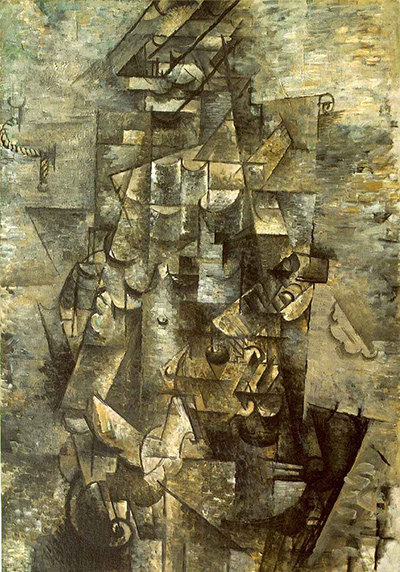
MoMA's Man with a Guitar belongs to an earlier moment. Made at Céret between summer 1911 and early 1912, it is an oil painting whose male guitarist the museum describes as nearly indecipherable within Analytic Cubism.[5] The comparison clarifies the later canvas's achievement: Braque preserves a demanding grid while allowing a more substantial figure to surface from it.
Centre Pompidou's L'Homme à la guitare is later again, dated spring 1914. Centre treats the similarly proportioned canvas as a pendant-like companion to Femme à la guitare, but its medium is oil and sawdust and its inventory number is AM 1981-540.[6] The relationship belongs to paired figure-and-instrument experiments; the material identities remain separate.
The English title also coincides with Picasso's Woman with a Guitar at MoMA. Picasso made his canvas in Paris in March 1914 with oil, sand and charcoal.[7] Artist, date, place and medium distinguish it decisively from Braque's Sorgues painting.
Recognition without resolution
Woman with a Guitar brings the human figure back into clearer view without surrendering the discoveries of Cubism. The grid remains active. Flat fields keep their assembled character. Words hover between fragment and meaning, and painted wood evokes both an instrument and the recent memory of wallpaper.
Braque makes oil and charcoal carry the conceptual weight that several physical materials might have borne in a collage. From rectangles comes a face; from related curves come woman, guitar and chair; from incomplete letters come music, print and reverie. Every recovered element adds richness while leaving the space mobile.
The painting's accomplishment lies in that balance. The woman becomes present through echoes across a surface that never settles around her. Collage has changed how painting thinks, and painting answers by showing how much can be assembled from a single canvas.
Related Pages
Frequently Asked Questions
The woman in Georges Braque's canvas arrives by degrees.
Centre Pompidou's current French title is Femme à la guitare, translated here as Woman with a Guitar.
The painting's accomplishment lies in that balance.
Discussion
The woman in Georges Braque's canvas arrives by degrees.
Reader Insights
The woman in Georges Braque's canvas arrives by degrees.
The face provides the clearest example of geometry becoming expressive.
The painting's accomplishment lies in that balance.
Join the Conversation
Share the visible detail or source that most changed your reading.
References
- Centre Pompidou, Isabelle Monod-Fontaine, Femme à la guitare.
- Metropolitan Museum of Art, Cubism and the Trompe l'Oeil Tradition.
- Musée des Beaux-Arts de Lyon and Centre Pompidou, Braque/Laurens, un dialogue.
- Museum of Modern Art, Georges Braque, Guitar.
- Museum of Modern Art, Georges Braque, Man with a Guitar.
- Centre Pompidou, Isabelle Monod-Fontaine, L'Homme à la guitare.
- Museum of Modern Art, Pablo Picasso, Woman with a Guitar.