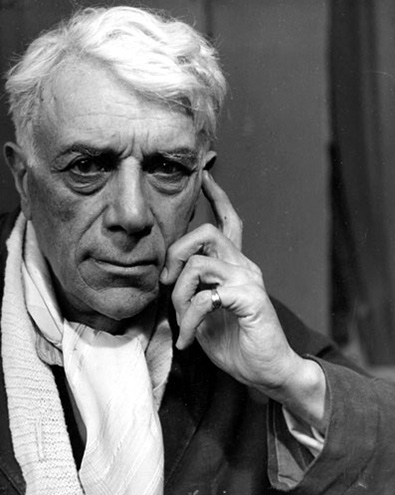
 by Tom Gurney
Tom Gurney BSc (Hons) is an art history expert with over 20 years experience
Published on August 14, 2026 / Updated on August 14, 2026
Email: tomgurney1@gmail.com / Phone: +44 7429 011000
Introduction
Georges Braque's career can seem divided by the First World War. Before 1914, he and Pablo Picasso overturned inherited ideas of perspective, representation and the painted surface. After a severe wound and a long interruption, Braque returned to still life, but also worked with figures, theatre, illustrated books, prints, sculpture, billiard tables, studios, birds and landscapes. The first period is famous enough to eclipse the second.
That division is useful historically and misleading artistically. Across both parts of his life, Braque kept testing how a familiar thing could inhabit a picture without being confined to one fixed view. A guitar might be recognised through only a few signs; imitation wood could look like a material while remaining painted; actual paper could refer to wood without becoming furniture. In later work, sand, heavy surfaces, folding rooms and bird forms reopened the same broad questions under different conditions.
Braque's identity extends beyond the partnership with Picasso and the compressed paintings of 1909–12 that often stand for Cubism as a whole. His six-decade career moved between colour and restraint, illusion and literal material, intimate objects and architectural settings. Its continuity resides in a sustained curiosity about how recognition, space, surface and touch can work together.
At a Glance
- ArtistGeorges Braque
- Born13 May 1882, Argenteuil, France
- Died31 August 1963, Paris, France
- Known forCubism, papier collé and the modern still life
- MediaPainting, drawing, printmaking, sculpture, ceramics and illustrated books
- Key collaboratorPablo Picasso during the formative Cubist years
Contents
- Introduction
- Who was Georges Braque?
- Colour before Cubism
- A partnership that changed painting
- When the surface became an active material
- Interruption and return
- The late Braque
- Ways into Braque's work
Who was Georges Braque?
Braque was born on 13 May 1882 in Argenteuil-sur-Seine, near Paris, and grew up in the port city of Le Havre. He came from a family of decorative painters and trained in that trade before moving to Paris at about eighteen. Museum records identify him simply as a French artist of 1882–1963, closely associated with Cubism and collage; the National Gallery of Art also places his participation in Fauvism beside his development of Cubism with Picasso.[1][2][3]
The decorative background matters without becoming a story of inevitability. House painting acquainted Braque with procedures that fine art often kept outside its boundaries: stencilling, graining, imitation finishes and the practical behaviour of surfaces. Years later, such knowledge became newly relevant when he introduced typographic stencils, simulated wood and pasted material into Cubist work. Training supplied a vocabulary and a set of possibilities, not a predetermined path.
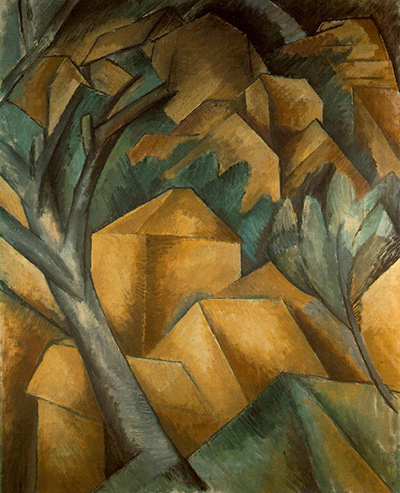
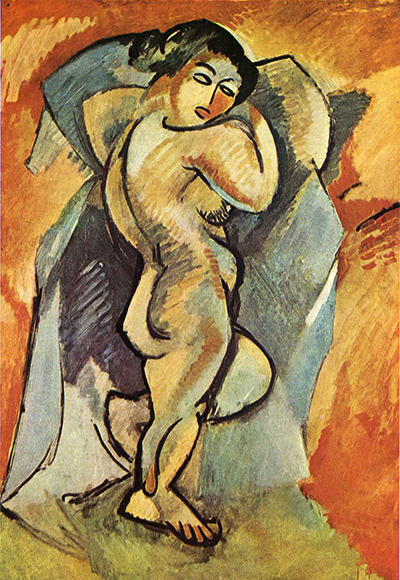
Before the near-monochrome analysis of form came colour. Braque's first mature phase was shaped by Henri Matisse, André Derain and other Fauves. He encountered their work at the 1905 Salon d'Automne, then developed his own response during campaigns in Antwerp, L'Estaque and La Ciotat in 1906–07.[2][3][6] Those landscapes belong to the story in their own right. They established that colour and brushwork could organise a scene instead of merely describing the local appearance of sky, water, trees or buildings.
Colour before Cubism
Braque's Fauvist period was brief and consequential. In the southern landscapes, strong chromatic intervals and freely structured compositions loosened the older obligation to reproduce nature faithfully. A harbour or hillside could remain recognisable while colour took on a constructive life of its own. The picture began to declare its surface even while presenting a place.[2][6]
Braque's later move toward geometry retained part of this experience. His palette changed and his forms grew more compact, yet the underlying problem remained related: how can a painting establish an order that is convincing on its own terms? Fauvism answered through liberated colour. The work that followed would place greater pressure on volume, viewpoint and the intervals between things.
Several encounters contributed to that change. Paul Cézanne's example offered a way to build landscape through organised masses and shallow, interdependent space. Braque's late-1907 introduction to Picasso brought him into contact with another radical rethinking of figure and pictorial structure. Neither influence operated like a switch. During 1907–08, Braque worked through them in landscapes and figures until his own questions and Picasso's entered an unusually close exchange.[2][3][6]
A partnership that changed painting
From autumn 1908, Braque and Picasso saw one another frequently and developed Cubism through sustained discussion and comparison. Their pictures became so close that historical accounts have repeatedly tried to decide who led and who followed. The more accurate starting point is reciprocity. Each artist made consequential decisions, and the language emerged through an exchange in which a change by one could become a challenge to the other.[2][4][6]
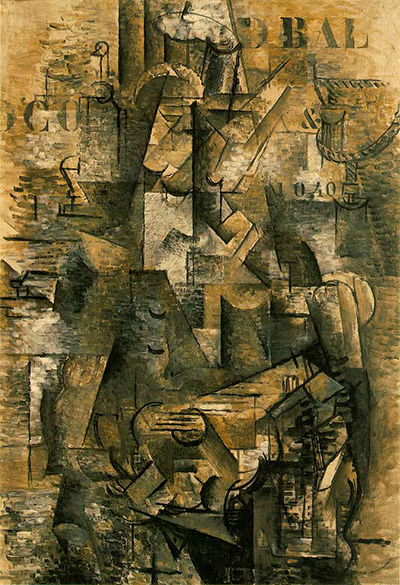
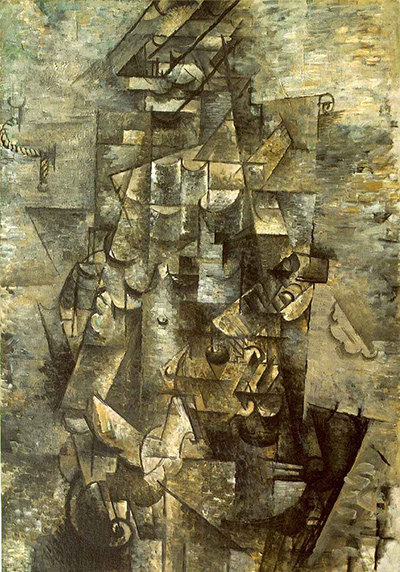
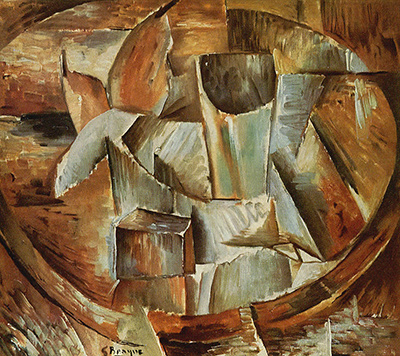
Cubism altered more than the outward shape of objects. Traditional perspective presents a scene as if observed from a stable position through a window. Braque and Picasso weakened that structure. Forms were fractured and realigned in shallow space; several aspects of an object could be held within one composition; modelling and foreshortening no longer had to make the canvas disappear behind an illusion.[4]
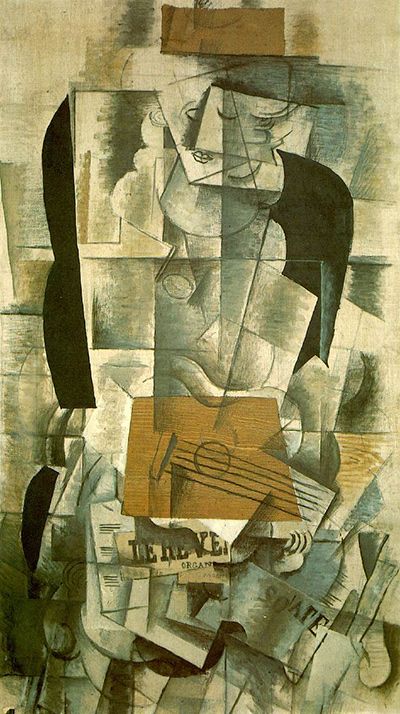
The resulting works kept the visible world present. Bottles, fruit, glasses, tables, instruments, faces, hands, letters and numbers remained active. Their familiarity gave viewers something to test against the new pictorial order. Strings, curves, apertures or inscriptions could call a violin to mind without completing its outline. Recognition became intermittent: an object could emerge, merge with adjacent planes and return in another form.
This is one reason music became so important in Braque's art. Instruments offered complex volumes, repeated curves and parts that could be detached without losing all association with the whole. Printed names, clefs and fragments of musical language added another kind of sign. Music offers one line of approach among several recurring subjects through which Braque investigated how seeing unfolds over time.[2]
The partnership ended as a working exchange when Braque entered military service in 1914.[3] By then, Cubism had already moved beyond the two painters. The Metropolitan Museum of Art notes that its visual language was taken up and developed by artists including Juan Gris, Fernand Léger, Robert and Sonia Delaunay, Jean Metzinger and others, while its consequences extended into sculpture, architecture and later avant-garde movements.[4] Braque's importance rests partly in that broad historical transformation, but his own work cannot be reduced to the movement's collective afterlife.
When the surface became an active material
Braque's most distinctive prewar experiments often made the physical surface impossible to ignore. In 1911, he introduced stencilled typographic elements into paintings. A letter could belong to a poster, newspaper or place name while also remaining a flat, machine-like mark on canvas. Such signs entered the represented world without pretending to be seen through ordinary perspective.[3][6]
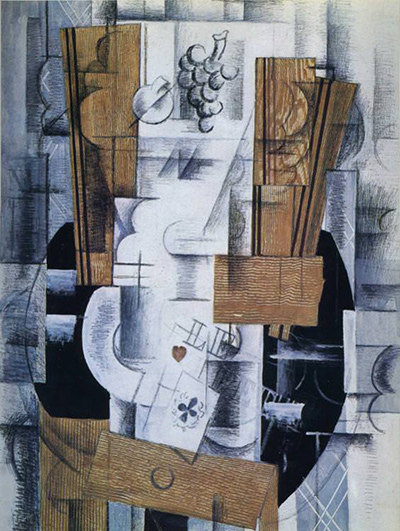
Imitation wood complicated matters further. A combed or painted grain could suggest timber and openly display the craft of simulation at the same time. Braque's decorative training made this procedure available, but its Cubist use was newly disruptive. The effect could look materially specific while refusing to certify what object, if any, was made of wood.[2][6]
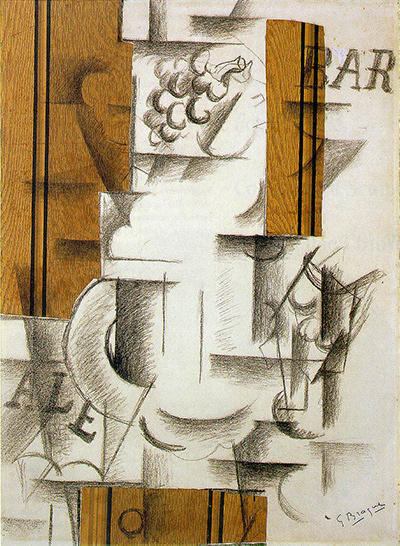
In September 1912 at Sorgues, Braque made Fruit Dish and Glass, identified in institutional chronologies as his first papier collé, or pasted-paper construction. Printed wallpaper entered the work as an actual manufactured sheet and as a sign for another surface. Colour, shape and material no longer needed to arrive as one unified description of an object.[3][6] This first remains category-specific rather than proof that Braque alone invented every kind of collage. Its importance lies in the precision of the pictorial problem it created.
The pasted papers also changed subsequent painting. Faux wood, solid zones of colour, typography, sand and other textured matter could make a surface behave in several ways at once: as a literal substance, an imitation, a sign and a component in a larger construction.[2][6] Material became part of the reasoning by which the image was formed, rather than decoration applied to a finished design.
Interruption and return
Braque was called into the French army in 1914 and seriously wounded at Artois in May 1915. A lengthy convalescence followed, and he resumed painting by 1917.[3][6] The interruption is essential to the chronology, but it supplies no diagnosis of the art that came afterwards. Secure evidence cannot support a simple equation between injury, temperament and style.
What can be observed historically is a changed field of work. Cubism was no longer the private, rapidly advancing exchange of the prewar years. Other artists had extended it, and Braque returned without resuming the daily partnership with Picasso. He carried forward some lessons of Synthetic Cubism while enlarging his colour, formats, subjects and material range.[5][6]
Still life remained central because it offered a compact theatre of relations among tables, fruit, vessels, instruments, papers and surrounding space. But it was never the whole postwar career. The monumental Canéphores brought the figure into a dense, tactile form in the early 1920s. Braque designed sets and costumes for productions connected with Sergei Diaghilev and the Ballets Russes. His collaboration with writers and publishers led into illustrated books, while the Theogony project expanded through etching and sculpture.[3][6]
These activities reveal a wider conception of making. A stage design operates at the scale of bodies and performance; a print depends upon line, plate and pressure; an illustrated book unfolds through sequence and handling; sculpture occupies actual space. His commitment varied by medium, and painting remained fundamental. Even so, the movement among them prevents the later artist from being understood as someone who merely softened or repeated an earlier formula.
The late Braque
Braque worked between Paris and Varengeville-sur-Mer during much of his later life.[3][6] This coastal setting yielded different answers from the Fauvist landscapes of youth. His work moved through still lifes, interiors and extended series in which space could bend, overlap or acquire palpable weight.
The Billiard Tables, begun in 1944 and continued through 1949, transformed a familiar piece of furniture into a problem of partial and distorted views. Around 1949, Braque began the eight paintings known as the Ateliers. These studio interiors gathered objects associated with making, but also allowed real things, remembered forms and signs such as the bird to occupy the same shifting field.[3][6]
The bird then crossed into a public architectural setting. In 1953 Braque painted Birds for the ceiling of the Louvre's Henri II gallery, and a wider bird series continued into the early 1960s.[3] The motif resists one universal symbol. Its meaning changes when it moves from an enclosed studio to a ceiling above the viewer, or when it enters another late composition. What remains consistent is its capacity to connect a readable silhouette with movement through otherwise unstable space.
Braque's last Varengeville landscapes, begun in 1955 and continued until his death, returned to earth, sky and the horizon after decades of interiors and tabletop objects.[3][5][6] They complete a career-long circuit without closing it neatly. The coast reappears, but the painter now brings to it the accumulated experience of Cubist construction, pasted and simulated materials, tactile paint, architectural scale and recurring signs.
Braque died in Paris on 31 August 1963 and received state honours.[3] Ending with that fact can make the late work appear like a calm epilogue to the revolutionary years. It is better understood as another period of active revision. Conventional perspective stayed displaced, while the dense facets of 1911 gave way to other ways of structuring a picture. The billiard tables, studios, birds and final landscapes gave old questions different bodies.
Ways into Braque's work
Braque can first be approached through his paintings, where the changes are immediately historical and material: Fauvist coasts, constructed landscapes, Cubist figures and still lifes, postwar interiors, studios and late horizons. The career follows a series of adjustments in the balance among resemblance, flatness, depth, colour and touch, rather than a march toward abstraction followed by retreat.
His life offers another path. Argenteuil, Le Havre, Paris, Provence and Varengeville each mattered differently, as did decorative training, military service, dealers, poets, musicians, architects and theatre collaborators. A full biography can give those relationships and movements their proper chronology without making any one event into a complete explanation of the art.
Braque's methods provide a third approach. Stencils, faux wood, pasted wallpaper, newspaper, charcoal, oil, sand, engraved line and sculptural form carried distinct effects. Each changed what could count as a fact within an artwork. Studying those materials closely reveals how Cubism changed both appearance and the very terms of what pictures could contain and how they could be made.
The major themes then open outward. The partnership with Picasso deserves a reciprocal history of its own. Cézanne and Fauvism explain different parts of Braque's early transformation. Music, still life, the Ateliers and birds reveal subjects that returned across decades without retaining a fixed meaning. Taken together, these approaches keep the famous Cubist years central while allowing the rest of Braque's career to remain fully visible.
Braque's art repeatedly asks a direct question: how little certainty can a picture offer without losing the world it represents? His answers changed. Sometimes colour carried the structure; sometimes a few lines or letters preserved an object; sometimes actual paper challenged painted illusion; sometimes a room, bird or horizon held together a dense material field. The continuity lies in that willingness to make recognition provisional—and to rebuild it from the physical and imaginative resources of art.
Related Pages
Frequently Asked Questions
Georges Braque's career can seem divided by the First World War.
Braque was born on 13 May 1882 in Argenteuil-sur-Seine, near Paris, and grew up in the port city of Le Havre.
Braque's art repeatedly asks a direct question: how little certainty can a picture offer without losing the world it represents?
Discussion
Georges Braque's career can seem divided by the First World War.
Reader Insights
Georges Braque's career can seem divided by the First World War.
In September 1912 at Sorgues, Braque made Fruit Dish and Glass, identified in institutional chronologies as his first papier collé, or pasted-paper construction.
Braque's art repeatedly asks a direct question: how little certainty can a picture offer without losing the world it represents?
Join the Conversation
Share the visible detail or source that most changed your reading.
References
- Museum of Modern Art, “Georges Braque,” controlled artist record and media pathways; and National Gallery of Art, “Georges Braque,” concise artist record. https://www.moma.org/artists/744-georges-braque ; https://www.nga.gov/artists/1027-georges-braque
- Kunstsammlung Nordrhein-Westfalen, Georges Braque: Inventor of Cubism, institutional resource on training, Fauvism, Cézanne, Braque and Picasso, Cubist subjects, typography and materials. https://www.kunstsammlung.de/en/braque/
- Guggenheim Museum Bilbao, “Georges Braque,” current institutional chronology. https://www.guggenheim-bilbao.eus/en/the-collection/artists/braque-georges
- Sabine Rewald, “Cubism,” Heilbrunn Timeline of Art History, Metropolitan Museum of Art. https://www.metmuseum.org/fr/essays/cubism
- Museum of Fine Arts, Houston, “Georges Braque: A Retrospective,” institutional full-career overview. https://www.mfah.org/art/exhibitions/georges-braque-retrospective
- Guggenheim Museum Bilbao, Georges Braque, institutional retrospective research dossier. https://prensa.guggenheim-bilbao.eus/src/uploads/2014/05/Dossier-Braque-EN.pdf