 by Tom Gurney
Tom Gurney BSc (Hons) is an art history expert with over 20 years experience
Published on August 14, 2026 / Updated on August 14, 2026
Email: tomgurney1@gmail.com / Phone: +44 7429 011000
Introduction
A Shape with Many Lives
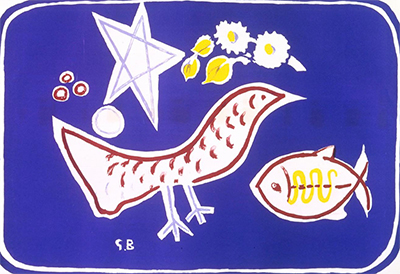
The bird gave Georges Braque a form that could travel. It could hover inside a studio, expand across the Louvre's architecture, gather near a nest, pass through a sheet of lithography or accompany a poet's words. Its outline remained legible even as its material, scale and setting changed. That adaptability helps explain why birds became so prominent during the final phase of his career.
Any fixed symbolic explanation soon proves too small. Freedom forms part of the motif's appeal, yet Braque's birds also evoke shelter, return, distance, movement and the exchange between earth and sky. At times a bird is an independent subject. Elsewhere it serves as a hinge between spaces or as a sign whose simplicity allows the surrounding surface to become more active. Braque himself connected his late concern with birds to questions of space and movement, as the Centre Pompidou's account of L'Oiseau et son nid records.[1]
The motif also rewards chronological care. Braque remembered placing birds in still lifes decades before the great late paintings. A renewed sequence of experiments began around 1949, followed by the Ateliers, the Louvre ceiling, the Camargue visit and a widening range of paintings and prints.[1][2] The late bird emerged through return and transformation. Each recurrence carried earlier habits of Cubist invention into a new field.
At a Glance
- ArtistGeorges Braque
- GuideBirds
- FocusThe bird motif from the Ateliers and Louvre ceiling to Camargue, paintings, prints and illustrated books.
- Key topicsA Shape with Many Lives; Earlier Flights; The Bird Enters the Studio; From Canvas to Ceiling
- OverviewThe bird gave Georges Braque a form that could travel.
Contents
- Introduction
- A Shape with Many Lives
- Earlier Flights
- The Bird Enters the Studio
- From Canvas to Ceiling
- Camargue as a Further Impulse
- The Bird Returns to Its Nest
- Variation as a Way of Thinking
- Lithograph, Aquatint and the Poet's Book
- An Open Sign
Earlier Flights
In a recollection cited by the Centre Pompidou, Braque traced birds in his work back to 1910, when he incorporated them into still-life compositions. He also remembered using the motif for an illustration of Hesiod in 1929.[1] These remarks establish antecedents without implying a continuous catalogue. They show that the bird already belonged to his vocabulary while Cubism and its aftermath still shaped his practice.
That history matters because the late works can otherwise appear to begin with one dramatic revelation. Braque's career followed a more recursive rhythm. Motifs disappeared, returned and acquired fresh force through altered materials and contexts. The remembered birds of 1910 were embedded among still-life things. The Hesiod illustration brought the form into conversation with an ancient poet. From 1949, the bird gained a more sustained independence and became one of the structures through which Braque tested flight, enclosure and pictorial space.[1][2]
Continuity here involves a working habit as much as an image. Cubism had taught Braque that a familiar object could survive radical simplification. A table, guitar or glass could be broken, compressed and rebuilt while retaining its identity. The bird offered a related opportunity. A few curves, angles and sweeping contours could preserve recognition while leaving ample room for changes of scale, texture and placement. Its earlier appearances prepared the ground for the concentrated late exploration.
The Bird Enters the Studio
The decisive late phase coincided with Braque's new studio at Varengeville. Designed by the architect Paul Nelson in 1949, the building had broad wall surfaces without conventional windows and received daylight through large ceiling openings. A Rouen museum account associates this setting with the bird becoming established as a subject.[3] The account presents an artistic environment and leaves literal observation unspecified. The studio offered an enclosed place in which the idea of flight could be imagined and revised.
Braque was already developing the group of paintings known as the Ateliers. These works brought together easels, palettes, tables, sculptures and openings onto an uncertain exterior. Within that shifting inventory, the bird gained special force because it could cross boundaries that the studio's other objects appeared to observe. It belonged to the air, yet it entered the room. It could read as a pictured form, a visitor, an emblem or an element of the composition's architecture.
The Rouen account places a bird above the easel in Atelier VI. Fondation Maeght dates the painting to 1950–51 and describes the conjunction of interior, exterior and bird.[3][4] This makes the work an important hinge. The motif has moved beyond an incidental place within a still life, while remaining entangled with the tools and spaces of painting. Its flight opens the studio imaginatively. At the same time, the surrounding room gives flight a frame, turning open air into a problem that can be explored on a bounded surface.
The Phillips Collection dates Braque's renewed experiments with birds in flight from 1949.[2] Together, the Phillips, Rouen and Fondation accounts clarify the sequence: an old motif returned with new intensity as Braque reconsidered the relation between the protected working room and the world beyond it. The bird became a compact means of holding those realms together.
From Canvas to Ceiling
In 1953, the bird crossed from the intimate world of the studio into the architecture of the Louvre. Braque created a three-part oil-on-canvas ceiling for the Renaissance antechamber associated with Henri II.[5][6] The commission enlarged a developing motif to a scale encountered overhead and in motion through a room.
The setting altered the bird's function. A studio painting can draw attention into an enclosed, private space; a ceiling shapes the visitor's bodily experience of public architecture. Looking upward activates the relation between human movement below and painted flight above. The three-part arrangement also makes interval and separation meaningful. Birds occupy an architectural field whose divisions become part of the encounter.
The Louvre connects the ceiling's imagery with the room's historical decoration, including Henri II's lunar emblem, and with bird motifs on Etruscan vessels.[6] Such associations extend the work backward into the museum's own collections while preserving its unmistakably modern economy of form. The ceiling gave Braque's bird civic and historical reach. It also confirmed that a highly reduced sign could carry sufficient visual authority for monumental decoration.
Architecture imposed a further discipline. An easel painting can be approached closely and surveyed at leisure; a ceiling must communicate across distance, changing angles and the distractions of a decorated room. The bird's economy became an advantage. Its broad identity could survive enlargement and oblique viewing, while the surrounding architecture supplied scale and orientation. Braque had spent decades compressing objects into signs that remained recognisable. At the Louvre, that experience met the demands of a permanent setting. The motif could answer an old interior without imitating its Renaissance ornament, creating a modern presence through clarity, interval and flight.
Camargue as a Further Impulse
Braque's visit to a bird sanctuary in the Camargue during the summer of 1955 added another stimulus. The Phillips Collection says the experience furthered his interest and encouraged additional variations.[2] By then, the late experiments, Atelier VI and the Louvre ceiling were already in place. The southern landscape deepened an existing pursuit.
The Camargue offered a living spectacle of birds in open terrain, yet Braque's art retained little need for ornithological precision. His forms tend toward signs: bodies compressed, wings enlarged, species dissolved into the broader fact of flight. This reduction gave him freedom to join observation with memory. A bird could carry the sensation of movement without becoming a natural-history specimen.
The visit also sharpened a productive tension. Flight suggests departure and expansiveness; Braque repeatedly paired it with frames, rooms, earth and nests. His birds inhabit the pull between release and attachment. Camargue supplied direct contact with birds and habitat, while the paintings translated that experience into relationships among form, matter and space.
The Bird Returns to Its Nest
L'Oiseau et son nid, dated 1955 by the Centre Pompidou, is among the fullest statements of this tension. The painting measures 130.5 by 173.5 centimetres and combines oil with sand on canvas.[1] Its scale allows the subject to unfold as an environment. The added sand gives the painted field a physical grain, bringing the suggestion of air into contact with something earthy and resistant.
Isabelle Monod-Fontaine's Centre Pompidou essay describes dark browns and blacks mixed with sand around lighter forms incised into that dense matter. She reads the bird's movement as a return toward a star-like nest.[1] The surface therefore carries two kinds of action. Its granular darkness has weight, while the cut or drawn clarity of the bird gives movement a concentrated direction. Flight emerges through its encounter with matter; weight helps make movement perceptible.
The nest changes the emotional range of the motif. It introduces a destination and turns open movement into a circuit. The bird leaves, crosses space and comes back. Home and distance become mutually defining. This structure can support thoughts of refuge, continuity or renewal, though the painting preserves enough ambiguity for each association to remain provisional. The nest is both a place within the composition and an idea that gives the bird's movement purpose.
Monod-Fontaine also records Braque's use of a paper model while developing the bird.[1] That modest studio device connects the late motif with his long fascination with cut paper, collage and the movement of shapes across a surface. A paper bird can be shifted, tested and reoriented before its contour enters paint. The procedure turns flight into a sequence of deliberate placements. It also allows the clear silhouette to stand against a materially dense field with unusual decisiveness.
Braque kept L'Oiseau et son nid until his death, moving it between Paris and Varengeville when necessary.[1] This prolonged proximity suggests an object that remained active for him, part finished painting and part enduring companion. Its history of movement between two working places quietly echoes its subject. The work itself travelled while holding an image of return.
Variation as a Way of Thinking
Braque's birds gain meaning through differences among related works. The Phillips Collection's Bird of 1956 is oil on paper mounted on canvas.[2] Its support preserves an affinity with drawing and movable paper while giving the result the durability of a painting. The museum places it among variants in which birds appear alone, together or in flight, sometimes within painted frames. Repetition becomes a means of testing relationships.
A solitary bird concentrates the viewer's attention on one compact sign. A pair or group introduces rhythm, encounter and spacing. A painted boundary can make the field feel like an image within an image, while an unconfined form encourages the eye to treat the whole surface as air. These possibilities show why the motif remained fertile. Small structural changes could alter the experience without requiring a new subject.
Duration mattered as well. The Centre Pompidou dates A tire d'aile across the years 1956–61. It is an oil-and-sand painting on canvas mounted on panel, measuring 114 by 170.5 centimetres.[7] The five-year span records sustained attention and reopening. A bird painting could remain available for adjustment while other versions developed around it.
This habit resists a simple progression toward ever greater abstraction. Braque returned to the same sign because recurrence allowed it to gather contrasts: heavy surface and airborne form, enclosure and passage, singularity and multiplication, immediacy and long revision. The bird served as a stable point around which those oppositions could keep changing.
Lithograph, Aquatint and the Poet's Book
The bird's reduced contours made it especially adaptable across graphic media. Yale University Art Gallery records The Bird and its Shadow as a colour lithograph of 1959, issued in an edition that includes the inscription 70/75.[8] Lithography carried the motif into a repeatable sheet while retaining the direct character of a drawn form. The title adds a second presence: the bird accompanied by its own dark double, movement paired with trace.
In 1962, Oiseau de passage extended the exploration through an embossed colour etching and aquatint published by Fondation Maeght.[9] The combination matters. Etching and aquatint build an image through bitten lines and tonal fields, while embossing gives the paper a shallow physical relief. The bird therefore moves through mark, tone and pressure on the sheet. A familiar silhouette can be perceived as both image and impressed surface.
That same year, Braque collaborated with Saint-John Perse on L'ordre des oiseaux. The National Gallery of Art describes the work as a bound volume containing twelve colour aquatints on wove paper.[10] A book creates a different temporal setting. Birds appear through successive openings, and the act of turning pages gives sequence to their recurrence. Image enters a measured dialogue with poetry, where a repeated form can gather resonance from words, pauses and the spaces between leaves.
The collaboration also returned the bird to a literary setting more than three decades after Braque's Hesiod illustration. The two moments belong to very different phases, yet together they reveal a durable attraction between the motif and poetry. A bird can cross a page as swiftly as an image crosses a thought. In a bound sequence, recurrence acquires cadence: the eye meets a form, carries its memory forward and recognises it again under altered conditions. The book turns Braque's habit of variation into an experience paced by the viewer's hands.
These works also reveal the breadth hidden inside the convenient category of print. Colour lithography, etched line, aquatint tone and embossed relief each shape the bird differently. The illustrated volume adds binding, sequence and collaboration. Braque could preserve the economy of his sign while allowing every medium to alter its presence.
The movement from painting to print and book brought the bird into circulation in another sense. A ceiling remains bound to one room; a painting has a singular material body; an edition distributes related impressions; a book joins images into a portable order. Across these forms, the bird retained its identity while acquiring fresh rhythms of encounter.
An Open Sign
Braque's late birds grew powerful through reduction, recurrence and change. Their history reaches back to remembered appearances in 1910 and 1929, gathers force in the studio around 1949, becomes architectural at the Louvre, receives fresh energy from the Camargue and continues through paintings, graphic works and a poet's book.[1][2][5][10]
Across that history, the bird avoids settling into a single emblem. It can connect inside and outside, animate a ceiling, return to a nest, carry the memory of cut paper or unfold across a sequence of printed pages. Its simplified shape creates room for material and setting to speak.
This is the central paradox of Braque's bird. As the form becomes more concise, its field of action expands. The same sign can be intimate or monumental, weighted by sand or pressed into paper, solitary or repeated, departing or returning. Braque found in it a durable way to make space feel active and movement feel held, momentarily, within art.
Related Pages
Frequently Asked Questions
The bird gave Georges Braque a form that could travel.
The bird gave Georges Braque a form that could travel.
This is the central paradox of Braque's bird.
Discussion
The bird gave Georges Braque a form that could travel.
Reader Insights
The bird gave Georges Braque a form that could travel.
L'Oiseau et son nid, dated 1955 by the Centre Pompidou, is among the fullest statements of this tension.
This is the central paradox of Braque's bird.
Join the Conversation
Share the visible detail or source that most changed your reading.
References
- Centre Pompidou, L'Oiseau et son nid
- The Phillips Collection, Bird
- Musées de la Métropole Rouen Normandie, Braque, Miró, Calder, Nelson: Varengeville, un atelier
- Fondation Maeght, Atelier VI
- Musée du Louvre, Plafond: Les oiseaux, INV 20379
- Musée du Louvre, “Les Oiseaux de Braque”
- Centre Pompidou, A tire d'aile
- Yale University Art Gallery, The Bird and its Shadow
- National Gallery of Art, Oiseau de passage (Bird of Passage)
- National Gallery of Art, L'ordre des oiseaux (The Order of the Birds)