 by Tom Gurney
Tom Gurney BSc (Hons) is an art history expert with over 20 years experience
Published on August 14, 2026 / Updated on August 14, 2026
Email: tomgurney1@gmail.com / Phone: +44 7429 011000
Introduction
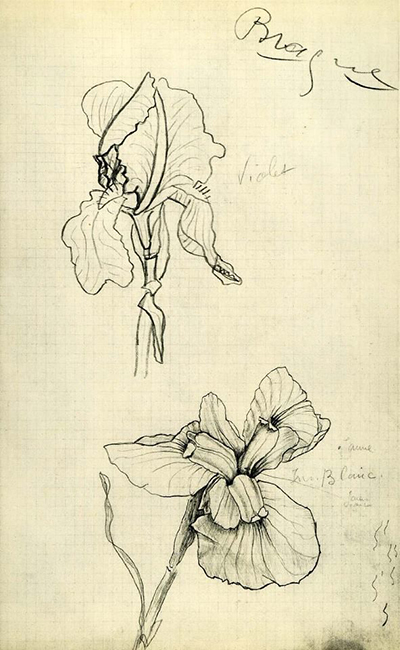
Drawing gave Georges Braque a place where an idea could remain visibly active. A charcoal line could establish a contour, interrupt it, or turn into a shadow. A letter could identify a word while also acting as a flat shape. Pencil and chalk could meet newspaper, decorative paper or simulated wood grain. Watercolour and gouache could turn a modest sheet into a complete work.
These possibilities resist a single definition of drawing as preparation for painting. Braque certainly drew towards other objects and events, especially in his designs for the theatre. He also made sheets whose scale, support and material complexity declare their autonomy. Across both kinds of work, drawing records decisions: where a line begins, where pressure changes, where one surface meets another, and where recognition is allowed to remain unsettled.
The medium therefore runs through his practice as a set of actions. It can test, combine, propose and complete. Following those actions reveals a history richer than a list of works on paper.
At a Glance
- ArtistGeorges Braque
- GuideDrawings
- FocusDrawing as experiment, notation, preparation and autonomous work across charcoal, pencil, chalk and pasted paper.
- Key topicsA medium made from decisions; Charcoal and the instability of signs; When drawing meets printed paper; Support that carries information
- OverviewDrawing gave Georges Braque a place where an idea could remain visibly active.
Contents
- Introduction
- A medium made from decisions
- Charcoal and the instability of signs
- When drawing meets printed paper
- Support that carries information
- A compact mixed-media whole
- Drawing towards performance
- Large Nude and autonomous scale
- What a drawing preserves
A medium made from decisions
Drawing begins with economy. A mark can define an edge without filling the form it encloses. Repeated strokes can build value; erasure can reopen space; a hard line and a soft passage can make different claims about solidity. The sheet preserves these operations close to the surface, often with less separation between thought and material act than a heavily worked painting allows.
Braque expanded this vocabulary by treating support as active. Paper already has colour, texture, weight and a physical edge. Printed fragments add words, patterns and associations made elsewhere. Cardboard supplies stiffness and depth. When such materials join charcoal or graphite, drawing becomes an arrangement of existing signs as well as marks made by the artist.
Function changes from sheet to sheet. One work can probe spatial ambiguity, another can assemble unlike papers, another can carry colour, and another can prepare décor or costume. The category holds these differences together through attention to mark, surface and decision.
Materials also preserve different kinds of contact. Pencil can produce a narrow, controlled trace. Charcoal can move from an edge to a clouded value. Chalk can sit densely on the fibres or spread through rubbing. Water-based colour enters the support in another way. Drawing remains immediate while its physical vocabulary grows remarkably broad.
Charcoal and the instability of signs
Metropolitan Museum catalogue data places Still Life with Dice in Paris in summer 1911 and identifies the work’s medium as charcoal on paper.[1] The sheet belongs to a moment when Braque was making recognition depend on fragments. Charcoal could suggest volume, yet the unfilled paper continually recalled the flat support beneath the illusion.
The Met’s interpretation centres a trompe-l’oeil nail and its shadow. It describes that small assertion of depth as a challenge to flatter elements, including stencilled letters and numbers.[1] Drawing here sets distinct kinds of representation beside one another. A shadow implies projection; a stencil sits emphatically on the surface; a letter belongs to language while occupying visual space.
Its curators also read the setting as a café and explain a wordplay around ROS, rosé and EROS. In its account, moving the missing “É” to the far side of ROS brings erotic love into a sign advertising wine.[1] The verbal shift is also graphic. One letter changes the sequence and therefore the meaning, showing how typography can behave as both notation and form.
This sheet makes drawing an unstable field of cues. Charcoal, stencil, number and word ask for different kinds of attention. The viewer moves between reading and seeing, surface and depth, ordinary signage and wit. Braque needed no dense modelling to create complexity; he could produce it through the friction among signs.
The making of those signs also differs. A stencil repeats a predetermined form, while a charcoal stroke registers the movement and pressure of a hand. Lettering carries linguistic order; shadow belongs to visual illusion. Their meeting turns the sheet into a negotiation among systems, with no single one absorbing the others.
When drawing meets printed paper
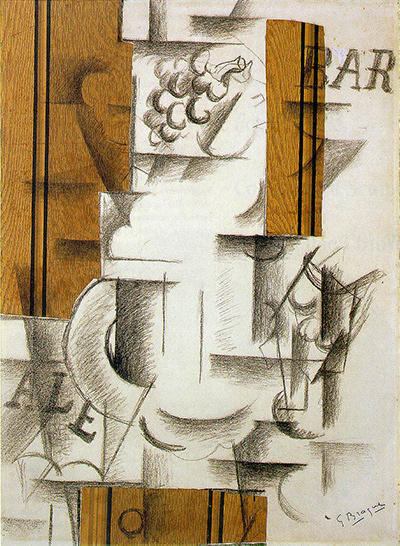
By 1913, Braque’s drawings could include pieces of print whose marks preceded his own. MoMA’s Glass and Tobacco combines pencil, charcoal and cut-and-pasted printed paper on paper.[2] Its institutional classification keeps drawing and pasted matter within one object, giving line and an already inscribed fragment equal access to the sheet.
Printed paper changes the artist’s task. A blank support waits for a mark. A printed fragment arrives with type, pattern, tone or prior use. Cutting selects a boundary; placement determines relation; charcoal or pencil can continue across the new surface, meet its edge, or allow its existing information to remain distinct.
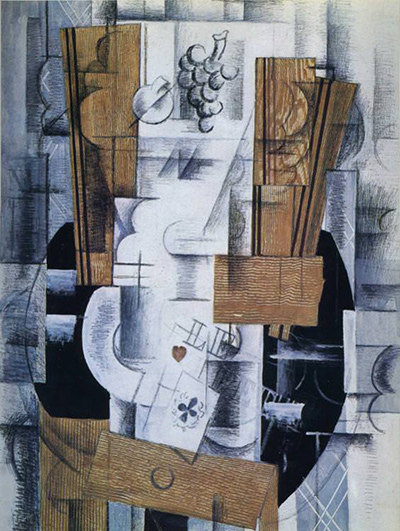
The 1913 Aria de Bach offers another precise combination. The National Gallery of Art lists white paper as the support, with pasted black and imitation wood-grain papers joined by charcoal and white chalk.[3] The materials create contrasts before any subject is considered: black against white, chalk against dark paper, and manufactured wood pattern against a hand-drawn mark.
Those oppositions make material carry pictorial work. White chalk gains force on black paper through value contrast. Faux-bois introduces a surface designed to resemble another material. Charcoal belongs to direct marking, while printed wood grain carries an imitation produced in advance. The sheet gathers those different origins without forcing them into a single texture.
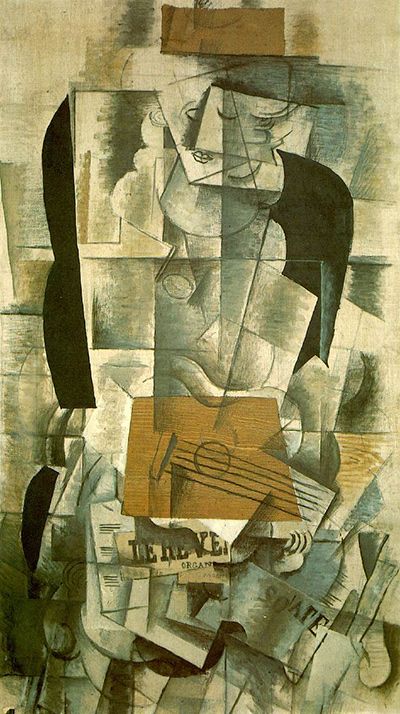
Centre Pompidou’s Violon et pipe, dated winter 1913–14, is larger and more materially layered. The museum records charcoal, graphite, chalk and pasted papers on paper mounted on cardboard; the work measures 74 by 106 centimetres.[4] Drawing here involves a substantial constructed support as well as a range of marks.
Cleveland’s Violin of early 1914 combines newsprint, block-printed or stencilled decorative paper and faux-bois paper with charcoal and graphite on cardboard.[5] Cleveland describes the drawn lines and varied papers as working together to establish a violin within intersecting planes.[5] The subject emerges through cooperation between hand-made marks and materials carrying patterns or words of their own.
The four objects share no composite recipe. Glass and Tobacco names printed paper in broad terms; Aria de Bach brings white chalk together with black and faux-bois papers; Violon et pipe adds several drawn media on a mounted support; Cleveland’s Violin differentiates newsprint, decorative pattern and faux bois. Their precision shows how much meaning rests in material choice.
Support that carries information
Across these four works, support becomes more than a surface beneath drawing. Printed matter brings typography and ordinary circulation into the composition. Decorative paper contributes repeat pattern. Faux-bois arrives with a ready-made claim about wood. Cardboard gives the assembled work a firmer physical base.
Such materials can also carry time. Centre Pompidou notes that one newspaper cutting in Violon et pipe comes from Le Journal of 28 December 1913, helping the museum date the work to winter 1913–14.[4] A fragment chosen for visual use also retains information about the world from which it came.
The relation between line and support therefore changes continuously. Charcoal can cross from plain paper onto print. Graphite can join a pattern, while chalk can answer the value of a dark fragment. An edge produced by scissors becomes as deliberate as an edge produced by a drawn contour.
Scale changes that encounter. MoMA’s sheet is under half a metre across, Cleveland’s work rises above seventy centimetres, and Violon et pipe extends to 106 centimetres. As the support expands, pasted fragments and drawn continuities must hold together across a larger field. Paper construction can therefore possess physical ambition as well as graphic delicacy.[2][4][5]
These sheets make Braque’s achievement legible by keeping those origins distinct. Newspaper remains newspaper, imitation wood keeps its printed pattern, and charcoal retains the character of a direct mark. Unity develops through placement and relation, while material differences stay active.
A compact mixed-media whole
A circa-1918 Still Life in the National Gallery of Art shifts the balance again. The work combines watercolour, gouache, graphite and black chalk on laid paper. Its worked area measures only 16.51 by 13.97 centimetres within a sheet of 23.5 by 23.18 centimetres.[6]
The modest dimensions carry a dense range of material possibilities. Graphite can establish or adjust structure. Black chalk can deepen value and produce a softer deposit. Watercolour introduces transparent colour, while gouache offers a more opaque body. Each medium responds differently to pressure, water and the absorbency of paper.
Their coexistence gives the sheet a finished material identity. Line remains present, yet colour becomes part of the drawing’s construction. Transparent and opaque passages can occupy the same support without turning the object into an oil painting or reducing it to a preliminary sketch.
Laid paper contributes its own physical character. Its manufacture leaves a regular texture capable of receiving dry and wet media differently. Graphite and chalk rest on the surface as deposits, while watercolour and gouache involve liquid binding and absorption. The support mediates every mark even when it remains visually quiet.
This small work expands the meaning of autonomy. Scale alone offers a poor measure of completion. A compact sheet can sustain several media, a deliberate support and an inscription, forming a self-contained object whose purpose lies in its own material relations.
Drawing towards performance
Preparation becomes explicit in Braque’s theatre designs. Centre Pompidou holds graphite-and-gouache costume studies for Salade, dated 1924 and connected to the production presented at La Cigale in Paris on 17 May.[7] The sheet belongs to an artistic event that would take form through clothing, scenery, music, choreography and performers.
As a drawing, the study occupies an intermediate state. It gives a proposal enough specificity to guide discussion and realisation, while leaving the final materials, scale and movement to a later collaborative process. Its value lies partly in that direction towards something still to come.
The same function appears in studies for Zéphyr et Flore, produced in 1925 for the ballet presented at the London Coliseum on 12 November. One Centre sheet combines graphite and gouache on paper.[8] Another is a separate graphite study with its own dimensions and accession.[9]
The difference between the two sheets is instructive. Gouache can add areas of opaque colour to a graphite structure; the graphite-only study remains concentrated on drawn relations. Both belong to a larger group of designs, showing preparation through several trials and refinements, each with a distinct material state.
Preparatory drawing also communicates. A sheet can travel between artist, workshop and production team, making an idea discussable before expensive materials or rehearsal time are committed. Its marks need enough clarity to guide further work and enough openness to accommodate translation. The medium serves invention and coordination at once.
The surviving paper and the performed event have different durations. A ballet unfolds through time and bodies, then ends. A drawing remains available for repeated examination. It preserves Braque’s contribution at a stage when the collective work was still being imagined, planned and translated into physical form.
Large Nude and autonomous scale
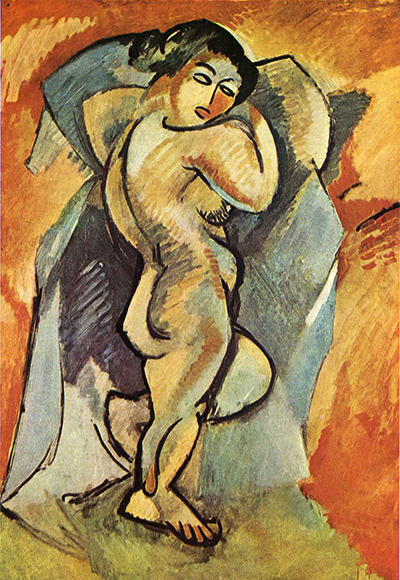
Large Nude establishes the opposite end of the functional range. The National Gallery of Art dates it to 1927 and records brown chalk and stumping on wove paper laid down on canvas. Its overall dimensions are 91 by 72.4 centimetres.[10]
Stumping spreads or softens chalk, allowing deposited pigment to move from a distinct stroke towards a broader tonal passage. Brown chalk can therefore support both line and modelling within one material. The wove paper provides the drawing surface, while the canvas backing gives a sheet of this size added stability.
That identity is complete within the drawing itself. The large format, sustained chalk technique and reinforced support give it the presence of an autonomous work. Its 1927 inscription belongs to the object, aligning execution, signature and date.[10]
The sheet also demonstrates how far Braque’s drawing could move from the compact 1918 Still Life. One concentrates several media within a small area; the other develops one principal medium across a much larger support. Autonomy accommodates both density and scale.
Scale changes the viewer’s relation to a mark. On a large sheet, a chalk passage can be encountered as both local texture and part of a body-sized structure. Stumping can connect discrete strokes across broader areas, while the canvas backing helps the paper withstand sustained handling and display. Monumental presence emerges within the category of drawing.
What a drawing preserves
Braque’s drawings hold decisions close to their materials. Still Life with Dice preserves the tension between charcoal illusion and flat stencil. The 1913–14 works preserve meetings among hand-drawn marks, typography, pattern and cut edges. The mixed-media Still Life preserves different bodies of colour. The theatre studies preserve proposals directed towards events. Large Nude preserves a sustained chalk process at substantial scale.
Preparation and completion describe different functions. A design can be valuable because it directs a collaborative future; an autonomous sheet can be valuable because its relations end within its own support. In each case, drawing makes thought material without concealing the stages through which it moved.
That openness is central to Braque’s achievement. Line, paper, colour, print and support remain recognisable as themselves, yet their placement creates a new whole. A drawing records the instant of choice and gives that instant duration.
Related Pages
Frequently Asked Questions
Drawing gave Georges Braque a place where an idea could remain visibly active.
Drawing begins with economy.
That openness is central to Braque’s achievement.
Discussion
Drawing gave Georges Braque a place where an idea could remain visibly active.
Reader Insights
Drawing gave Georges Braque a place where an idea could remain visibly active.
The relation between line and support therefore changes continuously.
That openness is central to Braque’s achievement.
Join the Conversation
Share the visible detail or source that most changed your reading.
References
- Metropolitan Museum of Art, Still Life with Dice
- Museum of Modern Art, Glass and Tobacco (Verre et paquet de tabac)
- National Gallery of Art, Braque: The Papiers Collés
- Centre Pompidou, Violon et pipe
- Cleveland Museum of Art, Violin
- National Gallery of Art, Still Life
- Centre Pompidou, Etudes de costume pour le ballet “Salade”
- Centre Pompidou, Etude de décor pour le ballet “Zéphyr et Flore”, AM 2018-200
- Centre Pompidou, Etude de décor pour le ballet “Zéphyr et Flore”, AM 2018-202
- National Gallery of Art, Large Nude