 by Tom Gurney
Tom Gurney BSc (Hons) is an art history expert with over 20 years experience
Published on August 14, 2026 / Updated on August 14, 2026
Email: tomgurney1@gmail.com / Phone: +44 7429 011000
Introduction
Georges Braque's Ateliers begin with a numerical puzzle. The sequence contains eight canvases, painted between 1949 and 1956, although their Roman numerals reach IX. The explanation lies in Braque's habit of returning to a painting: the canvas ultimately called Atelier IX first carried the number VII, then changed substantially before receiving its final title.[1][2]
That revision is more than a catalogue curiosity. It reveals how Braque approached the studio itself. Across the cycle, easels, palettes, brushes, furniture and still-life objects remain recognisable, yet their relationships continually shift. The workplace becomes a world assembled in paint, dense with previous motifs and open to further alteration. The Ateliers preserve the things among which art is made while unsettling any hope of reconstructing a single room.
These pictures belong to the period after the Second World War, when Braque was internationally celebrated but still developing new subjects. A major retrospective later described the studio paintings of 1949–56 as densely layered works linking his wartime interiors with the sparer landscapes of his final years.[4] Their richness comes from concentration. The painter's body stays outside the scene; tools, stored objects, spatial fragments and, eventually, the passage of a bird allow the studio to speak.
At a Glance
- ArtistGeorges Braque
- GuideThe Ateliers
- FocusThe numbered postwar Ateliers as paintings about making, memory, interior space and the arrival of the bird motif.
- Key topicsBefore the numbered Ateliers; Eight canvases, numbers I to IX; Between Paris and Varengeville; The vocabulary of making
- OverviewGeorges Braque's Ateliers begin with a numerical puzzle.
Contents
- Introduction
- Before the numbered Ateliers
- Eight canvases, numbers I to IX
- Between Paris and Varengeville
- The vocabulary of making
- A room built in layers
- Atelier VI and the opening of the room
- Atelier IX: a conclusion made through revision
- What the Ateliers make visible
Before the numbered Ateliers
The studio had occupied Braque long before 1949. In The Studio (Vase before a Window) of 1939, he explored the interaction of spatial representation, colour harmony and contrasting textures. The Metropolitan Museum of Art connects those concerns with his earlier Cubist investigations and with the postwar return to the artist's workplace.[7] The 1939 canvas remains a separate precursor, several years removed from the numbered cycle.
A closer threshold emerged during the war. Centre Pompidou's account of Braque's dialogue with the sculptor Henri Laurens groups Grand Intérieur à la palette of 1942 with Le Salon and Le Billard of 1944. Each is organised around an entire room, expanding the field beyond a compact tabletop arrangement. The museum sees these interiors as announcements of the Ateliers to come.[6]
That development changed the scale of the problem. A vase, table or palette could still command attention, but it now existed within an enclosure that was itself unstable. Walls, windows, furniture and painted surface began to exert pressure on one another. The later cycle gathered these experiments into a sustained meditation on the place of making.
Braque's studio subject also carried the memory of Cubism without merely reviving an old formula. Fragmentation and interlocking planes had long allowed him to examine an object from competing viewpoints. In the postwar interiors, that inquiry reaches across the whole workplace. The question becomes less how one thing occupies space than how a room full of things can remain legible while its structure changes around them.
Eight canvases, numbers I to IX
Braque began the numbered sequence in 1949. A retrospective dossier prepared by the Guggenheim Museum Bilbao and the Réunion des Musées Nationaux confirms that it comprised eight canvases and ran until 1956.[9] The numbering appears to promise a straightforward progression, but Atelier IX makes such an order impossible.
Centre Pompidou dates that final work [1952 / spring 1956]. Braque worked on its first state in 1952–53, when it was Atelier VII. He later resumed the canvas, completed it shortly before its spring 1956 exhibition at Galerie Maeght and presented it under the title Atelier IX.[1] Fondation Maeght independently records the same basic reconciliation: eight versions carry numbers from I through IX because the closing picture had occupied the seventh position before its transformation.[2]
The series thus unfolds through overlap, return and renaming. Its numbers offer orientation, yet they cannot function as a tidy annual timetable. One canvas could remain available for reconsideration while other ideas entered the group. The final numeral records a decision reached through revision; the physical count remains eight.
A numbered cycle often encourages viewers to search for a succession of solved stages. Braque's procedure points elsewhere. The old number VII remained part of the history of a canvas that would eventually stand at the end as IX. Early and late states therefore belong to the same physical support, while the sequence around it continued to develop. Numbering became another working instrument: useful for distinguishing paintings, flexible enough to change when the painting changed.[1]
The Galerie Maeght presentation gave that long process a public conclusion. Braque had held his first exhibition with Aimé Maeght in 1947, during a period of widening international recognition.[8] By 1956 the gathered Ateliers could be seen as a body of work, even though their making had resisted a straight path. Exhibition supplied a final occasion while preserving the changes within the pictures.
Between Paris and Varengeville
The painted studio becomes still harder to treat as a literal document once the cycle's geography is considered. An exhibition guide from the museums of Rouen records that Braque worked on the Ateliers partly in Paris and partly in Varengeville-sur-Mer. The canvases moved between the two, sometimes carried on the roof of a car.[3]
That striking detail brings the series back to physical labour. These were large objects handled, transported and reopened for work. It also weakens the idea that all eight pictures preserve one stable interior. A canvas could pass between the city studio and the Normandy coast while its represented space accumulated elements drawn from both places without belonging exclusively to one.
Varengeville nevertheless mattered. The Rouen guide describes a workspace designed for Braque by the architect Paul Nelson with large skylights in the roof and no windows in its walls.[3] Light entered from above, while painted openings and exterior references could answer needs created within the composition. The architecture offers context for the cycle, though it provides no master key to every depicted wall or aperture.
This movement between workplaces gives “memory” a practical meaning. Braque could retain a room's objects, habits and spatial sensations without copying it exactly. The studio could be reconstructed from things repeatedly seen and handled, then altered as the canvas travelled and developed. Memory here belongs to selection and rearrangement: a form of continuity created through work.
Transport also meant that each canvas possessed a material history independent of the room it represented. It could enter a different light, stand among different objects and return with earlier decisions still visible beneath new ones. The Rouen account offers no record of which passage prompted which alteration, yet it establishes revision as an ordinary, even expected possibility.[3] The painted studio could accumulate experiences from both places without becoming a composite floor plan.
The vocabulary of making
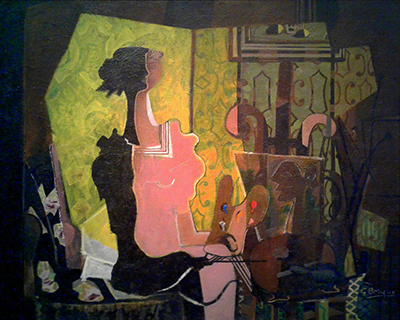
The numbered studios contain the familiar equipment of a painter, yet they rarely narrate a painting session. In its analysis of Atelier IX, Centre Pompidou identifies an easel, a pink palette and brushes, alongside a jar, stool, sculpture, lamp and table.[1] The tools make artistic labour present even as the artist's body remains absent.
That absence changes the character of the room. An easel marks a place where a picture may come into being; a palette and brushes carry the residue of decisions; stored motifs and furniture suggest repeated use. Together they form a working environment, far removed from a posed portrait of genius. The sequence makes creation visible through arrangement, interruption and revision.
Still life remains essential to this language. Braque had spent decades testing how ordinary things could activate the space around them. In the Ateliers, their relationships spread across the enclosure. Centre's catalogue analysis argues that Braque concentrates less on isolated description than on the relations that draw objects together and allow them to interpenetrate.[1] A separate Centre Pompidou exhibition likewise characterises Atelier VI as a search for conceptualised space through the interpenetration of its elements.[6]
The studio therefore serves two roles at once. It is the real setting in which materials and objects accumulate, and it is a pictorial structure capable of absorbing them into new connections. The everyday workplace becomes a store of motifs, but storage is only the beginning. Painting reorders what practice has gathered.
Centre's analysis of Atelier IX extends this argument to the different kinds of presence objects can assume. It sets dark against light, opacity against transparency, emptiness against fullness, and relates those oppositions to varied suggestions of touch.[1] A lamp, jar or palette can register as a solid thing in one passage and as a more elusive sign in another. The studio's contents are united by proximity while remaining unequal in weight, clarity and material force.
A room built in layers
Atelier IX offers the most detailed institutional account of this spatial method. Isabelle Monod-Fontaine, writing for Centre Pompidou, describes cut-out shapes, disarticulations, superpositions and suggested transparencies. Through these devices, space divides into successive layers that seem to extend behind the canvas surface and project before it.[1]
Recognition survives inside that instability. An easel or table can be named, yet its position participates in several possible readings. A plane may behave as furniture, enclosure and painted shape in quick succession. The eye is invited inward by one relation and returned to the surface by another. Braque's studio gains density because its parts never settle into a single spatial account.
Colour reinforces this tension in the closing canvas. Centre's analysis notes dominant browns and greys, interrupted by the pink field of the palette, yellow fragments around the bird and the red accent of the signature.[1] These details belong specifically to Atelier IX. Their concentration helps selected forms flare against a more subdued field, while their specificity confines the colour account to this canvas.
Guggenheim Bilbao interprets the studio as Braque's private or mental space, where real and metaphorical objects disclose a personal universe accumulated over time.[5] The phrase is useful when kept as a curatorial reading. The paintings provide no psychological diagram. Their inwardness arises visibly from recurrence: tools, furniture and motifs return bearing the weight of long familiarity, while their altered relations resist a documentary room.
Atelier VI and the opening of the room
The cycle's changing possibilities are especially clear in Atelier VI. Fondation Maeght dates the oil painting to 1950–51 and records its dimensions as 130 by 162.5 centimetres. Its account emphasises a three-way conjunction: the studio interior meets the outside, and a bird carries the composition toward a new kind of space.[2]
The Rouen museum guide locates the bird above an easel.[3] This placement gives the motif a precise function inside the workplace. The easel anchors the activity of painting; the bird introduces flight, passage and an element that exceeds the furniture-bound room. Interior and exterior remain distinguishable, but their boundary becomes permeable.
The format reinforces Atelier VI's individual identity within the cycle. At 130 by 162.5 centimetres, it is broader than it is high; Atelier IX, by contrast, is 146 centimetres square.[1][2] Difference of proportion cautions against imagining eight repetitions of one studio design. Braque retained the subject while allowing each support to set its own terms for the relation among enclosure, equipment and movement.
Chronology matters here. Atelier VI predates Braque's 1953 ceiling paintings for the Louvre, a date confirmed in the Guggenheim retrospective dossier.[9] The bird was already active within the studio cycle before that public commission. The Louvre enlarged its scale and setting after its role in the Ateliers was established.
Centre Pompidou's Braque–Laurens account likewise places the bird's emergence within the studios before following it into later works.[6] Within this sequence, its importance is spatial. A room built from accumulated objects acquires a sign of movement that can cross its divisions. The bird begins to connect the inward world of making with a more open field.
Atelier IX: a conclusion made through revision
The cycle closes with a canvas that had already lived another numbered life. Atelier IX is an oil painting measuring 146 centimetres square, signed at lower left and now held by Centre Pompidou as AM 1982-99.[1] Its square format differs from the broader Atelier VI, yet the two works share the problem of making a studio extend beyond stable enclosure.
In Atelier IX, the workplace's accumulated vocabulary returns with unusual compression. Tools, furniture and familiar motifs occupy a space whose layers continually fold into one another. Above them, the bird cuts across the measured room. Centre's analysis presents its movement as a force that breaks the interior open and enlarges it.[1]
Monod-Fontaine calls the resulting studio a kind of secret landscape: intimate, difficult to decipher and dense with the experience of a lifetime's painting.[1] That interpretation catches the peculiar reach of the canvas. The picture offers a workplace, yet its spatial transformations allow the room to behave like a territory traversed by thought. It remains grounded in easel, palette, table and lamp even as their arrangement exceeds ordinary architecture.
The long interval between first state and final completion gives this complexity a history. Braque returned to the former Atelier VII, altered it and changed its place in the order. The work closes the cycle because revision, followed by renewed revision, made it final.
Its completion before the 1956 Galerie Maeght exhibition provides a date, a title and a public endpoint. The painting itself preserves a less orderly truth. A studio is never only the room occupied on one day. It holds previous works, recurring objects, habits of looking and possibilities still under consideration.
What the Ateliers make visible
Braque's numbered studios turn artistic labour into a subject without relying on the familiar spectacle of an artist before a canvas. Labour appears through tools and accumulated things, through pictures carried between workplaces, and through the willingness to reopen a composition years after its first state.
The eight canvases also transform the meaning of interior space. Their rooms are recognisable enough to sustain easels, palettes, furniture and still-life objects. At the same time, superposition and interpenetration make those elements participate in several relationships at once. The studio becomes material place, remembered environment and pictorial construction.
The bird sharpens that transformation. In Atelier VI it enters the zone of the easel and joins inside with outside; in Atelier IX its passage disrupts an already layered room. Across those two anchors, flight grows from within the studio's own vocabulary. It carries the thought of painting beyond enclosure while remaining bound to the place where painting is made.
The sequence's numerical puzzle finally suits its deeper character. Eight works bear numbers extending to IX because Braque allowed one canvas to change identity through renewed attention. The Ateliers do the same with the workplace: they preserve it by transforming it.
Related Pages
Frequently Asked Questions
Georges Braque's Ateliers begin with a numerical puzzle.
The studio had occupied Braque long before 1949.
The sequence's numerical puzzle finally suits its deeper character.
Discussion
Georges Braque's Ateliers begin with a numerical puzzle.
Reader Insights
Georges Braque's Ateliers begin with a numerical puzzle.
The studio therefore serves two roles at once.
The sequence's numerical puzzle finally suits its deeper character.
Join the Conversation
Share the visible detail or source that most changed your reading.
References
- Centre Pompidou, “Atelier IX,” current collection record and catalogue analysis by Isabelle Monod-Fontaine. View source
- Fondation Maeght, “Atelier VI, Braque.” View source
- Musées de la Métropole Rouen Normandie, Braque, Miró, Calder, Nelson: Varengeville, un atelier, English exhibition guide. View source
- Museum of Fine Arts, Houston, “The Museum of Fine Arts, Houston, is Sole U.S. Venue for Georges Braque Retrospective.” View source
- Guggenheim Museum Bilbao, “The Studios.” View source
- Centre Pompidou, “Braque–Laurens: Un dialogue.” View source
- Metropolitan Museum of Art, “The Studio (Vase before a Window).” View source
- Guggenheim Museum Bilbao, “Georges Braque,” artist chronology. View source
- Guggenheim Museum Bilbao and Réunion des Musées Nationaux, Georges Braque, retrospective press dossier. View source