 by Tom Gurney
Tom Gurney BSc (Hons) is an art history expert with over 20 years experience
Published on August 14, 2026 / Updated on August 14, 2026
Email: tomgurney1@gmail.com / Phone: +44 7429 011000
Introduction
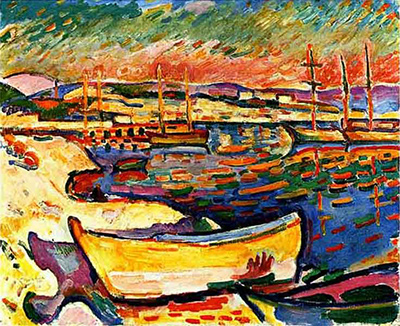
For a short, concentrated period, colour became one of the principal forces in Georges Braque's painting. It did more than brighten landscapes or translate the glare of the Mediterranean coast. Colour could separate one plane from another, pull distant forms towards the surface, set neighbouring areas into vibration and make a brushstroke register as an event in its own right. Between 1906 and late 1907, Braque explored those possibilities in ports, bays and hillside settlements, first beside Othon Friesz and then with an increasingly individual sense of pictorial order.[1][2]
Braque arrived after Fauvism's most celebrated opening moment. Henri Matisse and André Derain had already tested intensely unnaturalistic colour together at Collioure in summer 1905, and their paintings helped provoke the critical label of the “wild beasts” at that year's Salon d'Automne. Braque encountered their work and that of Maurice de Vlaminck and other associated painters at the exhibition, but his own sustained Fauvist campaign began in 1906.[1][2][3]
That later entry gave his contribution a particular shape. Fauvism offered no finished method. Its painters formed a loose alignment, sharing a new freedom from descriptive colour, polished surfaces and conventional perspective while differing markedly in touch, palette and purpose.[1] Braque used that freedom to investigate a question that would remain important long after his strongest colours subsided: how could the material relations inside a painting carry as much authority as the scene it represented?
At a Glance
- ArtistGeorges Braque
- GuideBraque and Fauvism
- FocusBraque’s brief Fauvist phase through colour, southern light, exhibitions and dialogue with Matisse and Derain.
- Key topicsFrom the Salon to Antwerp; L'Estaque: colour becomes construction; A public Fauvist position; La Ciotat and three balances of colour
- OverviewFor a short, concentrated period, colour became one of the principal forces in Georges Braque's painting.
Contents
- Introduction
- From the Salon to Antwerp
- L'Estaque: colour becomes construction
- A public Fauvist position
- La Ciotat and three balances of colour
- What Fauvist colour allowed Braque to do
- A gradual turn in 1907
- The importance of Braque's Fauvism
From the Salon to Antwerp
The 1905 Salon d'Automne offered Braque a public demonstration that colour could break free from the hue of an observed object. A sky, wall or tree could participate in a chromatic arrangement whose logic belonged to the painting. Visible strokes could remain plainly present, announcing direction, pace and pressure across the canvas.[1][2]
Individual choices varied. Matisse and Derain provided the decisive 1905 examples, while Friesz became Braque's closest working companion during the campaigns that followed. Both men came from Le Havre and took part in its active Fauvist setting in 1906. In June they travelled to Antwerp, where Braque produced his first sustained body of Fauvist work.[2][3]
K20's account of the Antwerp period stresses brighter colour and unusual views.[2] The port supplied both thematic material—water, vessels and built structures—and a setting in which Braque could test how colour changed the balance of a scene. A chromatic interval might bind two distant forms or make adjoining zones resist one another. A viewpoint could be chosen for the pattern it generated, rather than for a comfortably ordered prospect.
Antwerp places Braque's turn towards Fauvism before his arrival in Provence. The Mediterranean intensified an experiment already under way. Exhibition experience, sustained work beside Friesz and the practical discoveries made in front of new motifs all belonged to the change.
L'Estaque: colour becomes construction
In October 1906, Braque went south to L'Estaque. His first campaign extended from autumn into the following winter. The location brought together several histories: it offered harbour and inland subjects under a different light, and it was already strongly associated with Paul Cézanne, whose example informed Braque's decision to work there.[2][3][4]
At L'Estaque, Fauvist colour and Cézannian structure met within the same problem: colour itself could construct the picture. K20 notes that Braque's palette included mixed tones as well as stronger chromatic contrasts.[2] The qualification is important. Fauvist freedom enlarged his choices beyond literal appearance and beyond any single recipe of maximum brightness.
One Pompidou painting titled L'Estaque, made in October–November 1906, shows how precisely those chromatic decisions could be organised. The museum identifies simultaneous contrasts between orange and blue, yellow and violet, and red and green. Each pair makes its neighbour more active. Colour works relationally: its effect depends on what surrounds it, not on an isolated patch considered alone.[5]
Pompidou also distinguishes the handling of different areas in the same canvas. Longer strokes convey the movement of water, while smaller and lighter touches articulate the russet sky.[5] Their lengths, densities and rhythms help establish what water and sky can mean within the painted field. Description survives, produced through touch rather than concealed beneath it.
Braque's Fauvism therefore involved more than substituting surprising hues for natural ones. Complementary contrast could organise adjacency. A run of strokes could establish direction. Mixed tones could steady a passage against sharper accents. Recognisable boats, buildings, hills and water remained, yet the scene increasingly depended on the independent conduct of painted surfaces.
A public Fauvist position
Braque exhibited a group of southern Fauvist landscapes at the Salon des Indépendants in spring 1907.[3][4][6] The showing publicly consolidated the work made beside Friesz and at L'Estaque. He now occupied a visible place within the broad Fauvist field, even though he had entered after its first Collioure experiments.
The exhibition also reveals why a fixed definition of Fauvism is inadequate. The label could gather Matisse, Derain, Vlaminck, Friesz, Braque and others without making their paintings interchangeable. Their common ground was freedom from the demand that observed appearance dictate every colour and mark.[1] Braque's particular contribution lay increasingly in making that liberty answer to the organisation of the whole canvas.
Friesz occupied a distinct place in this development as the colleague with whom Braque travelled and worked through Antwerp and the southern campaigns.[2][4][6] Their proximity gave Braque a continuing dialogue within Fauvism, while the examples of Matisse and Derain remained crucial points of departure. Public stimulus came from the wider group; daily experiment took place beside a close companion.
La Ciotat and three balances of colour
In late spring and summer 1907, Braque and Friesz worked at La Ciotat. The surviving paintings reveal several concurrent balances among chromatic intensity, recognisable depth, contour and surface.[6][7][8]
The National Gallery of Art dates The Port of La Ciotat to spring 1907. Its catalogue essay describes a golden tonality heightened by southern light and notes that strokes and contours acquire an increasingly independent presence. At the same time, the harbour retains more naturalistic depth than some of Braque's more radical work from the middle of the year.[6] Flattening was only one option: colour and mark could assert themselves while still sustaining a legible recession.
MoMA's Landscape at La Ciotat, assigned to summer 1907, shifts that balance. The museum describes intense harmonic colour, strong outlines and a compressed or flattened space.[7] Contour now has a double effect: it can hold a form together, yet its visual weight also ties that form to the surface. The landscape remains identifiable, but the means used to construct it refuse to become transparent.
Centre Pompidou's much smaller Petite baie de La Ciotat, dated June 1907, offers another solution. According to the museum, simplified strokes and blocks can suggest a tree or the sun, while pink half-tones soften the most forceful pure-colour contrasts and Pointillist touches remain visible. Pompidou interprets the painting as a farewell to Fauvism.[8] The broader chronology turns that phrase into an account of transition rather than a definitive last-canvas claim. Braque was changing the balance of his language from work to work.
Placed together, these three institutional descriptions chart range rather than decline. Golden tonality, strong outline, flattened space, softened contrast and divided touch become alternative ways of testing how far colour can move away from local description while keeping a landscape coherent. At La Ciotat, Braque discovered both the range of his Fauvist language and its internal pressures.
What Fauvist colour allowed Braque to do
The first achievement was to make colour relational. In the Pompidou L'Estaque, blue changes the force of orange, just as violet answers yellow and green answers red.[5] Such pairings can bring a whole surface into play. Chromatic structure becomes convincing through the relations among areas, independently of exact optical colour.
The second was to give touch a constructive role. Long and short marks establish different kinds of movement and density, making the surface legible as something built over time. Braque could evoke water, sky, rock or foliage while leaving visible the acts by which those things became paint.
The third was to make depth negotiable. The NGA harbour can retain a measure of recession, while the MoMA landscape presses forms into a shallower arrangement.[6][7] Fauvism gave Braque ways to make illusion and flatness compete within a single image.
Finally, the phase loosened the bond between contour and local appearance. A strong boundary might describe the edge of a hill or building, but it could also function as an independent rhythm. As the NGA account observes, strokes and contours could acquire an autonomy of their own.[6] That autonomy would matter enormously in Braque's later work, but it was already a substantial Fauvist result.
Structure was already active throughout these achievements. Braque's Fauvist paintings were organised through contrast, intervals, repeated touches and the distribution of chromatic weight. Later in 1907 he changed the kind of order he sought.
A gradual turn in 1907
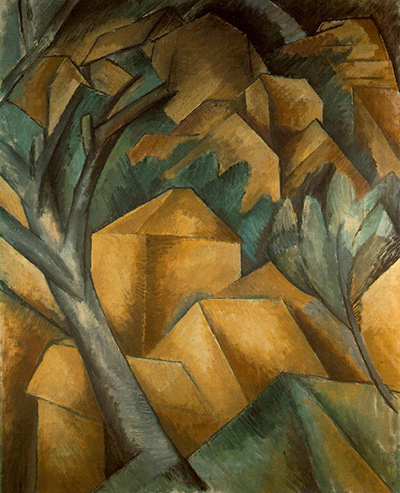
Braque's engagement with Cézanne preceded the major posthumous retrospective at the 1907 Salon d'Automne: the earlier painter's work had already helped direct him to L'Estaque in 1906.[2][4] The retrospective nevertheless intensified the encounter. K20 connects it with Braque's growing reduction of landscape elements to more elementary forms, his challenge to central perspective and his increasing use of browns, greys, greens and blues.[2]
The change unfolded as a reorganisation across several works. The La Ciotat examples already show multiple possibilities coexisting in mid-1907. During the autumn return to L'Estaque, firmer construction and a more restricted palette became increasingly prominent.[2][3][6] Colour continued to carry meaning: closer tones could make differences of value, edge and plane more consequential, just as the earlier complementaries had made adjacency more active.
Nor did the change expose Fauvism as a mistake. By releasing colour from strict imitation, the phase had taught Braque that every element of a painting could be judged by its role within the whole. Once that freedom existed, he could choose to heighten a contrast or suppress it; to open space or compress it; to let a stroke describe a thing or insist on its life as a mark. The later structural turn depended on those options even as it rearranged them.
The importance of Braque's Fauvism
Braque's Fauvist period lasted less than two years, but duration is a poor measure of consequence.[6] From the 1905 Salon he took the example of colour liberated from ordinary description. With Friesz in Antwerp, L'Estaque and La Ciotat, he made that liberation practical and sustained. In the southern paintings, complementary relations, mixed tones, visible touch, forceful contour and variable depth became parts of one pictorial inquiry.
Seen on its own terms, the phase joins several encounters without collapsing them. The wider Fauvist field opened a set of freedoms; Friesz helped provide the working dialogue; Cézanne's example sharpened the question of order; and Braque made those forces converge in paintings with a character distinct from both generic Fauvism and embryonic Cubism.
What he carried forward was more durable than a permanent palette: the knowledge that colour, touch, contour and surface could make their own claims against observed reality. Once Braque had tested that independence, a landscape could remain a harbour, bay or hillside while also becoming an arrangement whose internal relations commanded attention. Fauvism gave him the means to make paint answer less obediently to the world—and more decisively to the painting.
Related Pages
Frequently Asked Questions
For a short, concentrated period, colour became one of the principal forces in Georges Braque's painting.
The 1905 Salon d'Automne offered Braque a public demonstration that colour could break free from the hue of an observed object.
What he carried forward was more durable than a permanent palette: the knowledge that colour, touch, contour and surface could make their own claims against observed reality.
Discussion
For a short, concentrated period, colour became one of the principal forces in Georges Braque's painting.
Reader Insights
For a short, concentrated period, colour became one of the principal forces in Georges Braque's painting.
In late spring and summer 1907, Braque and Friesz worked at La Ciotat.
What he carried forward was more durable than a permanent palette: the knowledge that colour, touch, contour and surface could make their own claims against observed reality.
Join the Conversation
Share the visible detail or source that most changed your reading.
References
- Metropolitan Museum of Art, “Fauvism,” on the 1905 Collioure and Salon context, the group's loose affiliation, unnaturalistic colour, visible touch and Braque's 1906 entry. https://www.metmuseum.org/essays/fauvism
- Kunstsammlung Nordrhein-Westfalen, “Georges Braque,” current exhibition resource on the 1905 encounter, Antwerp and L'Estaque campaigns, mixed tones, colour as pictorial structure and the late-1907 transition. https://www.kunstsammlung.de/en/braque/
- Guggenheim Museum Bilbao, “Georges Braque,” artist chronology for the 1905 Salon encounter, Le Havre, Antwerp, the first L'Estaque stay and the 1907 exhibition sequence. https://www.guggenheim-bilbao.eus/en/the-collection/artists/braque-georges
- Centre Pompidou, “Le fauvisme et ses influences sur l'art moderne” and “L'Estaque,” French institutional accounts of the 1905 context, Braque and Friesz, Cézanne's importance to the site and the first southern campaign. https://mediation.centrepompidou.fr/education/ressources/ENS-Fauvisme/ ; https://www.centrepompidou.fr/fr/ressources/oeuvre/cMjaX6
- Centre Pompidou, “L'Estaque,” object record and catalogue note for AM 4297 P, on the exact October–November 1906 painting's complementary contrasts and differentiated touches. https://www.centrepompidou.fr/en/ressources/oeuvre/cGb4p6
- National Gallery of Art, “The Port of La Ciotat,” object record and catalogue essay on Braque's four Fauvist campaigns, work beside Friesz, southern light, colour, contour, space and the structural transition. https://www.nga.gov/artworks/106383-port-la-ciotat
- Museum of Modern Art, “Landscape at La Ciotat,” object record and gallery label on the distinct summer-1907 painting's strong outlines, compressed space and intense harmonic colour. https://www.moma.org/collection/works/79554
- Centre Pompidou, “Petite baie de La Ciotat,” object record and catalogue account of the June-1907 painting's simplified signs, softened contrasts, Pointillist touches and attributed end-of-phase significance. https://www.centrepompidou.fr/en/ressources/oeuvre/cnydKK