 by Tom Gurney
Tom Gurney BSc (Hons) is an art history expert with over 20 years experience
Published on August 14, 2026 / Updated on August 14, 2026
Email: tomgurney1@gmail.com / Phone: +44 7429 011000
Introduction
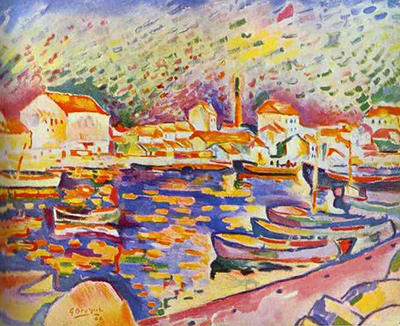
In Georges Braque's L'Estaque, colour gains force from company. Orange becomes more intense beside blue, yellow beside violet, and red beside green. The Centre Pompidou identifies these complementary encounters, together with fragmented brushwork, as the source of the painting's visual rhythm.[1] No hue has to carry the harbour alone. Each one changes what its neighbours can do.
That relational energy belongs to a specific canvas: an oil painting made between October and November 1906, measuring 50 by 60 centimetres and held by the Centre Pompidou under inventory number AM 4297 P.[1] Braque painted it during his first sustained engagement with the southern light and landscape around L'Estaque. The work is Fauvist in date and method, but its colour is more than an atmospheric flare or decorative surface. Contrasts and touches divide, connect and animate the scene. They are already instruments of construction.
At a Glance
- ArtistGeorges Braque[1]
- TitleL'Estaque[1]
- DateOctober–November 1906[1]
- MediumOil on canvas[1]
- Dimensions50 × 60 cm[1]
- CollectionCentre Pompidou, Musée national d'art moderne[1]
- InventoryAM 4297 P[1]
- SignificanceThe October-November 1906 Pompidou harbour as Fauvist colour construction before the 1908 Cubist landscapes
Contents
- Introduction
- A harbour built through adjacency
- Water and sky in different measures
- The first southern campaign
- A title with its own history
- Which L'Estaque?
- Colour as construction before Cubism
A harbour built through adjacency
Simultaneous contrast describes a perceptual relation: neighbouring colours can heighten one another even when neither changes materially. Pompidou's account locates three such relations in this painting. Orange and blue form one exchange, yellow and violet another, red and green a third.[1] The pattern matters because it prevents a single dominant opposition from explaining the entire canvas. Chromatic intensity passes through several pairings.
The effect is responsive, with no mechanical formula laid over the harbour. A complementary pair can sharpen a boundary, make an interval more active or pull separate passages into conversation. The result depends on where colours meet and how their painted marks behave. Colour therefore contributes to structure without losing its sensory immediacy: it can separate one area from another while making the whole surface vibrate.
Fauvist freedom also accommodated mixed tones. Kunstsammlung Nordrhein-Westfalen's account of Braque's early work stresses their presence in his L'Estaque palette.[3] Its essential liberty was the freedom to judge a colour by its pictorial work, independent of literal resemblance to the apparent colour of an object.
In L'Estaque, that work is distributed. Three complementary relations create multiple points of pressure; fragmented touches keep those pressures mobile. Attention can travel through a network of chromatic dependencies, an order produced by differences distributed across the painted field. The harbour remains a subject, yet colour refuses to become an invisible coating on a prearranged design. Its differences help establish the design.
Water and sky in different measures
Pompidou's analysis becomes especially precise when it turns from colour pairs to brushwork. In the water, elongated strokes convey ripples and reflections. In the sky, smaller and lighter touches introduce the russet tones of autumn.[1] The difference in scale gives the two zones distinct kinds of movement.
Length matters in the water because a stroke can carry direction. An elongated mark extends the sensation of a ripple or a reflected form across an interval. Its visibility keeps the depicted movement tied to the physical act of painting: water is suggested through a sequence of marks that never quite disappear into seamless illusion. The harbour seems active because the paint itself has extension and rhythm.
The sky asks for another tempo. Small, light touches can disperse russet colour without giving it the directional pull of the water's longer strokes. They register season as a chromatic condition. The source supplies no basis for adding a particular hour, cloud pattern or weather event. Autumn enters through the weight, scale and colour of the marks.[1]
These different measures distinguish water from sky, but they also connect them. Both zones are made legible by repeated touches whose spacing and scale remain perceptible. The eye can recognise reflection below and autumn colour above while also following a surface-wide rhythm. Fragmentation becomes Braque's way of joining the parts while preserving their differences.
The first southern campaign
The canvas emerged from a compact but decisive sequence. Braque had encountered the work of Henri Matisse, André Derain and other Fauvist painters at the 1905 Salon d'Automne. During summer 1906 he worked in Antwerp beside Othon Friesz, exploring brighter colour and new ways of organising a view. In October, the two painters moved south to L'Estaque.[3][4]
The site's appeal reached beyond picturesque novelty. Paul Cézanne had repeatedly worked around L'Estaque, making it an important testing ground for the relation between observed landscape and pictorial order. Pompidou's account of Fauvism identifies that precedent as part of Braque and Friesz's attraction to the place.[4] For Braque in 1906, however, Cézanne's example remained open enough to support a different immediate problem: how heightened colour and conspicuous touch could organise a recognisable setting. The reduced palette and denser geometry associated with Braque's later return still lay ahead.
Braque's first stay extended broadly from October 1906 into February 1907.[2] L'Estaque belongs near its beginning, with its narrower October–November date fixed by the record for AM 4297 P.[1] In spring 1907, paintings from this southern campaign entered public view at the Salon des Indépendants, held from 20 March to 30 April.[2][5] Their exhibition placed Braque's work within the public story of Fauvism, even as each canvas pursued its own balance of place, colour and mark.
A title with its own history
The broad title L'Estaque locates the painting within that campaign, although several names have been attached to the canvas. Centre Pompidou records Le port de la Ciotat as both a former and an attributed title.[1] The change is useful evidence of how an artwork's catalogue identity can evolve while separately documented paintings retain their independence.
The museum also provisionally associates AM 4297 P with catalogue number 723 at the 1907 Salon des Indépendants, where Braque exhibited a work titled Le Port.[1] The connection remains probable. If correct, it would add another historically situated label to the same object: a general port title at exhibition, a later La Ciotat attribution, and the present L'Estaque. The sequence shows why dimensions, dates and inventory numbers matter when Braque's recurring coastal subjects circulate under similar names.
Even the inscription has a documentary history. Pompidou states that the signature and 1906 date now visible on the canvas were added after 1940. The evidence is a photograph made after that year in which neither appears.[1] That sequence leaves Braque's authorship and the museum's independent dating intact. It simply separates the painting's creation from the later form of its inscription—another reminder that what is visible on an object today may record only one stage of its history.
The work entered the national collection through a donation from Mme Georges Braque in 1965.[1] That acquisition and the accession AM 4297 P complete a stable institutional identity beneath the shifting historical labels.
Which L'Estaque?
Centre Pompidou owns another oil painting with exactly the same main title and almost the same date. Its second L'Estaque was made in October 1906, measures 60 by 73.5 centimetres and carries inventory number AM 1982-98. It entered the collection by dation in 1982 and centres on a path and pines; AM 4297 P is the harbour analysed here.[2] Shared artist, place, month and title are insufficient to make the two canvases interchangeable.
The old La Ciotat title creates a second potential confusion. The National Gallery of Art's The Port of La Ciotat is a separate work from 1907, measuring 64.77 by 80.96 centimetres and catalogued as accession 1998.74.6.[6] The NGA places that painting in spring 1907 and identifies its setting as a shipbuilding harbour. Those identifiers distinguish it from the smaller October–November 1906 canvas at Pompidou. The dry dock, bands of masts and spatial argument belong exclusively to the Washington painting, regardless of the former title once attached to AM 4297 P.[6]
These distinctions are more than catalogue housekeeping. Braque's coastal campaign was a practice of return and variation. Similar place-names and maritime subjects allowed different experiments to unfold across separate supports. Preserving each object's identity makes those differences available instead of collapsing a body of work into one generic Fauvist harbour.
Colour as construction before Cubism
Braque's later painting at L'Estaque would change markedly. After the Cézanne retrospective of 1907 and his return south, he increasingly restricted colour, reduced motifs towards elementary forms and challenged conventional central perspective.[3] Those developments clarify the distinctive chromatic and rhythmic construction achieved by this earlier canvas. They belong to a subsequent reorganisation, not a standard by which the 1906 work becomes incomplete.
AM 4297 P already possesses a demanding form of order. Complementary colours create local intensities that reverberate across the surface. Elongated water strokes and small sky touches establish different rhythms without severing one zone from the other. Recognisable harbour and autonomous paint remain mutually sustaining. The subject gives the marks a field of action; the marks determine how the subject is experienced.
The painting therefore belongs fully to Braque's Fauvist inquiry and stands on its own, free of any need to serve as a colourful waiting room for Cubism. Its construction is chromatic and rhythmic. Orange needs blue, yellow needs violet, and red needs green; water needs one duration of touch and sky another. Through those relationships, L'Estaque becomes both a place on the Mediterranean coast and a surface whose order is created in paint.
Related Pages
Frequently Asked Questions
In Georges Braque's L'Estaque, colour gains force from company.
Simultaneous contrast describes a perceptual relation: neighbouring colours can heighten one another even when neither changes materially.
The painting therefore belongs fully to Braque's Fauvist inquiry and stands on its own, free of any need to serve as a colourful waiting room for Cubism.
Discussion
In Georges Braque's L'Estaque, colour gains force from company.
Reader Insights
In Georges Braque's L'Estaque, colour gains force from company.
The site's appeal reached beyond picturesque novelty.
The painting therefore belongs fully to Braque's Fauvist inquiry and stands on its own, free of any need to serve as a colourful waiting room for Cubism.
Join the Conversation
Share the visible detail or source that most changed your reading.
References
- Centre Pompidou, “L'Estaque,” current French collection record for AM 4297 P, including title history, date, medium, dimensions, donation, inventory, inscription history, probable 1907 exhibition identification and the museum's colour-and-touch analysis. https://www.centrepompidou.fr/fr/ressources/oeuvre/cGb4p6
- Centre Pompidou, “L'Estaque,” current English collection record for the separate October 1906 canvas AM 1982-98 and its first-stay and exhibition context. https://www.centrepompidou.fr/en/ressources/oeuvre/cMjaX6
- Kunstsammlung Nordrhein-Westfalen, “Georges Braque,” current resource on Braque's 1905–07 sequence, mixed tones, coloured surfaces and brushstrokes, and the later structural turn at L'Estaque. https://www.kunstsammlung.de/en/braque/
- Centre Pompidou, “Le Fauvisme,” educational dossier used for Braque and Friesz's Antwerp-to-L'Estaque sequence and Cézanne's importance to their choice of the site. https://mediation.centrepompidou.fr/education/ressources/ENS-Fauvisme/
- Guggenheim Museum Bilbao, “Georges Braque,” current chronology used for the dates of the 1907 Salon des Indépendants. https://www.guggenheim-bilbao.eus/en/the-collection/artists/braque-georges
- National Gallery of Art, “The Port of La Ciotat,” current record for the separate 1907 canvas, accession 1998.74.6, used only to resolve the former-title identity risk. https://www.nga.gov/artworks/106383-port-la-ciotat