 by Tom Gurney
Tom Gurney BSc (Hons) is an art history expert with over 20 years experience
Published on August 14, 2026 / Updated on August 14, 2026
Email: tomgurney1@gmail.com / Phone: +44 7429 011000
Introduction
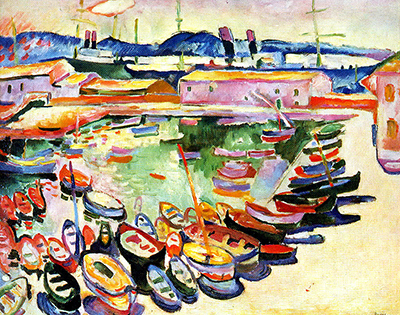
Three groups of masts run through Georges Braque's The Port of La Ciotat. They belong to the working harbour, but they also act as broken vertical lines that divide the composition into four broad bands.[1] Subject and structure are the same things seen in two ways: equipment for boats becomes a system for organising paint.
That double function extends across the canvas. A dry dock and two steamers establish La Ciotat as a shipbuilding port. Foreground boats retain volume through the distribution of lights and darks. Open ground and sky sustain deep space. Elsewhere, a distant boat may contract into one or two thick strokes, and some passages leave their spatial position unresolved.[1] The harbour remains legible while the means of representing it acquire increasing independence.
The National Gallery of Art dates the painting to 1907, while Jeffrey Weiss's catalogue essay places it more precisely in spring. It is an oil on canvas measuring 64.77 by 80.96 centimetres, part of the Collection of Mr. and Mrs. John Hay Whitney and held under accession number 1998.74.6.[1] These identifiers matter because several other Braque paintings from La Ciotat carry closely related titles.
At a Glance
- ArtistGeorges Braque[1]
- TitleThe Port of La Ciotat[1]
- Date1907[1]
- MediumOil on canvas[1]
- Dimensions64.77 × 80.96 cm[1]
- CollectionMusée national d’art moderne, Centre Pompidou[1]
- SignificanceThe NGA harbour to connect Fauvist colour, maritime motifs and Braque's growing concern with constructed space
Contents
- Introduction
- Masts as broken verticals
- The infrastructure of a working port
- Golden tonality and colour beyond description
- Deep space and spatial uncertainty
- When a boat becomes one or two strokes
- Spring 1907 within four painting campaigns
- Similar place-names, separate canvases
- From Kahnweiler to the Whitney gift
- A Fauvist harbour with constructed space
Masts as broken verticals
The mast system provides the clearest route into the painting's construction. Weiss describes three sets extending across the upper and lower parts of the scene. As interrupted verticals, they divide the image into four bands without hardening into a continuous grid.[1]
Their pictorial force comes from repetition with variation. Each mast belongs to the maritime subject, so the upright lines need no abstract pretext. Their recurrence nevertheless establishes intervals that can be followed across water, boats, shore and sky. The eye registers separate broad zones while the broken lines keep those zones connected.
The breaks are as important as the vertical direction. A continuous ruling would seal one band from another; interrupted masts allow movement across the divisions. They measure the field and disturb it at once. The construction emerges from observed material, with the harbour itself producing the geometry.
The masts also connect near and far. Their practical identity belongs to boats at different positions, while their painted role operates across the whole surface. A motif dispersed through depth becomes a repeated event on the canvas. Braque can therefore preserve the port's spatial cues while making them answer to a broad two-dimensional rhythm.
The infrastructure of a working port
La Ciotat was a shipbuilding town. Weiss explains that its small harbour was dominated by a large dry dock, visible in the background of this painting beside two steamers.[1] These are more than localising details. They introduce a scale of industrial construction against which smaller boats, open water and shore can be understood.
The harbour offered Braque a ready vocabulary of contrasts: large facility and small craft, upright mast and horizontal band, solid shore and open water, near boat and distant vessel. Every motif could contribute to recognition and spatial placement while also functioning as a line, interval or mass.
Braque and Othon Friesz repeatedly painted ports during their southern and maritime journeys. The choice was practical as well as pictorial. A harbour gathers many kinds of structure in one view without becoming static: hulls cluster, masts recur, water opens gaps, buildings establish limits, and industrial equipment enlarges the scale of the scene.[1][2]
For this canvas, the dry dock and steamers belong to the background. Their distant position strengthens their role in securing the setting as a working shipbuilding harbour, giving the more experimental marks a historical and material world to describe.
Golden tonality and colour beyond description
Weiss identifies a golden tonality in Braque's southern palette and relates its heightened force to his earlier encounter with the light at L'Estaque.[1] This account treats light as part of the painting's chromatic history while avoiding a claim about a particular hour or weather condition. The tonality establishes an overall warmth through which separate colours can interact.
At the same time, the essay calls the colours almost uniformly non-descriptive.[1] The qualifier matters. Colour loosens its obligation to match the apparent hue of every boat, building or stretch of water, yet the harbour stays readable. A colour can identify a passage broadly, distinguish it from a neighbour and carry weight in the surface arrangement without serving as a literal sample from nature.
This freedom belongs to Fauvism, a loose artistic affiliation with no definitive programme.[3] Braque entered its orbit in 1906 and developed his own southern palette through successive campaigns. K20's account adds that his colours could include mixed tones, correcting the idea that Fauvism demanded one universal recipe of pure paint.[2]
In The Port of La Ciotat, chromatic independence and recognisable subject reinforce one another. The harbour gives each colour a field of action; departures from local appearance let those colours establish emphasis and relation across the canvas. “Non-descriptive” therefore names a changed priority within the visible world.
Deep space and spatial uncertainty
The painting holds two apparently contrary spatial conditions together. Open areas of ground and sky relieve denser passages and coherently evoke depth. In the foreground, carefully distributed lights and darks give the boats plasticity—the sensation of substantial form.[1]
Those effects preserve a strong route into the scene. Less crowded passages allow the gaze to travel; tonal differences make the nearest boats feel grounded and voluminous. Weiss consequently describes the canvas as somewhat more naturalistic than Braque's unnamed, more radical work from mid-1907.[1] The comparison remains general because the essay leaves the particular later canvas unnamed.
Elsewhere, spatial relations become indeterminate. A mark can be difficult to assign securely to foreground, middle distance or background even though the harbour as a whole remains coherent.[1] Such uncertainty is productive. It prevents depth from becoming an automatic system in which every passage occupies one stable coordinate.
Flat decorative organisation and deep space can therefore coexist. They operate at different registers: the harbour recedes, while autonomous strokes and contours also insist on the surface where that recession is made. Foreground boats have volume; distant boats can approach signs; masts join multiple levels as repeated vertical marks.
The painting's spatial intelligence lies in managing these unequal degrees of certainty. Some forms model, some abbreviate, some divide, and some hover. The port remains a place, but no single illusionistic rule controls every passage.
When a boat becomes one or two strokes
The most compressed distant boats are represented, in Weiss's account, through one or two thick brushstrokes.[1] Their economy offers a small demonstration of Braque's changing technique. Very little paint can retain enough information for recognition when the surrounding harbour supplies context.
At the same time, thickness makes the stroke present as material. It describes a vessel and declares itself as a mark. This is what it means for brushwork to gain autonomy: the stroke continues to refer beyond itself while its shape, density and placement become independently significant.
Contours undergo a similar change. They can separate a boat from water or establish an edge, but they also participate in the network of directions across the canvas. The material used to describe the world begins to organise its own visible order.[1]
Foreground and distance consequently require different kinds of attention. Tonal distribution gives nearby boats plastic presence; one or two strokes leave distant craft cryptically abbreviated. The contrast helps produce depth, yet it also reveals that representation can vary in completeness within one coherent image.
Spring 1907 within four painting campaigns
Weiss places the canvas in the third of four important campaigns Braque made with Friesz: Antwerp in summer 1906, L'Estaque that autumn, La Ciotat in late spring 1907, and a return to L'Estaque in October.[1] Each journey altered the relation among colour, motif and construction. K20 likewise places Braque beside Friesz at La Ciotat during 1907 and treats the campaign as the closing phase of his short, intense Fauvist period.[2]
The spring date gives The Port a particular position. The Salon des Indépendants ran between 20 March and 30 April 1907, and Braque presented a group of Fauvist landscapes from the Midi there.[1][4] Museum accounts differ over whether that group contained five or six works. Its public appearance is secure; the exact total and the inclusion of this canvas remain unproven.
The major posthumous Cézanne retrospective and Braque's autumn return to L'Estaque followed later that year. By then, a relief-like structural approach and a more restricted palette were becoming increasingly prominent.[1][2] The sequence places the NGA harbour before that intensification while acknowledging that concern with constructed space was already active.
Similar place-names, separate canvases
MoMA catalogues a separate upright summer canvas as object 373.1975. Titled Landscape at La Ciotat, it has dimensions of 71.7 by 59.4 centimetres.[5] Its museum account of heavy outlines and flattened space belongs to that canvas. The NGA harbour is wider, earlier and structured through its own masts, open intervals, boats and industrial background.
Centre Pompidou's Petite baie de La Ciotat is separate again: a June 1907 oil measuring 36 by 48 centimetres, inventory AM 4298 P.[6] Pompidou describes Pointillist touches, softened contrasts and pink half-tones in that small bay. The comparison demonstrates variety within the campaign, while those exact properties remain in Paris.
A still more deceptive collision comes from an older title. Centre Pompidou's L'Estaque, AM 4297 P, is an October–November 1906 canvas measuring 50 by 60 centimetres. Its record lists Le port de la Ciotat as a former and attributed title.[7] That catalogue history cannot merge the 1906 Pompidou painting with the 1907 NGA work.
Kunstsammlung Nordrhein-Westfalen also holds a smaller 1907 Paysage de La Ciotat, measuring 38 by 46.2 centimetres.[2] Place-name, artist and year define a campaign more readily than an individual object. Accession, collection, dimensions and date refinement identify the harbour considered here.
From Kahnweiler to the Whitney gift
The NGA traces the painting through Galerie Kahnweiler, where it carried archive number 1037. Sequestered by the French government during the First World War, it was sold at the Kahnweiler collection sale on 4 July 1922 as lot 44 and purchased by Constantin Rodenbach. In 1952 Rodenbach sold it through Irma Hoenigsberg and René Gas, acting for Galerie André Maurice, to Mr. and Mrs. John Hay Whitney. Their 1998 gift brought it to the National Gallery of Art.[1]
This trail secures a distinct object history beneath the overlapping La Ciotat titles. The Whitney credit and accession 1998.74.6 belong to the harbour with the mast bands, dry dock and steamers; the MoMA landscape and both Pompidou canvases have separate histories.
A Fauvist harbour with constructed space
The Port of La Ciotat gains its force from coexistence. Golden and largely non-descriptive colour can operate across a legible shipbuilding harbour. Open ground and sky can establish distance while other passages resist exact spatial placement. Foreground boats can retain volume while distant ones become thick, economical marks. Masts can belong to vessels and divide the canvas into bands.
These relationships give structure an active presence in spring 1907 without requiring a Cubist label. The painting's space is tested, varied and partially uncertain, yet its maritime world remains specific. Braque makes representation carry its own analysis: each boat, mast, contour and open interval tells us what the harbour contains and how a painted surface can be organised.
The result is a completed Fauvist experiment in its own right, independent of any later movement's claims. Its most compelling question belongs to the present tense of the canvas: how far can marks and colours assert their independence while a port, its depth and its working infrastructure remain recognisable? Here, the answer is held across four bands and broken verticals, between substantial foreground craft and distant boats that survive in only a stroke or two.
Related Pages
Frequently Asked Questions
Three groups of masts run through Georges Braque's The Port of La Ciotat.
The mast system provides the clearest route into the painting's construction.
The result is a completed Fauvist experiment in its own right, independent of any later movement's claims.
Discussion
Three groups of masts run through Georges Braque's The Port of La Ciotat.
Reader Insights
Three groups of masts run through Georges Braque's The Port of La Ciotat.
Flat decorative organisation and deep space can therefore coexist.
The result is a completed Fauvist experiment in its own right, independent of any later movement's claims.
Join the Conversation
Share the visible detail or source that most changed your reading.
References
- National Gallery of Art, “The Port of La Ciotat,” current record for accession 1998.74.6 and Jeffrey Weiss's object essay on the spring date, campaigns, colour, depth, autonomy, ambiguity, masts, maritime infrastructure, provenance and later chronology. https://www.nga.gov/artworks/106383-port-la-ciotat
- Kunstsammlung Nordrhein-Westfalen, “Georges Braque,” current resource for Braque's colour/surface practice, Friesz and the southern campaigns, the separate Düsseldorf Paysage de La Ciotat and the later structural turn. https://www.kunstsammlung.de/en/braque/
- Metropolitan Museum of Art, “Fauvism,” on the loose affiliation, absence of a definitive programme and Braque's 1906 entry. https://www.metmuseum.org/essays/fauvism
- Guggenheim Museum Bilbao, “Georges Braque,” current chronology used only for the 20 March–30 April 1907 Salon des Indépendants dates. https://www.guggenheim-bilbao.eus/en/the-collection/artists/braque-georges
- Museum of Modern Art, “Landscape at La Ciotat,” current record used to separate the summer 1907 vertical canvas 373.1975. https://www.moma.org/collection/works/79554
- Centre Pompidou, “Petite baie de La Ciotat,” current French record used to separate the June 1907 small bay AM 4298 P. https://www.centrepompidou.fr/fr/ressources/oeuvre/cnydKK
- Centre Pompidou, “L'Estaque,” current French record used to distinguish AM 4297 P and its former/attributed Le port de la Ciotat title from the NGA harbour. https://www.centrepompidou.fr/fr/ressources/oeuvre/cGb4p6