 by Tom Gurney
Tom Gurney BSc (Hons) is an art history expert with over 20 years experience
Published on August 14, 2026 / Updated on August 14, 2026
Email: tomgurney1@gmail.com / Phone: +44 7429 011000
Introduction
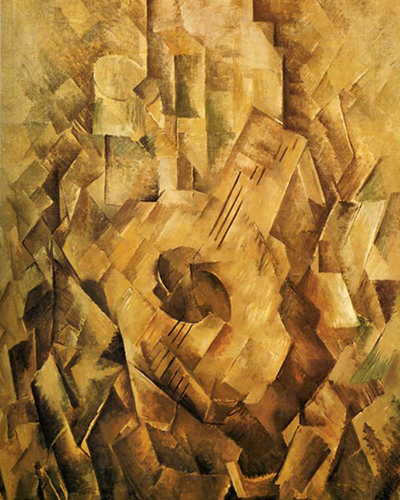
Music occupied an unusually intimate place in Georges Braque's life and art. He listened, attended concerts and played instruments himself. He also returned persistently to violins, guitars, mandolins, mandolas, woodwinds, keyboards, scores, clefs and composers' names. These subjects offered more than a repertory of attractive studio objects. An instrument has a body shaped for the hand, a familiar outline and an implied life in time. Braque could break that body into planes, scatter its signs across a painting or combine it with printed paper while preserving enough evidence for recognition.
This balance made music especially productive for Cubism. A curve might recall an instrument's sounding body; a row of keys could establish a sequence; parallel staves could belong to a score and simultaneously act as lines on a flat surface. Musical knowledge also encouraged comparisons with rhythm, polyphony and fugue. Such terms become useful when they describe visible relationships among distinct parts. Braque's paintings remain silent, yet they can make looking unfold as an active, cumulative process.
At a Glance
- ArtistGeorges Braque
- GuideMusic and Instruments
- FocusWhy instruments, notation, rhythm, cafés and Braque’s own musicianship became central formal resources.
- Key topicsBraque as musician and listener; How musical objects entered Cubism; Studio, café and folk performance; When notation becomes pictorial form
- OverviewMusic occupied an unusually intimate place in Georges Braque's life and art.
Contents
- Introduction
- Braque as musician and listener
- How musical objects entered Cubism
- Studio, café and folk performance
- When notation becomes pictorial form
- Rhythm, polyphony and fugue
- A theme that continued after Cubism
Braque as musician and listener
The musical theme began with lived experience. The Metropolitan Museum of Art describes Braque as a classically trained flutist who also learned the concertina. Kunstsammlung Nordrhein-Westfalen gives a broader account: he played violin, flute and piano, and was particularly associated with the accordion. The two institutions use their own terms for concertina and accordion, so each contributes a distinct part of the record. Together they establish serious musical practice within a painter's life.[1][3]
Braque's listening mattered as well. Kunstsammlung Nordrhein-Westfalen records that he owned a gramophone and frequently attended concerts. Paris offered opera, concert halls, revues and café-concerts, bringing contemporary composers into contact with a large popular audience. Erik Satie and Joseph-Marie Déodat de Séverac belonged to Braque's circle. Musical culture therefore reached him through private playing, friendship, formal concerts and the varied entertainment of the modern city.[1]
This background helps explain the persistence of instruments in his work without reducing every painting to autobiography. A violin or mandola carried associations accumulated through practice and listening, yet it also presented a demanding visual structure: rounded body, neck, strings, openings and fittings. Braque could treat those cues selectively, allowing the viewer's knowledge of the object to complete what the painting only partly disclosed.
Playing and listening also share a dependence on sequence. A player coordinates gesture after gesture, while a listener retains one phrase as the next arrives. Braque's pictures never reproduce that experience literally, but his familiarity with it gave musical objects an unusually rich field of associations. The hand implied by an instrument, the order implied by notation and the duration implied by performance could all remain available when the represented object lost its continuous outline.[1][3]
How musical objects entered Cubism
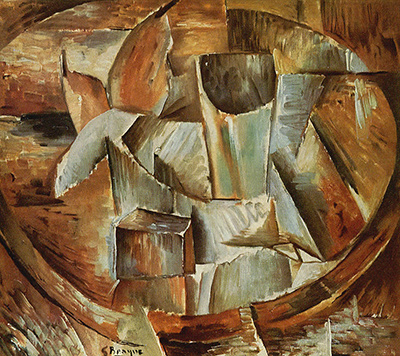
Kunstsammlung Nordrhein-Westfalen places Braque's introduction of musical instruments into still life in autumn 1908.[1] The change is already clear in Mandolin and Fruit Dish, painted in Paris early in 1909. The Met calls it one of his first Cubist works to feature an instrument. Its written account also identifies an open book or, more probably, pages of sheet music whose staves introduce notation alongside the mandolin.[2]
That combination proved fertile. Instrument and score could each remain partly identifiable while also supplying formal elements: an arc, a vertical neck, repeated strings, parallel staff lines. Familiarity gave viewers a foothold as ordinary spatial relations became less secure. In the Met's account of Braque's early musical still lifes, recognisable instruments helped contemporary audiences approach Cubism's unfamiliar fragmentation and overlapping planes.[3]
Touch added another dimension. The Museum of Modern Art's discussion of Homage to J. S. Bach stresses that an instrument comes into its fullest life through handling.[4] A painted bottle invites identification chiefly through sight; a violin also recalls the pressure of fingers, the movement of a bow and the posture of a player. Even when its outline breaks apart, the remaining signs can awaken a bodily memory of use. The object becomes a meeting point between visible form and imagined action.
Many musical objects contain visible systems of order. Strings run alongside one another, frets divide a neck, piano keys form a progression and staves organise notes at measured intervals. Cubist fragmentation can interrupt such systems while leaving enough of their pattern for the eye to continue it. The viewer moves between isolated clues and an anticipated whole, discovering recognition as an activity that unfolds beyond a single instant. This made instruments valuable both as things and as structures.
Between late 1909 and early 1910, Braque produced a concentrated group of five musical still lifes, including Still Life with Metronome.[3] Each canvas poses its own problem of recognition, but the group shares a durable premise: a familiar instrument can survive as a collection of partial signs while the space around it becomes faceted, shallow and unstable. Music was becoming central to how Braque tested the threshold between an object and a pictorial construction.
Repetition gave Braque room to vary that threshold. One work might retain a strong instrumental silhouette; another might depend on a few curves, strings or keyboard intervals. The recurrence of related subjects therefore created no fixed formula. It allowed him to ask repeatedly how much visual information an object needs, how surrounding space can share its facets and how memory supplies continuity where contour has been interrupted.
Studio, café and folk performance
Braque's musical vocabulary developed across several social settings. MoMA connects the limited range of everyday Cubist subjects with the surroundings of both studio and café.[5] Kunstsammlung Nordrhein-Westfalen places those settings within the wider musical life of Paris, where café-concerts, revues and concert halls brought different audiences and repertories together.[1] The distinction between a setting and a cultural reference remains important: some pictures evoke public entertainment directly, while others carry its words and objects into a studio arrangement.
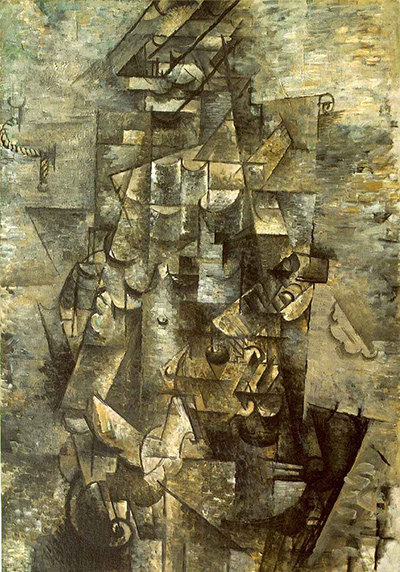
The Met's Bottle of Marc Vieux offers a clear café example. In this 1912 painting, BOCK 30 c advertises a mug of beer and BA[L] points toward a dance hall. Nearby forms can be read as a glass and curved tabletop or as part of a violin or cello. Letters establish the atmosphere of a bar while their size, opacity and position also contribute to the construction of space.[8] Music enters through an ambiguous instrument and through the social world named by the signs.
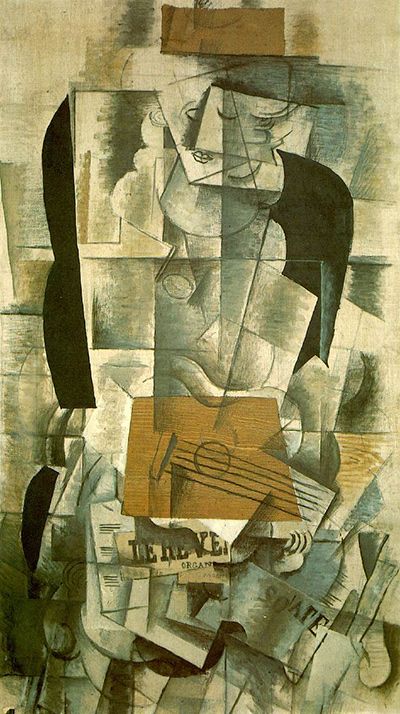
Still Life: “2e étude” makes the relation more complex. The word CAFÉ appears in the 1914 canvas, although the Met explains that Braque arranged and painted the still life in his studio. Solo violin and 2eme étude add further musical references.[9] Here the café is present through language and association. The studio can gather a newspaper, instrument, bottle and remembered public culture into a newly organised field.
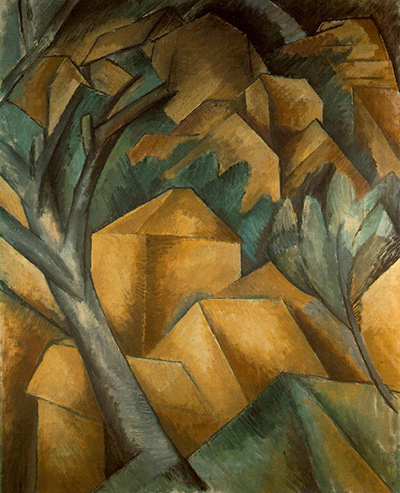
Braque's stay at Céret brought a different kind of musical encounter. A painting long called Still Life with Clarinet actually represents a tenora, according to the Met: a Catalan woodwind that Braque heard in local folk bands during summer and autumn 1911.[7] This precise correction belongs to that canvas, and it broadens the larger theme. The musical world of Braque's Cubism could encompass Parisian concerts, popular dance halls, domestic playing and a regional ensemble heard in the Pyrenees.
The violin itself crossed cultural boundaries. The Met observes that Braque depicted it more frequently than any other instrument and associates it with classical and folk music, refined taste and popular sentiment.[6] Its wide range of associations suited an art that repeatedly placed inherited traditions beside signs of contemporary life.
When notation becomes pictorial form
Musical writing gave Braque another bridge between reference and structure. Staff lines can identify sheet music, while their parallel movement remains visibly active even before a melody is recognised. Clefs and composers' names carry meaning as signs, yet they also occupy the surface as curves, intervals and repeated shapes. Kunstsammlung Nordrhein-Westfalen notes the recurrence of musical titles, names and clefs as fragments across Braque's art.[1]
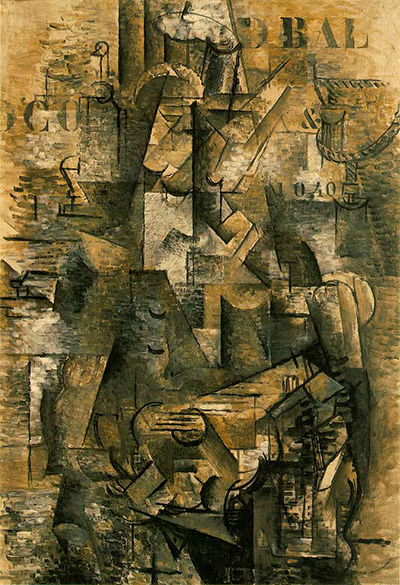
Homage to J. S. Bach, painted in winter 1911–12, makes this double role especially clear. MoMA identifies the stencilled forms BACH, J and S within compressed Analytic Cubist space. The letters stay sharply legible while violin parts appear in fleeting fragments. They refer to Johann Sebastian Bach, one of Braque's favourite composers, and at the same time introduce crisp linguistic shapes among shifting planes.[4] The personal reference and the visual function reinforce each other.
The same principle extends beyond a composer's name. Solo violin and 2eme étude invoke musical study; café signs summon performance and sociability; probable staves in Mandolin and Fruit Dish signal a score through a spare linear pattern.[2][9] Braque's words and notation therefore occupy two systems at once. They belong to the represented world of music, drink, rehearsal and entertainment, and they assert the flat surface on which reading and seeing occur.
Reading changes the pace of looking. A familiar word may register quickly, then send the eye back toward neighbouring fragments in search of a bottle, instrument or sheet. Staff lines can guide attention horizontally even when the score remains incomplete. Clefs and names can work as points of cultural recognition before their surrounding objects cohere. Braque thus used musical writing to alternate between immediate legibility and slower visual reconstruction.
MoMA's acquisition history for Homage to J. S. Bach links these readable stencils with the later development of collage.[5] That connection can be understood without treating letters as a simple preliminary stage. A stencil already arrives with a different visual character from a modelled object: repeatable, frontal and resistant to deep recession. Once printed and cut papers entered Braque's work, musical signs could participate in still more explicit exchanges among drawing, text and actual material.
Rhythm, polyphony and fugue
Music also offers a vocabulary for the experience of Braque's Cubism. Kunstsammlung Nordrhein-Westfalen compares the gradual apprehension of a Cubist composition with the succession through which notes become music. In its account, fragmented signs and multiple viewpoints make seeing temporal: the viewer gathers relations over time before a complete object coheres.[1]
Polyphony sharpens this idea. MoMA compares Bach's interdependent musical voices with the shifting planes and multiple perspectives of Homage to J. S. Bach.[4] The analogy works because several elements can retain their individual character while contributing to a larger organisation. A letter remains a letter, a violin fragment preserves an instrumental cue and a plane carries its own direction; their interaction produces the pictorial whole. “Polyphonic” describes that relation among parts, with no suggestion of audible music.
MoMA uses a more specific analogy for Still Life with Tenora of 1913. The work combines cut-and-pasted printed and painted papers with charcoal, chalk and pencil. Its geometric paper fragments and drawn motifs interlace in a way the museum compares with a fugue, where distinct melodic lines answer and frame one another.[10] The comparison centres on difference held together: pasted material and drawn representation preserve separate identities while acting within one composition.
These musical terms are most illuminating when anchored to visible structure. Rhythm can arise from repeated lines and intervals; polyphony can clarify concurrent but distinct signs; fugue can describe interweaving elements in one named work. Music supplies a language for relations, sequence and memory, while each painting determines how far the analogy can travel.
A theme that continued after Cubism
The First World War ended Braque's intense prewar Cubist exchange with Picasso, yet musical subjects remained available to him.[1] The Met's Guitar and Still Life on a Mantelpiece dates from 1921 and brings a guitar and musical score into a tall postwar still life. The museum links it to paintings with subtitles such as Valse, Java, Quatuor and Duo.[11] Those names reach from waltz and popular dance to chamber music, carrying forward the breadth already present in his earlier work.
Across these changes, music gave Braque several resources at once. It connected painting with his own experience of playing and listening. It supplied objects whose touch, volume and characteristic parts could survive radical fragmentation. It brought the studio into contact with cafés, concert culture, dance halls and folk bands. Through staves, clefs, names and printed matter, it also turned musical reference into line, shape and surface.
The result is richer than an iconography of instruments. Braque made music part of the way his art asks to be seen. Recognition arrives piece by piece, as the eye connects a curve with a body, a set of lines with a score or a stencil with a composer. In that unfolding act, physical memory and cultural memory meet pictorial structure. Music became central because it allowed an image to remain materially still while making perception active in time.
Related Pages
Frequently Asked Questions
Music occupied an unusually intimate place in Georges Braque's life and art.
The musical theme began with lived experience.
The result is richer than an iconography of instruments.
Discussion
Music occupied an unusually intimate place in Georges Braque's life and art.
Reader Insights
Music occupied an unusually intimate place in Georges Braque's life and art.
Still Life: “2e étude” makes the relation more complex.
The result is richer than an iconography of instruments.
Join the Conversation
Share the visible detail or source that most changed your reading.
References
- Kunstsammlung Nordrhein-Westfalen, “Georges Braque: Inventor of Cubism”
- Metropolitan Museum of Art, “Mandolin and Fruit Dish”
- Lauren Rosati, Metropolitan Museum of Art, “Georges Braque's Still Life with Metronome (Still Life with Mandola and Metronome), late 1909”
- Museum of Modern Art, “Homage to J. S. Bach”
- Museum of Modern Art, “The Museum of Modern Art Acquires Important Work by Georges Braque”
- Metropolitan Museum of Art, “Violin and Sheet Music: Petit Oiseau”
- Metropolitan Museum of Art, “Still Life with Clarinet (Bottle and Clarinet)”
- Metropolitan Museum of Art, “Bottle of Marc Vieux”
- Metropolitan Museum of Art, “Still Life: 2e étude”
- Museum of Modern Art, “Still Life with Tenora”
- Metropolitan Museum of Art, “Guitar and Still Life on a Mantelpiece”