 by Tom Gurney
Tom Gurney BSc (Hons) is an art history expert with over 20 years experience
Published on August 14, 2026 / Updated on August 14, 2026
Email: tomgurney1@gmail.com / Phone: +44 7429 011000
Introduction
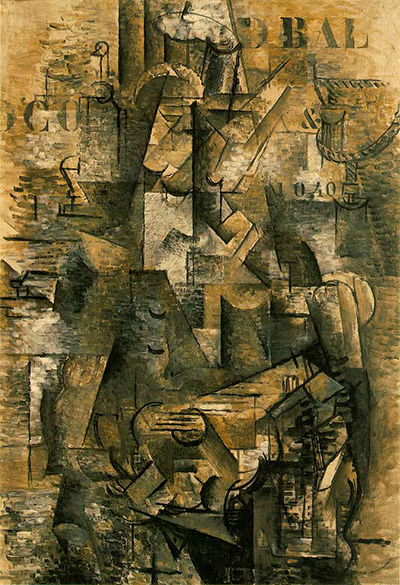
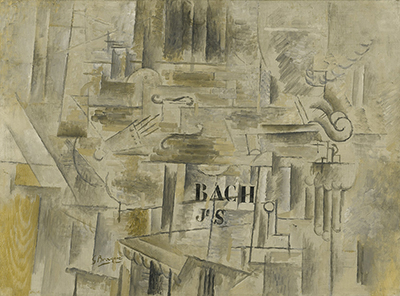
The name arrives before the instrument. BACH stands out with the initials J and S in a field of tans and greys, while the violin appears by degrees. Its parts seem to surface, withdraw and return among compressed planes. Nearby, a passage of painted wood grain offers a different kind of recognition: the eye meets a familiar material, then remembers that the wood is an illusion made in oil. Georges Braque brought language, craft and music together in Homage to J. S. Bach, yet each speaks in its own register. Their coexistence gives this demanding Cubist painting its unusual clarity.
At a Glance
- ArtistGeorges Braque[1]
- TitleHomage to J. S. Bach[1]
- Datewinter 1911–12[1]
- MediumOil on canvas[1]
- Dimensions54 × 73 cm (21 1/4 × 28 3/4 in.)[1]
- CollectionMuseum of Modern Art 544.2008[1]
- SignificanceStencilled letters, simulated wood grain and musical analogy work together in a major 1911-12 canvas
Contents
- Introduction
- The painting and its moment
- A violin in flickering moments
- Faux bois and the knowledge of a trade
- BACH as image and language
- Why Johann Sebastian Bach matters
- Three speeds of recognition
- The signature joins the homage
- From painted grain to pasted grain
- A history marked by seizure and uncertainty
The painting and its moment
Braque made Homage to J. S. Bach in the winter of 1911–12. The oil painting measures 54 by 73 centimetres and belongs to the Museum of Modern Art in New York as object 544.2008.[1] Its horizontal format holds a composition poised close to abstraction while still offering several unmistakable points of contact with the world.
Those dimensions—about 21 1/4 by 28 3/4 inches—give the work the scale of a concentrated encounter, far from a panoramic statement. MoMA credits it to the Sidney and Harriet Janis Collection.[1] The museum identity matters here because it fixes the object before interpretation begins: this is an oil painting, with every apparent change of substance created on one canvas.
MoMA places the canvas near the end of a period of especially close exchange between Braque and Pablo Picasso. Their work of these years came to be called Analytic Cubism. Pictorial depth became shallow and compressed; a narrow range of tans and greys replaced the high colour of Braque's earlier Fauvist years; familiar things survived as partial, shifting signs.[1] The painters had developed a language in which an object could remain present without being enclosed by one continuous contour.
A 1989 MoMA account of their collaboration emphasised both the intensity of this dialogue and Braque's inventiveness with material and texture.[3] Homage to J. S. Bach makes that inventiveness unusually visible. It joins several ways of representing something—fragment, imitation, written name and signature—inside one compact construction.
The historical setting helps clarify the painting's ambition. Braque was testing how far a picture could move from continuous modelling while keeping contact with objects, materials and names. Each surviving cue carries more weight because conventional spatial description has been compressed. The violin needs only to recur in parts; the grain needs only to resemble a surface; the letters need only to remain readable. None has to rebuild a complete room around itself.
A violin in flickering moments
The violin gives the painting a subject, although it never settles into the stable display expected of a traditional musical still life. MoMA describes its parts as appearing in “flickering moments” within the shallow space.[1] Recognition therefore unfolds as an activity. A fragment prompts the idea of an instrument; adjoining planes interrupt that reading; another cue allows the violin to return.
This intermittent visibility matters. Complete disappearance would leave pure abstraction, while a fully outlined violin would restore the old separation between a solid object and the air around it. Braque sustains a more elusive condition. The instrument belongs to the field, shares its tonal shifts and remains available through selected cues. Looking becomes a process of holding several possible relations in mind.
The violin also carries an implication of touch. MoMA recounts Braque's belief that a musical instrument gains a distinctive life when handled.[1] A violin is shaped for the player's hand, chin and bow; its sounding body joins material form with physical action. In the painting, that tactile object has become visually unstable. The tension between remembered solidity and scattered appearance helps explain why musical instruments remained so fertile for Braque.
Faux bois and the knowledge of a trade
The most concentrated illusion in the canvas is the faux bois, or imitation wood grain, which MoMA locates in the lower-left. The museum identifies this as Braque's introduction of imitation wood grain into Cubism.[1] The claim concerns a specific device: oil paint arranged to resemble the veins and texture of wood.
That skill came from a world beyond the conventional fine-art studio. Braque's father and grandfather were housepainters, and he received training in the family firm and from painter-decorators. Such artisans created convincing imitations of wood, marble, stone and architectural finishes, as well as signage for shops and businesses.[2] Braque carried this practical knowledge into a painting whose surrounding forms resist ordinary illusion.
The result contains a layered deception. The oil paint is physically present on canvas. The wood it resembles is absent. Even so, the grain can feel more immediately recognisable than the violin. A technique associated with decorating doors, walls or furniture becomes a small zone of virtuoso illusion inside a picture that continually unsettles the relationship between object and space.
Braque's use of craft also changes the social character of Cubist innovation. Painter-decorator methods had often been dismissed as manual tricks, yet here a learned trade supplies one of the work's sharpest intellectual devices.[2] The passage offers pleasure in resemblance and simultaneously calls attention to the act of making resemblance. It looks like wood while declaring the power of paint to manufacture that look.
This is more than a borrowed effect. Decorative graining depended on controlled repetition, close observation and the ability to make one surface stand convincingly for another.[2] Braque redirected that competence toward a different problem. Surrounded by fractured forms, the imitation becomes both a persuasive local image and evidence of artifice. Craft knowledge supplies certainty at the very point where the larger composition withholds it.
BACH as image and language
The stencilled BACH, J and S came from the same broad field of commercial training. MoMA links Braque's use of stencils to the lettering practices he knew through that background.[1] Their effect differs from the faux bois. Wood grain asks the eye to recognise a material appearance; letters ask it to read.
Reading happens quickly. The violin arrives through uncertain fragments, but BACH retains the crisp identity of a name. The initials complete the reference to Johann Sebastian Bach and make the homage explicit. At the same time, the letters remain shapes: hard-edged interruptions whose flatness resists absorption into the shallow pictorial space.
This dual function gives language an unusually active role. The stencils belong to the subject of the painting because they identify its dedicatee. They also belong to its construction because their repeated, impersonal appearance contrasts with the shifting painted planes. A method suited to a signboard enters a canvas and carries its public, reproducible character with it.
The connection with faux bois is especially revealing. Both devices emerge from painter-decorator practice, yet they address the viewer differently. Graining works through likeness: a painted pattern evokes wood. Stencilling works through convention: a set of shapes becomes a name because the viewer can read it. Braque places a material illusion beside a linguistic sign and lets their different kinds of directness sharpen the violin's elusiveness.
Braque leaves the letters open enough to generate associations without turning them into a hidden sentence. Their force lies in what they securely establish. They name Bach, punctuate the field and place written language beside an instrument that can only be recovered intermittently.
Why Johann Sebastian Bach matters
The homage grows from Braque's own musical knowledge. He had trained as a classical musician, and MoMA identifies Bach as one of his favourite composers.[1] Music therefore enters the work through more than the still-life convention of depicting an instrument. The title joins a composer Braque admired to an object whose tactile character he valued.
MoMA suggests that Bach's polyphonic compositions may offer a musical analogue for the shifting planes and multiple perspectives of Analytic Cubism.[1] Polyphony allows several parts to remain individually active while contributing to a larger order. That provides a productive way to think about the painting. Violin fragments, stencilled language, imitation grain and faceted structure preserve different kinds of identity, yet their relations make the composition cohere.
The comparison works best as an analogy, free from a literal code. The planes supply no visual transcription of a Bach score, and the painting identifies no particular composition. Its kinship with polyphony lies in coexistence: distinct elements unfold together, each altering how the others are understood.
The word BACH sharpens that relationship. It acts like a firmly stated theme within a more elusive field, while J and S answer it as separate signs. The violin introduces the embodied practice of music; the painted construction offers a visual experience of parts repeatedly joining and separating. Braque's tribute emerges through these relations, beyond any illustration of the composer's life or scene of performance.
Three speeds of recognition
The painting can be approached through three speeds. The stencils are read almost at once. The faux bois is recognised as a material appearance and then reconsidered as paint. The violin demands slower assembly from partial cues. Each encounter carries a different relation between sign and thing.
This variety helps the work hover near abstraction without surrendering reference. The letters retain linguistic precision. The grain produces a concentrated illusion. The instrument survives through fragments. Surrounding planes can then remain comparatively unstable because these anchors prevent the entire field from dissolving into undifferentiated pattern.[1]
The devices also expose the limits of one another. A written name can identify Bach but cannot make music audible. Painted grain can summon wood but cannot become timber. Fragments can suggest a violin but cannot place a playable instrument before the viewer. The canvas gains energy from those gaps. Representation remains powerful precisely because its acts are visible and incomplete.
The three speeds can operate in either direction. A viewer drawn first to the surname may then test the painted surface for other stable signs. Someone who begins with the grain may move from apparent material to language and then toward the violin. Braque provides anchors without prescribing a single route through them. Recognition becomes cumulative: every newly grasped element changes the field in which the others sit.
The signature joins the homage
Braque usually kept his signature less conspicuous in works from this period. Here he placed his name prominently on the face of the painting. MoMA proposes, with deliberate caution, that this may invite the ear to notice a slippage between the names Bach and Braque.[1]
The possibility suits a canvas already attentive to the look and sound of words. BACH identifies the composer; Braque's signature identifies the maker. Their proximity lets authorship become another linguistic element without providing a master key to the composition. The association remains a witty opening, as provisional as the music analogy itself.
It also complicates the ordinary division between dedication and signature. One name announces the person honoured, while the other records the person who made the homage. Because both appear within the pictorial field, the conventional signature participates in the same play of reading as the stencil. The museum's cautious proposal preserves the right balance: the resemblance between the names enriches the work, while the painting remains fully intelligible without treating that resemblance as a solved pun.[1]
From painted grain to pasted grain
During 1912, Braque's experiments with texture and constructed form moved toward a decisive change in material. MoMA's history of the Braque–Picasso dialogue places his first papier collé, Fruit Dish and Glass, in September of that year.[3] Homage to J. S. Bach stands just before that turn. Its wood grain is still an image created with oil paint.
A separate work makes the difference clear. In the National Gallery of Art's Aria de Bach of 1913, charcoal and white chalk meet two pasted materials on a white paper support: solid black paper and a sheet manufactured to imitate wood grain.[4] The later work incorporates manufactured material directly. What had been simulated in Homage became a physical component of the composition.
The comparison reveals continuity as well as change. Bach, an instrument and imitation wood remain productive ideas. Their material relations have shifted. Painted craft in the earlier canvas prepares a question that pasted paper answers in a new form: how can a familiar surface be both itself and part of a represented world?
A history marked by seizure and uncertainty
The painting entered Daniel-Henry Kahnweiler's Paris gallery in the summer of 1912, purchased from Braque. War transformed that ordinary dealer history. After France classified the German-born dealer's collection and stock as enemy property in December 1914, the work was sequestered. It appeared as lot 129 in the fourth Kahnweiler sale at the Hôtel Drouot in May 1923, where an unidentified buyer acquired it.[1]
By about 1927, the canvas was recorded in Pierre and Dollie Chareau's Paris apartment. MoMA also lists a possible connection with Jean and Annie Dalsace, preserving the uncertainty around this stage. Henri-Pierre and Denise Roché acquired it in 1930 from an unnamed friend and held it until 1959. The Roché estate followed; the museum brackets Norman Granz and Nicole Higgons as possible links, leaving their precise roles unresolved.[1]
Sidney and Harriet Janis bought the painting at a Sotheby's auction in London in April 1968. A private collection in New York held it from 1989 until 2008, when MoMA acquired it through gift and purchase.[1] This interrupted chain belongs to the object's history as surely as its medium and dimensions. The gaps reveal the effects of wartime confiscation, dispersal and private circulation, while the museum's qualifications keep conjecture visible.
What the homage holds together
Homage to J. S. Bach rewards attention because its elements refuse a single form of certainty. The letters name their subject directly. The faux bois demonstrates Braque's command of illusion. The violin comes and goes among shallow planes. Music offers a structural analogy, while the signature adds one last play between written identity and sound.
Braque gathered commercial craft, classical music and radical painting without smoothing away their differences. That balance gives the homage its force. A composer can be present as a name, an instrument as fragments and wood as painted resemblance; together they create a visual order whose parts remain as active as the whole.
Related Pages
Frequently Asked Questions
The name arrives before the instrument.
Braque made Homage to J.
Braque gathered commercial craft, classical music and radical painting without smoothing away their differences.
Discussion
The name arrives before the instrument.
Reader Insights
The name arrives before the instrument.
The homage grows from Braque's own musical knowledge.
Braque gathered commercial craft, classical music and radical painting without smoothing away their differences.
Join the Conversation
Share the visible detail or source that most changed your reading.
References
- Museum of Modern Art. “Georges Braque. Homage to J. S. Bach. winter 1911–12.” https://www.moma.org/collection/works/116275
- Metropolitan Museum of Art. “Cubism and the Trompe l’Oeil Tradition: Visiting Guide.” https://www.metmuseum.org/fr/exhibitions/cubism-trompe-loeil/visiting-guide
- Museum of Modern Art. “Picasso and Braque: Pioneering Cubism.” Press release, September 1989. https://assets.moma.org/documents/moma_press-release_327550.pdf
- National Gallery of Art. “Aria de Bach.” https://www.nga.gov/artworks/61217-aria-de-bach