 by Tom Gurney
Tom Gurney BSc (Hons) is an art history expert with over 20 years experience
Published on August 14, 2026 / Updated on August 14, 2026
Email: tomgurney1@gmail.com / Phone: +44 7429 011000
Introduction
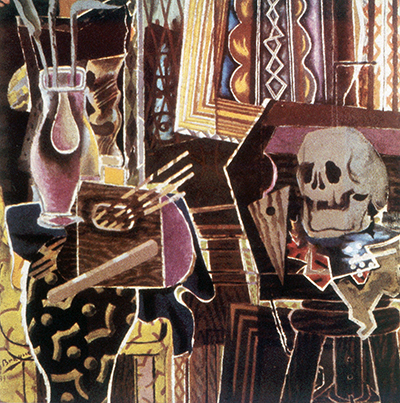
Georges Braque painted Vase, Palette, and Skull in 1939. The work is oil and sand on canvas and measures 36 1/8 by 36 1/4 inches, approximately 91.8 by 92.1 centimetres. It belongs to the Kreeger Museum as accession 1963.3.[1] Those nearly equal dimensions matter. They gather the studio into an almost square field whose boundaries feel unusually present.
Within that field, an easel, vase, artist's palette, pieces of furniture and frames meet the skull named in the title. The Kreeger describes these elements as overlapping, flattened and fractured into spatial relations that resist ordinary continuity.[1] Recognition survives, yet the room refuses to settle around its objects. Braque makes a studio that can be identified piece by piece while remaining elusive as a whole.
The canvas joins three kinds of pressure. Its equipment turns painting toward the circumstances of its own making. Sand and simulated wood grain place actual texture beside depicted texture. The skull introduces mortality into a room devoted to artistic work. The date then gives that encounter historical weight, while Braque's later description of his skull pictures as apolitical keeps their meaning open.[1]
At a Glance
- ArtistGeorges Braque[1]
- TitleVase, Palette, and Skull[1]
- Date1939[1]
- MediumOil and sand on canvas[1]
- Dimensions36 1/8 × 36 1/4 in. (approximately 91.8 × 92.1 cm)[1]
- CollectionThe Kreeger Museum[1]
- Accession1963.3[1]
- SignificanceThe 1939 studio vanitas through overlapping frames, palette, vase, skull, faux wood and sand
Contents
- Introduction
- The Studio as a Field of Surfaces
- A Still Life About Making Pictures
- Sand, Wood Grain and Two Kinds of Matter
- What the Skull Changes
- 1939 and the Pressure of History
- From One Studio to a Larger Theme
The Studio as a Field of Surfaces
A conventional interior gives objects stable places and uses the room to hold them together. Braque gives the holding function to overlaps. Frames, furniture, easel and still-life objects participate in a network of edges and surfaces. The studio emerges from their contact, interruption and partial alignment. Its architecture is therefore experienced through painted relations, with no need for a complete floor plan.
Kreeger's account calls the spatial combinations “impossible.”[1] The word captures a structure in which legible things inhabit incompatible cues. Flattening brings several elements toward the canvas, while fracture prevents them from forming one seamless view. These operations preserve the vase or palette as a recognisable sign, then loosen its position within a continuous room. Looking becomes a sequence of provisional settlements.
That instability carries the history of Cubism into a late work without turning the painting into an exercise in an earlier style. Braque had spent decades testing how one surface could sustain several views, different kinds of mark and competing degrees of reality.[4] The studio gives those questions a fitting home: it is the place where representation is produced, and here it becomes the thing under examination.
The near-square format reinforces the sense of concentration. A long horizontal support could extend the objects laterally; this canvas presses them into a more compact arena. Such compression increases the importance of every boundary. A frame can read as an object and as a division inside the larger field. Furniture can suggest depth while joining the surface pattern that unsettles it.
Braque's room consequently offers two experiences at once. It has enough equipment to establish a working studio, yet its most persuasive unity comes from pictorial construction. The eye moves among separate clues, repeatedly assembling and revising the interior. Space appears as an activity of perception, shaped through the same adjustments by which vase, palette, easel and skull become intelligible.
A Still Life About Making Pictures
The palette changes the status of the still life. It belongs among the arranged things, while also pointing to the act that brought every painted thing into being. The easel strengthens that reflexive turn. Together they make artistic labour present through its equipment, even though the written description supplies no painter, active session or identifiable work in progress.[1]
This presence through tools gives the studio a peculiar intimacy. A palette is handled, an easel supports work, and frames mediate between making and display. Braque converts that practical environment into a set of forms. The equipment retains its connection to use, although usefulness can no longer organise the room. Each item also serves the painting's larger play of planes.
The frames deepen the recursive quality. A frame normally separates a picture from its surroundings. Inside this canvas, frames become elements within another framed field. They introduce boundaries whose contents and functions remain open. That uncertainty matters more than any invented inventory: painting presents its own apparatus of division, selection and containment, then subjects that apparatus to fracture.
Still life has often depended on withdrawal from human action. Objects wait after touch or before use. Here, the tools keep work conceptually close. The palette and easel suggest a maker through function, while the skull gives human absence a second register. It evokes the body's limit without supplying a represented person. Studio labour and mortality meet through objects whose relations remain available to revision.
The Phillips Collection describes Braque's still lifes from 1928 to 1945 as a field in which he synthesised Cubist discoveries and developed an individual language. It traces a movement from intimate late-1920s interiors toward larger 1930s spaces and stresses his concern with the physicality of objects and their surroundings.[3] The Kreeger canvas concentrates that mature inquiry within the painter's own workplace.
Sand, Wood Grain and Two Kinds of Matter
Braque's room is materially complex before any object receives symbolic weight. Sand is part of the medium itself. According to the Kreeger, he mixed it into the oil paint to create pronounced texture and to bring a sense of depth.[1] Granularity belongs to the physical paint layer, so the surface addresses sight through qualities associated with touch while remaining an object for viewing.
This actual texture complicates the studio's pictorial compression. The represented room is flattened and fractured, yet the paint possesses relief. Depth therefore enters by two routes: as an unstable illusion among objects and as a material fact on the support. These routes can reinforce or interrupt each other. A compressed room gains physical presence precisely where conventional spatial continuity grows uncertain.
Wood grain establishes a different relation between paint and matter. Kreeger notes Braque's careful rendering of grain and connects that skill with his early training as a decorative house painter.[1] The grain is a painted simulation, an effect produced by the artist's command of marks. Sand, by contrast, contributes real particles. One material device depicts a surface; the other alters the surface that depicts.
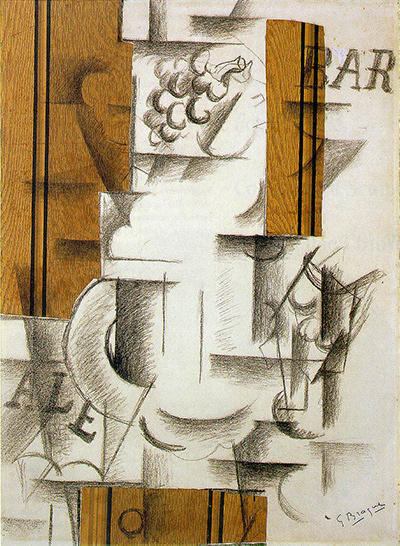
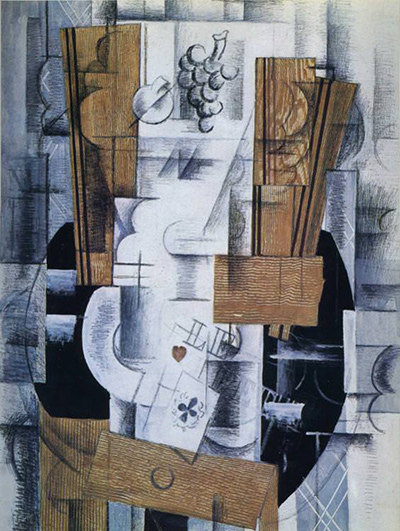
Braque had explored this boundary long before 1939. In 1912 he brought imitation wood-grain wallpaper into his papiers collés. Subsequent paintings could reproduce wooden structures through painted means, while sand or sawdust gave colour a tactile body.[4] The Centre Pompidou likewise distinguishes faux-bois paper used in collage from wood effects later imitated in paint.[6] The distinction is crucial here, where the documented medium is oil and sand.
Across those techniques, continuity lies in the question being asked. How can painting evoke an object, acknowledge its own support and allow real matter to enter representation? Vase, Palette, and Skull gives no single answer. Simulated grain demonstrates paint's power to resemble another substance. Sand makes resemblance share the canvas with a substance that carries its own texture.
The result exceeds decorative richness. Texture participates in the structure of recognition. A depicted surface may attract attention as pattern, while granular paint insists on the canvas as a made thing. Braque's studio thus oscillates between place and artefact. Its objects invite naming, and its material construction repeatedly returns attention to the labour through which naming becomes possible.
What the Skull Changes
The skull shifts the studio from self-reflection toward the limits of the self. Historic vanitas paintings used still-life objects to address human vanity and the brevity of life; in the Metropolitan Museum of Art's Vanitas Still Life by Jacques de Gheyn II, the skull belongs to an explicit group of mortality signs.[2] That tradition offers a useful lens for Braque's canvas, especially in a room organised around making.
Here the lens remains deliberately loose. Braque's title names a skull, while the Kreeger work carries no documented symbol-by-symbol programme. The vase, palette, easel, furniture and frames retain their ordinary studio identities. They can gather new associations around mortality, though none comes with a compulsory translation. Vanitas poses a question to the ensemble while leaving any code unsettled.
The palette makes that question especially sharp. Artistic work depends on materials, skill and repeated acts; the skull compresses bodily duration into a single enduring form. Their proximity may suggest art's persistence, its fragility, or both. Choosing one final moral would reduce the painting's richer tension. Braque places an instrument of making beside a sign of life's limit and lets the studio sustain the encounter.
Frames add another layer without becoming emblems of memory by decree. They indicate selection, preservation and the boundaries of pictures. The skull can make those functions feel newly charged, because every act of preserving an appearance unfolds against time. Yet the fractured room keeps that meditation material and pictorial. Mortality enters through an object embedded in the same unstable surface as everything else.
Sand also resists a purely literary reading. The skull may lead thought toward transience, while the canvas asserts the density of made matter. Painted grain, granular oil and overlapping planes keep meaning rooted in construction. The vanitas theme therefore grows from the relation between motif and medium. It never floats free as a detachable message about death.
1939 and the Pressure of History
The year 1939 places the painting at a severe historical threshold. Kreeger characterises it as made just before the Nazi occupation of France and reads ominous force in its sombre palette and skull. The museum adds that the approaching danger of the Second World War would have been inescapable.[1] This interpretation belongs to the work's date and atmosphere without converting either into a secret political programme.
Braque later insisted that his use of skulls was apolitical.[1] His statement deserves full weight because it resists an easy account of deliberate allegory. It also leaves other forms of meaning intact. An artist's declaration, a museum's interpretation and the historical conditions surrounding a painting answer different questions. Their friction can be more illuminating than a verdict that allows only one to stand.
The biographical context sharpens that friction. Braque had served in the First World War and suffered a severe wound. In 1940 he fled Paris with his wife, Marcelle, then returned soon afterwards and spent the occupation years in France.[1] These events followed the Kreeger painting. They reveal the reality of the danger around its date, while offering no direct key to what each object meant during its making.
Later wartime still lifes attracted similarly divided responses. The Phillips Collection observes that some viewers understood Braque's modest subjects as withdrawal from current events, whereas others found creative freedom in their intimate, imaginary spaces during tragic circumstances.[3] Those views concern later works, yet the disagreement clarifies why a studio interior can carry historical pressure without becoming straightforward reportage.
In Vase, Palette, and Skull, history is felt through convergence. A dark studio, a mortality cue and a date near catastrophe gather around a fractured spatial order. Braque's retrospective claim prevents that convergence from hardening into a statement of political intention. The painting remains historically resonant because context reaches it from outside, even as its formal and material organisation generates pressures of its own.
From One Studio to a Larger Theme
A second 1939 painting, the Met's The Studio (Vase before a Window), helps place the Kreeger canvas within a broader concentration on studio space. The museum associates its work with Braque's continuing exploration of spatial representation, colour harmony and contrasting textures.[5] These concerns also illuminate the overlapping planes and varied material effects described in Vase, Palette, and Skull.
The Met further identifies its canvas as an anticipation of nine large studio paintings created after the Second World War.[5] That connection gives the late-1930s studio a transitional position. Braque was already treating the workplace as a complex subject before the later sequence made it an extended field of inquiry. The Kreeger picture belongs to that prewar moment while retaining its own skull-centred tension.
Developments during the intervening years strengthened the room's importance. The Centre Pompidou links Braque's Grand Intérieur à la palette of 1942 and the 1944 Salon and Billard interiors, each organised around a whole room, with the later Ateliers.[6] The sequence suggests a sustained expansion of the interior as pictorial problem, from clustered equipment toward a more encompassing meditation on the artist's domain.
Yet Vase, Palette, and Skull already makes the studio encompass more than location. It is workplace, still life, constructed space and material demonstration. The palette and easel speak of making; frames multiply internal boundaries; sand gives paint a physical insistence; simulated wood tests illusion; the skull directs these concerns toward duration. Each strand modifies the others.
That interdependence is the painting's lasting force. Its studio can be recognised without resolving into a stable room. Its materials can be separated conceptually while meeting on one canvas. Its skull can awaken vanitas associations while resisting a fixed political or moral key. Braque holds craft, space and mortality together at the edge of war, leaving their relations tense, tactile and alive.
Related Pages
Frequently Asked Questions
Georges Braque painted Vase, Palette, and Skull in 1939.
A conventional interior gives objects stable places and uses the room to hold them together.
That interdependence is the painting's lasting force.
Discussion
Georges Braque painted Vase, Palette, and Skull in 1939.
Reader Insights
Georges Braque painted Vase, Palette, and Skull in 1939.
Across those techniques, continuity lies in the question being asked.
That interdependence is the painting's lasting force.
Join the Conversation
Share the visible detail or source that most changed your reading.
References
- Kreeger Museum, “Georges Braque: Vase, Palette, and Skull.” https://www.kreegermuseum.org/about-us/collection/painting/Georges-Braque_Vase-Palette-and-Skull. Accessed 14 August 2026.
- Metropolitan Museum of Art, “Jacques de Gheyn II: Vanitas Still Life.” https://www.metmuseum.org/art/collection/search/436485. Accessed 14 August 2026.
- The Phillips Collection, “Georges Braque and the Cubist Still Life, 1928–1945.” https://www.phillipscollection.org/event/2013-06-07-georges-braque-and-cubist-still-life-1928-1945. Accessed 14 August 2026.
- Kunstsammlung Nordrhein-Westfalen, “Georges Braque.” https://www.kunstsammlung.de/en/braque/. Accessed 14 August 2026.
- Metropolitan Museum of Art, “Georges Braque: The Studio (Vase before a Window).” https://www.metmuseum.org/art/collection/search/486270. Accessed 14 August 2026.
- Centre Pompidou, “Braque–Laurens: Un dialogue.” https://www.centrepompidou.fr/fr/programme/agenda/evenement/c7GoEoE. Accessed 14 August 2026.