 by Tom Gurney
Tom Gurney BSc (Hons) is an art history expert with over 20 years experience
Published on August 14, 2026 / Updated on August 14, 2026
Email: tomgurney1@gmail.com / Phone: +44 7429 011000
Introduction
Begin with the ceiling
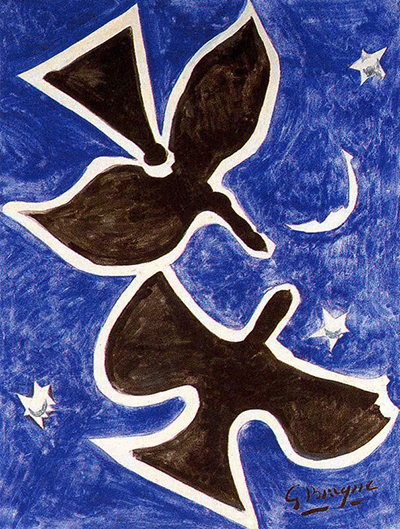
The first fact about Georges Braque’s Les Oiseaux is spatial: the painting is above you. It occupies a ceiling in the Louvre’s Salle Henri II, and its three oil-on-canvas parts belong to the architecture around them. A familiar reproduction can turn this arrangement into a flat, self-contained design. In the room, the work asks for an upward gaze and an awareness of scale, position and historical setting.
The Louvre titles each component Plafond : Les oiseaux and dates the ensemble to 1953. The museum records it through three inventory numbers, INV 20379, INV 20380 and INV 20378. Together they establish one commissioned ceiling made from three physical pieces.[1][2][3] That distinction shapes every other question about the work. Braque was addressing a room as well as a painted surface.
Ceiling painting carries a peculiar demand. A portable canvas can move from wall to wall while retaining much of its basic orientation. Here, oil on canvas became part of an overhead field. The viewer encounters it through the body’s relation to a building: looking up, turning, crossing the room and registering separate shapes across a space. The architecture participates in the act of seeing.
That setting also carries several times at once. The room belonged to a Renaissance palace, its name recalls Henri II, and it later held part of the Louvre’s Etruscan collection. Braque’s modern signs entered this accumulated history. Les Oiseaux therefore concerns more than a late motif enlarged to monumental size. It tests how modern painting can inhabit an inherited place without dissolving into period decoration.
At a Glance
- ArtistGeorges Braque[1]
- TitleLes Oiseaux (The Birds) at the Louvre[1]
- Date1953[1]
- MediumOil on canvas; three-part ceiling ensemble[1]
- Dimensions3.46 × 5.05 m; 2.81 × 2.07 m; 2.70 × 2.12 m[1]
- CollectionMusée du Louvre, Salle Henri II[1]
- InventoryINV 20379, INV 20380 and INV 20378[1]
- SignificanceThe 1953 Louvre commission as a three-part ceiling ensemble shaped for an architectural and historical setting
Contents
- Introduction
- Begin with the ceiling
- Three accessions form one ensemble
- A compressed commission in 1953
- An inherited room
- Moon, birds and two histories
- Modern signs at architectural scale
- The bird was already in motion
- A living artist inside the Louvre
- Work and setting remain joined
Three accessions form one ensemble
The largest recorded component, INV 20379, measures 3.46 by 5.05 metres. The Louvre gives no special format for it. INV 20380 is an oval measuring 2.81 by 2.07 metres, while INV 20378 is another oval, 2.70 by 2.12 metres.[1][2][3] Keeping those facts together matters. The dimensions describe distinct canvases, and their slight differences resist the idea of three interchangeable panels.
The separate inventory numbers can initially look like evidence for three individual paintings. The Louvre’s records resolve that impression by linking the components as an ensemble and repeating the same commission history across them.[1][2][3] The administrative division preserves each canvas’s identity; the architectural commission gives the group its unity. Both levels remain active whenever the work is discussed.
The records also guard against an easy category mistake. A title repeated across three entries might suggest variants of a subject, yet the shared history and linked accessions identify constituent parts. Read together, the entries become structural evidence. The ensemble exists through difference: each canvas remains individually accountable while its role becomes intelligible through the other two.
This structure creates variation before any subject is considered. One expansive component and two differently proportioned ovals establish changes of scale and shape within a single ceiling. Their relationship carries a rhythm unavailable to one unbroken rectangle. Attention has to move between parts, while the room gathers them into one field.
The oil-on-canvas medium adds another productive tension. Each part remains a painted object with its own dimensions and inventory identity, yet each was made to occupy a fixed architectural role. The ensemble sits between mobility and attachment. Its supports belong to the tradition of painting; its meaning depends heavily on where those supports were placed.
A compressed commission in 1953
The Louvre records an unusually concentrated administrative sequence. The ceiling was commissioned on 22 June 1953 for ten million francs and put in place in the Salle Henri II around 15 July. The museum then acquired it through purchase after commission during the same year.[1] Less than a month separates the documented decision from the approximate installation date.
Those dates convey urgency without supplying a studio diary. They identify a commission and a placement, while the stages of conception, painting, transport and mounting remain outside the surviving account. The useful historical point lies in the speed of the institutional sequence. A major modern decoration entered a highly charged room through a remarkably compressed summer timetable.
The sum of ten million francs also marks the work as a substantial public commission. Its significance comes through the scale of the undertaking, the permanent architectural destination and the direct relationship between artist and museum. A price alone cannot measure cultural value, yet here it belongs to a precise chain of commitment: order, delivery, purchase and installation.
Purchase after commission differs from retrospective collecting. The Louvre had already defined an architectural purpose before the ensemble entered its holdings. Braque’s work developed toward a known destination, with dimensions, component structure and completion tied to that destination. Museum patronage shaped the conditions under which the painting came into being.
Braque delivered Les Oiseaux during the summer of 1953, according to the Louvre’s account.[4] The season matters because it binds the work to a definite institutional moment, far from the open-ended chronology of many late paintings that he revised over years. The ceiling had to meet the demands of a place and a schedule. Its public destination gave the act of completion an architectural consequence.
An inherited room
The Salle Henri II already possessed a history of ceiling decoration. Braque’s ensemble replaced a ceiling by Blondel that had been removed in 1938. The Louvre records that predecessor through three inventory numbers of its own: INV 2626, INV 2626 BIS and INV 2626 TER.[1] The new work therefore entered a space whose upper surface had already been conceived as a multi-part decorative field.
The removal date creates a fifteen-year interval before Braque’s commission. Within that gap, the ceiling remained an architectural problem awaiting a new answer. Braque inherited the place, its proportions and its cultural associations, while the earlier decoration ceased to provide the visible solution. His response belonged to the twentieth century, yet it occupied a position shaped by the palace’s much longer life.
Replacement carried continuity and rupture together. The room retained the expectation that its upper field could bear a painted decoration, while a living modern artist supplied a fresh answer after the long interval. Braque’s commission renewed an architectural function without pretending that historical time had stood still since Blondel.
The Louvre describes the Salle Henri II as the Renaissance antechamber of the French king who reigned from 1547 to 1559.[4] An antechamber is a space of approach and transition. That function suits a work built from movement between separate parts. The ceiling accompanies passage through the room while drawing the gaze away from the ordinary horizontal direction of travel.
Architecture here acts as an active condition. Scale, height and division influence how quickly a form can register and how long its relationships take to unfold. A ceiling also lacks the stable frontality of a conventional wall painting. The body keeps adjusting beneath it. Braque’s three canvases turn this instability into part of the encounter.
Moon, birds and two histories
The Louvre explains the ensemble through two connections to its site. In a starry sky, the moon recalls Henri II’s emblem. The birds, meanwhile, relate to bird motifs on Etruscan vases displayed in the antechamber at that time.[4] These readings link the decoration both to the palace’s royal past and to the museum collection that occupied the room in 1953.
The two connections work differently. An emblem belongs to the history of a ruler and court, whereas the vase motifs belong to ancient objects gathered and interpreted by a modern museum. One points toward the building’s origins; the other addresses the collection’s later presence. The ceiling joins them through a concise vocabulary of moon, stars and birds.
Such a dialogue avoids historical pastiche. Braque could acknowledge Henri II without reviving a sixteenth-century pictorial language, and he could answer Etruscan birds without copying one archaeological object. The Louvre calls the work modern while stressing its place within the room’s history.[4] Modernity appears here as an ability to converse across periods while preserving formal independence.
The birds are especially effective mediators. They can inhabit a starry field, echo ancient vessel decoration and remain recognisable signs within Braque’s late art. Their mobility in meaning answers their implied movement through space. Yet the site keeps interpretation grounded: these birds participate in one room’s royal, architectural and museological history before they invite broader symbolism.
Modern signs at architectural scale
The documented imagery is spare: a moon, a starry sky and birds. At ceiling height, such reduced signs can register across distance without requiring the detailed description associated with an eye-level picture. Their economy gives them architectural force. Each remains legible enough to connect with the setting while open enough to sustain relationships among parts.
Scale changes the effect of reduction. A small sign on a large overhead surface can command attention through placement and contrast, while elaborate modelling might compete with the room’s own structure. Braque’s vocabulary allows the ceiling to assert a modern presence without trying to transform the Renaissance interior into an illusionistic world.
Recognition at this distance depends on concentration. Moon, stars and birds carry different historical associations, but each can register as a compact sign. Their economy creates room for the architecture to remain perceptible. Painting and setting share attention, and the ceiling’s meaning arises through that coexistence.
The three-part format intensifies this balance. The larger component and two ovals establish intervals, edges and shifts in proportion. The viewer cannot grasp their physical condition through the logic of one frame. Unity arrives through recurrence and architectural placement, while difference survives in each canvas’s shape and measure.
An overhead ensemble also unfolds through position. A viewer approaching, standing beneath and moving onward encounters changing relations among the parts even when their placement stays fixed. The work consequently has a temporal dimension: seeing develops through successive orientations, and the room supplies the continuity that a single frame would ordinarily provide.
This is why the work loses something essential when treated as a detachable emblem of “the bird.” The motif remains important, yet the ceiling gives it a specific task. Birds have to operate across height, scale, royal association and archaeological context. They become instruments through which a modern painter addresses the structure and memory of a museum room.
The bird was already in motion
The Louvre commission enlarged an existing concern. Fondation Maeght dates Atelier VI to 1950–51 and describes the bird joining studio interior and exterior in that painting.[5] The Phillips Collection places Braque’s renewed experiments with independent birds from 1949.[6] By 1953, the motif could already cross boundaries between enclosed space and an imagined beyond.
Braque’s own later recollection extended the history further. In an account preserved by the Centre Pompidou, he remembered birds incorporated into still lifes in 1910 and the motif appearing again in a 1929 illustration for Hesiod. He associated his later preoccupation with space and movement.[7] The ceiling belongs within that long, uneven development.
Its novelty lies in situation and scale. A form previously embedded in a still life or studio could now occupy a public ceiling, answer an ancient collection and participate in the memory of a king. The bird moved from one pictorial context into another, gaining new work from its architectural surroundings.
The chronology also clarifies the place of Braque’s 1955 visit to the bird sanctuary in the Camargue. The Phillips Collection says that experience furthered his interest.[6] It followed the Louvre ceiling, adding another stage to a concern already active. Les Oiseaux stands as a monumental hinge within this sequence, with earlier experiments behind it and further transformations ahead.
A living artist inside the Louvre
The Louvre places Les Oiseaux within a prestigious policy of commissioning ceilings from living artists. Its account looks back to Delacroix’s completion of the Galerie d’Apollon ceiling in 1850 and forward to later modern interventions.[4] Braque’s commission belongs to an institutional history in which the palace continues to receive new art as part of its fabric.
This context changes the usual relation between modern artist and old museum. Braque entered the Louvre as the creator of a permanent architectural element, a more embedded role than the later acquisition of a portable work. The commission asked him to contribute to the building’s ongoing history while remaining recognisably of his own time.
That balance carries a subtle authority. The historical room sets limits and offers cues, but the modern painter supplies an answer that refuses antiquarian disguise. Moon and birds can acknowledge the setting through signs whose reduction belongs to twentieth-century painting. Respect for place emerges through transformation.
The commission also makes the museum visible as an active patron. Its rooms preserve earlier art, yet they can become sites of contemporary creation. In 1953, the Louvre used a living artist to renew a missing ceiling within a Renaissance interior. Les Oiseaux records that institutional choice in permanent, spatial form.
Once installed, the ensemble became both a collection object and part of the building’s fabric. Inventory numbers keep the three canvases administratively distinct; the Salle Henri II keeps their historical function joined. The double status captures the commission’s importance. The museum collected a work by giving it an architectural purpose.
Work and setting remain joined
Les Oiseaux becomes clearest when its several identities stay together. It is one ensemble and three catalogued canvases; a modern painting and an architectural decoration; a late bird work and a response to older histories. Each description corrects the limits of the others.
The accessions and dimensions secure its physical complexity. The commission dates place it within a compressed summer sequence. The removed Blondel ceiling gives the site a prior decorative life. The Louvre’s readings of moon and birds connect the modern work to Henri II and to Etruscan objects once displayed below it. None of these elements alone defines the ensemble.
Their conjunction is the achievement. Braque used a deliberately concentrated set of signs to meet a place dense with inherited meanings. The ceiling acknowledges royal memory and museum history while preserving the clarity of modern pictorial language. Its three parts belong to the room without surrendering their identity as paintings.
Looking upward therefore becomes an act of historical orientation. The viewer stands beneath a work that joins different centuries, different kinds of object and different institutions of meaning. Les Oiseaux remains inseparable from that encounter: a flight across canvas, architecture and memory held together by one Louvre ceiling.
Related Pages
Frequently Asked Questions
The first fact about Georges Braque’s Les Oiseaux is spatial: the painting is above you.
The first fact about Georges Braque’s Les Oiseaux is spatial: the painting is above you.
Looking upward therefore becomes an act of historical orientation.
Discussion
The first fact about Georges Braque’s Les Oiseaux is spatial: the painting is above you.
Reader Insights
The first fact about Georges Braque’s Les Oiseaux is spatial: the painting is above you.
Such a dialogue avoids historical pastiche.
Looking upward therefore becomes an act of historical orientation.
Join the Conversation
Share the visible detail or source that most changed your reading.
References
- Musée du Louvre, Département des Peintures. “Plafond : Les oiseaux,” INV 20379. View source
- Musée du Louvre, Département des Peintures. “Plafond : Les oiseaux,” INV 20380. View source
- Musée du Louvre, Département des Peintures. “Plafond : Les oiseaux,” INV 20378. View source
- Musée du Louvre. “Les Oiseaux de Braque.” View source
- Fondation Maeght. “Atelier VI, Braque.” View source
- The Phillips Collection. “Bird.” View source
- Centre Pompidou, Isabelle Monod-Fontaine. “L’Oiseau et son nid.” View source