 by Tom Gurney
Tom Gurney BSc (Hons) is an art history expert with over 20 years experience
Published on August 14, 2026 / Updated on August 14, 2026
Email: tomgurney1@gmail.com / Phone: +44 7429 011000
Introduction
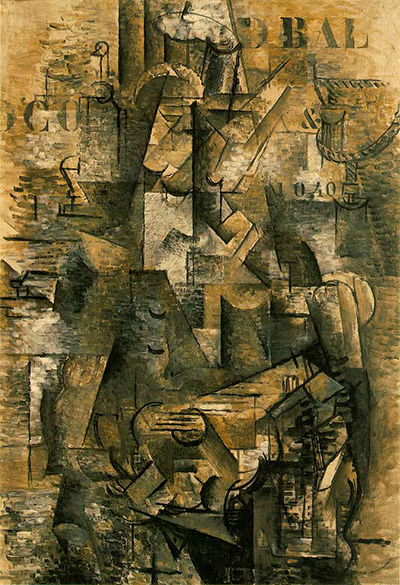
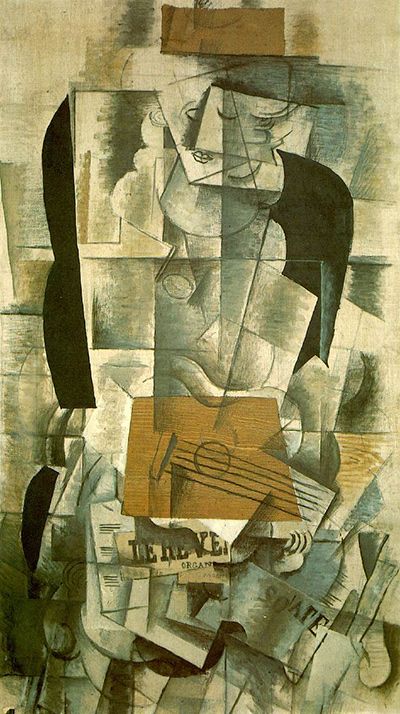
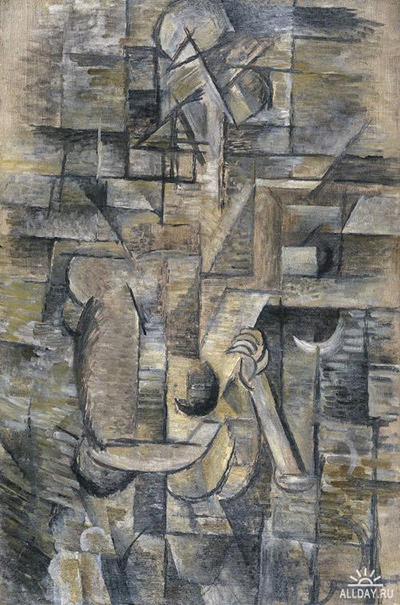
A mandolin appears before its player does. In Georges Braque’s Woman with a Mandolin, the instrument and the hand that holds it remain comparatively easy to recognise, while the woman’s head and shoulders recede into the surrounding structure. The subject survives through a few connected clues, each helping the next one make sense. Instrument implies hand, hand implies musician, and the title confirms a woman whose full outline never settles into place.
Painted in spring 1910, this encounter between clarity and uncertainty belongs to Braque’s early Analytic Cubism. The Museo Nacional Thyssen-Bornemisza identifies the work as an oil on canvas measuring 80.5 × 54 centimetres, inventory 478 (1976.24).[1] Those basic facts matter because Braque produced another woman-and-mandolin composition in an oval format, while closely related titles recur in his later career. The tall rectangle in Madrid is a specific object, and its particular achievement lies in making figure, instrument and setting share one pictorial fabric.
At a Glance
- ArtistGeorges Braque[1]
- TitleWoman with a Mandolin[1]
- DateSpring 1910[1]
- MediumOil on canvas[1]
- Dimensions80.5 × 54 cm[1]
- CollectionMuseo Nacional Thyssen-Bornemisza[1]
- Inventory478 (1976.24)[1]
- SignificanceThe rectangular Thyssen figure and instrument interpenetrate in 1910 Analytic Cubism
Contents
- Introduction
- A Rectangle Within a Field of Planes
- Returning to the Human Figure
- Corot Remembered and Transformed
- Recognition Begins with the Mandolin
- Figure and Background in One Structure
- Restricted Colour, Lively Touch
- One Title, Several Distinct Works
- The Painting’s Later Passage
A Rectangle Within a Field of Planes
The canvas’s proportions provide an initial certainty. Its upright rectangle offers firm vertical and horizontal limits, even as the forms within those limits become mobile and difficult to separate. The straight outer boundary therefore plays an orienting role: it contains a composition whose internal divisions rarely behave like the stable contours of conventional figure painting.
That format also distinguishes this painting from Braque’s separate oval Woman with a Mandolin of the same year. The Thyssen account places the two works within a concentrated period of experimentation and describes the oval version as the first Cubist painting executed in that format.[1] An oval removes the corners and changes the pressure exerted by the edge of a canvas. Braque’s rectangular work keeps the firmer framework. Its verticals and horizontals can answer the shape of the support while drawing the woman and her surroundings into a common system.
The inventory number gives the painting another kind of boundary. “Woman with a mandolin” names a subject that Braque revisited; 478 identifies this material canvas. Format, date, dimensions and collection preserve its identity even when the title recurs elsewhere.
Returning to the Human Figure
Paloma Alarcó’s Thyssen commentary describes the painting as part of Braque’s first, or Analytical, Cubist phase. It also presents the work as a return to the human figure after two years devoted to landscapes and still lifes.[1] The change of subject brought earlier discoveries into a new setting. A human body could now undergo the same structural inquiry that had transformed hills, houses, tables and musical instruments.
The mandolin makes that transition especially fertile. It belongs to the figure because someone holds and plays it, yet it also belongs to the familiar repertory of still life. Its compact body, neck and relation to a hand can provide recognisable connections when the wider anatomy becomes elusive. The instrument therefore mediates between two genres. A seated musician carries the presence of a person, while the mandolin introduces the poise and concentration of an arranged object.
Thyssen’s interpretation speaks of the instrument giving the character something of a still life’s calm.[1] Calm belongs to the subject type; the painted surface stays active. Across that surface, lines change direction, planes meet, and boundaries migrate. A composed musician becomes the occasion for intense pictorial movement.
Corot Remembered and Transformed
The older figure-and-instrument tradition enters the painting through Camille Corot. Thyssen suggests that Braque’s return to the figure may have followed his encounter with twenty-four paintings by Corot at the Salon d’Automne of 1909. Corot’s seated women holding musical instruments impressed Braque and Picasso, according to the museum, partly because the instrument could give a figure the stillness associated with an object.[1]
One work that clarifies this historical type is Corot’s Gypsy Woman with Mandolin, dated about 1870 by the National Gallery of Art in Washington.[2] Corot’s canvas establishes how a woman with an instrument could carry repose, duration and expressive gravity long before Cubism. Braque retained the broad conjunction—a seated woman, an instrument, a mood of concentration—while changing the means through which it could be pictured.
The relationship is most useful as a transformation of type. Corot offered no ready-made Cubist structure, and Braque’s painting follows no simple recipe from a nineteenth-century precedent. A familiar subject enters a field of intersecting planes. Historical memory supplies composure; the 1910 method makes that composure visually demanding. The woman rests within the theme while her pictorial boundaries remain in flux.
Recognition Begins with the Mandolin
The Thyssen analysis identifies a striking imbalance in legibility. The mandolin and the hand holding it can be recognised, whereas the head and shoulders are so thoroughly integrated with the surrounding field that they become difficult to distinguish.[1] This imbalance gives the painting its rhythm of discovery. Viewers receive enough information to begin, then have to test how far each clue will carry them.
The instrument is especially effective because recognition depends on relations. A mandolin implies a way of being held. A hand touching it proposes a bodily action. That action, together with the title, establishes the musician even as her upper body resists a closed outline. The painting preserves subject matter through a network of partial confirmations.
This procedure preserves uncertainty while avoiding the promise of one final solution. The head and shoulders need no complete reconstruction for the figure to remain present. Their reduced clarity changes the kind of presence involved. The woman emerges through connections distributed across the canvas; a single silhouette or a fully modelled face would offer a very different kind of certainty.
Different kinds of evidence consequently carry different weights. The title names the subject category, the mandolin identifies an object, and the hand establishes an action. Those three cues can sustain the idea of a musician even where anatomy supplies fewer stable boundaries. Recognition becomes relational: viewers understand the woman through what she holds and does, then bring that understanding to the more elusive head and shoulders. Braque makes the represented action clearer than the complete appearance of the actor.
Analytic Cubism here reaches toward abstraction while continuing to depend on things in the world. MoMA’s discussion of Picasso’s separate 1910 Woman with a Mandolin describes a comparable threshold: linear scaffolding and flickering planes make the subject difficult to discern, yet a small group of attributes keeps woman and instrument available.[3] Braque’s painting finds its own balance. The hand and mandolin act as anchors inside a field that keeps every larger boundary provisional.
Figure and Background in One Structure
Thyssen describes the composition as a dense mesh of vertical and horizontal lines spread across a continuous spatial surface. Small planes interrelate and interpenetrate; figure and background participate in the same construction.[1] “Interpenetrate” is crucial. It describes pictorial sharing while differences remain active. Lines that help build a shoulder can also continue the surrounding field, while a plane can contribute to bodily volume and to the space around it.
Conventional figure painting often gives the body a containing contour and assigns the setting a supporting role. Braque makes that division unstable. The surrounding area carries as much structural activity as the represented person. Background becomes an active term, and the figure gains coherence locally—around an instrument, a hand or a directional relation—before dispersing again.
The result is a continuous field with internal differences. Continuity brings figure and setting together; differences in direction, tone and touch keep the surface from becoming uniform. Depth persists as a set of shallow adjustments, with some relations seeming to press forward and others to withdraw. The canvas offers no single corridor into distance. Space develops through the changing contact among adjacent planes.
This structure also alters the viewer’s task. Looking becomes cumulative. One clue establishes a possible relation, another revises it, and a third may reconnect it elsewhere. Recognition grows through time, closer to following a musical phrase than identifying an isolated emblem at a glance.
Restricted Colour, Lively Touch
Braque’s palette concentrates on ochres, greys and browns. Thyssen stresses both this chromatic restriction and the range of pictorial effects achieved within it.[1] The limited hues help the planes belong to a shared atmosphere. Strong local colour would tend to isolate one object from another; close tonal families allow boundaries to remain permeable.
Restraint still permits variety. Ochre can warm a passage, grey can cool it, and brown can give another relation greater density. Small changes carry unusual weight because the chromatic interval between neighbouring areas remains narrow. Colour becomes a means of modulation across the structural web.
The museum also connects Braque’s small, loose and luminous brushstrokes with Divisionist technique.[1] That connection concerns the vitality of the touch and stops short of equating the two movements. Discrete strokes, once used to activate light and colour through juxtaposition, now serve an interlocking Cubist construction. Their looseness prevents the mesh from feeling diagrammatic, and their luminosity keeps a restricted palette alive.
This combination gives the painting a productive double character. Its verticals and horizontals suggest order; its touches remain responsive and mobile. Its hues are restrained; its surface can still flicker. The woman’s composure and the canvas’s activity coexist.
One Title, Several Distinct Works
The 1910 rectangular painting formed part of a wider moment in which both Braque and Picasso explored women with mandolins in oval and rectangular formats. Thyssen presents these works as closely related experiments, while each retains its own authorship and material identity.[1] Their proximity reveals a shared question: how far could a familiar figure be reorganised before recognition gave way?
Braque later returned to the title under very different conditions. LaM holds La Joueuse de mandoline, a signed and dated oil on canvas from 1917 measuring 92 × 65 centimetres.[4] MoMA’s Woman with a Mandolin is a much larger oil from 1937, object 2.1948.[5] LACMA’s Femme à la mandoline dates from 1945 and is a lithograph, accession AC1994.87.4.[6] Each is an independent work, far removed from a successive label for the Thyssen canvas.
The repeated title makes the Madrid painting’s full identity especially valuable: spring 1910, oil on canvas, 80.5 × 54 centimetres, inventory 478, rectangular format. Such facts secure the object while its represented figure remains deliberately hard to secure. Documentary precision and pictorial uncertainty serve different purposes, and the painting needs both.
The Painting’s Later Passage
The work’s ownership history adds a final change of context. Thyssen states that André Breton bought it in 1921 at the sale of possessions confiscated from the German dealer Daniel-Henry Kahnweiler. Years later it belonged to André Lefèvre, a major collector of Cubism during the interwar period.[1] Breton’s purchase belongs to the painting’s reception, eleven years after its creation; the canvas retained its 1910 historical identity as it entered a new cultural circle.
That chronology separates making from afterlife. Breton and Lefèvre help explain the channels through which early Cubist painting acquired new audiences and collectors during the following decades. The formal decisions themselves—restricted colour, luminous touch, the rectangular mesh and the measured survival of recognisable cues—were already present before either owner entered the work’s story. Provenance broadens its history while leaving the spring of 1910 as the decisive creative setting.
What endured across those settings was Braque’s carefully calibrated threshold. The subject never vanishes. Mandolin, hand, title and upright format keep the woman within reach. Head, shoulders and surrounding space resist firm separation, encouraging recognition to proceed through relations as outline loses its former authority. In this rectangular Woman with a Mandolin, a figure becomes most present precisely where certainty is distributed: among an instrument, a gesture, a web of planes and the attentive act of joining them.
Related Pages
Frequently Asked Questions
A mandolin appears before its player does.
The canvas’s proportions provide an initial certainty.
What endured across those settings was Braque’s carefully calibrated threshold.
Discussion
A mandolin appears before its player does.
Reader Insights
A mandolin appears before its player does.
Analytic Cubism here reaches toward abstraction while continuing to depend on things in the world.
What endured across those settings was Braque’s carefully calibrated threshold.
Join the Conversation
Share the visible detail or source that most changed your reading.
References
- Museo Nacional Thyssen-Bornemisza, “Woman with a Mandolin”.
- National Gallery of Art, “Gypsy Woman with Mandolin” by Jean-Baptiste-Camille Corot.
- Museum of Modern Art, “Pablo Picasso. Woman with a Mandolin. 1910”.
- LaM — Lille Métropole Musée d’art moderne, “La Joueuse de mandoline”.
- Museum of Modern Art, “Georges Braque. Woman with a Mandolin. 1937”.
- Los Angeles County Museum of Art, “Georges Braque, Femme à la mandoline, 1945”.