 by Tom Gurney
Tom Gurney BSc (Hons) is an art history expert with over 20 years experience
Published on August 14, 2026 / Updated on August 14, 2026
Email: tomgurney1@gmail.com / Phone: +44 7429 011000
Introduction
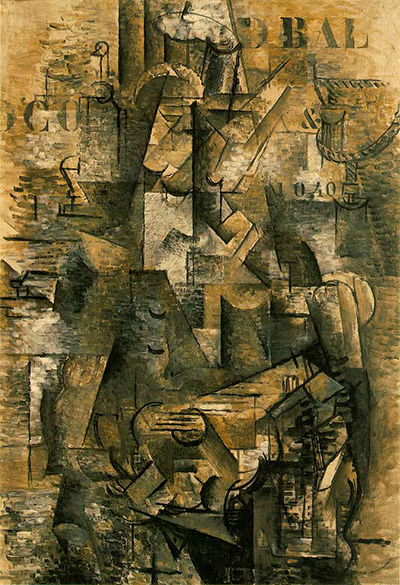
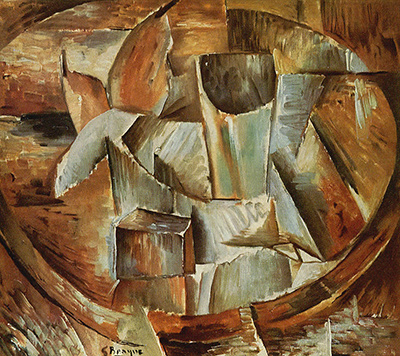
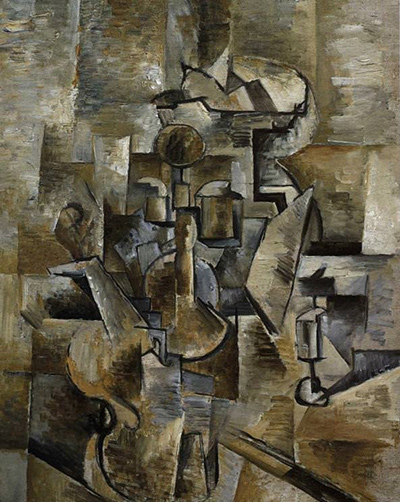
One title asks us to find a candlestick; another asks us to find a fruit dish. The San Francisco Museum of Modern Art preserves both for Georges Braque’s 1910 painting: its principal title is Nature Morte (Violon et Compotier), while an alternate title calls it Still Life (Violin and Candlestick).[1] The difference belongs at the centre of any reading. It reveals how words can guide recognition in a Cubist still life without settling every shape they direct us toward.
Some clues are secure. SFMOMA’s written transcript places a candle in a circular base just below the centre and a violin below and to the left. Yet compotier introduces a fruit dish into the same field of possibilities. The circular form can support more than one reading of the painting, and other clustered props resist confident naming. Braque offers enough structure to begin identifying objects while keeping their boundaries mobile.
At a Glance
- ArtistGeorges Braque[1]
- TitleViolin and Candlestick[1]
- Date1910[1]
- MediumOil on canvas[1]
- Dimensions61 × 50.3 cm (24 × 19 3/4 in.)[1]
- CollectionSan Francisco Museum of Modern Art[1]
- Accession89.78[1]
- SignificanceMake the SFMOMA still life's violin, vessel, tabletop and fractured illumination legible without flattening its ambiguity
Contents
- Introduction
- Two Titles for One Material Object
- The Violin and the Circular Base
- A Candlestick, a Compotier, or Both Readings
- The Central Armature
- Shallow Space and Multiple Surfaces
- The Expected Table
- Earth Tones and Pictorial Light
- From Oil Painting to Pasted Paper
Two Titles for One Material Object
The painting itself has a precise institutional identity. Braque made it in 1910 in oil on canvas. It measures 61.0 × 50.3 centimetres and belongs to SFMOMA as object 89.78.[1] Those facts establish the material work even as its two titles foster different interpretations. The distinction between object and title is useful: accession, date, medium and dimensions remain stable while naming opens several paths of attention.
Three levels of evidence operate together here. The accession record identifies the durable object; the museum transcript locates a few forms; the titles propose how those forms might be gathered into names. Keeping those levels distinct prevents an interpretive suggestion from hardening into metadata. It also explains why ambiguity survives careful documentation. Institutional precision can tell us which canvas we are discussing without compelling every broken contour to resolve.
The alternate English title foregrounds violin and candlestick. SFMOMA’s principal French title expands to Still Life (Violin and Fruit Dish) in the museum transcript.[1] Each title secures the violin, but the second noun changes. One sends the eye toward a candle and its base; the other creates an expectation of a raised vessel or dish. The museum keeps both names in active circulation, turning a cataloguing difference into an unusually direct lesson in Cubist recognition.
Titles often appear to describe what a painting contains. Here they also expose the instability of that description. A word can make a form newly plausible, yet the surrounding contours still refuse a final inventory. “Candlestick” and “compotier” function as proposals tested against lines, angles and planes. Their coexistence gives ambiguity a documentary foundation. It arises from the current identity of the work as well as from its formal organisation.
The Violin and the Circular Base
SFMOMA’s transcript supplies the clearest map. According to that text, the candle occupies a circular base beneath the composition’s centre. Slightly lower and toward the left lies the violin.[1] These positions create a compact relational group. The circular object helps orient the instrument, and the instrument helps establish the scale and direction of nearby forms.
Curator Janet Bishop explains that the rear of the candlestick base tilts upward. The tilt makes two angles of the base available and allows its form to echo the violin.[1] This is a concise example of what Cubist multiple-point presentation can achieve. A circular base becomes more informative than it would from one fixed position, while its changed orientation also brings it into formal conversation with another object.
The violin remains recognisable through its relation to the base and to the title, yet recognition stops short of a complete diagram. SFMOMA describes some props as identifiable and others as impossible to name.[1] The instrument therefore acts as an anchor inside a field of partial evidence. Its presence is firm enough to organise attention, while individual fragments can still detach from any single object assignment.
That balance matters. Total obscurity would make the titles arbitrary; total clarity would make their disagreement trivial. Braque sustains a middle state in which a few forms carry the burden of recognition. The viewer builds outward from violin, candle and circular base, then encounters passages whose ownership remains open.
A Candlestick, a Compotier, or Both Readings
The title pair encourages two kinds of search. Under Violin and Candlestick, the candle and tilted circular base form a coherent unit. Under Violon et Compotier, the same field invites a fruit-dish reading. The circular form may participate in both interpretations, or the compotier may remain among the less secure clustered props. SFMOMA’s commentary leaves that assignment productively unresolved.[1]
The ambiguity has precise limits. The candle, base and violin come from the museum’s transcript. The fruit dish comes from the principal French title and its museum translation. A complete vessel, particular fruit and settled overlap pattern go beyond those terms. The painting supports alternate recognitions, while withholding the evidence needed to turn either into an exhaustive reconstruction.
This is why the dual title enriches the work. It demonstrates that recognition depends on expectations as well as contours. Once “compotier” enters the mind, a rounded or raised form can begin to behave like a dish. Once “candlestick” takes priority, circularity becomes a base and vertical extension becomes relevant. Braque lets verbal and pictorial evidence interact, with each sharpening possibilities that the other leaves incomplete.
The result avoids mere indecision. Candlestick and fruit dish belong to an organised field with secure coordinates, echoes and spatial cues. Ambiguity becomes a disciplined form of looking: several answers remain available because the painting has carefully limited the authority of any single boundary.
The Central Armature
In SFMOMA’s account, the objects gather around the middle of a framework organised in gridlike fashion.[1] “Armature” suggests a supporting framework, while “gridlike” points to recurrent vertical and horizontal directions. The structure gathers objects without enclosing each one in an intact contour. It creates order at the level of the whole even where local identities remain uncertain.
Braque joins objects to their background by opening some black-outlined boundaries and covering over others. Related earth tones extend across the entire painting.[1] Contour and colour therefore perform double duties. A dark line can help establish an object, then break or pass into the surrounding network. A brown or ochre plane can belong to a represented volume while also participating in the general field.
This organisation changes the status of background. It becomes structurally active, carrying many of the same directions and hues as the props. Objects emerge locally through converging evidence—an angle, a curve, a title cue, a change of value—then loosen again where outlines open. The painting produces recognition by degrees, without assigning every passage permanently to object or setting.
The armature also prevents ambiguity from dissolving into visual drift. Vertical and horizontal relations give the clustered centre a framework against which tilted forms can register. The candlestick base gains force because its upward tilt departs from more stable directions. Its echo with the violin gains force because both belong to the same organised network.
Shallow Space and Multiple Surfaces
SFMOMA places the work within Analytic Cubism, describing forms as broken down, fractured, flattened and reconstructed within shallow space.[1] The physical support is flat, yet the represented objects still imply volume. Braque compresses the distance between foreground and background while making more than one surface of an object available on the same plane.
The tilted candlestick base offers a concrete instance. Its two angles suggest a volume understood across changing positions. The painting does more than reproduce what one stationary eye could receive at a single instant. It assembles information about an object, granting the viewer access to relations that conventional fixed-point perspective would keep apart.
Braque described fragmentation as “a technique for getting closer to the object.”[1] The phrase reverses the idea that broken contour simply destroys likeness. Fragmentation can reduce immediate legibility and increase conceptual access at the same time. The viewer loses a continuous outline but gains several surfaces, directions and formal echoes.
That exchange can be stated precisely. Access to several surfaces expands the information carried by a single object, while the loss of an enclosing contour weakens the viewer’s ability to assign each fragment immediately. Knowledge accumulates across relations: a tilt establishes orientation; an echo binds forms; a title activates a possible noun. Each cue carries part of the burden, and their convergence makes recognition gradual.
That gain stays partial. Several views never become all possible views, and reconstruction never yields a complete inventory. Cubist space here is investigative: it tests how much an object can disclose when contour, viewpoint and surrounding field cease to operate as fixed compartments.
The Expected Table
A still life normally encourages us to imagine a supporting table. Clustered objects and shallow space keep that expectation active in Braque’s painting, yet SFMOMA’s account identifies no continuous tabletop or table edge. The stronger evidence concerns a central armature and a flat plane on which transformed volumes meet.
The distinction protects the painting’s spatial tension. A firmly recovered table would stabilise every prop too quickly, placing each object on a common piece of furniture. A support-like field leaves orientation open. Forms can appear gathered, tilted and layered without requiring one uninterrupted horizontal surface beneath them.
The table therefore remains useful as an expectation, distinct from a completed object. It helps explain why viewers seek support and gravity, while the actual analysis proceeds through shallowness, overlap and directional structure. Braque preserves the logic of still-life arrangement and loosens the furniture that would conventionally guarantee it.
Earth Tones and Pictorial Light
Objects and background share muted, earthy colour. SFMOMA interprets this restraint as allowing Braque to concentrate on structure and form while moving toward abstraction.[1] Close chromatic relations reduce the tendency of one prop to detach cleanly from its setting. Differences in outline, angle and value carry more responsibility.
Earth tones still provide colour. Their narrow range can produce warmth, coolness and density while maintaining continuity across the canvas. A local dark edge may briefly consolidate a form; a related tone can then return it to the surrounding field. Colour supports the opening and closing of boundaries described by the museum.
The represented candle names an object, while pictorial light belongs to tonal relations across the surface. SFMOMA supplies no account of a flame casting rays through the composition. Illumination is better understood through graded facets, dark outlines and muted contrasts. The candle contributes to recognition; value contributes to construction.
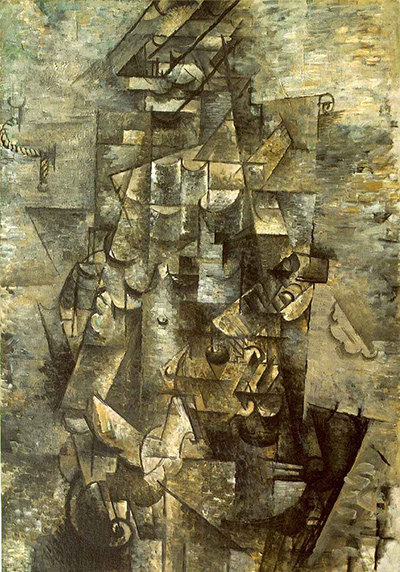
A separate Nature morte au violon in the Centre Pompidou shows Braque extending this approach in November 1911. That much larger oil, inventory AM 4299 P, organises difficult still-life forms through an orthogonal grid, a dark upward-leading network and lighter horizontal touches that make light pulse across reduced greys, ochres and browns.[2] The comparison clarifies a continuing interest in grids and tonal movement. Its fireplace, table, score and other props belong exclusively to the later painting.
From Oil Painting to Pasted Paper
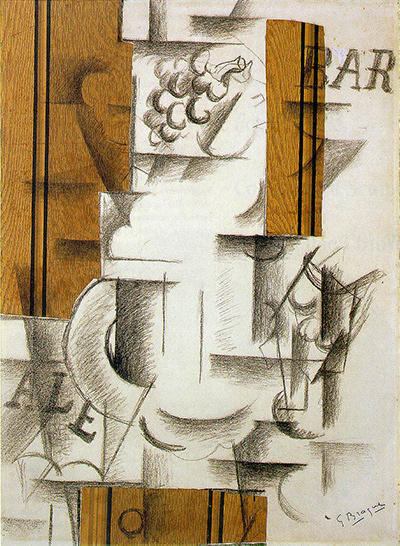
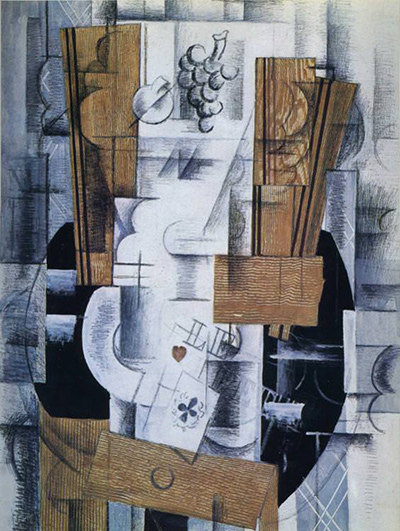
The exact date and medium also separate SFMOMA 89.78 from Braque’s later Violon et pipe at the Centre Pompidou. That work dates from winter 1913–14 and combines charcoal, graphite, chalk and pasted papers in a drawing and papier collé, inventory AM 3405 D.[3] It represents a later material stage, distinct from the 1910 oil on canvas.
SFMOMA acquired Nature Morte (Violon et Compotier) in 1989 as a gift from Rita B. Schreiber in memory of her husband, Taft Schreiber.[1] The gift brought a painting with two active titles into a collection that continues to preserve their tension.
That tension gives Violin and Candlestick its unusual clarity. The work teaches us exactly where certainty begins—with date, medium, dimensions, violin, candle and circular base—and where it opens into interpretation. Candlestick and compotier remain competing instructions within one material object. Braque’s achievement lies in making both instructions useful: each leads deeper into the armature, while the broken boundaries continue beyond the reach of either title.
Related Pages
Frequently Asked Questions
One title asks us to find a candlestick; another asks us to find a fruit dish.
The painting itself has a precise institutional identity.
That tension gives Violin and Candlestick its unusual clarity.
Discussion
One title asks us to find a candlestick; another asks us to find a fruit dish.
Reader Insights
One title asks us to find a candlestick; another asks us to find a fruit dish.
This organisation changes the status of background.
That tension gives Violin and Candlestick its unusual clarity.
Join the Conversation
Share the visible detail or source that most changed your reading.
References
- San Francisco Museum of Modern Art, “Nature Morte (Violon et Compotier), also titled Still Life (Violin and Candlestick)”.
- Centre Pompidou, “Nature morte au violon”.
- Centre Pompidou, “Violon et pipe”.