 by Tom Gurney
Tom Gurney BSc (Hons) is an art history expert with over 20 years experience
Published on August 14, 2026 / Updated on August 14, 2026
Email: tomgurney1@gmail.com / Phone: +44 7429 011000
Introduction
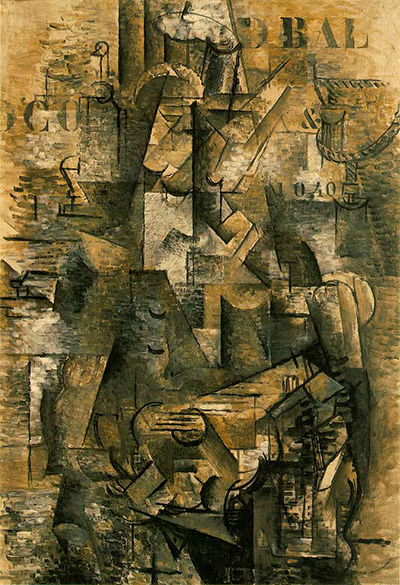
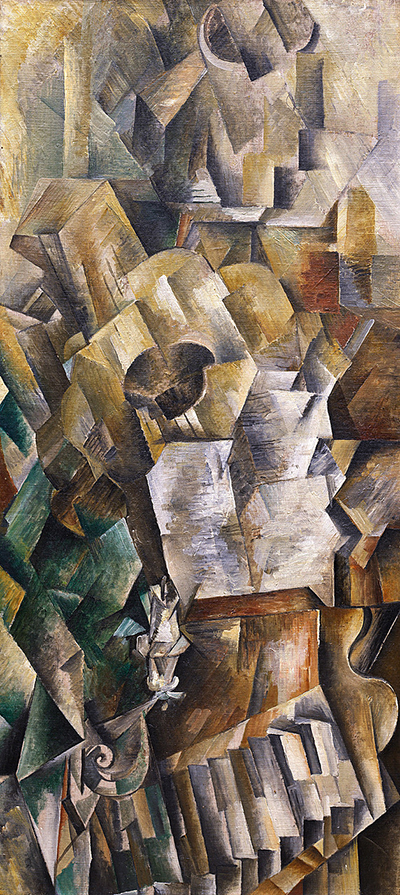
A candle, a run of piano keys and the remnants of a stringed instrument offer three very different kinds of certainty in Piano and Mandola. The candle holds together as a comparatively familiar thing. The keyboard survives through a broken alternation of black and white. The mandola has dispersed so widely that its identity depends on scattered cues and the help of the title. Between them, sheets of music lose their ordinary integrity and enter the same faceted construction as the objects around them.
Braque uses those degrees of recognition to animate a still life. Each clue is strong enough to begin an identification, yet every identification has to be renewed as the eye moves onward. Light shifts, planes change allegiance and a fragment that seemed to belong to an instrument joins the surrounding space. The painting turns looking into a sequence of recoveries. Music matters here through handled objects, repeated intervals and remembered coordination, even as the canvas remains silent.
At a Glance
- ArtistGeorges Braque[1]
- TitlePiano and Mandola[1]
- Datewinter 1909–10[1]
- MediumOil on canvas[1]
- Dimensions91.7 × 42.8 cm[1]
- CollectionSolomon R. Guggenheim Museum 54.1411[1]
- Accession54.1411[1]
- SignificanceThe Guggenheim painting as an early Analytic Cubist construction of keyboard, strings, shadow and shallow space
Contents
- Introduction
- A tall canvas and its pendant
- The candle as a point of stability
- Piano keys turned into intervals
- Music sheets and the decomposed mandola
- Facets, restricted colour and shallow continuity
- Repetition, orientation and a silent rhythm
A tall canvas and its pendant
Piano and Mandola, also titled Piano et mandore, dates from the winter of 1909–10. The oil painting measures 91.7 × 42.8 centimetres and belongs to the Solomon R. Guggenheim Museum as accession 54.1411.[1] Its height is a little more than twice its width, giving Braque an unusually narrow vertical field in which distinct clues can appear, separate and re-form across successive levels.
The Guggenheim treats the painting as a pendant to Violin and Palette. Jan Avgikos discusses the two canvases together because both fracture objects and their surrounding space into related facets, while preserving different points of stability.[2] Their relationship gives useful context, though each painting establishes its own visual problem. In Violin and Palette, the paired essay emphasises the violin, palette and illusionistic nail. In Piano and Mandola, the decisive clues are the candle, keyboard, sheets and decomposed stringed instrument.
Their early ownership histories also overlap. Metropolitan Museum of Art research records both Guggenheim paintings as former works in Wilhelm Uhde's collection and places them among Edwin Suermondt's early Braque acquisitions.[5] The circumstances of those purchases remain incompletely documented. This shared path strengthens the historical association between the canvases while leaving their original conception and exact early chronology open.
This separation matters. The pair shares a method of interlocking object and space, yet the active canvas has a distinctive internal rhythm. A piano keyboard brings repetition and interval into the field. A mandola carries curves, strings and the memory of touch. Paper introduces thin, angular supports. The candle supplies a compact, comparatively intact form against which their dispersal can be measured.
The vertical format intensifies the sense of successive discovery. The eye cannot hold all four object types in a single, settled arrangement. It finds a cue, follows an edge or tonal change, and meets another clue elsewhere. The format encourages movement through the construction while the facets keep redirecting that movement across the surface.
The candle as a point of stability
Avgikos calls the candle naturalistic in comparison with the rest of the composition and treats it as a stabilising presence.[2] Its value lies in degree. It gives the eye a recognisable object whose identity survives with unusual clarity, then makes the surrounding dissolution feel more pronounced. The candle establishes a local measure of legibility.
That clarity never pulls the object outside the Cubist field. It remains surrounded by angular relations and changing tonal conditions. Its familiar form helps organise attention, while nearby planes refuse to settle into one continuous setting. Stability becomes temporary and local, a moment of orientation within a composition that quickly resumes its movement.
The candle also sharpens the role of illumination. Avgikos describes the eye adjusting to shifting light as it passes among facets.[2] Illumination therefore belongs to the construction as a mobile relation. A plane may brighten, darken or change its apparent direction without joining a single, consistent lighting scheme. Tonal shadow travels through the field as part of its structure, separated from any complete diagram of candlelight.
This mobile illumination affects recognition. A lighter facet may briefly support the volume of an object; a darker neighbour may interrupt it or connect it to another part of the canvas. The candle remains a reference point, though it cannot resolve every shift. Its comparative coherence reveals how actively the rest of the work must be assembled.
The contrast also keeps naturalism and fragmentation in conversation. Braque preserves enough conventional description to establish one object firmly, then surrounds it with marks that require a different kind of seeing. The painting accommodates both modes at once. The candle offers immediate recognition; keys, sheets and mandola emerge through recurrence, relation and memory.
Piano keys turned into intervals
The keyboard is present through black-and-white keys that Avgikos describes as almost detached from a complete piano.[2] Their recognisability comes from alternation. Even after the larger instrument has lost a continuous body, contrasting keys retain the idea of ordered succession. A fragment of keyboard can therefore carry more identity than its small size might suggest.
Braque transforms that practical sequence into a visual one. Dark and light units establish intervals, gaps divide them, and surrounding facets disturb any expectation of a smooth run. The eye groups several elements as keys, then has to decide where their pattern ends and the wider construction begins. Keyboard and composition share repetition without becoming identical systems.
The keys supply rhythm in a concrete sense. Recurring contrasts create pulses of attention across the surface. Their separations make the eye pause and restart, much as the title prompts it to search for an instrument whose wholeness has disappeared. Rhythm here describes the spacing and recurrence of painted cues. It carries no audible tempo and dictates no single order of looking.
The keyboard also demonstrates how little of an object Braque needs. A full case, lid, pedals and continuous bank of keys would establish a conventional piano. The isolated black-and-white alternation already activates recognition. Knowledge of a keyboard completes part of the work, while the painting keeps that completion provisional by embedding the keys among similarly angular planes.
This exchange between familiarity and disruption gives the keys a double role. They belong to the represented piano, and they help organise the whole canvas through repeated contrast. Their partial autonomy allows them to act as object clues and abstract intervals in the same moment.
Music sheets and the decomposed mandola
Avgikos identifies sheets of music whose ordinary form has almost broken apart.[2] Their presence expands the painting's musical vocabulary beyond the two instruments named in the title. Paper can carry notation, but here its edges and surfaces also enter the faceted field. The sheets remain identifiable as a category while any particular composition, melody or score stays unavailable.
That intermediate condition is important. A sheet of music normally joins material support and readable sign: paper holds lines, notes and instructions for performance. Braque retains the idea of such a support while loosening its boundaries. Music survives as an association and an object type, even after precise musical information has dissolved.
The mandola undergoes an even more radical dispersal. Avgikos describes it as decomposed, a term that captures the loss of one continuous instrument body.[2] The current title still directs attention toward a stringed object, and fragments can be gathered under that name. Exact strings, tuning and anatomy remain beyond recovery. Recognition depends on the relation among partial cues, with a complete inventory remaining unavailable.
Touch provides a way to connect piano and mandola without pretending that the two look alike. A keyboard responds to pressure in sequence; a stringed instrument responds to contact across strings and body. Avgikos links musical instruments with tactile experience because they become active through handling.[2] The painting draws on that memory. The viewer can recall the coordinated use of hands even while the represented objects appear broken and unavailable to actual touch.
This tactile dimension deepens the tension between presence and dispersal. The candle is easy to name through its comparative coherence. The piano and mandola are also familiar objects, yet their identities arrive through habits of use as much as through outline. The hands remember order where the eyes encounter fragments.
The music sheets introduce another form of mediation. They imply instructions between object and sound, performer and composition. Braque breaks their visual unity while retaining their cultural identity. Across keys, instrument and paper, music appears through systems that require assembly: sequence, handling and notation.
Facets, restricted colour and shallow continuity
Guggenheim Bilbao describes Piano and Mandola through fragmented facets, a reduced range of green and greyish-beige, and forms that merge into a spatial continuum while remaining partly recognisable.[3] These elements reinforce one another. Restricted colour allows edges, tonal steps and changes of direction to carry much of the structural work. Objects share the same chromatic field as their surroundings, so identity has to survive through smaller differences.
Faceting breaks the expectation that each object will possess one stable surface and orientation. A plane can help define the piano in one relation and join the surrounding space in another. The eye adjusts as it moves, testing whether an edge belongs to an instrument, a sheet or the field that contains them. Avgikos describes this motion through changing light and orientation.[2] Light alters tonal relations; orientation alters the possible identity of a plane.
The resulting space is continuous in a compressed way. Forms connect across shared angles and tonal transitions, though the canvas offers no deep room into which they can recede. Object and setting interpenetrate near the surface. A clue may seem to project briefly, then flatten into the network around it.
Partial legibility prevents that network from becoming pure abstraction. The candle, alternating keys, paper and mandola retain different amounts of descriptive force. Guggenheim Bilbao's account emphasises subjects that are condensed and hinted through planes and sharp edges.[3] Braque allows each object to approach the general structure at its own rate.
This creates a hierarchy of recognition. The candle coheres quickly. The keyboard coheres through repetition. The sheets remain recognisable as material supports after their content disappears. The mandola requires the broadest act of reconstruction. Their differences give the painting variety inside a tightly unified surface.
Repetition, orientation and a silent rhythm
Tate's catalogue for Mandora proposes that a similar, perhaps identical, lute-like instrument appears in Piano and Mandola, turned in the opposite direction.[4] The suggestion remains an attributed possibility, since the physical instrument has never been securely traced. Its value lies in the idea of renewed orientation. A related object could generate a different composition when Braque turned it and reconsidered how its parts met the surrounding field.
That comparison fits Avgikos's emphasis on shifting orientation. The active painting continually asks how an object can be known when its parts face different ways and merge with space. The mandola's identity survives through relations among fragments, while the keyboard survives through recurring contrast. Both reward accumulated attention.
Rhythm emerges from this process without turning the painting into a score. Black and white return across the keys; tonal planes echo and interrupt one another; the eye moves between stable candle and dispersed instruments. Each recurrence adds information, yet none completes the composition once and for all.
Braque makes recognition tactile, sequential and revisable. The candle supplies an initial foothold. The piano offers intervals. The sheets preserve the idea of written music after their content fragments. The mandola carries the memory of a handled stringed body. Together they produce an order that has to be assembled through looking, one relation at a time. The painting's silence leaves that activity visible: music becomes a structure for seeing.
Related Pages
Frequently Asked Questions
A candle, a run of piano keys and the remnants of a stringed instrument offer three very different kinds of certainty in Piano and Mandola.
Piano and Mandola, also titled Piano et mandore, dates from the winter of 1909–10.
Braque makes recognition tactile, sequential and revisable.
Discussion
A candle, a run of piano keys and the remnants of a stringed instrument offer three very different kinds of certainty in Piano and Mandola.
Reader Insights
A candle, a run of piano keys and the remnants of a stringed instrument offer three very different kinds of certainty in Piano and Mandola.
This exchange between familiarity and disruption gives the keys a double role.
Braque makes recognition tactile, sequential and revisable.
Join the Conversation
Share the visible detail or source that most changed your reading.
References
- Solomon R. Guggenheim Museum, “Piano and Mandola”
- Jan Avgikos, Guggenheim collection essay for Piano and Mandola and Violin and Palette
- Guggenheim Museum Bilbao, “Analytic Cubism”
- Ronald Alley, “La Mandore (Mandora),” catalogue entry embedded in Tate's collection record
- Luise Mahler, “Edwin Suermondt,” The Metropolitan Museum of Art