 by Tom Gurney
Tom Gurney BSc (Hons) is an art history expert with over 20 years experience
Published on August 14, 2026 / Updated on August 14, 2026
Email: tomgurney1@gmail.com / Phone: +44 7429 011000
Introduction
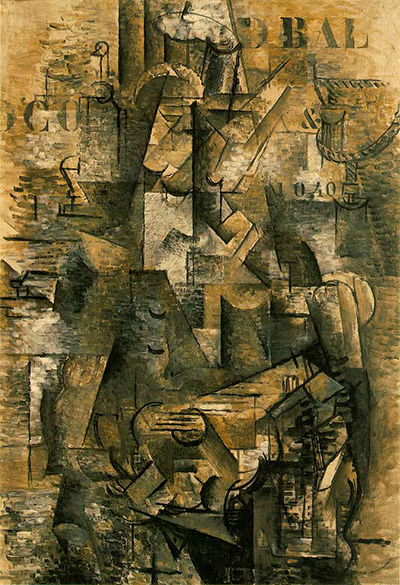
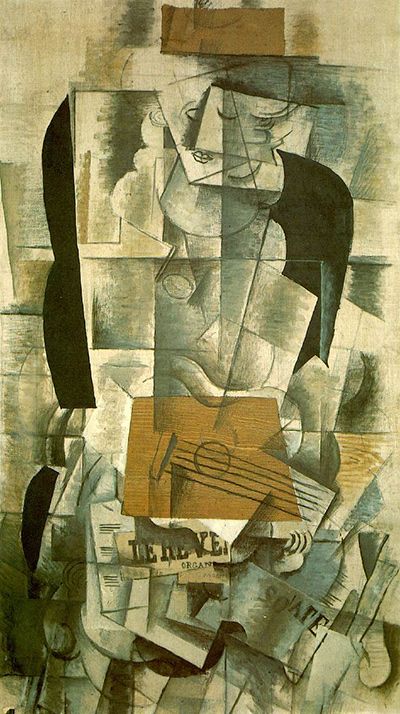
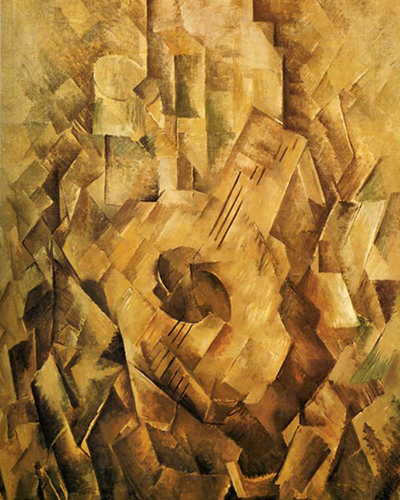
Braque’s title supplies a noun before the eye has fully assembled its object. Mandora promises a musical instrument, and enough of one emerges to justify the name. Its body and neck gather gradually from a field of angled forms. Around them, the ordinary assurance of still life gives way. Dark structures cross lighter planes; outlines begin, change direction and dissolve; possible objects appear briefly without settling into a dependable inventory. The painting makes recognition possible while keeping it provisional.
That tension gives Mandora its particular force. Braque had already begun carrying musical instruments into Cubist still life, where their familiar shapes could survive radical changes in space and form. Here, familiarity functions as a slender anchor. The instrument offers a way into the composition, though it never becomes a complete, isolated silhouette. Its partial presence allows Braque to examine how little information a painted object needs in order to be recognised—and how quickly that recognition can become uncertain again.
At a Glance
- ArtistGeorges Braque[1]
- TitleMandora[1]
- Date1909–10[1]
- MediumOil paint on canvas[1]
- Dimensions71.1 × 55.9 cm[1]
- CollectionTate[1]
- AccessionT00833[1]
- SignificanceClarify the lute-like instrument and analyse the painting's dark scaffolding, pale facets and unstable object
Contents
- Introduction
- The painting and its changing names
- Finding the instrument among fragments
- Dark scaffolding and pale facets
- A still life that withholds its inventory
- Among the musical still lifes of 1909–10
- When a title becomes a visual anchor
The painting and its changing names
Tate’s Mandora, accession T00833, dates from 1909–10. It is an oil painting on canvas measuring 71.1 × 55.9 centimetres, purchased by Tate in 1966. The collection record also gives the foreign title La Mandore.[1] These concise facts place the work at a crucial early point in Braque’s Cubist still lifes, when identifiable things remained present even as continuous contours and conventional recession were being dismantled.
The apparent precision of the title hides a complicated naming history. Tate’s catalogue records that Daniel-Henry Kahnweiler’s photographic files called the work Mandora, a name probably supplied by Braque. Other publications described the same canvas as a guitar, mandolin or mandola. Douglas Cooper and Claude Laurens also recalled Braque using “mandora,” which helped preserve the current title.[2]
The variations arise partly from the instrument itself. Tate’s catalogue places its broad body and fingerboard within the lute family, while leaving its exact type open. The terms mandora, mandola and lute carried overlapping associations in the historical discussion, and the painted form gives limited anatomical evidence. A useful description is therefore a lute-like plucked string instrument. “Mandora” remains the painting’s established name and preserves historical usage while leaving modern classification open.
This uncertainty matters because it repeats, in language, an experience built into the composition. A title fixes one point of recognition, yet the represented thing keeps slipping among related identities. The viewer can say what family of object is present and can follow several of its cues. Complete certainty about its species, construction and surroundings stays out of reach. Naming becomes the beginning of close attention, with further looking still required.
Finding the instrument among fragments
Charles Cramer and Kim Grant describe the mandora as the only object in the painting that can be identified with confidence. They place it within a shifting lattice of diamond-like forms, where several additional things may be suggested but remain unresolved.[3] This distinction is essential. The work retains a subject, though it distributes that subject across fragments whose relations continually change.
Recognition begins through broad affinities. A curved, lute-like body can be inferred within the lighter central area, while an extending neck offers a directional cue. These parts never lock into one uninterrupted contour. Each belongs simultaneously to the instrument and to the larger network of angles, tonal changes and intersections. A plane that helps describe volume in one moment can join the surrounding structure in the next.
The result is a form of cumulative seeing. No single fragment has to carry the whole identity. Shape, orientation and the expectation created by the title work together until the mandora becomes provisionally coherent. Once found, it remains vulnerable to the field around it. The eye can follow the instrument, lose it at an intersection, then recover it elsewhere. Recognition behaves as an activity unfolding over time.
This way of seeing helps explain why musical objects were so effective for Braque. The Metropolitan Museum of Art observes that familiar instruments made the unfamiliar procedures of early Cubism more legible to contemporary audiences.[4] Curves, necks and the memory of handling an instrument provide durable clues. Braque could break their outlines and redistribute their volumes while preserving enough identity for the viewer to participate in reconstruction.
The instrument in Mandora therefore occupies a finely judged middle ground. A fully intact lute would dominate the field as a conventional depicted object. A completely dispersed one would surrender the title’s anchoring role. Braque sustains the interval between those extremes, making the mandora available in pieces and relations. Its identity arrives through persistence.
Dark scaffolding and pale facets
The painting’s strongest formal contrast lies between dark geometric structures and the lighter facets near the centre. Cramer and Grant describe the darker forms as a shadowed frame around the pale area.[3] “Frame” here names a compositional action. These angular forms enclose the centre, divide it and keep redirecting attention across its edges. They create boundaries while disrupting any single stable boundary around the instrument.
The pale facets carry much of the mandora’s uncertain emergence. Their changes of angle can imply surfaces turning toward and away from light, so a shallow sense of relief develops. At the same time, their close interlocking keeps them near the canvas. Projection and surface coexist. The viewer feels volume beginning to gather, then sees the same planes return to the picture’s larger pattern.
Light and dark consequently organise both volume and a visual rhythm of appearance, interruption and return. A pale zone may briefly read as part of the instrument before a dark diagonal cuts across it. A darker shape may seem to mark an edge, then continue beyond the object it appeared to define. Repetition gives the field coherence, while shifts in direction prevent that coherence from becoming a diagram.
This is the value of the lattice. Its diamond-like units provide recurrence without uniformity. They give the composition a shared grammar, joining instrument and setting through related angles. Yet each recurrence alters the possible reading of its neighbours. The lattice can support the mandora’s form and break it apart within the same passage.
The patterned contrast also changes the role of chiaroscuro, the arrangement of light and dark. In conventional modelling, tonal change often helps stabilise a body in continuous space. In Mandora, tonal contrasts act across discontinuous facets. They suggest relief locally while contributing to an overall surface pattern. Light becomes a structural participant, carrying the eye between fragments while leaving continuous volume unconfirmed.
A still life that withholds its inventory
The surrounding objects remain far less secure than the instrument. Cramer and Grant mention upright rectangles in the upper area that may indicate further things resting on a table, while stressing the lack of enough information for firm identification.[3] That limit should remain intact. The visual experience depends on suggestion, and a confident list of bottles, vessels, papers or furniture would close possibilities that the painting keeps active.
Uncertainty here has structure. The possible objects feel related to still-life space because their scales, alignments and overlaps imply a compact arrangement. Their identities remain suspended because the same marks also belong to the geometric network. Braque gives the viewer relational evidence—one form touching, crossing or sitting near another—while withholding the complete contours that would turn those relations into a settled scene.
Tate’s catalogue calls Mandora the shallowest and most compressed of four closely related musical still lifes. It describes the objects as unusually integrated with their background and proposes that this degree of compression may make the canvas the latest of the group.[2] The chronology is an attributed inference, yet the spatial observation illuminates the work. Object and environment share so much of the same angular language that separating them becomes a recurring mental task.
Shallow space still carries movement. Pale planes press forward, dark intersections appear to pass across them, and overlapping directions imply small changes of level. These effects remain tightly compressed. Space feels like a thin, shifting relief, far removed from an open room receding behind the canvas. The mandora occupies that narrow zone, emerging through minute distinctions in adjacency and tone.
This compression sharpens the painting’s central question. How can an object retain identity when its boundaries belong equally to the field around it? Braque’s answer lies in degrees. The mandora receives enough distinctive information to cohere; possible neighbouring things receive less. The composition establishes a hierarchy of recognisability without giving any form complete independence.
Among the musical still lifes of 1909–10
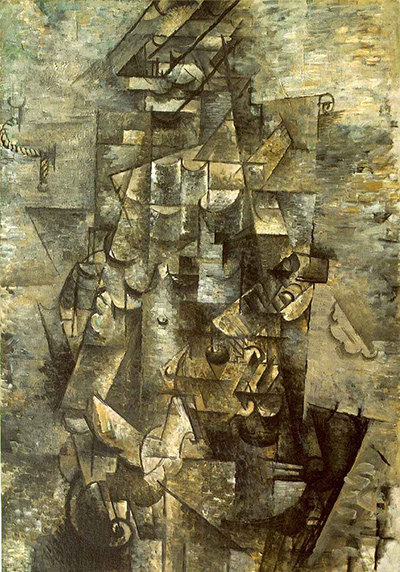
Tate associates Mandora with three musical still lifes generally dated to the winter of 1909–10: the Basel painting known as Violin and Jug, and the Guggenheim’s Violin and Palette and Piano and Mandola.[2] The Met uses a broader grouping of five works from late 1909 to early 1910 because it includes its own Still Life with Metronome.[4] The two counts describe overlapping frames of comparison.
Within Tate’s group, Piano and Mandola offers the closest instrument comparison. The catalogue suggests that a similar, perhaps identical, lute-like instrument appears there, turned in the opposite direction.[2] The proposal raises the possibility that Braque revisited the same or a closely related physical instrument. Reversal changes its relation to the surrounding construction, allowing a comparable body and neck to generate a different set of spatial problems.
Alley’s suggestion that Mandora came last among the four grows from its exceptional compression. The catalogue offers stylistic reasoning in the absence of a documented day-by-day sequence. The value of the proposal lies in the comparison it encourages. Here, recognisable object and surrounding field approach an unusually close equivalence. The instrument remains available, yet nearly every part of it participates in the same shifting structure as everything else.
The musical subject strengthens that balance. An instrument has a remembered unity: body, neck and the expectation of strings belong together even when only fragments survive. It also carries associations of touch, resonance and ordered relations. The canvas stays silent, while knowledge of the object helps the eye connect separated signs. Musical familiarity becomes a resource for visual reconstruction.
When a title becomes a visual anchor
Mandora offers certainty in layers. Tate secures the painting’s identity, date, material and established title. The catalogue secures a history of names while leaving the exact instrument open. Formal analysis secures the mandora as the most recognisable object while preserving doubt around its neighbours. Each layer defines what can be known and where interpretation begins.
The painting turns those limits into its subject. Dark scaffolding supplies order, pale facets suggest shallow relief, and fragmented contours allow a lute-like form to gather without separating cleanly from its setting. The title anchors the search, though the act of seeing remains mobile. One moment yields an instrument; the next returns it to angles and tonal intervals.
Braque leaves recognition active to the end. The mandora is present enough to name, fragmented enough to require reconstruction and uncertain enough to resist a final inventory. Its identity survives chiefly through relations, with isolation always incomplete. In that sustained movement between noun and form, Mandora makes seeing feel less like the receipt of a finished object and more like the patient creation of one.
Related Pages
Frequently Asked Questions
Braque’s title supplies a noun before the eye has fully assembled its object.
Tate’s Mandora, accession T00833, dates from 1909–10.
Braque leaves recognition active to the end.
Discussion
Braque’s title supplies a noun before the eye has fully assembled its object.
Reader Insights
Braque’s title supplies a noun before the eye has fully assembled its object.
This is the value of the lattice.
Braque leaves recognition active to the end.
Join the Conversation
Share the visible detail or source that most changed your reading.
References
- Tate, “Mandora”
- Ronald Alley, “La Mandore (Mandora),” catalogue entry embedded in Tate’s collection record
- Charles Cramer and Kim Grant, “Georges Braque, Violin and Palette” (including discussion of Mandora), Smarthistory, archived 13 January 2026](https://smarthistory.org/georges-braque-violin-and-palette/))
- The Metropolitan Museum of Art, “Still Life with Metronome (Still Life with Mandola and Metronome)”