 by Tom Gurney
Tom Gurney BSc (Hons) is an art history expert with over 20 years experience
Published on August 14, 2026 / Updated on August 14, 2026
Email: tomgurney1@gmail.com / Phone: +44 7429 011000
Introduction
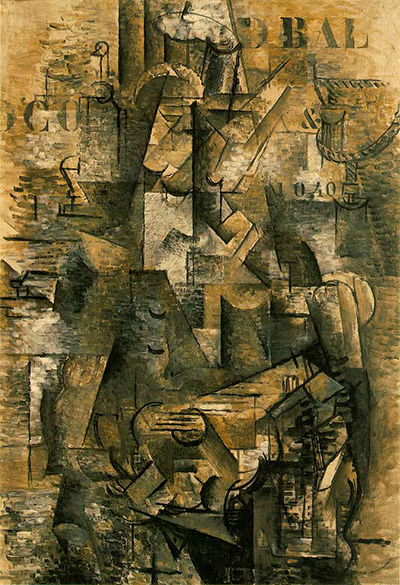
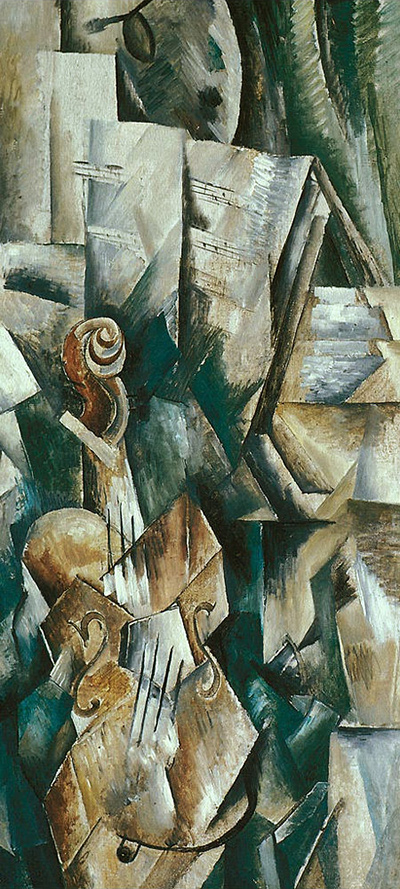
The violin in Georges Braque's Violin and Palette changes character as it rises. Its lower body still appears to occupy shallow space. Farther up, the bridge tilts, the strings break into different directions, the neck contracts and the scroll shifts away from the body it should complete. Above this disrupted instrument, pages of music, a green curtain, a painter's palette and a small nail preserve further pieces of studio reality.[1][2]
These clues offer several ways of picturing an object on one tall canvas. The violin moves between apparent volume, omission and geometric conversion. Staff lines describe notation while also escaping the paper that supposedly carries them. A shadow makes the naturally flat palette seem to hang away from the painted support. At the summit, the nail adopts familiar illusionistic modelling and appears capable of fastening the entire field to a wall. Braque joins these different conventions while keeping their differences visible.
At a Glance
- ArtistGeorges Braque[1]
- TitleViolin and Palette[1]
- DateAutumn 1909[1]
- MediumOil on canvas[1]
- Dimensions91.7 × 42.8 cm[1]
- CollectionSolomon R. Guggenheim Museum[1]
- Accession54.1412[1]
- SignificanceBraque sets the violin and palette inside a lattice of planes while keeping signs of studio reality
Contents
- Introduction
- The Guggenheim painting and its pendant
- A violin that changes as it rises
- When sheet music becomes line and volume
- Palette and curtain as signs of the studio
- The painted nail and the wall
- Why several viewpoints explain only part of the painting
- Several kinds of studio reality
The Guggenheim painting and its pendant
The Solomon R. Guggenheim Museum catalogues Violin and Palette—Violon et palette—as an oil painting from autumn 1909. The canvas measures 91.7 × 42.8 centimetres and carries the inventory number 54.1412.[1] Those dimensions establish an unusually tall, narrow format. Its verticality supports the upward sequence of violin, music and palette described in the museum's collection essay.
The Guggenheim presents the work as a pendant to Piano and Mandola. Both canvases have the same dimensions, yet their documentary identities and object systems remain distinct. Piano and Mandola, inventory 54.1411, dates to winter 1909–10; Violin and Palette belongs to the preceding autumn.[1][6] Their matched proportions make comparison productive. One composition develops around keyboard, candle and mandola, while this one rises through violin, notation, palette and nail.
The pair also shares an early ownership history. Metropolitan Museum of Art research records that both works had belonged to the German collector Wilhelm Uhde and were among Edwin Suermondt's earliest acquisitions of paintings by Braque. The circumstances by which Suermondt acquired them remain incompletely documented.[5] The surviving evidence establishes a connection between the canvases without supplying a full transaction chain.
Their pendant relation matters most at the level of pictorial design. Braque uses the same tall support for two distinct tests of how familiar studio objects can organise a shallow field. In Violin and Palette, the upward order supplies continuity even as individual forms come apart. The dimensions hold the sequence together before every object has been securely reconstructed.
A violin that changes as it rises
Charles Cramer and Kim Grant's exact-object analysis locates the violin in the lower portion of the painting. Its body is already divided into geometric shapes, some of which appear to extend into the surrounding area at the right. Even so, the lower instrument retains a comparatively naturalistic recession. It offers the strongest local impression of a solid thing occupying space.[2]
That impression weakens higher up. The bridge, which ordinarily raises and supports the strings, becomes a tilted, flattened, light-grey pentagon between the instrument's S-shaped sound holes. The strings separate into two sections set at different angles. The neck is shortened, while the scroll is displaced and twisted in relation to the body below.[2] Each part can still contribute to the name “violin,” though their connections have grown discontinuous.
The sequence creates a hierarchy of recognition. The broad lower body gives the eye an initial volume. Sound holes and bridge provide compact structural signs. Angled strings guide attention upward while interrupting the continuity they would usually affirm. The shortened neck and displaced scroll then leave the instrument suspended between identification and reconstruction.
Omission becomes active within this process. Cramer and Grant observe that part of the upper-left violin is absent.[2] A change in viewpoint can shift the scroll relative to the body; an omitted section presents a different kind of transformation. Braque allows the viewer to retain the instrument through selected relations while releasing the obligation to complete every contour.
The surrounding field participates in the same change. Geometric divisions that begin within the violin continue beyond it. An edge can serve briefly as part of the instrument and then join the structure around it. The Guggenheim essay describes objects and their surrounding space as sharing a fractured, merging field whose apparent light and orientation keep shifting.[1] The violin therefore loses a closed border while preserving enough internal signs to remain legible.
When sheet music becomes line and volume
Several pages of music occupy the upper half of the canvas. Cramer and Grant suggest that they may be propped on a music stand behind the violin, leaving the stand itself as a cautious possibility. Shading gives the papers creases and a bowed shape, so an object that is physically thin acquires an impression of shallow volume.[2]
The musical staves create another instability. Their lines extend left beyond the pages on which they are printed.[2] Within the represented world, the lines belong to notation. Across the painted surface, they become directions able to cross the boundary of one object and enter another zone. Their extension echoes the violin facets that seem to pass into adjacent space.
Paper consequently performs two roles. It remains a pictured thing that bends, creases and occupies a place near the instrument. It also carries marks that emphasise the canvas as a field of lines. The staves can lead the eye across the composition before they yield any musical information. Their visual rhythm arises from interval, recurrence and interruption.
This is where the Guggenheim's musical analogy becomes precise. Jan Avgikos links the handled character of instruments to touch and compares the movement among faceted planes with rhythm and harmony.[1] In this canvas, touch belongs first to the violin as an object designed for the hands. Rhythm belongs to the repeated shifts by which body, strings, paper and staff lines are assembled. The analogy describes looking, while the score itself remains unidentified.
Palette and curtain as signs of the studio
Above and behind the music, Cramer and Grant identify a green curtain and a painter's palette. The curtain frames the palette, drawing on a European pictorial convention in which drapery helps establish an apparent depth.[2] Its green also carries one of the canvas's few distinct colour cues. The wider range remains concentrated in browns and greys with a limited amount of green.[2]
These studio signs supply familiarity without closing the composition into a measured room. Curtain, pages and palette imply a setting in which painting and music coexist. Their precise distances, materials and physical arrangement remain open. Each cue contributes a recognisable function, while the faceted field interrupts a continuous interior.
The palette is especially productive because it is already a flat object. Braque gives its curved edge an apparent cast shadow, creating a slight separation between the represented palette and the surface behind it.[2] One flat thing appears to lift from another. The illusion depends on a modest difference in shading, yet that difference allows the palette to occupy a more conventional depth than much of the violin.
The title gives palette and violin equal billing, though their pictorial roles diverge. The violin undergoes segmentation, displacement and omission. The palette remains a compact studio emblem whose flatness makes illusion easier to stage. Between them, the music pages combine both conditions: they gain volume through shading while their printed lines detach from their edges.
The painted nail and the wall
At the upper centre, the small nail concentrates the canvas's debate about illusion. Guggenheim's essay notes that Braque modelled the nail and its shadow in a familiar illusionistic manner, setting them against the faceted system below.[1] Cramer and Grant add that the palette appears to hang from it and that the nail can create the impression of fixing the whole canvas to the wall.[2]
This device belongs to a longer pictorial tradition. The Metropolitan Museum's guide to Cubism and trompe l'oeil explains that artists had long represented papers, prints and objects as nailed or strapped to a hard surface. Violins or guitars accompanied by sheet music entered this “things on a wall” repertory. Painted highlights and shadows made such objects seem to project toward the spectator and encouraged an imagined appeal to touch.[3]
Braque adapts that convention to a field already questioning how projection works. The nail's shadow supplies an immediate cue for a fictive third dimension. At the same time, a nail associated with fastening an object to a wall draws attention to the canvas as a flat material support. The Met describes this as the motif's capacity to create depth while pointing back toward flatness.[3]
The chronology is significant. Met curator Lauren Rosati identifies Violin and Palette and Pitcher and Violin as the two canvases in which Braque first introduced the trompe-l'oeil nail motif in late 1909.[4] Here, that early experiment unites studio object and picture surface. The palette seems suspended from a nail; the entire painted field can also seem temporarily held in place by the same tiny sign.
Why several viewpoints explain only part of the painting
The displaced scroll offers a clear use for the idea of multiple viewpoints. Cramer and Grant propose that combining different angles can help account for its twisted relation to the lower violin.[2] A part observed from one orientation can coexist with a body organised through another. The concept illuminates a specific disruption.
Its explanatory reach ends before the whole canvas has been accounted for. Changing the angle of view cannot by itself generate the omission of an entire violin section. It also leaves unresolved the conversion of named parts into geometric shapes and the treatment of surrounding space as though emptiness could fracture into planes.[2] These effects arise from choices about representation as well as choices about viewpoint.
Four operations can therefore be distinguished. Reorientation changes how one surviving part relates to another, as with scroll and body. Abbreviation compresses a familiar element, as with the shortened neck. Omission leaves a break that the eye can recognise yet cannot fully repair. Faceting carries the transformation across the boundary between instrument and surrounding field. The first two can preserve a comparatively direct relation to an observed object. The latter two make the painting's construction especially evident, because missing matter and geometrically organised space have no single angle from which they become an intact violin.
The distinction matters because it preserves the painting's variety. Local recession in the lower violin uses one spatial language. The displaced scroll uses another. Missing connections place pressure on reconstruction. Staff lines detach from their paper and operate as surface directions. Palette, curtain, nail and shadows reactivate established illusionistic conventions. Braque arranges these procedures within one composition without reducing them to a single optical formula.
Restricted colour helps hold the procedures together. Browns and greys allow changes in value and direction to carry much of the spatial work, while the small presence of green keeps the curtain legible.[2] The field can merge across object boundaries without becoming wholly abstract. Violin, notation, palette and nail survive at different levels of certainty.
Several kinds of studio reality
Violin and Palette belongs to an early moment of Analytic Cubism, yet its force lies in the precision of its remaining things. A lower violin body recedes; a bridge flattens; strings change direction; a scroll loses alignment. Music pages bow through shading while their staff lines exceed the paper. A green curtain frames a flat palette whose shadow gives it apparent lift. A painted nail seems capable of holding this unstable construction against the wall.[1][2]
The ascent through the canvas is therefore also an ascent through representational methods. Solid volume, compact sign, omission, linear notation, shallow shadow and trompe-l'oeil projection appear in succession. Each offers a different degree of credibility. Their coexistence turns the studio into a field of partial recognitions, with the complete room left unresolved.
Braque's achievement here depends on keeping those differences active. The violin can remain an instrument after its contour breaks. The paper can retain its identity after its lines escape. The palette can appear spatial because its real-world form is flat. The nail can project toward the viewer while recalling the literal plane beneath every object. Studio reality survives through several painted conventions, each testing what the others make possible.
Related Pages
Frequently Asked Questions
The violin in Georges Braque's Violin and Palette changes character as it rises.
The Solomon R.
Braque's achievement here depends on keeping those differences active.
Discussion
The violin in Georges Braque's Violin and Palette changes character as it rises.
Reader Insights
The violin in Georges Braque's Violin and Palette changes character as it rises.
Above and behind the music, Cramer and Grant identify a green curtain and a painter's palette.
Braque's achievement here depends on keeping those differences active.
Join the Conversation
Share the visible detail or source that most changed your reading.
References
- Solomon R. Guggenheim Museum, “Violin and Palette”
- Charles Cramer and Kim Grant, “Georges Braque, Violin and Palette,” Smarthistory](https://smarthistory.org/georges-braque-violin-and-palette/))
- Metropolitan Museum of Art, “Cubism and the Trompe l'Oeil Tradition: Things on a Wall”
- Lauren Rosati, “Georges Braque's Still Life with Metronome,” Metropolitan Museum of Art
- Luise Mahler, “Edwin Suermondt,” Metropolitan Museum of Art
- Solomon R. Guggenheim Museum, “Piano and Mandola”